

Systematic review of the application of the plan–do–study–act method to improve quality in healthcare
Open accessThe DOI matches its Crossref record; 79 of the 81 references it cites were found in a registry or an index.
Abstract
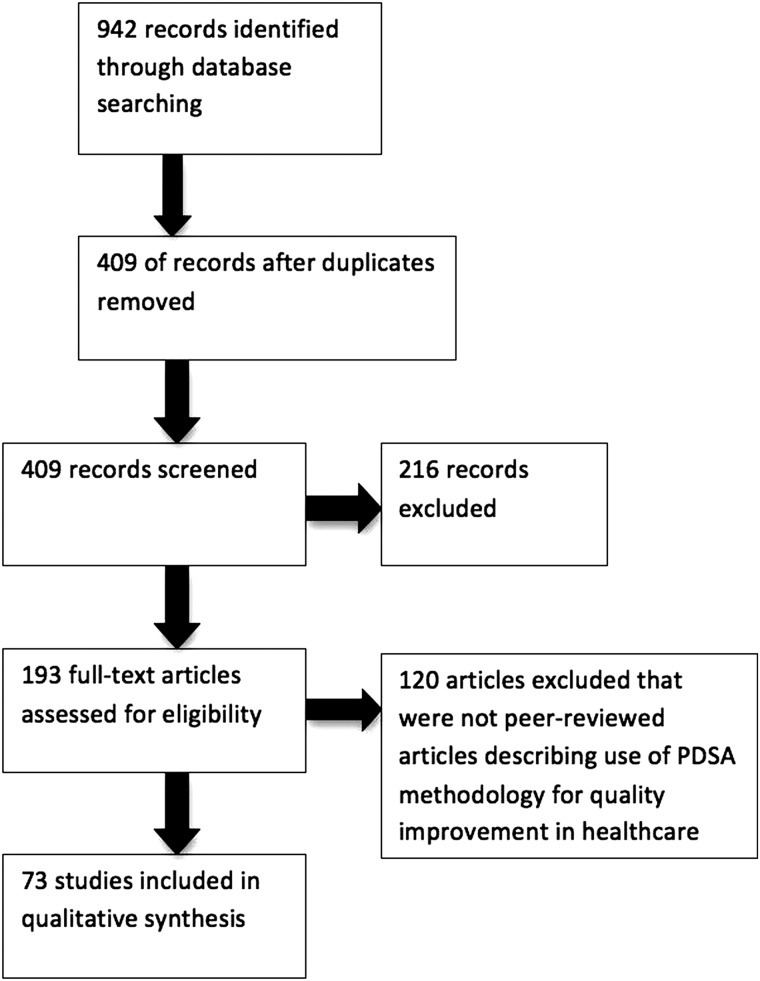
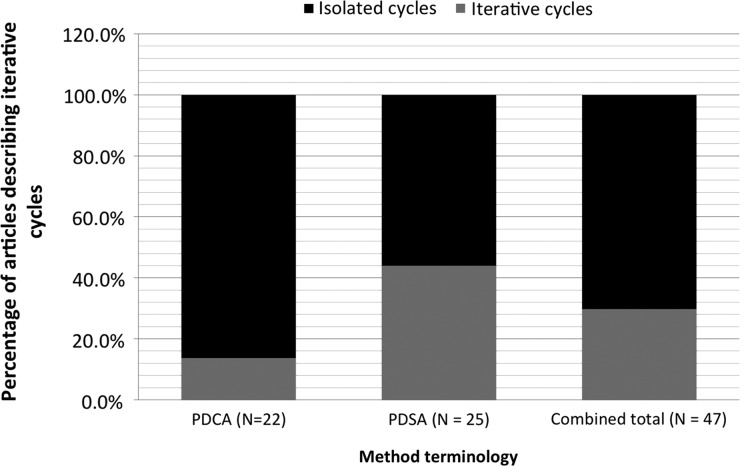
Background: Plan–do–study–act (PDSA) cycles provide a structure for iterative testing of changes to improve quality of systems. The method is widely accepted in healthcare improvement; however there is little overarching evaluation of how the method is applied. This paper proposes a theoretical framework for assessing the quality of application of PDSA cycles and explores the consistency with which the method has been applied in peer-reviewed literature against this framework. Methods: NHS Evidence and Cochrane databases were searched by three independent reviewers. Empirical studies were included that reported application of the PDSA method in healthcare. Application of PDSA cycles was assessed against key features of the method, including documentation characteristics, use of iterative cycles, prediction-based testing of change, initial small-scale testing and use of data over time. Results: 73 of 409 individual articles identified met the inclusion criteria. Of the 73 articles, 47 documented PDSA cycles in sufficient detail for full analysis against the whole framework. Many of these studies reported application of the PDSA method that failed to accord with primary features of the method. Less than 20% (14/73) fully documented the application of a sequence of iterative cycles. Furthermore, a lack of adherence to the notion of small-scale change is apparent and only 15% (7/47) reported the use of quantitative data at monthly or more frequent data intervals to inform progression of cycles. Discussion: To progress the development of the science of improvement, a greater understanding of the use of improvement methods, including PDSA, is essential to draw reliable conclusions about their effectiveness. This would be supported by the development of systematic and rigorous standards for the application and reporting of PDSAs.
Overview
The claims and statistics of this paper haven’t been checked yet.
Free: it reads the open-access text and checks the first 5 claims that cite a source we can check. Create a free account to check every claim.
Integrity signals
Registry
Cites
Statistics
Figures
Verification
Claims the paper makes
The claims and statistics of this paper haven’t been checked yet.
Free: it reads the open-access text and checks the first 5 claims that cite a source we can check. Create a free account to check every claim.
Claims other papers make about this one
Each is checked against this paper’s own text: does it say what the citing paper says it does?
The source backs part of the claim, not all of it — or backs it for a different population, condition or comparison.
In the citing paper
“Drawing on impact evaluation research from the TSBM (5), CQI (6–8, 16), and team science (9–12), we develop a theory-driven, team-based approach to CQI and impact evaluation.”
From Building on the Translational Science Benefits Model to include team science: a practical and theory-based approach to continuous quality improvement and impact evaluation for Clinical and Translational Science Award programs (2025) · cites this paper as [8]
Experimental — accuracy not yet measuredThe cited source says what the claim attributes to it.
In the citing paper
“The Plan-Do-Study/Check-Act (PDSA/PDCA) cycle of CQI is one of the most widely used methods within health care and considered a key foundational approach to quality improvement (6–8).”
The cited source says what the claim attributes to it.
In the citing paper
“Rooted in the scientific method, CQI methods have been used to iteratively improve health care (8, 15) and more recently encouraged to enhance CTSA efforts toward translational science (1–3).”
In the citing paper
“Without a good theoretical grasp of the underlying theory and its critical components (‘active ingredients’), improvers may adopt the label or outward appearance attached to a successful intervention, which does not permit them to reproduce its impact.46”
From Demystifying theory and its use in improvement (2015) · cites this paper as [46]
Self-check
Percentages, sums and reported differences re-computed from the paper’s own numbers.
The self-check needs the paper’s full text.
Citations
Cites
Liberati, A., Altman, D. G., Tetzlaff, J., Mulrow, C., Gøtzsche, P. C., Ioannidis, J. P. A., Clarke, M., Devereaux, P. J., Kleijnen, J., & Moher, D. (2009) · PLoS Medicine · doi:10.1371/journal.pmed.1000100 · Cited by 28,164
Damschroder, L. J., Aron, D. C., Keith, R. E., Kirsh, S. R., Alexander, J. A., & Lowery, J. C. (2009) · Implementation Science · doi:10.1186/1748-5908-4-50 · Cited by 14,496
Diffusion of Innovations in Service Organizations: Systematic Review and Recommendations
GREENHALGH, T., ROBERT, G., MACFARLANE, F., BATE, P., & KYRIAKIDOU, O. (2004) · The Milbank Quarterly · doi:10.1111/j.0887-378x.2004.00325.x · Cited by 7,448
Deming, W. E. (1982) · Medical Entomology and Zoology · Cited by 7,297
An Intervention to Decrease Catheter-Related Bloodstream Infections in the ICU
Pronovost, P., Needham, D., Berenholtz, S., Sinopoli, D., Chu, H., Cosgrove, S., Sexton, B., Hyzy, R., Welsh, R., Roth, G., et al. (2006) · New England Journal of Medicine · doi:10.1056/nejmoa061115 · Cited by 4,387
The Improvement Guide: A Practical Approach to Enhancing Organizational Performance
(1997) · Quality Management Journal · doi:10.1080/10686967.1998.11919154 · Cited by 2,895
The improvement guide : a practical approach to enhancing organizational performance
Langley, G. J. (1996) · Jossey-Bass Publishers eBooks · Cited by 875
Getting evidence into practice: the meaning of `context'
McCormack, B., Kitson, A., Harvey, G., Rycroft‐Malone, J., Titchen, A., & Seers, K. (2002) · Journal of Advanced Nursing · doi:10.1046/j.1365-2648.2002.02150.x · Cited by 765
Complexity, leadership, and management in healthcare organisations
Plsek, P. E., & Wilson, T. (2001) · BMJ · doi:10.1136/bmj.323.7315.746 · Cited by 754
KAPLAN, H. C., BRADY, P. W., DRITZ, M. C., HOOPER, D. K., LINAM, W. M., FROEHLE, C. M., & MARGOLIS, P. (2010) · Milbank Quarterly · doi:10.1111/j.1468-0009.2010.00611.x · Cited by 714 · cited 1×
“5 Research findings highlight the influential effect that local context can have on the success of an intervention 6 7 and, as such, ‘ single-bullet ’ interventions are not anticipated to deliver consistent improvements.”
Background
Research works printed but not linked: 5
- 13. Powell AE, Rushmer RK, Davies HTO. A systematic narrative review of quality improvement models in health care: NHS Quality Improvement Scotland. 2009. Report No. 1844045242.
- 27. Systematic review Taylor MJ, et al. BMJ Qual Saf 2014;23:290-298. doi:10.1136/bmjqs-2013-001862
- 30. Imai M. The key to Japan's competitive success. New York: McGraw-Hill, 1986.
- 40. Moen R, Norman C. Circling back: clearing up the myths about the Deming cycle and seeing how it keeps evolving. Qual Progress 2010;42:23-8.
- 42. Berwick DM. Developing and testing changes in delivery of care. Ann Intern Med 1998;128:651. · DOI · Paper page
Cited by
Items 501–600 of 1,000
Nagji, A., Yılmaz, Y., Zhang, P., Dida, J., Cook‐Chaimowitz, L., Dong, J. K., Colpitts, L., Beecroft, J., & Chan, T. M. (2020) · AEM Education and Training · doi:10.1002/aet2.10498 · Cited by 14
Meeting the guidelines: Implementing a distress screening intervention for veterans with cancer
Azizoddin, D. R., Lakin, J. R., Hauser, J. M., Rynar, L. Z., Weldon, C. B., Molokie, R. E., Enzinger, A. C., Payvar, S., & Martin, J. L. (2020) · Psycho-Oncology · doi:10.1002/pon.5565 · Cited by 14
“As such, program implementation was an iterative process following a “Plan Do Study Act” process.(16)”
BackgroundMethodPittman, J. O. E., Lindamer, L. A., Afari, N., Depp, C. A., Villodas, M. T., Hamilton, A., Kim, B., Mor, M. K., Almklov, E., Gault, J. D., et al. (2021) · Implementation Science Communications · doi:10.1186/s43058-021-00142-9 · Cited by 16
“Using a Plan-Do-Study-Act (PDSA) framework [54], the plans to achieve the target state are enacted with a detailed plan”
MethodCaminiti, C., Annunziata, M. A., Verusio, C., Pinto, C., Airoldi, M., Aragona, M., Caputo, F., Cinieri, S., Giordani, P., Gori, S., et al. (2021) · JAMA Network Open · doi:10.1001/jamanetworkopen.2021.28667 · Cited by 15
Weldingh, N., Mellingsæter, M., Hegna, B. W., Benth, J. Š., Einvik, G., Juliebø, V., Thommessen, B., & Kirkevold, M. (2022) · BMC Geriatrics · doi:10.1186/s12877-022-02949-0 · Cited by 37
Shelley, D., Wang, V. H.-C., Taylor, K. L., Williams, R. M., Toll, B. A., Rojewski, A. M., Foley, K. L., Rigotti, N. A., & Ostroff, J. S. (2022) · Translational Behavioral Medicine · doi:10.1093/tbm/ibac076 · Cited by 14
“Quality improvement (QI) models like Plan-Do-Study-Act cycles (PDSA) provide a pragmatic structure for an iterative evaluation of practice changes to ensure that the program is meeting its goals [46].”
BackgroundEgan, S., Neal, J., Ure, S., Callaghan, T., Ho, P. L., Shafran, R., & Wade, T. (2023) · Journal of Eating Disorders · doi:10.1186/s40337-023-00860-6 · Cited by 13
Sibthorpe, B. M., Gardner, K., & McAullay, D. R. (2016) · Australian Journal of Primary Health · doi:10.1071/py15139 · Cited by 14
“It involves frequent, routine plan– do–study–act (PDSA) cycles that provide a structure for iterative testing of changes to improve the quality of service systems (Taylor et al. 2013).”
BackgroundAn intraorganizational model for developing and spreading quality improvement innovations
Kellogg, K. C., Gainer, L. A., Allen, A. S., O'Sullivan, T., & Singer, S. J. (2016) · Health Care Management Review · doi:10.1097/hmr.0000000000000122 · Cited by 18
“…(PDSA, popularized by Edward Deming as Plan-Do-Check-Act) is perhaps the iconic model for new process development and local implementation, providing a structure for the iterative application of scientific methods for testing small changes to improve quality in systems (Taylor et al., 2014).”
BackgroundThe Role of Hospice and Palliative Care Nurses in Quality Improvement
Lindley, L. C., Herr, K., & Norton, S. A. (2017) · Journal of Hospice and Palliative Nursing · doi:10.1097/njh.0000000000000324 · Cited by 16
The Benefits of Community and Juvenile Justice Involvement in Organizational Research.
Leukefeld, C. G., Cawood, M., Wiley, T., Robertson, A. A., Fisher, J. H., Arrigona, N., Donohue, P., Staples-Horne, M., Harris, P. W., Dembo, R., et al. (2017) · PubMed · Cited by 17
Ghafuri, D. L., Sanger, M., Rodeghier, M., & DeBaun, M. R. (2019) · Pediatric Blood & Cancer · doi:10.1002/pbc.27755 · Cited by 14
Adamu, A. A., Uthman, O. A., Gadanya, M. A., & Wiysonge, C. S. (2019) · Expert Review of Vaccines · doi:10.1080/14760584.2019.1647782 · Cited by 15
Sundararajan, K., Bi, P., Milazzo, A., Poole, A. P., Reddi, B. A. J., & Mahmood, M. A. (2022) · BMJ Open · doi:10.1136/bmjopen-2021-051982 · Cited by 15
Mahon, A. R., & Neu, A. M. (2016) · Pediatric Nephrology · doi:10.1007/s00467-016-3531-1 · Cited by 16
“One of the most commonly used models in improvement science is the Model for Improvement [17, 18].”
BackgroundMethodInfluentialImpact of structured insulin order sets on inpatient hypoglycemia and glycemic control
Kravchenko, M. I., Tate, J. M., Clerc, P. G., Forbes, W. L., Gettle, M. C., Wardian, J. L., & Colburn, J. A. (2020) · Endocrine Practice · doi:10.4158/ep-2019-0341 · Cited by 13
Bollo, R. J., Gross, P. H., Rocque, B. G., Browd, S. R., Raskin, J. S., Leonard, J. R., Albarqawi, L., Bailes, A. F., & _, _. (2023) · Journal of Neurosurgery Pediatrics · doi:10.3171/2023.1.peds22368 · Cited by 15
Harnessing Implementation Science in Clinical Psychology: Past, Present, and Future
Beidas, R. S., Boyd, M. R., Casline, E. P., Scott, K., Patel, Z. S., Mills, C., Mustanski, B. S., Schriger, S. H., Williams, F. S., Waller, C., et al. (2025) · Annual Review of Clinical Psychology · doi:10.1146/annurev-clinpsy-081423-021727 · Cited by 14
“These FTMs outline key steps for implementing and sustaining EBTs (Taylor et al. 2014).”
Pearson, M., Hemsley, A. G., Blackwell, R. E., Pegg, L., & Custerson, L. (2017) · BMC Health Services Research · doi:10.1186/s12913-017-2334-9 · Cited by 13
“A recent systematic review identified benefits of using a QI approach, including flexibility, freedom of approach, engagement and evidence building [12].”
BackgroundCare Pathway Effect on In-Hospital Care for ST-Elevation Myocardial Infarction
Aeyels, D., Bruyneel, L., Sinnaeve, P., Claeys, M. J., Gevaert, S., Schoors, D. F., Panella, M., Sermeus, W., & Vanhaecht, K. (2018) · Cardiology · doi:10.1159/000488932 · Cited by 16
Potugari, B. R., Umukoro, P. E., & Vedre, J. G. (2020) · Clinical Medicine & Research · doi:10.3121/cmr.2020.1533 · Cited by 13
Dale-Tam, J., Menard, P., & Posner, G. (2021) · Clinical Simulation in Nursing · doi:10.1016/j.ecns.2021.01.001 · Cited by 13
Milošević, M., Djapan, M., D’Amato, R., Ungureanu, N. S., & Ruggiero, A. (2021) · Lecture notes in mechanical engineering · doi:10.1007/978-3-030-71956-2_16 · Cited by 13
Pittman, J. O. E., Rabin, B. A., Almklov, E., Afari, N., Floto, E., Rodriguez, E., & Lindamer, L. A. (2021) · Implementation Science Communications · doi:10.1186/s43058-021-00132-x · Cited by 13
“Using a Plan-Do-Study-Act framework [22], the plans to achieve the target state are enacted, and reports are completed at 30, 60, and 90 days to evaluate progress.”
MethodJohnson, M. R., Raitt, M. H., Asghar, A., Condon, D. L., Beck, D. J., & Huang, G. D. (2021) · Contemporary Clinical Trials · doi:10.1016/j.cct.2021.106505 · Cited by 14
Managing violence and aggression in the emergency department
Carver, M., & Beard, H. (2021) · Emergency Nurse · doi:10.7748/en.2021.e2094 · Cited by 13
Avruscio, G., Ragazzo, S., Ceccato, D., Adamo, A., Napoli, C., Cacco, L., Scalzotto, F., Canciani, M., Cognolato, M., Fedele, A., et al. (2022) · Annali di Igiene Medicina Preventiva e di Comunità · doi:10.7416/ai.2022.2501 · Cited by 13
YouTube Video Playlist as Mathematics Supplementary Learning Material for Blended Learning
Insorio, A. O., & Macandog, D. M. (2022) · European Journal of Interactive Multimedia and Education · doi:10.30935/ejimed/12490 · Cited by 13
Ginsburg, L. R., Easterbrook, A., Massie, A. S., Berta, W. B., Doupe, M. B., Hoben, M., Norton, P., Reid, C. J., Song, Y., Wagg, A., et al. (2023) · The Gerontologist · doi:10.1093/geront/gnad064 · Cited by 14
Patient Safety 2.0: Slaying Dragons, Not Just Investigating Them
Card, A. J. (2023) · Journal of Patient Safety · doi:10.1097/pts.0000000000001140 · Cited by 14
Diverting Food Waste From Landfill in Exemplar Hospital Foodservices: A Qualitative Study
Cook, N., Porter, J. A., Goodwin, D. M., & Collins, J. (2023) · Journal of the Academy of Nutrition and Dietetics · doi:10.1016/j.jand.2023.12.010 · Cited by 15
Theory and context: putting the science into improvement
Moonesinghe, R., & Peden, C. J. (2017) · British Journal of Anaesthesia · doi:10.1093/bja/aew469 · Cited by 15
Improving the care of patients feeding at risk using a novel care bundle
Sommerville, P., Lang, A., Harbert, L., Archer, S. K., Nightingale, S., & Birns, J. (2017) · Future Healthcare Journal · doi:10.7861/futurehosp.4-3-202 · Cited by 13
Improving Anemia in Inflammatory Bowel Disease: Impact of the Anemia Care Pathway
Qureshi, T. M., Nguyen, T. P., Wang, R., Willis, D., Shah, R., & Hou, J. K. (2019) · Digestive Diseases and Sciences · doi:10.1007/s10620-019-05559-w · Cited by 13
Pollastri, A. R., Wang, L., Youn, S. J., Ablon, J. S., & Marques, L. M. (2020) · Journal of Community Psychology · doi:10.1002/jcop.22325 · Cited by 16
Bernard, L., McGinnis, J. M., Su, J., Alyafi, M., Palmer, D., Potts, L., Nancekivell, K., Thomas, H., Kokus, H., Eiriksson, L. R., et al. (2020) · Acta Obstetricia Et Gynecologica Scandinavica · doi:10.1111/aogs.14009 · Cited by 13
Zheleznyakova, I. A., Seryapina, Y. V., Mikhailov, I. А., Omelyanovskiy, V. V., Sukhorukikh, O. A., Lukyantseva, D. V., Daikhes, A. N., & Курносова, Т. И. (2020) · Medical Technologies Assessment and Choice · doi:10.17116/medtech20204204113 · Cited by 13
Patterson, J., Worku, B., Jones, D., Clary, A., Ramaswamy, R., & Bose, C. L. (2021) · BMJ Open Quality · doi:10.1136/bmjoq-2020-000927 · Cited by 14
Rusanganwa, V., Gahutu, J. B., Evander, M., & Hurtig, A. (2019) · American Journal of Clinical Pathology · doi:10.1093/ajcp/aqz092 · Cited by 13
Hasil, L., Fenton, T. R., Ljungqvist, O. H., & Gillis, C. (2021) · Nutrition in Clinical Practice · doi:10.1002/ncp.10751 · Cited by 14
Building a Targeted Automatic e-Consult (TACo) Program
Judson, T. J., Mourad, M., & Wachter, R. M. (2021) · The Joint Commission Journal on Quality and Patient Safety · doi:10.1016/j.jcjq.2021.10.007 · Cited by 13
Tsarkov, A., Fernandez, A. F. D. A., Ribeiro, M. L., & Petlovanyi, P. (2024) · European Journal of Medical and Health Sciences · doi:10.24018/ejmed.2024.6.3.2112 · Cited by 12
“The PDSA cycle is beneficial for managing and reducing substance use within wards [27].”
BackgroundPriorities in physical therapy research: A scoping review
Souto‐Miranda, S., Cruz, E. B., Pires, D., Ribeiro, F., Cordeiro, N., & Jácome, C. I. O. (2024) · Brazilian Journal of Physical Therapy · doi:10.1016/j.bjpt.2024.101135 · Cited by 14
“42 The third category with highest number of research priorities was education, professional development, and quality.”
Sidik, A. I., Faybushevich, A. G., Hossain, M., Samnang, E., & Dontsov, V. V. (2024) · Cureus · doi:10.7759/cureus.75250 · Cited by 14
Fisher, G., Smith, C. L., Pagano, L., Spanos, S., Zurynski, Y. A., & Braithwaite, J. (2025) · The Lancet Planetary Health · doi:10.1016/s2542-5196(25)00056-7 · Cited by 12
Bildung-Psychology and implementation science
Fixsen, D. L., Schultes, M.-T., & Blasé, K. A. (2016) · European Journal of Developmental Psychology · doi:10.1080/17405629.2016.1204292 · Cited by 13
“Looking back, we recognize our engagement in PDSA improvement cycles as we applied new learning as rapidly as we could (Fixsen, Blase, Duda, naoom, & van Dyke, 2010; Taylor et al., 2014).”
MethodImproving developmental care in primary practice for disadvantaged children
Edmond, K. M., Tung, S., McAuley, K., Strobel, N., & McAullay, D. R. (2018) · Archives of Disease in Childhood · doi:10.1136/archdischild-2018-315164 · Cited by 13
Modified Research Utilization Questionnaire: Development and Validation Study among Italian Nurses
Caruso, R., Grugnetti, A. M., Pastore, U., Dellafiore, F., Pittella, F., Ausili, D., Stievano, A., & Arrigoni, C. (2019) · Asian Nursing Research · doi:10.1016/j.anr.2019.01.006 · Cited by 12
“In fact, nursing has a strong potentiality to translate in practice the research findings, often shaping methods, interventions, and contextual variables to improve clinical and operational decision-making in health care [23,27,28].”
BackgroundIntegrating “Exercise Is Medicine” into primary care workflow: a study protocol
Linke, S., Kallenberg, G., Kronick, R. G., Tai‐Seale, M., Guzman, K. R. D., & Rabin, B. A. (2020) · Translational Behavioral Medicine · doi:10.1093/tbm/ibaa088 · Cited by 14
“One approach that serves as the basis for many QI models is known as the PlanDoStudyAct (PDSA) cycle [22].”
BackgroundBrima, N., Sevdalis, N., Daoh, K., Deen, B., Kamara, T. B., Wurie, H. R., Davies, J. I., & Leather, A. J. M. (2021) · Pilot and Feasibility Studies · doi:10.1186/s40814-021-00768-5 · Cited by 14
Carrad, A., Parrish, A., & Yeatman, H. R. (2021) · International Journal of Environmental Research and Public Health · doi:10.3390/ijerph18136726 · Cited by 12
“Alternative process models describe cyclical processes [52,53], which similarly propose a stage-based approach while also recognizing the ongoing nature of change.”
BackgroundThe palliative clinical specialist radiation therapist: A CAMRT White Paper
Lavergne, C., Rozanec, N., & Harnett, N. (2021) · Journal of medical imaging and radiation sciences · doi:10.1016/j.jmir.2021.08.016 · Cited by 12
Sullivan, K. J., Topper, L., & Rajwani, A. (2022) · International Journal for Quality in Health Care · doi:10.1093/intqhc/mzac061 · Cited by 12
Marsaa, K., Mendahl, J., Nielsen, S. P., Mørk, L., Sjøgren, P., & Kurita, G. P. (2022) · European Clinical Respiratory Journal · doi:10.1080/20018525.2022.2108195 · Cited by 12
De-Escalation Training for Managing Patient Aggression in High-Incidence Care Areas
Jones, N., Decker, V. B., & Houston, A. (2023) · Journal of Psychosocial Nursing and Mental Health Services · doi:10.3928/02793695-20230221-02 · Cited by 12
Harvey, A., Nigro, E., Hanley, J., & Bouchard, M. L. (2023) · Journal of PeriAnesthesia Nursing · doi:10.1016/j.jopan.2023.01.001 · Cited by 12
Tendo‐Bugondo, C., Lieke, O., Kasongo, P., Diur, B., Canagasabey, D., Thior, I., Milenge, P. K., & Kiluba, J. (2023) · Journal of the International AIDS Society · doi:10.1002/jia2.26112 · Cited by 12
Schuler, R., Woitschitzky, L., Eiben, C., Beck, J., Jägers, A., Windhorst, A., Kampschulte, B., Petzinger, J., Waitz, M., Kilsdonk, M. O. R.-V., et al. (2023) · BMC Pediatrics · doi:10.1186/s12887-023-04165-0 · Cited by 12
“Consistent improvements require iterative adaptation to the local context therefore greater scientific rigour is needed in the application and reporting of these methods [18].”
BackgroundMethodInfluentialThe Managerial Ethical and Operational Challenges of Hospital Cybersecurity
Burrell, D. N., Burton, S. L., Nobles, C., Springs, D., Huff, A. J., Brown-Jackson, K. L., Richardson, K., Wright, J. B., Muller, S. R., & Jones, A. J. (2023) · Advances in business strategy and competitive advantage book series · doi:10.4018/979-8-3693-1634-4.ch026 · Cited by 17
Jones, E., Lees, N. J., Martin, G. P., & Dixon‐Woods, M. (2014) · Systematic Reviews · doi:10.1186/2046-4053-3-98 · Cited by 14
“Systematic review has evaluated data generated by QI methods across cardiothoracic, colorectal [14], vascular, hepatobiliary and upper gastrointestinal specialties [2,15,16] and has reported measureable improvements across the whole perioperative journey including the preoperative period (reduction in time to surgery…”
Bowie, P., Halley, L., Blamey, A., Gillies, J., & Houston, N. (2016) · BMJ Open · doi:10.1136/bmjopen-2015-009526 · Cited by 14
Health Management Information System (HMIS); Whose Data is it Anyway? Contextual Challenges
Muhindo, R., & Nakku-Joloba, E. (2016) · Review of Public Administration and Management · doi:10.4172/2315-7844.1000190 · Cited by 20
Reducing the number of invalid surgical consents in the day surgery unit
Chong, W. G. W., Fong, A., Yeo, Y. L., Ng, A. P. H., Neo, E. M. L., Sam, V. L. E., Ong, J. K. J., & Loh, H. P. (2018) · BMJ Open Quality · doi:10.1136/bmjoq-2017-000167 · Cited by 12
The new challenge for improving psychosocial cancer care: shifting to a system-based approach
Sanson‐Fisher, R., Hobden, B., Watson, R., Turon, H., Carey, M. L., Bryant, J., & Freund, M. (2018) · Supportive Care in Cancer · doi:10.1007/s00520-018-4568-4 · Cited by 14
Oxytocin Guidelines Associated with Compliance to National Standards
Jackson, J. K., Wickstrom, E., & Anderson, B. (2019) · MCN The American Journal of Maternal/Child Nursing · doi:10.1097/nmc.0000000000000520 · Cited by 13
Leveraging Advanced Practice Nursing in Complex Health Care Systems
Younger, S. J. (2020) · Nursing Administration Quarterly · doi:10.1097/naq.0000000000000408 · Cited by 12
Eboreime, E., Olawepo, J. O., Banke-Thomas, A. O., & Ramaswamy, R. (2020) · Evaluation and Program Planning · doi:10.1016/j.evalprogplan.2020.101876 · Cited by 13
A Systematic Review of Quality Improvement Interventions in Burn Care
Rogers, A. D., Wallace, D. L., & Cartotto, R. C. (2021) · Journal of Burn Care & Research · doi:10.1093/jbcr/irab006 · Cited by 12
McKay, G. E., Zakas, A. L., Osman, F., Lee‐Miller, C., Pophali, P. A., & Parkes, A. M. (2021) · JCO Oncology Practice · doi:10.1200/op.20.00938 · Cited by 12
“Many initiatives to improve care for AYAs use standard quality improvement (QI) processes.(18) As this work is predicated on accurate understanding of patient needs, clinical practices, and existing resources, it is critical to understand the best methods to evaluate AYA needs.”
BackgroundLloyd‐Donald, P., Lee, W.-S., Hooper, J. W., Lee, D. K., Moore, A., Chandra, N., McCall, P., Seevanayagam, S., Matalanis, G. S., Warrillow, S. J., et al. (2021) · BMC Research Notes · doi:10.1186/s13104-021-05620-w · Cited by 14
“In accordance with international quality improvement standards, we implemented a plan-do-study-act (PDSA) quality improvement process for our cardiac surgical patients [7].”
MethodMYERS, B. J., van der Westhuizen, C., Pool, M., Hornsby, N., & Sorsdahl, K. R. (2021) · Trials · doi:10.1186/s13063-021-05400-8 · Cited by 13
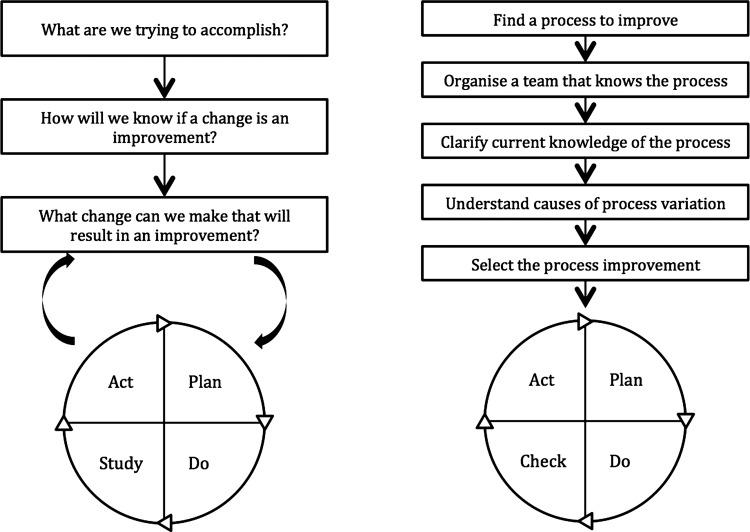
“This method involves a four-stage cycle: the “plan” stage involves identifying the desired change, the “do” stage involves implementing the change, the success of this change is evaluated in the “study” stage and further refinements to the original change are identified in the “act” stage which informs the next cycle…”
MethodSuccessful Trial of Practice Facilitation for Plan, Do, Study, Act Quality Improvement
Sutton, K. F., Richman, E. L., Rees, J. R., Pugh-Nicholson, L. L., Craft, M. M., Peaden, S. H., Mackey, M., & Halladay, J. R. (2021) · The Journal of the American Board of Family Medicine · doi:10.3122/jabfm.2021.05.210140 · Cited by 13
Pashmdarfard, M., Arabshahi, K. S., Shafaroodi, N., Mehraban, A. H., Parvizy, S., & Haracz, K. (2020) · Medical Journal of the Islamic Republic of Iran · doi:10.47176/mjiri.34.76 · Cited by 12
Atsumi, C., Hasegawa, Y., Tsumura, K., Ueda, T., Suzuki, K., Sugiyama, M., Nozaki, H., Suzuki, S., Nakane, M., Nagashima, G., et al. (2014) · Journal of Stroke and Cerebrovascular Diseases · doi:10.1016/j.jstrokecerebrovasdis.2014.08.013 · Cited by 12
Lee, P., Pham, L., Oakley, S., Eng, K., Freydin, E., Rose, T. N., Ruiz, A., Reen, J., Suleyman, D., Altman, V., et al. (2019) · BMJ Open Quality · doi:10.1136/bmjoq-2018-000373 · Cited by 13
Raj, L. K., Creaton, A., & Phillips, G. A. (2019) · Emergency Medicine Australasia · doi:10.1111/1742-6723.13225 · Cited by 12
“Review of the trauma call data was to be used to refine the trauma call process as part of a quality improvement loop (plan-dostudy-act cycle).(10) Multidisciplinary consultation (including ED, surgical, anaesthetic, radiology, pathology and intensive care representatives) enabled two key benchmarks to be set: an expe…”
MethodHanlon, C., Smartt, C., Mutiso, V. N., Yaro, P., Misganaw, E., Read, U., Mayston, R., Birhanu, R., Dako-Gyeke, P., Ndetei, D. M., et al. (2025) · Epidemiology and Psychiatric Sciences · doi:10.1017/s2045796025000186 · Cited by 11
“Regular meetings (every 1–2 weeks) with implementers and people with lived experience, supported by the project team, will use plan-do-study-act (PDSA) cycles (Taylor et al. , 2014) to identify and address emerging challenges, allowing iterative improvement of the intervention and approaches.”
Hoyle, E., Patino, F., & YOXALL, C. W. (2019) · Acta Paediatrica · doi:10.1111/apa.15076 · Cited by 11
Bugten, V., Wennberg, S., Amundsen, M. F., & Blindheimsvik, M. A. B. (2022) · BMJ Open Quality · doi:10.1136/bmjoq-2022-001887 · Cited by 11
Giri, S., Gyeltshen, D., Wangchuk, N., Dorji, K. S., Drakpa, L., Wangdi, S., & Diyali, K. B. (2024) · BMJ Open Quality · doi:10.1136/bmjoq-2024-002870 · Cited by 11
New horizons in systems engineering and thinking to improve health and social care for older people
Aujla, N., Tooman, T., Arakelyan, S., Kerby, T., Hartley, L., O'Donnell, A. J., Guthrie, B., Underwood, I., Jacko, J. A., & Anand, A. (2024) · Age and Ageing · doi:10.1093/ageing/afae238 · Cited by 11
“…t h e n t e s t e d i n t h e ‘ D o ’ s t a g e , t h e s u cc e ss o f w h i c h i s e x a m i n e d i n t h e ‘ S t u d y ’ s t a g e , a n d t h e ‘ A c t ’ s t a g e i d e n t i fi e s a r e a s f o r i m p r o v e m e n t o r a d a p t a t i o n t o i n f o r m t h e n e x t c y c l e [ 78 ] .”
Gaylis, F. D., Nasseri, R., Salmasi, A., Anderson, C. B., Mohedin, S., Prime, R., Swift, S., Dato, P. E., Cohen, E. S., Catàlona, W. J., et al. (2021) · Urology · doi:10.1016/j.urology.2020.11.068 · Cited by 11
Tepper, M. C., Ward, M. C., Aldis, R., Lanca, M., Wang, P. S., & Fulwiler, C. (2022) · Community Mental Health Journal · doi:10.1007/s10597-022-00957-3 · Cited by 12
Gestão baseada em processos visando à melhoria dos resultados assistenciais e financeiros em Saúde
Brancalion, F. N. M., & Lima, A. F. C. (2022) · Revista da Escola de Enfermagem da USP · doi:10.1590/1980-220x-reeusp-2021-0333pt · Cited by 11
Back, D., Estel, K., Pförringer, D., Tsitsilonis, S., Bachner, J., Willy, C., working group digitalization (DGOU), & Becker, H. (2022) · BMC Health Services Research · doi:10.1186/s12913-022-08352-0 · Cited by 12
“Its application has often been successfully used to improve processes in the health sector [35] and represents an important framework structure in the presented project.”
BackgroundUsing the PDCA cycle to uncover sources of mental health disparities for Hispanics
Moyce, S. C., Claudio, D., & Velazquez, M. (2022) · International Journal of Mental Health Nursing · doi:10.1111/inm.13100 · Cited by 12
Blakeney, E. A., Baird, J. D., Beaird, G., Khan, A., Parente, V. M., O’Brien, K. D., Zierler, B. K., O’Leary, K. J., & Weiner, B. J. (2023) · Frontiers in Medicine · doi:10.3389/fmed.2023.1275480 · Cited by 11
Schiele, F., Catapano, A. L., Caterina, R. D., Laufs, U., Jukema, J. W., Zaman, A., & Sionís, A. (2023) · European Heart Journal Acute Cardiovascular Care · doi:10.1093/ehjacc/zuad119 · Cited by 15
“EuroPath is a quality programme, 39 with a first survey of lipid management post ACS in 2018 (EuroPath I) followed by analysis and proposal for changes.”
BackgroundPrimary Care Collaboration to Improve Diagnosis and Screening for Colorectal Cancer
Schiff, G. D., Bearden, T., Hunt, L. S., Azzara, J., Larmon, J., Phillips, R. S., Singer, S. J., Bennett, B., Sugarman, J. R., Bitton, A., et al. (2017) · The Joint Commission Journal on Quality and Patient Safety · doi:10.1016/j.jcjq.2017.03.004 · Cited by 12
Pirani, S. (2020) · Journal of Psychiatric and Mental Health Nursing · doi:10.1111/jpm.12629 · Cited by 11
Wray, J., & Oldham, G. (2020) · International Journal for Quality in Health Care · doi:10.1093/intqhc/mzaa001 · Cited by 11
Creation and Implementation of a Large-Scale Geriatric Interprofessional Education Experience
McQuown, C. M., Ahmed, R. A., Hughes, P. G., Ortiz-Figueroa, F., Drost, J. C., Brown, D. K., Fosnight, S., & Hazelett, S. E. (2020) · Current Gerontology and Geriatrics Research · doi:10.1155/2020/3175403 · Cited by 11
“-e design of the project was a Plan-DoStudy-Act (PDSA) model [31].”
MethodImproving the Quality of Provided Care: Lessons Learned From Auditing Neonatal Stabilization
den Boer, M. C., Martherus, T., Houtlosser, M., Root, L., Witlox, R. S. G. M., & Pas, A. B. T. (2020) · Frontiers in Pediatrics · doi:10.3389/fped.2020.00560 · Cited by 11
“This change is tested, the success of this change is studied, and consequently this change is implemented or adapted, starting a new PDSA cycle (25).”
BackgroundAccreditation Program for Excellence (APEx): A Catalyst for Quality Improvement
Hong, D. S., Boike, T. P., Dawes, S. L., Klash, S. J., Kudner, R., Okoye, C., Rosu‐Bubulac, M., Watanabe, Y., Wright, J. L., & Jennelle, R. L. S. (2020) · Practical Radiation Oncology · doi:10.1016/j.prro.2020.10.014 · Cited by 11
Verburg, A. C., van Dulmen, S. A., Kiers, H., der Sanden, M. W. G. N., & van der Wees, P. J. (2021) · Physical Therapy · doi:10.1093/ptj/pzab118 · Cited by 11
Brown, A. D., & Grierson, L. (2021) · Journal of Evaluation in Clinical Practice · doi:10.1111/jep.13598 · Cited by 11
Ghoshal, A., Deodhar, J. K., Adhikarla, C., Tiwari, A., Dy, S. M., & Pramesh, C. S. (2021) · Indian Journal of Palliative Care · doi:10.25259/ijpc_394_20 · Cited by 12
“[11] We hypothesized that the pilot QI project would increase the rates of EPC referrals in lung cancer, establish standardized referral criteria, and ensure documentation of referral to PC services in patients’ medical records (paper/electronic).”
Lin, J. A., Pierce, L., Murray, S. G., Soleimani, H., Wick, E. C., Sosa, J. A., & Hirose, K. (2021) · Journal of surgical education · doi:10.1016/j.jsurg.2021.08.011 · Cited by 11
Brooks, R. P., Wegener, M., Freeman, B., Fowles, C., Madden, L. M., Tetrault, J. M., Nichols, L., Altice, F. L., & Villanueva, M. S. (2023) · Health Promotion Practice · doi:10.1177/15248399231169791 · Cited by 11
“PDSA cycles facilitate the rapid implementation of change based on the management of iterative modifications to process and procedure (Taylor et al., 2014).”
Method“Nomen Omen”: Exploring Connected Healthcare through the Perspective of Name Omen
Chen, S. C.-I., Liu, C., Hu, R., Mo, Y., & Ye, X. (2020) · Healthcare · doi:10.3390/healthcare8010066 · Cited by 13
Metadata
- Authors
- Taylor, M. J., McNicholas, C., Nicolay, C., Darzi, A., Bell, D., & Reed, J. E.
- Affiliations
- National Institute for Health and Care Research (GB)
- Imperial College London (GB)
- Corresponding author
- Taylor, Michael J
- Venue
- BMJ Quality & Safety
- Publisher
- BMJ
- Published
- 2013-09-11
- Volume
- 23
- Issue
- 4
- Pages
- 290-298
- ISSN
- 1475-3898 (ISSN-L)
- 2044-5415
- 2044-5423
- PMC
- PMC3963536
- OpenAlex
- W2115133509
- Semantic Scholar
- 661ab1c69e92f60884b5e1a143dc17c90020de3c
- Cited by
- 1,871
- References
- 81
- Citations by year
- 2026: 176 · 2025: 225 · 2024: 178 · 2023: 172 · 2022: 173 · 2021: 200 · 2020: 188 · 2019: 143 · 2018: 120 · 2017: 113 · 2016: 84 · 2015: 63 · 2014: 27 · 2013: 2
- FWCI
- 9.85
- Type
- journal article
- Language
- en
- Open access
- hybrid
- doi.org
- Licence
- cc-by-nc
- Locations
- BMJ Quality & Safety (publishedVersion, cc-by-nc)
- Europe PMC (PubMed Central) (publishedVersion, other-oa)
- PubMed Central (publishedVersion, cc-by-nc)
- PubMed (publishedVersion)
- HighWire Press Open Archive (acceptedVersion)
- Spiral (Imperial College London) (submittedVersion, other-oa)
- Funders
- National Institute for Health and Care Research (NF-SI-0510-10186)
- Topics
- Health Sciences › Medicine › Public Health, Environmental and Occupational Health › Healthcare Quality and Management
- Health Sciences › Health Professions › General Health Professions › Health Policy Implementation Science
- Social Sciences › Business, Management and Accounting › Organizational Behavior and Human Resource Management › Appreciative Inquiry and Organizational Change
- Keywords
- PDSA cycle, healthcare quality improvement, methodological quality assessment
- MeSH terms
- Humans, Organizational Innovation, Quality of Health Care, Quality Indicators, Health Care, Quality Improvement
About these checks
Registry, retraction, Cites and statistics results are computed, not judged, with one exception: a printed reference that no index lists is read once by a model before it counts as a citation error. Claims are extracted by a model and kept only when their quote appears verbatim in the text; each cited source is then checked, with a model’s help, for whether it says what the claim relies on. Those verdicts can be wrong — read the claim’s quote and the cited source before relying on one.
Statistics and arithmetic are recomputed, not judged.
Confidence bands are shown only for fields calibrated on our annotated test set. None is calibrated yet, so no band is shown.
What counts as a claim ›How we measure confidence ›How we check this ›
Are you an author, or do you see a problem with this page? Request a review
Data sources
Bibliographic data: Semantic Scholar, OpenAlex, Crossref.
Contains information from the Semantic Scholar Academic Graph Datasets, made available under the ODC Attribution License (ODC-BY 1.0).
Semantic Scholar’s data is described in: Kinney, R., et al. (2023). The Semantic Scholar Open Data Platform. arXiv:2301.10140.
