

Systematic review of the application of the plan–do–study–act method to improve quality in healthcare
Open accessThe DOI matches its Crossref record; 79 of the 81 references it cites were found in a registry or an index.
Abstract
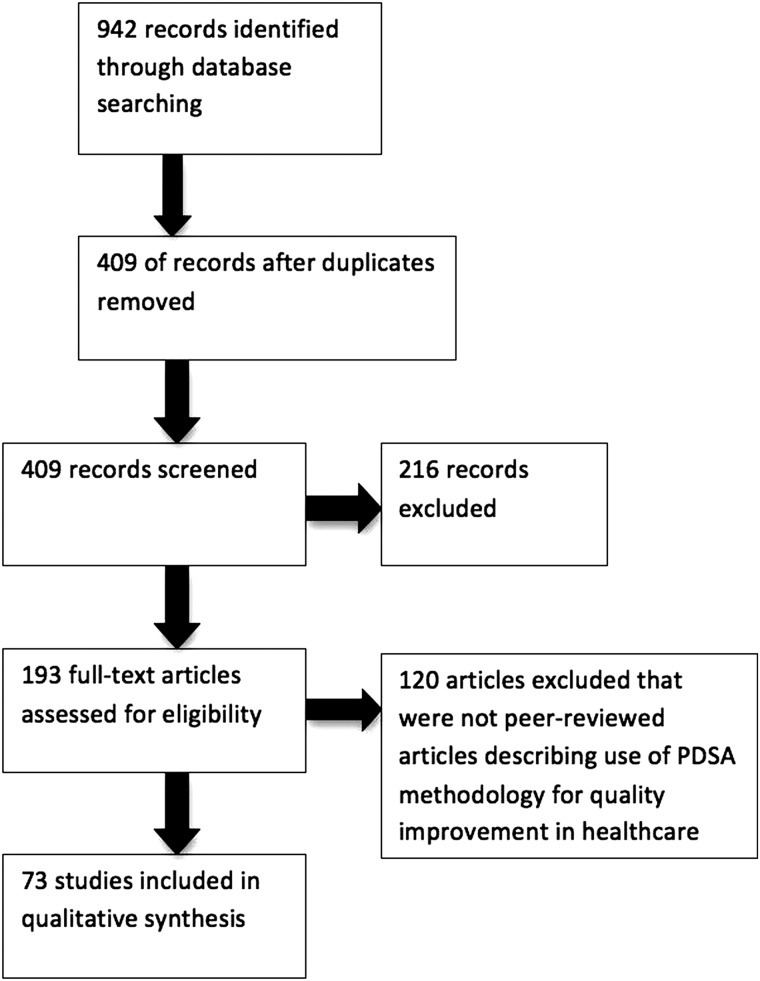
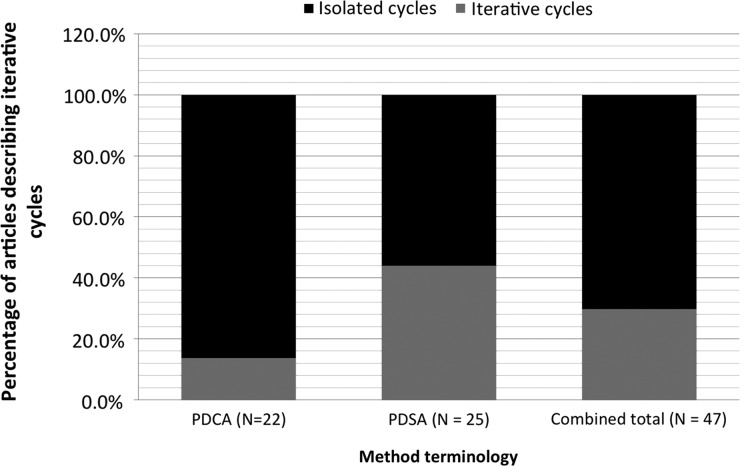
Background: Plan–do–study–act (PDSA) cycles provide a structure for iterative testing of changes to improve quality of systems. The method is widely accepted in healthcare improvement; however there is little overarching evaluation of how the method is applied. This paper proposes a theoretical framework for assessing the quality of application of PDSA cycles and explores the consistency with which the method has been applied in peer-reviewed literature against this framework. Methods: NHS Evidence and Cochrane databases were searched by three independent reviewers. Empirical studies were included that reported application of the PDSA method in healthcare. Application of PDSA cycles was assessed against key features of the method, including documentation characteristics, use of iterative cycles, prediction-based testing of change, initial small-scale testing and use of data over time. Results: 73 of 409 individual articles identified met the inclusion criteria. Of the 73 articles, 47 documented PDSA cycles in sufficient detail for full analysis against the whole framework. Many of these studies reported application of the PDSA method that failed to accord with primary features of the method. Less than 20% (14/73) fully documented the application of a sequence of iterative cycles. Furthermore, a lack of adherence to the notion of small-scale change is apparent and only 15% (7/47) reported the use of quantitative data at monthly or more frequent data intervals to inform progression of cycles. Discussion: To progress the development of the science of improvement, a greater understanding of the use of improvement methods, including PDSA, is essential to draw reliable conclusions about their effectiveness. This would be supported by the development of systematic and rigorous standards for the application and reporting of PDSAs.
Overview
The claims and statistics of this paper haven’t been checked yet.
Free: it reads the open-access text and checks the first 5 claims that cite a source we can check. Create a free account to check every claim.
Integrity signals
Registry
Cites
Statistics
Figures
Verification
Claims the paper makes
The claims and statistics of this paper haven’t been checked yet.
Free: it reads the open-access text and checks the first 5 claims that cite a source we can check. Create a free account to check every claim.
Claims other papers make about this one
Each is checked against this paper’s own text: does it say what the citing paper says it does?
The source backs part of the claim, not all of it — or backs it for a different population, condition or comparison.
In the citing paper
“Drawing on impact evaluation research from the TSBM (5), CQI (6–8, 16), and team science (9–12), we develop a theory-driven, team-based approach to CQI and impact evaluation.”
From Building on the Translational Science Benefits Model to include team science: a practical and theory-based approach to continuous quality improvement and impact evaluation for Clinical and Translational Science Award programs (2025) · cites this paper as [8]
Experimental — accuracy not yet measuredThe cited source says what the claim attributes to it.
In the citing paper
“The Plan-Do-Study/Check-Act (PDSA/PDCA) cycle of CQI is one of the most widely used methods within health care and considered a key foundational approach to quality improvement (6–8).”
The cited source says what the claim attributes to it.
In the citing paper
“Rooted in the scientific method, CQI methods have been used to iteratively improve health care (8, 15) and more recently encouraged to enhance CTSA efforts toward translational science (1–3).”
In the citing paper
“Without a good theoretical grasp of the underlying theory and its critical components (‘active ingredients’), improvers may adopt the label or outward appearance attached to a successful intervention, which does not permit them to reproduce its impact.46”
From Demystifying theory and its use in improvement (2015) · cites this paper as [46]
Self-check
Percentages, sums and reported differences re-computed from the paper’s own numbers.
The self-check needs the paper’s full text.
Citations
Cites
Liberati, A., Altman, D. G., Tetzlaff, J., Mulrow, C., Gøtzsche, P. C., Ioannidis, J. P. A., Clarke, M., Devereaux, P. J., Kleijnen, J., & Moher, D. (2009) · PLoS Medicine · doi:10.1371/journal.pmed.1000100 · Cited by 28,164
Damschroder, L. J., Aron, D. C., Keith, R. E., Kirsh, S. R., Alexander, J. A., & Lowery, J. C. (2009) · Implementation Science · doi:10.1186/1748-5908-4-50 · Cited by 14,496
Diffusion of Innovations in Service Organizations: Systematic Review and Recommendations
GREENHALGH, T., ROBERT, G., MACFARLANE, F., BATE, P., & KYRIAKIDOU, O. (2004) · The Milbank Quarterly · doi:10.1111/j.0887-378x.2004.00325.x · Cited by 7,448
Deming, W. E. (1982) · Medical Entomology and Zoology · Cited by 7,297
An Intervention to Decrease Catheter-Related Bloodstream Infections in the ICU
Pronovost, P., Needham, D., Berenholtz, S., Sinopoli, D., Chu, H., Cosgrove, S., Sexton, B., Hyzy, R., Welsh, R., Roth, G., et al. (2006) · New England Journal of Medicine · doi:10.1056/nejmoa061115 · Cited by 4,387
The Improvement Guide: A Practical Approach to Enhancing Organizational Performance
(1997) · Quality Management Journal · doi:10.1080/10686967.1998.11919154 · Cited by 2,895
The improvement guide : a practical approach to enhancing organizational performance
Langley, G. J. (1996) · Jossey-Bass Publishers eBooks · Cited by 875
Getting evidence into practice: the meaning of `context'
McCormack, B., Kitson, A., Harvey, G., Rycroft‐Malone, J., Titchen, A., & Seers, K. (2002) · Journal of Advanced Nursing · doi:10.1046/j.1365-2648.2002.02150.x · Cited by 765
Complexity, leadership, and management in healthcare organisations
Plsek, P. E., & Wilson, T. (2001) · BMJ · doi:10.1136/bmj.323.7315.746 · Cited by 754
KAPLAN, H. C., BRADY, P. W., DRITZ, M. C., HOOPER, D. K., LINAM, W. M., FROEHLE, C. M., & MARGOLIS, P. (2010) · Milbank Quarterly · doi:10.1111/j.1468-0009.2010.00611.x · Cited by 714 · cited 1×
“5 Research findings highlight the influential effect that local context can have on the success of an intervention 6 7 and, as such, ‘ single-bullet ’ interventions are not anticipated to deliver consistent improvements.”
Background
Research works printed but not linked: 5
- 13. Powell AE, Rushmer RK, Davies HTO. A systematic narrative review of quality improvement models in health care: NHS Quality Improvement Scotland. 2009. Report No. 1844045242.
- 27. Systematic review Taylor MJ, et al. BMJ Qual Saf 2014;23:290-298. doi:10.1136/bmjqs-2013-001862
- 30. Imai M. The key to Japan's competitive success. New York: McGraw-Hill, 1986.
- 40. Moen R, Norman C. Circling back: clearing up the myths about the Deming cycle and seeing how it keeps evolving. Qual Progress 2010;42:23-8.
- 42. Berwick DM. Developing and testing changes in delivery of care. Ann Intern Med 1998;128:651. · DOI · Paper page
Cited by
Items 801–900 of 1,000
Bernard, S., Teasdale, N., Harris, C. J., & Girdler, S. J. (2025) · Neurodiversity · doi:10.1177/27546330251317807 · Cited by 6
“Plan-Do-Study-Act (PDSA) cycles were used to iteratively improve neurodiversity education (Taylor et al., 2014).”
Law, R. G., Koh, W., Poh, P. K., Htet, N. M., Ng, S. W. B., Liu, E. H., & Ang, K. S. (2025) · Canadian Journal of Anesthesia/Journal canadien d anesthésie · doi:10.1007/s12630-025-03003-4 · Cited by 6
ESTRO framework for radiation oncology departments to mitigate against cyberattacks
Peters, S., O’Donovan, A., Bellini, M., Caissie, A. L., Coffey, M., Dabach, A., Delaney, G. P., Fischer, P. E., Frenken, G., Liszewski, B., et al. (2025) · Radiotherapy and Oncology · doi:10.1016/j.radonc.2025.111305 · Cited by 6
Larrañaga, I., Mar, J., Gorostiza, A., García‐Lorenzo, B., Zubeltzu, B., Vega, R., Kaye, R., Levy, G., Vishnevetsky, O., Christensen, R. L., et al. (2025) · Frontiers in Public Health · doi:10.3389/fpubh.2025.1682492 · Cited by 6
“This also paves the way for the use of continuous improvement tools that support management, such as Deming’s plan-do-study-act (PDSA) cycle (86, 87).”
Candelaria, D., Gibson, I., Babu, A. S., Briffa, T. G., Mbau, L. K., Gallagher, R. D., Wu, W., Beatty, A. L., Ghisi, G. L. D. M., Namanja, A., et al. (2026) · Global Heart · doi:10.5334/gh.1563 · Cited by 6
Patient Adherence to Oral Anticancer Agents: A Mapping Review of Supportive Interventions
Ahmed, S., & Loiselle, C. G. (2023) · Current Oncology · doi:10.3390/curroncol30120744 · Cited by 6
“Two separate systematic reviews of the model found that although widely used, many projects that use PDSA report improvements while not adhering to its methodology of four steps [41,43].”
BackgroundCox, D. J. (2024) · Behavior Analysis in Practice · doi:10.1007/s40617-024-00937-x · Cited by 8
“…in reducing cost or improving quality are certainly useful, the literature on the development of quality measures over time highlights that variation, iteration, and selection of measures over time can add to significant improvement over time (e.g., Crandall et al., 2011; Taylor et al., 2014).”
Richardson, S., Huen, K. H. Y., Benga, T., Fajardo, B., Sturm, R. M., Lerman, S. E., & Singer, J. S. (2024) · Frontiers in Urology · doi:10.3389/fruro.2024.1383108 · Cited by 6
“Plan – do – study – act (PDSA) cycles were utilized for real-time assessment and implementation (7).”
Bharadwaj, R., Kaviprawin, M., Neelkanth, N., Navkar, V. K., Azarudeen, M. J., Ganeshkumar, P., Ramalingam, A., & Kaur, P. (2025) · BMJ Open Quality · doi:10.1136/bmjoq-2024-003124 · Cited by 6
Use of Iterative Cycles in Quality Improvement Projects in Imaging: A Systematic Review
Cheung, Y. Y., Riblet, N. B. V., & Osunkoya, T. O. (2018) · Journal of the American College of Radiology · doi:10.1016/j.jacr.2018.06.007 · Cited by 6
Esmail, R., Hanson, H. M., Holroyd-Leduc, J. M., Niven, D. J., & Clement, F. M. (2021) · BMJ Open · doi:10.1136/bmjopen-2020-042251 · Cited by 7
Richardson, E. V., Fifolt, M. M., Barstow, E. A., & Motl, R. W. (2021) · Disability and Rehabilitation · doi:10.1080/09638288.2021.1998662 · Cited by 6
Kim, J., Estabrooks, P. A., Aggarwal, A., McMillan, A., & Alshehri, K. (2022) · Implementation Science Communications · doi:10.1186/s43058-022-00375-2 · Cited by 6
“Plan‐Do‐Study‐Act (PDSA) cycle We used the PDSA cycle as a key approach within our bundled implementation strategy [36].”
MethodMiller, C. R., Johnston, R. D., Blake, B. H., & Aronson, J. F. (2023) · American Journal of Forensic Medicine & Pathology · doi:10.1097/paf.0000000000000857 · Cited by 7
Toropova, A., Rödlund, A., Björklund, C., Elinder, L. S., Jensen, I. B., & Kwak, L. (2023) · Scandinavian Journal of Work Environment & Health · doi:10.5271/sjweh.4108 · Cited by 7
“The iterative and evaluative strategy employed in this trial was the Plan-Do-Study-Act (PDSA) strategy (31).”
MethodDerendorf, L., Kusch, M., Stock, S., & Lemmen, C. (2023) · Journal of Healthcare Quality Research · doi:10.1016/j.jhqr.2023.10.007 · Cited by 6
Odendaal, W., Chetty, T., Tomlinson, M., Goga, A. E., Singh, Y., Kauchali, S., Marshall, C., & Hunt, X. (2023) · BMC Health Services Research · doi:10.1186/s12913-023-10378-x · Cited by 7
“It comprises rapid, iterative cycles of: Plan concerns developing a Quality Improvement Plan (QIP) to fix the identified problem; Do is implementing the QIP; Study is assessing the QIP outcomes; and Act is when the team decides to either adopt, i adapt, or abandon the QIP [10].”
Sosa, M. A., Garg, N., Onge, J. E. S., Issenberg, S. B., & Diaz, Y. M. (2024) · International Journal of Medical Informatics · doi:10.1016/j.ijmedinf.2024.105444 · Cited by 6
McKee, K. E., Knighton, A. J., Veale, K., Martinez, J., McCann, C., Anderson, J. W., Wolfe, D., Blackburn, R. A., McKasson, M., Bardsley, T. R., et al. (2024) · Circulation Cardiovascular Quality and Outcomes · doi:10.1161/circoutcomes.123.010477 · Cited by 6
“19 A neurology nurse led the system project.”
BackgroundUsing quality improvement to pursue equity: lessons from healthcare
Aurelio, M. G., Brittin, K., Darknell, L., Chitewe, A., & Shah, A. (2024) · British Journal of Healthcare Management · doi:10.12968/bjhc.2023.0142 · Cited by 6
E-learning Interventions for Quality Improvement Continuing Medical Education—A Scoping Review
Roth, M. J., Maggio, L. A., Costello, J. A., & Samuel, A. (2024) · Journal of Continuing Education in the Health Professions · doi:10.1097/ceh.0000000000000564 · Cited by 9
“62 Although our included studies documented the educational modalities used, they often did not provide speci fi c instructional details, limiting our ability to assess the author ’ s fi delity to the various QI methods.”
Multidisciplinary care meeting practices across diverse international settings
Pershad, A. R., Graetz, D. E., Le, M. A., Forrest, H. L., Gonzalez‐Guzman, M., & Friedrich, P. M. (2024) · Cancer Medicine · doi:10.1002/cam4.70136 · Cited by 7
“1,22,23 However, we identify residual disparities and opportunities for improvement.”
BackgroundIntegrating Patients Into Programmes to Address the Allergy Knowledge Practice Gap
Warner, J. O., & Spitters, S. (2024) · Clinical & Experimental Allergy · doi:10.1111/cea.14563 · Cited by 6
“Regular meetings to review progress using plan/do/study/ act cycles provide the structure to learn iteratively whether the changes being implemented are having the desired effects [113].”
Learning health system linchpins: information exchange and a common data model
Eisman, A. S., Chen, E. S., Wu, W., Crowley, K. M., Aluthge, D. P., Brown, K., & Sarkar, I. N. (2024) · Journal of the American Medical Informatics Association · doi:10.1093/jamia/ocae277 · Cited by 6
Implementing a Tribally Engaged Lung Cancer Screening Pilot Program in Rural Oklahoma
Nagykaldi, Z. J., Doescher, M. P., Rhoades, D. A., Dwyer, K. A., Chou, A. F., & Gibson, M. (2025) · Cancer Prevention Research · doi:10.1158/1940-6207.capr-24-0348 · Cited by 6
Lowe, C., Atherton, L., Lloyd, P. A., Waters, A., & Morrissey, D. (2025) · Journal of Medical Internet Research · doi:10.2196/67269 · Cited by 7
“To maximize the scientific rigor of the PDSA method, Taylor et al [22] emphasize the importance of following the design structure, both in application and reporting.”
Brett, L., Nguyen, A., Siette, J., Dove‐Pizarro, J., Hourihan, F., & Georgiou, A. (2019) · Australian Journal on Ageing · doi:10.1111/ajag.12706 · Cited by 6
Patient- and Family-Centered Video Rounds in the Pediatric Intensive Care Unit
DeSanti, R. L., Brown, D. H., Srinivasan, S., Brazelton, T., & Wilhelm, M. (2020) · Telehealth and Medicine Today · doi:10.30953/tmt.v5.231 · Cited by 6
Hakim, L. N., Rosadi, K. I., Widdah, M. E., Us, K. A., Shalahudin, & Mahmud, M. Y. (2020) · Systematic Reviews in Pharmacy · doi:10.31838/srp.2020.10.131 · Cited by 11
“Such as the effect of the application of the PDCA cycle on service quality in the retail sector (Chiguvi, 2016), in the public sector (Al-Ibrahim, 2014), in the field of education (Li et al., 2014), in the health sector (Taylor et al., 2014) and so forth.”
BackgroundImplementation of an improvement cycle in the care of a primary health care
Nunes, T. B., de Souza, É. C. R., Gama, Z. A. D. S., Medeiros, W. R., & de Mendonça, A. E. O. (2021) · Revista Brasileira de Enfermagem · doi:10.1590/0034-7167-2020-0099 · Cited by 6
Quality Function Deployment: Comprehensive Framework for Patient Satisfaction in Private Hospitals
Kanan, M. A., & Essemmar, S. (2021) · Advances in Science Technology and Engineering Systems Journal · doi:10.25046/aj0601163 · Cited by 6
“Based on their findings, the benefits of the PDSA can be maximized by starting the cycle on a small scale and following an iterative approach [22].”
BackgroundFifolt, M. M., Richardson, E. V., Barstow, E. A., & Motl, R. W. (2021) · Journal for Healthcare Quality · doi:10.1097/jhq.0000000000000279 · Cited by 6
“The goal of a PDSA ramp is to learn quickly and make adjustments to increase the chances of delivering and sustaining the desired improvement.(20) Plan-DoStudy-Act cycles rely on rapid testing among a small number of specific individuals relative to the context of the implementation setting to collect just enough data…”
BackgroundJohn, W. S., & Kamin, Y. (2021) · Universal Journal of Educational Research · doi:10.13189/ujer.2021.090805 · Cited by 7
“The PDCA cycle's action stage examines the TVET system to implement actions necessary to achieve TVET improvement and ensure quality within the TVET system.[1; 2; 3].”
MethodThe role of implementation science in improving epilepsy surgery utilization
Samanta, D. (2022) · Epilepsy & Behavior · doi:10.1016/j.yebeh.2022.108669 · Cited by 6
Lian, T., Brandrud, A. S., Mariero, L., Nordsletten, L., & Figved, W. (2022) · BMJ Open Quality · doi:10.1136/bmjoq-2022-001848 · Cited by 6
Callaghan, E. M., Diamandis-Nikoletatos, E., van Leeuwen, P. P., Higgins, J. B., Somerville, C. E., Brown, L., & Schumacher, T. L. (2022) · Patient Education and Counseling · doi:10.1016/j.pec.2022.08.011 · Cited by 6
Harris, C. K., Chen, Y., Jensen, K. C., Hornick, J. L., Kilfoyle, C., Lamps, L. W., & Heher, Y. (2022) · Academic Pathology · doi:10.1016/j.acpath.2022.100048 · Cited by 6
Wagstaff, D., Warnakulasuriya, S. R., Singleton, G. F., Moonesinghe, R., Fulop, N., & Vindrola‐Padros, C. (2022) · Perioperative Medicine · doi:10.1186/s13741-022-00273-0 · Cited by 6
“Furthermore, there is a tendency to only report those projects which achieve ‘positive’ results, leading to significant publication bias (Taylor et al. 2014).”
BackgroundIdentifying the core components of a nursing home hospital avoidance programme
O’Neill, B. J., Dwyer, T., Parkinson, L., Reid‐Searl, K., & Jeffrey, D. (2022) · International Journal of Older People Nursing · doi:10.1111/opn.12493 · Cited by 6
“These modifications were consistent with the plan, do, study act cycle (Taylor et al., 2014) and were made at the discretion of the Site Two on- site facilitators who lead the Programme implementation due to their local operational knowledge.”
MethodInfluentialInsorio, A. O., Villanueva, Z. T., & General, D. E. (2023) · Contemporary Mathematics and Science Education · doi:10.30935/conmaths/12818 · Cited by 6
“Figure 1 presents the study flow under the plan-do-study-act model derived from the work of Edward Deming and Walter Shewhart (Taylor et al., 2014).”
Chheda, S., Tullius, Z. S., Tejeda, K. A., & Leiner, M. A. (2023) · The Journal of Perinatal & Neonatal Nursing · doi:10.1097/jpn.0000000000000685 · Cited by 6
Lifestyle Changes Using the Plan-Do-Study-Act Cycle among Older Thai Adults – A Focus Group Study
Wongsala, M., Anbäcken, E., Manasatchakun, P., Rungkawatt, V., & Rosendahl, S. P. (2023) · Activities Adaptation & Aging · doi:10.1080/01924788.2023.2172881 · Cited by 6
“The PDSA cycle is also known as the Deming cycle; it has been used within organizations, such as industries and health care organizations (Knudsen et al., 2019; Taylor et al., 2013).”
BackgroundMethodAlvarez, O. A., Rodriguez-Cortes, H., Clay, E. L. J., Echenique, S., Kanter, J., Strouse, J. J., Buitrago-Mogollon, T., Courtlandt, C., Noonan, L. E., & Osunkwo, I. (2023) · BMJ Quality & Safety · doi:10.1136/bmjqs-2022-015209 · Cited by 6
Lu, M., Jiang, M., Gu, Y., Li, H., Hou, Y., Yu, X., Cao, Y., Zhu, B., & Tao, F. (2023) · BMJ Open · doi:10.1136/bmjopen-2022-063593 · Cited by 6
Implementing Preference-Based Communication Tools in Nursing Homes: Influence of Champions
Kunkel, M. C., Kasler, K., Heppner, A., Haitsma, K. S. V., & Abbott, K. H. (2023) · Activities Adaptation & Aging · doi:10.1080/01924788.2023.2213022 · Cited by 6
“Quality improvement uses systematic, multistep approaches to implementing changes with real-time measurement for improvement to make a difference for older adults living in nursing homes by improving safety, effectiveness, and experience of care (Taylor et al., 2014).”
Irimu, G., Okwaro, F. M., Coleman, J., Waiyego, M., Murila, F. V., Chomba, D., Parsimei, M., Shitote, C., Ochieng, R., Shah, J., et al. (2023) · Implementation Science Communications · doi:10.1186/s43058-023-00455-x · Cited by 6
“This will be achieved using a continuous quality improvement strategy that applies a Plan-DoStudy-Act (PDSA) framework integrated with key stakeholders’ engagement, audits and feedback [15, 16].”
BackgroundMethodRao, A., Gallagher, E., Mickelsen, J., González, S., Forby, F., Andrews, K., Hosie, A., Sheehan, C., DeNatale, M., & Agar, M. R. (2023) · Journal of Palliative Medicine · doi:10.1089/jpm.2022.0576 · Cited by 6
“14 An overview of the course structure and process is provided in Table 2.”
Wolfstadt, J. I., Ward, S. E., Kim, S., & Bell, C. M. (2018) · Journal of Bone and Joint Surgery · doi:10.2106/jbjs.18.00225 · Cited by 6
Li, L., Gupta, N., & Wasser, T. D. (2019) · The Journal of Mental Health Training Education and Practice · doi:10.1108/jmhtep-10-2018-0060 · Cited by 6
Huang, S., Gardner, S. K., Piper, K. N., Coleman, A. S., Becan, J. E., Robertson, A. A., & Elkington, K. S. (2020) · AIDS Education and Prevention · doi:10.1521/aeap.2020.32.5.432 · Cited by 6
Administrative and Registry Databases for Patient Safety Tracking and Quality Improvement
Brajcich, B. C., Fischer, C. P., & Ko, C. Y. (2020) · Surgical Clinics of North America · doi:10.1016/j.suc.2020.09.010 · Cited by 7
Kawabata, N., & Nin, M. (2021) · BMC Palliative Care · doi:10.1186/s12904-021-00741-2 · Cited by 6
“Utilizing of these frameworks has also been explored and evaluated in other healthcare fields [19, 20].”
Souza, L. A. B., Neves, H. C. C., Aredes, N. D., Medeiros, I. C. L. J., Silva, G. O., & Ribeiro, L. C. M. (2021) · Revista da Escola de Enfermagem da USP · doi:10.1590/1980-220x-reeusp-2021-0003 · Cited by 6
“For the development of the internship activities, the PDSA methodology was used, which is based on planning, doing, studying and acting, aiming to improve the quality of systems(9).”
MethodReducing Tracheostomy Medical Device-Related Pressure Injury: A Quality Improvement Project
Holder, H., & Gannon, B. “. (2022) · AACN Advanced Critical Care · doi:10.4037/aacnacc2022874 · Cited by 6
Williams, S. (2016) · Springer eBooks · doi:10.1007/978-3-319-46913-3_3 · Cited by 6
Advances in performance, more benefits... the perspectives of rapid response teams
Boniatti, M. M. (2016) · Revista Brasileira de Terapia Intensiva · doi:10.5935/0103-507x.20160048 · Cited by 6
“(7) Although the RRT performance in this study has been restricted to 12 daytime hours, the initiative has produced the following quality criteria:(8) the “dose” delivered by the RRT was 102 calls per 1,000 admissions in the first year, with a median of two minutes for the arrival of the RRT at the bedside.”
BackgroundKilroy, G., Lorbiecki, M., Ndakuya‐Fitzgerald, F., & Hagle, M. E. (2023) · Journal of the American Psychiatric Nurses Association · doi:10.1177/10783903231178556 · Cited by 5
“This phase used the Plan-Do-Study-Act (PDSA) quality improvement (QI) framework (Taylor et al., 2014).”
Improving the Sustainability of Public Health Interventions: The INNOVATE Model
Haregu, T., Kwaśnicka, D., Shrestha, A., Lynch, C., Absetz, P., Miranda, J. J., Thankappan, K. R., & Oldenburg, B. F. (2025) · Global Implementation Research and Applications · doi:10.1007/s43477-025-00149-7 · Cited by 6
“Subsequently, we examined these stages against the program cycle, Knowledge-to-Action framework (Anjana et al., 2023 ), and Plan-Do-Study-Act (PDSA) cycle to ensure comprehensiveness(Taylor et al., 2014 ).”
Zhang, F., Xie, J., Chutinan, S., & Riedy, C. A. (2025) · BMC Medical Education · doi:10.1186/s12909-025-07354-w · Cited by 5
“This QI study solely focuses on the “Plan” phase of the PDSA cycle, gathering base-line data on communication approaches used by student-providers in practice [20] The subsequent “Do”, “Study”, and “Act” phases remain to be explored further in future QI studies.”
Home-based geriatric rehabilitation after inpatient rehabilitation: a redesign and feasibility study
Preitschopf, A., Pol, M., Buurman, B. M., & Holstege, M. S. (2025) · BMC Geriatrics · doi:10.1186/s12877-025-06043-z · Cited by 5
“The working group meetings, including field notes, were used as additional input during the analysis, which followed a plan-do-check-act cycle [26].”
Knippen, K. L., Woodcock, L., Papoutsakis, C., & Gonzales‐Pacheco, D. (2025) · Nutrition in Clinical Practice · doi:10.1002/ncp.70043 · Cited by 6
“26,29 Unlike other QI methods, it requires minimal training, resources, and leadership support.”
Simulation in healthcare: Navigating the space between quality improvement and research
Schram, A. (2025) · Clinical Simulation in Nursing · doi:10.1016/j.ecns.2025.101824 · Cited by 5
Munk, T., Beck, A. M., Møller, C. M., Pudselykke, F. E., Mikkelsen, G. Ø. H., Filtenborg, H. T., Pedersen, T. S., Alva‐Jørgensen, J. P., & Knudsen, A. W. (2025) · Nutrition in Clinical Practice · doi:10.1002/ncp.70049 · Cited by 5
“15,19 In our study, the structured role of the embedded clinical dietitian was essential to strengthening nutrition care.”
Gadsden, T., Sujarwoto, S., Salsabilla, S. A., Maharani, A., Praveen, D., Tampubolon, G., Abímbọ́lá, Ṣ., Patel, A. A., & Palagyi, A. (2025) · PLOS Global Public Health · doi:10.1371/journal.pgph.0005577 · Cited by 5
“PDSA cycles are underpinned by continuous data collection, small-scale testing and iterative hypothesis-driven changes [12].”
Design science research in quality improvement: Embedding rigour in digital health innovation
Dyers, R., Mahomed, H., & van Greunen, D. (2025) · African Journal of Primary Health Care & Family Medicine · doi:10.4102/phcfm.v17i2.5194 · Cited by 5
“6,8 Quality improvement’s process, outcome and balancing measures resemble DSR’s multifaceted evaluation criteria.”
Cha, J., Cha, E. D., Yoo, E. H., & Song, H. K. (2025) · BMC Public Health · doi:10.1186/s12889-025-25279-3 · Cited by 5
“ABMs can further embed social norms, adherence rules, and local interactions absent in conventional models [5, 6, 19, 20].”
Stockley, R., Gooch, H. J., Jarvis, K. A., & Watkins, C. L. (2026) · npj Digital Medicine · doi:10.1038/s41746-026-02599-1 · Cited by 5
Building Purpose-Driven Radiology Departments: Distributive and Servant Leadership in Action
Kamran, R., Patlas, M. N., Cecere, M., & Doria, A. S. (2026) · Canadian Association of Radiologists Journal · doi:10.1177/08465371261437071 · Cited by 6
Shakeel, F., Napolitano, A., Newkirk, M., Harris, J. E., & Ghazarian, S. R. (2015) · ICAN Infant Child & Adolescent Nutrition · doi:10.1177/1941406415617147 · Cited by 6
Audit of the national meal guidelines for home‐delivered and centre‐based meal programs
Kemp, A., Walton, K. L., do Rosario, V. A., Charlton, K. E., & McMahon, A. (2020) · Australian Journal on Ageing · doi:10.1111/ajag.12806 · Cited by 5
Reamer, C. B., O'Malley, C. A., Nufer, J., & Savant, A. P. (2020) · BMJ Open Quality · doi:10.1136/bmjoq-2019-000890 · Cited by 5
Glover, J., Lynn, C., Holzman, J. B. W., Germone, M. M., & Talmi, A. (2022) · Journal of Pediatric Psychology · doi:10.1093/jpepsy/jsac063 · Cited by 5
Patient Understanding of Tumor Genomic Testing: A Quality Improvement Effort
Senter, L. A., Veney, D. J., Surplus, T., Haynam, M. L., Adams, E. J., Hampel, H., Toland, A. E., Presley, C. J., Padamsee, T. J., Lee, C. N., et al. (2022) · JCO Oncology Practice · doi:10.1200/op.22.00316 · Cited by 5
“To address this need, we engaged in a quality improvement (QI) initiative focused on patient education before TGT using a Plan-Do-Study-Act (PDSA) approach.(14) Author affiliations and support information (if applicable) appear at the end of this article.”
MethodŻegleń, P., Kluczek, A., & Matušíková, D. (2022) · Management and Production Engineering Review · doi:10.24425/mper.2022.142378 · Cited by 5
Record, reflect and refine: using video review as an initiative to improve neonatal care
Heesters, V., van Zanten, H. A., Heijstek, V., Pas, A. B. T., & Witlox, R. S. G. M. (2024) · Pediatric Research · doi:10.1038/s41390-024-03083-w · Cited by 5
Guerra-Paiva, S., Mira, J. J., Strametz, R., Fernandes, J., Klemm, V., Gecková, A. M., Knežević, B., Potura, E., Buttiġieġ, S. C., Carrillo, I., et al. (2024) · JMIR Formative Research · doi:10.2196/58727 · Cited by 5
Siefen, A., Kurte, M. S., Jakobs, F., Teichert, M., von Tresckow, B., Reinhardt, H. C., Holtick, U., Atta, J., Jehn, C. F., Sala, E., et al. (2024) · Frontiers in Oncology · doi:10.3389/fonc.2024.1466803 · Cited by 5
Total quality management (TQM) for sustainable growth performance in the private healthcare sector
Ramasamy, G., & Avadaiyar, P. (2024) · Problems and Perspectives in Management · doi:10.21511/ppm.22(4).2024.18 · Cited by 5
Bechtold, M. L., & Matteson, M. (2025) · Nutrition in Clinical Practice · doi:10.1002/ncp.70041 · Cited by 5
Sorita, A., Raslau, D., Murad, M. H., & Steffen, M. W. (2015) · Journal of Occupational and Environmental Medicine · doi:10.1097/jom.0000000000000394 · Cited by 6
Improving apnoeic oxygenation use for rapid sequence intubation in an emergency department
Pek, J. H., Kang, H. M., & Wong, E. (2017) · Trends in Anaesthesia and Critical Care · doi:10.1016/j.tacc.2017.01.059 · Cited by 7
Publication Bias Among Conference Abstracts Reporting on Pediatric Quality Improvement Projects
Tumin, D., Akpan, U. S., Kohler, J. A., & Uffman, J. C. (2019) · American Journal of Medical Quality · doi:10.1177/1062860619873716 · Cited by 5
“Contemporary guidance on QI projects emphasizes the need for conducting multiple PDSA cycles, monitoring long-term outcomes to demonstrate project sustainability, and using SPC methodology to determine progress toward project goals over time.(17,18) Additionally, checklists such as SQUIRE are recommended (and often re…”
Cox, J., Linthwaite, B., Engler, K., Lessard, D., Lebouché, B., & Kronfli, N. (2020) · Pilot and Feasibility Studies · doi:10.1186/s40814-020-0559-6 · Cited by 6
Optimization of Delivery of Pediatric Otolaryngology Surgical Antibiotic Prophylaxis
Yalamanchi, P., Parent, A., & Thorne, M. C. (2020) · Otolaryngology · doi:10.1177/0194599820933191 · Cited by 5
Using a Quality Improvement Model to Implement Distress Screening in a Community Cancer Setting
Bush, N. J., Goebel, J. R., Hardan-Khalil, K., & Kayo, M. (2020) · Journal of the Advanced Practitioner in Oncology · doi:10.6004/jadpro.2020.11.8.3 · Cited by 5
“Initially developed for business, this framework has been adapted by health care for use in quality improvement (QI) projects (Crowl et al., 2015; Riblet et al., 2014; Taylor et al., 2014).”
MethodImprovement of CT Target Scanning Quality for Pulmonary Nodules by PDCA Management Method
Liu, D., Zhu, S., Liu, B., Sun, D., & Fei, F. (2021) · Mathematical Problems in Engineering · doi:10.1155/2021/6632960 · Cited by 5
“Delivering improvements in the quality and safety of clinical diagnosis of pulmonary nodules remain an international challenge [1].”
BackgroundThulstrup, S. H., Petersen, S., & Morsø, L. (2021) · Journal of Rehabilitation Medicine · doi:10.2340/16501977-2853 · Cited by 5
“To test the feasibility of the developed exercise programme, the study design was motivated by improvement research, in which development, testing, evaluating, and adjusting are closely linked (11).”
MethodECMO During a Pandemic: A COVID-19 Quality Improvement Process
Tukacs, M., Singh, D., & Halliday, C. A. (2021) · AACN Advanced Critical Care · doi:10.4037/aacnacc2021446 · Cited by 5
Diorio, C., Vardaro, J., Wei, Y., Mauro, J., Croy, C., Oranges, K. E., Flanagan, L., Reilly, A. F., Bailey, L. C., Jubelirer, T., et al. (2021) · JCO Oncology Practice · doi:10.1200/op.21.00476 · Cited by 5
Scott, E., Rowan, S. E., Chandler, K., Fisher, A., Hill, B. T., Hill, J., Marx, G. E., Farrell, E., Wendel, K. A., & Stella, S. A. (2022) · Progress in community health partnerships · doi:10.1353/cpr.2022.0034 · Cited by 5
Information sharing in differences of sex development: The creation of a caregiver-support tool.
Moyer, D. N., Workgroup, D.-T. P., Suorsa, K. I., Weidler, E. M., & Ernst, M. M. (2022) · Families Systems & Health · doi:10.1037/fsh0000724 · Cited by 5
“Using elements of User-Centered Design (Johnson et al., 2005) and Quality Improvement (Taylor et al., 2014), we implemented an iterative process of assessing clinician needs and subsequent feedback regarding this clinical resource tool.”
MethodEastment, M. C., Long, J. E., Wanje, G., Richardson, B. A., Mwaringa, E., Sherr, K., Barnabas, R. V., Mandaliya, K. N., Jaoko, W. G., & McClelland, R. S. (2022) · Implementation Science Communications · doi:10.1186/s43058-022-00342-x · Cited by 6
“Plan-do-study-act cycles are repeated in steps 3 through 5 [12].”
BackgroundKuchin, N. E., & Tyukov, Y. A. (2022) · Health Care of the Russian Federation · doi:10.47470/0044-197x-2022-66-4-329-335 · Cited by 5
Cawthorne, T., Käll, A., Bennett, S. D., Andersson, G., & Shafran, R. (2022) · PLoS ONE · doi:10.1371/journal.pone.0278746 · Cited by 6
“PDSA cycles are an individualised quality improvement method which aims to maximise the feasibility and acceptability of interventions by providing a framework for development, testing and implementation of change [32].”
MethodVitamin D and Calcium Supplementation in Nursing Homes—A Quality Improvement Study
Mortensen, C. G., Tetens, I., Kristensen, M., & Beck, A. M. (2022) · Nutrients · doi:10.3390/nu14245360 · Cited by 5
“As previously stated, using the Model for Improvement has been reported to be resourcedemanding and time-consuming and problematic for the HCPs to follow [25,28,29].”
Developing a tool to measure enactment of complex quality improvement interventions in healthcare
MacEachern, L., Ginsburg, L. R., Hoben, M., Doupe, M. B., Wagg, A., Knopp‐Sihota, J., Cranley, L. A., Song, Y., Estabrooks, C. A., & Berta, W. B. (2023) · BMJ Open Quality · doi:10.1136/bmjoq-2022-002027 · Cited by 6
Fox, C., Hammond, S. P., Backhouse, T., Poland, F. M., Waring, J. J., Penhale, B., & Cross, J. (2023) · PLoS ONE · doi:10.1371/journal.pone.0279651 · Cited by 5
“In each site, a Service Improvement Lead (SIL) used the Plan-Do-Study-Act (PDSA) model to lead implementation, for four PDSA cycles over 12 months (each cycle lasting three months) [26].”
Methodvan Rens, M. F. P. T., Hugill, K., Francia, A. L. V., Macaraig, A. V., van Loon, F. H. J., Spencer, T. R., & Bayoumi, M. A. A. (2023) · Nursing in Critical Care · doi:10.1111/nicc.12941 · Cited by 5
Effendi, M., Roberto, A., & Slater, E. (2023) · Journal of Burn Care & Research · doi:10.1093/jbcr/irad101 · Cited by 5
Killian, H. J., Deacy, A. D., Edmundson, E. W., Raab, L., & Schurman, J. V. (2024) · Journal of Pediatric Nursing · doi:10.1016/j.pedn.2024.01.024 · Cited by 7
Metadata
- Authors
- Taylor, M. J., McNicholas, C., Nicolay, C., Darzi, A., Bell, D., & Reed, J. E.
- Affiliations
- National Institute for Health and Care Research (GB)
- Imperial College London (GB)
- Corresponding author
- Taylor, Michael J
- Venue
- BMJ Quality & Safety
- Publisher
- BMJ
- Published
- 2013-09-11
- Volume
- 23
- Issue
- 4
- Pages
- 290-298
- ISSN
- 1475-3898 (ISSN-L)
- 2044-5415
- 2044-5423
- PMC
- PMC3963536
- OpenAlex
- W2115133509
- Semantic Scholar
- 661ab1c69e92f60884b5e1a143dc17c90020de3c
- Cited by
- 1,871
- References
- 81
- Citations by year
- 2026: 176 · 2025: 225 · 2024: 178 · 2023: 172 · 2022: 173 · 2021: 200 · 2020: 188 · 2019: 143 · 2018: 120 · 2017: 113 · 2016: 84 · 2015: 63 · 2014: 27 · 2013: 2
- FWCI
- 9.85
- Type
- journal article
- Language
- en
- Open access
- hybrid
- doi.org
- Licence
- cc-by-nc
- Locations
- BMJ Quality & Safety (publishedVersion, cc-by-nc)
- Europe PMC (PubMed Central) (publishedVersion, other-oa)
- PubMed Central (publishedVersion, cc-by-nc)
- PubMed (publishedVersion)
- HighWire Press Open Archive (acceptedVersion)
- Spiral (Imperial College London) (submittedVersion, other-oa)
- Funders
- National Institute for Health and Care Research (NF-SI-0510-10186)
- Topics
- Health Sciences › Medicine › Public Health, Environmental and Occupational Health › Healthcare Quality and Management
- Health Sciences › Health Professions › General Health Professions › Health Policy Implementation Science
- Social Sciences › Business, Management and Accounting › Organizational Behavior and Human Resource Management › Appreciative Inquiry and Organizational Change
- Keywords
- PDSA cycle, healthcare quality improvement, methodological quality assessment
- MeSH terms
- Humans, Organizational Innovation, Quality of Health Care, Quality Indicators, Health Care, Quality Improvement
About these checks
Registry, retraction, Cites and statistics results are computed, not judged, with one exception: a printed reference that no index lists is read once by a model before it counts as a citation error. Claims are extracted by a model and kept only when their quote appears verbatim in the text; each cited source is then checked, with a model’s help, for whether it says what the claim relies on. Those verdicts can be wrong — read the claim’s quote and the cited source before relying on one.
Statistics and arithmetic are recomputed, not judged.
Confidence bands are shown only for fields calibrated on our annotated test set. None is calibrated yet, so no band is shown.
What counts as a claim ›How we measure confidence ›How we check this ›
Are you an author, or do you see a problem with this page? Request a review
Data sources
Bibliographic data: Semantic Scholar, OpenAlex, Crossref.
Contains information from the Semantic Scholar Academic Graph Datasets, made available under the ODC Attribution License (ODC-BY 1.0).
Semantic Scholar’s data is described in: Kinney, R., et al. (2023). The Semantic Scholar Open Data Platform. arXiv:2301.10140.
