

The DOI matches its Crossref record; 65 of the 66 references it cites were found in a registry or an index, and 1 are not checked yet.
Coproduction of healthcare service
Open accessAbstract
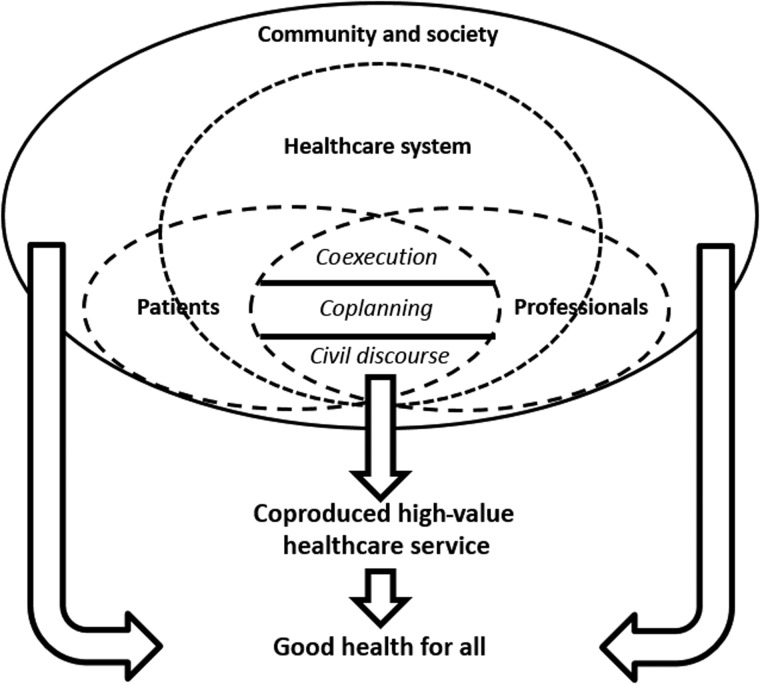
Efforts to ensure effective participation of patients in healthcare are called by many names—patient centredness, patient engagement, patient experience. Improvement initiatives in this domain often resemble the efforts of manufacturers to engage consumers in designing and marketing products. Services, however, are fundamentally different than products; unlike goods, services are always ‘coproduced’. Failure to recognise this unique character of a service and its implications may limit our success in partnering with patients to improve health care. We trace a partial history of the coproduction concept, present a model of healthcare service coproduction and explore its application as a design principle in three healthcare service delivery innovations. We use the principle to examine the roles, relationships and aims of this interdependent work. We explore the principle's implications and challenges for health professional development, for service delivery system design and for understanding and measuring benefit in healthcare services.
Overview
The claims and statistics of this paper haven’t been checked yet.
Run the check — free, no account needed. It reads the open-access text and checks the sources it cites.
Integrity signals
Registry
Cites
Statistics
Figures
Verification
Claims the paper makes
The claims and statistics of this paper haven’t been checked yet.
Run the check — free, no account needed. It reads the open-access text and checks the sources it cites.
Claims other papers make about this one
Each is checked against this paper’s own text: does it say what the citing paper says it does?
The source backs part of the claim, not all of it — or backs it for a different population, condition or comparison.
In the citing paper
“When developing interventions, involving diverse stakeholders (e.g., patients, healthcare staff and their managers, researchers, and policy makers) has been recommended to enhance accuracy, fit, and sense of ownership within the specific setting [15, 16].”
From Developing a primary care-based cognitive behavioral intervention for anxiety in children through a participatory approach: a qualitative study. (2026) · cites this paper as [15]
Experimental — accuracy not yet measured
Self-check
Percentages, sums and reported differences re-computed from the paper’s own numbers.
The self-check needs the paper’s full text.
Citations
Cites
Crossing the Quality Chasm: A New Health System for the 21st Century
Baker, A. (2001) · BMJ · doi:10.1136/bmj.323.7322.1192 · Cited by 10,779
Crossing the Quality Chasm: A New Health System for the 21st Century
Bloom, B. S. (2002) · JAMA · doi:10.1001/jama.287.5.646-a · Cited by 3,733
Improving chronic illness care: translating evidence into action
Wagner, E. H., Austin, B. T., Davis, C., Hindmarsh, M., Schaefer, J., & Bonomi, A. (2001) · Health Affairs · doi:10.1377/hlthaff.20.6.64 · Cited by 3,446
Shared decision making — The pinnacle of patient-centered care
Barry, M. J., & Edgman-Levitan, S. (2012) · New England Journal of Medicine · doi:10.1056/nejmp1109283 · Cited by 3,433 · cited 1×
“’ 55 It is difficult for the NHS to calculate the long-term return on investment in evaluating these paradigm-shifting trainings.”
BackgroundCrossing the great divide: Coproduction, synergy, and development
Elinor Ostrom, B. (1996) · World Development · doi:10.1016/0305-750x(96)00023-x · Cited by 2,838
Hibbard, J. H., Stockard, J., Mahoney, E. R., & Tusler, M. (2004) · Health Services Research · doi:10.1111/j.1475-6773.2004.00269.x · Cited by 2,748
Lorig, K. R., Sobel, D. S., Stewart, A. L., Brown, B. W., Bandura, A., Ritter, P., Gonzalez, V. M., Laurent, D. D., & Holman, H. R. (1999) · Medical Care · doi:10.1097/00005650-199901000-00003 · Cited by 2,261
Chronic disease management: what will it take to improve care for chronic illness?
Eh, W. (1998) · PubMed · Cited by 2,095
Beyond Engagement and Participation: User and Community Coproduction of Public Services
Bovaird, T. (2007) · Public Administration Review · doi:10.1111/j.1540-6210.2007.00773.x · Cited by 2,061
Leavitt, M. (2001) · PubMed · Cited by 1,835
Research works printed but not linked: 2
- Sandström P . A toolbox for co-production of knowledge and improved land use dialogues: the perspective of reindeer husbandry [PhD Thesis]. Umeå, Sweden: Department of Forest Resource Management, Swedish University of Agricultural Sciences, 2015:20.
- Flood S . Enhancing adaptive capacity through co-production of knowledge in New Zealand. Proceedings of the Resilient Cities 2014 congress; 5th Global Forum on Urban Resilience and Adaptation; Bonn, Germany, 29–31 May, 2014.
Cited by
Sorted by citations
The Lancet Global Health Commission on Global Eye Health: vision beyond 2020
Burton, M. J., Ramke, J., Marques, A. P., Bourne, R. R. A., Congdon, N., Jones, I., Ah Tong, B. A. M., Arunga, S., Bachani, D., Bascaran, C., et al. (2021) · The Lancet Global Health · doi:10.1016/s2214-109x(20)30488-5 · Cited by 1,624
A three-talk model for shared decision making: multistage consultation process
Elwyn, G. J., Durand, M., Song, J. H., Aarts, J. W. M., Barr, P. J., Berger, Z. D., Cochran, N., Frosch, D. L., Galasiński, D., Gulbrandsen, P., et al. (2017) · BMJ · doi:10.1136/bmj.j4891 · Cited by 1,031
From tokenism to empowerment: progressing patient and public involvement in healthcare improvement
Ocloo, J. E., & Matthews, R. (2016) · BMJ Quality & Safety · doi:10.1136/bmjqs-2015-004839 · Cited by 1,015
“67 68 There is no one ‘ correct ’ way of doing co-production, but there are six principles that help to underpin practice: A. assets: recognising people as assets; B. capabilities: building on people ’ s existing strengths; C. mutuality: reciprocal relations with mutual responsibilities and…”
BackgroundDiffusion Of Innovations Theory, Principles, And Practice
Dearing, J. W., & Cox, J. G. (2018) · Health Affairs · doi:10.1377/hlthaff.2017.1104 · Cited by 757
Brandsen, T., Steen, T. P. S., & Verschuere, B. (2018) · Routledge eBooks · doi:10.4324/9781315204956 · Cited by 577
Metadata
- Authors
- Batalden, M., Batalden, P., Margolis, P., Seid, M., Armstrong, G., Opipari-Arrigan, L., & Hartung, H.
- Affiliations
- Cambridge Health Alliance (US)
- Dartmouth Institute for Health Policy and Clinical Practice (US)
- Cincinnati Children's Hospital Medical Center (US)
- College of Nursing, University of Colorado, Aurora, Colorado, USA
- Department of Pediatrics, Cincinnati Children's Hospital Medical Center, Cincinnati, Ohio, USA
- University Hospital Crosshouse (GB)
- Corresponding author
- Batalden, Maren
- Venue
- BMJ Quality & Safety
- Publisher
- BMJ
- Published
- 2015-09-16
- Volume
- 25
- Issue
- 7
- Pages
- 509-517
- ISSN
- 1475-3898 (ISSN-L)
- 2044-5415
- 2044-5423
- PMC
- PMC4941163
- OpenAlex
- W2277370197
- Cited by
- 1,078
- References
- 65
- Citations by year
- 2026: 68 · 2025: 84 · 2024: 149 · 2023: 92 · 2022: 130 · 2021: 139 · 2020: 120 · 2019: 91 · 2018: 94 · 2017: 72 · 2016: 38
- FWCI
- 168.93
- Type
- journal article
- Language
- en
- Open access
- hybrid
- doi.org
- Licence
- cc-by-nc
- Locations
- BMJ Quality & Safety (publishedVersion, cc-by-nc)
- PubMed Central (publishedVersion, cc-by-nc)
- PubMed (publishedVersion)
- Diva portal (Dalarna University Library) (submittedVersion, other-oa)
- HighWire Press Open Archive (submittedVersion)
- Funders
- National Institute of Diabetes and Digestive and Kidney Diseases (R01DK085719)
- Topics
- Social Sciences › Business, Management and Accounting › Marketing › Service and Product Innovation
- Health Sciences › Health Professions › General Health Professions › Mental Health and Patient Involvement
- Health Sciences › Health Professions › General Health Professions › Patient Satisfaction in Healthcare
- Keywords
- patient engagement, patient-centered care, service design, service delivery innovation
- MeSH terms
- Delivery of Health Care, Humans, Patient Participation, Quality Assurance, Health Care, Models, Organizational, Quality Improvement
About these checks
Registry, retraction, Cites and statistics results are computed, not judged, with one exception: a printed reference that no index lists is read once by a model before it counts as a citation error. Claims are extracted by a model and kept only when their quote appears verbatim in the text; each cited source is then checked, with a model’s help, for whether it says what the claim relies on. Those verdicts can be wrong — read the claim’s quote and the cited source before relying on one.
Statistics and arithmetic are recomputed, not judged.
Confidence bands are shown only for fields calibrated on our annotated test set. None is calibrated yet, so no band is shown.
What counts as a claim ›How we measure confidence ›How we check this ›
Are you an author, or do you see a problem with this page? Request a review
