

Artificial intelligence, bias and clinical safety
Open accessThe DOI matches its Crossref record; 53 of the 54 references it cites were found in a registry or an index.
Abstract
This is the final version. Available on open access from BMJ Publishing group via the DOI in this record
Overview
The claims and statistics of this paper haven’t been checked yet.
Free: it reads the open-access text and checks the first 5 claims that cite a source we can check. Create a free account to check every claim.
Integrity signals
Registry
Cites
Statistics
Figures
Verification
Claims the paper makes
The claims and statistics of this paper haven’t been checked yet.
Free: it reads the open-access text and checks the first 5 claims that cite a source we can check. Create a free account to check every claim.
Claims other papers make about this one
Each is checked against this paper’s own text: does it say what the citing paper says it does?
The source backs part of the claim, not all of it — or backs it for a different population, condition or comparison.
In the citing paper
“Most of the health literature on AI is biased towards its potential benefits, and discussions about its potential harms tend to be focused on the misapplication of AI in clinical settings.”
From Threats by artificial intelligence to human health and human existence (2023) · cites this paper as [11]
Experimental — accuracy not yet measuredThe source backs part of the claim, not all of it — or backs it for a different population, condition or comparison.
In the citing paper
“AI applications have vulnerabilities that could be hacked or maliciously tampered with and produce unsafe outcomes”
From Ethics and governance of trustworthy medical artificial intelligence (2023) · cites this paper as [56]
Experimental — accuracy not yet measuredThe source backs part of the claim, not all of it — or backs it for a different population, condition or comparison.
In the citing paper
“are likely only be exacerbated in more complex domains, such as healthcare diagnostics, where there may be a virtually unlimited number of individual, group, and social factors that can be relevant, from lifestyle and eating habits, to weather and chemical exposure, and particularities regarding where one lives [24,59,119].”
From Out of Context: Investigating the Bias and Fairness Concerns of “Artificial Intelligence as a Service” (2023) · cites this paper as [24]
Experimental — accuracy not yet measuredThe cited source says what the claim attributes to it.
In the citing paper
“Poor-quality data can result in AI models that incorrectly predict outcomes based on artifacts in the data rather than actual clinical results [21].”
From Proposing a Principle-Based Approach for Teaching AI Ethics in Medical Education (2024) · cites this paper as [21]
The cited source says what the claim attributes to it.
In the citing paper
“Issues such as amplification of biases present in the training data, failure to generalize effectively beyond specific populations, or errors in classification can affect reliability [ 2 - 7 ].”
3 more claims about this paper
Create a free account to see every claim other papers make about this one.
Self-check
Percentages, sums and reported differences re-computed from the paper’s own numbers.
The self-check needs the paper’s full text.
Citations
Cites
Mastering the game of Go with deep neural networks and tree search
Silver, D., Huang, A., Maddison, C. J., Guez, A., Sifre, L., van den Driessche, G., Schrittwieser, J., Antonoglou, I., Panneershelvam, V., Lanctot, M., et al. (2016) · Nature · doi:10.1038/nature16961 · Cited by 15,612
Dermatologist-level classification of skin cancer with deep neural networks
Esteva, A., Kuprel, B., Novoa, R. A., Ko, J., Swetter, S. M., Blau, H. M., & Thrun, S. (2017) · Nature · doi:10.1038/nature21056 · Cited by 14,362
Gulshan, V., Peng, L., Coram, M., Stumpe, M. C., Wu, D., Narayanaswamy, A., Venugopalan, S., Widner, K., Madams, T., Cuadros, J., et al. (2016) · JAMA · doi:10.1001/jama.2016.17216 · Cited by 7,697
AUC: A misleading measure of the performance of predictive distribution models
Lobo, J. M., Jiménez‐Valverde, A., & Real, R. (2008) · Global Ecology and Biogeography · doi:10.1111/j.1466-8238.2007.00358.x · Cited by 3,499
Clinically applicable deep learning for diagnosis and referral in retinal disease
De Fauw, J., Ledsam, J. R., Romera-Paredes, B., Nikolov, S., Tomasev, N., Blackwell, S., Askham, H., Glorot, X., O’Donoghue, B., Visentin, D., et al. (2018) · Nature Medicine · doi:10.1038/s41591-018-0107-6 · Cited by 2,639
Learning from class-imbalanced data: Review of methods and applications
Haixiang, G., Yijing, L., Shang, J., Mingyun, G., Yuanyue, H., & Bing, G. (2017) · Expert Systems with Applications · doi:10.1016/j.eswa.2016.12.035 · Cited by 2,377 · cited 1×
“ML systems perform best when index cases and controls are approximately equal in the training set, 37 and this is not common in medicine.”
Role of Computerized Physician Order Entry Systems in Facilitating Medication Errors
Koppel, R. (2005) · JAMA · doi:10.1001/jama.293.10.1197 · Cited by 2,126
Implementing Machine Learning in Health Care — Addressing Ethical Challenges
Char, D. S., Shah, N. H., & Magnus, D. (2018) · New England Journal of Medicine · doi:10.1056/nejmp1714229 · Cited by 1,857 · cited 1×
“11 This analysis is written with the dual aim of helping clinical safety professionals to critically appraise current medical AI research from a quality and safety perspective, and supporting research and development in AI by highlighting some of the clinical safety questions that must be…”
Complacency and Bias in Human Use of Automation: An Attentional Integration
Parasuraman, R., & Manzey, D. H. (2010) · Human Factors: The Journal of the Human Factors and Ergonomics Society · doi:10.1177/0018720810376055 · Cited by 1,710 · cited 2×
“25 Automation bias 48 describes the phenomenon whereby clinicians accept the guidance of an automated system and cease searching for confirmatory evidence (eg, see Tsai et al 49 ), perhaps transferring responsibility for decision-making onto the machine—an effect reportedly strongest when a machine…”
Intelligible Models for HealthCare: Predicting Pneumonia Risk and Hospital 30-day Readmission
Caruana, R., Lou, Y., Gehrke, J., Koch, P., Sturm, M., & Elhadad, N. (2015) · Proceedings of the 21th ACM SIGKDD International Conference on Knowledge Discovery and Data Mining · doi:10.1145/2783258.2788613 · Cited by 1,685 · cited 1×
“44 45 Unsafe failure mode The concept of confidence of prediction was mentioned in the context of distributional shift above.”
Dataset Shift in Machine Learning
(2008) · doi:10.7551/mitpress/9780262170055.001.0001 · Cited by 1,553
Predicting cardiovascular risk in England and Wales: prospective derivation and validation of QRISK2
Hippisley-Cox, J., Coupland, C., Vinogradova, Y., Robson, J., Minhas, R., Sheikh, A., & Brindle, P. (2008) · BMJ · doi:10.1136/bmj.39609.449676.25 · Cited by 1,459 · cited 1×
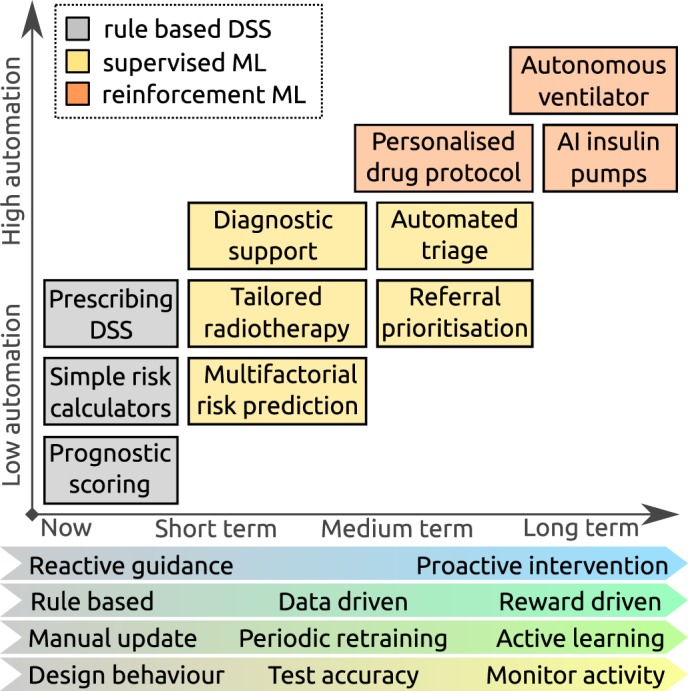
“Clinical decision support systems (DSS) are in widespread use in medicine and have had most impact providing guidance on the safe prescription of medicines, 12 guideline adherence, simple risk screening 13 or prognostic scoring.”
Concrete Problems in AI Safety
Amodei, D., Olah, C., Steinhardt, J., Christiano, P., Schulman, J., & Mané, D. (2016) · arXiv · doi:10.48550/arxiv.1606.06565 · Cited by 1,314 · cited 9×
“32 ► Unsafe exploration: As part of its continuous learning, the system may experiment with the dosing of heparin to try and improve its current behaviour.”
InfluentialCheXNet: Radiologist-Level Pneumonia Detection on Chest X-Rays with Deep Learning
Rajpurkar, P., Irvin, J., Zhu, K., Yang, B., Mehta, H., Duan, T., Ding, D. Y., Bagul, A., Langlotz, C. P., Shpanskaya, K. S., et al. (2017) · arXiv (Cornell University) · doi:10.48550/arxiv.1711.05225 · Cited by 1,219 · cited 2×
“9 Inappropriate application of an ML system to a different context can be quite subtle.”
Han, Y. Y., Carcillo, J. A., Venkataraman, S. T., Clark, R. S. B., Watson, R. S., Nguyen, T. C., Bayir, H., & Orr, R. A. (2005) · Pediatrics · doi:10.1542/peds.2005-1287 · Cited by 1,149
Towards Complete and Accurate Reporting of Studies of Diagnostic Accuracy: The STARD Initiative
Bossuyt, P. M., Reitsma, J. B., Bruns, D. E., Gatsonis, C. A., Glasziou, P. P., Irwig, L. M., Lijmer, J. G., Moher, D., Rennie, D., de Vet, H. C. W., et al. (2003) · Clinical Chemistry · doi:10.1373/49.1.1 · Cited by 862
Predicting Risk of Suicide Attempts Over Time Through Machine Learning
Walsh, C. G., Ribeiro, J. D., & Franklin, J. C. (2017) · Clinical Psychological Science · doi:10.1177/2167702617691560 · Cited by 567
Desautels, T., Calvert, J., Hoffman, J., Jay, M., Kerem, Y., Shieh, L., Shimabukuro, D., Chettipally, U., Feldman, M. D., Barton, C., et al. (2016) · JMIR Medical Informatics · doi:10.2196/medinform.5909 · Cited by 509 · cited 1×
“20 21 Outside of diagnostic support ML systems are being developed to provide other kinds of decision support, such as providing risk predictions (eg, for sepsis 20 ) based on a multitude of complex factors, or tailoring specific types of therapy to individuals.”
Miller, R. A. (1994) · Journal of the American Medical Informatics Association · doi:10.1136/jamia.1994.95236141 · Cited by 458 · cited 1×
“15 16 Rules-based systems have also been developed to address diagnostic uncertainty 17–19 but have struggled to deal with the breadth and variety of information involved in the typical diagnostic process, a problem for which ML systems are potentially better suited.”
Shimabukuro, D. W., Barton, C. W., Feldman, M. D., Mataraso, S. J., & Das, R. (2017) · BMJ Open Respiratory Research · doi:10.1136/bmjresp-2017-000234 · Cited by 382 · cited 1×
“42 53 As with all clinical safety discussions we need to maintain a realistic perspective.”
Apples-to-apples in cross-validation studies: pitfalls in classifier performance measurement
Forman, G., & Scholz, M. (2010) · ACM SIGKDD Explorations Newsletter · doi:10.1145/1882471.1882479 · Cited by 368
Mao, Q., Jay, M., Hoffman, J. L., Calvert, J., Barton, C., Shimabukuro, D., Shieh, L., Chettipally, U., Fletcher, G., Kerem, Y., et al. (2018) · BMJ Open · doi:10.1136/bmjopen-2017-017833 · Cited by 336
Calibration drift in regression and machine learning models for acute kidney injury
Davis, S. E., Lasko, T. A., Chen, G., Siew, E. D., & Matheny, M. E. (2017) · Journal of the American Medical Informatics Association · doi:10.1093/jamia/ocx030 · Cited by 312 · cited 1×
“The effect of this on ML models of acute kidney injury was studied by Davis et al, 40 who found that over time decreasing AKI incidence was associated with increasing false positives from their ML system, an example of prediction drift.”
Auditing black-box models for indirect influence
Adler, P., Falk, C., Friedler, S. A., Nix, T., Rybeck, G., Scheidegger, C., Smith, B., & Venkatasubramanian, S. (2018) · Knowledge and Information Systems · doi:10.1007/s10115-017-1116-3 · Cited by 280 · cited 1×
“44 45 Unsafe failure mode The concept of confidence of prediction was mentioned in the context of distributional shift above.”
Auditing Black-Box Models for Indirect Influence
Adler, P., Falk, C., Friedler, S. A., Rybeck, G., Scheidegger, C., Smith, B., & Venkatasubramanian, S. (2016) · 2016 IEEE 16th International Conference on Data Mining (ICDM) · doi:10.1109/icdm.2016.0011 · Cited by 280
Artificial intelligence in radiation oncology: A specialty-wide disruptive transformation?
Thompson, R. F., Valdes, G., Fuller, C. D., Carpenter, C. M., Morin, O., Aneja, S., Lindsay, W. D., Aerts, H. J. W. L., Agrimson, B., Deville, C., et al. (2018) · Radiotherapy and Oncology · doi:10.1016/j.radonc.2018.05.030 · Cited by 258 · cited 1×
“22 Other earlier stage research in this area uses algorithms that learn strategies to maximise a ‘reward’ (reinforcement learning).”
A computational approach to early sepsis detection
Calvert, J. S., Price, D. A., Chettipally, U. K., Barton, C. W., Feldman, M. D., Hoffman, J. L., Jay, M., & Das, R. (2016) · Computers in Biology and Medicine · doi:10.1016/j.compbiomed.2016.05.003 · Cited by 244 · cited 2×
“20 21 Outside of diagnostic support ML systems are being developed to provide other kinds of decision support, such as providing risk predictions (eg, for sepsis 20 ) based on a multitude of complex factors, or tailoring specific types of therapy to individuals.”
Bossuyt, P. M., Reitsma, J. B., Bruns, D. E., Gatsonis, C. A., Glasziou, P., Irwig, L., Lijmer, J. G., Moher, D., Rennie, D., & de Vet, H. C. W. (2003) · PubMed · Cited by 242
Leike, J., Martic, M., Krakovna, V., Ortega, P. A., Everitt, T., Lefrancq, A., Orseau, L., & Legg, S. (2017) · arXiv · doi:10.48550/arxiv.1711.09883 · Cited by 240 · cited 1×
“At present these issues are merely theoretical in medicine, but they have been observed in ML test environments 51 and are increasingly becoming relevant in applications such as autonomous driving systems.”
Framing the challenges of artificial intelligence in medicine
Yu, K.-H., & Kohane, I. S. (2019) · BMJ Quality & Safety · doi:10.1136/bmjqs-2018-008551 · Cited by 233
Machine Learning: The High Interest Credit Card of Technical Debt
Sculley, D., Holt, G. D., Golovin, D., Davydov, E. V., Phillips, T., Ebner, D., Chaudhary, V., & Young, M. (2014) · Cited by 218
Systematic errors in medical decision making: Judgment limitations
Dawson, N. V., & Arkes, H. R. (1987) · Journal of General Internal Medicine · doi:10.1007/bf02596149 · Cited by 214 · cited 1×
“47 Particularly relevant is ‘confirmation bias’ in which clinicians give excessive significance to evidence which supports their presumed diagnosis and ignore evidence which refutes it.”
Severity scoring systems in the critically ill
Bouch, D. C., & Thompson, J. P. (2008) · Continuing Education in Anaesthesia Critical Care & Pain · doi:10.1093/bjaceaccp/mkn033 · Cited by 205 · cited 1×
“14 These systems use predefined rules, which have predictable behaviour and are usually shown to reduce clinical error, 12 although sometimes inadvertently introduce safety issues themselves.”
Optimal medication dosing from suboptimal clinical examples: a deep reinforcement learning approach
Nemati, S., Ghassemi, M. M., & Clifford, G. D. (2016) · 2016 38th Annual International Conference of the IEEE Engineering in Medicine and Biology Society (EMBC) · doi:10.1109/embc.2016.7591355 · Cited by 195
An integrated e‐recruitment system for automated personality mining and applicant ranking
Faliagka, E., Tsakalidis, A., & Tzimas, G. (2012) · Internet Research · doi:10.1108/10662241211271545 · Cited by 176
Sizing the prize: what’s the real value of AI for your business and how can you capitalise?
Rao, A. S., & Verweij, G. (2017) · Cited by 170
When Training and Test Sets Are Different: Characterizing Learning Transfer
Storkey, A. (2008) · The MIT Press eBooks · doi:10.7551/mitpress/7921.003.0004 · Cited by 170
Computer Decision Support as a Source of Interpretation Error: The Case of Electrocardiograms
Tsai, T. L., Fridsma, D. B., & Gatti, G. (2003) · Journal of the American Medical Informatics Association · doi:10.1197/jamia.m1279 · Cited by 161 · cited 2×
“25 Automation bias 48 describes the phenomenon whereby clinicians accept the guidance of an automated system and cease searching for confirmatory evidence (eg, see Tsai et al 49 ), perhaps transferring responsibility for decision-making onto the machine—an effect reportedly strongest when a machine advises that a case…”
Nuti, G., Mirghaemi, M., Treleaven, P. C., & Yingsaeree, C. (2011) · Computer · doi:10.1109/mc.2011.31 · Cited by 151
McCoy, A., & Das, R. (2017) · BMJ Open Quality · doi:10.1136/bmjoq-2017-000158 · Cited by 148 · cited 1×
“…is notable however that the sepsis detection system mentioned above 20 has been successfully tested in the different context of a community hospital 5 despite being trained in intensive care, a potential distributional shift, and thus shows some capability of adaptation through ‘transfer learning’.”
When Training and Test Sets are Different: Characterising Learning Transfer
Storkey, A. (2013) · Cited by 140
Differential Diagnosis Generators: an Evaluation of Currently Available Computer Programs
Bond, W. F., Schwartz, L. M., Weaver, K. R., Levick, D., Giuliano, M., & Graber, M. L. (2012) · Journal of General Internal Medicine · doi:10.1007/s11606-011-1804-8 · Cited by 132 · cited 1×
“15 16 Rules-based systems have also been developed to address diagnostic uncertainty 17–19 but have struggled to deal with the breadth and variety of information involved in the typical diagnostic process, a problem for which ML systems are potentially better suited.”
The use of reinforcement learning algorithms to meet the challenges of an artificial pancreas
Bothe, M. K., Dickens, L., Reichel, K., Tellmann, A., Ellger, B., Westphal, M., & Faisal, A. A. (2013) · Expert Review of Medical Devices · doi:10.1586/17434440.2013.827515 · Cited by 124 · cited 2×
“…in medicine, but one can imagine a future where ‘closed loop’ applications, such as subcutaneous insulin pumps driven by information from wearable sensors, 33 or automated ventilator control driven by physiological monitoring data in intensive care, 34 are directly controlled by AI algorithms.”
Engineering safety in machine learning
Varshney, K. R. (2016) · 2016 Information Theory and Applications Workshop (ITA) · doi:10.1109/ita.2016.7888195 · Cited by 118 · cited 3×
“If the system’s confidence is low, best practice design would be to fail-safe 46 and refuse to make a prediction either way.”
InfluentialPolyp Detection via Imbalanced Learning and Discriminative Feature Learning
Bae, S.-H., & Yoon, K.-J. (2015) · IEEE Transactions on Medical Imaging · doi:10.1109/tmi.2015.2434398 · Cited by 106
Digital healthcare: regulating the revolution
Duggal, R., Brindle, I., & Bagenal, J. (2018) · BMJ · doi:10.1136/bmj.k6 · Cited by 93
Safe Exploration of State and Action Spaces in Reinforcement Learning
Garcia, J., & Fernandez, F. (2012) · Journal of Artificial Intelligence Research · doi:10.1613/jair.3761 · Cited by 85 · cited 1×
“How do we set limits to prevent dangerous overdosing, and define what changes in strategy are safe for the system to ‘explore’ 50 ?”
Safe Exploration of State and Action Spaces in Reinforcement Learning
García, J., & Fernández, F. (2013) · Cited by 81
Representation and Reinforcement Learning for Personalized Glycemic Control in Septic PatientsPreprint
Weng, W., Gao, M., He, Z. G., Yan, S., & Szolovits, P. (2017) · arXiv (Cornell University) · doi:10.48550/arxiv.1712.00654 · Cited by 69
Nurek, M., Kostopoulou, O., Delaney, B. C., & Esmail, A. (2015) · European Journal of General Practice · doi:10.3109/13814788.2015.1043123 · Cited by 60
What artificial experts can and cannot do
Dreyfus, H. L., & Dreyfus, S. E. (1992) · AI & Society · doi:10.1007/bf02472766 · Cited by 60
A Reinforcement Learning Approach to Weaning of Mechanical Ventilation in Intensive Care Units
Prasad, N., Cheng, L., Chivers, C., Draugelis, M. E., & Engelhardt, B. E. (2017) · arXiv (Cornell University) · doi:10.48550/arxiv.1704.06300 · Cited by 39 · cited 2×
“…in medicine, but one can imagine a future where ‘closed loop’ applications, such as subcutaneous insulin pumps driven by information from wearable sensors, 33 or automated ventilator control driven by physiological monitoring data in intensive care, 34 are directly controlled by AI algorithms.”
Kaushal, R., Shojania, K. G., & Bates, D. W. (2003) · Archives of Internal Medicine · doi:10.1001/archinte.163.12.1409 · Cited by 30
Cited by
On the Opportunities and Risks of Foundation Models
Bommasani, R., Hudson, D. A., Adeli, E., Altman, R., Arora, S., von Arx, S., Bernstein, M. S., Bohg, J., Bosselut, A., Brunskill, E., et al. (2021) · arXiv · doi:10.48550/arxiv.2108.07258 · Cited by 2,676
The ethics of AI in health care: A mapping review
Morley, J., Machado, C. C. V., Burr, C., Cowls, J., Joshi, I., Taddeo, M., & Floridi, L. (2020) · Social Science & Medicine · doi:10.1016/j.socscimed.2020.113172 · Cited by 1,105
“…not, or vice versa), or, an HCP relying on clinical decision support software (CDSS) (Ruckenstein and Schüll, 2017) could be given an inaccurate diagnosis or recommendation which they do not question due to a tendency to uncritically accept the decisions of automated systems (Challen et al., 2019).”
BackgroundAhmed, Z., Mohamed, K., Zeeshan, S., & Dong, X. (2020) · Database · doi:10.1093/database/baaa010 · Cited by 1,035
“ML is becoming the transformational force in healthcare (89) for guiding individual and population health with several computational benefits, which includes realtime patient monitoring; disease patterns analysis (90); disease diagnosis and prescription of medicines; patientcentric care provision with enhanced treatme…”
BackgroundA governance model for the application of AI in health care
Reddy, S., Allan, S., Coghlan, S., & Cooper, P. (2020) · Journal of the American Medical Informatics Association · doi:10.1093/jamia/ocz192 · Cited by 979
“1,19 Also, recent episodes of hospitals sharing patient data with AI developers without the patients’ informed consent has added to the problem of trusting AI developers and AI itself.”
BackgroundLekadir, K., Frangi, A. F., Porras, A. R., Glocker, B., Cintas, C., Langlotz, C. P., Weicken, E., Asselbergs, F. W., Prior, F., Collins, G. S., et al. (2025) · BMJ · doi:10.1136/bmj-2024-081554 · Cited by 957
“For example, the FAIR guideline 10 for data management has been widely adopted by researchers, organisations, and authorities, as the principles provide a structured framework for standardising and enhancing the tasks of data collection, curation, organisation, and storage.”
Metadata
- Authors
- Challen, R., Denny, J., Pitt, M., Gompels, L., Edwards, T., & Tsaneva-Atanasova, K.
- Affiliations
- University of Exeter (GB)
- Vanderbilt University Medical Center (US)
- Taunton & Somerset NHS Foundation Trust (GB)
- Corresponding author
- Challen, Robert
- Venue
- BMJ Quality & Safety
- Publisher
- BMJ
- Published
- 2019-01-12
- Volume
- 28
- Issue
- 3
- Pages
- 231-237
- ISSN
- 1475-3898 (ISSN-L)
- 2044-5415
- 2044-5423
- PMC
- PMC6560460
- OpenAlex
- W2910707576
- Cited by
- 956
- References
- 52
- Citations by year
- 2026: 150 · 2025: 171 · 2024: 146 · 2023: 136 · 2022: 122 · 2021: 108 · 2020: 92 · 2019: 30
- FWCI
- 27.99
- Type
- journal article
- Language
- en
- Open access
- hybrid
- doi.org
- Licence
- cc-by
- Locations
- BMJ Quality & Safety (publishedVersion, cc-by)
- Europe PMC (PubMed Central) (publishedVersion, cc-by)
- PubMed Central (publishedVersion, cc-by)
- PubMed (publishedVersion)
- Figshare (submittedVersion, cc-by)
- HighWire Press Open Archive (submittedVersion)
- Open Research Exeter (University of Exeter) (submittedVersion, cc-by)
- Funders
- Engineering and Physical Sciences Research Council (EP/N014391/1)
- Topics
- Health Sciences › Medicine › Health Informatics › Artificial Intelligence in Healthcare and Education
- Physical Sciences › Computer Science › Artificial Intelligence › Ethics and Social Impacts of AI
- Physical Sciences › Engineering › Safety, Risk, Reliability and Quality › Safety Systems Engineering in Autonomy
- Keywords
- artificial intelligence, algorithmic bias, clinical safety, health care AI, algorithmic fairness
- MeSH terms
- Algorithms, Artificial Intelligence, Humans, Quality of Health Care, Bias, Patient Safety
About these checks
Registry, retraction, Cites and statistics results are computed, not judged, with one exception: a printed reference that no index lists is read once by a model before it counts as a citation error. Claims are extracted by a model and kept only when their quote appears verbatim in the text; each cited source is then checked, with a model’s help, for whether it says what the claim relies on. Those verdicts can be wrong — read the claim’s quote and the cited source before relying on one.
Statistics and arithmetic are recomputed, not judged.
Confidence bands are shown only for fields calibrated on our annotated test set. None is calibrated yet, so no band is shown.
What counts as a claim ›How we measure confidence ›How we check this ›
Are you an author, or do you see a problem with this page? Request a review
Data sources
Bibliographic data: Semantic Scholar, OpenAlex, Crossref.
Contains information from the Semantic Scholar Academic Graph Datasets, made available under the ODC Attribution License (ODC-BY 1.0).
Semantic Scholar’s data is described in: Kinney, R., et al. (2023). The Semantic Scholar Open Data Platform. arXiv:2301.10140.
