

The gut microbiota and host health: a new clinical frontier
Open accessThe DOI matches its Crossref record; 116 of the 118 references it cites were found in a registry or an index; 11 of the 84 sources its claims cite were checked for support.
Abstract
Over the last 10–15 years, our understanding of the composition and functions of the human gut microbiota has increased exponentially. To a large extent, this has been due to new ‘omic’ technologies that have facilitated large-scale analysis of the genetic and metabolic profile of this microbial community, revealing it to be comparable in influence to a new organ in the body and offering the possibility of a new route for therapeutic intervention. Moreover, it might be more accurate to think of it like an immune system: a collection of cells that work in unison with the host and that can promote health but sometimes initiate disease. This review gives an update on the current knowledge in the area of gut disorders, in particular metabolic syndrome and obesity-related disease, liver disease, IBD and colorectal cancer. The potential of manipulating the gut microbiota in these disorders is assessed, with an examination of the latest and most relevant evidence relating to antibiotics, probiotics, prebiotics, polyphenols and faecal microbiota transplantation.
Overview
CoChat Summary
TL;DR
This narrative review updates the role of the gut microbiota in metabolic/obesity-related disease, liver disease, IBD, and colorectal cancer, and assesses microbiota-modulating therapies including antibiotics, probiotics, prebiotics, polyphenols, and faecal microbiota transplantation. It argues the microbiota is a modifiable, host-specific system with therapeutic and diagnostic potential, while noting that human evidence remains limited by confounding, sampling bias, and equivocal trial results.
Key findings
- The gut microbiota is described as containing “100 times more genes than the host,” with about 160 species in the large intestine of any individual; function appears more conserved across people than species identity, and 10% of daily energy requirements come from colonic fermentation.
- In obesity/metabolic disease, metagenomic studies identified high versus low microbial gene richness (HGC/LGC); LGC was linked to proinflammatory *Bacteroides* spp and oxidative-stress genes, while HGC had more *F. prausnitzii* and butyrate-production potential. FMT from lean donors to metabolic syndrome patients significantly increased insulin sensitivity, faecal butyrate, microbial diversity, and *Roseburia intestinalis*-related bacteria.
- In IBD, the most consistent change is reduced Firmicutes; the IBD metagenome contains “25% fewer genes” than healthy gut. A meta-analysis of FMT in IBD found overall clinical remission in 45% (54/119), and 36% when only cohort studies were analysed.
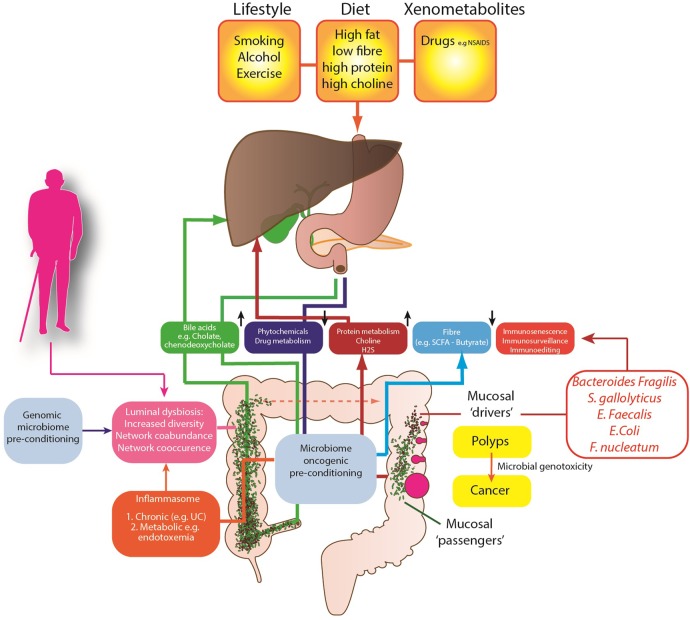
- In CRC, pathobionts including *Streptococcus gallolyticus*, *Enterococcus faecalis*, *Bacteroides fragilis*, *E. coli*, and *Fusobacterium nucleatum* have been linked with adenomas/CRC; butyrate-producers are reduced, and H₂S is implicated in CRC development.
Methods
- Narrative review of current knowledge and evidence, not a primary study; it synthesizes large-scale microbiome projects, metagenomic/metatranscriptomic studies, animal models, human observational studies, RCTs, and meta-analyses.
- The review covers GI and liver diseases—metabolic syndrome/obesity-related disease, NAFLD/alcoholic/autoimmune liver disease, IBD, and CRC—and evaluates microbiota modulation via antibiotics, probiotics, prebiotics, polyphenols, and FMT.
- No systematic search strategy, inclusion criteria, or formal quality assessment is reported.
Limitations
- The paper states that most data derive from faecal samples, which do not represent the complete gut picture; the small intestine differs markedly from the colon, and most studies come from North America and Europe, giving a biased view.
- It states that human probiotic and prebiotic data are equivocal, with poor study design/strain choice and few well-powered prebiotic trials; obesity links are confounded by diet, host genetics, hormones, lifestyle, and BMI limitations.
- It states that CRC human studies involve small patient numbers, sampling heterogeneity, limited tumour phenotyping, and limited oncological data. Evident from the text: as a narrative review, it lacks systematic methods and formal evidence grading.
Model-written summary. Check it against the paper before relying on it.
Integrity signals
Registry
Cites
Statistics
Figures
Verification
Claims the paper makes
9 Valid · 14 Not valid · 65 Not checked · 31 Own results and interpretations
The cited sources support only part of this claim — read each source’s verdict below.
In the paper
“there is growing evidence that the high fat intake rather than obesity per se had a direct effect on the microbiota and linked clinical parameters.26”
§ The gut microbiota and host health: a new clinical frontier > Obesity-related diseases and the gut microbiota
What the sources say
- Partly supportedcites [26] Claesson MJ, Jeffery IB, Conde S, et al Gut microbiota composition correlates with diet and health in the elderly. Nature 2012; 488: 178– 84. 10.1038/nature11319 22797518 sourceExperimental — accuracy not yet measured
Our copy supports the general thrust: diet-separated groups (DG1 'low fat/high fibre' through DG4 'high fat/low fibre', Concordance of diet and microbiota, p. 7) co-segregated with microbiota composition, microbiota-health links held after adjustment, and the authors 'infer that the causal relationship is in a diet-microbiota-health direction' (Microbiota-health correlations, p. 10; Discussion, p. 12). It also supports the 'rather than obesity per se' contrast in a limited way: 'There was no correlation between the Bacteroidetes : Firmicutes ratio and BMI' (p. 9). Not supported: the paper never isolates high fat intake as the operative variable (its dietary axis combines fat and fibre, with vegetables, fruit and meat as the most discriminating foods), it does not test adiposity as a comparator beyond that single B:F–BMI result, and it reports correlation with an inferred direction rather than a demonstrated 'direct effect'; the cohort is 178 Irish elderly (>65) across community/long-stay settings, not adults generally. (LLM, conf=0.72)
hedgedstates a cause- Asserted: passes — The authors put it forward as true.
- Checkable: passes — It can be checked against evidence.
- Load-bearing: unclear — It is unclear whether the paper’s conclusions depend on it.
- Based: passes — The paper gives a reason why it holds.
- Partly supported
Every source the paper cites for this claim was checked and supports it.
In the paper
“It is now recognised that the gut microbiota and chronic liver diseases are closely linked.”
§ The gut microbiota and host health: a new clinical frontier > Liver disease and the gut microbiota
What the sources say
- Supportedcites [37] Son G, Kremer M, Hines IN Contribution of gut bacteria to liver pathobiology. Gastroenterol Res Pract 2010; 2010:1–13. 10.1155/2010/453563 PMC2913801 20706692 source
The Concluding Remarks state that gut-derived antigens contribute significantly to various acute and chronic liver diseases and describe a connection between the gut microbiota and liver disease. This supports the broad claim that the two are closely linked, while the paper notes that specific mechanisms remain under investigation. (LLM, conf=0.93)
boostedstates an association- Asserted: passes — The authors put it forward as true.
- Checkable: passes — It can be checked against evidence.
- Load-bearing: passes — The paper’s conclusions depend on it.
- Based: passes — The paper gives a reason why it holds.
- Supported
None of the sources cited for this claim have been checked yet.
In the paper
“Analysis of colon biopsy microbiota revealed that patients with PSC-IBD and IBD showed reduced abundance of Prevotella and Roseburia (a butyrate-producer) compared with controls.48 49”
§ The gut microbiota and host health: a new clinical frontier > Liver disease and the gut microbiota > Autoimmune liver diseases
What the sources say
- Not checked yetcites [48] Quraishi SM, Adams D, Pallen M, et al Probing the microbiota in PSC: the gut adherent microbiota of PSC-IBD is distinct to that of IBD and controls. Hepatol 2014; 60: 267A. 27196590
- Could not verifycites [49] Rossen NG, Fuentes S, Boonstra K, et al The mucosa-associated microbiota of PSC patients is characterized by low diversity and low abundance of uncultured Clostridiales II. J Crohn's Colitis 2015; 9: 342– 8. 10.1093/ecco-jcc/jju023 25547975 sourceExperimental — accuracy not yet measured
Section 3.6 reports lower uncultured Clostridiales II in PSC patients than in UC patients and controls, but does not report the claimed reductions in Prevotella or Roseburia in PSC-IBD and IBD. A search for Roseburia found no mention; Prevotella appears in the Discussion only in a description of another study, not as a result for these patient groups. Page numbers were not available in our copy. (LLM, conf=0.76)
plainstates an association- Asserted: passes — The authors put it forward as true.
- Checkable: passes — It can be checked against evidence.
- Load-bearing: passes — The paper’s conclusions depend on it.
- Based: passes — The paper gives a reason why it holds.
Every source the paper cites for this claim was checked and supports it.
In the paper
“A definitive change of the normal gut microbiota with a breakdown of host-microbial mutualism is probably the defining event in IBD development.59”
§ The gut microbiota and host health: a new clinical frontier > IBD and the gut microbiota
What the sources say
- Supportedcites [59] Hold GL, Smith M, Grange C, et al Role of the gut microbiota in inflammatory bowel disease pathogenesis: what have we learnt in the past 10 years? World J Gastroenterol 2014; 20: 1192– 210. 10.3748/wjg.v20.i5.1192 24574795 PMC3921503 source
The DYSBIOSIS section states the claim almost verbatim, including its qualifier “probably.” (LLM, conf=0.95)
hedgedstates a possible cause- Asserted: passes — The authors put it forward as true.
- Checkable: passes — It can be checked against evidence.
- Load-bearing: passes — The paper’s conclusions depend on it.
- Based: passes — The paper gives a reason why it holds.
- Supported
Every source the paper cites for this claim was checked and supports it.
In the paper
“Specifically, ileal CD has been shown to be associated with alterations in bacterial carbohydrate metabolism and bacterial-host interactions, as well as human host-secreted enzymes.69”
§ The gut microbiota and host health: a new clinical frontier > IBD and the gut microbiota
What the sources say
- Supportedcites [69] Erickson AR, Cantarel BL, Lamendella R, et al Integrated metagenomics/metaproteomics reveals human host-microbiota signatures of Crohn's disease. PLoS ONE 2012; 7: e49138 10.1371/journal.pone.0049138 23209564 PMC3509130 source
The Results report altered metabolic pathways in ileal Crohn’s disease, including reduced glycolysis and butyrate-production pathways, and increased abundance of bacterial outer-membrane proteins relevant to host interactions. They also report higher levels of pancreatic enzymes in stool from affected subjects. The Discussion links these microbiota changes with altered handling of secreted enzymes; page numbers were not provided. (LLM, conf=0.94)
plainstates an association- Asserted: passes — The authors put it forward as true.
- Checkable: passes — It can be checked against evidence.
- Load-bearing: unclear — It is unclear whether the paper’s conclusions depend on it.
- Based: passes — The paper gives a reason why it holds.
- Supported
53 more claims · 1 with their cited sources checked
Create a free account to see all 119 claims and to verify the 73 references still open.
- It may state two separate claims as one. 50
- Probably not a substantial claim. 17
- The quote only partly states this claim. 1
Claims other papers make about this one
Each is checked against this paper’s own text: does it say what the citing paper says it does?
The cited source says what the claim attributes to it.
In the citing paper
“Additionally, dietary fiber and high consumption of plant-based foods appears to inhibit the bacteria from producing harmful metabolites from proteins, emphasizing the importance of eating adequate complex carbohydrates to maintain gut microbiome carbohydrate fermentation [36].”
From Exercise-induced stress behavior, gut-microbiota-brain axis and diet: a systematic review for athletes (2016) · cites this paper as [36]
The cited source says what the claim attributes to it.
In the citing paper
“Chronic liver disorders have also been associated with changes in gut microbiome composition and the disruption of the intestinal barrier3,5–8.”
From Cholestasis induced by bile duct ligation promotes changes in the intestinal microbiome in mice (2019) · cites this paper as [3]
In the citing paper
“Specific bacteria shown to be more abundant in health compared with disease states include Bifidobacterium and Lactobacillus spp.(2,7,14)”
From Dietary fiber intervention on gut microbiota composition in healthy adults: a systematic review and meta-analysis (2018) · cites this paper as [2]
In the citing paper
“In the colon and cecum, complex plant-derived polysaccharides are digested and subsequently fermented by gut microorganisms, such as Lactobacillus, Bifidobacterium, Clostridium, Bacteroides, into SCFAs and gases which are also used as carbon and energy sources by specialized bacteria such as reductive acetogens, sulfate-reducing bacteria and methanogens (reviewed by Marchesi et al [36] and by Flin”
From Exercise-induced stress behavior, gut-microbiota-brain axis and diet: a systematic review for athletes (2016) · cites this paper as [36]
In the citing paper
“P-cresol, phenols, certain amines and hydrogen sulfide have a known role in irritable bowel disease, colon cancer, increased intestinal permeability, inflammation, DNA damage and more [36].”
From Exercise-induced stress behavior, gut-microbiota-brain axis and diet: a systematic review for athletes (2016) · cites this paper as [36]
1 more claim about this paper
Create a free account to see every claim other papers make about this one.
Citations
Cites
Diet rapidly and reproducibly alters the human gut microbiome
David, L. A., Maurice, C. F., Carmody, R. N., Gootenberg, D. B., Button, J. E., Wolfe, B. E., Ling, A. V., Devlin, A. S., Varma, Y., Fischbach, M. A., et al. (2014) · Nature · doi:10.1038/nature12820 · Cited by 10,100
Hill (2014) · doi:10.1038/nrgastro.2014.66 · Cited by 9,592
Human gut microbes associated with obesity
Ley, R. E., Turnbaugh, P. J., Klein, S., & Gordon, J. I. (2006) · Nature · doi:10.1038/4441022a · Cited by 8,785 · cited 2×
“24 Nevertheless, based on most human studies, the obesity-associated decrease in the ratio of Bacteroidetes to Firmicutes (B:F) remains controversial.”
BackgroundDietary Modulation of the Human Colonic Microbiota: Introducing the Concept of Prebiotics
Gibson, G. R., & Roberfroid, M. B. (1995) · The Journal of Nutrition · doi:10.1093/jn/125.6.1401 · Cited by 7,667
Changes of Intestinal Functions in Liver Cirrhosis
Fukui, H., & Wiest, R. (2016) · Inflammatory Intestinal Diseases · doi:10.1159/000444436 · Cited by 6,808
A metagenome-wide association study of gut microbiota in type 2 diabetes
Qin, J., Li, Y., Cai, Z., Li, S., Zhu, J., Zhang, F., Liang, S., Zhang, W., Guan, Y., Shen, D., et al. (2012) · Nature · doi:10.1038/nature11450 · Cited by 6,762
Linking long-term dietary patterns with gut microbial enterotypes
Wu, G. D., Chen, J., Hoffmann, C., Bittinger, K., Chen, Y.-Y., Keilbaugh, S. A., Bewtra, M., Knights, D., Walters, W. A., Knight, R., et al. (2011) · Science · doi:10.1126/science.1208344 · Cited by 6,513
Obesity alters gut microbial ecology
Ley, R. E., Bäckhed, F., Turnbaugh, P., Lozupone, C. A., Knight, R. D., & Gordon, J. I. (2005) · Proceedings of the National Academy of Sciences · doi:10.1073/pnas.0504978102 · Cited by 6,176 · cited 1×
“An increase in relative abundance of Firmicutes and a proportional decrease in Bacteroidetes were associated with the microbiota of obese mice, 23 which was con fi rmed in a human dietary intervention study demonstrating that weight loss of obese individuals (body mass index, BMI>30) was accompanied…”
BackgroundMetabolites produced by commensal bacteria promote peripheral regulatory T-cell generation
Arpaia, N., Campbell, C., Fan, X., Dikiy, S., van der Veeken, J., deRoos, P., Liu, H., Cross, J. R., Pfeffer, K., Coffer, P. J., et al. (2013) · Nature · doi:10.1038/nature12726 · Cited by 4,838 · cited 1×
“14 In the colon, the majority of this carbohydrate fermentation occurs in the proximal colon, at least for people following a Western style diet.”
BackgroundRichness of human gut microbiome correlates with metabolic markers
Le Chatelier, E., Nielsen, T., Qin, J., Prifti, E., Hildebrand, F., Falony, G., Almeida, M., Arumugam, M., Batto, J.-M., Kennedy, S., et al. (2013) · Nature · doi:10.1038/nature12506 · Cited by 4,662
Self-citation
Cited by
Items 901–1,000 of 1,006
Wu, P.-N., Liu, J., Fang, M.-J., Fu, X.-S., Wei, J., Wang, Y., Qian, H.-H., & Zhang, D. (2024) · International Journal of Surgery · doi:10.1097/js9.0000000000001342 · Cited by 39
Qiao, Y., Tang, X., Liu, Z., Ocansey, D. K. W., Zhou, M., Shang, A., & Mao, F. (2024) · Pharmaceuticals · doi:10.3390/ph17050607 · Cited by 35
Gut microbiota and epigenetic choreography: Implications for human health: A review
Kim, B., Song, A., Son, A., & Shin, Y. (2024) · Medicine · doi:10.1097/md.0000000000039051 · Cited by 42
Woh, P. Y., Shiu, H. Y., & Fang, J. K. (2024) · Journal of Hazardous Materials · doi:10.1016/j.jhazmat.2024.136350 · Cited by 42
Faecal (or intestinal) microbiota transplant: a tool for repairing the gut microbiome
Ghani, R., Chrysostomou, D., Roberts, L. A., Pandiaraja, M., Marchesi, J. R., & Mullish, B. H. (2024) · Gut Microbes · doi:10.1080/19490976.2024.2423026 · Cited by 33
Self-citationMurugesan, R., Kumar, J. S., Leela, K. V., Meenakshi, S., Srivijayan, A., Thiruselvam, S., Satheesan, A., & Chaithanya, V. (2025) · Physiology & Behavior · doi:10.1016/j.physbeh.2025.114838 · Cited by 35
The Role of Macrophage Migration Inhibitory Factor in the Function of Intestinal Barrier
Vujičić, M., Saksida, T., Despotović, S. Z., Bajić, S. S., Lalić, I. M., Koprivica, I., Gajić, D., Golić, N., Tolinački, M., & Stojanović, I. (2018) · Scientific Reports · doi:10.1038/s41598-018-24706-3 · Cited by 29
Wu, R., Tang, X., Kang, X., Luo, Y., Wang, L., Li, J., Wu, X., & Liu, D. (2019) · Journal of Functional Foods · doi:10.1016/j.jff.2019.103555 · Cited by 31
Jarmakiewicz-Czaja, S., Sokal-Dembowska, A., & Filip, R. (2020) · Nutrients · doi:10.3390/nu12103073 · Cited by 32
Chen, Z., Maqbool, J., Sajid, F., Hussain, G., & Sun, T. (2020) · Microbial Pathogenesis · doi:10.1016/j.micpath.2020.104675 · Cited by 28
The Role of Nutritional Factors in Asthma: Challenges and Opportunities for Epidemiological Research
Bédard, A., Li, Z., Ait‐hadad, W., Camargo, C. A., Leynaert, B., Pison, C. M., Dumas, O., & Varraso, R. (2021) · International Journal of Environmental Research and Public Health · doi:10.3390/ijerph18063013 · Cited by 36
Dong, Y., Yuan, Y., Ma, Y., Luo, Y., Zhou, W., Deng, X., Pu, J., Hu, B., & Liu, S. (2021) · Frontiers in Cellular and Infection Microbiology · doi:10.3389/fcimb.2021.791373 · Cited by 27
Wu, H., Wu, R., Chen, X., Geng, H., Hu, Y., Gao, L., Fu, J., Pi, J., & Xu, Y. (2022) · Toxicology and Applied Pharmacology · doi:10.1016/j.taap.2022.116174 · Cited by 29
Li, J., Lv, J.-L., Cao, X.-Y., Zhang, H., Tan, Y., Chu, T., Zhao, L., Liu, Z., & Ren, Y. (2022) · Frontiers in Microbiology · doi:10.3389/fmicb.2022.1040846 · Cited by 39
Polyunsaturated fatty acids-rich dietary lipid prevents high fat diet-induced obesity in mice
Haneishi, Y., Furuya, Y., Hasegawa, M., Takemae, H., Tanioka, Y., Mizutani, T., Rossi, M., & Miyamoto, J. (2023) · Scientific Reports · doi:10.1038/s41598-023-32851-7 · Cited by 37
The role of faecal microbiota transplantation in chronic noncommunicable disorders
Mullish, B. H., Tohumcu, E., Porcari, S., Fiorani, M., Tommaso, N. D., Gasbarrini, A., Cammarota, G., Ponziani, F. R., & Ianiro, G. (2023) · Journal of Autoimmunity · doi:10.1016/j.jaut.2023.103034 · Cited by 27
Changes in gut microbes and host metabolism: squaring the circle?
Cani, P. D. (2016) · Nature Reviews Gastroenterology & Hepatology · doi:10.1038/nrgastro.2016.135 · Cited by 31
Carvalho‐Queiroz, C., Johansson, M. A., Persson, J., Jörtsö, E., Kjerstadius, T., Nilsson, C. A., Saghafian‐Hedengren, S., & Sverremark‐Ekström, E. (2016) · Frontiers in Pediatrics · doi:10.3389/fped.2016.00093 · Cited by 33
Therapeutic Modulation of Gut Microbiota in Functional Bowel Disorders
Lee, H. J., Choi, J., Ryu, H. S., Choi, C. H., Kang, E. H., Park, K. S., Min, Y. W., & Hong, K. S. (2017) · Journal of Neurogastroenterology and Motility · doi:10.5056/jnm16124 · Cited by 37
Linking gut microbiota with human diseases
Vandana, U. K., Barlaskar, N. H., Gulzar, A. B. M., Laskar, I. H., Kumar, D., Paul, P., Pandey, P., & Mazumder, P. B. (2020) · Bioinformation · doi:10.6026/97320630016196 · Cited by 33
The sweet side of dark chocolate for chronic kidney disease patients
Fanton, S., Cardozo, L., Combet, E., Shiels, P. G., Stenvinkel, P., Vieira, I. O., Narciso, H. R., Schmitz, J., & Mafra, D. (2020) · Clinical Nutrition · doi:10.1016/j.clnu.2020.06.039 · Cited by 36
Synergy between oligosaccharides and probiotics: From metabolic properties to beneficial effects
Han, D., Żulewska, J., Xiong, K., & Yang, Z. (2022) · Critical Reviews in Food Science and Nutrition · doi:10.1080/10408398.2022.2139218 · Cited by 27
Silva, M., Geada, P., Pereira, R. N., & Teixeira, J. A. (2025) · Food Chemistry Advances · doi:10.1016/j.focha.2025.100926 · Cited by 34
Intestinal hormones, gut microbiota and non-alcoholic fatty liver disease
Koukias, N., Buzzetti, E., & Tsochatzis, E. A. (2017) · Minerva Endocrinology · doi:10.23736/s0391-1977.16.02567-0 · Cited by 31
Lee, Y. Y., Hassan, S. A., Ismail, I. H., Chong, S. Y., Ali, R. A. R., Nordin, S. A., Lee, W. S., & Majid, N. A. (2017) · Journal of Paediatrics and Child Health · doi:10.1111/jpc.13640 · Cited by 31
Kenyon, J., Coe, S., & Izadi, H. (2019) · Human Microbiome Journal · doi:10.1016/j.humic.2019.100061 · Cited by 28
Иванович, Р. П. (2020) · Bulletin of Science and Practice · doi:10.33619/2414-2948/51/07 · Cited by 31
Huang, J., Xiao, N., Sun, Y., Wu, S., Tian, W., Lai, Y., Li, P., & Du, B. (2020) · Applied Microbiology and Biotechnology · doi:10.1007/s00253-020-10977-2 · Cited by 31
Risk-benefit in food safety and nutrition – Outcome of the 2019 Parma Summer School
Verhagen, H., Alonso-Andicoberry, C., Assunção, R., Cavaliere, F., Eneroth, H., Hoekstra, J., Koulouris, S., Kouroumalis, A., Lorenzetti, S., Mantovani, A., et al. (2021) · Food Research International · doi:10.1016/j.foodres.2020.110073 · Cited by 33
Mousavi, S., Bereswill, S., & Heimesaat, M. M. (2021) · Current topics in microbiology and immunology · doi:10.1007/978-3-030-65481-8_9 · Cited by 30
Santibañez-Gutierrez, A., Fernández-Landa, J., Calleja-González, J., Delextrat, A. A., & Mielgo‐Ayuso, J. (2022) · Nutrients · doi:10.3390/nu14030622 · Cited by 33
A review of research on the impact of E171/TiO2 NPs on the digestive tract
Baranowska‐Wójcik, E., Szwajgier, D., & Winiarska‐Mieczan, A. (2022) · Journal of Trace Elements in Medicine and Biology · doi:10.1016/j.jtemb.2022.126988 · Cited by 32
Yao, N., Yang, Y., Li, X., Wang, Y., Guo, R., Wang, X., Li, J., Xie, Z., Li, B., & Cui, W. (2022) · Frontiers in Nutrition · doi:10.3389/fnut.2022.906511 · Cited by 32
Popa, A. D., Niță, O., Gherasim, A., Enache, A. I., Caba, L., Mihalache, L., & Arhire, L. I. (2023) · Nutrients · doi:10.3390/nu15092095 · Cited by 33
Probiotics and the Upper Respiratory Tract - A Review
Tapiovaara, L. K., Pitkäranta, A., & Korpela, R. (2016) · Pediatric Infectious Diseases Open Access · doi:10.21767/2573-0282.100019 · Cited by 35
David, I., Canario, L., Combes, S., & Demars, J. (2019) · Frontiers in Genetics · doi:10.3389/fgene.2019.01058 · Cited by 41
Heaney, L. M. (2019) · Clinical Chemistry and Laboratory Medicine (CCLM) · doi:10.1515/cclm-2019-0974 · Cited by 34
Hatanaka, M., Morita, H., Aoyagi, Y., Sasaki, K., Sasaki, D., Kondo, A., & Nakamura, T. (2020) · Scientific Reports · doi:10.1038/s41598-020-64374-w · Cited by 27
Olesen, S. W., & Gerardin, Y. (2020) · Journal of Crohn s and Colitis · doi:10.1093/ecco-jcc/jjaa170 · Cited by 32
Śliżewska, K., Włodarczyk, M., Sobczak, M., Barczyńska, R., Kapuśniak, J., Socha, P., Wierzbicka, A., & Kotowska, A. (2023) · Nutrients · doi:10.3390/nu15040987 · Cited by 33
Young, G. R., Sherry, A., & Smith, D. (2023) · Scientific Reports · doi:10.1038/s41598-023-42427-0 · Cited by 28
Tang, Z., Luo, J., Faqir, Y., Zhang, Y., Xue, W., Zhao, H., Jakhar, A. M., Tan, C., & Ma, J. (2023) · International Journal of Biological Macromolecules · doi:10.1016/j.ijbiomac.2023.128219 · Cited by 26
Li, F., Wang, Z., Cao, Y., Pei, B., Luo, X., Liu, J., Ge, P., Luo, Y., Ma, S., & Chen, H. (2024) · Journal of Inflammation Research · doi:10.2147/jir.s448819 · Cited by 33
Li, X., Lv, Q., Chen, Y., Yan, L.-B., & Xiong, X. (2024) · World Journal of Gastroenterology · doi:10.3748/wjg.v30.i16.2249 · Cited by 36
Microbiota, natural products, and human health: exploring interactions for therapeutic insights
Qadri, H., Shah, A. H., Almilaibary, A., & Mir, M. A. (2024) · Frontiers in Cellular and Infection Microbiology · doi:10.3389/fcimb.2024.1371312 · Cited by 32
Zhou, Z., Zhang, R., Zhang, Y., Xu, Y., Wang, R., Chen, S., Lv, Y., Chen, Y., Ren, Y., Luo, P., et al. (2024) · Cancer Letters · doi:10.1016/j.canlet.2024.217273 · Cited by 35
Therapeutic targeting of the host-microbiota-immune axis: implications for precision health
Nazir, A., Hussain, F. H. N., Hussain, T. H. N., Dweik, R. A., & Raza, A. (2025) · Frontiers in Immunology · doi:10.3389/fimmu.2025.1570233 · Cited by 34
How Useful Are Monogenic Rodent Models for the Study of Human Non-Alcoholic Fatty Liver Disease?
Mann, J. P., Semple, R. K., & Armstrong, M. J. (2016) · Frontiers in Endocrinology · doi:10.3389/fendo.2016.00145 · Cited by 32
Rifkin, R. F., Vikram, S., Ramond, J., Rey‐Iglesia, A., Brand, T. B., Porraz, G., Val, A., Hall, G., Woodborne, S. M., Bailly, M. L., et al. (2020) · Microbiome · doi:10.1186/s40168-020-00832-x · Cited by 31
Wang, D., Ren, J., Tan, Z., & You, J. (2020) · Environmental Science & Technology · doi:10.1021/acs.est.9b07854 · Cited by 25
Warbeck, C. B., Dowd, A. J., Kronlund, L. J., Parmar, C., Daun, J. T., Wytsma-Fisher, K., Millet, G. Y., Schick, A., Reimer, R. A., Fung, T. S., et al. (2020) · Applied Physiology, Nutrition, and Metabolism · doi:10.1139/apnm-2020-0459 · Cited by 32
Wang, Z., Chen, J., Chen, Z., Xie, L., & Wang, W. (2021) · Saudi Journal of Gastroenterology · doi:10.4103/sjg.sjg_462_20 · Cited by 29
Cao, K., Pan, Y., Yan, T., Tao, P., Xiao, Y., & Jiang, Z. (2022) · mSystems · doi:10.1128/msystems.00164-22 · Cited by 29
Ichim, T. E., Patel, A. N., & Shafer, K. (2016) · Journal of Translational Medicine · doi:10.1186/s12967-016-0945-2 · Cited by 27
Beyond Digestion: The Pancreas Shapes Intestinal Microbiota and Immunity
Tilg, H., & Adolph, T. E. (2017) · Cell Metabolism · doi:10.1016/j.cmet.2017.02.018 · Cited by 30
Kousgaard, S. J., Michaelsen, T. Y., Nielsen, H. L., Kirk, K. F., Brandt, J., Albertsen, M., & Thorlacius‐Ussing, O. (2020) · Scandinavian Journal of Gastroenterology · doi:10.1080/00365521.2020.1748221 · Cited by 31
Reiman, D. J., Metwally, A. A., & Dai, Y. D. (2018) · bioRxiv (Cold Spring Harbor Laboratory) · doi:10.1101/257931 · Cited by 27
Human Gut Microbiome: an Imperative Element for Human Survival
Chauhan, N. S. (2017) · Current Trends in Biomedical Engineering & Biosciences · doi:10.19080/ctbeb.2017.06.555680 · Cited by 26
Qu, J., Zuo, X., Xu, Q., Li, M., Zou, L., Tao, R., Liu, X., Wang, X., Wang, J., Wen, L., et al. (2023) · Animals · doi:10.3390/ani13091454 · Cited by 32
Benvenuti, L., D’Antongiovanni, V., Pellegrini, C., Fornai, M., Bernardini, N., Ippolito, C., Segnani, C., Salvo, C. D., Colucci, R., Martelli, A., et al. (2023) · Molecular Nutrition & Food Research · doi:10.1002/mnfr.202200442 · Cited by 29
Yao, J., Chen, Y., Zhang, L., Cheng, Y., Chen, Z., Zhang, Y., Zheng, X., Lv, Y., Wang, S., Li, Z., et al. (2024) · Acta Biomaterialia · doi:10.1016/j.actbio.2024.02.034 · Cited by 30
Gut microbiota: A key role for human milk oligosaccharides in regulating host health early in life
Chen, Q., Xinming, M., Guo, Z., Zhang, P., Li, B., & Wang, Z. (2024) · Comprehensive Reviews in Food Science and Food Safety · doi:10.1111/1541-4337.13431 · Cited by 33
Advances and challenges in the treatment of osteosarcoma
Wang, X., Zhu, K., Hu, J., & Zhang, C. (2025) · Progress in Biophysics and Molecular Biology · doi:10.1016/j.pbiomolbio.2025.07.001 · Cited by 38
Research progress of gut flora in improving human wellness
Zhang, C., Gong, W., Li, Z., Gao, D., & Gao, Y. Q. (2019) · Food Science and Human Wellness · doi:10.1016/j.fshw.2019.03.007 · Cited by 29
Oh, Y. J., Kim, H. J., Kim, T. S., Yeo, I. H., & Ji, G. E. (2019) · Journal of Medicinal Food · doi:10.1089/jmf.2018.4349 · Cited by 31
An, J., & Ha, E.-M. (2020) · The Journal of Microbiology · doi:10.1007/s12275-020-0375-y · Cited by 29
Bratlie, M., Hagen, I. V., Helland, A., Erchinger, F., Midttun, Ø., Ueland, P. M., Rosenlund, G., Sveier, H., Mellgren, G., Hausken, T., et al. (2020) · European Journal of Nutrition · doi:10.1007/s00394-020-02417-8 · Cited by 27
Food, Nutrition, Physical Activity and Microbiota: Which Impact on Lung Cancer?
Nigro, E., Perrotta, F., Scialò, F., D’Agnano, V., Mallardo, M., Bianco, A., & Daniele, A. (2021) · International Journal of Environmental Research and Public Health · doi:10.3390/ijerph18052399 · Cited by 28
Gut Microbiota Predicts Healthy Late-Life Aging in Male Mice
Ke, S., Mitchell, S. J., MacArthur, M. R., Kane, A. E., Sinclair, D. A., Venable, E. M., Chadaideh, K. S., Carmody, R. N., Grodstein, F., Mitchell, J. R., et al. (2021) · Nutrients · doi:10.3390/nu13093290 · Cited by 29
Utilization of Host and Microbiome Features in Determination of Biological Aging
Ratiner, K., Abdeen, S. K., Goldenberg, K., & Elinav, E. (2022) · Microorganisms · doi:10.3390/microorganisms10030668 · Cited by 30
Biotransformation of Liquiritigenin into Characteristic Metabolites by the Gut Microbiota
Keranmu, A., Pan, L., Fu, J., et al. (2022) · Molecules · doi:10.3390/molecules27103057 · Cited by 26
Nutraceuticals for the Treatment of IBD: Current Progress and Future Directions
Ban, Q.-Y., Liu, M., Ding, N., Chen, Y., Lin, Q., Zha, J., & He, W. (2022) · Frontiers in Nutrition · doi:10.3389/fnut.2022.794169 · Cited by 27
Li, Y., Yu, Z., Li, A., & Ren, Z. (2022) · World Journal of Gastroenterology · doi:10.3748/wjg.v28.i28.3555 · Cited by 31
Zhang, X., Shen, M., Wang, C., Gao, M., Wang, L., Jin, Z., & Xia, X. (2022) · The Science of The Total Environment · doi:10.1016/j.scitotenv.2022.158902 · Cited by 29
Vaginal microbiome in obesity and its impact on reproduction
Garg, A., Ellis, L. B., Love, R. L., Grewal, K. J., Bowden, S. J., Bennett, P. R., & Kyrgiou, M. (2023) · Best Practice & Research Clinical Obstetrics & Gynaecology · doi:10.1016/j.bpobgyn.2023.102365 · Cited by 31
Werner, K., Weitz, J., & Stange, D. E. (2016) · Current Pathobiology Reports · doi:10.1007/s40139-016-0100-z · Cited by 27
Diets link metabolic syndrome and colorectal cancer development
Saetang, J., & Sangkhathat, S. (2017) · Oncology Reports · doi:10.3892/or.2017.5385 · Cited by 28
Isidro, R. A., López, A., Cruz, M. L., Torres, M. I. G., Chompré, G., Isidro, A., & Appleyard, C. B. (2017) · Journal of Histochemistry & Cytochemistry · doi:10.1369/0022155417718542 · Cited by 30
Adipose Tissue Metabolism and Cancer Progression: Novel Insights from Gut Microbiota?
Jordan, B. F., Gourgue, F., & Cani, P. D. (2017) · Current Pathobiology Reports · doi:10.1007/s40139-017-0154-6 · Cited by 25
Encapsulation of Polyphenols: An Effective Way To Enhance Their Bioavailability for Gut Health
Kasote, D. M., Jayaprakasha, G. K., & Patil, B. S. (2018) · ACS symposium series · doi:10.1021/bk-2018-1286.ch013 · Cited by 33
Stable Colonization of Orally Administered Lactobacillus casei SY13 Alters the Gut Microbiota
Yue, Y., Xu, X., Yang, B., Lü, J., Zhang, S., Liu, L., Nassar, K. S., Zhang, C., Zhang, M., Pang, X., et al. (2020) · BioMed Research International · doi:10.1155/2020/5281639 · Cited by 34
Tan, S. C., Chong, C. W., Yap, I. K. S., Thong, K. L., & Teh, C. S. J. (2020) · Scientific Reports · doi:10.1038/s41598-020-65891-4 · Cited by 27
Escribano, E., Saralegui, C., Moles, L., Montes, M. T., Alba, C., Alarcón, T., Lázaro-Perona, F., Rodríguez, J. M., de Pipaón, M. S., & del Campo, R. (2019) · PLoS ONE · doi:10.1371/journal.pone.0216581 · Cited by 28
Zhang, Z., Zhou, H., Bai, L., Lv, Y., Yi, H., Zhang, L., & Li, R. (2019) · Journal of Functional Foods · doi:10.1016/j.jff.2019.05.018 · Cited by 33
The gut microbiota: a new perspective on the toxicity of malachite green (MG)
Li, T., Tian, D., Zhu, Z., Jin, W., Wu, S., & Li, H. (2019) · Applied Microbiology and Biotechnology · doi:10.1007/s00253-019-10214-5 · Cited by 28
Steel, A., Goldenberg, J. Z., Hawrelak, J. A., Foley, H., Gerontakos, S., Harnett, J., Schloss, J. M., & Reid, R. (2020) · Integrative Medicine Research · doi:10.1016/j.imr.2020.100424 · Cited by 23
Healthy Microbiota and Natural Functional Nutrition: Humoral and Cellular Immunity
Romanchuk, N. (2020) · Bulletin of Science and Practice · doi:10.33619/2414-2948/58/14 · Cited by 25
Factors Conditioning the Potential Effects TiO2 NPs Exposure on Human Microbiota: a Mini-Review
Baranowska‐Wójcik, E. (2021) · Biological Trace Element Research · doi:10.1007/s12011-021-02578-5 · Cited by 27
Lunasin Peptide is a Modulator of the Immune Response in the Human Gastrointestinal Tract
Fernández‐Tomé, S., Indiano‐Romacho, P., Mora‐Gutiérrez, I., Pérez‐Rodríguez, L., Moreno, L. O., Marín, A. C., Martin, M. B., Moreno-Monteagudo, J. A., Santander, C., Chaparro, M., et al. (2021) · Molecular Nutrition & Food Research · doi:10.1002/mnfr.202001034 · Cited by 28
Beyond classic concepts in thyroid homeostasis: Immune system and microbiota
Fernández-García, V., González-Ramos, S., Martín‐Sanz, P., Laparra, J. M., & Boscá, L. (2021) · Molecular and Cellular Endocrinology · doi:10.1016/j.mce.2021.111333 · Cited by 29
Yong, Y., Fang, B., Huang, Y., Li, J., Yu, T., Wu, L., Hu, C., Liu, X., Yu, Z., Ma, X., et al. (2022) · Frontiers in Nutrition · doi:10.3389/fnut.2021.805612 · Cited by 27
Sun, H., Chen, F., Hao, H., & Wang, K. (2022) · Frontiers in Microbiology · doi:10.3389/fmicb.2022.918191 · Cited by 23
Edwards, C. A., Bouwman, C. A., van Diepen, J. A., Schoemaker, M. H., Ozanne, S. E., Venema, K., Stanton, C., Marinello, V., Rueda, R., Flourakis, M., et al. (2022) · Beneficial Microbes · doi:10.3920/bm2021.0098 · Cited by 34
Du, C., Li, Z., Zhang, J., Yin, N., Tang, L., Li, J., Sun, J., Yu, X., Chen, W., Xiao, H., et al. (2022) · Food Science and Human Wellness · doi:10.1016/j.fshw.2022.10.003 · Cited by 26
Cai, Y., & Wei, K. (2023) · BMC Microbiology · doi:10.1186/s12866-022-02709-5 · Cited by 25
Fernandes, A. R., Oliveira, A. B. F. D., Soares, R. A., & Barata, P. (2023) · Current Issues in Molecular Biology · doi:10.3390/cimb45050249 · Cited by 28
Human gut microbiome: Therapeutic opportunities for metabolic syndrome—Hype or hope?
Horvath, A., Žukauskaitė, K., Hazia, O., Balázs, I., & Stadlbauer, V. (2023) · Endocrinology Diabetes & Metabolism · doi:10.1002/edm2.436 · Cited by 33
Butt, J., Werner, S., Willhauck‐Fleckenstein, M., Michel, A., Waterboer, T., Zörnig, I., Boleij, A., Dramsi, S., Brenner, H., & Pawlita, M. (2017) · International Journal of Cancer · doi:10.1002/ijc.30765 · Cited by 27
Aquaporin 4 deficiency alleviates experimental colitis in mice
Wang, L., Tang, H., Wang, C., Hu, Y., Wang, S., & Shen, L. (2019) · The FASEB Journal · doi:10.1096/fj.201802769rr · Cited by 29
Sila, S., Jelić, M., Trivić, I., Andrašević, A. T., Hojsak, I., & Kolaček, S. (2020) · Journal of Pediatric Gastroenterology and Nutrition · doi:10.1097/mpg.0000000000002611 · Cited by 26
Metadata
- Authors
- Marchesi, J. R., Adams, D. H., Fava, F., Hermes, G. D. A., Hirschfield, G. M., Hold, G., Quraishi, M. N., Kinross, J., Smidt, H., Tuohy, K. M., Thomas, L. V., Zoetendal, E. G., & Hart, A.
- Affiliations
- Imperial College London (GB)
- University of Birmingham (GB)
- Nutrition and Nutrigenomics Group, Department of Food Quality and Nutrition, Research and Innovation Centre, Trento, Italy
- TiFN (NL)
- University of Aberdeen (GB)
- Wageningen University & Research (NL)
- Yakult UK Limited, Middlesex, UK
- St Mark's Hospital (GB)
- Corresponding author
- Hart, Ailsa
- ORCID
- Venue
- Gut
- Publisher
- BMJ
- Published
- 2015-09-02
- Volume
- 65
- Issue
- 2
- Pages
- 330-339
- ISSN
- 0017-5749 (ISSN-L)
- 1468-3288
- PMC
- PMC4752653
- OpenAlex
- W2129690444
- Cited by
- 2,302
- References
- 118
- Citations by year
- 2026: 126 · 2025: 195 · 2024: 214 · 2023: 224 · 2022: 257 · 2021: 294 · 2020: 258 · 2019: 201 · 2018: 202 · 2017: 209 · 2016: 114 · 2015: 4
- FWCI
- 17.08
- Type
- journal article
- Language
- en
- Open access
- hybrid
- doi.org
- Licence
- cc-by-nc
- Locations
- Gut (publishedVersion, cc-by-nc)
- Europe PMC (PubMed Central) (publishedVersion, cc-by-nc)
- PubMed Central (publishedVersion, cc-by-nc)
- PubMed (publishedVersion)
- ORCA Online Research @Cardiff (Cardiff University) (acceptedVersion)
- Socio-Environmental Systems Modeling (acceptedVersion, cc-by-nc)
- CINECA IRIS Institutional Research Information System (Fondazione Edmund Mach) (submittedVersion, cc-by-nc)
- Aberdeen University Research Archive (Aberdeen University) (submittedVersion)
- HighWire Press Open Archive (submittedVersion)
- University of Birmingham Research Portal (University of Birmingham) (submittedVersion)
- Spiral (Imperial College London) (submittedVersion, other-oa)
- Data Archiving and Networked Services (DANS) (submittedVersion, cc-by-nc)
- Funders
- National Institute for Health and Care Research (NF-SI-0512-10080, ACF-2012-09-007)
- Academy of Medical Sciences (AMS-SGCL8-Kinross)
- Topics
- Life Sciences › Biochemistry, Genetics and Molecular Biology › Molecular Biology › Gut microbiota and health
- Life Sciences › Agricultural and Biological Sciences › Food Science › Probiotics and Fermented Foods
- Health Sciences › Medicine › Gastroenterology › Gastrointestinal motility and disorders
- Keywords
- gut microbiota, host health, metabolic syndrome, obesity-related comorbidities, liver disease, inflammatory bowel disease, colorectal cancer, microbiome manipulation, antibiotics, probiotics, prebiotics, polyphenols, fecal microbiota transplantation
- MeSH terms
- Gastrointestinal Microbiome, Animals, Autoimmune Diseases, Bacteria, Colitis, Ulcerative, Crohn Disease, Health Status, Humans, Liver Diseases, Liver Diseases, Alcoholic, Obesity, Inflammatory Bowel Diseases, Pouchitis, Probiotics, Prebiotics, Polyphenols, Non-alcoholic Fatty Liver Disease
About these checks
Registry, retraction, Cites and statistics results are computed, not judged, with one exception: a printed reference that no index lists is read once by a model before it counts as a citation error. Claims are extracted by a model and kept only when their quote appears verbatim in the text; each cited source is then checked, with a model’s help, for whether it says what the claim relies on. Those verdicts can be wrong — read the claim’s quote and the cited source before relying on one.
The claim verdicts this report counts are experimental: their accuracy is not yet measured.
A language model drew the claims from the paper on 2026-10-07, under version 3 of the claim definition (model deepseek-v4.1-flash, prompt extract-v3).
A second model labelled each claim on 2026-10-07 (model jev-1.13-20260917, definition revision gold-guideline-v0.2).
Cited sources are checked with a language model’s help (qwen3.8-omni-flash and gpt-6-sol).
Statistics and arithmetic are recomputed, not judged.
Confidence bands are shown only for fields calibrated on our annotated test set. None is calibrated yet, so no band is shown.
What counts as a claim ›How we measure confidence ›How we check this ›
Are you an author, or do you see a problem with this page? Request a review
Data sources
Bibliographic data: Semantic Scholar, OpenAlex, Crossref.
Contains information from the Semantic Scholar Academic Graph Datasets, made available under the ODC Attribution License (ODC-BY 1.0).
Semantic Scholar’s data is described in: Kinney, R., et al. (2023). The Semantic Scholar Open Data Platform. arXiv:2301.10140.
