

The gut microbiota and host health: a new clinical frontier
Open accessThe DOI matches its Crossref record; 116 of the 118 references it cites were found in a registry or an index; 11 of the 84 sources its claims cite were checked for support.
Abstract
Over the last 10–15 years, our understanding of the composition and functions of the human gut microbiota has increased exponentially. To a large extent, this has been due to new ‘omic’ technologies that have facilitated large-scale analysis of the genetic and metabolic profile of this microbial community, revealing it to be comparable in influence to a new organ in the body and offering the possibility of a new route for therapeutic intervention. Moreover, it might be more accurate to think of it like an immune system: a collection of cells that work in unison with the host and that can promote health but sometimes initiate disease. This review gives an update on the current knowledge in the area of gut disorders, in particular metabolic syndrome and obesity-related disease, liver disease, IBD and colorectal cancer. The potential of manipulating the gut microbiota in these disorders is assessed, with an examination of the latest and most relevant evidence relating to antibiotics, probiotics, prebiotics, polyphenols and faecal microbiota transplantation.
Overview
CoChat Summary
TL;DR
This narrative review updates the role of the gut microbiota in metabolic/obesity-related disease, liver disease, IBD, and colorectal cancer, and assesses microbiota-modulating therapies including antibiotics, probiotics, prebiotics, polyphenols, and faecal microbiota transplantation. It argues the microbiota is a modifiable, host-specific system with therapeutic and diagnostic potential, while noting that human evidence remains limited by confounding, sampling bias, and equivocal trial results.
Key findings
- The gut microbiota is described as containing “100 times more genes than the host,” with about 160 species in the large intestine of any individual; function appears more conserved across people than species identity, and 10% of daily energy requirements come from colonic fermentation.
- In obesity/metabolic disease, metagenomic studies identified high versus low microbial gene richness (HGC/LGC); LGC was linked to proinflammatory *Bacteroides* spp and oxidative-stress genes, while HGC had more *F. prausnitzii* and butyrate-production potential. FMT from lean donors to metabolic syndrome patients significantly increased insulin sensitivity, faecal butyrate, microbial diversity, and *Roseburia intestinalis*-related bacteria.
- In IBD, the most consistent change is reduced Firmicutes; the IBD metagenome contains “25% fewer genes” than healthy gut. A meta-analysis of FMT in IBD found overall clinical remission in 45% (54/119), and 36% when only cohort studies were analysed.
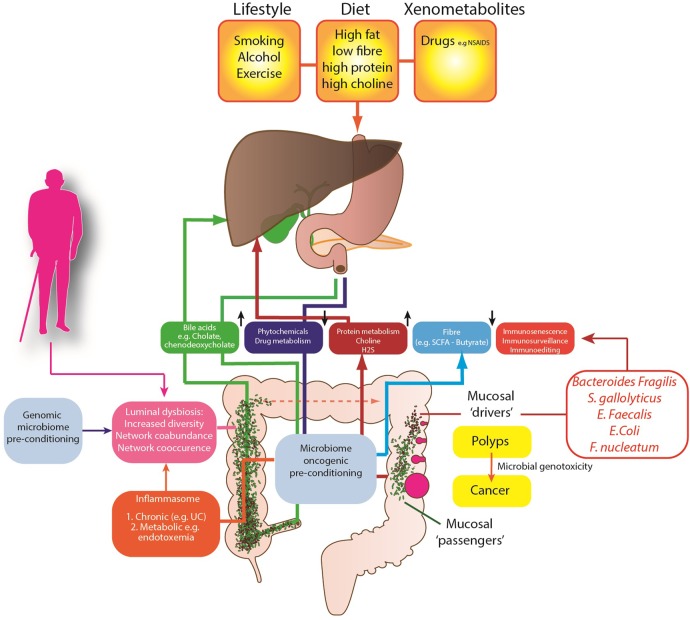
- In CRC, pathobionts including *Streptococcus gallolyticus*, *Enterococcus faecalis*, *Bacteroides fragilis*, *E. coli*, and *Fusobacterium nucleatum* have been linked with adenomas/CRC; butyrate-producers are reduced, and H₂S is implicated in CRC development.
Methods
- Narrative review of current knowledge and evidence, not a primary study; it synthesizes large-scale microbiome projects, metagenomic/metatranscriptomic studies, animal models, human observational studies, RCTs, and meta-analyses.
- The review covers GI and liver diseases—metabolic syndrome/obesity-related disease, NAFLD/alcoholic/autoimmune liver disease, IBD, and CRC—and evaluates microbiota modulation via antibiotics, probiotics, prebiotics, polyphenols, and FMT.
- No systematic search strategy, inclusion criteria, or formal quality assessment is reported.
Limitations
- The paper states that most data derive from faecal samples, which do not represent the complete gut picture; the small intestine differs markedly from the colon, and most studies come from North America and Europe, giving a biased view.
- It states that human probiotic and prebiotic data are equivocal, with poor study design/strain choice and few well-powered prebiotic trials; obesity links are confounded by diet, host genetics, hormones, lifestyle, and BMI limitations.
- It states that CRC human studies involve small patient numbers, sampling heterogeneity, limited tumour phenotyping, and limited oncological data. Evident from the text: as a narrative review, it lacks systematic methods and formal evidence grading.
Model-written summary. Check it against the paper before relying on it.
Integrity signals
Registry
Cites
Statistics
Figures
Verification
Claims the paper makes
9 Valid · 14 Not valid · 65 Not checked · 31 Own results and interpretations
The cited sources support only part of this claim — read each source’s verdict below.
In the paper
“there is growing evidence that the high fat intake rather than obesity per se had a direct effect on the microbiota and linked clinical parameters.26”
§ The gut microbiota and host health: a new clinical frontier > Obesity-related diseases and the gut microbiota
What the sources say
- Partly supportedcites [26] Claesson MJ, Jeffery IB, Conde S, et al Gut microbiota composition correlates with diet and health in the elderly. Nature 2012; 488: 178– 84. 10.1038/nature11319 22797518 sourceExperimental — accuracy not yet measured
Our copy supports the general thrust: diet-separated groups (DG1 'low fat/high fibre' through DG4 'high fat/low fibre', Concordance of diet and microbiota, p. 7) co-segregated with microbiota composition, microbiota-health links held after adjustment, and the authors 'infer that the causal relationship is in a diet-microbiota-health direction' (Microbiota-health correlations, p. 10; Discussion, p. 12). It also supports the 'rather than obesity per se' contrast in a limited way: 'There was no correlation between the Bacteroidetes : Firmicutes ratio and BMI' (p. 9). Not supported: the paper never isolates high fat intake as the operative variable (its dietary axis combines fat and fibre, with vegetables, fruit and meat as the most discriminating foods), it does not test adiposity as a comparator beyond that single B:F–BMI result, and it reports correlation with an inferred direction rather than a demonstrated 'direct effect'; the cohort is 178 Irish elderly (>65) across community/long-stay settings, not adults generally. (LLM, conf=0.72)
hedgedstates a cause- Asserted: passes — The authors put it forward as true.
- Checkable: passes — It can be checked against evidence.
- Load-bearing: unclear — It is unclear whether the paper’s conclusions depend on it.
- Based: passes — The paper gives a reason why it holds.
- Partly supported
Every source the paper cites for this claim was checked and supports it.
In the paper
“It is now recognised that the gut microbiota and chronic liver diseases are closely linked.”
§ The gut microbiota and host health: a new clinical frontier > Liver disease and the gut microbiota
What the sources say
- Supportedcites [37] Son G, Kremer M, Hines IN Contribution of gut bacteria to liver pathobiology. Gastroenterol Res Pract 2010; 2010:1–13. 10.1155/2010/453563 PMC2913801 20706692 source
The Concluding Remarks state that gut-derived antigens contribute significantly to various acute and chronic liver diseases and describe a connection between the gut microbiota and liver disease. This supports the broad claim that the two are closely linked, while the paper notes that specific mechanisms remain under investigation. (LLM, conf=0.93)
boostedstates an association- Asserted: passes — The authors put it forward as true.
- Checkable: passes — It can be checked against evidence.
- Load-bearing: passes — The paper’s conclusions depend on it.
- Based: passes — The paper gives a reason why it holds.
- Supported
None of the sources cited for this claim have been checked yet.
In the paper
“Analysis of colon biopsy microbiota revealed that patients with PSC-IBD and IBD showed reduced abundance of Prevotella and Roseburia (a butyrate-producer) compared with controls.48 49”
§ The gut microbiota and host health: a new clinical frontier > Liver disease and the gut microbiota > Autoimmune liver diseases
What the sources say
- Not checked yetcites [48] Quraishi SM, Adams D, Pallen M, et al Probing the microbiota in PSC: the gut adherent microbiota of PSC-IBD is distinct to that of IBD and controls. Hepatol 2014; 60: 267A. 27196590
- Could not verifycites [49] Rossen NG, Fuentes S, Boonstra K, et al The mucosa-associated microbiota of PSC patients is characterized by low diversity and low abundance of uncultured Clostridiales II. J Crohn's Colitis 2015; 9: 342– 8. 10.1093/ecco-jcc/jju023 25547975 sourceExperimental — accuracy not yet measured
Section 3.6 reports lower uncultured Clostridiales II in PSC patients than in UC patients and controls, but does not report the claimed reductions in Prevotella or Roseburia in PSC-IBD and IBD. A search for Roseburia found no mention; Prevotella appears in the Discussion only in a description of another study, not as a result for these patient groups. Page numbers were not available in our copy. (LLM, conf=0.76)
plainstates an association- Asserted: passes — The authors put it forward as true.
- Checkable: passes — It can be checked against evidence.
- Load-bearing: passes — The paper’s conclusions depend on it.
- Based: passes — The paper gives a reason why it holds.
Every source the paper cites for this claim was checked and supports it.
In the paper
“A definitive change of the normal gut microbiota with a breakdown of host-microbial mutualism is probably the defining event in IBD development.59”
§ The gut microbiota and host health: a new clinical frontier > IBD and the gut microbiota
What the sources say
- Supportedcites [59] Hold GL, Smith M, Grange C, et al Role of the gut microbiota in inflammatory bowel disease pathogenesis: what have we learnt in the past 10 years? World J Gastroenterol 2014; 20: 1192– 210. 10.3748/wjg.v20.i5.1192 24574795 PMC3921503 source
The DYSBIOSIS section states the claim almost verbatim, including its qualifier “probably.” (LLM, conf=0.95)
hedgedstates a possible cause- Asserted: passes — The authors put it forward as true.
- Checkable: passes — It can be checked against evidence.
- Load-bearing: passes — The paper’s conclusions depend on it.
- Based: passes — The paper gives a reason why it holds.
- Supported
Every source the paper cites for this claim was checked and supports it.
In the paper
“Specifically, ileal CD has been shown to be associated with alterations in bacterial carbohydrate metabolism and bacterial-host interactions, as well as human host-secreted enzymes.69”
§ The gut microbiota and host health: a new clinical frontier > IBD and the gut microbiota
What the sources say
- Supportedcites [69] Erickson AR, Cantarel BL, Lamendella R, et al Integrated metagenomics/metaproteomics reveals human host-microbiota signatures of Crohn's disease. PLoS ONE 2012; 7: e49138 10.1371/journal.pone.0049138 23209564 PMC3509130 source
The Results report altered metabolic pathways in ileal Crohn’s disease, including reduced glycolysis and butyrate-production pathways, and increased abundance of bacterial outer-membrane proteins relevant to host interactions. They also report higher levels of pancreatic enzymes in stool from affected subjects. The Discussion links these microbiota changes with altered handling of secreted enzymes; page numbers were not provided. (LLM, conf=0.94)
plainstates an association- Asserted: passes — The authors put it forward as true.
- Checkable: passes — It can be checked against evidence.
- Load-bearing: unclear — It is unclear whether the paper’s conclusions depend on it.
- Based: passes — The paper gives a reason why it holds.
- Supported
53 more claims · 1 with their cited sources checked
Create a free account to see all 119 claims and to verify the 73 references still open.
- It may state two separate claims as one. 50
- Probably not a substantial claim. 17
- The quote only partly states this claim. 1
Claims other papers make about this one
Each is checked against this paper’s own text: does it say what the citing paper says it does?
The cited source says what the claim attributes to it.
In the citing paper
“Additionally, dietary fiber and high consumption of plant-based foods appears to inhibit the bacteria from producing harmful metabolites from proteins, emphasizing the importance of eating adequate complex carbohydrates to maintain gut microbiome carbohydrate fermentation [36].”
From Exercise-induced stress behavior, gut-microbiota-brain axis and diet: a systematic review for athletes (2016) · cites this paper as [36]
The cited source says what the claim attributes to it.
In the citing paper
“Chronic liver disorders have also been associated with changes in gut microbiome composition and the disruption of the intestinal barrier3,5–8.”
From Cholestasis induced by bile duct ligation promotes changes in the intestinal microbiome in mice (2019) · cites this paper as [3]
In the citing paper
“Specific bacteria shown to be more abundant in health compared with disease states include Bifidobacterium and Lactobacillus spp.(2,7,14)”
From Dietary fiber intervention on gut microbiota composition in healthy adults: a systematic review and meta-analysis (2018) · cites this paper as [2]
In the citing paper
“In the colon and cecum, complex plant-derived polysaccharides are digested and subsequently fermented by gut microorganisms, such as Lactobacillus, Bifidobacterium, Clostridium, Bacteroides, into SCFAs and gases which are also used as carbon and energy sources by specialized bacteria such as reductive acetogens, sulfate-reducing bacteria and methanogens (reviewed by Marchesi et al [36] and by Flin”
From Exercise-induced stress behavior, gut-microbiota-brain axis and diet: a systematic review for athletes (2016) · cites this paper as [36]
In the citing paper
“P-cresol, phenols, certain amines and hydrogen sulfide have a known role in irritable bowel disease, colon cancer, increased intestinal permeability, inflammation, DNA damage and more [36].”
From Exercise-induced stress behavior, gut-microbiota-brain axis and diet: a systematic review for athletes (2016) · cites this paper as [36]
1 more claim about this paper
Create a free account to see every claim other papers make about this one.
Citations
Cites
Diet rapidly and reproducibly alters the human gut microbiome
David, L. A., Maurice, C. F., Carmody, R. N., Gootenberg, D. B., Button, J. E., Wolfe, B. E., Ling, A. V., Devlin, A. S., Varma, Y., Fischbach, M. A., et al. (2014) · Nature · doi:10.1038/nature12820 · Cited by 10,100
Hill (2014) · doi:10.1038/nrgastro.2014.66 · Cited by 9,592
Human gut microbes associated with obesity
Ley, R. E., Turnbaugh, P. J., Klein, S., & Gordon, J. I. (2006) · Nature · doi:10.1038/4441022a · Cited by 8,785 · cited 2×
“24 Nevertheless, based on most human studies, the obesity-associated decrease in the ratio of Bacteroidetes to Firmicutes (B:F) remains controversial.”
BackgroundDietary Modulation of the Human Colonic Microbiota: Introducing the Concept of Prebiotics
Gibson, G. R., & Roberfroid, M. B. (1995) · The Journal of Nutrition · doi:10.1093/jn/125.6.1401 · Cited by 7,667
Changes of Intestinal Functions in Liver Cirrhosis
Fukui, H., & Wiest, R. (2016) · Inflammatory Intestinal Diseases · doi:10.1159/000444436 · Cited by 6,808
A metagenome-wide association study of gut microbiota in type 2 diabetes
Qin, J., Li, Y., Cai, Z., Li, S., Zhu, J., Zhang, F., Liang, S., Zhang, W., Guan, Y., Shen, D., et al. (2012) · Nature · doi:10.1038/nature11450 · Cited by 6,762
Linking long-term dietary patterns with gut microbial enterotypes
Wu, G. D., Chen, J., Hoffmann, C., Bittinger, K., Chen, Y.-Y., Keilbaugh, S. A., Bewtra, M., Knights, D., Walters, W. A., Knight, R., et al. (2011) · Science · doi:10.1126/science.1208344 · Cited by 6,513
Obesity alters gut microbial ecology
Ley, R. E., Bäckhed, F., Turnbaugh, P., Lozupone, C. A., Knight, R. D., & Gordon, J. I. (2005) · Proceedings of the National Academy of Sciences · doi:10.1073/pnas.0504978102 · Cited by 6,176 · cited 1×
“An increase in relative abundance of Firmicutes and a proportional decrease in Bacteroidetes were associated with the microbiota of obese mice, 23 which was con fi rmed in a human dietary intervention study demonstrating that weight loss of obese individuals (body mass index, BMI>30) was accompanied…”
BackgroundMetabolites produced by commensal bacteria promote peripheral regulatory T-cell generation
Arpaia, N., Campbell, C., Fan, X., Dikiy, S., van der Veeken, J., deRoos, P., Liu, H., Cross, J. R., Pfeffer, K., Coffer, P. J., et al. (2013) · Nature · doi:10.1038/nature12726 · Cited by 4,838 · cited 1×
“14 In the colon, the majority of this carbohydrate fermentation occurs in the proximal colon, at least for people following a Western style diet.”
BackgroundRichness of human gut microbiome correlates with metabolic markers
Le Chatelier, E., Nielsen, T., Qin, J., Prifti, E., Hildebrand, F., Falony, G., Almeida, M., Arumugam, M., Batto, J.-M., Kennedy, S., et al. (2013) · Nature · doi:10.1038/nature12506 · Cited by 4,662
Self-citation
Cited by
Items 101–200 of 1,006
Role of oxidative stress and antioxidants in daily nutrition and human health
Bjørklund, G., & Chirumbolo, S. (2017) · Nutrition · doi:10.1016/j.nut.2016.07.018 · Cited by 239
Wu, Y., Jha, R., Li, A., Liu, H., Zhang, Z., Zhang, C., Zhai, Q., & Zhang, J. (2022) · Microbiology Spectrum · doi:10.1128/spectrum.01651-22 · Cited by 239
“Furthermore, due to the disadvantages of traditional surgery and drug therapy of UC, such as postoperative complications, side effects, and high cost (5), there is an urgent need to develop a new UC treatment method.”
BackgroundMetagenomic analysis revealed the potential role of gut microbiome in gout
Chu, Y., Sun, S., Huang, Y., Gao, Q., Xie, X., Wang, P., Li, J., Liang, L., He, X., Jiang, Y., et al. (2021) · npj Biofilms and Microbiomes · doi:10.1038/s41522-021-00235-2 · Cited by 237
Gut Microbiota Metabolism and Interaction with Food Components
Vernocchi, P., Del Chierico, F., & Putignani, L. (2020) · International Journal of Molecular Sciences · doi:10.3390/ijms21103688 · Cited by 227
“When the intestinal SCFA (butyrate) level decreases in patients with IBDs, it is clear that GM diversity decreases by reducing the abundance of Firmicutes and Bacteroidetes and increasing the Proteobacteria level [66].”
BackgroundInfluentialDysbiosis signatures of gut microbiota in coronary artery disease
Zhu, Q., Gao, R., Zhang, Y., Pan, D., Zhu, Y., Zhang, X., Yang, R., Jiang, R., Xu, Y., & Qin, H. (2018) · Physiological Genomics · doi:10.1152/physiolgenomics.00070.2018 · Cited by 221
Gut microbiome production of short-chain fatty acids and obesity in children
Murugesan, S., Nirmalkar, K., Hoyo-Vadillo, C., García-Espitia, M., Ramírez-Sánchez, D., & García-Mena, J. (2018) · European Journal of Clinical Microbiology & Infectious Diseases · doi:10.1007/s10096-017-3143-0 · Cited by 220
“Bacteroidetes as the most abundant phyla members, Actinobacteria, Verrucomicrobia and Proteobacteria being the least abundant [10].”
BackgroundColon‐Targeted Adhesive Hydrogel Microsphere for Regulation of Gut Immunity and Flora
Liu, H., Cai, Z., Wang, F., Hong, L., Deng, L., Zhong, J., Wang, Z., & Cui, W. (2021) · Advanced Science · doi:10.1002/advs.202101619 · Cited by 220
Intestinal gases: influence on gut disorders and the role of dietary manipulations
Kalantar-Zadeh, K., Berean, K. J., Burgell, R. E., Muir, J. G., & Gibson, P. R. (2019) · Nature Reviews Gastroenterology & Hepatology · doi:10.1038/s41575-019-0193-z · Cited by 219
Bosi, A., Banfi, D., Bistoletti, M., Giaroni, C., & Baj, A. (2020) · International Journal of Tryptophan Research · doi:10.1177/1178646920928984 · Cited by 221
The promise of the gut microbiome as part of individualized treatment strategies
Schupack, D. A., Mars, R. A. T., Voelker, D. H., Abeykoon, J. P., & Kashyap, P. C. (2022) · Nature Reviews Gastroenterology & Hepatology · doi:10.1038/s41575-021-00499-1 · Cited by 217
Zhou, D., Chen, Y.-W., Zhao, Z.-H., Yang, R.-X., Xin, F.-Z., Liu, X.-L., Pan, Q., Zhou, H., & Fan, J.-G. (2018) · Experimental & Molecular Medicine · doi:10.1038/s12276-018-0183-1 · Cited by 217
Cui, Y., Wang, Q., Chang, R., Zhou, X., & Xu, C. (2019) · Journal of Agricultural and Food Chemistry · doi:10.1021/acs.jafc.9b00080 · Cited by 217
Gut microbiota, cognitive frailty and dementia in older individuals: A systematic review
Ticinesi, A., Tana, C., Nouvenne, A., Prati, B., Lauretani, F., & Meschi, T. (2018) · Clinical Interventions in Aging · doi:10.2147/cia.s139163 · Cited by 215
“12 However, in other studies, a Mini-Mental State Examination test score # 25 was used as a simplified method for assessing cognitive symptoms.”
BackgroundMethodEffect of Ginger on Inflammatory Diseases
Ballester, P., Cerdá, B., Arcusa, R., Marhuenda, J., Yamedjeu, K., & Zafrilla, P. (2022) · Molecules · doi:10.3390/molecules27217223 · Cited by 214
“Patients with Crohn’s disease and ulcerative colitis have an increased proportion of Proteobacteria and a decreased proportion of Firmicutes [58].”
BackgroundObesity and disease severity magnify disturbed microbiome-immune interactions in asthma patients
Michalovich, D., Rodriguez-Perez, N., Smolinska, S., Pirozynski, M., Mayhew, D., Uddin, S., Van Horn, S., Sokolowska, M., Altunbulakli, C., Eljaszewicz, A., et al. (2019) · Nature Communications · doi:10.1038/s41467-019-13751-9 · Cited by 213
Houtman, T. A., Eckermann, H. A., Smidt, H., & de Weerth, C. (2022) · Scientific Reports · doi:10.1038/s41598-022-07176-6 · Cited by 213
Self-citationEffects of Polyphenol Intake on Metabolic Syndrome: Current Evidences from Human Trials
Chiva-Blanch, G., & Badimon, L. (2017) · Oxidative Medicine and Cellular Longevity · doi:10.1155/2017/5812401 · Cited by 211
“Moreover, MetS features may also influence intestinal microbiota and polyphenol metabolism and therefore their bioactivity [127, 128].”
BackgroundModulation of the human gut microbiota by phenolics and phenolic fiber‐rich foods
Loo, Y. T., Howell, K., Chan, M., Zhang, P., & Ng, K. (2020) · Comprehensive Reviews in Food Science and Food Safety · doi:10.1111/1541-4337.12563 · Cited by 210
Li, C., Zhao, Y., Cheng, J., Guo, J., Zhang, Q., Zhang, X., Ren, J., Wang, F., Huang, J., Hu, H., et al. (2019) · Advanced Science · doi:10.1002/advs.201900610 · Cited by 209
The Interaction between Flavonoids and Intestinal Microbes: A Review
Xiong, H.-H., Lin, S.-Y., Chen, L.-L., Ouyang, K.-H., & Wang, W.-J. (2023) · Foods · doi:10.3390/foods12020320 · Cited by 209
Biomarkers of gastrointestinal functionality in animal nutrition and health
Celi, P., Verlhac, V., Pérez Calvo, E., Schmeisser, J., & Kluenter, A.-M. (2019) · Animal Feed Science and Technology · doi:10.1016/j.anifeedsci.2018.07.012 · Cited by 208
Gut Microbiota and Type 1 Diabetes
Han, H., Li, Y., Fang, J., Liu, G., Yin, J., Li, T., & Yin, Y. (2018) · International Journal of Molecular Sciences · doi:10.3390/ijms19040995 · Cited by 206
Salmonella versus the Microbiome
Rogers, A. W. L., Tsolis, R. M., & Bäumler, A. J. (2021) · Microbiology and Molecular Biology Reviews · doi:10.1128/mmbr.00027-19 · Cited by 205
Gut microbiota and colorectal cancer
Gao, R., Gao, Z., Huang, L., & Qin, H. (2017) · European Journal of Clinical Microbiology & Infectious Diseases · doi:10.1007/s10096-016-2881-8 · Cited by 205
Angiogenin maintains gut microbe homeostasis by balancing α-Proteobacteria and Lachnospiraceae
Sun, D., Bai, R., Zhou, W., Yao, Z., Liu, Y., Tang, S., Ge, X., Luo, L., Luo, C., Hu, G.-F., et al. (2021) · Gut · doi:10.1136/gutjnl-2019-320135 · Cited by 204
Diet Supplementation, Probiotics, and Nutraceuticals in SARS-CoV-2 Infection: A Scoping Review
Infusino, F., Marazzato, M., Mancone, M., Fedele, F., Mastroianni, C. M., Severino, P., Ceccarelli, G., Santinelli, L., Cavarretta, E., Marullo, A. G. M., et al. (2020) · Nutrients · doi:10.3390/nu12061718 · Cited by 203
“Probiotics consist of alive organisms that, when administered in sufficient amounts, confer positive benefits to patients, and their potential clinical utilization has been proposed in numerous pathologic conditions [53].”
BackgroundGut microbiota, diet, and obesity-related disorders: the good, the bad, and the future challenges
Portune, K. J., Benítez‐Páez, A., Del Pulgar, E. M. G., Cerrudo, V., & Sanz, Y. (2017) · Molecular Nutrition & Food Research · doi:10.1002/mnfr.201600252 · Cited by 201
Evolution of food antioxidants as a core topic of food science for a century
Cömert, E. D., & Gökmen, V. (2018) · Food Research International · doi:10.1016/j.foodres.2017.10.056 · Cited by 198
Nonalcoholic fatty liver disease: Evolving paradigms
Lonardo, A., Nascimbeni, F., Maurantonio, M., Marrazzo, A., Rinaldi, L., & Adinolfi, L. E. (2017) · World Journal of Gastroenterology · doi:10.3748/wjg.v23.i36.6571 · Cited by 197
Gut Microbiota and Nonalcoholic Fatty Liver Disease: Insights on Mechanisms and Therapy
Ma, J., Zhou, Q., & Li, H. (2017) · Nutrients · doi:10.3390/nu9101124 · Cited by 197
“Figure 1 Schematic view on roles of gut microbiota in NAFLD [2, 48-60].”
BackgroundKump, P., Wurm, P., Gröchenig, H. P., Wenzl, H., Petritsch, W., Halwachs, B., Wagner, M., Stadlbauer, V., Eherer, A., Hoffmann, K. M., et al. (2018) · Alimentary Pharmacology & Therapeutics · doi:10.1111/apt.14387 · Cited by 196
High-order interactions distort the functional landscape of microbial consortia
Sanchez-Gorostiaga, A., Bajić, D., Osborne, M. L., Poyatos, J. F., & Sanchez, A. (2019) · PLOS Biology · doi:10.1371/journal.pbio.3000550 · Cited by 196
Wang, X., Jia, Y., Wen, L., Mu, W., Wu, X., Liu, T., Liu, X., Fang, J., Luan, Y., Chen, P., et al. (2021) · Cancer Research · doi:10.1158/0008-5472.can-20-3827 · Cited by 194
“In humans, diseases, particularly metabolic syndrome and obesity-related diseases, liver diseases, inflammatory bowel disease (IBD), and colorectal cancer can originate from dysbiosis of the gut microbiota in humans (1).”
Backgroundde Souza, E. L., de Albuquerque, T. M. R., dos Santos, A. S., Massa, N. M. L., & de Brito Alves, J. L. (2019) · Critical Reviews in Food Science and Nutrition · doi:10.1080/10408398.2018.1425285 · Cited by 193
“the same biological level as prebiotics for intestinal health (Marchesi et al. 2016).”
BackgroundGong, P., Wang, S., Liu, M., Chen, F., Yang, W., Chang, X., Liu, N., Zhao, Y., Wang, J., & Chen, X. (2020) · Carbohydrate Research · doi:10.1016/j.carres.2020.108037 · Cited by 193
Guo, Y., Luo, S., Ye, Y., Yin, S., Fan, J., & Xia, M. (2021) · The Journal of Clinical Endocrinology & Metabolism · doi:10.1210/clinem/dgaa644 · Cited by 191
Brodmann, T., Endo, A., Gueimonde, M., Vinderola, G., Kneifel, W., de Vos, W. M., Salminen, S., & Gómez-Gallego, C. (2017) · Frontiers in Microbiology · doi:10.3389/fmicb.2017.01725 · Cited by 191
“Studies involving new analytical technologies have generated new insights into the human and animal guts and yielded new isolates and candidates that perform special functions in this complex intestinal environment (Marchesi et al., 2016).”
BackgroundFehlbaum, S., Prudence, K., Kieboom, J., Heerikhuisen, M., Van den Broek, T., Schuren, F. H. J., Steinert, R. E., & Raederstorff, D. (2018) · International Journal of Molecular Sciences · doi:10.3390/ijms19103097 · Cited by 190
“Dietary intervention to modulate the gut microbiota has become a potentially effective strategy to improve host health [3].”
BackgroundChen, H., Zhao, R., Wang, B., Cai, C., Zheng, L., Wang, H., Wang, M., Ouyang, H., Zhou, X., Chai, Z., et al. (2017) · NanoImpact · doi:10.1016/j.impact.2017.07.005 · Cited by 190
Pichler, M. J., Yamada, C., Shuoker, B., Alvarez-Silva, C., Gotoh, A., Leth, M. L., Schoof, E., Katoh, T., Sakanaka, M., Katayama, T., et al. (2020) · Nature Communications · doi:10.1038/s41467-020-17075-x · Cited by 189
A review of selection criteria for starter culture development in the food fermentation industry
Vinicius De Melo Pereira, G., De Carvalho Neto, D. P., Junqueira, A. C. D. O., Karp, S. G., Letti, L. A. J., Magalhães Júnior, A. I., & Soccol, C. R. (2020) · Food Reviews International · doi:10.1080/87559129.2019.1630636 · Cited by 189
Stevia Leaf to Stevia Sweetener: Exploring Its Science, Benefits, and Future Potential
Samuel, P., Ayoob, K. T., Magnuson, B. A., Wölwer-Rieck, U., Jeppesen, P. B., Rogers, P. J., Rowland, I., & Mathews, R. (2018) · The Journal of Nutrition · doi:10.1093/jn/nxy102 · Cited by 189
Kong, C., Yan, X., Zhu, Y., Zhu, H., Luo, Y., Liu, P., Ferrandon, S., Kalady, M. F., Gao, R., He, J., et al. (2021) · Cancer Research · doi:10.1158/0008-5472.can-21-0453 · Cited by 186
Ticinesi, A., Milani, C., Guerra, A., Allegri, F., Lauretani, F., Nouvenne, A., Mancabelli, L., Lugli, G. A., Turroni, F., Duranti, S., et al. (2018) · Gut · doi:10.1136/gutjnl-2017-315734 · Cited by 185
Clostridium difficile infection and antibiotic-associated diarrhoea
Mullish, B. H., & Williams, H. R. (2018) · Clinical Medicine · doi:10.7861/clinmedicine.18-3-237 · Cited by 182
Kang, L., Li, P., Wang, D., Wang, T., Hao, D., & Qu, X. (2021) · Scientific Reports · doi:10.1038/s41598-021-84031-0 · Cited by 182
Barrientos-Durán, A., Fuentes-López, A., de Salazar, A., Plaza-Díaz, J., & García, F. (2020) · Nutrients · doi:10.3390/nu12020419 · Cited by 181
“Furthermore, pro-inflammatory effects of altered intestinal microbiota on distal systems of the body are increasingly recognized [164].”
BackgroundDiet influence on the gut microbiota and dysbiosis related to nutritional disorders
Tidjani Alou, M., Lagier, J.-C., & Raoult, D. (2016) · Human Microbiome Journal · doi:10.1016/j.humic.2016.09.001 · Cited by 179
“On the other hand, LGC obese subjects gut microbiota is associated with a higher prevalence of potentially pro-inflammatory species and genes implicated in oxidative stress response [61].”
BackgroundKim, D.-H., Kim, H., Jeong, D., Kang, I.-B., Chon, J.-W., Kim, H.-S., Song, K.-Y., & Seo, K.-H. (2017) · The Journal of Nutritional Biochemistry · doi:10.1016/j.jnutbio.2017.02.014 · Cited by 179
The Th17/Treg Cell Balance: A Gut Microbiota-Modulated Story
Cheng, H., Guan, X., Chen, D., & Ma, W. (2019) · Microorganisms · doi:10.3390/microorganisms7120583 · Cited by 178
“Gut microbiota offer many benefits to the host through its regulation of host immunity [8,9].”
BackgroundReview article: the gut microbiome in inflammatory bowel disease—avenues for microbial management
McIlroy, J., Ianiro, G., Mukhopadhya, I., Hansen, R., & Hold, G. L. (2018) · Alimentary Pharmacology & Therapeutics · doi:10.1111/apt.14384 · Cited by 176
“the immune system, breakdown of dietary substrates inaccessible to host enzymes, and detoxification of xenobiotics.(7) The healthy gut”
BackgroundSelf-citationde Mejia, E. G., Zhang, Q., Penta, K., Eroglu, A., & Lila, M. A. (2020) · Annual Review of Food Science and Technology · doi:10.1146/annurev-food-032519-051729 · Cited by 176
Lamas, B., Martins Breyner, N., & Houdeau, E. (2020) · Particle and Fibre Toxicology · doi:10.1186/s12989-020-00349-z · Cited by 174
Impact of plant extracts upon human health: A review
Veiga, M., Costa, E. M., Silva, S., & Pintado, M. (2020) · Critical Reviews in Food Science and Nutrition · doi:10.1080/10408398.2018.1540969 · Cited by 174
Schiavi, E., Gleinser, M., Molloy, E., Groeger, D., Frei, R., Ferstl, R., Rodriguez-Perez, N., Ziegler, M., Grant, R., Moriarty, T. F., et al. (2016) · Applied and Environmental Microbiology · doi:10.1128/aem.02238-16 · Cited by 173
Aberrant IgA responses to the gut microbiota during infancy precede asthma and allergy development
Dzidic, M., Abrahamsson, T. R., Artacho, A., Björkstén, B., Collado, M. C., Mira, A., & Jenmalm, M. C. (2017) · Journal of Allergy and Clinical Immunology · doi:10.1016/j.jaci.2016.06.047 · Cited by 170
Utilization of the microbiome in personalized medicine
Ratiner, K., Ciocan, D., Abdeen, S. K., & Elinav, E. (2024) · Nature Reviews Microbiology · doi:10.1038/s41579-023-00998-9 · Cited by 170
“Expanding research on the microbiome in preclinical and clinical contexts is a substantial step towards harnessing its potential in real-life settings 6,8 .”
Physiological Role of Gut Microbiota for Maintaining Human Health
Andoh, A. (2016) · Digestion · doi:10.1159/000444066 · Cited by 169
Liu, W., Zhao, S., Wang, J., Shi, J., Sun, Y., Wang, W., Ning, G., Hong, J., & Liu, R. (2017) · Molecular Nutrition & Food Research · doi:10.1002/mnfr.201601082 · Cited by 169
Cueva, C., Gil-Sánchez, I., Ayuda-Durán, B., González-Manzano, S., González-Paramás, A., Santos-Buelga, C., Bartolomé, B., & Moreno-Arribas, M. (2017) · Molecules · doi:10.3390/molecules22010099 · Cited by 169
“Several strategies, including the intake of some types of polyphenols, have been proposed to modulate the composition and metabolic activity of the human gut microbiota [17].”
BackgroundLeth, M. L., Ejby, M., Workman, C., Ewald, D. A., Pedersen, S. S., Sternberg, C., Bahl, M. I., Licht, T. R., Aachmann, F. L., Westereng, B., et al. (2018) · Nature Microbiology · doi:10.1038/s41564-018-0132-8 · Cited by 167
Impact of food grade and nano-TiO2 particles on a human intestinal community
Dudefoi, W., Moniz, K., Allen-Vercoe, E., Ropers, M.-H., & Walker, V. K. (2017) · Food and Chemical Toxicology · doi:10.1016/j.fct.2017.05.050 · Cited by 163
“Since changes to this microbiota can be associated with disease states such as obesity, diabetes, rheumatoid arthritis, and inflammatory bowel disease (Marchesi et al., 2016; Pietroiusti et al., 2016), it is important and timely to assess the impact of food grade TiO2 on the human gut consortia.”
BackgroundLinking dietary patterns with gut microbial composition and function
Sheflin, A. M., Melby, C. L., Carbonero, F., & Weir, T. L. (2017) · Gut Microbes · doi:10.1080/19490976.2016.1270809 · Cited by 162
“Proposed mechanisms range from generation of bioactive metabolites to inducing systemic low-grade inflammation via Toll-Like receptors (TLR).(3,4) While genetics, mode of delivery at birth, physical environment, age, stress, and other factors can influence the dynamics of the gut microbiota, diet may be the single mos…”
BackgroundSex and strain dependent differences in mucosal immunology and microbiota composition in mice
Elderman, M., Hugenholtz, F., Belzer, C., Boekschoten, M., van Beek, A., de Haan, B., Savelkoul, H., de Vos, P., & Faas, M. (2018) · Biology of Sex Differences · doi:10.1186/s13293-018-0186-6 · Cited by 151
Current understanding of the gut microbiota shaping mechanisms
Chang, C.-S., & Kao, C.-Y. (2019) · Journal of Biomedical Science · doi:10.1186/s12929-019-0554-5 · Cited by 161
Yang, Y., Li, L., Xu, C., Wang, Y., Wang, Z., Chen, M., Jiang, Z., Pan, J., Yang, C., Li, X., et al. (2021) · Gut · doi:10.1136/gutjnl-2020-320777 · Cited by 161
Chng, K. R., Ghosh, T. S., Tan, Y. H., Nandi, T., Lee, I. R., Ng, A. H. Q., Li, C., Ravikrishnan, A., Lim, K. M., Lye, D., et al. (2020) · Nature Ecology & Evolution · doi:10.1038/s41559-020-1236-0 · Cited by 160
The Effect of Gut Microbiota and Probiotics on Metabolism in Fish and Shrimp
Ringø, E., Harikrishnan, R., Soltani, M., & Ghosh, K. (2022) · Animals · doi:10.3390/ani12213016 · Cited by 177
Nakamura, Y., Janowitz, C., Metea, C., Asquith, M. J., Karstens, L., Rosenbaum, J. T., & Lin, P. (2017) · Scientific Reports · doi:10.1038/s41598-017-12163-3 · Cited by 170
Gut-Muscle Axis Exists and May Affect Skeletal Muscle Adaptation to Training
Przewłócka, K., Folwarski, M., Kaźmierczak-Siedlecka, K., Skonieczna‐Żydecka, K., & Kaczor, J. J. (2020) · Nutrients · doi:10.3390/nu12051451 · Cited by 197
Microbiome therapeutics: exploring the present scenario and challenges
Yadav, M., & Chauhan, N. S. (2021) · Gastroenterology report · doi:10.1093/gastro/goab046 · Cited by 181
Kandpal, M., Indari, O., Baral, B., Jakhmola, S., Tiwari, D., Bhandari, V., Pandey, R. K., Bala, K., Sonawane, A., & Jha, H. C. (2022) · Metabolites · doi:10.3390/metabo12111064 · Cited by 159
Gut Microbiota in Colorectal Cancer: Biological Role and Therapeutic Opportunities
Pandey, H., Tang, D. W. T., Wong, S. H., & Lal, D. (2023) · Cancers · doi:10.3390/cancers15030866 · Cited by 159
“It is estimated that microbial metabolism results in the generation of about 70% of body heat at rest [35,36], which is important for maintaining a stable gut and body”
BackgroundTang, X., Wang, W., Hong, G., Duan, C., Zhu, S., Tian, Y., Han, C., Qian, W., Lin, R., & Hou, X. (2021) · Journal of Biomedical Science · doi:10.1186/s12929-021-00711-z · Cited by 158
Wu, Z., Zhang, B., Chen, F., Xia, R., Zhu, D., Chen, B., Lin, A., Zheng, C., Hou, D., Li, X., et al. (2023) · Frontiers in Cellular and Infection Microbiology · doi:10.3389/fcimb.2022.1089991 · Cited by 158
“The composition and quantity of intestinal microbiota in diabetic patients have been found to differ from healthy individuals (Marchesi et al., 2016; Chen et al., 2019).”
BackgroundAccessing Bioactive Natural Products from the Human Microbiome
Milshteyn, A., Colosimo, D. A., & Brady, S. F. (2018) · Cell Host & Microbe · doi:10.1016/j.chom.2018.05.013 · Cited by 150
Barrila, J., Crabbé, A., Yang, J., Franco, K., Nydam, S. D., Forsyth, R. J., Davis, R. R., Gangaraju, S., Ott, C. M., Coyne, C. B., et al. (2018) · Infection and Immunity · doi:10.1128/iai.00282-18 · Cited by 154
Tea Compounds and the Gut Microbiome: Findings from Trials and Mechanistic Studies
Bond, T., & Derbyshire, E. J. (2019) · Nutrients · doi:10.3390/nu11102364 · Cited by 174
Zhu, L., Yu, T., Wang, W., Xu, T., Geng, W., Li, N., & Zan, X. (2024) · Advanced Materials · doi:10.1002/adma.202308728 · Cited by 161
Strain profiling and epidemiology of bacterial species from metagenomic sequencing
Albanese, D., & Donati, C. (2017) · Nature Communications · doi:10.1038/s41467-017-02209-5 · Cited by 135
Liver–Microbiome Axis in Health and Disease
Adolph, T. E., Grander, C., Moschen, A. R., & Tilg, H. (2018) · Trends in Immunology · doi:10.1016/j.it.2018.05.002 · Cited by 150
Hydroxycinnamic acids and human health: recent advances
Coman, V., & Vodnar, D. C. (2019) · Journal of the Science of Food and Agriculture · doi:10.1002/jsfa.10010 · Cited by 173
Microbiota and mucosal defense in IBD: an update
Stange, E. F., & Schroeder, B. O. (2019) · Expert Review of Gastroenterology & Hepatology · doi:10.1080/17474124.2019.1671822 · Cited by 159
Towards modulating the gut microbiota to enhance the efficacy of immune-checkpoint inhibitors
Simpson, R. C., Shanahan, E. R., Scolyer, R. A., & Long, G. V. (2023) · Nature Reviews Clinical Oncology · doi:10.1038/s41571-023-00803-9 · Cited by 153
Tincati, C., Douek, D. C., & Marchetti, G. C. (2016) · AIDS Research and Therapy · doi:10.1186/s12981-016-0103-1 · Cited by 160
The influence of the intestinal microbiome on vaccine responses
Zimmermann, P., & Curtis, N. C. (2018) · Vaccine · doi:10.1016/j.vaccine.2018.04.066 · Cited by 173
Contact lens-related corneal infection: Intrinsic resistance and its compromise
Fleiszig, S. M. J., Kroken, A. R., Nieto, V., Grosser, M. R., Wan, S. J., Metruccio, M. M. E., & Evans, D. J. (2019) · Progress in Retinal and Eye Research · doi:10.1016/j.preteyeres.2019.100804 · Cited by 162
Drug–gut microbiota interactions: implications for neuropharmacology
Walsh, J., Griffin, B. T., Clarke, G., & Hyland, N. P. (2018) · British Journal of Pharmacology · doi:10.1111/bph.14366 · Cited by 149
Symbiont-induced odorant binding proteins mediate insect host hematopoiesis
Benoit, J. B., Vigneron, A., Broderick, N. A., Wu, Y., Sun, J. S., Carlson, J. R., Aksoy, S., & Weiss, B. L. (2017) · eLife · doi:10.7554/elife.19535 · Cited by 143
Secretome of Intestinal Bacilli: A Natural Guard against Pathologies
Ilinskaya, O. N., Владимировна, У. В., Рашидовна, Я. Д., & Гатауллин, И. Г. (2017) · Frontiers in Microbiology · doi:10.3389/fmicb.2017.01666 · Cited by 158
Body Mass Index and Sex Affect Diverse Microbial Niches within the Gut
Borgo, F., Garbossa, S., Riva, A., Severgnini, M., Luigiano, C., Benetti, A., Pontiroli, A. E., Morace, G., & Borghi, E. (2018) · Frontiers in Microbiology · doi:10.3389/fmicb.2018.00213 · Cited by 144
Vuik, F., Dicksved, J., Lam, S., Fuhler, G., van der Laan, L., van de Winkel, A., Konstantinov, Sr., Spaander, M., Peppelenbosch, M., Engstrand, L., et al. (2019) · United European Gastroenterology Journal · doi:10.1177/2050640619852255 · Cited by 140
Increased gut permeability in cancer cachexia: mechanisms and clinical relevance
Bindels, L. B., Neyrinck, A. M., Loumaye, A., Catry, E., Walgrave, H., Cherbuy, C., Leclercq, S., Van Hul, M., Plovier, H., Pachikian, B., et al. (2018) · Oncotarget · doi:10.18632/oncotarget.24804 · Cited by 147
Linking Gut Microbiota to Colorectal Cancer
Raskov, H., Burcharth, J., & Pommergaard, H.-C. (2017) · Journal of Cancer · doi:10.7150/jca.20497 · Cited by 146
Pietroiusti, A., Magrini, A., & Campagnolo, L. (2015) · Toxicology and Applied Pharmacology · doi:10.1016/j.taap.2015.12.017 · Cited by 156
Diet, the intestinal microbiota, and immune health in aging
Clements, S. J., & R. Carding, S. (2018) · Critical Reviews in Food Science and Nutrition · doi:10.1080/10408398.2016.1211086 · Cited by 134
Exercise mimetics: harnessing the therapeutic effects of physical activity
Gubert, C., & Hannan, A. J. (2021) · Nature Reviews Drug Discovery · doi:10.1038/s41573-021-00217-1 · Cited by 172
The association of type II diabetes with gut microbiota composition
Navab-Moghadam, F., Sedighi, M., Khamseh, M. E., Alaei-Shahmiri, F., Talebi, M., Razavi, S., & Amirmozafari, N. (2017) · Microbial Pathogenesis · doi:10.1016/j.micpath.2017.07.034 · Cited by 144
The microbiota-gut-bone axis and bone health
Tu, Y., Yang, R., Xu, X., & Zhou, X. (2021) · Journal of Leukocyte Biology · doi:10.1002/jlb.3mr0321-755r · Cited by 160
Intestinal microbiota control acute kidney injury severity by immune modulation
Yang, J., Kim, C. J., Ko, Y. S., Lee, H. Y., Kim, M.-G., Oh, S. W., Cho, W. Y., Im, S., & Jo, S. (2020) · Kidney International · doi:10.1016/j.kint.2020.04.048 · Cited by 153
Metadata
- Authors
- Marchesi, J. R., Adams, D. H., Fava, F., Hermes, G. D. A., Hirschfield, G. M., Hold, G., Quraishi, M. N., Kinross, J., Smidt, H., Tuohy, K. M., Thomas, L. V., Zoetendal, E. G., & Hart, A.
- Affiliations
- Imperial College London (GB)
- University of Birmingham (GB)
- Nutrition and Nutrigenomics Group, Department of Food Quality and Nutrition, Research and Innovation Centre, Trento, Italy
- TiFN (NL)
- University of Aberdeen (GB)
- Wageningen University & Research (NL)
- Yakult UK Limited, Middlesex, UK
- St Mark's Hospital (GB)
- Corresponding author
- Hart, Ailsa
- ORCID
- Venue
- Gut
- Publisher
- BMJ
- Published
- 2015-09-02
- Volume
- 65
- Issue
- 2
- Pages
- 330-339
- ISSN
- 0017-5749 (ISSN-L)
- 1468-3288
- PMC
- PMC4752653
- OpenAlex
- W2129690444
- Cited by
- 2,302
- References
- 118
- Citations by year
- 2026: 126 · 2025: 195 · 2024: 214 · 2023: 224 · 2022: 257 · 2021: 294 · 2020: 258 · 2019: 201 · 2018: 202 · 2017: 209 · 2016: 114 · 2015: 4
- FWCI
- 17.08
- Type
- journal article
- Language
- en
- Open access
- hybrid
- doi.org
- Licence
- cc-by-nc
- Locations
- Gut (publishedVersion, cc-by-nc)
- Europe PMC (PubMed Central) (publishedVersion, cc-by-nc)
- PubMed Central (publishedVersion, cc-by-nc)
- PubMed (publishedVersion)
- ORCA Online Research @Cardiff (Cardiff University) (acceptedVersion)
- Socio-Environmental Systems Modeling (acceptedVersion, cc-by-nc)
- CINECA IRIS Institutional Research Information System (Fondazione Edmund Mach) (submittedVersion, cc-by-nc)
- Aberdeen University Research Archive (Aberdeen University) (submittedVersion)
- HighWire Press Open Archive (submittedVersion)
- University of Birmingham Research Portal (University of Birmingham) (submittedVersion)
- Spiral (Imperial College London) (submittedVersion, other-oa)
- Data Archiving and Networked Services (DANS) (submittedVersion, cc-by-nc)
- Funders
- National Institute for Health and Care Research (NF-SI-0512-10080, ACF-2012-09-007)
- Academy of Medical Sciences (AMS-SGCL8-Kinross)
- Topics
- Life Sciences › Biochemistry, Genetics and Molecular Biology › Molecular Biology › Gut microbiota and health
- Life Sciences › Agricultural and Biological Sciences › Food Science › Probiotics and Fermented Foods
- Health Sciences › Medicine › Gastroenterology › Gastrointestinal motility and disorders
- Keywords
- gut microbiota, host health, metabolic syndrome, obesity-related comorbidities, liver disease, inflammatory bowel disease, colorectal cancer, microbiome manipulation, antibiotics, probiotics, prebiotics, polyphenols, fecal microbiota transplantation
- MeSH terms
- Gastrointestinal Microbiome, Animals, Autoimmune Diseases, Bacteria, Colitis, Ulcerative, Crohn Disease, Health Status, Humans, Liver Diseases, Liver Diseases, Alcoholic, Obesity, Inflammatory Bowel Diseases, Pouchitis, Probiotics, Prebiotics, Polyphenols, Non-alcoholic Fatty Liver Disease
About these checks
Registry, retraction, Cites and statistics results are computed, not judged, with one exception: a printed reference that no index lists is read once by a model before it counts as a citation error. Claims are extracted by a model and kept only when their quote appears verbatim in the text; each cited source is then checked, with a model’s help, for whether it says what the claim relies on. Those verdicts can be wrong — read the claim’s quote and the cited source before relying on one.
The claim verdicts this report counts are experimental: their accuracy is not yet measured.
A language model drew the claims from the paper on 2026-10-07, under version 3 of the claim definition (model deepseek-v4.1-flash, prompt extract-v3).
A second model labelled each claim on 2026-10-07 (model jev-1.13-20260917, definition revision gold-guideline-v0.2).
Cited sources are checked with a language model’s help (qwen3.8-omni-flash and gpt-6-sol).
Statistics and arithmetic are recomputed, not judged.
Confidence bands are shown only for fields calibrated on our annotated test set. None is calibrated yet, so no band is shown.
What counts as a claim ›How we measure confidence ›How we check this ›
Are you an author, or do you see a problem with this page? Request a review
Data sources
Bibliographic data: Semantic Scholar, OpenAlex, Crossref.
Contains information from the Semantic Scholar Academic Graph Datasets, made available under the ODC Attribution License (ODC-BY 1.0).
Semantic Scholar’s data is described in: Kinney, R., et al. (2023). The Semantic Scholar Open Data Platform. arXiv:2301.10140.
