

The screening and management of pituitary dysfunction following traumatic brain injury in adults: British Neurotrauma Group guidance
Open accessThe DOI matches its Crossref record; 79 of the 83 references it cites were found in a registry or an index; 1 of the 13 sources its claims cite were checked for support.
Abstract
Pituitary dysfunction is a recognised, but potentially underdiagnosed complication of traumatic brain injury (TBI). Post-traumatic hypopituitarism (PTHP) can have major consequences for patients physically, psychologically, emotionally and socially, leading to reduced quality of life, depression and poor rehabilitation outcome. However, studies on the incidence of PTHP have yielded highly variable findings. The risk factors and pathophysiology of this condition are also not yet fully understood. There is currently no national consensus for the screening and detection of PTHP in patients with TBI, with practice likely varying significantly between centres. In view of this, a guidance development group consisting of expert clinicians involved in the care of patients with TBI, including neurosurgeons, neurologists, neurointensivists and endocrinologists, was convened to formulate national guidance with the aim of facilitating consistency and uniformity in the care of patients with TBI, and ensuring timely detection or exclusion of PTHP where appropriate. This article summarises the current literature on PTHP, and sets out guidance for the screening and management of pituitary dysfunction in adult patients with TBI. It is hoped that future research will lead to more definitive recommendations in the form of guidelines.
Overview
CoChat Summary
TL;DR
This British Neurotrauma Group guidance summarizes the literature and provides consensus recommendations for screening and managing pituitary dysfunction after traumatic brain injury (TBI) in adults. It advises against routine acute-phase pituitary testing, recommends targeted cortisol testing only when insufficiency is clinically suspected, and recommends screening at 3–6 months for patients admitted for >48 hours.
Key findings
- A meta-analysis of 14 studies reported pooled post-traumatic hypopituitarism prevalence of 27.5%; by TBI severity, pituitary dysfunction was detected in 16.8% with mild TBI (GCS 13–15), 10.9% with moderate TBI (GCS 9–12), and 35.5% with severe TBI (GCS 3–8).
- Acute anterior hypopituitarism prevalence was reported as 53%–78%, while chronic rates varied from 5.4% to 76.4% at >12 months; GH and gonadotrophin deficiencies were the most commonly identified deficits.
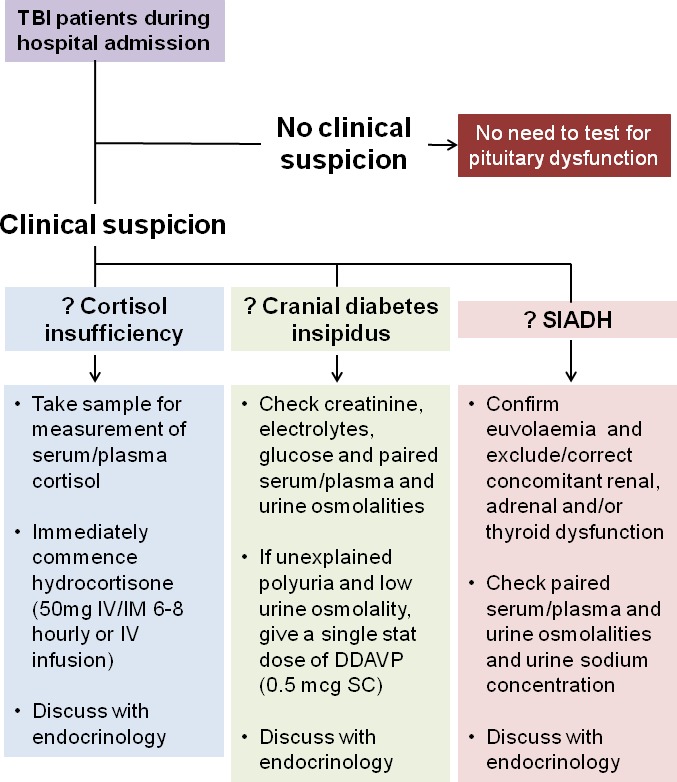
- The guidance recommends no routine acute-phase pituitary function testing or plasma/serum cortisol measurement; if cortisol insufficiency is suspected, give empirical hydrocortisone 50 mg 6–8 hourly intravenously/intramuscularly, or 50–100 mg as an initial intravenous bolus followed by 4–8 mg/hour, after taking a random cortisol sample, and discuss with endocrinology.
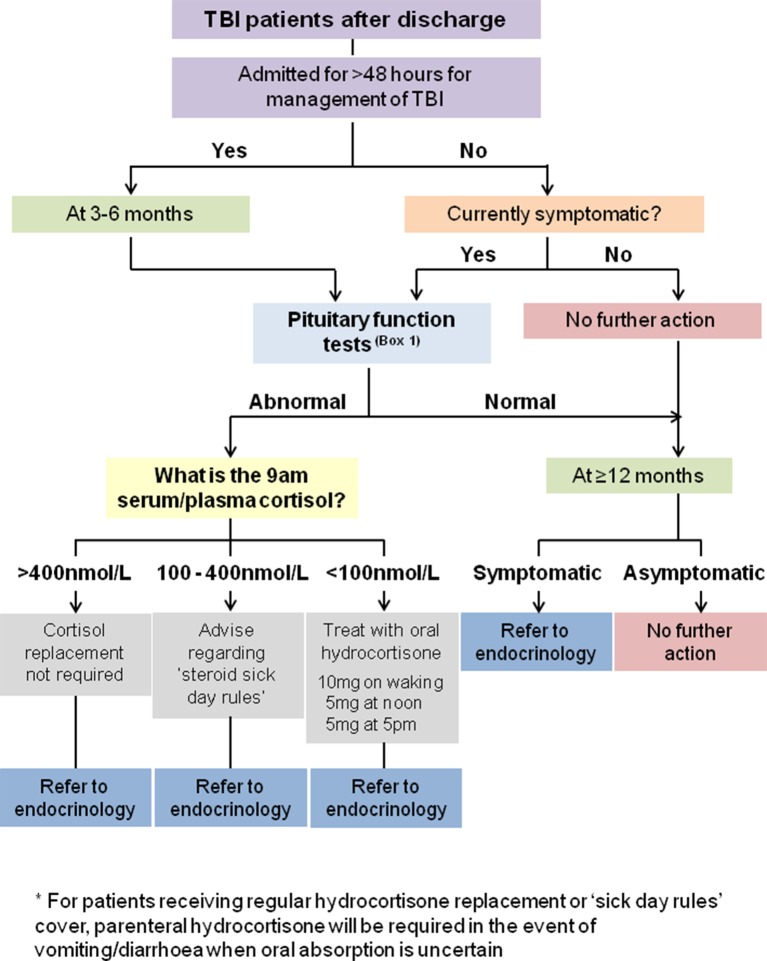
- Patients admitted for >48 hours after TBI should be screened at 3–6 months; advised 09:00 cortisol action limits are <100 nmol/L (start oral hydrocortisone 10 mg on waking, 5 mg at noon, 5 mg at 17:00 and refer urgently), 100–400 nmol/L (refer and advise steroid sick day rules), and >400 nmol/L (no routine endocrinology referral).
Methods
- A guidance development group of expert clinicians involved in TBI care—including neurosurgeons, neurologists, neurointensivists, and endocrinologists—was convened; an initial meeting was held in October 2014 at Robinson College, Cambridge, UK, with drafts revised by email to consensus and final approval by all members.
- Evidence types and recommendation grades followed the Agency for Healthcare Policy and Research framework; the document summarizes current literature on post-traumatic hypopituitarism and sets out consensus recommendations, mostly graded IV,C or III,B.
- No formal systematic review, search strategy, or primary data collection is described; this is a consensus guidance document rather than an original study.
Limitations
- The paper states that there is currently no national consensus for screening, incidence studies have highly variable findings, risk factors and pathophysiology are not fully understood, and no definitive recommendations can yet be made; it calls for a multicentre study powered to determine true incidence, predictors, and optimal methods/timing of endocrine investigation.
- The paper states that symptoms overlap considerably between TBI itself and pituitary dysfunction and have poor specificity, and that static blood tests have recognized limitations, with definitive investigation frequently requiring dynamic hormone testing interpreted by an experienced endocrinologist.
- Evident from the text: most recommendations rely on expert opinion/level IV evidence and are graded C, with few higher-grade recommendations, and the guidance does not describe a formal systematic literature search or meta-analytic method.
Model-written summary. Check it against the paper before relying on it.
Integrity signals
Registry
Cites
Statistics
Figures
Verification
Claims the paper makes
1 Valid · 1 Not valid · 8 Not checked · 6 Own results and interpretations
The cited sources support only part of this claim — read each source’s verdict below.
In the paper
“Two recent studies have suggested high rates (52%–78%) of hypothalamic–pituitary–adrenal axis dysfunction within the first 10 days after injury”
§ The screening and management of pituitary dysfunction following traumatic brain injury in adults: British Neurotrauma Group guidance > Introduction > Hypopituitarism
What the sources say
- Partly supportedcites [48] Olivecrona Z, Dahlqvist P, Koskinen LO Acute neuro-endocrine profile and prediction of outcome after severe brain injury. Scand J Trauma Resusc Emerg Med 2013; 21: 33 10.1186/1757-7241-21-33 23601250 PMC3637196 sourceExperimental — accuracy not yet measured
The Results (Hypothalamic-pituitary-adrenal axis; page unavailable) report low cortisol in 52.3% of patients on day 1 and up to 70.5% on day 4 after severe traumatic brain injury, supporting a high rate of possible adrenal insufficiency early after injury. The paper does not report a 78% rate or identify two studies yielding the stated 52%–78% range; its Discussion also cautions that strict diagnostic criteria for cortisol insufficiency are lacking. (LLM, conf=0.85)
- Not checked — no full text of the sourcecites [50] Hannon MJ, Crowley RK, Behan LA, et al Acute glucocorticoid deficiency and diabetes insipidus are common after acute traumatic brain injury and predict mortality. J Clin Endocrinol Metab 2013; 98: 3229– 37. 10.1210/jc.2013-1555 23690314 source
hedged- Asserted: passes — The authors put it forward as true.
- Checkable: passes — It can be checked against evidence.
- Load-bearing: unclear — It is unclear whether the paper’s conclusions depend on it.
- Based: passes — The paper gives a reason why it holds.
- Partly supported
A result the paper states — it cites no source for it, so there is none to check. The quote shows it is in the paper.
In the paper
“The reported prevalence of post-traumatic hypopituitarism (PTHP) differs significantly between studies.”
§ The screening and management of pituitary dysfunction following traumatic brain injury in adults: British Neurotrauma Group guidance > Introduction
plain- Asserted: passes — The authors put it forward as true.
- Checkable: passes — It can be checked against evidence.
- Load-bearing: passes — The paper’s conclusions depend on it.
- Based: passes — The paper gives a reason why it holds.
The paper states this without a source or data behind it here, so there is nothing to check it against. The quote shows it is in the paper.
In the paper
“although some data suggest that severe TBI is a particular risk factor for PTHP, even in this subgroup it is not clear which patients are at greatest risk and should be prioritised for investigation and treatment.”
§ The screening and management of pituitary dysfunction following traumatic brain injury in adults: British Neurotrauma Group guidance > Conclusion
hedgedstates a possible cause- Asserted: passes — The authors put it forward as true.
- Checkable: passes — It can be checked against evidence.
- Load-bearing: unclear — It is unclear whether the paper’s conclusions depend on it.
- Based: unclear — It is unclear why the paper says it holds.
In the paper
“A meta-analysis of 14 studies reported the pooled prevalence of PTHP to be 27.5%.11”
§ The screening and management of pituitary dysfunction following traumatic brain injury in adults: British Neurotrauma Group guidance > Introduction
What the sources say
- Not checked — no full text of the sourcecites [11] Schneider HJ, Kreitschmann-Andermahr I, Ghigo E, et al Hypothalamopituitary dysfunction following traumatic brain injury and aneurysmal subarachnoid hemorrhage: a systematic review. JAMA 2007; 298: 1429– 38. 10.1001/jama.298.12.1429 17895459 source
plain- Asserted: passes — The authors put it forward as true.
- Checkable: passes — It can be checked against evidence.
- Load-bearing: unclear — It is unclear whether the paper’s conclusions depend on it.
- Based: passes — The paper gives a reason why it holds.
A claim is checked only against the cited paper’s full text, never its abstract, and none is available for its sources.
In the paper
“Due to the potential confounding effects of non-thyroidal illness (sick euthyroid syndrome) and the long half-life of thyroxine, it has been suggested that screening for hypothalamic–pituitary–thyroid dysfunction can reasonably be deferred for several (>4–6) weeks after TBI (assuming there is no suspicion of prior thyroid dysfunction).50 62”
§ The screening and management of pituitary dysfunction following traumatic brain injury in adults: British Neurotrauma Group guidance > Guidance > Screening for pituitary dysfunction following discharge from hospital
What the sources say
- Not checked — no full text of the sourcecites [50] Hannon MJ, Crowley RK, Behan LA, et al Acute glucocorticoid deficiency and diabetes insipidus are common after acute traumatic brain injury and predict mortality. J Clin Endocrinol Metab 2013; 98: 3229– 37. 10.1210/jc.2013-1555 23690314 source
- Not checked — no full text of the sourcecites [62] Tritos NA, Yuen KC, Kelly DF, et al American association of clinical endocrinologists and American college of endocrinology disease state clinical review: a neuroendocrine approach to patients with traumatic brain injury. Endocr Pract 2015; 21: 823– 31. 10.4158/EP14567.DSCR 26172127 source
plain- Asserted: passes — The authors put it forward as true.
- Checkable: passes — It can be checked against evidence.
- Load-bearing: passes — The paper’s conclusions depend on it.
- Based: passes — The paper gives a reason why it holds.
5 more claims
Create a free account to see all 16 claims and every source verdict.
- It may state two separate claims as one. 6
- Probably not a substantial claim. 1
Claims other papers make about this one
Each is checked against this paper’s own text: does it say what the citing paper says it does?
The source backs part of the claim, not all of it — or backs it for a different population, condition or comparison.
In the citing paper
“provocative testing (such as the cosyntropin stimulation test, the gold standard in the chronic period) is not reliable in the first 6 weeks after an injury”
From Neuroendocrine Disruptions Following Head Injury (2023) · cites this paper as [6]
Experimental — accuracy not yet measuredThe source backs part of the claim, not all of it — or backs it for a different population, condition or comparison.
In the citing paper
“and up to 42% of children and adolescents [6-9].”
From Neuroendocrine Disruptions Following Head Injury (2023) · cites this paper as [6]
Experimental — accuracy not yet measuredIn the citing paper
“An acknowledged hypothesis suggests that suppression of the secretion of anabolic hormones (including GH) results in decreased energy consumption and the preservation of metabolic resources essential for sustaining vital organs (Tan et al., 2017; Preiser et al., 2014).”
From Acute neuroendocrine changes after traumatic brain injury (2024) · cites this paper as Tan et al., 2017
In the citing paper
“Since IGF-1 and IGFBP-3 are not reliable screening tools, some of the patients with GH deficiency were probably missed in these studies [59,61,62].”
From An Approach to Traumatic Brain Injury-Related Hypopituitarism: Overcoming the Pediatric Challenges (2023) · cites this paper as [61]
Self-check
Percentages, sums and reported differences re-computed from the paper’s own numbers.
Each contradiction between two passages listed here was confirmed by an independent check.
Rated minor: it would not touch a result — a value no result rests on, a p-value that stays on the same side of the significance level, or a conflict that is clerical, resolved elsewhere in the paper, or outside its own findings.
In the paper
§ The screening and management of pituitary dysfunction following traumatic brain injury in adults: British Neurotrauma Group guidance > Introduction > Hypopituitarism
“One group who followed their patients at 1 year, 3 years and 5 years post-TBI demonstrated a progressively decreasing trend for pituitary deficits from the first year to the fifth.46”
§ The screening and management of pituitary dysfunction following traumatic brain injury in adults: British Neurotrauma Group guidance > Introduction > Hypopituitarism
“| | | | 3 years | 23.5 | 23 | 0 | 0 | 0 | 0 | | | | | 5 years | 32 | 28 | 4 | 1 | 0 | 1 |”
Rated minor: it would not touch a result — a value no result rests on, a p-value that stays on the same side of the significance level, or a conflict that is clerical, resolved elsewhere in the paper, or outside its own findings.
In the paper
§ The screening and management of pituitary dysfunction following traumatic brain injury in adults: British Neurotrauma Group guidance > Introduction > Hypopituitarism
“ranging from 2.6% to 51% (table 3)”
§ The screening and management of pituitary dysfunction following traumatic brain injury in adults: British Neurotrauma Group guidance > Introduction > Hypopituitarism
“| Boughey et al 54 | – | – | Mean 1.5 days | 2.9 |”
Rated minor: it would not touch a result — a value no result rests on, a p-value that stays on the same side of the significance level, or a conflict that is clerical, resolved elsewhere in the paper, or outside its own findings.
In the paper
§ The screening and management of pituitary dysfunction following traumatic brain injury in adults: British Neurotrauma Group guidance > Introduction > Hypopituitarism
“| Aimaretti et al 24 | 100 | 3–15 | 3 months | 35 | 37 | 17 | 8 | 5 | – |”
§ The screening and management of pituitary dysfunction following traumatic brain injury in adults: British Neurotrauma Group guidance > Introduction > Hypopituitarism
“Anterior hypopituitarism (axis affected) Total (%) | Anterior hypopituitarism (axis affected) GH (%)”
Citations
Cites
National Center for Injury Prevention and Control (U.S.). Division of Injury Response., Faul, M., Wald, M. M., Wu, L., & Coronado, V. G. (2010) · doi:10.15620/cdc.5571 · Cited by 3,494
A systematic review of brain injury epidemiology in Europe
Tagliaferri, F., Compagnone, C., Korsic, M., Servadei, F., & Kraus, J. (2006) · Acta Neurochirurgica · doi:10.1007/s00701-005-0651-y · Cited by 1,223
Clinical practice guideline on diagnosis and treatment of hyponatraemia
Spasovski, G., Vanholder, R., Allolio, B., Annane, D., Ball, S., Bichet, D., Decaux, G., Fenske, W., Hoorn, E., Ichai, C., et al. (2014) · Intensive Care Medicine · doi:10.1007/s00134-014-3210-2 · Cited by 1,020
Clinical practice guideline on diagnosis and treatment of hyponatraemia
Spasovski, G., Vanholder, R., Allolio, B., Annane, D., Ball, S., Bichet, D., Decaux, G., Fenske, W., Hoorn, E. J., Ichai, C., et al. (2014) · European Journal of Endocrinology · doi:10.1530/eje-13-1020 · Cited by 855
The Mayo Classification System for Traumatic Brain Injury Severity
Malec, J. F., Brown, A. W., Leibson, C. L., Flaada, J. T., Mandrekar, J. N., Diehl, N. N., & Perkins, P. K. (2007) · Journal of Neurotrauma · doi:10.1089/neu.2006.0245 · Cited by 669
Schneider, H. J., Kreitschmann-Andermahr, I., Ghigo, E., Stalla, G. K., & Agha, A. (2007) · JAMA · doi:10.1001/jama.298.12.1429 · Cited by 549
Acute Pain Management: Operative or Medical Procedures and Trauma
Follin, S. L., & Charland, S. L. (1997) · Annals of Pharmacotherapy · doi:10.1177/106002809703100917 · Cited by 489
Kelly, D. F., Gaw Gonzalo, I. T., Cohan, P., Berman, N., Swerdloff, R., & Wang, C. (2000) · Journal of Neurosurgery · doi:10.3171/jns.2000.93.5.0743 · Cited by 455 · cited 3×
“Kelly et al reported that certain imaging findings, such as diffuse brain swelling, on initial CT head scan predicted PTHP, 16 while Schneider et al found an association between PTHP and diffuse axonal injury or basal skull fracture.”
BackgroundInfluentialHypopituitarism Secondary to Head Trauma
Benvenga, S. (2000) · Journal of Clinical Endocrinology & Metabolism · doi:10.1210/jc.85.4.1353 · Cited by 423
Anterior Pituitary Dysfunction in Survivors of Traumatic Brain Injury
Agha, A., Rogers, B., Sherlock, M., O’Kelly, P., Tormey, W., Phillips, J., & Thompson, C. J. (2004) · The Journal of Clinical Endocrinology & Metabolism · doi:10.1210/jc.2004-0511 · Cited by 390
Research works printed but not linked: 4
- US Department of Health and Human Services; Public Health Service; Agency for Health Care and Policy Research. Acute lower back problems in adults. Clinical Practice Guideline 14. Rockville, MD: Agency for Health Care and Policy Research Publications, 1994.
- NICE. Head injury: assessment and early management [CG176]. NICE, Published Online First: January 2014.
- Ghigo E, Masel B, Aimaretti G, et al Consensus guidelines on screening for hypopituitarism following traumatic brain injury. Brain Inj 2005; 19: 711– 24. 10.1080/02699050400025315 16195185 · DOI · Paper page
- Sesmilo G, Halperin I, Puig-Domingo M Endocrine evaluation of patients after brain injury: what else is needed to define specific clinical recommendations? Hormones 2007; 6: 132– 7. 10.14310/horm.2002.1111013 17704044 · DOI · Paper page
Cited by
Wong, K. R., Mychasiuk, R., O'Brien, T. J., Shultz, S. R., McDonald, S. J., & Brady, R. D. (2020) · Bone Research · doi:10.1038/s41413-020-00119-9 · Cited by 74
Insights into non-classic and emerging causes of hypopituitarism
Prodam, F., Caputo, M., Mele, C., Marzullo, P., & Aimaretti, G. (2020) · Nature Reviews Endocrinology · doi:10.1038/s41574-020-00437-2 · Cited by 71
Molaie, A. M., & Maguire, J. (2018) · Frontiers in Endocrinology · doi:10.3389/fendo.2018.00176 · Cited by 60
“(44), which summarize studies done to date on the prevalence of chronic PHTH, discuss the frequency of various deficiencies, and comment on the methods used in experiments.”
BackgroundEmelifeonwu, J. A., Flower, H., Loan, J. J., McGivern, K., & Andrews, P. J. D. (2020) · Journal of Neurotrauma · doi:10.1089/neu.2018.6349 · Cited by 55
Traumatic brain injuries induced pituitary dysfunction: a call for algorithms
Gilis-Januszewska, A., Kluczyński, Ł., & Hubalewska-Dydejczyk, A. (2020) · Endocrine Connections · doi:10.1530/ec-20-0117 · Cited by 50
“The prevalence of PTHP among patients with a history of TBI is estimated to be 15-68% [10, 11, 12].”
BackgroundNeuroinflammation and hypothalamo-pituitary dysfunction: focus of traumatic brain injury
Mele, C., Pingue, V., Caputo, M., Zavattaro, M., Pagano, L., Prodam, F., Nardone, A., Aimaretti, G., & Marzullo, P. (2021) · International Journal of Molecular Sciences · doi:10.3390/ijms22052686 · Cited by 53
“Overall, growth hormone deficiency (GHD), ACTH insufficiency, and gonadotropin deficiency are the most frequent abnormalities observed in post-TBI patients [27,32,38,155].”
BackgroundEndocrine Dysfunction After Traumatic Brain Injury: An Ignored Clinical Syndrome?
Mahajan, C., Prabhakar, H., & Bilotta, F. (2023) · Neurocritical Care · doi:10.1007/s12028-022-01672-3 · Cited by 65
“Patients not admitted or admitted for less than 48 h who have features consistent with pituitary dysfunction may also require screening [41].”
BackgroundInfluentialUntangling PTSD and TBI: Challenges and Strategies in Clinical Care and Research
Hendrickson, R. C., Schindler, A. G., & Pagulayan, K. F. (2018) · Current Neurology and Neuroscience Reports · doi:10.1007/s11910-018-0908-5 · Cited by 42
The frequency and the diagnosis of pituitary dysfunction after traumatic brain injury
Glynn, N., & Agha, A. (2019) · Pituitary · doi:10.1007/s11102-019-00938-y · Cited by 36
Clinical picture and the treatment of TBI-induced hypopituitarism
Caputo, M., Mele, C., Prodam, F., Marzullo, P., & Aimaretti, G. (2019) · Pituitary · doi:10.1007/s11102-019-00956-w · Cited by 34
Experimental Evidence and Clinical Implications of Pituitary Adenoma Stem Cells
Würth, R., Thellung, S., Corsaro, A., Barbieri, F., & Florio, T. (2020) · Frontiers in Endocrinology · doi:10.3389/fendo.2020.00054 · Cited by 29
Ntali, G., & Tsagarakis, S. (2019) · Pituitary · doi:10.1007/s11102-019-00944-0 · Cited by 29
Neuroendocrine Disruptions Following Head Injury
Wexler, T. L. (2023) · Current Neurology and Neuroscience Reports · doi:10.1007/s11910-023-01263-5 · Cited by 23
Acute neuroendocrine changes after traumatic brain injury
Magyar-Sumegi, Z. D., Stankovics, L., Lendvai-Emmert, D., Czigler, A., Hegedus, E., Csendes, M., Toth, L., Ungvari, Z., Buki, A., & Toth, P. (2024) · Brain and Spine · doi:10.1016/j.bas.2024.102830 · Cited by 23
“There is ambiguous nomenclature in the literature of post-TBI adrenal insufficiency (AI), either simply referred to as hypocortisolemia, or – more precisely – defined as decreased ACTH and consequently lowered cortisol levels (Tan et al., 2017).”
BackgroundMethodInfluentialLong-term neuroendocrine consequences of traumatic brain injury and strategies for management
Hacıoğlu, A., Keleştimur, F., & Tanrıverdi, F. (2020) · Expert Review of Endocrinology & Metabolism · doi:10.1080/17446651.2020.1733411 · Cited by 23
“Clinicians are strongly recommended to observe TBI patients in terms of symptoms of adrenal insufficiency if routine hormone measurement is not to be performed [65].”
BackgroundMethodInfluentialThe role of autoimmunity in pituitary dysfunction due to traumatic brain injury
De Bellis, A., Bellastella, G., Maiorino, M. I., Costantino, A., Cirillo, P., Longo, M., Pernice, V., Bellastella, A., & Esposito, K. (2019) · Pituitary · doi:10.1007/s11102-019-00953-z · Cited by 21
Zhang, B., Bai, M., Xu, X., Yang, M., Niu, F., Gao, F., & Liu, B. (2020) · Journal of Neuroinflammation · doi:10.1186/s12974-020-02000-2 · Cited by 24
Zhou, M., Feng, Z., Ou, Y., Peng, J., Li, K., Gong, H., Qiu, B., Liu, Y., Wang, Y., & Qi, S. (2019) · CNS Neuroscience & Therapeutics · doi:10.1111/cns.13089 · Cited by 23
Yuen, K. C. J., Masel, B., Jaffee, M. S., O'Shanick, G., Wexler, T. L., Reifschneider, K., Urban, R. J., Hoang, S., Kelepouris, N., & Hoffman, A. R. (2022) · Growth Hormone & IGF Research · doi:10.1016/j.ghir.2022.101495 · Cited by 18
Hume, P. A., Quarrie, K. L., Lewis, G. N., & Theadom, A. (2022) · Sports Medicine · doi:10.1007/s40279-021-01630-7 · Cited by 22
The history of pituitary dysfunction after traumatic brain injury
Benvenga, S. (2019) · Pituitary · doi:10.1007/s11102-019-00949-9 · Cited by 17
Traumatic brain injury and resultant pituitary dysfunction: insights from experimental animal models
Vennekens, A., & Vankelecom, H. E. J. (2019) · Pituitary · doi:10.1007/s11102-019-00961-z · Cited by 20
A neurosurgical approach to traumatic brain injury and post-traumatic hypopituitarism
Tan, C. L., & Hutchinson, P. J. (2019) · Pituitary · doi:10.1007/s11102-018-0925-z · Cited by 14
Self-citationFeng, Z., Ou, Y., Zhou, M., et al. (2018) · Neuroscience Letters · doi:10.1016/j.neulet.2018.02.038 · Cited by 14
Pituitary dysfunction after traumatic brain injury: prevalence and screening strategies
Ntali, G., & Tsagarakis, S. (2020) · Expert Review of Endocrinology & Metabolism · doi:10.1080/17446651.2020.1810561 · Cited by 17
Activation of pituitary axis according to underlying critical illness and its effect on outcome
Mazzeo, A. T., Guaraldi, F., Filippini, C., Tesio, R., Settanni, F., Lucchiari, M., Mengozzi, G., Grottoli, S., Ghigo, E., & Mascia, L. (2019) · Journal of Critical Care · doi:10.1016/j.jcrc.2019.07.006 · Cited by 12
Risk Factors for Anterior Hypopituitarism in Patients With Traumatic Brain Injury
You, W., Zhu, Y., Wen, L., Sun, Y., Pan, D., & Yang, X. (2019) · Journal of Craniofacial Surgery · doi:10.1097/scs.0000000000005405 · Cited by 9
“Many questions arise concerning the definition of risky patients and estimation of the incidence rate of hypopituitarism.(21) In this present study, we found that the prevalence rate of anterior hypopituitarism in TBI patients was 17.”
BackgroundWagner, A. K., Franzese, K. M., Weppner, J. L., Kwasnica, C. M., Galang, G., Edinger, J. M., & Linsenmeyer, M. A. (2020) · Elsevier eBooks · doi:10.1016/b978-0-323-62539-5.00043-6 · Cited by 19
Ebrahimi, F., Andereggen, L., & Christ, E. (2024) · Reviews in Endocrine and Metabolic Disorders · doi:10.1007/s11154-024-09888-8 · Cited by 13
“…clinical manifestations range from generalized fatigue and head-ache to more specific signs such as amenorrhea or lack of libido, with the most common deficiencies reported being growth hormone, ACTH, and gonadotropins, although the prevalence may vary with time since injury [65, 88, 89].”
BackgroundEmelifeonwu, J. A., Wiggins, A., & Andrews, P. (2019) · British Journal of Neurosurgery · doi:10.1080/02688697.2019.1699902 · Cited by 9
“Over the years, there have been several attempts to influence surveillance practice(5) including the recent guidelines issued by the British Neurotrauma Group.(6) However, the influences of such guidelines remain uncertain because non have been able to identify any definitive clinical or radiological risk factors attr…”
BackgroundAn Approach to Traumatic Brain Injury-Related Hypopituitarism: Overcoming the Pediatric Challenges
Vlad, R. M., Albu, A. I., Nicolaescu, I. D., Dobritoiu, R., Carsote, M., Sandru, F., Albu, D., & Păcurar, D. (2023) · Diagnostics · doi:10.3390/diagnostics13020212 · Cited by 7
Architects of Pituitary Tumour Growth
Sabatino, M. E., Grondona, E., & Paul, A. L. D. (2022) · Frontiers in Endocrinology · doi:10.3389/fendo.2022.924942 · Cited by 7
Weppner, J. L., Rosenthal, K., Bath, J. L., Locklear, T. M., & Martinez, M. (2025) · Neurotrauma Reports · doi:10.1089/neur.2025.0009 · Cited by 5
Hasan, S., & Uff, C. E. G. (2025) · Best Practice & Research Clinical Endocrinology & Metabolism · doi:10.1016/j.beem.2025.102006 · Cited by 7
Mild traumatic brain injury as a cause of adult growth hormone deficiency: Diagnosis and treatment
Herodes, M., Legaspi, A., & Garcia, J. M. (2023) · Best Practice & Research Clinical Endocrinology & Metabolism · doi:10.1016/j.beem.2023.101818 · Cited by 5
Duerksen, J. M., Lopez, R. C. T., Tappia, P. S., Ramjiawan, B., & Mansouri, B. (2024) · Molecular and Cellular Biochemistry · doi:10.1007/s11010-024-05176-w · Cited by 8
“More specifically, in mTBI victims 16.8% of patients reported PTHP, although, given the nonspecific nature of PTHP symptoms, it may be underdiagnosed [59, 68].”
InfluentialKarvandi, E., Helmy, A. E., Kolias, A. G., Belli, A., Ganau, M., Gomes, C., Grey, M. J., Griffiths, M. J., Griffiths, T. D., Griffiths, P., et al. (2023) · BMJ Open · doi:10.1136/bmjopen-2023-077022 · Cited by 10
“Additionally, similar guidance has been provided regarding the use of Open access advanced neuroimaging and other objective biomarkers in clinical practice.”
BackgroundSelf-citationFama', F., Vita, R., Sindoni, A., Vinci, S. L., Giorgianni, G., Grasso, L., Gioffre'-Florio, M., & Benvenga, S. (2019) · Journal of Clinical & Translational Endocrinology · doi:10.1016/j.jcte.2018.12.008 · Cited by 4
Zacharia, S. S., Thomas, R., Johnson, J. T., Kapoor, N., Ramanathan, S., Asha, H. S., Cherian, K. E., & Paul, T. V. (2024) · Pituitary · doi:10.1007/s11102-024-01433-9 · Cited by 5
“Tan et al. proposed that screening for hormonal dysfunction in the acute phase may not be necessary as it is often transient [35].”
Haria, J., Singh, N. K., Kumar, J., Jain, S. K., & Pamidimarri, D. (2025) · Behavioural Brain Research · doi:10.1016/j.bbr.2025.115697 · Cited by 6
Colclough, Z., Estrella, M. J., Joyce, J. M., Hanafy, S., Babineau, J., Colantonio, A., & Chan, V. (2024) · PLoS Medicine · doi:10.1371/journal.pmed.1004418 · Cited by 5
Post-Traumatic Hypopituitarism
Blocher, N. (2024) · Current Physical Medicine and Rehabilitation Reports · doi:10.1007/s40141-024-00468-0 · Cited by 5
Clinical manifestations and treatment of hypopituitarism due to traumatic brain injury
Zhang, C. D., & Ioachimescu, A. G. (2025) · Best Practice & Research Clinical Endocrinology & Metabolism · doi:10.1016/j.beem.2025.101996 · Cited by 5
Adipsic diabetes insipidus and SGLT2 inhibitor: A perplexing conundrum
Chua, M. W. J., Tay, D., Ng, Y. S., & Rajasoorya, C. (2021) · Annals of the Academy of Medicine Singapore · doi:10.47102/annals-acadmedsg.2020418 · Cited by 4
Zheng, H., Tian, X., Wang, Y., Ye, X., Ren, X., Gu, Y., Wang, J., Zheng, G., & Yang, X. (2025) · Pharmacological Research · doi:10.1016/j.phrs.2025.108034 · Cited by 5
Rubiano, A. M., Olaya-Perea, S., Ramírez, C. O., et al. (2026) · Brain and Spine · doi:10.1016/j.bas.2026.106046 · Cited by 3
“…et al., 2023; The PATCH-Trauma Investigators and the ANZICS Clinical Trials Group, 2023; Sewalt et al., 2021; Smith et al., 2022; Godoy et al., 2023b; Godoy et al., 2023c; Clavijo et al., 2019; Tan et al., 2017; Rasulo et al., 2022; Maas et al., 2022; Griswold et al., 2022; Picetti et al., 2019).”
Neuroendocrine Dysfunction in the Acute Setting of Penetrating Brain Injury: A Systematic Review
Loggini, A., Tangonan, R., Ammar, F. E., Mansour, A. R., Kramer, C. L., Lazaridis, C., & Goldenberg, F. D. (2020) · World Neurosurgery · doi:10.1016/j.wneu.2020.12.058 · Cited by 4
Managing post-traumatic headache: guidance for primary care
Kernick, D. P., & Lambru, G. (2020) · British Journal of General Practice · doi:10.3399/bjgp20x710357 · Cited by 3
Claessen, L. Ó. E., Kristjánsdóttir, H., Jónsdóttir, M. K., Lund, S. H., Kristensen, I. U., & Sigurjónsdóttir, H. Á. (2023) · Neurorehabilitation · doi:10.3233/nre-220194 · Cited by 5
Tahara, S., Otsuka, F., & Endo, T. (2023) · Neurology and Therapy · doi:10.1007/s40120-023-00553-x · Cited by 6
Anterior Pituitary Dysfunction After Traumatic Brain Injury: A Prospective Study
Rai, A., Rajasekar, G., Sahoo, J., Kumari, M. M., & Anbazhagan, S. (2024) · World Neurosurgery · doi:10.1016/j.wneu.2024.07.186 · Cited by 6
The Case | Severe hyponatremia in a young cyclist
Muller, R., Laforêt, M., Hallah, M., et al. (2021) · Kidney International · doi:10.1016/j.kint.2020.12.004 · Cited by 3
Traumatic Brain Injury-associated Hypopituitarism-A Case Report with Mini Review
Song, Y.-M. (2020) · 內科學誌 · doi:10.6314/jimt.202010_31(5).09 · Cited by 4
Lateral fluid-percussion injury leads to pituitary atrophy in rats
Anwer, M., Immonen, R. J., Hayward, N., Ndode‐Ekane, X. E., Puhakka, N., Gröhn, O. H. J., & Pitkänen, A. (2019) · Scientific Reports · doi:10.1038/s41598-019-48404-w · Cited by 5
Rhyu, J., & Yu, R. (2021) · AACE Clinical Case Reports · doi:10.1016/j.aace.2020.11.026 · Cited by 3
Varlamov, E. V., & Fleseriu, M. (2022) · Elsevier eBooks · doi:10.1016/b978-0-323-99899-4.00019-6 · Cited by 6
Mishra, V., Martinez, M., & Weppner, J. L. (2026) · Journal of Neurotrauma · doi:10.1177/08977151261434917 · Cited by 2
Penetrating brain injury with hypopituitarism
Appelbaum, R. D., Neri, K. E., Rebo, K. A., et al. (2022) · Trauma Case Reports · doi:10.1016/j.tcr.2022.100628 · Cited by 2
“The majority of PTHP occurs in the setting of TBI secondary to blunt injury [3].”
BackgroundAhmed, A., Inkollu, S., Chauhan, A., Westanmo, A. D., Ercan-Fang, N. G., & Sibley, S. D. (2025) · Military Medicine · doi:10.1093/milmed/usae563 · Cited by 2
Neuroendocrine changes during the acute phase following traumatic brain injury
Lonergan, E. M., & Agha, A. (2025) · Best Practice & Research Clinical Endocrinology & Metabolism · doi:10.1016/j.beem.2025.102003 · Cited by 4
Multiphase management of sodium imbalance following traumatic brain injury: a case-based review
James, V., & Nimkoff, L. (2025) · BMC Pediatrics · doi:10.1186/s12887-025-05862-8 · Cited by 3
Carolina Carmona, R., Pablo Villanueva, G., Huete, I., Cruz, J. P., Bravo, S., Guarda, F. J., & Nilo, F. (2020) · Revista médica de Chile · doi:10.4067/s0034-98872020001201796 · Cited by 4
Retracing the tracks for SIAD: hyponatraemia due to post-traumatic brain injury hypopituitarism
Awan, N. M., Mat, A., & Canavan, R. J. (2021) · BMJ Case Reports · doi:10.1136/bcr-2021-242764 · Cited by 2
Pengelolaan Central Diabetes Insipidus Pasca Cedera Kepala Berat
Fithrah, B. A., Rasman, M., & Saleh, S. C. (2019) · Jurnal Neuroanestesi Indonesia · doi:10.24244/jni.v8i2.219 · Cited by 3
Neuroendocrine Dysfunction After TBI
Alfawares, Y., Yang, G. L., Lamichhane, R. R., Yaqub, A., & Ngwenya, L. B. (2024) · Hot topics in acute care surgery and trauma · doi:10.1007/978-3-031-50117-3_25 · Cited by 1
Crosstalk between brain and the endocrine system
Kaur, M., Prakash, K., Srivastav, S., Gadhvi, M. A., & Sharma, R. (2024) · Elsevier eBooks · doi:10.1016/b978-0-443-22268-9.00009-0 · Cited by 2
Hacıoğlu, A., Urhan, E., Karaca, Z., Selçuklu, A., Ulutabanca, H., Gokcek, O. C., Yekeler, B., Ünlühızarcı, K., Blennow, K., Zetterberg, H., et al. (2024) · Annales d Endocrinologie · doi:10.1016/j.ando.2024.10.003 · Cited by 2
Pituitary dysfunction after traumatic brain injury: A focus on screening, diagnosis, and treatment
Hacıoğlu, A., Karaca, Z., & Keleştimur, F. (2022) · Elsevier eBooks · doi:10.1016/b978-0-12-823347-4.00026-9 · Cited by 3
Traumatic brain injury and hypopituitarism
Leeder, S. (2019) · Advances in Clinical Neuroscience & Rehabilitation · doi:10.47795/teks3001 · Cited by 1
Yasudome, Y., Kubota, T., Kusubae, R., Ikeda, N., Hazeki, D., & Nomura, Y. (2024) · Clinical Pediatric Endocrinology · doi:10.1297/cpe.2023-0057 · Cited by 1
Delayed onset arginine vasopressin deficiency after traumatic brain injury
Tomulescu, S.-A., Boto, J., & Gariani, K. (2024) · Endocrinology, Diabetes & Metabolism Case Reports · doi:10.1530/edm-24-0039
Wilson, H., Paton, E., Hacker, D., Stevens, A. R., Belli, A., Yakoub, K. M., Jones, C. A., & Hawkins, A. (2024) · Neurocase · doi:10.1080/13554794.2024.2443249 · Cited by 1
“Whilst a link between pituitary dysfunction and mTBI is well-established (Schneider et al., 2007; Tan et al., 2017; Tanriverdi et al., 2015), profound hypocortisolism requiring replacement is rarer in our clinic’s experience with this cohort.”
Self-citationAutoimmunity following traumatic brain injury: hypopituitarism and beyond
Kumaria, A., Robertson, I. J. A., & Tolias, C. M. (2019) · British Journal of Neurosurgery · doi:10.1080/02688697.2019.1645300 · Cited by 2
“Other hypotheses seeking to explain mechanisms of post-traumatic hypopituitarism include pituitary ischaemia/infarction and direct trauma to gland or stalk.(4) Nonetheless, why hypopituitarism presents months or years following trauma could be explained by”
BackgroundAungkawattanapong, N., Jakchai, K., Tempark, T., & Bongsebandhu-phubhakdi, C. (2022) · Journal of Pediatric Endocrinology and Metabolism · doi:10.1515/jpem-2022-0129 · Cited by 1
Adenohipófisis en la fase aguda del trauma craneoencefálico severo, estudio descriptivo
Tovar, A. P., Gonzalez, G. A., González, J. C. C., & Jiménez-Canizales, C. E. (2022) · Acta Colombiana de Cuidado Intensivo · doi:10.1016/j.acci.2022.08.001 · Cited by 2
Hypopituitarism, Causes, Diagnosis, Management and Mortality
Fountas, A., & Karavitaki, N. (2018) · Elsevier eBooks · doi:10.1016/b978-0-12-801238-3.64277-0 · Cited by 1
Plavov, O., Martínez-Pérez, R., García-Ballestas, E., Agrawal, A., & Moscote‐Salazar, L. R. (2020) · British Journal of Neurosurgery · doi:10.1080/02688697.2020.1766664 · Cited by 1
“Many logistics and economic issues have been discussed relating to investigation and screening in the management of these dysfunctions.(1) Studies(2,3) have suggested that hypopituitarism could be found in up to 36% of patients at 1 year following traumatic brain injury (TBI).”
BackgroundNeuropsychiatry and Traumatic Brain Injury
Scicutella, A. (2019) · Springer eBooks · doi:10.1007/978-3-030-16613-7_10
Neuroendocrine, metabolic and hormonal conditions
McKay, O., & Jasey, N. N. (2020) · Elsevier eBooks · doi:10.1016/b978-0-323-65385-5.00032-9
DIAGNOSIS AND TREATMENT ASPECTS OF SECONDARY NEUROENDOCRINE CHANGES IN ACUTE TWIN BRAIN INJURIES
Mirzakarimovna, K. Y., d.m.n., X. F. A., Abdukhalilovich, K. K., Kahramonjonovna, K. Z., & Kakhramonjonovna, I. G. (2021) · European Journal of Molecular & Clinical Medicine
Postsurgical and Posttraumatic Hyponatremia
Goel, A., & Verbalis, J. G. (2021) · Elsevier eBooks · doi:10.1016/b978-0-323-76097-3.00018-1 · Cited by 2
Traumatic brain injuries- How can Endocrinologists help?
Jacob, J. J. (2021) · Indian Journal of Endocrinology and Metabolism · doi:10.4103/2230-8210.325715
Moreau-Bourbonnais, A., Lamarre, C., & Dagher, J. H. (2022) · Research Square · doi:10.21203/rs.3.rs-1596755/v1
Korkmaz, N., Yaşar, E., Tezen, Ö., Sabuncu, T., GÜMRÜ, S. A., & Gürçay, E. (2022) · Fiziksel Tıp ve Rehabilitasyon Bilimleri Dergisi · doi:10.31609/jpmrs.2021-84770
Pituitary Disorders Following Traumatic Brain Injury
Hannon, A. M., & Thompson, C. J. (2018) · Elsevier eBooks · doi:10.1016/b978-0-12-801238-3.64204-6
Hypopituitary syndrome with pituitary crisis in a patient with traumatic shock: A case report
Zhang, X.-C., & Sun, Y. (2022) · World Journal of Clinical Cases · doi:10.12998/wjcc.v10.i20.7029
Neuroendocrine abnormalities following traumatic brain injury
Benjamin, G., & Dagher, J. H. (2022) · Elsevier eBooks · doi:10.1016/b978-0-12-823036-7.00004-9
Alteraciones hipofisiarias postraumáticas y trastornos cognitivos
Tovar, A. P., Tovar, C., & Jiménez-Canizales, C. E. (2023) · Revista Colombiana de Endocrinología Diabetes & Metabolismo · doi:10.53853/encr.10.1.753
Gänsslen, A., & Schmehl, I. (2023) · Springer eBooks · doi:10.1007/978-3-662-65600-6_34
Schädel-Hirn-Trauma und Kiefer- und Gesichtstrauma
Schwerdtfeger, K., & Ketter, R. (2023) · Springer eBooks · doi:10.1007/978-3-662-64542-0_51
Endocrine Dysfunction in Acute Brain Injury
Prus, K., Akça, B., & Bilotta, F. (2024) · Springer eBooks · doi:10.1007/978-981-99-8059-8_31
Mendoza, M. J. E., Zambrano, M. B. C., & Morales, V. E. B. (2024) · Ciencia Latina Revista Científica Multidisciplinar · doi:10.37811/cl_rcm.v8i4.12328
Traumatismo crânio-encefálico e suas implicações no desenvolvimento de hipopituitarismo
Nery, V. G. C. C. D. A., Feitosa, M. E. S., Moreira, E. D. M., Pinto, N. O., de Araújo, C. F. B., de Carvalho, É. G. M. I., Silva, V. L. D. N., Bezerra, A. F., Chianca, A. Á. C. B., & de Lucena, A. B. (2024) · Revista Eletrônica Acervo Saúde · doi:10.25248/reas.e17793.2024
Pituitary disorders following traumatic brain injury
Refardt, J. (2024) · Elsevier eBooks · doi:10.1016/b978-0-443-13825-6.00187-4
1 Sports-Related Head Injury Head injuries, sports-related
(2025) · Thieme Medical Publishers eBooks · doi:10.1055/b-0045-209373
Endocrinopathy and Dysautonomia
Fote, G., Himstead, A. S., & Chen, J. W. (2025) · Neurosurgery Clinics of North America · doi:10.1016/j.nec.2025.03.008
Electrolyte and Endocrine Disturbances After Acute Brain Injury
van der Jagt, M., & Aries, M. J. H. (2025) · Oxford University Press eBooks · doi:10.1093/med/9780198864714.003.0028
Growth Hormone Deficiency and Therapy During Aging
Herodes, M., Leonardi, C., & Garcia, J. M. (2025) · Springer eBooks · doi:10.1007/978-3-031-89650-7_25
Cáceres, E. L., Olivella-Gómez, J., Garcés, A. E. V., Ramírez, P. O. N., Zafarshamspour, S., Cole, C. D., Hinduja, A., Divani, A. A., & Reyes, L. F. (2025) · Critical Care Science · doi:10.62675/2965-2774.20250106 · Cited by 2
“(25) 26-28) Nevertheless, less information is available regarding its clinical consequences, which is crucial for determining which patients might need closer follow-up.”
Ren, X., Su, J., Shi, W., Wang, J., & Yang, X. (2025) · Acta Neurologica Belgica · doi:10.1007/s13760-025-02948-z
Metadata
- Authors
- Tan, C. L., Alavi, S. A., Baldeweg, S. E., Belli, A., Carson, A., Feeney, C., Goldstone, A. P., Greenwood, R., Menon, D. K., Simpson, H. L., Toogood, A. A., Gurnell, M., & Hutchinson, P. J.
- Affiliations
- University of Cambridge (GB)
- Queen's Medical Centre (GB)
- University College Hospital (GB)
- Queen Elizabeth Hospital Birmingham (GB)
- University of Edinburgh (GB)
- Imperial College Healthcare NHS Trust (GB)
- UCL Queen Square Institute of Neurology (GB)
- Corresponding author
- Gurnell, Mark
- ORCID
- Venue
- Journal of Neurology, Neurosurgery & Psychiatry
- Publisher
- BMJ
- Published
- 2017-08-31
- Volume
- 88
- Issue
- 11
- Pages
- 971-981
- ISSN
- 0022-3050 (ISSN-L)
- 1468-330X
- PMC
- PMC5740545
- OpenAlex
- W2752710898
- Semantic Scholar
- 88ba3278610c13535d453f34e06b61aacf43c76a
- Cited by
- 111
- References
- 83
- Citations by year
- 2026: 11 · 2025: 16 · 2024: 17 · 2023: 10 · 2022: 12 · 2021: 8 · 2020: 14 · 2019: 16 · 2018: 7
- FWCI
- 1.48
- Type
- journal article
- Language
- en
- Open access
- hybrid
- doi.org
- Licence
- cc-by
- Locations
- Journal of Neurology Neurosurgery & Psychiatry (publishedVersion, cc-by)
- Europe PMC (PubMed Central) (publishedVersion, cc-by)
- PubMed Central (publishedVersion, cc-by)
- PubMed (publishedVersion)
- UCL Discovery (University College London) (submittedVersion)
- HighWire Press Open Archive (submittedVersion)
- University of Birmingham Research Portal (University of Birmingham) (submittedVersion, cc-by)
- Spiral (Imperial College London) (submittedVersion, other-oa)
- Apollo (University of Cambridge) (submittedVersion, cc-by)
- Apollo (cc-by)
- Funders
- National Institute for Health and Care Research (NIHR-RP-R3-12-013)
- Surgical Reconstruction and Microbiology Research Centre
- Medical Research Council
- NIHR Cambridge Biomedical Research Centre
- Topics
- Health Sciences › Medicine › Endocrinology, Diabetes and Metabolism › Pituitary Gland Disorders and Treatments
- Health Sciences › Medicine › Clinical Neurology › Traumatic Brain Injury and Neurovascular Disturbances
- Health Sciences › Medicine › Clinical Neurology › Traumatic Brain Injury Research
- Keywords
- post-traumatic hypopituitarism, pituitary dysfunction, traumatic brain injury, adult patients, quality of life, depression, rehabilitation outcomes, risk factors, pathophysiology
- MeSH terms
- Brain Injuries, Traumatic, Adrenal Insufficiency, Adult, Female, Follow-Up Studies, United Kingdom, Humans, Hypopituitarism, Inappropriate ADH Syndrome, Male, Mass Screening, Patient Admission, Pituitary Function Tests, Pituitary Gland, Anterior, Early Diagnosis, Early Medical Intervention
About these checks
Registry, retraction, Cites and statistics results are computed, not judged, with one exception: a printed reference that no index lists is read once by a model before it counts as a citation error. Claims are extracted by a model and kept only when their quote appears verbatim in the text; each cited source is then checked, with a model’s help, for whether it says what the claim relies on. Those verdicts can be wrong — read the claim’s quote and the cited source before relying on one.
The claim verdicts this report counts are experimental: their accuracy is not yet measured.
A language model drew the claims from the paper on 2026-10-10, under version 3 of the claim definition (model deepseek-v4.1-flash, prompt extract-v3).
A second model labelled each claim on 2026-10-10 (model jev-1.13-20260917, definition revision gold-guideline-v0.2).
Cited sources are checked with a language model’s help (gpt-6-sol).
Statistics and arithmetic are recomputed, not judged.
Confidence bands are shown only for fields calibrated on our annotated test set. None is calibrated yet, so no band is shown.
What counts as a claim ›How we measure confidence ›How we check this ›
Are you an author, or do you see a problem with this page? Request a review
Data sources
Bibliographic data: Semantic Scholar, OpenAlex, Crossref.
Contains information from the Semantic Scholar Academic Graph Datasets, made available under the ODC Attribution License (ODC-BY 1.0).
Semantic Scholar’s data is described in: Kinney, R., et al. (2023). The Semantic Scholar Open Data Platform. arXiv:2301.10140.
