

Long-term effectiveness of a cognitive behavioural therapy (CBT) in the management of fatigue in patients with relapsing remitting multiple sclerosis (RRMS): a multicentre, randomised, open-label, controlled trial versus standard care
Open accessThe DOI matches its Crossref record; 38 of the 38 references it cites were found in a registry or an index.
Abstract
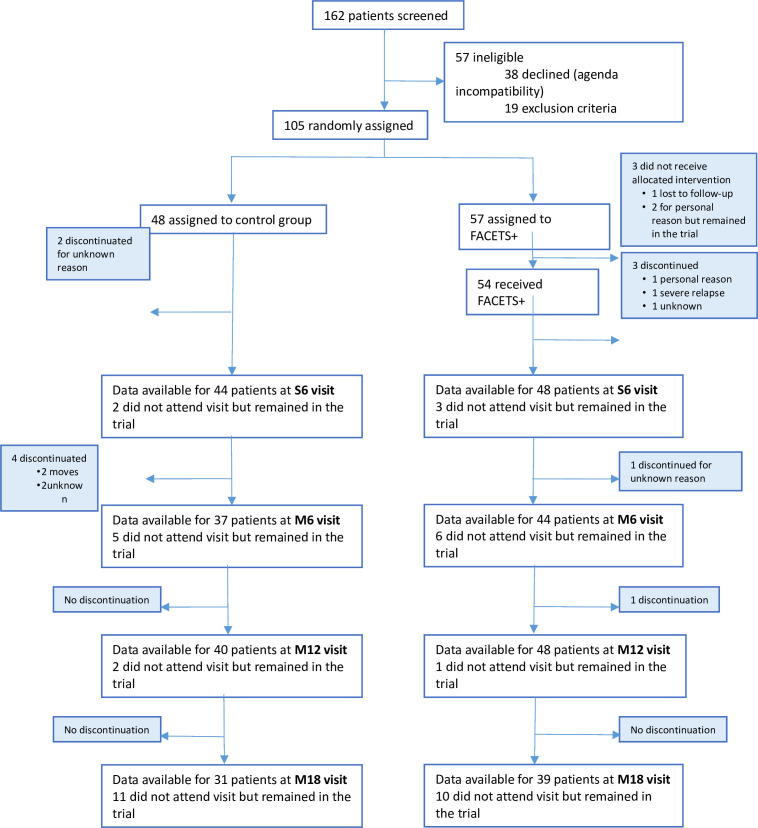
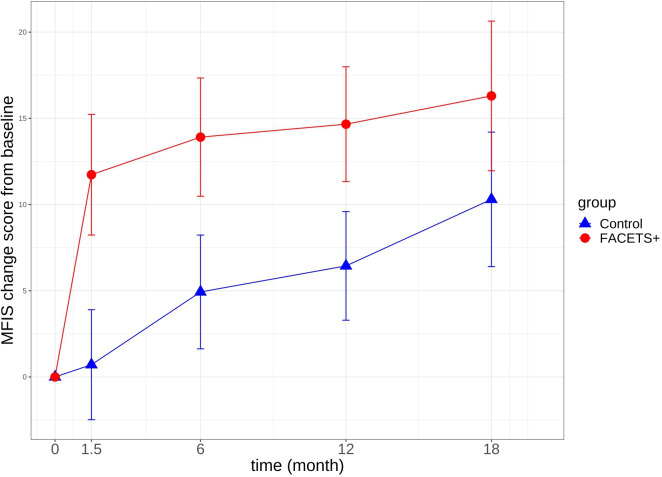
Background: Fatigue is a disabling symptom of multiple sclerosis (MS). The lack of effective therapeutics has promoted the development of cognitive behavioural therapy (CBT)-based fatigue management programmes. However, their efficacy does not sustain over time. We proposed to test the long-term effectiveness of a 6-week fatigue programme supplemented with four booster sessions (‘FACETS+’) in patients with relapsing remitting MS (RRMS) and fatigue. Methods: This multicentre, randomised, controlled, open-label, parallel-group trial versus standard care enrolled patients with RRMS and fatigue. Participants were randomised to either FACETS+ plus standard care or standard care alone. The primary outcome measure was fatigue impact (Modified Fatigue Impact Scale (MFIS) at 12 months) based on intention-to-treat analyses. Results: From May 2017 to September 2020, 162 patients were screened; 105 were randomly assigned to FACETS+ (n=57) or standard care (n=48) and 88 completed the primary outcome assessment for the MFIS. At month 12, participants showed improved MFIS compared with baseline in the intervention group (mean difference (MD)=14.0 points; (95% CI 6.45 to 21.5)) and the control group (MD=6.1 points; (95% CI −0.30 to 12.5)) with a significant between-group difference in favour of the intervention group (adjusted MD=7.89 points; (95% CI 1.26 to 14.52), standardised effect size=0.52, p=0.021). No trial-related serious adverse events were reported. Conclusions: A 6-week CBT-based programme with four booster sessions is superior to standard care alone to treat MS-related fatigue in the long term (12 months follow-up). The results support the use of the FACETS+ programme for the treatment of MS-related fatigue. Trial registration number: NCT03758820.
Overview
The claims and statistics of this paper haven’t been checked yet.
Free: it reads the open-access text and checks the first 5 claims that cite a source we can check. Create a free account to check every claim.
Integrity signals
Registry
Cites
Statistics
Figures
Verification
Claims the paper makes
The claims and statistics of this paper haven’t been checked yet.
Free: it reads the open-access text and checks the first 5 claims that cite a source we can check. Create a free account to check every claim.
Claims other papers make about this one
Each is checked against this paper’s own text: does it say what the citing paper says it does?
The cited source says what the claim attributes to it.
In the citing paper
“Encouragingly, the results of a recent randomised clinical trial suggest that the statistically significant positive effect of CBT on fatigue in multiple sclerosis was sustained over 12 months. 93”
From Persistent physical symptoms: definition, genesis, and management (2024) · cites this paper as [93]
Self-check
Percentages, sums and reported differences re-computed from the paper’s own numbers.
The self-check needs the paper’s full text.
Citations
Cites
Schwarzer, R. (2008) · Applied Psychology · doi:10.1111/j.1464-0597.2007.00325.x · Cited by 2,569 · cited 1×
“FACETS+ incorporates four face- to-face booster sessions (at weeks 6, 12, 18 and 36) drawing on Schwarzer’s Health Action Process Approach 30 31 in order to activate and reinforce the cognitive and behavioural processes initiated during the intervention.”
MethodSchwarzer, R., Lippke, S., & Luszczynska, A. (2011) · Rehabilitation Psychology · doi:10.1037/a0024509 · Cited by 743 · cited 1×
“FACETS+ incorporates four face- to-face booster sessions (at weeks 6, 12, 18 and 36) drawing on Schwarzer’s Health Action Process Approach 30 31 in order to activate and reinforce the cognitive and behavioural processes initiated during the intervention.”
MethodCognitive therapy: Past, present, and future
Beck, A. T. (1993) · Journal of Consulting and Clinical Psychology · doi:10.1037/0022-006x.61.2.194 · Cited by 513
van der Zweerde, T., Bisdounis, L., Kyle, S. D., Lancee, J., & van Straten, A. (2019) · Sleep Medicine Reviews · doi:10.1016/j.smrv.2019.08.002 · Cited by 336
Modafinil for fatigue in MS: A randomized placebo-controlled double-blind study
Stankoff, B., Waubant, E., Confavreux, C., Edan, G., Debouverie, M., Rumbach, L., Moreau, T., Pelletier, J., Lubetzki, C., Clanet, M., et al. (2005) · Neurology · doi:10.1212/01.wnl.0000158272.27070.6a · Cited by 318
A Randomized Controlled Trial of Cognitive Behavior Therapy for Multiple Sclerosis Fatigue
van Kessel, K., Moss-Morris, R., Willoughby, E., Chalder, T., Johnson, M. H., & Robinson, E. (2008) · Psychosomatic Medicine · doi:10.1097/psy.0b013e3181643065 · Cited by 276 · cited 1×
“All statistical analyses were performed using software R (V.4”
MethodThe Sonya Slifka Longitudinal Multiple Sclerosis Study: methods and sample characteristics
Minden, S. L., Frankel, D., Hadden, L., Perloff, J., Srinath, K. P., & Hoaglin, D. C. (2006) · Multiple Sclerosis Journal · doi:10.1191/135248506ms1262oa · Cited by 272
What drives quality of life in multiple sclerosis?
Hemmett, L., Holmes, J., Barnes, M., & Russell, N. (2004) · QJM: An International Journal of Medicine · doi:10.1093/qjmed/hch105 · Cited by 252
Asano, M., & Finlayson, M. L. (2014) · Multiple Sclerosis International · doi:10.1155/2014/798285 · Cited by 230
Moss-Morris, R., McCrone, P., Yardley, L., van Kessel, K., Wills, G., & Dennison, L. (2012) · Behaviour Research and Therapy · doi:10.1016/j.brat.2012.03.001 · Cited by 209
The EQ-HWB: Overview of the Development of a Measure of Health and Wellbeing and Key Results
Brazier, J., Peasgood, T., Mukuria, C., Marten, O., Kreimeier, S., Luo, N., Mulhern, B., Pickard, A. S., Augustovski, F., Greiner, W., et al. (2022) · Value in Health · doi:10.1016/j.jval.2022.01.009 · Cited by 177
Nourbakhsh, B., Revirajan, N., Morris, B., Cordano, C., Creasman, J., Manguinao, M., Krysko, K., Rutatangwa, A., Auvray, C., Aljarallah, S., et al. (2021) · The Lancet Neurology · doi:10.1016/s1474-4422(20)30354-9 · Cited by 173
Skerrett, T. N., & Moss-Morris, R. (2006) · Journal of Psychosomatic Research · doi:10.1016/j.jpsychores.2006.04.018 · Cited by 171
Rooney, S., McFadyen, D. A., Wood, D. L., Moffat, D. F., & Paul, P. L. (2019) · Multiple Sclerosis and Related Disorders · doi:10.1016/j.msard.2019.07.028 · Cited by 171
An examination of four models predicting fatigue in multiple sclerosis
STROBER, L., & ARNETT, P. (2005) · Archives of Clinical Neuropsychology · doi:10.1016/j.acn.2005.04.002 · Cited by 151 · cited 1×
“8 22 23 However, this effect does not last >6 months after the end of the sessions even if the effect on quality of life is maintained for a longer period of time.”
BackgroundThomas, S., Thomas, P. W., Kersten, P., Jones, R., Green, C., Nock, A., Slingsby, V., Smith, A. D., Baker, R., Galvin, K. T., et al. (2013) · Journal of Neurology, Neurosurgery & Psychiatry · doi:10.1136/jnnp-2012-303816 · Cited by 146
Self-citationvan den Akker, L. E., Beckerman, H., Collette, E. H., Eijssen, I. C. J. M., Dekker, J., & de Groot, V. (2016) · Journal of Psychosomatic Research · doi:10.1016/j.jpsychores.2016.09.002 · Cited by 143
Gearing, R. E., Schwalbe, C. S. J., Lee, R., & Hoagwood, K. E. (2013) · Depression and Anxiety · doi:10.1002/da.22118 · Cited by 136
Ehde, D. M., Elzea, J. L., Verrall, A. M., Gibbons, L. E., Smith, A. E., & Amtmann, D. (2015) · Archives of Physical Medicine and Rehabilitation · doi:10.1016/j.apmr.2015.07.015 · Cited by 132
Randomised controlled trial of a self-guided online fatigue intervention in multiple sclerosis
Pöttgen, J., Moss-Morris, R., Wendebourg, J.-M., Feddersen, L., Lau, S., Köpke, S., Meyer, B., Friede, T., Penner, I.-K., Heesen, C., et al. (2018) · Journal of Neurology, Neurosurgery & Psychiatry · doi:10.1136/jnnp-2017-317463 · Cited by 129
Penner, I.-K., Bechtel, N., Raselli, C., Stöcklin, M., Opwis, K., Kappos, L., & Calabrese, P. (2007) · Multiple Sclerosis Journal · doi:10.1177/1352458507079267 · Cited by 111
Moss-Morris, R. E., Harrison, A. M., Safari, R., Norton, S., van der Linden, M. L., Picariello, F., Thomas, S., White, C. M., & Mercer, T. H. (2019) · Behaviour Research and Therapy · doi:10.1016/j.brat.2019.103464 · Cited by 103
Self-citationEfthymiadou, O., Mossman, J., & Kanavos, P. G. (2018) · Health Policy · doi:10.1016/j.healthpol.2018.12.003 · Cited by 98
Management of Fatigue in Patients with Multiple Sclerosis
Zifko, U. (2004) · Drugs · doi:10.2165/00003495-200464120-00003 · Cited by 97
Quality of life in multiple sclerosis is dominated by fatigue, disability and self-efficacy
Young, C. A., Mills, R. J., Rog, D. J., Sharrack, B., Majeed, T., Constantinescu, C. S., Kalra, S., Harrower, T., Santander, H., Courtald, G., et al. (2021) · Journal of the Neurological Sciences · doi:10.1016/j.jns.2021.117437 · Cited by 84
van den Akker, L. E., Beckerman, H., Collette, E. H., Twisk, J. W., Bleijenberg, G., Dekker, J., Knoop, H., de Groot, V., & TREFAMS-ACE Study Group (2017) · Multiple Sclerosis Journal · doi:10.1177/1352458517709361 · Cited by 80
van Kessel, K., Wouldes, T., & Moss-Morris, R. (2016) · Clinical Rehabilitation · doi:10.1177/0269215515584800 · Cited by 71
Linardon, J. (2018) · Cognitive Behaviour Therapy · doi:10.1080/16506073.2018.1427785 · Cited by 68
Thomas, P. W., Thomas, S., Kersten, P., Jones, R., Slingsby, V., Nock, A., Davies Smith, A., Baker, R., Galvin, K. T., & Hillier, C. (2014) · BMC Neurology · doi:10.1186/1471-2377-14-109 · Cited by 67
Self-citation(2016) · Neurodegenerative Disease Management · doi:10.2217/nmt.15.55 · Cited by 61
Thomas, S., Thomas, P., Nock, A., Slingsby, V., Galvin, K., Baker, R. D., Moffat, N., & Hillier, C. (2009) · Patient Education and Counseling · doi:10.1016/j.pec.2009.07.001 · Cited by 52
Self-citationLong-term follow-up after cognitive behaviour therapy for chronic fatigue syndrome
Janse, A., Nikolaus, S., Wiborg, J. F., Heins, M., van der Meer, J. W. M., Bleijenberg, G., Tummers, M., Twisk, J., & Knoop, H. (2017) · Journal of Psychosomatic Research · doi:10.1016/j.jpsychores.2017.03.016 · Cited by 30
de Groot, V., Beckerman, H., Twisk, J. W. R., Uitdehaag, B. M. J., Hintzen, R. Q., Minneboo, A., Lankhorst, G. J., Polman, C. H., & Bouter, L. M. (2008) · Acta Dermato Venereologica · doi:10.2340/16501977-0145 · Cited by 29
Differential Diagnosis and Management of Fatigue in Multiple Sclerosis: Considerations for the Nurse
Costello, K., & Harris, C. J. (2003) · Journal of Neuroscience Nursing · doi:10.1097/01376517-200306000-00003 · Cited by 26
Blome, C., Carlton, J., Heesen, C., Janssen, M. F., Lloyd, A. J., Otten, M., & Brazier, J. E. (2021) · Quality of Life Research · doi:10.1007/s11136-021-02802-8 · Cited by 15
Reconsidérer l’apparition du handicap dès le début de la SEP : la fatigue
Debouverie, M., Pittion‐Vouyovitch, S., & Guillemin, F. (2009) · Revue Neurologique · doi:10.1016/s0035-3787(09)72125-3 · Cited by 12
Hawton, A., Goodwin, E., Boddy, K., Freeman, J. A., Thomas, S., Chataway, J., & Green, C. (2020) · Multiple Sclerosis Journal · doi:10.1177/1352458520954172 · Cited by 12
Self-citationNegreiros, J., Selles, R. R., Lin, S. Y., Belschner, L., & Stewart, S. E. (2019) · Annals of Clinical Psychiatry · doi:10.1177/154733251903100312 · Cited by 8
Cited by
Persistent physical symptoms: definition, genesis, and management
Löwe, B., Toussaint, A., Rosmalen, J. G. M., Huang, W.-L., Burton, C., Weigel, A., Levenson, J. L., & Henningsen, P. (2024) · The Lancet · doi:10.1016/s0140-6736(24)00623-8 · Cited by 280
Vo, H. L. T., Elias, S., & Hardy, T. A. (2024) · Multiple Sclerosis and Related Disorders · doi:10.1016/j.msard.2024.105908 · Cited by 17
Non-pharmacological treatment options for fatigue: A systematic review of RCTs in adults
Steen, C., Zalpur, A., Bentele, M., Zipfel, S., & Stengel, A. (2025) · Journal of Psychosomatic Research · doi:10.1016/j.jpsychores.2025.112084 · Cited by 11
Leaviss, J., Booth, A., Coyle, D., Daly, G., Davis, S., Dawes, H., Deary, V., Dwivedi, K., Forsyth, J. E., Fryer, K., et al. (2026) · BMJ Medicine · doi:10.1136/bmjmed-2025-001746 · Cited by 7
Linking Pathogenesis to Fall Risk in Multiple Sclerosis
Patel, J., Fraix, M. P., & Agrawal, D. K. (2025) · Archives of Internal Medicine Research · doi:10.26502/aimr.0194 · Cited by 6
Metadata
- Authors
- Gay, M. C., Cassedanne, F., Barbot, F., Vaugier, I., Thomas, S., Manchon, E., Bensmail, D., Blanchere, M., & Heinzlef, O.
- Affiliations
- Université Paris Nanterre (FR)
- Inserm (FR)
- Bournemouth University (GB)
- Centre Hospitalier Intercommunal de Poissy (FR)
- Corresponding author
- Heinzlef, Olivier
- Venue
- Journal of Neurology, Neurosurgery & Psychiatry
- Publisher
- BMJ
- Published
- 2023-08-30
- Volume
- 95
- Issue
- 2
- Pages
- 158-166
- ISSN
- 0022-3050 (ISSN-L)
- 1468-330X
- PMC
- PMC10850683
- OpenAlex
- W4386282461
- Semantic Scholar
- 483ceff099a853477feba3fa91b0290bde2a43aa
- Cited by
- 22
- References
- 38
- Citations by year
- 2026: 7 · 2025: 7 · 2024: 8
- FWCI
- 4.36
- Type
- journal article
- Language
- en
- Open access
- hybrid
- doi.org
- Licence
- Locations
- Journal of Neurology Neurosurgery & Psychiatry (publishedVersion, cc-by-nc)
- PubMed Central (publishedVersion, cc-by-nc)
- PubMed (publishedVersion)
- Bournemouth University Research Online (Bournemouth University) (acceptedVersion)
- HAL (submittedVersion, cc-by-nc)
- HAL (submittedVersion)
- HighWire Press Open Archive (submittedVersion)
- Funders
- Novartis (NA)
- Agence Nationale de la Recherche (NA)
- Ligue Contre la sclerose en plaques (NA)
- Merck (10.13039/100009945)
- Topics
- Health Sciences › Medicine › Clinical Neurology › Multiple Sclerosis Research Studies
- Health Sciences › Medicine › Oncology › Cancer survivorship and care
- Social Sciences › Psychology › Clinical Psychology › Mindfulness and Compassion Interventions
- Keywords
- multiple sclerosis, fatigue, cognitive behavioral therapy, relapsing-remitting multiple sclerosis, booster sessions, long-term effectiveness, fatigue effects, Modified Fatigue Impact Scale, fatigue management
- MeSH terms
- Fatigue, Humans, Multiple Sclerosis, Cognitive Behavioral Therapy, Outcome Assessment, Health Care, Multiple Sclerosis, Relapsing-Remitting
About these checks
Registry, retraction, Cites and statistics results are computed, not judged, with one exception: a printed reference that no index lists is read once by a model before it counts as a citation error. Claims are extracted by a model and kept only when their quote appears verbatim in the text; each cited source is then checked, with a model’s help, for whether it says what the claim relies on. Those verdicts can be wrong — read the claim’s quote and the cited source before relying on one.
Statistics and arithmetic are recomputed, not judged.
Confidence bands are shown only for fields calibrated on our annotated test set. None is calibrated yet, so no band is shown.
What counts as a claim ›How we measure confidence ›How we check this ›
Are you an author, or do you see a problem with this page? Request a review
Data sources
Bibliographic data: Semantic Scholar, OpenAlex, Crossref.
Contains information from the Semantic Scholar Academic Graph Datasets, made available under the ODC Attribution License (ODC-BY 1.0).
Semantic Scholar’s data is described in: Kinney, R., et al. (2023). The Semantic Scholar Open Data Platform. arXiv:2301.10140.
