

Quantifying echo chamber effects in information spreading over political communication networks
Open accessThe DOI matches its Crossref record; 43 of the 43 references it cites were found in a registry or an index.
Abstract
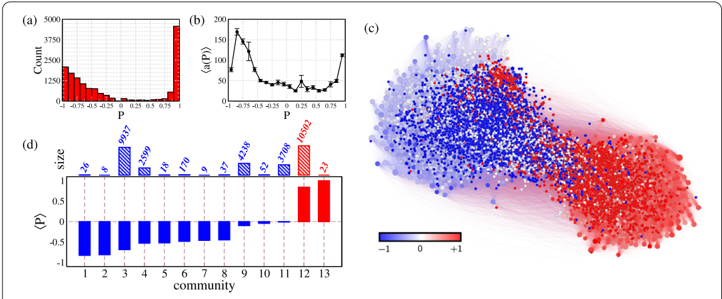
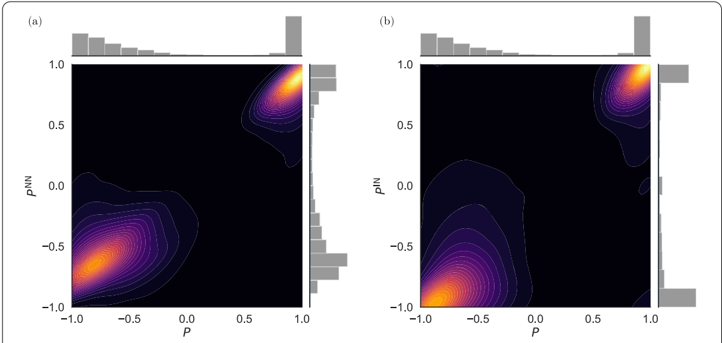
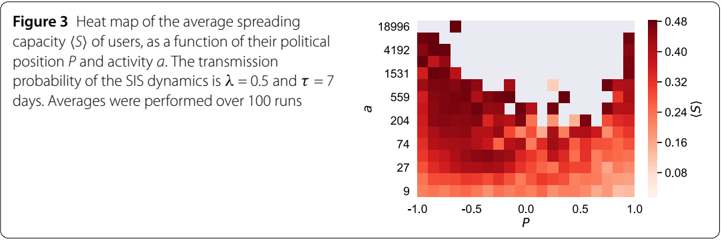
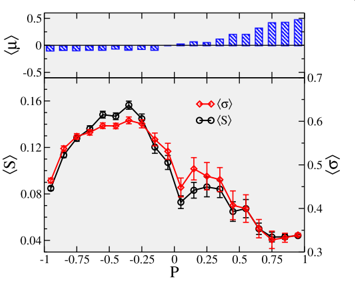
Echo chambers in online social networks, in which users prefer to interact only with ideologically-aligned peers, are believed to facilitate misinformation spreading and contribute to radicalize political discourse. In this paper, we gauge the effects of echo chambers in information spreading phenomena over political communication networks. Mining 12 million Twitter messages, we reconstruct a network in which users interchange opinions related to the impeachment of the former Brazilian President Dilma Rousseff. We define a continuous political leaning parameter, independent of the network’s structure, that allows to quantify the presence of echo chambers in the strongly connected component of the network. These are reflected in two well-separated communities of similar sizes with opposite views of the impeachment process. By means of simple spreading models, we show that the capability of users in propagating the content they produce, measured by the associated spreading capacity, strongly depends on their attitude. Users expressing pro-impeachment leanings are capable to transmit information, on average, to a larger audience than users expressing anti-impeachment leanings. Furthermore, the users’ spreading capacity is correlated to the diversity, in terms of political position, of the audience reached. Our method can be exploited to identify the presence of echo chambers and their effects across different contexts and shed light upon the mechanisms allowing to break echo chambers.
Overview
The claims and statistics of this paper haven’t been checked yet.
Free: it reads the open-access text and checks the first 5 claims that cite a source we can check. Create a free account to check every claim.
Integrity signals
Registry
Cites
Statistics
Figures
Verification
Claims the paper makes
The claims and statistics of this paper haven’t been checked yet.
Free: it reads the open-access text and checks the first 5 claims that cite a source we can check. Create a free account to check every claim.
Claims other papers make about this one
Each is checked against this paper’s own text: does it say what the citing paper says it does?
The cited source says what the claim attributes to it.
In the citing paper
“Furthermore, users show a tendency to favor information adhering to their beliefs and join groups formed around a shared narrative, that is, echo chambers (1, 14–18).”
From The echo chamber effect on social media (2021) · cites this paper as [18]
The cited source says what the claim attributes to it.
In the citing paper
“Simple models of information spreading can gauge the presence of echo chambers: Users are expected to be more likely to exchange information with peers sharing a similar leaning (18, 42, 43).”
From The echo chamber effect on social media (2021) · cites this paper as [18]
The cited source says what the claim attributes to it.
In the citing paper
“Echo chambers have been quantified in several controversial debates on different social media platforms [2, 16, 17] and may be related to the spread of misinformation [18].”
From Modeling echo chambers and polarization dynamics in social networks (2020) · cites this paper as [16]
The cited source says what the claim attributes to it.
In the citing paper
“In network terms, this translates into a node i with a given leaning xi more likely to be connected with nodes with a leaning close to xi (18).”
From The echo chamber effect on social media (2021) · cites this paper as [18]
The cited source says what the claim attributes to it.
In the citing paper
“On the other hand, when considering social networks and the impact of digital media on homophilic structures, the literature contains consistent reports of ideologically homogeneous social clusters147–151.”
From A systematic review of worldwide causal and correlational evidence on digital media and democracy (2022) · cites this paper as [149]
2 more claims about this paper
Create a free account to see every claim other papers make about this one.
Self-check
Percentages, sums and reported differences re-computed from the paper’s own numbers.
The self-check needs the paper’s full text.
Citations
Cites
Fast unfolding of communities in large networks
Blondel, V. D., Guillaume, J.-L., Lambiotte, R., & Lefebvre, E. (2008) · Journal of Statistical Mechanics: Theory and Experiment · doi:10.1088/1742-5468/2008/10/p10008 · Cited by 21,424
Social Network Analysis: Methods and Applications
Wasserman, S., & Faust, K. (1994) · doi:10.1017/cbo9780511815478 · Cited by 17,557
Fortunato, S. (2010) · Physics Reports · doi:10.1016/j.physrep.2009.11.002 · Cited by 11,293
Newman, M. (2010) · doi:10.1093/acprof:oso/9780199206650.001.0001 · Cited by 6,595
Infectious Diseases of Humans: Dynamics and Control
Anderson, R. M., & May, R. M. (1991) · doi:10.1093/oso/9780198545996.001.0001 · Cited by 6,179
Lazer, D., Pentland, A., Adamic, L., Aral, S., Barabási, A.-L., Brewer, D., Christakis, N., Contractor, N., Fowler, J., Gutmann, M., et al. (2009) · Science · doi:10.1126/science.1167742 · Cited by 3,365
A simple model of global cascades on random networks
Watts, D. J. (2002) · Proceedings of the National Academy of Sciences · doi:10.1073/pnas.082090499 · Cited by 2,673
A 61-million-person experiment in social influence and political mobilization
Bond, R. M., Fariss, C. J., Jones, J. J., Kramer, A. D. I., Marlow, C., Settle, J. E., & Fowler, J. H. (2012) · Nature · doi:10.1038/nature11421 · Cited by 2,575
The spreading of misinformation online
Del Vicario, M., Bessi, A., Zollo, F., Petroni, F., Scala, A., Caldarelli, G., Stanley, H. E., & Quattrociocchi, W. (2016) · Proceedings of the National Academy of Sciences · doi:10.1073/pnas.1517441113 · Cited by 2,407
Ferrara, E., Varol, O., Davis, C., Menczer, F., & Flammini, A. (2016) · Communications of the ACM · doi:10.1145/2818717 · Cited by 1,973
Research works printed but not linked: 7
- 1. Masum H, Newmark C, Tovey M (2011) The reputation society: how online opinions are reshaping the offline world. Information society series. MIT Press, Cambridge
- 9. Borge-Holthoefer J, Magdy W, Darwish K, Weber I (2015) Content and network dynamics behind Egyptian political polarization on Twitter. In: Proceedings of the 18th ACM conference on computer supported cooperative work & social computing, CSCW 2015, Vancouver, BC, Canada, March 14-18, 2015, pp 700-711
- 22. Lambiotte R, Masuda N (2016) A guide to temporal networks. Series on complexity science, vol 4. World Scientific, Singapore
- 23. Galuba W, Aberer K, Chakraborty D, Despotovic Z, Kellerer W (2010) Outtweeting the Twitterers-predicting information cascades in microblogs. In: Proceedings of the 3rd wonference on online social networks, WOSN'10. USENIX Association, Berkeley, pp 3-3
- Holme P, Saramäki J (eds) (2013) Temporal networks. Springer, Berlin
- 33. Anderson RM, May RM (1992) Infectious diseases in humans. Oxford University Press, Oxford
- 46. Saito K, Nakano R, Kimura M (2008) Prediction of information diffusion probabilities for independent cascade model. In: Proceedings of the 12th international conference on knowledge-based intelligent information and engineering systems, part III, KES '08. Springer, Berlin, pp 67-75
Cited by
Items 101–188 of 188
Reconstructing community structure of online social network via user opinions
Li, R., Guo, Q., Zhang, X.-K., & Liu, J.-G. (2022) · Chaos An Interdisciplinary Journal of Nonlinear Science · doi:10.1063/5.0086796 · Cited by 5
Kozitsin, I. (2023) · Computers · doi:10.3390/computers12090178 · Cited by 6
“…balance between cross-ideological and coherent replies— may raise some concerns, but we will proceed from the notice that people prefer to avoid conflict situations and communicate primarily with those espousing similar views, as reported by empirical studies of online communication networks [40].”
BackgroundInformation parity in complex networks
Viol, A., Vuksanović, V., & Hövel, P. (2020) · Physica A Statistical Mechanics and its Applications · doi:10.1016/j.physa.2020.125233 · Cited by 5
To Comment or Not to Comment: Communication Strategies of Social Media Commentators
Luk'yanova, G. V. (2020) · Communication Strategies in Digital Society Seminar (ComSDS) · doi:10.1109/comsds49898.2020.9101250 · Cited by 5
Guest, N. M., Twedt, B. J., & Vosse, M. M. (2023) · SSRN Electronic Journal · doi:10.2139/ssrn.4487717 · Cited by 6
“…we analyze the amount and information content of tweets issued on the day the firm announces earnings, as Twitter is a key channel through which homogenous beliefs have been shown to be reinforced and propagated (Cota et al. 2019; Cinelli et al. 2021; Di Tella et al. 2021; Campbell et al. 2022).”
BackgroundMethodSun, Y., Gao, Y., Zheng, W., & Liu, F. (2025) · Online Information Review · doi:10.1108/oir-11-2024-0735 · Cited by 4
How opinions crystallise: an analysis of polarisation in the voter modelPreprint
Vendeville, A., Guedj, B., & Zhou, S. (2020) · arXiv (Cornell University) · doi:10.1007/978-3-030-93413-2_29
Quantifying the drivers behind collective attention in information ecosystems
Calleja-Solanas, V., Pigani, E., Palazzi, M. J., Solé‐Ribalta, A., Suweis, S. S., Borge‐Holthoefer, J., & Meloni, S. (2021) · Journal of Physics Complexity · doi:10.1088/2632-072x/ac35b6 · Cited by 4
“This duality and the new paradigm it induced, make also OSNs a perfect example of social information processing, leading to emergent phenomena such as viral information spreading [1], fake news [2] and the formation of echo-chambers [3, 4].”
BackgroundJesenšek, L., & Verčič, D. (2025) · Communications · doi:10.1515/commun-2024-0018 · Cited by 5
Twitter polarity and computational propaganda: the case of the Woman, Life, Freedom movement in Iran
Rahbari, M. M., Blanchard, P., & Safari, H. (2025) · Journal of Information Technology & Politics · doi:10.1080/19331681.2025.2537270 · Cited by 3
Carrasco, L. M. V., Naranjo, M. M., Naranjo, P. M., & Ortiz, W. X. C. (2025) · Polo del Conocimiento · doi:10.23857/pc.v10i1.8798 · Cited by 3
La culpabilidad más allá de la neurociencia: ¿qué sigue?
Arana, A. F. D. (2020) · Revista Mexicana de Ciencias Penales · doi:10.57042/rmcp.v3i12.364 · Cited by 5
They Will Surveil You to Death: Gangstalking as a Cultural Concept of Distress
Reed, J. C. (2024) · Culture Medicine and Psychiatry · doi:10.1007/s11013-024-09881-5 · Cited by 3
“This study furthers inquiry into potential mis/information or alternative (non-science-based) views with significant influence on mental health, but in a peer setting where information is more freely shared (Cota et al., 2019).”
X’s role in shaping mental health conversations in Nigeria
Nwagbara, U. U., & Dennis, W. U. (2025) · Discover Global Society · doi:10.1007/s44282-025-00173-w · Cited by 3
“Moreover, misinformation and echo chambers reinforce harmful narratives, particularly in contexts where mental illness is heavily stigmatised, such as Nigeria [15, 16, 42].”
Reducing echo chamber effects: an allostatic regulator for recommendation algorithms
Henry, N., Pedersen, M., Williams, M. N., Martin, J. L. B., & Donkin, L. (2025) · Journal of Psychology and AI · doi:10.1080/29974100.2025.2517191 · Cited by 3
Emergence, survival, and segregation of competing gangs
Pérez-Martínez, H., Mingueza, F. B., Soriano‐Paños, D., Gómez‐Gardeñes, J., & Floría, L. M. (2022) · Chaos An Interdisciplinary Journal of Nonlinear Science · doi:10.1063/5.0084972 · Cited by 4
Ünver, H. A. (2019) · SocArXiv (OSF Preprints) · doi:10.31235/osf.io/nj8gx · Cited by 5
Career Cocoons: Analyzing Occupational Mobility with Graph Embedding Model
Liu, J., Wang, T., Yao, F., Huang, J., He, R., & Li, J. (2023) · International Conference on Data Science and Information Technology (DSIT) · doi:10.1109/dsit60026.2023.00027 · Cited by 2
“For example, [9, 17] analyzed the homogeneity of social networks and the bias of information diffusion, identifying homogeneity and polarization as the factors characterizing information cocoons.”
BackgroundDong, X. (2025) · Discover Sustainability · doi:10.1007/s43621-025-01649-0 · Cited by 2
“Acknowledging that digital information environments inherently shape students’ viewpoints [13–15, 49, 50, 52–54], we demonstrate that any thinking solutions developed through higher education for achieving sustainability must account for varying degrees of information cocoon penetration.”
Temporal stability and cross-topic re-emergence of ideological divides on X
Riedl, J., Drews, W., Dafnos, A., & Neumeier, A. (2026) · Information Communication & Society · doi:10.1080/1369118x.2026.2659287 · Cited by 3
Inafuku, K., Fushimi, T., & Satoh, T. (2022) · Social Network Analysis and Mining · doi:10.1007/s13278-022-00865-0 · Cited by 2
“In addition to network structure and interaction, research focusing on the contents of information is also active (Cota et al. 2019; Stieglitz and Dang-Xuan 2013; Takashi et al. 2016).”
BackgroundSuswanta, S., & Setiawan, A. (2024) · Revista de Gestão Social e Ambiental · doi:10.24857/rgsa.v18n2-141 · Cited by 2
“This form of communication between the government and society aims for the government to explain policies while the public seeks transparency and effectiveness (Cota et al. 2019).”
BackgroundClaud, F. (2024) · International Journal of Political Science and Public Administration · doi:10.51483/ijpspa.4.1.2024.72-95 · Cited by 2
Analyst cliques coverage and the speed of leverage adjustment: Evidence from China
Ouyang, H., Liu, X., & Huang, K. (2024) · International Review of Economics & Finance · doi:10.1016/j.iref.2024.103731 · Cited by 3
Understanding Political Narratives: Word Cloud Analysis of Yoon Seok-Yeol's Impeachment
Rahmadani, S., & Yuadi, I. (2025) · Journal of Law Politic and Humanities · doi:10.38035/jlph.v5i4.1427 · Cited by 3
“On the other hand, Cota et al. (2019) probe how echo chambers within political networks support information flow but at the same time limit ideological diversity.”
Tommasel, A., & Assent, I. (2023) · IEEE International Conference on Big Data (BigData) · doi:10.1109/bigdata59044.2023.10386616 · Cited by 2
“We assessed user interactions based on their political alignment using the same metrics as in [20, 26].”
MethodDuskin, K. (2024) · ACM Web Science Conference (WebSci) · doi:10.1145/3630744.3658615 · Cited by 2
“Some studies have focused on political echo chambers [11, 23], and their relationship to online political polarization [14, 22, 24, 33] while others have focused on the spread of misinformation [17, 36].”
BackgroundInfodemics on Youtube: Reliability of Content and Echo Chambers on COVID-19Preprint
Marco, N. D., Cinelli, M., & Quattrociocchi, W. (2021) · arXiv (Cornell University) · doi:10.13140/rg.2.2.27101.33766 · Cited by 3
Quantifying Opinion Rejection: A Method to Detect Social Media Echo Chambers
Perera, K., & Karunasekera, S. A. (2024) · Lecture notes in computer science · doi:10.1007/978-981-97-2266-2_5 · Cited by 4
Humanitarian Communication and virtual reality: Empathy and intention to share information
Borah, P., Lee, D. K. L., Mu, D., Vishnevskaya, A., Irom, B., Price, R., Ramazan, O., & Lee, Y. J. (2025) · Atlantic Journal of Communication · doi:10.1080/15456870.2025.2606391 · Cited by 1
“…sharing and its behavioral implications are studied in a variety of domains, such as health communication (e.g., Wu & Kuang, 2021) political communication (e.g., Cota et al., 2019), organizational communication (e.g., Yang & Maxwell, 2011), as well as crisis communication (Standley et al., 2020).”
Vadapalli, S. K., Doyal, S., Vanheusden, F. J., Binder, J. F., & Kuss, D. J. (2026) · SN Social Sciences · doi:10.1007/s43545-026-01349-0 · Cited by 2
“Put together, these perspectives on clustering in social networks can help strengthen the understanding of the association between echo chambers, the spread of misinformation online, and ideological polarisation (Cota et al. 2019 ; Interian et al. 2023; Gil de Zúñiga et al. 2025 ).”
Kawahata, Y., & Hatadani, S. (2026) · Games · doi:10.3390/g17050045 · Cited by 1
“Furthermore, as quantified by Cota et al. (2019), users’ information spreadability correlates strongly with their political stances, and agents with specific extreme opinions are more likely to broadly diffuse information beyond their own echo chambers.”
Digitalisierung und Demokratie: Ethische Perspektiven
Grimm, P., & Zöllner, O. (2020) · Franz Steiner Verlag eBooks · doi:10.25162/9783515128278 · Cited by 1
Exploring the echo chamber concept: A linguistic perspective
Bondi, M., & Sanna, L. (2022) · Discourse approaches to politics, society and culture · doi:10.1075/dapsac.98.07bon · Cited by 5
Suswanta, S., & Setiawan, A. (2022) · doi:10.2991/978-2-494069-65-7_70 · Cited by 1
The Effect of Increasing Number of Topics to Polarization and Echo Chambers on SNS
Nagura, T., & Akiyama, E. (2023) · Transactions of the Japanese Society for Artificial Intelligence · doi:10.1527/tjsai.38-4_b-n11 · Cited by 1
Confirmation Bias-Aware Fake News Detection with Graph Transformer Networks
Soga, K., Yoshida, S., & Muneyasu, M. (2023) · Global Conference on Consumer Electronics · doi:10.1109/gcce59613.2023.10315635
“This bias in fake news spread relates to opinion radicalization [12].”
BackgroundA primer on data-driven modeling \@ifstar{}of complex social systems
Volkening, A. (2025) · Proceedings of symposia in applied mathematics · doi:10.1090/psapm/080/00726 · Cited by 2
Evolution of swing voters under strategic campaigns in presidential elections
Liu, Z., Wang, X., Lu, J., Liu, L., Zheng, H., & Tang, S. (2026) · Physical Review Research · doi:10.1103/jdyh-t4rp · Cited by 3
Echo chamber effects based on a novel three-dimensional Deffuant-Weisbuch modelPreprint
Gao, F., & Xu, Y. (2022) · arXiv (Cornell University) · doi:10.48550/arxiv.2209.07748 · Cited by 1
Hernandez, J. P. T. (2022) · Zenodo (CERN European Organization for Nuclear Research) · doi:10.5281/zenodo.7030283 · Cited by 1
Evidence-Based Policy and Misinformation: Exploring the Public's Processing of Information
Hann, A. E. (2025) · International Journal of Strategic Research in Public Administration and Organizational Process · doi:10.48028/iiprds/ijsrpaop.v5.i1.11
Once Upon a Time a Trump Was Just a Bad Smell
Pollitt, E. (2021) · Figshare
Digitalisierung und Demokratie: Eine Momentaufnahme
Mechnich, J., & Kallinich, D. (2019) · Journal für politische Bildung · doi:10.46499/1254.1679
Reconstructing social sensitivity from evolution of content volume in Twitter
Pinto, S., Trevisan, M. A., & Balenzuela, P. (2022) · Physical review. E · doi:10.1103/physreve.106.064308
Impact of Dimensionality of User Interaction Subspace on Multi-dimensional Opinion Formation
Hirakura, N., & Aida, M. (2022) · IEEE Intl Conf on Dependable, Autonomic and Secure Computing, Intl Conf on Pervasive Intelligence and Computing, Intl Conf on Cloud and Big Data Computing, Intl Conf on Cyber Science and Technology Congress (DASC/PiCom/CBDCom/CyberSciTech) · doi:10.1109/dasc/picom/cbdcom/cy55231.2022.9927833 · Cited by 1
Axiomatic and Algorithmic Study on Different Areas of Collective Decision Making
Seeger, T. (2022) · Lecture notes in computer science · doi:10.1007/978-3-031-20614-6_27
Phase Transitions in Ising Model Defined on Complex Networks
Nikitina, M. M., & Bazhenov, A. (2023) · Reviews on advanced materials and technologies · doi:10.17586/2687-0568-2023-5-1-16-21
Biostatistical Analysis on the Generation Mechanism of Neutral Consensus and Opinion Polarization
Zhao, B., & Jiang, X. (2023) · Journal of Biomedical Research & Environmental Sciences · doi:10.37871/jbres1752
Biostatistical Models of Breaking the "Scream Effect" and "Echo Chamber Effect"
Zhao, B. (2022) · American Journal of Biomedical Science & Research · doi:10.17303/jaaa.2024.1.105
Mechanisms For Information Enhancement In Distributed Intelligent Network Systems
Alodjants, A. P. (2023) · International Conference Management of Large-Scale System Development (MLSD) · doi:10.1109/mlsd58227.2023.10304021
“In the absence of an echo chamber, s-information spreads in social networks and may be lost after several (or even many) steps, which are characterized by the lifetime of the s-quanta 1 23 ∝ 1/6, where 6 characterizes the rate of loss of s-field quanta from the region occupied by DIS, c.f. [14].”
Backgrounddel Pozo, S. M., Pinto, S., Serafino, M., Cicchini, T., Moss, F., Makse, H. A., & Balenzuela, P. (2023) · Research Square · doi:10.21203/rs.3.rs-3627291/v1
Biostatistical Analysis on the Generation Mechanism of Neutral Consensus and Opinion Polarization
Zhao, B. (2024) · Open Access Journal of Data Science and Artificial Intelligence · doi:10.23880/oajda-16000115
Measuring Political Activity How Online and Offline Political Activities Connect
Túry-Angyal, E. (2024) · CUB Ph.D. Dissertations (Corvinus University of Budapest) · doi:10.14267/phd.2024034
de Oliveira, N. R., Medeiros, D. S. V., & Mattos, D. M. F. (2024) · Simpósio Brasileiro de Cibersegurança (SBSeg) · doi:10.5753/sbseg.2024.241730
A tudományba vetett bizalom alakulása: értékek és dimenziók
Kobl, G. A. (2024) · Kultúra és Közösség · doi:10.35402/kek.2024.3.21
“Ezek a visszhangkamrák, melyek a meglévő hiedelmek megerősítésére és az eltérő nézetek kizárására épül-nek, gátolhatják a nyílt párbeszédet és az ellenté-tes nézőpontok kritikai vizsgálatát (Cota et al., 2019).”
Dorendro, A., & Devi, H. M. (2025) · Lecture notes in networks and systems · doi:10.1007/978-981-97-9523-9_9
KALKINMANIN İKTİSADİ, SOSYAL VE KÜLTÜREL BOYUTLARI BAĞLAMINDA YAPAY ZEKA
Demir, C. (2025) · Pamukkale University Journal of Social Sciences Institute · doi:10.30794/pausbed.1611378
Wesemael, T. V., Rocha, L. E. C., Alleman, T. W., & Baetens, J. M. (2026) · Journal of Medical Internet Research · doi:10.2196/87723
A Multilayer Network Approach to Identifying Investors' Echo Chambers in Chinese Stock Forums (Guba)Preprint
Liu, X. (2025) · SSRN Electronic Journal · doi:10.2139/ssrn.5625050
Occam’s Razor in Pooling of Probability Densities
Kárný, M. (2025) · IEEE Signal Processing Letters · doi:10.1109/lsp.2025.3640068
“Weakly overlapping echo chambers [23] are a real example of such cases. which are given by the partially known p on v c , ∀ c ∈ c .”
Cicchini, T., del Pozo, S. M., Tagliazucchi, E., & Balenzuela, P. (2022) · Figshare · doi:10.6084/m9.figshare.20521412
Emergent properties of multi-agent dynamics on networks and spaces
Bara, J. (2026) · Warwick Research Archive Portal (University of Warwick) · doi:10.82444/warw.33889471
Wahlström, L. (2023) · DiVA (Digitala Vetenskapliga Arkivet)
Beaudoin-Paul, É. (2022) · Papyrus : Institutional Repository (Université de Montréal) · doi:10.71781/12784
Codal, K. S. (2026) · Gazi Üniversitesi Fen Bilimleri Dergisi Part C Tasarım ve Teknoloji · doi:10.29109/gujsc.1839147
Stable Boundaries of Opinion Dynamics in Heterogeneous Spatial Complex Networks
Bierwirth, M., & Lengler, J. (2026) · Entropy · doi:10.3390/e28040401
“It is natural that those properties foster coexistence of competing opinions [40,41], since an isolated cluster of one opinion can only be stable if every vertex has at least as many edges inside of the cluster as outside, a condition closely connected to the concepts of communities and of small…”
Zadeh, A. H., & Swinford, D. (2026) · Journal of Information Technology Case and Application Research · doi:10.1080/15228053.2026.2655484
“Finally, to assess the presence of echo-chamber dynamics, the study examines the degree of narrative segregation in hashtag usage (Cota et al., 2019; Jiang et al., 2021).”
Partition Diversity in Complex Networks
Mangold, L. (2025) · theses.fr (ABES) · doi:10.70675/65c3485bz7da2z4fd6z91fcz90db3ecec3bb
External-Facing Communication on Social Media During the Russia-Ukraine Conflict of 2014
Ahmed, K. M., Choe, S., de Freitas, C., Patil, S., & Kogan, M. (2026) · CHI Conference on Human Factors in Computing Systems · doi:10.1145/3772318.3791595 · Cited by 1
“Because hashtags are often indicative of specific political viewpoints [45], hashtag projection can be an effective method for estimating a tweet’s political leaning.”
Griffiths, L., & Ismagilova, E. (2026) · IFIP advances in information and communication technology · doi:10.1007/978-3-032-16775-0_8
Santosh, M., Vishal Khanna, P., & Raja Mohamed, N. (2026) · International Conference on Intelligent Computing and Control Systems (ICICCS) · doi:10.1109/iciccs67901.2026.11502794
“Cota, et al. [4] provide very strong quantitative analysis of political networks and how echo chambers filter and influence the sharing of information in politics.”
PANther: Party-specific Attention-based Networks for Accurate Political Perspective Detection
Ryu, S., & Kim, S. (2026) · ACM Symposium on Applied Computing · doi:10.1145/3748522.3780001
“This tendency has exacerbated the echo chamber effect [2, 6, 52] and political polarization [8, 12, 16–18, 47, 49, 56, 57].”
da Silva, D. P. (2026) · Intellèctus · doi:10.12957/intellectus.2026.91877
Uma reflexão sobre história digital e soberania: o uso e reuso de bancos de dados
Rota, A. R. (2026) · Intellèctus · doi:10.12957/intellectus.2026.97011
Ayanie, F. T. (2026) · CUB Ph.D. Dissertations (Corvinus University of Budapest) · doi:10.14267/phd.2026029
Drew, S. (2026) · UNSWorks (University of New South Wales, Sydney, Australia) · doi:10.26190/unsworks/32541
Impact of the COVID-19 Outbreak on the Italian Twitter Vaccination Debate: A Network-Based Analysis
Lachi, V., Dimitri, G. M., Stefano, A. D., Lió, P., Bianchini, M., & Mocenni, C. (2026) · Communications in computer and information science · doi:10.1007/978-3-032-33185-4_13
JECHO: Scalable Echo Chamber Detection via Jaccard-based Homophily and Seed Expansion
Dehkordi, A. S., Miyauchi, A., Bonchi, F., & Zehmakan, A. N. (2026) · ACM International Conference on Information and Knowledge Management (CIKM) · doi:10.1145/3799682.3840960
On the Vulnerability of Community Notes to Participation Concentration
Nudo, J., Nemmi, E. N., Loru, E., Mei, A., Quattrociocchi, W., & Cinelli, M. (2026) · Lecture notes in computer science · doi:10.1007/978-3-032-38695-3_24
“…to actively choose which content to evaluate and to rate the contributions of others, community-based fact-checking may replicate and be affected by certain dynamics observed on social media [38, 6, 39], namely the extreme concentration of activity and polarization dynamics [21, 17, 15, 26].”
Trust, Science and Disinformation
Ausili, L. (n.d.) · Archivio Istituzionale della Ricerca - Università Vita-Salute San Raffaele
ALGORITMOS E DESINFORMAÇÃO: DESAFIOS TEÓRICOS PARA A DEMOCRACIA NA ERA DIGITAL
Soares, M., & da Silva, A. J. (2026) · Revista GeTeC
DEQ-EC: Dynamic Exposure-Aware Measurement of Echo Chambers in Social Media Information Networks
Long, T. T., Nhi, L. U., Hieu, N. D., & Bich, N. (2026) · Lecture notes in computer science · doi:10.1007/978-981-92-6513-8_28
Kawahata, Y., & Hatadani, S. (2026) · Games · doi:10.3390/g17060062
Metadata
- Authors
- Cota, W., Ferreira, S. C., Pastor-Satorras, R., & Starnini, M.
- Affiliations
- Universidade Federal de Viçosa (BR)
- Institute for Scientific Interchange (IT)
- Corresponding author
- Starnini, Michele
- Venue
- EPJ Data Science
- Published
- 2019-12
- Volume
- 8
- Issue
- 1
- ISSN
- 2193-1127 (ISSN-L)
- OpenAlex
- W2909429265
- Cited by
- 146
- References
- 40
- Citations by year
- 2026: 15 · 2025: 26 · 2024: 26 · 2023: 31 · 2022: 29 · 2021: 13 · 2020: 5 · 2019: 1
- FWCI
- 5.55
- Type
- journal article
- Language
- en
- Open access
- gold
- doi.org
- Licence
- cc-by
- creativecommons.org/licenses/by/4.0 (tdm)
- creativecommons.org/licenses/by/4.0 (vor, 8 d)
- Locations
- EPJ Data Science (publishedVersion, cc-by)
- Repositori digital de la UPF (Universitat Pompeu Fabra) (publishedVersion, cc-by)
- arXiv (Cornell University) (submittedVersion)
- DOAJ (DOAJ: Directory of Open Access Journals) (submittedVersion)
- UPCommons institutional repository (Universitat Politècnica de Catalunya) (submittedVersion, cc-by-nc-nd)
- arXiv (Cornell University)
- Funders
- James S. McDonnell Foundation
- Coordenação de Aperfeiçoamento de Pessoal de Nível Superior (88881, 2013‐01, (Code 001), 88881.030375/2013-01)
- Generalitat de Catalunya
- Conselho Nacional de Desenvolvimento Científico e Tecnológico (88881)
- Institució Catalana de Recerca i Estudis Avançats
- Fundação de Amparo à Pesquisa do Estado de Minas Gerais (Code 001, 88881.030375/2013-01)
- Ciência sem Fronteiras
- Topics
- Physical Sciences › Physics and Astronomy › Statistical and Nonlinear Physics › Complex Network Analysis Techniques
- Social Sciences › Communication › Social Media and Politics
- Social Sciences › Sociology and Political Science › Misinformation and Its Impacts
- Keywords
- echo chambers, information dissemination, Twitter, misinformation, ideological polarization, political orientation, Dilma Rousseff impeachment, social network reconstruction, spreading models
About these checks
Registry, retraction, Cites and statistics results are computed, not judged, with one exception: a printed reference that no index lists is read once by a model before it counts as a citation error. Claims are extracted by a model and kept only when their quote appears verbatim in the text; each cited source is then checked, with a model’s help, for whether it says what the claim relies on. Those verdicts can be wrong — read the claim’s quote and the cited source before relying on one.
Statistics and arithmetic are recomputed, not judged.
Confidence bands are shown only for fields calibrated on our annotated test set. None is calibrated yet, so no band is shown.
What counts as a claim ›How we measure confidence ›How we check this ›
Are you an author, or do you see a problem with this page? Request a review
Data sources
Bibliographic data: Semantic Scholar, OpenAlex, Crossref.
Contains information from the Semantic Scholar Academic Graph Datasets, made available under the ODC Attribution License (ODC-BY 1.0).
Semantic Scholar’s data is described in: Kinney, R., et al. (2023). The Semantic Scholar Open Data Platform. arXiv:2301.10140.
