

Quantifying echo chamber effects in information spreading over political communication networks
Open accessThe DOI matches its Crossref record; 43 of the 43 references it cites were found in a registry or an index.
Abstract
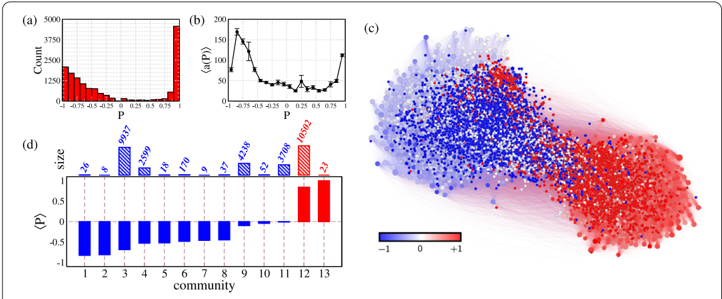
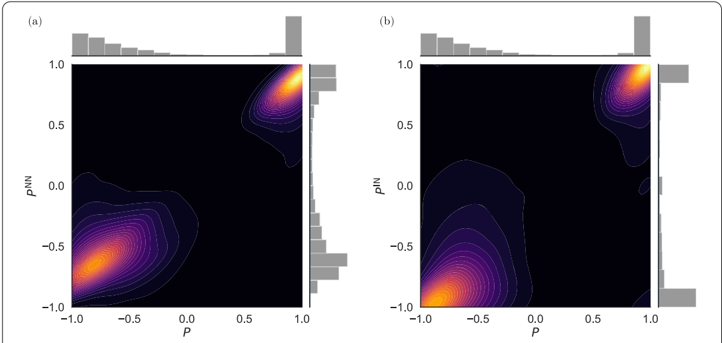
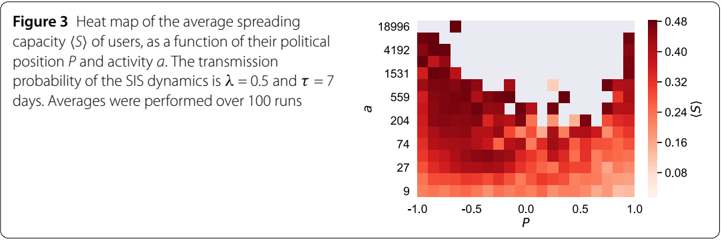
Echo chambers in online social networks, in which users prefer to interact only with ideologically-aligned peers, are believed to facilitate misinformation spreading and contribute to radicalize political discourse. In this paper, we gauge the effects of echo chambers in information spreading phenomena over political communication networks. Mining 12 million Twitter messages, we reconstruct a network in which users interchange opinions related to the impeachment of the former Brazilian President Dilma Rousseff. We define a continuous political leaning parameter, independent of the network’s structure, that allows to quantify the presence of echo chambers in the strongly connected component of the network. These are reflected in two well-separated communities of similar sizes with opposite views of the impeachment process. By means of simple spreading models, we show that the capability of users in propagating the content they produce, measured by the associated spreading capacity, strongly depends on their attitude. Users expressing pro-impeachment leanings are capable to transmit information, on average, to a larger audience than users expressing anti-impeachment leanings. Furthermore, the users’ spreading capacity is correlated to the diversity, in terms of political position, of the audience reached. Our method can be exploited to identify the presence of echo chambers and their effects across different contexts and shed light upon the mechanisms allowing to break echo chambers.
Overview
The claims and statistics of this paper haven’t been checked yet.
Free: it reads the open-access text and checks the first 5 claims that cite a source we can check. Create a free account to check every claim.
Integrity signals
Registry
Cites
Statistics
Figures
Verification
Claims the paper makes
The claims and statistics of this paper haven’t been checked yet.
Free: it reads the open-access text and checks the first 5 claims that cite a source we can check. Create a free account to check every claim.
Claims other papers make about this one
Each is checked against this paper’s own text: does it say what the citing paper says it does?
The cited source says what the claim attributes to it.
In the citing paper
“Furthermore, users show a tendency to favor information adhering to their beliefs and join groups formed around a shared narrative, that is, echo chambers (1, 14–18).”
From The echo chamber effect on social media (2021) · cites this paper as [18]
The cited source says what the claim attributes to it.
In the citing paper
“Simple models of information spreading can gauge the presence of echo chambers: Users are expected to be more likely to exchange information with peers sharing a similar leaning (18, 42, 43).”
From The echo chamber effect on social media (2021) · cites this paper as [18]
The cited source says what the claim attributes to it.
In the citing paper
“Echo chambers have been quantified in several controversial debates on different social media platforms [2, 16, 17] and may be related to the spread of misinformation [18].”
From Modeling echo chambers and polarization dynamics in social networks (2020) · cites this paper as [16]
The cited source says what the claim attributes to it.
In the citing paper
“In network terms, this translates into a node i with a given leaning xi more likely to be connected with nodes with a leaning close to xi (18).”
From The echo chamber effect on social media (2021) · cites this paper as [18]
The cited source says what the claim attributes to it.
In the citing paper
“On the other hand, when considering social networks and the impact of digital media on homophilic structures, the literature contains consistent reports of ideologically homogeneous social clusters147–151.”
From A systematic review of worldwide causal and correlational evidence on digital media and democracy (2022) · cites this paper as [149]
2 more claims about this paper
Create a free account to see every claim other papers make about this one.
Self-check
Percentages, sums and reported differences re-computed from the paper’s own numbers.
The self-check needs the paper’s full text.
Citations
Cites
Fast unfolding of communities in large networks
Blondel, V. D., Guillaume, J.-L., Lambiotte, R., & Lefebvre, E. (2008) · Journal of Statistical Mechanics: Theory and Experiment · doi:10.1088/1742-5468/2008/10/p10008 · Cited by 21,424
Social Network Analysis: Methods and Applications
Wasserman, S., & Faust, K. (1994) · doi:10.1017/cbo9780511815478 · Cited by 17,557
Fortunato, S. (2010) · Physics Reports · doi:10.1016/j.physrep.2009.11.002 · Cited by 11,293
Newman, M. (2010) · doi:10.1093/acprof:oso/9780199206650.001.0001 · Cited by 6,595
Infectious Diseases of Humans: Dynamics and Control
Anderson, R. M., & May, R. M. (1991) · doi:10.1093/oso/9780198545996.001.0001 · Cited by 6,179
Lazer, D., Pentland, A., Adamic, L., Aral, S., Barabási, A.-L., Brewer, D., Christakis, N., Contractor, N., Fowler, J., Gutmann, M., et al. (2009) · Science · doi:10.1126/science.1167742 · Cited by 3,365
A simple model of global cascades on random networks
Watts, D. J. (2002) · Proceedings of the National Academy of Sciences · doi:10.1073/pnas.082090499 · Cited by 2,673
A 61-million-person experiment in social influence and political mobilization
Bond, R. M., Fariss, C. J., Jones, J. J., Kramer, A. D. I., Marlow, C., Settle, J. E., & Fowler, J. H. (2012) · Nature · doi:10.1038/nature11421 · Cited by 2,575
The spreading of misinformation online
Del Vicario, M., Bessi, A., Zollo, F., Petroni, F., Scala, A., Caldarelli, G., Stanley, H. E., & Quattrociocchi, W. (2016) · Proceedings of the National Academy of Sciences · doi:10.1073/pnas.1517441113 · Cited by 2,407
Ferrara, E., Varol, O., Davis, C., Menczer, F., & Flammini, A. (2016) · Communications of the ACM · doi:10.1145/2818717 · Cited by 1,973
Network structure and minimum degree
Seidman, S. B. (1983) · Social Networks · doi:10.1016/0378-8733(83)90028-x · Cited by 1,891
Complex Contagions and the Weakness of Long Ties
Centola, D., & Macy, M. (2007) · American Journal of Sociology · doi:10.1086/521848 · Cited by 1,878
Tweeting From Left to Right: Is Online Political Communication More Than an Echo Chamber?
Barberá, P., Jost, J. T., Nagler, J., Tucker, J. A., & Bonneau, R. (2015) · Psychological Science · doi:10.1177/0956797615594620 · Cited by 1,472
Political Polarization on Twitter
Conover, M., Ratkiewicz, J., Francisco, M., Goncalves, B., Flammini, A., & Menczer, F. (2011) · Zenodo · doi:10.5281/zenodo.4589064 · Cited by 1,254
Distinguishing influence-based contagion from homophily-driven diffusion in dynamic networks
Aral, S., Muchnik, L., & Sundararajan, A. (2009) · Proceedings of the National Academy of Sciences · doi:10.1073/pnas.0908800106 · Cited by 1,207
The spread of low-credibility content by social bots
Shao, C., Ciampaglia, G. L., Varol, O., Yang, K.-C., Flammini, A., & Menczer, F. (2018) · Nature Communications · doi:10.1038/s41467-018-06930-7 · Cited by 1,125
Dynamical Interplay between Awareness and Epidemic Spreading in Multiplex Networks
Granell, C., Gómez, S., & Arenas, A. (2013) · Physical Review Letters · doi:10.1103/physrevlett.111.128701 · Cited by 1,064
The echo chamber is overstated: the moderating effect of political interest and diverse media
Dubois, E., & Blank, G. (2018) · Information, Communication & Society · doi:10.1080/1369118x.2018.1428656 · Cited by 1,055
Echo chambers online?: Politically motivated selective exposure among Internet news users
Garrett, R. K. (2009) · Journal of Computer-Mediated Communication · doi:10.1111/j.1083-6101.2009.01440.x · Cited by 1,040
Modern temporal network theory: a colloquium
Holme, P. (2015) · The European Physical Journal B · doi:10.1140/epjb/e2015-60657-4 · Cited by 734
Predicting the Political Alignment of Twitter Users
Conover, M. D., Goncalves, B., Ratkiewicz, J., Flammini, A., & Menczer, F. (2011) · 2011 IEEE Third Int'l Conference on Privacy, Security, Risk and Trust and 2011 IEEE Third Int'l Conference on Social Computing · doi:10.1109/passat/socialcom.2011.34 · Cited by 588 · cited 2×
“These methods are, however, not exempt from limitations [44, 45].”
MethodEcho Chambers: Emotional Contagion and Group Polarization on Facebook
Del Vicario, M., Vivaldo, G., Bessi, A., Zollo, F., Scala, A., Caldarelli, G., & Quattrociocchi, W. (2016) · Scientific Reports · doi:10.1038/srep37825 · Cited by 576
The dynamics of protest recruitment through an online network
González-Bailón, S., Borge-Holthoefer, J., Rivero, A., & Moreno, Y. (2011) · Scientific Reports · doi:10.1038/srep00197 · Cited by 571
Ratkiewicz (2011) · doi:10.1145/1963192.1963301 · Cited by 541
Bots increase exposure to negative and inflammatory content in online social systems
Stella, M., Ferrara, E., & De Domenico, M. (2018) · Proceedings of the National Academy of Sciences · doi:10.1073/pnas.1803470115 · Cited by 492
Social Media, Network Heterogeneity, and Opinion Polarization
Lee, J. K., Choi, J., Kim, C., & Kim, Y. (2014) · Journal of Communication · doi:10.1111/jcom.12077 · Cited by 457
Echo chambers and viral misinformation: Modeling fake news as complex contagion
Törnberg, P. (2018) · PLOS ONE · doi:10.1371/journal.pone.0203958 · Cited by 419
Comparing and combining sentiment analysis methods
Gonçalves, P., Araújo, M., Benevenuto, F., & Cha, M. (2013) · Proceedings of the first ACM conference on Online social networks · doi:10.1145/2512938.2512951 · Cited by 371
Political Discourse on Social Media: Echo Chambers, Gatekeepers, and the Price of Bipartisanship
Garimella, K., De Francisci Morales, G., Gionis, A., & Mathioudakis, M. (2018) · Proceedings of the 2018 World Wide Web Conference on World Wide Web - WWW '18 · doi:10.1145/3178876.3186139 · Cited by 335
Threshold Models for Competitive Influence in Social Networks
Borodin, A., Filmus, Y., & Oren, J. (2010) · Lecture Notes in Computer Science · doi:10.1007/978-3-642-17572-5_48 · Cited by 306
Social Features of Online Networks: The Strength of Intermediary Ties in Online Social Media
Grabowicz, P. A., Ramasco, J. J., Moro, E., Pujol, J. M., & Eguiluz, V. M. (2012) · PLoS ONE · doi:10.1371/journal.pone.0029358 · Cited by 263
SIR rumor spreading model in the new media age
Zhao, L., Cui, H., Qiu, X., Wang, X., & Wang, J. (2013) · Physica A: Statistical Mechanics and its Applications · doi:10.1016/j.physa.2012.09.030 · Cited by 263
Wojcieszak, M. (2010) · New Media & Society · doi:10.1177/1461444809342775 · Cited by 259
Partisan asymmetries in online political activity
Conover, M. D., Gonçalves, B., Flammini, A., & Menczer, F. (2012) · EPJ Data Science · doi:10.1140/epjds6 · Cited by 234
Network reachability of real-world contact sequences
Holme, P. (2005) · Physical Review E · doi:10.1103/physreve.71.046119 · Cited by 213
Analyzing and predicting viral tweets
Jenders, M., Kasneci, G., & Naumann, F. (2013) · Proceedings of the 22nd International Conference on World Wide Web · doi:10.1145/2487788.2488017 · Cited by 195
Secular vs. Islamist polarization in Egypt on Twitter
Weber, I., Garimella, V. R. K., & Batayneh, A. (2013) · Proceedings of the 2013 IEEE/ACM International Conference on Advances in Social Networks Analysis and Mining · doi:10.1145/2492517.2492557 · Cited by 118
Threshold model of cascades in empirical temporal networks
Karimi, F., & Holme, P. (2013) · Physica A: Statistical Mechanics and its Applications · doi:10.1016/j.physa.2013.03.050 · Cited by 117
The role of hidden influentials in the diffusion of online information cascades
Baños, R. A., Borge-Holthoefer, J., & Moreno, Y. (2013) · EPJ Data Science · doi:10.1140/epjds18 · Cited by 79
Political hashtag hijacking in the U.S.
Hadgu, A. T., Garimella, K. V., & Weber, I. G. (2013) · International World Wide Web Conference (WWW) · doi:10.1145/2487788.2487809 · Cited by 75
Sentiment cascades in the 15M movement
Alvarez, R., Garcia, D., Moreno, Y., & Schweitzer, F. (2015) · EPJ Data Science · doi:10.1140/epjds/s13688-015-0042-4 · Cited by 74
The geographic embedding of online echo chambers: Evidence from the Brexit campaign
Bastos, M., Mercea, D., & Baronchelli, A. (2018) · PLOS ONE · doi:10.1371/journal.pone.0206841 · Cited by 68
Hanna, A., Wells, C., Maurer, P., Friedland, L., Shah, D., & Matthes, J. (2013) · Proceedings of the 2nd workshop on Politics, elections and data · doi:10.1145/2508436.2508438 · Cited by 49
Research works printed but not linked: 7
- 1. Masum H, Newmark C, Tovey M (2011) The reputation society: how online opinions are reshaping the offline world. Information society series. MIT Press, Cambridge
- 9. Borge-Holthoefer J, Magdy W, Darwish K, Weber I (2015) Content and network dynamics behind Egyptian political polarization on Twitter. In: Proceedings of the 18th ACM conference on computer supported cooperative work & social computing, CSCW 2015, Vancouver, BC, Canada, March 14-18, 2015, pp 700-711
- 22. Lambiotte R, Masuda N (2016) A guide to temporal networks. Series on complexity science, vol 4. World Scientific, Singapore
- 23. Galuba W, Aberer K, Chakraborty D, Despotovic Z, Kellerer W (2010) Outtweeting the Twitterers-predicting information cascades in microblogs. In: Proceedings of the 3rd wonference on online social networks, WOSN'10. USENIX Association, Berkeley, pp 3-3
- Holme P, Saramäki J (eds) (2013) Temporal networks. Springer, Berlin
- 33. Anderson RM, May RM (1992) Infectious diseases in humans. Oxford University Press, Oxford
- 46. Saito K, Nakano R, Kimura M (2008) Prediction of information diffusion probabilities for independent cascade model. In: Proceedings of the 12th international conference on knowledge-based intelligent information and engineering systems, part III, KES '08. Springer, Berlin, pp 67-75
Cited by
The echo chamber effect on social media
Cinelli, M., De Francisci Morales, G., Galeazzi, A., Quattrociocchi, W., & Starnini, M. (2021) · Proceedings of the National Academy of Sciences · doi:10.1073/pnas.2023301118 · Cited by 2,092
“Simple models of information spreading can gauge the presence of echo chambers: Users are expected to be more likely to exchange information with peers sharing a similar leaning (18, 42, 43).”
BackgroundSelf-citationModeling echo chambers and polarization dynamics in social networks
Baumann, F., Lorenz-Spreen, P., Sokolov, I. M., & Starnini, M. (2020) · Physical Review Letters · doi:10.1103/physrevlett.124.048301 · Cited by 427
Self-citationA systematic review of worldwide causal and correlational evidence on digital media and democracy
Lorenz-Spreen, P., Oswald, L., Lewandowsky, S., & Hertwig, R. (2022) · Nature Human Behaviour · doi:10.1038/s41562-022-01460-1 · Cited by 348
How behavioural sciences can promote truth, autonomy and democratic discourse online
Lorenz-Spreen, P., Lewandowsky, S., Sunstein, C. R., & Hertwig, R. (2020) · Nature Human Behaviour · doi:10.1038/s41562-020-0889-7 · Cited by 223
“…and misin-formation (falsehoods created without intent, for example, poorly researched content or biased reporting)—or attitudinal and emotional polarization 15,16 (for example, polarization of elites 17 , partisan sorting 18 and polarization with respect to controversial topics 19,20 ).”
BackgroundPersistent interaction patterns across social media platforms and over time
Avalle, M., Marco, N. D., Etta, G., Sangiorgio, E., Alipour, S., Bonetti, A., Alvisi, L., Scala, A., Baronchelli, A., Cinelli, M., et al. (2024) · Nature · doi:10.1038/s41586-024-07229-y · Cited by 225
“…below—this is a standard approach that has been used in several studies, and has become a common and established practice in the field of social media analysis due to its practicality and effectiveness in providing a broad understanding of political dynamics on these online platforms 1,43,86–88 .”
Background
Metadata
- Authors
- Cota, W., Ferreira, S. C., Pastor-Satorras, R., & Starnini, M.
- Affiliations
- Universidade Federal de Viçosa (BR)
- Institute for Scientific Interchange (IT)
- Corresponding author
- Starnini, Michele
- Venue
- EPJ Data Science
- Published
- 2019-12
- Volume
- 8
- Issue
- 1
- ISSN
- 2193-1127 (ISSN-L)
- OpenAlex
- W2909429265
- Semantic Scholar
- 6580afff031fa614b8374b15d0585215dbec1e62
- Cited by
- 146
- References
- 40
- Citations by year
- 2026: 15 · 2025: 26 · 2024: 26 · 2023: 31 · 2022: 29 · 2021: 13 · 2020: 5 · 2019: 1
- FWCI
- 5.55
- Type
- journal article
- Language
- en
- Open access
- gold
- doi.org
- Licence
- cc-by
- creativecommons.org/licenses/by/4.0 (tdm)
- creativecommons.org/licenses/by/4.0 (vor, 8 d)
- Locations
- EPJ Data Science (publishedVersion, cc-by)
- Repositori digital de la UPF (Universitat Pompeu Fabra) (publishedVersion, cc-by)
- arXiv (Cornell University) (submittedVersion)
- DOAJ (DOAJ: Directory of Open Access Journals) (submittedVersion)
- UPCommons institutional repository (Universitat Politècnica de Catalunya) (submittedVersion, cc-by-nc-nd)
- arXiv (Cornell University)
- Funders
- James S. McDonnell Foundation
- Coordenação de Aperfeiçoamento de Pessoal de Nível Superior (88881, 2013‐01, (Code 001), 88881.030375/2013-01)
- Generalitat de Catalunya
- Conselho Nacional de Desenvolvimento Científico e Tecnológico (88881)
- Institució Catalana de Recerca i Estudis Avançats
- Fundação de Amparo à Pesquisa do Estado de Minas Gerais (Code 001, 88881.030375/2013-01)
- Ciência sem Fronteiras
- Topics
- Physical Sciences › Physics and Astronomy › Statistical and Nonlinear Physics › Complex Network Analysis Techniques
- Social Sciences › Communication › Social Media and Politics
- Social Sciences › Sociology and Political Science › Misinformation and Its Impacts
- Keywords
- echo chambers, information dissemination, Twitter, misinformation, ideological polarization, political orientation, Dilma Rousseff impeachment, social network reconstruction, spreading models
About these checks
Registry, retraction, Cites and statistics results are computed, not judged, with one exception: a printed reference that no index lists is read once by a model before it counts as a citation error. Claims are extracted by a model and kept only when their quote appears verbatim in the text; each cited source is then checked, with a model’s help, for whether it says what the claim relies on. Those verdicts can be wrong — read the claim’s quote and the cited source before relying on one.
Statistics and arithmetic are recomputed, not judged.
Confidence bands are shown only for fields calibrated on our annotated test set. None is calibrated yet, so no band is shown.
What counts as a claim ›How we measure confidence ›How we check this ›
Are you an author, or do you see a problem with this page? Request a review
Data sources
Bibliographic data: Semantic Scholar, OpenAlex, Crossref.
Contains information from the Semantic Scholar Academic Graph Datasets, made available under the ODC Attribution License (ODC-BY 1.0).
Semantic Scholar’s data is described in: Kinney, R., et al. (2023). The Semantic Scholar Open Data Platform. arXiv:2301.10140.
