

Child as Protagonist: Expanding the Role of Children in Participatory Design
Open accessThe DOI matches its Crossref record; 42 of the 42 references it cites were found in a registry or an index; none of the 9 sources its claims cite is checked for support yet.
Abstract
We suggest that a commitment to political participatory design defines a new role for children in participatory practices--the role of protagonist. The objective here transcends the goal of giving children a voice in design, and addresses more broadly how children can be empowered to shape technological development and critically reflect on the role of technology in their practices. This re-accentuation of political participatory design to formulate the protagonist role is important, because it deepens our understanding of how children may be empowered through design. It is also timely in view of current societal challenges pertaining to training children in twenty-first century skills. Based on a case study, we illustrate how the protagonist role, based on political participatory design, can change the objective, process, and outcome measures of the design process.
Overview
CoChat Summary
TL;DR
The paper proposes a sixth role for children in participatory design—the “child as protagonist”—rooted in political participatory design, where the aim is children’s critical reflection on technology and development of design competence rather than only producing technology. A six-week Danish school case with 69 seventh-grade students illustrates how this role reshapes the objective, process, and outcome measures of design.
Key findings
- The paper introduces “child as protagonist” as a distinct category alongside children as users, testers, informants, design partners, and co-researchers; its objective is for children to develop skills to design and reflect on technology and its role in their lives, with process arranged primarily to build design competence and outcome measures focused on new insights and reflective stance.
- The case study involved 69 students aged 13–14 in three seventh-grade classes over six weeks, with two to four lessons per week; the design brief asked them to redesign a public park in Aarhus in connection with the city’s 2017 European Capital of Culture status.
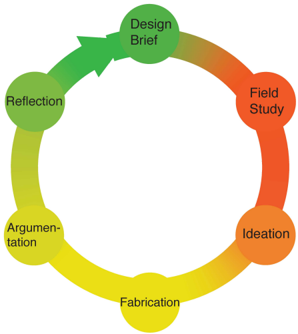
- The process model had six main activities—design brief, field studies, ideation, fabrication, argumentation, and reflection—and positioned argumentation and reflection as closing activities of each iteration.
- Evaluation used nine interview questions adapted from Bossen et al.’s taxonomy; 14 pairs of students were interviewed for 20–30 minutes, and the authors report that some students followed an “almost vertical learning curve,” illustrated by Sarah and Agnes shifting from thinking design meant clothes to seeing it as open creative thinking.
Methods
- The study was a research-through-design experiment conducted in Danish public schools, carried out with three seventh-grade classes at N. J. Fjordsgades School in Aarhus, Western Denmark, between October and December 2014.
- The experiment ran in the school’s makerspace over six weeks, amounted to two to four lessons per week, engaged 69 students aged 13–14, and was developed, evaluated, and refined in three iterations; a design researcher facilitated with a local teacher, while three design researchers documented using video and field notes.
- Researchers followed selected student groups and conducted semi-structured interviews with 14 pairs of students about their experiences and reflections; field notes and video were logged and analyzed with focus on the most closely followed groups, as also described in Smith et al. [34].
Limitations
- The authors state that they refrained from engaging children in framing the design brief and activities and in analyzing the data; they note this could potentially have strengthened the study and depth of children’s involvement but would have demanded more resources than available.
- The authors state that some students do not necessarily internalize knowledge from this kind of participation, and they report great variation among student gains.
- Evident from the text: the findings rest on a single case in one Danish school, with interviews limited to 14 students (in pairs) out of 69, and no comparison or control group is reported.
Model-written summary. Check it against the paper before relying on it.
Integrity signals
Registry
Cites
Statistics
Figures
Verification
Claims the paper makes
0 Valid · 0 Not valid · 8 Not checked · 47 Own results and interpretations
A result the paper reports from its own data — it cites no other source for it, so there is none to check. The quote shows it is in the paper.
In the paper
“Finally, the interview sessions suggested that the process had implications for their general perception of digital technology and design.”
hedgedstates a possible cause- Asserted: passes — The authors put it forward as true.
- Checkable: passes — It can be checked against evidence.
- Load-bearing: unclear — It is unclear whether the paper’s conclusions depend on it.
- Based: passes — The paper gives a reason why it holds.
- Rests on an assumption not shown here.
A result the paper reports from its own data — it cites no other source for it, so there is none to check. The quote shows it is in the paper.
In the paper
“In our design experiment, however, some students followed an almost vertical learning curve in terms of their ability not only to participate in design process but also in their understanding of digital technology.”
plain- Asserted: passes — The authors put it forward as true.
- Checkable: passes — It can be checked against evidence.
- Load-bearing: unclear — It is unclear whether the paper’s conclusions depend on it.
- Based: passes — The paper gives a reason why it holds.
- Rests on an assumption not shown here.
A result the paper reports from its own data — it cites no other source for it, so there is none to check. The quote shows it is in the paper.
In the paper
“Through their participation, they also managed to develop a design language and a sense of direction that enabled them to engage dynamically in the complex process of using a range of analog and digital materials in iterative movements of reflection and action.”
plainstates a cause- Asserted: passes — The authors put it forward as true.
- Checkable: passes — It can be checked against evidence.
- Load-bearing: passes — The paper’s conclusions depend on it.
- Based: passes — The paper gives a reason why it holds.
- Rests on an assumption not shown here.
A result the paper reports from its own data — it cites no other source for it, so there is none to check. The quote shows it is in the paper.
In the paper
“As this example illustrates, the students managed not only to create coherent products in response to the design challenge.”
plain- Asserted: passes — The authors put it forward as true.
- Checkable: passes — It can be checked against evidence.
- Load-bearing: unclear — It is unclear whether the paper’s conclusions depend on it.
- Based: passes — The paper gives a reason why it holds.
- Rests on an assumption not shown here.
A result the paper states — it cites no source for it, so there is none to check. The quote shows it is in the paper.
In the paper
“The availability of different technologies as flexible tools and materials to be integrated into the process shifted the students' perceptions of technology from something involving fixed objects to something involving digital means for creating their own alternative opportunities and solutions.”
plainstates a cause- Asserted: passes — The authors put it forward as true.
- Checkable: passes — It can be checked against evidence.
- Load-bearing: passes — The paper’s conclusions depend on it.
- Based: unclear — It is unclear why the paper says it holds.
- Rests on an assumption not shown here.
10 more claims
Create a free account to see all 55 claims and every source verdict.
- Probably not a substantial claim. 39
- It may state two separate claims as one. 6
Self-check
Percentages, sums and reported differences re-computed from the paper’s own numbers.
Each contradiction between two passages listed here was confirmed by an independent check.
Rated major: it would touch a result — a value a result rests on, reported and recomputed p-values on opposite sides of the significance level, two passages that conflict with no sign which is right, or a cited work retracted before this paper was published.
In the paper
§ METHOD · p. 5
“They also conducted semi-structured interviews (20 to 30 minutes in duration) with 14 pairs of students about their experiences of and reflections on the design process.”
§ OUTCOME MEASURES: EVALUATING THE OUTCOME OF A POLITICAL PD PROCESS · p. 7
“In this project, 14 students were interviewed in rounds of two-and-two.”
Rated minor: it would not touch a result — a value no result rests on, a p-value that stays on the same side of the significance level, or a conflict that is clerical, resolved elsewhere in the paper, or outside its own findings.
In the paper
§ DISCUSSION · p. 8
“The nine questions (Table 2) proposed for measuring outcomes”
§ Newly emerged opportunities in general · p. 7
“Table 3: Interview guide for evaluating children's gains.”
Citations
Cites
Research through design as a method for interaction design research in HCI
Zimmerman, J., Forlizzi, J., & Evenson, S. (2007) · Proceedings of the SIGCHI Conference on Human Factors in Computing Systems · doi:10.1145/1240624.1240704 · Cited by 2,304 · cited 1×
“design experiment [43] to examine how we could invite children into design in a protagonist role.”
BackgroundRoutledge International Handbook of Participatory Design
(2012) · doi:10.4324/9780203108543 · Cited by 1,606
21st century skills and competences for new millennium learners in OECD countries
(2009) · OECD Education Working Papers · doi:10.1787/218525261154 · Cited by 1,549
Participatory Design: Issues and Concerns
Kensing, F., & Blomberg, J. (1998) · Computer Supported Cooperative Work (CSCW) · doi:10.1023/a:1008689307411 · Cited by 1,084 · cited 1×
“POLITICAL PARTICIPATORY DESIGN Historically, PD has always had a strong political component [9, 24].”
BackgroundThe role of children in the design of new technology
(2002) · Behaviour & Information Technology · doi:10.1080/01449290110108659 · Cited by 1,071 · cited 10×
“We position the role of protagonist in relation to existing IDC research, involving children as users, testers, informants, codesigners [12, 17] and co-researchers [10].”
BackgroundMethodResultInfluential(2002) · Cited by 993
Computers and Democracy: A Scandinavian Challenge
Bjerknes, G., Ehn, P., Kyng, M., & Nygaard, K. (1987) · Medical Entomology and Zoology · Cited by 732
Work‐Oriented Design of Computer Artifacts
Hakken, D. (1989) · Anthropology of Work Review · doi:10.1525/awr.1989.10.4.14 · Cited by 713
Digital Fabrication and ‘Making’ in Education: The Democratization of Invention
Blikstein, P. (2013) · FabLab · doi:10.14361/transcript.9783839423820.203 · Cited by 672 · cited 1×
“[6] coins the rapidly extending reach of digital fabrication technologies as a “democratization of innovation” that emphasizes the possibilities for including children in the”
BackgroundThe design of children's technology
Druin, A. (1998) · Morgan Kaufmann Publishers Inc. eBooks · Cited by 475
Research works printed but not linked: 4
- 7. Bielefeld: Transcript Publishers.
- 10.5555/958052.958061 · doi:10.5555/958052.958061
- 27. Maarten Van Mechelen, M. (2016). Designing technologies for and with children: Theoretical reflections and a practical inquiry towards a co-design toolkit. Doctoral thesis defended in June 2016, UHasselt-KU Leuven.
- 39. Greg Walsh and Elizabeth Foss. 2015. A case for intergenerational distributed co-design: the online kidsteam example. In Proceedings of the 14th · DOI
Cited by
Iivari, N., Sharma, S., & Ventä-Olkkonen, L. (2020) · International Journal of Information Management · doi:10.1016/j.ijinfomgt.2020.102183 · Cited by 1,048
“We should also aim to empower them to start more proactively shaping and making our digital futures as protagonists (Iivari & Kinnula, 2018; Iversen et al., 2017), who not merely accept digitalization as is but critically reflect on it and try to shape its trajectories.”
BackgroundParticipatory Design that Matters—Facing the Big Issues
Bødker, S., & Kyng, M. (2018) · ACM Transactions on Computer-Human Interaction · doi:10.1145/3152421 · Cited by 361
“In [47, p. 27], the project researchers, Iversen, Smith, and Dindler, discuss how a commitment to political participatory design defines a new role for children in participatory practices – the role of protagonist.”
BackgroundComputational empowerment: participatory design in education
Dindler, C., Smith, R., & Iversen, O. S. (2020) · CoDesign · doi:10.1080/15710882.2020.1722173 · Cited by 182
“Further, values and PD ’ s political commitments have been developed in the context of engaging with children (e.g. Iversen, Smith, and Dindler 2017).”
BackgroundSelf-citationFrom computational thinking to computational empowerment: a 21 st century PD agenda
Iversen, O. S., Smith, R. C., & Dindler, C. (2018) · Proceedings of the 15th Participatory Design Conference: Full Papers - Volume 1 · doi:10.1145/3210586.3210592 · Cited by 169
Self-citationADHD and Technology Research – Investigated by Neurodivergent Readers
Spiel, K., Hornecker, E., Williams, R. M., & Good, J. (2022) · CHI Conference on Human Factors in Computing Systems · doi:10.1145/3491102.3517592 · Cited by 150
“Moreover, as participants in our corpus skew towards younger populations, it is commonly deemed insufficient in the area of Child Computer Interaction to take account of children’s cognitive development as reported by medical and educational experts, but that children need to be directly involved in the design of tech…”
Using participatory design approaches in educational research
Cumbo, B. J., & Selwyn, N. (2021) · International Journal of Research & Method in Education · doi:10.1080/1743727x.2021.1902981 · Cited by 194
“Ways of achieving this include preliminary forms of infrastructuring and ‘backstage work’ (Bødker, Dindler, and Iversen 2017) that establish rapport and trust between participants.”
BackgroundInfluentialEmpowering children through design and making: towards protagonist role adoption
Iivari, N., & Kinnula, M. (2018) · Participatory Design Conference · doi:10.1145/3210586.3210600 · Cited by 127
How Participatory Design Works: Mechanisms and Effects
Hansen, N. B., Dindler, C., Halskov, K., Iversen, O. S., Bossen, C., Basballe, D. A., & Schouten, B. A. M. (2019) · Australian Conference on Human-Computer Interaction (OzCHI) · doi:10.1145/3369457.3369460 · Cited by 140
“[47]) and within the Participatory Design conference series, a plethora of politically activist projects are reported in the literature (e.”
BackgroundSelf-citation18 Years of ethics in child-computer interaction research: a systematic literature review
Van Mechelen, M., Baykal, G. E., Dindler, C., Eriksson, E., & Iversen, O. S. (2020) · Proceedings of the Interaction Design and Children Conference · doi:10.1145/3392063.3394407 · Cited by 75
Self-citationInforming Age-Appropriate AI: Examining Principles and Practices of AI for Children
Wang, G., Zhao, J., Van Kleek, M., & Shadbolt, N. (2022) · CHI Conference on Human Factors in Computing Systems · doi:10.1145/3491102.3502057 · Cited by 76
“[72, 112]), and should be an essential strategy in creating human-centred AI for children.”
BackgroundHuman-Computer Interactions in Museums
Hornecker, E., & Ciolfi, L. (2019) · Synthesis lectures on human-centered informatics · doi:10.2200/s00901ed1v01y201902hci042 · Cited by 101
Iivari, N., Sharma, S., Ventä-Olkkonen, L., Molin‐Juustila, T., Kuutti, K., Holappa, J., & Kinnunen, E. (2021) · International Journal of Child-Computer Interaction · doi:10.1016/j.ijcci.2021.100408 · Cited by 79
A research agenda for computational empowerment for emerging technology education
Smith, R. C., Schaper, M.-M., Tamashiro, M. A., Van Mechelen, M., Petersen, M. G., & Iversen, O. S. (2023) · International Journal of Child-Computer Interaction · doi:10.1016/j.ijcci.2023.100616 · Cited by 62
Self-citationManifesto for children’s genuine participation in digital technology design and making
Kinnula, M., & Iivari, N. (2021) · International Journal of Child-Computer Interaction · doi:10.1016/j.ijcci.2020.100244 · Cited by 67
“…lacking (Iivari & Kinnula, 2016a), even though some attempts have been made (Cumbo et al., 2019; Iivari & Kinnula, 2018; Iivari et al., 2015, 2016; Iversen et al., 2017, 2018; Kinnula, Iivari et al., 2017; Nouwen et al., 2016; Schaper, Iversen, Malinverni, & Pares, 2019; Schepers et al., 2018c,…”
BackgroundInfluentialDistributing participation in design: Addressing challenges of a global pandemic
Constantin, A., Alexandru, C., Korte, J., Wilson, C., Fails, J. A., Sim, G., Read, J. C., & Eriksson, E. W. (2021) · International Journal of Child-Computer Interaction · doi:10.1016/j.ijcci.2021.100255 · Cited by 75
Another decade of IDC research: examining and reflecting on values and ethics
Kawas, S., Yuan, Y., DeWitt, A., Jin, Q., Kirchner, S., Bilger, A., Grantham, E., Kientz, J. A., Tartaro, A., & Yarosh, S. (2020) · Proceedings of the Interaction Design and Children Conference · doi:10.1145/3392063.3394436 · Cited by 58
A Systematic Review of Empowerment in Child-Computer Interaction Research
Mechelen, M. V., Musaeus, L. H., Iversen, O. S., Dindler, C., & Hjorth, A. (2021) · ACM International Conference on Interaction Design and Children (IDC) · doi:10.1145/3459990.3460701 · Cited by 82
“Rather, as proposed by [40], children should be admitted access to all processes around design of future technology, including a critical stance towards digital technology and their implications.”
BackgroundInfluentialSelf-citationCollaborative Design Thinking (CoDeT): A co-design approach for high child-to-adult ratios
Mechelen, M. V., Laenen, A., Zaman, B., Willems, B., & Abeele, V. V. (2019) · International Journal of Human-Computer Studies · doi:10.1016/j.ijhcs.2019.06.013 · Cited by 61
Children on ChatGPT Readability in an Educational Context: Myth or Opportunity?
Murgia, E., Pera, M. S., Landoni, M., & Huibers, T. (2023) · Adjunct Proceedings of the 31st ACM Conference on User Modeling, Adaptation and Personalization · doi:10.1145/3563359.3596996 · Cited by 54
Human-Computer Interactions in Museums
Hornecker, E., & Ciolfi, L. (2019) · Synthesis lectures on human-centered informatics · doi:10.1007/978-3-031-02225-8 · Cited by 95
Fails, J. A., Ratakonda, D. K., Koren, N., Elsayed-Ali, S., Bonsignore, E., & Yip, J. C. (2022) · International Journal of Child-Computer Interaction · doi:10.1016/j.ijcci.2022.100476 · Cited by 58
“Other models from the CCI community that consider child partnerships and roles (e.g., Barendregt, Bekker, Börjesson, Eriksson, & Torgersson, 2016; Iversen, Smith, & Dindler, 2017) could also benefit from these contextual dimensions when considering DPD.”
BackgroundWilson, C., Sitbon, L., Ploderer, B., Opie, J., & Brereton, M. F. (2020) · CHI Conference on Human Factors in Computing Systems · doi:10.1145/3313831.3376171 · Cited by 63
“And, therefore, through understanding self-expression, we can begin to move towards other important participatory concepts like self-advocacy, agency and empowerment: all central to participatory and co-design mindsets [2, 26].”
BackgroundCoenraad, M., Palmer, J., Franklin, D. M., & Weintrop, D. (2019) · ACM International Conference on Interaction Design and Children (IDC) · doi:10.1145/3311927.3323148 · Cited by 63
“shape participants, their emerging view of themselves, and their identities and relationship to their world [5, 7, 29, 33].”
BackgroundNurturing Constructive Disagreement - Agonistic Design with Neurodiverse Children
Frauenberger, C., Spiel, K., Scheepmaker, L., & Posch, I. (2019) · Proceedings of the 2019 CHI Conference on Human Factors in Computing Systems · doi:10.1145/3290605.3300501 · Cited by 45
Designing learning technology collaboratively: analysis of a chatbot co-design
Durall Gazulla, E., Martins, L., & Fernández-Ferrer, M. (2023) · Education and Information Technologies · doi:10.1007/s10639-022-11162-w · Cited by 46
“Some of the reasons that explain the adoption of this approach in the educational field respond to the predominance of student-centered approaches, as well as the recognition that students are experts of their own learning (Iversen et al., 2017).”
BackgroundSharma, K., & Giannakos, M. N. (2021) · International Journal of Child-Computer Interaction · doi:10.1016/j.ijcci.2021.100331 · Cited by 50
Iivari, N., Ventä-Olkkonen, L., Hartikainen, H., Sharma, S., Lehto, E., Holappa, J., & Molin‐Juustila, T. (2023) · International Journal of Child-Computer Interaction · doi:10.1016/j.ijcci.2023.100600 · Cited by 54
Transformative agency – the next step towards children's computational empowerment
Iivari, N., Iversen, O. S., Smith, R. C., Schaper, M.-M., Ventä-Olkkonen, L., Hartikainen, H., Sharma, S., Kinnula, M., Lehto, E., Holappa, J., et al. (2024) · ACM International Conference on Interaction Design and Children (IDC) · doi:10.1145/3628516.3655806 · Cited by 53
Self-citationChildren’s design recommendations for online safety education
Hartikainen, H., Iivari, N., & Kinnula, M. (2019) · International Journal of Child-Computer Interaction · doi:10.1016/j.ijcci.2019.100146 · Cited by 55
“In the future, we are also interested in inviting children as process designers [87] and protagonists [84, 85] to shape and reflect on their own safety education and urge other researchers to do the same.”
BackgroundA systematic review of physical–digital play technology and developmentally relevant child behaviour
Torres, P. E., Ulrich, P., Cucuiat, V., Cukurova, M., la Presa, M. C. F. D., Luckin, R., Carr, A., Dylan, T., Durrant, A. C., Vines, J., et al. (2021) · International Journal of Child-Computer Interaction · doi:10.1016/j.ijcci.2021.100323 · Cited by 98
“child-led, participatory or cooperative technology design [51, 190].”
BackgroundTuhkala, A., Wagner, M.-L., Iversen, O. S., & Kärkkäinen, T. (2019) · International Journal of Child-Computer Interaction · doi:10.1016/j.ijcci.2019.03.004 · Cited by 42
Self-citationKinnula, M., & Iivari, N. (2019) · FabLearn Europe Conference · doi:10.1145/3335055.3335071 · Cited by 50
“However, it is acknowledged that the design, education, and empowerment aspects need further work even in Making projects with children [2, 9, 10, 28, 30, 36, 38, 59].”
BackgroundInfluentialResearch in Child–Computer Interaction: Provocations and envisioning future directions
Antle, A. N., & Hourcade, J. P. (2021) · International Journal of Child-Computer Interaction · doi:10.1016/j.ijcci.2021.100374 · Cited by 51
Movement forward: The continued growth of Child–Computer Interaction research
Giannakos, M. N., Horn, M., Read, J. C., & Markopoulos, P. (2020) · International Journal of Child-Computer Interaction · doi:10.1016/j.ijcci.2020.100204 · Cited by 45
Cumbo, B. J., & Iversen, O. S. (2020) · doi:10.1145/3392063.3394398 · Cited by 38
“Divergent and convergent thinking [34] was applied to further refine the ideas generated, which further supported the competences of children to critically apply the tools to their play practice.”
BackgroundSelf-citationVentä-Olkkonen, L., Iivari, N., Sharma, S., Molin‐Juustila, T., Kuutti, K., Juustila-Cevirel, N., Kinnunen, E., & Holappa, J. (2021) · Designing Interactive Systems Conference · doi:10.1145/3461778.3462044 · Cited by 52
“Then again, some CCI studies explicitly rely on the Scandinavian PD tradition and underscore children’s empowerment to drive technology development and to critically reflect on the digitalization of our society and everyday life (e.g., [24, 37, 44]).”
BackgroundPires, A. C., Bakała, E., Perilli, F. G., Sansone, G., Fleischer, B., Marichal, S., & Guerreiro, T. (2021) · International Journal of Child-Computer Interaction · doi:10.1016/j.ijcci.2021.100382 · Cited by 52
A systematic literature review of participatory design studies involving teachers
Tuhkala, A. (2021) · European Journal of Education · doi:10.1111/ejed.12471 · Cited by 66
Bluyssen, P. M., Kim, D. H., Eijkelenboom, A., & Ortiz, M. A. (2019) · Building and Environment · doi:10.1016/j.buildenv.2019.106486 · Cited by 47
Robot Co-design Can Help Us Engage Child Stakeholders in Ethical Reflection
Mott, T., Bejarano, A., & Williams, T. (2022) · ACM/IEEE International Conference on Human-Robot Interaction (HRI) · doi:10.1109/hri53351.2022.9889430 · Cited by 49
“All of these challenges are exacerbated due to the typically imbalanced power dynamic between children and adults [15], [16], [17].”
BackgroundInfluentialIivari, N., & Kuutti, K. (2018) · ACM International Conference on Interaction Design and Children (IDC) · doi:10.1145/3202185.3202773 · Cited by 36
Gennari, R., Matera, M., Melonio, A., Rizvi, M., & Roumelioti, E. (2020) · Multimedia Tools and Applications · doi:10.1007/s11042-020-09927-x · Cited by 33
“More-over, in line with [21], the work reported in this paper invites children to take and reflect on design from different perspectives, that is, individual and group-based.”
BackgroundResultDigital Design Literacy in K-9 Education: Experiences from Pioneer Teachers
Van Mechelen, M., Wagner, M.-L., Baykal, G. E., Charlotte Smith, R., & Iversen, O. S. (2021) · Interaction Design and Children · doi:10.1145/3459990.3460696 · Cited by 30
“Second, strong voices in CCI research have promoted a protago-nist approach to the design of children’s technology, emphasizing a need for providing children with the skills, knowledge and attitudes to independently critique and design technologies [18, 28, 30, 50].”
BackgroundResultSelf-citationItenge, H., Winschiers‐Theophilus, H., Soro, A., & Brereton, M. F. (2018) · ACM International Conference on Interaction Design and Children (IDC) · doi:10.1145/3202185.3202760 · Cited by 34
“Further, [10] suggest extending children beyond the role of design partners to protagonists with the emphasis on developing their critical reflection and design abilities [10].”
BackgroundCosentino, G., & Giannakos, M. N. (2023) · IEEE Transactions on Learning Technologies · doi:10.1109/tlt.2023.3243210 · Cited by 51
Antle, A. N., Murai, Y., Kitson, A., Candau, Y., Dao-Kroeker, Z. M.-T., & Adibi, A. (2022) · ACM International Conference on Interaction Design and Children (IDC) · doi:10.1145/3501712.3529717 · Cited by 43
“That’s what techquity is”: youth perceptions of technological and algorithmic bias
Coenraad, M. (2022) · Information and Learning Sciences · doi:10.1108/ils-03-2022-0024 · Cited by 36
Promoting Criticality with Design Futuring with Young Children
Sharma, S., Howell, N., Ventä-Olkkonen, L., Iivari, N., Eden, G., Hartikainen, H., Kinnula, M., Durall, E., Nitsche, M. A., Okkonen, J., et al. (2024) · Nordic Conference on Human-Computer Interaction · doi:10.1145/3679318.3685335 · Cited by 35
“Such approaches have also featured in CCI research (e.g., [24] [50] [91] [92]).”
InfluentialSchaper, M.-M., & Parés, N. (2021) · ACM Transactions on Computer-Human Interaction · doi:10.1145/3450446 · Cited by 31
“In this context, Iversen and Dindler [44] specifically pointed toward the need of methods and tools that focus on children’s capacities.”
BackgroundCoenraad, M., Palmer, J., Eatinger, D., Weintrop, D., & Franklin, D. M. (2021) · International Journal of Child-Computer Interaction · doi:10.1016/j.ijcci.2021.100353 · Cited by 39
Children's Assessment of Co-design Skills
Mechelen, M. V., Schut, A., Gielen, M. A., & Södergren, A. C. (2019) · ACM International Conference on Interaction Design and Children (IDC) · doi:10.1145/3311927.3325334 · Cited by 27
Co-design of Technology Involving Autistic Children: A Systematic Literature Review
Hijab, M. H. F., Banire, B., Neves, J., Qaraqe, M., Othman, A., & Al‐Thani, D. (2023) · International Journal of Human-Computer Interaction · doi:10.1080/10447318.2023.2266248 · Cited by 41
“Furthermore, the community has delved into exploring the impact of co-design on children, encompassing studies on children’s empowerment (Iversen et al., 2017), their role as social ’actors’ (Iversen et al., 2017), and the educational value of co-design (Barendregt et al., 2016).”
DESIGN OF DIGITAL TECHNOLOGIES FOR CHILDREN
Markopoulos, P., Read, J. C., & Giannakos, M. N. (2021) · Wiley eBooks · doi:10.1002/9781119636113.ch49 · Cited by 40
Elsayed-Ali, S., Bonsignore, E., & Chan, J. (2023) · Proceedings of the ACM on Human-Computer Interaction · doi:10.1145/3579606 · Cited by 35
“PD, which echoes Iversen et al’s [43] efforts to define a new role for young users as “protagonist” and critical designer of the technological systems in their everyday lives.”
BackgroundInfluentialA Literature Review of the Practice of Educating Children About Technology Making
Ventä-Olkkonen, L., Hartikainen, H., Norouzi, B., Iivari, N., & Kinnula, M. (2019) · Lecture notes in computer science · doi:10.1007/978-3-030-29381-9_27 · Cited by 25
Enabling children to design for others with expanded proxy design
Metatla, O., Read, J. C., & Horton, M. (2020) · ACM International Conference on Interaction Design and Children (IDC) · doi:10.1145/3392063.3394431 · Cited by 29
The evolution of a toolkit for smart-thing design with children through action research
Gennari, R., Matera, M., Melonio, A., Rizvi, M., & Roumelioti, E. (2021) · International Journal of Child-Computer Interaction · doi:10.1016/j.ijcci.2021.100359 · Cited by 27
Bødker, S., Dindler, C., Iversen, O. S., & Smith, R. C. (2021) · Synthesis lectures on human-centered informatics · doi:10.2200/s01136ed1v01y202110hci052 · Cited by 154
Self-citationRubegni, E., & Landoni, M. (2018) · CHI Conference on Human Factors in Computing Systems · doi:10.1145/3173574.3173969 · Cited by 40
“The study was run following the participatory design [20] approach and involving the stakeholders (both adults and children) as informants [3].”
MethodFUBImethod: Strategies to engage children in the co-design of Full-Body interactive experiences
Schaper, M.-M., Iversen, O. S., Malinverni, L., & Parés, N. (2019) · International Journal of Human-Computer Studies · doi:10.1016/j.ijhcs.2019.07.008 · Cited by 27
Self-citationThe "Least-Adult" Role in Participatory Design with Children
Cumbo, B. J., Eriksson, E. W., & Iversen, O. S. (2019) · Australian Conference on Human-Computer Interaction (OzCHI) · doi:10.1145/3369457.3369464 · Cited by 35
“More recently, researchers have also focused on the benefits of participation afforded to children, such fun and enjoyment [39, 43], and building of design and research competences [30, 33, 52].”
BackgroundInfluentialSelf-citationChatbots to Support Children in Coping with Online Threats: Socio-technical Requirements
Piccolo, L. S. G., Troullinou, P., & Alani, H. (2021) · Designing Interactive Systems Conference 2021 · doi:10.1145/3461778.3462114 · Cited by 25
“Inspired by work of Sanders and William [40] that propose make methods to harness creativity, the design session aimed to engage children with a generative technique [40] likely to activate their feelings and enable the articulation of ideas, also inviting them to reflect on the usage and impact of technology in real-…”
BackgroundShemy, I. E., Jaccheri, L., Giannakos, M. N., & Vulchanova, M. (2024) · Entertainment Computing · doi:10.1016/j.entcom.2024.100756 · Cited by 41
Applying Design Fiction in Primary Schools to Explore Environmental Challenges
Maxwell, D., Pillatt, T., Edwards, L., & Newman, R. (2019) · The Design Journal · doi:10.1080/14606925.2019.1594972 · Cited by 24
Famaye, T., Irgens, G. A., & Adisa, I. O. (2024) · Behaviour and Information Technology · doi:10.1080/0144929x.2024.2313147 · Cited by 25
“Iversen, Smith, and Dindler (2017) added the role of the protago-nist, giving the child more control over setting the goals of the project, making decisions about the design, and testing the final product.”
Engaging Children to Co-create Outdoor Play Activities for Place-making
Slingerland, G., Lukosch, S. G., & Brazier, F. M. T. (2020) · Participatory Design Conference · doi:10.1145/3385010.3385017 · Cited by 30
“Further, children can learn valuable skills throughout the PD process [25, 47], such as working with other people [16], communication skills, and design knowledge [11, 25].”
BackgroundInfluentialMaking Sense of 3D Modelling and 3D Printing Activities of Young People: A Nexus Analytic Inquiry
Norouzi, B., Kinnula, M., & Iivari, N. (2021) · CHI Conference on Human Factors in Computing Systems · doi:10.1145/3411764.3445139 · Cited by 28
“…disciplines while mainly from HCI [73], has already been interested in how to introduce and integrate 3D modelling and 3D printing into children’s everyday lives and practices; studies have been conducted in the both informal and formal learning settings (see e.g., [12, 13, 38, 68, 83, 87]).”
BackgroundFun as a user gain in participatory design processes involving children: a case study
Schepers, S., Dreessen, K., & Zaman, B. (2018) · ACM International Conference on Interaction Design and Children (IDC) · doi:10.1145/3202185.3202763 · Cited by 33
“However, current research on involving children in PD processes is often criticised for being ‘fast and furious’ or ‘reduced PD’: child-participants are only engaged in isolated, short-termed design sessions while being left out of the decision-making process [11].”
BackgroundTowards equity and equality in American co-design: a case study
Walsh, G. (2018) · ACM International Conference on Interaction Design and Children (IDC) · doi:10.1145/3202185.3202768 · Cited by 25
Interaction Order and Historical Body Shaping Children’s Making Projects—A Literature Review
Norouzi, B., Kinnula, M., & Iivari, N. (2019) · Multimodal Technologies and Interaction · doi:10.3390/mti3040071 · Cited by 25
Ventä-Olkkonen, L., Iivari, N., Sharma, S., Juustila-Cevirel, N., Molin‐Juustila, T., Kinnunen, E., Holappa, J., & Hartikainen, H. (2022) · Nordic Conference on Human-Computer Interaction · doi:10.1145/3546155.3546705 · Cited by 24
“We maintain TO, combined with critical design and Making, holds great promise for CCI to empower children of today to act as protagonists of the future (cf. [ 54]), harnessing design and technology for making the world a better place.”
BackgroundMethodInfluentialPlay-Based Design: Giving 3- to 4-Year-Old Children a Voice in the Design Process
Pantoja, L. S., Diederich, K., Crawford, L., Corbett, M., Klemm, S., Peterman, K., Currin, F. H., & Hourcade, J. P. (2020) · CHI Conference on Human Factors in Computing Systems · doi:10.1145/3313831.3376407 · Cited by 25
P for Politics D for Dialogue: Reflections on Participatory Design with Children and Animals
Chisik, Y. I., & Mancini, C. (2019) · International Conference on Animal-Computer Interaction (ACI) · doi:10.1145/3371049.3371061 · Cited by 26
Schultz, E., García, L. S., Fernandes, L. A., Paixão, M. R., Kawasaki, F., & Pereira, R. (2020) · Participatory Design Conference · doi:10.1145/3385010.3385019 · Cited by 23
Retos y oportunidades del diseño participativo en tecnología educativa
Salvat, B. M. G., & Durall, E. (2020) · Edutec Revista Electrónica de Tecnología Educativa · doi:10.21556/edutec.2020.74.1761 · Cited by 59
The show must go on! Strategies for making and makerspaces during pandemic
Kinnula, M., Milara, I. S., Norouzi, B., Sharma, S., & Iivari, N. (2021) · International Journal of Child-Computer Interaction · doi:10.1016/j.ijcci.2021.100303 · Cited by 25
“…child–computer interaction (CCI) community has already recognized the importance of empowerment of children as regards design and technology (e.g. Iversen et al., 2017; Kinnula et al., 2017) as well as the importance of teachers in this quest (e.g. Sanchez Milara et al., 2020; Pitkänen et al.,…”
BackgroundUnderstanding Research Related to Designing for Children's Privacy and Security: A Document Analysis
Kumar, P. C., O’Connell, F., Lucy, L., Byrne, V. L., Chetty, M., Clegg, T., & Vitak, J. (2023) · ACM International Conference on Interaction Design and Children (IDC) · doi:10.1145/3585088.3589375 · Cited by 31
Contemporary Participatory Design: Research Agendas for Societal Crisis
Smith, R. C., Huybrechts, L., Simonsen, J. W., & Loi, D. (2025) · Decennial Aarhus Conference · doi:10.1145/3744169.3744183 · Cited by 30
Self-citationPrimary school design: co-creation with children
Ghaziani, R. (2020) · International Journal of Architectural Research Archnet-IJAR · doi:10.1108/arch-07-2020-0132 · Cited by 28
DORIT: An analytical model for computational empowerment in K-9 education
Dindler, C., Iversen, O. S., Hjorth, M., Smith, R. C., & Nielsen, H. D. (2023) · International Journal of Child-Computer Interaction · doi:10.1016/j.ijcci.2023.100599 · Cited by 27
Self-citationDobal, F., & Lalioti, V. (2021) · ACM International Conference on Interaction Design and Children (IDC) · doi:10.1145/3459990.3460698 · Cited by 24
Rubegni, E., Landoni, M., & Jaccheri, L. (2020) · Designing Interactive Systems Conference · doi:10.1145/3357236.3395470 · Cited by 25
Rötkönen, E., Winschiers‐Theophilus, H., Goagoses, N., Itenge, H., Shinedima, G., & Sutinen, E. (2021) · ACM International Conference on Interaction Design and Children (IDC) · doi:10.1145/3459990.3460707 · Cited by 21
“Co-designing practices and theories with children have matured over the last 18 years [2], in which children are acknowledged as design partners and even protagonists [16], [13].”
BackgroundIivari, N., Ventä-Olkkonen, L., Lehto, E., Holappa, J., & Hartikainen, H. (2024) · Nordic Conference on Human-Computer Interaction · doi:10.1145/3679318.3685354 · Cited by 19
“If , instead, one wishes children to start developing a critical and reflective mindset towards computing and its implications more generally (e.g., [12, 30]), these activities seem to work for the purpose.”
InfluentialEmbedded assumptions in design and Making projects with children
Ventä-Olkkonen, L., Kinnula, M., Hartikainen, H., & Iivari, N. (2020) · Australian Conference on Human-Computer Interaction (OzCHI) · doi:10.1145/3441000.3441077 · Cited by 17
“[23], [25], [48]) as well as combining Making and entrepreneurial education ([14], [49]) design and Making are seen as vessels for serving something else than purely the individual provided with practical tools: they advocate empowerment, agency, entrepreneurship.”
BackgroundInfluentialItenge, H., Sedano, C. A. I., & Winschiers‐Theophilus, H. (2021) · African Human Computer Interaction Conference (AfriCHI) · doi:10.1145/3448696.3448700 · Cited by 17
Gillett‐Swan, J. K., & Burton, L. O. (2022) · International Journal of Speech-Language Pathology · doi:10.1080/17549507.2022.2148742 · Cited by 16
“Co-design facilitates processes that extend seeking children’s contribution to design, to cultivate empowered, participatory, and heroic “protagonists” (Iversen et al., 2017, p. 27).”
BackgroundZibin, A. S., Altakhaineh, A. R. M., Suleiman, D., & Al-Abdallat, B. M. M. (2023) · Journal of Psycholinguistic Research · doi:10.1007/s10936-023-10019-8 · Cited by 21
“A Participatory Approach to software design was adopted in the current study (see Frauen - berger et al., 2011; Hamidi et al., 2017; Iversen et al., 2017 among others).”
MethodCo-designing sustainable practices for emerging technologies education
Schaper, M.-M., Smith, R. C., Mechelen, M. V., Tamashiro, M. A., & Iversen, O. S. (2023) · International Journal of Technology and Design Education · doi:10.1007/s10798-023-09857-3 · Cited by 24
“The protagonist approach provides people a voice in design processes and empowers them ‘to shape technological development and critically reflect on the role of technology in their practices’ (Iversen et al., 2017).”
Self-citationExploring user gains in participatory design processes with vulnerable children
Schepers, S., Dreessen, K., & Zaman, B. (2018) · Participatory Design Conference · doi:10.1145/3210604.3210617 · Cited by 17
Noh, D. J., Fields, D. A., Morales‐Navarro, L., Cabrera-Sutch, A. M., Kafai, Y. B., & Metaxa, D. (2025) · ACM International Conference on Interaction Design and Children (IDC) · doi:10.1145/3713043.3728849 · Cited by 24
Brinck, J., Leinonen, T., Lipponen, L., & Kallio‐Tavin, M. (2020) · CoDesign · doi:10.1080/15710882.2020.1812667 · Cited by 22
“Prior studies (Druin 1999; Iversen, Smith, and Dindler 2017; Landoni, Rubegni, and Nicol 2018) note the importance of the roles of the participants, e.g. children and adults, as a significant feature in participatory design.”
Simko, L., Chin, B., Na, S., Saluja, H. K., Zhu, T. Q., Kohno, T., Hiniker, A., Yip, J. C., & Cobb, C. (2021) · ACM International Conference on Interaction Design and Children (IDC) · doi:10.1145/3459990.3460708 · Cited by 22
“A number of studies in the IDC community have demonstrated that children and adults can work together in democratic collaboration on the design of new technologies [18, 25, 36, 52, 69, 72].”
Ahmadpour, N., Pillai, A. G., Yao, S., & Weatherall, A. (2023) · International Journal of Human-Computer Studies · doi:10.1016/j.ijhcs.2023.103193 · Cited by 15
Towards a child-led design process A pilot study
Södergren, A. C., & Mechelen, M. V. (2019) · ACM International Conference on Interaction Design and Children (IDC) · doi:10.1145/3311927.3325330 · Cited by 14
Children as Designers - Recognising divergent creative modes in Participatory Design
Kender, K., Frauenberger, C., Pichlbauer, J., & Werner, K. (2020) · Nordic Conference on Human-Computer Interaction · doi:10.1145/3419249.3420145 · Cited by 22
“They argued for children as protagonists in PD sessions, encouraging them to assume the role that drives the design process and enable them to develop design skills [24].”
BackgroundEntrepreneurship Education Meets FabLab: Lessons Learned with Teenagers
Hartikainen, H., Ventä-Olkkonen, L., Kinnula, M., & Iivari, N. (2021) · FabLearn Europe / MakeEd - International Conference on Computing, Design and Making in Education · doi:10.1145/3466725.3466727 · Cited by 20
“We contribute by presenting one example of how digital fabrication and making can be combined with entrepreneurship education with teenagers, aiming them to adopt the role of the Protagonist, driving digital business innovation.”
BackgroundInfluentialKinnula, M., Durall, E., & Haukipuro, L. (2022) · FabLearn Europe / MakeEd Conference · doi:10.1145/3535227.3535229 · Cited by 17
“nists’ [21, 23] who, in addition to having enough skills and competences in technology design to even drive development of new technology, are able to also reflect technology role critically in their own lives as well as in the society.”
BackgroundHartikainen, H., Ventä-Olkkonen, L., Iivari, N., Sharma, S., Lehto, E., Molin‐Juustila, T., & Holappa, J. (2023) · Frontiers in Education · doi:10.3389/feduc.2023.1112835 · Cited by 14
“, not only acting as informants, testers, or design partners during specific sessions but also as protagonists (Iversen et al., 2017).”
BackgroundYou have to start somewhere: initial meanings making in a design and making project
Iivari, N., Kinnula, M., & Molin‐Juustila, T. (2018) · ACM International Conference on Interaction Design and Children (IDC) · doi:10.1145/3202185.3202742 · Cited by 22
“[29, 33]) or should they settle with User, Informant, and Evaluator roles? In the longer timespan, we think that the development of Designer and Maker identities in children”
Background
Metadata
- Authors
- Iversen, O. S., Smith, R. C., & Dindler, C.
- Affiliations
- Aarhus University (DK)
- Venue
- Proceedings of the 2017 Conference on Interaction Design and Children
- Publisher
- ACM
- Published
- 2017-06-27
- Pages
- 27-37
- OpenAlex
- W2684774892
- Cited by
- 333
- References
- 41
- Citations by year
- 2026: 57 · 2025: 51 · 2024: 34 · 2023: 39 · 2022: 32 · 2021: 34 · 2020: 34 · 2019: 32 · 2018: 20
- FWCI
- 68.85
- Type
- conference paper
- Language
- en
- Open access
- green
- pure.au.dk
- Locations
- ACM International Conference on Interaction Design and Children (IDC) (publishedVersion)
- Funders
- Industriens Fond
- Topics
- Social Sciences › Sociology and Political Science › Children's Rights and Participation
- Physical Sciences › Computer Science › Human-Computer Interaction › Innovative Human-Technology Interaction
- Physical Sciences › Engineering › Mechanical Engineering › Design Education and Practice
- Keywords
- children as protagonists, child empowerment, critical reflection on technology, 21st century skills
About these checks
Registry, retraction, Cites and statistics results are computed, not judged, with one exception: a printed reference that no index lists is read once by a model before it counts as a citation error. Claims are extracted by a model and kept only when their quote appears verbatim in the text; each cited source is then checked, with a model’s help, for whether it says what the claim relies on. Those verdicts can be wrong — read the claim’s quote and the cited source before relying on one.
A language model drew the claims from the paper on 2026-10-10, under version 3 of the claim definition (model deepseek-v4.1-flash, prompt extract-v3).
A second model labelled each claim on 2026-10-10 (model jev-1.13-20260917, definition revision gold-guideline-v0.2).
Statistics and arithmetic are recomputed, not judged.
Confidence bands are shown only for fields calibrated on our annotated test set. None is calibrated yet, so no band is shown.
What counts as a claim ›How we measure confidence ›How we check this ›
Are you an author, or do you see a problem with this page? Request a review
Data sources
Bibliographic data: Semantic Scholar, OpenAlex, Crossref.
Contains information from the Semantic Scholar Academic Graph Datasets, made available under the ODC Attribution License (ODC-BY 1.0).
Semantic Scholar’s data is described in: Kinney, R., et al. (2023). The Semantic Scholar Open Data Platform. arXiv:2301.10140.
