

Child as Protagonist: Expanding the Role of Children in Participatory Design
Open accessThe DOI matches its Crossref record; 42 of the 42 references it cites were found in a registry or an index; none of the 9 sources its claims cite is checked for support yet.
Abstract
We suggest that a commitment to political participatory design defines a new role for children in participatory practices--the role of protagonist. The objective here transcends the goal of giving children a voice in design, and addresses more broadly how children can be empowered to shape technological development and critically reflect on the role of technology in their practices. This re-accentuation of political participatory design to formulate the protagonist role is important, because it deepens our understanding of how children may be empowered through design. It is also timely in view of current societal challenges pertaining to training children in twenty-first century skills. Based on a case study, we illustrate how the protagonist role, based on political participatory design, can change the objective, process, and outcome measures of the design process.
Overview
CoChat Summary
TL;DR
The paper proposes a sixth role for children in participatory design—the “child as protagonist”—rooted in political participatory design, where the aim is children’s critical reflection on technology and development of design competence rather than only producing technology. A six-week Danish school case with 69 seventh-grade students illustrates how this role reshapes the objective, process, and outcome measures of design.
Key findings
- The paper introduces “child as protagonist” as a distinct category alongside children as users, testers, informants, design partners, and co-researchers; its objective is for children to develop skills to design and reflect on technology and its role in their lives, with process arranged primarily to build design competence and outcome measures focused on new insights and reflective stance.
- The case study involved 69 students aged 13–14 in three seventh-grade classes over six weeks, with two to four lessons per week; the design brief asked them to redesign a public park in Aarhus in connection with the city’s 2017 European Capital of Culture status.
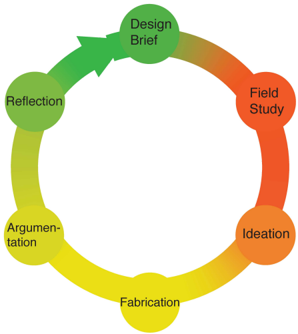
- The process model had six main activities—design brief, field studies, ideation, fabrication, argumentation, and reflection—and positioned argumentation and reflection as closing activities of each iteration.
- Evaluation used nine interview questions adapted from Bossen et al.’s taxonomy; 14 pairs of students were interviewed for 20–30 minutes, and the authors report that some students followed an “almost vertical learning curve,” illustrated by Sarah and Agnes shifting from thinking design meant clothes to seeing it as open creative thinking.
Methods
- The study was a research-through-design experiment conducted in Danish public schools, carried out with three seventh-grade classes at N. J. Fjordsgades School in Aarhus, Western Denmark, between October and December 2014.
- The experiment ran in the school’s makerspace over six weeks, amounted to two to four lessons per week, engaged 69 students aged 13–14, and was developed, evaluated, and refined in three iterations; a design researcher facilitated with a local teacher, while three design researchers documented using video and field notes.
- Researchers followed selected student groups and conducted semi-structured interviews with 14 pairs of students about their experiences and reflections; field notes and video were logged and analyzed with focus on the most closely followed groups, as also described in Smith et al. [34].
Limitations
- The authors state that they refrained from engaging children in framing the design brief and activities and in analyzing the data; they note this could potentially have strengthened the study and depth of children’s involvement but would have demanded more resources than available.
- The authors state that some students do not necessarily internalize knowledge from this kind of participation, and they report great variation among student gains.
- Evident from the text: the findings rest on a single case in one Danish school, with interviews limited to 14 students (in pairs) out of 69, and no comparison or control group is reported.
Model-written summary. Check it against the paper before relying on it.
Integrity signals
Registry
Cites
Statistics
Figures
Verification
Claims the paper makes
0 Valid · 0 Not valid · 8 Not checked · 47 Own results and interpretations
A result the paper reports from its own data — it cites no other source for it, so there is none to check. The quote shows it is in the paper.
In the paper
“Finally, the interview sessions suggested that the process had implications for their general perception of digital technology and design.”
hedgedstates a possible cause- Asserted: passes — The authors put it forward as true.
- Checkable: passes — It can be checked against evidence.
- Load-bearing: unclear — It is unclear whether the paper’s conclusions depend on it.
- Based: passes — The paper gives a reason why it holds.
- Rests on an assumption not shown here.
A result the paper reports from its own data — it cites no other source for it, so there is none to check. The quote shows it is in the paper.
In the paper
“In our design experiment, however, some students followed an almost vertical learning curve in terms of their ability not only to participate in design process but also in their understanding of digital technology.”
plain- Asserted: passes — The authors put it forward as true.
- Checkable: passes — It can be checked against evidence.
- Load-bearing: unclear — It is unclear whether the paper’s conclusions depend on it.
- Based: passes — The paper gives a reason why it holds.
- Rests on an assumption not shown here.
A result the paper reports from its own data — it cites no other source for it, so there is none to check. The quote shows it is in the paper.
In the paper
“Through their participation, they also managed to develop a design language and a sense of direction that enabled them to engage dynamically in the complex process of using a range of analog and digital materials in iterative movements of reflection and action.”
plainstates a cause- Asserted: passes — The authors put it forward as true.
- Checkable: passes — It can be checked against evidence.
- Load-bearing: passes — The paper’s conclusions depend on it.
- Based: passes — The paper gives a reason why it holds.
- Rests on an assumption not shown here.
A result the paper reports from its own data — it cites no other source for it, so there is none to check. The quote shows it is in the paper.
In the paper
“As this example illustrates, the students managed not only to create coherent products in response to the design challenge.”
plain- Asserted: passes — The authors put it forward as true.
- Checkable: passes — It can be checked against evidence.
- Load-bearing: unclear — It is unclear whether the paper’s conclusions depend on it.
- Based: passes — The paper gives a reason why it holds.
- Rests on an assumption not shown here.
A result the paper states — it cites no source for it, so there is none to check. The quote shows it is in the paper.
In the paper
“The availability of different technologies as flexible tools and materials to be integrated into the process shifted the students' perceptions of technology from something involving fixed objects to something involving digital means for creating their own alternative opportunities and solutions.”
plainstates a cause- Asserted: passes — The authors put it forward as true.
- Checkable: passes — It can be checked against evidence.
- Load-bearing: passes — The paper’s conclusions depend on it.
- Based: unclear — It is unclear why the paper says it holds.
- Rests on an assumption not shown here.
10 more claims
Create a free account to see all 55 claims and to verify the 1 reference still open.
- Probably not a substantial claim. 39
- It may state two separate claims as one. 6
Self-check
Percentages, sums and reported differences re-computed from the paper’s own numbers.
Each contradiction between two passages listed here was confirmed by an independent check.
Rated major: it would touch a result — a value a result rests on, reported and recomputed p-values on opposite sides of the significance level, two passages that conflict with no sign which is right, or a cited work retracted before this paper was published.
In the paper
§ METHOD · p. 5
“They also conducted semi-structured interviews (20 to 30 minutes in duration) with 14 pairs of students about their experiences of and reflections on the design process.”
§ OUTCOME MEASURES: EVALUATING THE OUTCOME OF A POLITICAL PD PROCESS · p. 7
“In this project, 14 students were interviewed in rounds of two-and-two.”
Rated minor: it would not touch a result — a value no result rests on, a p-value that stays on the same side of the significance level, or a conflict that is clerical, resolved elsewhere in the paper, or outside its own findings.
In the paper
§ DISCUSSION · p. 8
“The nine questions (Table 2) proposed for measuring outcomes”
§ Newly emerged opportunities in general · p. 7
“Table 3: Interview guide for evaluating children's gains.”
Citations
Cites
Research through design as a method for interaction design research in HCI
Zimmerman, J., Forlizzi, J., & Evenson, S. (2007) · Proceedings of the SIGCHI Conference on Human Factors in Computing Systems · doi:10.1145/1240624.1240704 · Cited by 2,304 · cited 1×
“design experiment [43] to examine how we could invite children into design in a protagonist role.”
BackgroundRoutledge International Handbook of Participatory Design
(2012) · doi:10.4324/9780203108543 · Cited by 1,606
21st century skills and competences for new millennium learners in OECD countries
(2009) · OECD Education Working Papers · doi:10.1787/218525261154 · Cited by 1,549
Participatory Design: Issues and Concerns
Kensing, F., & Blomberg, J. (1998) · Computer Supported Cooperative Work (CSCW) · doi:10.1023/a:1008689307411 · Cited by 1,084 · cited 1×
“POLITICAL PARTICIPATORY DESIGN Historically, PD has always had a strong political component [9, 24].”
BackgroundThe role of children in the design of new technology
(2002) · Behaviour & Information Technology · doi:10.1080/01449290110108659 · Cited by 1,071 · cited 10×
“We position the role of protagonist in relation to existing IDC research, involving children as users, testers, informants, codesigners [12, 17] and co-researchers [10].”
BackgroundMethodResultInfluential(2002) · Cited by 993
Computers and Democracy: A Scandinavian Challenge
Bjerknes, G., Ehn, P., Kyng, M., & Nygaard, K. (1987) · Medical Entomology and Zoology · Cited by 732
Work‐Oriented Design of Computer Artifacts
Hakken, D. (1989) · Anthropology of Work Review · doi:10.1525/awr.1989.10.4.14 · Cited by 713
Digital Fabrication and ‘Making’ in Education: The Democratization of Invention
Blikstein, P. (2013) · FabLab · doi:10.14361/transcript.9783839423820.203 · Cited by 672 · cited 1×
“[6] coins the rapidly extending reach of digital fabrication technologies as a “democratization of innovation” that emphasizes the possibilities for including children in the”
BackgroundThe design of children's technology
Druin, A. (1998) · Morgan Kaufmann Publishers Inc. eBooks · Cited by 475
Research works printed but not linked: 4
- 7. Bielefeld: Transcript Publishers.
- 10.5555/958052.958061 · doi:10.5555/958052.958061
- 27. Maarten Van Mechelen, M. (2016). Designing technologies for and with children: Theoretical reflections and a practical inquiry towards a co-design toolkit. Doctoral thesis defended in June 2016, UHasselt-KU Leuven.
- 39. Greg Walsh and Elizabeth Foss. 2015. A case for intergenerational distributed co-design: the online kidsteam example. In Proceedings of the 14th · DOI
Cited by
Items 101–200 of 307
Giannakos, M. N., Markopoulos, P., Hourcade, J. P., & Antle, A. N. (2022) · International Journal of Child-Computer Interaction · doi:10.1016/j.ijcci.2022.100469 · Cited by 21
Good for Children, Good for All?
Landoni, M., Huibers, T. W. C., Murgia, E., & Pera, M. S. (2024) · Lecture notes in computer science · doi:10.1007/978-3-031-56066-8_24 · Cited by 14
Making The Future School: An Analysis of Teens' Collaborative Digital Fabrication Project
Hartikainen, H., Ventä-Olkkonen, L., Cortés, M., Milara, I. S., Käsmä, M., & Kuure, L. (2024) · Proceedings of the ACM on Human-Computer Interaction · doi:10.1145/3637368 · Cited by 16
Towards Making Children Independent in Design
Roumelioti, E., Gennari, R., Matera, M., Melonio, A., & Rizvi, M. (2020) · Designing Interactive Systems Conference · doi:10.1145/3393914.3395849 · Cited by 13
“Considering this way of empowerment, a novel role for children emerged, the role of protagonist [12, 17].”
BackgroundBehind the Scenes: Design, Collaboration, and Video Creation with Youth
McRoberts, S., Yuan, Y., Watson, K., & Yarosh, S. (2019) · ACM International Conference on Interaction Design and Children (IDC) · doi:10.1145/3311927.3323134 · Cited by 20
“Participatory work with youth has also expanded to consider the incentives and motivations for teens [28] and encourages youth to be leaders for more of the design process [36].”
BackgroundSharma, S., Klemettilä, P. A., & Junko, T. (2025) · CHI Conference on Human Factors in Computing Systems · doi:10.1145/3706598.3713204 · Cited by 16
“Thus, our work also contributes to diversifying design futuring [32, 45, 69], inviting young children to be empowered as protagonists of their own future lives [24, 35, 37].”
InfluentialTowards Locative Systems for, and by, Children
Silva, C., Prandi, C., Ferreira, M. S., et al. (2019) · doi:10.1145/3325480.3326568 · Cited by 11
Teaching technical and societal aspects of IoT - A case study using the Orbit IoT Kit
Tamashiro, M. A., Schaper, M.-M., Jensen, A. V., Heick, R., Danielsen, B., Mechelen, M. V., Jensen, K. L., Smith, R. C., & Iversen, O. S. (2023) · Designing Interactive Systems Conference · doi:10.1145/3563657.3596092 · Cited by 15
“Based on such approaches, we aimed to develop new teaching practices and tools that address the particular challenges and characteristics of emerging technologies [9, 10, 17].”
BackgroundSelf-citationFostering children?s critical literacy in computing education
Iivari, N., Ventä-Olkkonen, L., Sharma, S., Hartikainen, H., Holappa, J., & Lehto, E. (2024) · Symposium on Learning, Design and Technology (LDT) · doi:10.1145/3663433.3663462 · Cited by 19
“We also invited the children to critically reflect on their designs and their consequences, inspired by the literature on critical reflection on the consequences and impacts of digital technology in society and our everyday life (e.g. [20]).”
BackgroundDreessen, K., & Schepers, S. (2018) · Participatory Design Conference · doi:10.1145/3210586.3210602 · Cited by 17
“Novel approaches, that build further upon Druin’s [9] framework and/or explore different roles, include Van Doorn, Stappers & Gielen’s [24] investigations into child coresearchers, Salian et al.’s [25] explorations of children as heuristic evaluators and Iversen, Smith & Dindler’s [10] role of the child as protagonist.”
BackgroundBrave and Kind Superheroes – Children's Reflections on the Design Protagonist Role
Kanafi, M. M., Iivari, N., & Kinnula, M. (2022) · Participatory Design Conference · doi:10.1145/3536169.3537783 · Cited by 17
Youth co-design of responsive digital badge systems: disrupting hierarchy and empowering youth
Tierney, G., Horstman, T., & Tzou, C. (2019) · CoDesign · doi:10.1080/15710882.2019.1654522 · Cited by 17
“Roles, particularly those that challenge youths ’ perception of pre-existing power structures, introduce opportunity for young people to collaborate in new and empowering ways (Iversen, Smith, and Dindler 2017).”
BackgroundChildren's Beliefs and Understanding of Smart Objects
Melonio, A., Rizvi, M., Roumelioti, E., Angeli, A. D., Gennari, R., & Matera, M. (2020) · International Conference on Advanced Visual Interfaces (AVI) · doi:10.1145/3399715.3399828 · Cited by 12
“The role of children as design protagonists has emerged from such efforts [9].”
BackgroundMethodA comparative study into how pupils can play different roles in co-design activities
Landoni, M., Rubegni, E., & Nicol, E. (2018) · International Journal of Child-Computer Interaction · doi:10.1016/j.ijcci.2018.04.003 · Cited by 13
“By reflecting on the political value of the design process as a means to empower its actors, Iversen et al [19] provide an interesting insight into how to make children truly protagonists in the process.”
BackgroundInfluentialSee the World Through the Eyes of a Child
Silva, C., Prandi, C., Ferreira, M. S., et al. (2019) · doi:10.1145/3322276.3323700 · Cited by 10
Participatory design that matters – with activism education of children
Iivari, N., Ventä-Olkkonen, L., Hartikainen, H., & Sharma, S. (2024) · Participatory Design Conference · doi:10.1145/3666094.3666108 · Cited by 13
Emerging Technologies in Global South Classrooms: Teachers Imagining Future of Education
Sebastian, P., Sharma, S., Iivari, N., Kinnula, M., Monga, C., Verma, D., & Abbas, M. S. (2024) · Participatory Design Conference · doi:10.1145/3666094.3666109 · Cited by 17
Discussing the Protagonist Role of Students in Game-Based Learning
Weixelbraun, P., Göbl, B., Steinböck, M., Duvivié, M., & Kayali, F. (2024) · Proceedings of the ACM on Human-Computer Interaction · doi:10.1145/3677065 · Cited by 19
“These six activities include: a short design brief, an exploration and research of the context, idea generation, prototyping of learning concepts, argumentation for testing the learning concepts, and reflecting on the design process [28].”
InfluentialNorouzi, B., Sharma, S., Kinnula, M., Iivari, N., Ukkola, M., Milara, I. S., Bulygin, G., uusitalo, J., & Iwata, M. (2023) · International Journal of Technology and Design Education · doi:10.1007/s10798-023-09856-4 · Cited by 13
“…literature base on children’s genuine participation, empowerment of children and the principles of Scandinavian participatory design (Druin, 2002; Iversen et al., 2017), and propose a four-part genuine participation framework to understand how children and other user groups can genuinely…”
Researchers' toolbox for the future
Kinnula, M., Iivari, N., Kotilainen, S., Okkonen, J., & Sharma, S. (2020) · ACM International Conference on Interaction Design and Children (IDC) · doi:10.1145/3397617.3398064 · Cited by 10
Ritual Drones: Designing and Studying Critical Flying Companions
Gamboa, M., Obaid, M., & Ljungblad, S. (2021) · ACM/IEEE International Conference on Human-Robot Interaction (HRI) · doi:10.1145/3434074.3446363 · Cited by 11
Magical Realism and Augmented Reality: Designing Apps with Children in a Cultural Institution
Schofield, T., Trujillo-Pisanty, D., Arrigoni, G., Reynolds, K., & Pattinson, R. (2019) · Designing Interactive Systems Conference · doi:10.1145/3322276.3322293 · Cited by 10
Design Empowerment: Participatory Design Towards Social Sustainability
Zhang, M. (2022) · Lecture notes in computer science · doi:10.1007/978-3-031-06038-0_20 · Cited by 12
Mejeh, M., & Sarbach, L. (2024) · Technology Knowledge and Learning · doi:10.1007/s10758-024-09788-5 · Cited by 20
“This approach positions learners as protago-nists in participatory design, enabling them to influence technological development and critically reflect on the role of technology in their learning practices (Iversen et al., 2017).”
Zhou, X., Gong, Y., Zhou, Y., Jiang, Y., & Bai, Z. (2025) · International Journal of Human-Computer Studies · doi:10.1016/j.ijhcs.2025.103462 · Cited by 13
What is a robot? an artistic approach to understand children's imaginaries about robots
Malinverni, L., & Valero, C. (2020) · ACM International Conference on Interaction Design and Children (IDC) · doi:10.1145/3392063.3394415 · Cited by 12
“Under the claim that children are the experts in their own experience [26], a broad range of initiatives explored strategies to listen to children’s voices in research and involve them either as co-designers [26, 28, 48], co-researchers [53] or as design protagonists [31].”
BackgroundCollective co-design activities with children for designing classroom robots
Obaid, M., Baykal, G. E., Kırlangıç, G., Göksun, T., & Yantaç, A. E. (2023) · African Human Computer Interaction Conference (AfriCHI) · doi:10.1145/3628096.3630094 · Cited by 14
Troiano, G. M., Cassidy, M. F., Morales, D. E., Pons-Castro, G., Abdollahi, A., Robles, G., Puttick, G. M., & Harteveld, C. (2025) · CHI Conference on Human Factors in Computing Systems · doi:10.1145/3706598.3713368 · Cited by 10
Bilstrup, K.-E. K., Connelly, L. C., Musaeus, L. H., Kaspersen, M. H., & Petersen, M. G. (2025) · ACM International Conference on Interaction Design and Children (IDC) · doi:10.1145/3713043.3728857 · Cited by 15
Designing Technologies with and for Youth: Traps of Privacy by Design
Zaman, B. (2020) · Media and Communication · doi:10.17645/mac.v8i4.3261 · Cited by 12
Fostering Children's Stewardship of Local Nature Through Game Co-design
Vella, K., Dema, T., Soro, A., & Brereton, M. F. (2021) · Australian Conference on Human-Computer Interaction (OzCHI) · doi:10.1145/3520495.3522702 · Cited by 11
“As such, PD with children can do more than simply give them a voice in design [24].”
BackgroundBezabih, A. M., Gerling, K., Abebe, W., & Abeele, V. V. (2023) · CHI Conference on Human Factors in Computing Systems · doi:10.1145/3544548.3580756 · Cited by 13
Children’s Ideal Nature-Related Digital Tools: A Co-design Experiment
Yin, S., Kasraian, D., Wang, G., Evers, S., & van Wesemael, P. J. V. (2023) · Communications in computer and information science · doi:10.1007/978-3-031-35989-7_22 · Cited by 8
Sharma, S., Achary, K., Kinnula, M., Iivari, N., & Varkey, B. (2020) · ACM International Conference on Interaction Design and Children (IDC) · doi:10.1145/3392063.3394394 · Cited by 8
ZooDesign: Methods for Understanding and Facilitating Children’s Education at Zoos
Hirskyj-Douglas, I., Gray, S. I., & Piitulainen, R. (2021) · ACM International Conference on Interaction Design and Children (IDC) · doi:10.1145/3459990.3460697 · Cited by 10
Design Opportunities to Enhance Children's Engagement with Nature in Bhutan: A Working Field Theory
Om, C., Brereton, M. F., Dema, T., & Ploderer, B. (2021) · Australian Conference on Human-Computer Interaction (OzCHI) · doi:10.1145/3520495.3520516 · Cited by 8
SNaP 2: The Evolution of a Board Game for Smart Nature Environments
Gennari, R., Matera, M., Melonio, A., & Roumelioti, E. (2019) · Annual Symposium on Computer-Human Interaction in Play · doi:10.1145/3341215.3356281 · Cited by 8
“Recently, the role of protag-onist has emerged as relevant and critical, e.g., [9].”
BackgroundResultSchepers, S., Schoffelen, J., Zaman, B., & Dreessen, K. (2021) · CoDesign · doi:10.1080/15710882.2021.1912775 · Cited by 11
Child participation in decision making: Implications for education and beyond
Gottschalk, F., & Borhan, H. (2023) · OECD education working papers · doi:10.1787/a37eba6c-en · Cited by 62
Morris, B., Havlucu, H., Oldfield, A., & Metatla, O. (2025) · CHI Conference on Human Factors in Computing Systems · doi:10.1145/3706598.3713738 · Cited by 11
“One way to better understand how to develop technologies to support neurodiverse social play is to engage with neurodiverse groups of children through co-design [8, 27, 33, 40, 78].”
Shokeen, E., Dindler, C., & Iversen, O. S. (2025) · ACM International Conference on Interaction Design and Children (IDC) · doi:10.1145/3713043.3728851 · Cited by 8
Self-citationStorying-Roleplay: A Co-design Method Supporting Young Children to Understand Environmental Problems
Om, C., Vella, K., Dema, T., Ploderer, B., Murcia, K., & Brereton, M. F. (2025) · ACM International Conference on Interaction Design and Children (IDC) · doi:10.1145/3713043.3728842 · Cited by 9
Raihan, J. (2025) · Decennial Aarhus Conference · doi:10.1145/3744169.3744184 · Cited by 11
Lowy, R., Magiawala, K., Mittal, S., Hall, K., Roberts, J., & Kim, J. G. (2024) · Proceedings of the ACM on Human-Computer Interaction · doi:10.1145/3687050 · Cited by 9
“This is critical to CE as this approach encourages students to recognize how to relate their own experiences to technology development [36].”
InfluentialNunes, E. H. D. C., Silva, P. V. D. S., Souza, R. G. L. E., & Monteiro, I. T. (2024) · Brazilian Symposium on Human Factors in Computing Systems (IHC) · doi:10.1145/3702038.3702098 · Cited by 6
Morales‐Navarro, L., Noh, D. J., & Kafai, Y. B. (2025) · ACM International Conference on Interaction Design and Children (IDC) · doi:10.1145/3713043.3731525 · Cited by 16
Reporting Back in HCI Work with Children
Read, J. C., Sim, G., Horton, M., & Fitton, D. (2022) · ACM International Conference on Interaction Design and Children (IDC) · doi:10.1145/3501712.3535279 · Cited by 13
“When children participate in IDC research, it is very important to be clear about their inclusion and the meaning of their contributions [23].”
BackgroundRelating to materials in digital fabrication: Transform materials to transform yourself
Malinverni, L., Schaper, M.-M., & Valero, C. (2020) · International Journal of Child-Computer Interaction · doi:10.1016/j.ijcci.2020.100166 · Cited by 11
Engaging Pre-teens in Ideating and Programming Smart Objects Through Play
Gennari, R., Matera, M., Melonio, A., Rizvi, M., & Roumelioti, E. (2020) · Advances in intelligent systems and computing · doi:10.1007/978-3-030-52538-5_4 · Cited by 11
Multi-stakeholder Perspectives on Mental Health Screening Tools for Children
Kalanadhabhatta, M., Santana, A. M., Mayorga, L., Rahman, T., Ganesan, D., & Grabell, A. S. (2024) · CHI Conference on Human Factors in Computing Systems · doi:10.1145/3613904.3642604 · Cited by 9
“We encourage future studies to involve children as stakeholders in the design of screening technologies through age-appropriate participatory design approaches [23, 38, 40].”
Children’s Design Values Manifestos: Integrating Human Values in Middle School Design-based Learning
Veldhuis, A., Antle, A. N., Smith, C., Lo, P., Kim, T. H., & Murai, Y. (2025) · ACM International Conference on Interaction Design and Children (IDC) · doi:10.1145/3713043.3728838 · Cited by 9
“Similarly, Iversen et al. [53] extend the role of children in CCI research toward main agents of the design process as they engage with authentic design problems, referred to as ‘ protagonist ’.”
Eliciting Preschool Children's Preferences for Augmented Reality Smart Glasses
Hourcade, J. P., Schmuecker, S., Norris, D., Onions, M., & Gilhoi, A. (2025) · ACM International Conference on Interaction Design and Children (IDC) · doi:10.1145/3713043.3728861 · Cited by 7
Learning AI Auditing: A Case Study of Teenagers Auditing a Generative AI Model
Morales‐Navarro, L., Gan, M. A., Yu, E., Vogelstein, L., Kafai, Y. B., & Metaxa, D. (2025) · Proceedings of the ACM on Human-Computer Interaction · doi:10.1145/3757620 · Cited by 13
“Iversen et al. [19] argue that young people can also engage in such participatory activities by becoming protagonists or the main decision-makers.”
Exploring Children’s Engagement in Monitoring Indoor Air Quality: Longitudinal Study
Kim, S., & Sohanchyk, G. (2022) · JMIR Formative Research · doi:10.2196/32404 · Cited by 7
“Thus, the participatory design approach has been extensively used to design technology for children [26-28] and has become one of the most prevalent usability methods in the fields of human-computer interaction for children.”
MethodPlay—An essential part of children’s lives and their computational empowerment
Tikkanen, R., Iivari, N., & Paananen, P. (2023) · Frontiers in Education · doi:10.3389/feduc.2022.1088716 · Cited by 9
“…invited not only into the role of users or testers as regards digital technology and its development but also into the role of design partners and protagonists, acting as equals to adult designers, if not even driving the development of digital technology (e.g., Druin, 2002; Iversen et al., 2017).”
BackgroundChen, J., Zhao, L., Li, Y., Xie, Z., Wilensky, U. J., & Horn, M. (2024) · CHI Conference on Human Factors in Computing Systems · doi:10.1145/3613904.3642043 · Cited by 11
Children’s Participation in the Design of Smart Solutions: A Literature Review
Pellegrino, M. A., Roumelioti, E., D’Angelo, M., & Gennari, R. (2022) · Smart Cities · doi:10.3390/smartcities5020026 · Cited by 8
“Such workshops, thus, do not offer the chance to children for a more critical and reflective stance toward technology [24].”
BackgroundDigital Design With Children in Mind
Chelvachandran, N., & Michael, K. (2022) · IEEE Technology and Society Magazine · doi:10.1109/mts.2022.3201450 · Cited by 8
Funds of Identity in Co-Design
Iriarte, M. P., Koren, N., Blinder, E. B., & Bonsignore, E. (2023) · ACM International Conference on Interaction Design and Children (IDC) · doi:10.1145/3585088.3593901 · Cited by 10
Researchers' Toolbox for the Future: Empowering Children to Shape Their Future
Kotilainen, S., Okkonen, J., Spurava, G., Iversen, O. S., Iivari, N., Kinnula, M., & Sharma, S. (2020) · Nordic Conference on Human-Computer Interaction · doi:10.1145/3419249.3420082 · Cited by 6
“trajectories, and lives in general, not only on their participation in some particular project [5] [10] [12], i.”
BackgroundSelf-citationMuñoz, J. E., Chandra, S., Rincon, A. M. R., et al. (2021) · Interaction Design and Children · doi:10.1145/3459990.3460517 · Cited by 6
“Nevertheless, applying methods that actively involve children throughout the design process as design partners can be a challenging tasks considering how demanding this can be in terms of preparing the activities and accessing the participants as well as interpreting all the qualitative data collected and most importa…”
MethodMorais, D., Falcão, T. P., & Tedesco, P. C. D. A. R. (2024) · Journal of the Brazilian Computer Society · doi:10.5753/jbcs.2024.3114 · Cited by 7
“[2003]; and with 5, roles of children in PD [Druin, 2002; Hussain, 2010; van Doorn, 2016; Iversen et al ., 2017; Schepers et al ., 2018], including the artifact designer.”
BackgroundInfluentialInclusive Child Engagement in HCI: Exploring Ocean Health with Schoolchildren
Read, J. C., Horton, M., Fitton, D., King, J., Sim, G., Allen, J., Doumanis, I., Graham, T. L., Xu, D., Tierney, M., et al. (2024) · ACM International Conference on Interaction Design and Children (IDC) · doi:10.1145/3628516.3655750 · Cited by 8
Yin, S., Kasraian, D., Wang, G., Evers, S., & van Wesemael, P. J. V. (2024) · Environment and Behavior · doi:10.1177/00139165241311071 · Cited by 6
“Children can be empowered to actively shape technological development and critically reflect on the role of technology in their practices (Iversen et al., 2017).”
Guidelines for Empowering Children to Make and Shape Digital Technology—Case Fab Lab Oulu
Kinnula, M., Iivari, N., Milara, I. S., & Ylioja, J. (2020) · Lecture notes in educational technology · doi:10.1007/978-981-15-6747-6_9 · Cited by 7
Pre-schoolers’ Stewardship – Embracing Higgledy-piggledy Behaviours through Participatory Plaything
Södergren, A. C., & Montero, C. S. (2022) · ACM International Conference on Interaction Design and Children (IDC) · doi:10.1145/3501712.3529737 · Cited by 7
“In our study, the plaything establishes an exploratory PD setting empowering pre-schoolers as stewards of self-determined expressions and are “protagonists” [22] that determine direction and activities.”
BackgroundAge Against the Machine: A Call for Designing Ethical AI for and with Children
Sharma, S., Kinnula, M., Iivari, N., Ventä-Olkkonen, L., Hartikainen, H., Durall, E., Molin‐Juustila, T., Okkonen, J., Kotilainen, S., Sawhney, N., et al. (2022) · Nordic Conference on Human-Computer Interaction · doi:10.1145/3547522.3547702 · Cited by 11
“5692437 Children have a crucial role in technology design and development [18, 19, 21, 22, 31] and “there is a need to seize the creativity and”
Background”This book is magical!”: exploring emergent readers’ preferences and wishes for storytelling tools
Valguarnera, S., & Landoni, M. (2022) · Nordic Conference on Human-Computer Interaction · doi:10.1145/3546155.3547274 · Cited by 8
Rethinking children's co-creation processes beyond the design of TUIs
Catalá, A., Sylla, C., Theune, M., Brooks, E., & Read, J. C. (2018) · ACM International Conference on Interaction Design and Children (IDC) · doi:10.1145/3202185.3205870 · Cited by 5
“Based on the relation that children and the research team have, as well as the stage at which children are integrated in the design process, children can be users, testers, informants, design partners, or protagonists [14,10,9].”
BackgroundCo-Designing Health-Related Digital Tools with Children: A Scoping Review of Current Practice
Roberts, P., Boylan, F., Collins, P. R., & Barblett, L. (2025) · Education Sciences · doi:10.3390/educsci15060671 · Cited by 5
“Children commonly have roles in design research as user, tester, informant, and design partner; however, Iversen et al. (2017) introduced a role that empowers the child further— that of a protagonist.”
Identities in Flux—Exploring Children’s Emerging Identities in Design and Making
Ventä-Olkkonen, L., Kuure, L., Iivari, N., Molin‐Juustila, T., Sharma, S., Hartikainen, H., Holappa, J., & Lehto, E. (2025) · ACM Transactions on Computer-Human Interaction · doi:10.1145/3729425 · Cited by 4
“Children should be supported in becoming empowered citizens capable of developing the technology-rich world they live in into a better place (e.g., Iivari and Kinnula [2023]; Iversen et al. [2017]).”
Sharma, S., Babai, N., Durall, E., Hartikainen, H., Iivari, N., Kinnula, M., Klemettilä, P. A., Niaz, Y., Norouzi, B., Sebastian, P., et al. (2026) · CHI Conference on Human Factors in Computing Systems · doi:10.1145/3772318.3793214 · Cited by 3
Chuah, K.-M., Mohamad, F. S., Minoi, J.-L., et al. (2021) · World Engineering Education Forum - Global Engineering Deans Council (WEEF-GEDC) · doi:10.1109/weef/gedc53299.2021.9657214 · Cited by 4
Uncovering Children's Situated Design Capital – A Nexus Analytic Inquiry
Kanafi, M. M., Iivari, N., Kinnula, M., & Sharma, S. (2022) · ACM International Conference on Interaction Design and Children (IDC) · doi:10.1145/3501712.3529732 · Cited by 5
“[44], where children are put at the center of the design process, expressing their voice, and participating in solving real-world design problems.”
BackgroundInfluentialSay It with Emojis: Co-Designing Relevance Cues for Searching in the Classroom
Aliannejadi, M., Landoni, M., Huibers, T. W. C., Murgia, E., Pera, M. S., Cantador, I., Chevalier, M., Melucci, M., & Mothe, J. (2020) · UvA-DARE (University of Amsterdam) · Cited by 4
Birch, H. J. S., & Epp, C. D. (2023) · Educational Technology Research and Development · doi:10.1007/s11423-023-10252-x · Cited by 5
“Children are likely accustomed to adults being in a power position over them (Druin & Fast, 2002; Iversen et al., 2017; Punch, 2002).”
BackgroundCo-Designing Digital Technologies to Support Minimally-Verbal Children on the Autism Spectrum
Wilson, C. (2019) · CHI Conference Extended Abstracts on Human Factors in Computing Systems (CHI EA) · doi:10.1145/3290607.3299076 · Cited by 4
Davis, K. S., & Subramaniam, M. M. (2022) · Information and Learning Sciences · doi:10.1108/ils-07-2022-264 · Cited by 4
Gak, L., Li, I., Rosner, D. K., & Salehi, N. (2025) · CHI Conference Extended Abstracts on Human Factors in Computing Systems (CHI EA) · doi:10.1145/3706599.3719952 · Cited by 3
Morales‐Navarro, L. (2025) · ACM International Conference on Interaction Design and Children (IDC) · doi:10.1145/3713043.3731602 · Cited by 4
“…how these systems work from both technical and ethical perspectives. conjecture is that through construction and deconstruction activities, learners develop understandings of how computing systems work and skills to design and reflect on computing technologies and their role in everyday life [16].”
Durall, E., Hurley, M., Iivari, N., Kinnula, M., Babai, N., & Niaz, Y. (2025) · Postdigital science and education · doi:10.1007/978-3-032-01539-6_15 · Cited by 5
Youth AI designs meet eternal values: responsible digital technology design and innovation education
Haarjärvi, T., Norouzi, B., Kinnula, M., Ventä-Olkkonen, L., Hartikainen, H., & Sharma, S. (2026) · Behaviour and Information Technology · doi:10.1080/0144929x.2026.2615036 · Cited by 4
“This is argued to empower them to shape and influence technologies (Iversen, Smith, and Dindler 2017; Kinnula and Iivari 2021), even drive the process where designing is done by them (and not with or for them).”
InfluentialThe IDC Research and Design Challenge throughout the years: achievements, reflections and next steps
Valguarnera, S., Sylla, C., & Landoni, M. (2023) · ACM International Conference on Interaction Design and Children (IDC) · doi:10.1145/3585088.3589382 · Cited by 6
Ethical Concerns when Working with Mixed-Ability Groups of Children
Henriques, A. O., Piedade, P., Rocha, F., Neto, I., & Nicolau, H. (2024) · International ACM SIGACCESS Conference on Computers and Accessibility (ASSETS) · doi:10.1145/3663548.3675648 · Cited by 3
“In that context, we consider it particularly important to actively include marginalized populations in our work, and, within that, we also highlight the importance of including children as protagonists in participatory research [26].”
Ethical Considerations in Designing and Testing Robots for Children in Educational Settings
Arriaga, P., Neto, I., Correia, F., & Soares, A. (2025) · Studies in computational intelligence · doi:10.1007/978-3-031-82915-4_8 · Cited by 5
Children Involvement in Participatory Design Process: A Background Review
Alhatem, M. (2019) · International Journal of Advanced Trends in Computer Science and Engineering · doi:10.30534/ijatcse/2019/7581.42019 · Cited by 3
Children's participation in the design of digital artifacts in rural schools
Morais, D., Falcão, T. P., & Tedesco, P. C. D. A. R. (2022) · Brazilian Symposium on Human Factors in Computing Systems (IHC) · doi:10.1145/3554364.3559110 · Cited by 6
“Besides the roles suggested in [10], other children’s roles in PD were proposed, namely: process designers [10], co-researchers [35] and protagonists [15].”
BackgroundInfluentialTowards Bridging the Gap between Participatory Design and Formal Education
Göbl, B., Duvivié, M., Jovicic, S., & Kayali, F. (2023) · ACM International Conference on Interaction Design and Children (IDC) · doi:10.1145/3585088.3593881 · Cited by 4
“Students are encouraged to take a more active, self-determined protagonist role [20], while teachers serve as facilitators, or meta-designers [9].”
BackgroundDesigning for Educational Resilience to Reduce School Dropout: A Case Study of Namibian San Learners
Kays, R., Goagoses, N., & Winschiers‐Theophilus, H. (2023) · ACM Journal on Computing and Sustainable Societies · doi:10.1145/3616389 · Cited by 5
“The benefit of engaging learners in re-shaping of their own learning context has previously been established, and particularly the role of children in participatory design [ 20 , 27 ].”
BackgroundLee, K. J., Na, S., Wang, H., Park, H., Jo, M., Cho, Y., Jung, Y., Park, G., Lee, J. H., & Yip, J. C. (2023) · Behaviour and Information Technology · doi:10.1080/0144929x.2023.2272194 · Cited by 3
“Iversen et al. (2017) suggested the role of child as protagonist where children gain new insights into design and digital technology.”
Nurturing the Transformative Agency and Activism of Children Through Digital Technology
Iivari, N., & Kinnula, M. (2024) · Springer eBooks · doi:10.1007/978-3-031-30438-5_13 · Cited by 3
Södergren, A. C. (2024) · ACM International Conference on Interaction Design and Children (IDC) · doi:10.1145/3628516.3659407 · Cited by 5
Botta, C., Robertson, J., McMellon, C., Lawson, J. F., Ajala, J., Gonzalez, S. L., Hamidi, A., Hicks, N., McDonald, K., Paterson, R. J., et al. (2025) · Conference on United Kingdom & Ireland Computing Education Research (UKICER) · doi:10.1145/3754508.3754519 · Cited by 3
Children as Designers: Co-Designing and Making Products for a Better Everyday Life
Salonen, N. (2018) · FabLearn Europe Conference on Creativity and Making in Education (FabLearn Europe) · doi:10.1145/3213818.3213832 · Cited by 4
Schultz, E., Ortiz, J. S. B., García, L. S., & Pereira, R. (2018) · Anais do ... Simpósio Brasileiro de Informática na Educação/Anais do Simpósio Brasileiro de Informática na Educação · doi:10.5753/cbie.sbie.2018.1103 · Cited by 3
“Facilitator 8 instead of a traditional teacher : In [Iversen et al. 2017], authors suggest a new role for children in PD practices: the protagonist role.”
BackgroundResultInfluentialEmerging Children Roles in Child-Computing Interaction Research: A Systematic Literature ReviewPreprint
Abimbade, O., & Adisa, I. O. (2023) · Preprints.org · doi:10.20944/preprints202308.0550.v1 · Cited by 2
Co-designing Lesson Plans for Supporting Human-Centred AI Literacy in K-12 Education
Mannila, L., Hägglund, S., & Wingren, M. (2025) · Lecture notes in computer science · doi:10.1007/978-3-031-93564-0_7 · Cited by 8
Kinnula, M., Durall, E., & Iivari, N. (2025) · Decennial Aarhus Conference · doi:10.1145/3737609.3747120 · Cited by 2
STS and Participatory Edtech (Re-)Design
Hartong, S., & Decuypere, M. (2026) · Springer eBooks · doi:10.1007/978-981-92-1483-9_28 · Cited by 3
Community-Situated Mixed-Methods Robotics Research for Children and Childhood Spaces
Mott, T., & Williams, T. (2022) · ACM/IEEE International Conference on Human-Robot Interaction (HRI) · doi:10.1109/hri53351.2022.9889505 · Cited by 2
“Additionally, the codesign community has a strong tradition of power-sharing—in which researchers treat children as equals and respect their voice and intellectual property [22], [24], [27].”
BackgroundMethodInfluential
Metadata
- Authors
- Iversen, O. S., Smith, R. C., & Dindler, C.
- Affiliations
- Aarhus University (DK)
- Venue
- Proceedings of the 2017 Conference on Interaction Design and Children
- Publisher
- ACM
- Published
- 2017-06-27
- Pages
- 27-37
- OpenAlex
- W2684774892
- Cited by
- 333
- References
- 41
- Citations by year
- 2026: 57 · 2025: 51 · 2024: 34 · 2023: 39 · 2022: 32 · 2021: 34 · 2020: 34 · 2019: 32 · 2018: 20
- FWCI
- 68.85
- Type
- conference paper
- Language
- en
- Open access
- green
- pure.au.dk
- Locations
- ACM International Conference on Interaction Design and Children (IDC) (publishedVersion)
- Funders
- Industriens Fond
- Topics
- Social Sciences › Sociology and Political Science › Children's Rights and Participation
- Physical Sciences › Computer Science › Human-Computer Interaction › Innovative Human-Technology Interaction
- Physical Sciences › Engineering › Mechanical Engineering › Design Education and Practice
- Keywords
- children as protagonists, child empowerment, critical reflection on technology, 21st century skills
About these checks
Registry, retraction, Cites and statistics results are computed, not judged, with one exception: a printed reference that no index lists is read once by a model before it counts as a citation error. Claims are extracted by a model and kept only when their quote appears verbatim in the text; each cited source is then checked, with a model’s help, for whether it says what the claim relies on. Those verdicts can be wrong — read the claim’s quote and the cited source before relying on one.
A language model drew the claims from the paper on 2026-10-10, under version 3 of the claim definition (model deepseek-v4.1-flash, prompt extract-v3).
A second model labelled each claim on 2026-10-10 (model jev-1.13-20260917, definition revision gold-guideline-v0.2).
Statistics and arithmetic are recomputed, not judged.
Confidence bands are shown only for fields calibrated on our annotated test set. None is calibrated yet, so no band is shown.
What counts as a claim ›How we measure confidence ›How we check this ›
Are you an author, or do you see a problem with this page? Request a review
Data sources
Bibliographic data: Semantic Scholar, OpenAlex, Crossref.
Contains information from the Semantic Scholar Academic Graph Datasets, made available under the ODC Attribution License (ODC-BY 1.0).
Semantic Scholar’s data is described in: Kinney, R., et al. (2023). The Semantic Scholar Open Data Platform. arXiv:2301.10140.
