

Child as Protagonist: Expanding the Role of Children in Participatory Design
Open accessThe DOI matches its Crossref record; 42 of the 42 references it cites were found in a registry or an index; none of the 9 sources its claims cite is checked for support yet.
Abstract
We suggest that a commitment to political participatory design defines a new role for children in participatory practices--the role of protagonist. The objective here transcends the goal of giving children a voice in design, and addresses more broadly how children can be empowered to shape technological development and critically reflect on the role of technology in their practices. This re-accentuation of political participatory design to formulate the protagonist role is important, because it deepens our understanding of how children may be empowered through design. It is also timely in view of current societal challenges pertaining to training children in twenty-first century skills. Based on a case study, we illustrate how the protagonist role, based on political participatory design, can change the objective, process, and outcome measures of the design process.
Overview
CoChat Summary
TL;DR
The paper proposes a sixth role for children in participatory design—the “child as protagonist”—rooted in political participatory design, where the aim is children’s critical reflection on technology and development of design competence rather than only producing technology. A six-week Danish school case with 69 seventh-grade students illustrates how this role reshapes the objective, process, and outcome measures of design.
Key findings
- The paper introduces “child as protagonist” as a distinct category alongside children as users, testers, informants, design partners, and co-researchers; its objective is for children to develop skills to design and reflect on technology and its role in their lives, with process arranged primarily to build design competence and outcome measures focused on new insights and reflective stance.
- The case study involved 69 students aged 13–14 in three seventh-grade classes over six weeks, with two to four lessons per week; the design brief asked them to redesign a public park in Aarhus in connection with the city’s 2017 European Capital of Culture status.
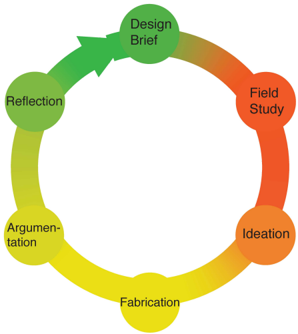
- The process model had six main activities—design brief, field studies, ideation, fabrication, argumentation, and reflection—and positioned argumentation and reflection as closing activities of each iteration.
- Evaluation used nine interview questions adapted from Bossen et al.’s taxonomy; 14 pairs of students were interviewed for 20–30 minutes, and the authors report that some students followed an “almost vertical learning curve,” illustrated by Sarah and Agnes shifting from thinking design meant clothes to seeing it as open creative thinking.
Methods
- The study was a research-through-design experiment conducted in Danish public schools, carried out with three seventh-grade classes at N. J. Fjordsgades School in Aarhus, Western Denmark, between October and December 2014.
- The experiment ran in the school’s makerspace over six weeks, amounted to two to four lessons per week, engaged 69 students aged 13–14, and was developed, evaluated, and refined in three iterations; a design researcher facilitated with a local teacher, while three design researchers documented using video and field notes.
- Researchers followed selected student groups and conducted semi-structured interviews with 14 pairs of students about their experiences and reflections; field notes and video were logged and analyzed with focus on the most closely followed groups, as also described in Smith et al. [34].
Limitations
- The authors state that they refrained from engaging children in framing the design brief and activities and in analyzing the data; they note this could potentially have strengthened the study and depth of children’s involvement but would have demanded more resources than available.
- The authors state that some students do not necessarily internalize knowledge from this kind of participation, and they report great variation among student gains.
- Evident from the text: the findings rest on a single case in one Danish school, with interviews limited to 14 students (in pairs) out of 69, and no comparison or control group is reported.
Model-written summary. Check it against the paper before relying on it.
Integrity signals
Registry
Cites
Statistics
Figures
Verification
Claims the paper makes
0 Valid · 0 Not valid · 8 Not checked · 47 Own results and interpretations
A result the paper reports from its own data — it cites no other source for it, so there is none to check. The quote shows it is in the paper.
In the paper
“Finally, the interview sessions suggested that the process had implications for their general perception of digital technology and design.”
hedgedstates a possible cause- Asserted: passes — The authors put it forward as true.
- Checkable: passes — It can be checked against evidence.
- Load-bearing: unclear — It is unclear whether the paper’s conclusions depend on it.
- Based: passes — The paper gives a reason why it holds.
- Rests on an assumption not shown here.
A result the paper reports from its own data — it cites no other source for it, so there is none to check. The quote shows it is in the paper.
In the paper
“In our design experiment, however, some students followed an almost vertical learning curve in terms of their ability not only to participate in design process but also in their understanding of digital technology.”
plain- Asserted: passes — The authors put it forward as true.
- Checkable: passes — It can be checked against evidence.
- Load-bearing: unclear — It is unclear whether the paper’s conclusions depend on it.
- Based: passes — The paper gives a reason why it holds.
- Rests on an assumption not shown here.
A result the paper reports from its own data — it cites no other source for it, so there is none to check. The quote shows it is in the paper.
In the paper
“Through their participation, they also managed to develop a design language and a sense of direction that enabled them to engage dynamically in the complex process of using a range of analog and digital materials in iterative movements of reflection and action.”
plainstates a cause- Asserted: passes — The authors put it forward as true.
- Checkable: passes — It can be checked against evidence.
- Load-bearing: passes — The paper’s conclusions depend on it.
- Based: passes — The paper gives a reason why it holds.
- Rests on an assumption not shown here.
A result the paper reports from its own data — it cites no other source for it, so there is none to check. The quote shows it is in the paper.
In the paper
“As this example illustrates, the students managed not only to create coherent products in response to the design challenge.”
plain- Asserted: passes — The authors put it forward as true.
- Checkable: passes — It can be checked against evidence.
- Load-bearing: unclear — It is unclear whether the paper’s conclusions depend on it.
- Based: passes — The paper gives a reason why it holds.
- Rests on an assumption not shown here.
A result the paper states — it cites no source for it, so there is none to check. The quote shows it is in the paper.
In the paper
“The availability of different technologies as flexible tools and materials to be integrated into the process shifted the students' perceptions of technology from something involving fixed objects to something involving digital means for creating their own alternative opportunities and solutions.”
plainstates a cause- Asserted: passes — The authors put it forward as true.
- Checkable: passes — It can be checked against evidence.
- Load-bearing: passes — The paper’s conclusions depend on it.
- Based: unclear — It is unclear why the paper says it holds.
- Rests on an assumption not shown here.
10 more claims
Create a free account to see all 55 claims and to verify the 1 reference still open.
- Probably not a substantial claim. 39
- It may state two separate claims as one. 6
Self-check
Percentages, sums and reported differences re-computed from the paper’s own numbers.
Each contradiction between two passages listed here was confirmed by an independent check.
Rated major: it would touch a result — a value a result rests on, reported and recomputed p-values on opposite sides of the significance level, two passages that conflict with no sign which is right, or a cited work retracted before this paper was published.
In the paper
§ METHOD · p. 5
“They also conducted semi-structured interviews (20 to 30 minutes in duration) with 14 pairs of students about their experiences of and reflections on the design process.”
§ OUTCOME MEASURES: EVALUATING THE OUTCOME OF A POLITICAL PD PROCESS · p. 7
“In this project, 14 students were interviewed in rounds of two-and-two.”
Rated minor: it would not touch a result — a value no result rests on, a p-value that stays on the same side of the significance level, or a conflict that is clerical, resolved elsewhere in the paper, or outside its own findings.
In the paper
§ DISCUSSION · p. 8
“The nine questions (Table 2) proposed for measuring outcomes”
§ Newly emerged opportunities in general · p. 7
“Table 3: Interview guide for evaluating children's gains.”
Citations
Cites
Research through design as a method for interaction design research in HCI
Zimmerman, J., Forlizzi, J., & Evenson, S. (2007) · Proceedings of the SIGCHI Conference on Human Factors in Computing Systems · doi:10.1145/1240624.1240704 · Cited by 2,304 · cited 1×
“design experiment [43] to examine how we could invite children into design in a protagonist role.”
BackgroundRoutledge International Handbook of Participatory Design
(2012) · doi:10.4324/9780203108543 · Cited by 1,606
21st century skills and competences for new millennium learners in OECD countries
(2009) · OECD Education Working Papers · doi:10.1787/218525261154 · Cited by 1,549
Participatory Design: Issues and Concerns
Kensing, F., & Blomberg, J. (1998) · Computer Supported Cooperative Work (CSCW) · doi:10.1023/a:1008689307411 · Cited by 1,084 · cited 1×
“POLITICAL PARTICIPATORY DESIGN Historically, PD has always had a strong political component [9, 24].”
BackgroundThe role of children in the design of new technology
(2002) · Behaviour & Information Technology · doi:10.1080/01449290110108659 · Cited by 1,071 · cited 10×
“We position the role of protagonist in relation to existing IDC research, involving children as users, testers, informants, codesigners [12, 17] and co-researchers [10].”
BackgroundMethodResultInfluential(2002) · Cited by 993
Computers and Democracy: A Scandinavian Challenge
Bjerknes, G., Ehn, P., Kyng, M., & Nygaard, K. (1987) · Medical Entomology and Zoology · Cited by 732
Work‐Oriented Design of Computer Artifacts
Hakken, D. (1989) · Anthropology of Work Review · doi:10.1525/awr.1989.10.4.14 · Cited by 713
Digital Fabrication and ‘Making’ in Education: The Democratization of Invention
Blikstein, P. (2013) · FabLab · doi:10.14361/transcript.9783839423820.203 · Cited by 672 · cited 1×
“[6] coins the rapidly extending reach of digital fabrication technologies as a “democratization of innovation” that emphasizes the possibilities for including children in the”
BackgroundThe design of children's technology
Druin, A. (1998) · Morgan Kaufmann Publishers Inc. eBooks · Cited by 475
Research works printed but not linked: 4
- 7. Bielefeld: Transcript Publishers.
- 10.5555/958052.958061 · doi:10.5555/958052.958061
- 27. Maarten Van Mechelen, M. (2016). Designing technologies for and with children: Theoretical reflections and a practical inquiry towards a co-design toolkit. Doctoral thesis defended in June 2016, UHasselt-KU Leuven.
- 39. Greg Walsh and Elizabeth Foss. 2015. A case for intergenerational distributed co-design: the online kidsteam example. In Proceedings of the 14th · DOI
Cited by
Items 201–300 of 307
Baldauf, M., Ingold, S., Thoma, A., Dickenmann, C., Ziegler, M., Falkenreck, M., Cicia, L., Kirchschläger, T., & Flisch, R. (2023) · International Conference on Mobile and Ubiquitous Multimedia (MUM) · doi:10.1145/3626705.3627973 · Cited by 2
Iivari, N., Ventä-Olkkonen, L., Hartikainen, H., Sharma, S., Lehto, E., & Holappa, J. (2023) · IFIP advances in information and communication technology · doi:10.1007/978-3-031-50154-8_15 · Cited by 5
A systematic mapping study on participatory game design with children
Galvão, L. F. O., García, L. S., & Felipe, T. A. (2023) · Brazilian Symposium on Human Factors in Computing Systems (IHC) · doi:10.1145/3638067.3638078 · Cited by 4
Gillett‐Swan, J. K., Kerr, J. T., Winter, A., & Callard, N. (2024) · Children and Youth Services Review · doi:10.1016/j.childyouth.2024.107971 · Cited by 3
Ruiz, N., Wilson, C., Gallagher, M. S., & Ross, J. (2025) · CHI Conference Extended Abstracts on Human Factors in Computing Systems (CHI EA) · doi:10.1145/3706599.3706699 · Cited by 4
“To expand children’s role in participatory design, Iversen et al. [28] propose considering them as protagonists of the design process.”
Digital tools to promote or measure health literacy in children aged 3–5 years: scoping review
Molster, C. M., Irvine, J., Devine, A., Wallace, R., Barblett, L., & Costello, L. N. (2025) · Health Promotion International · doi:10.1093/heapro/daaf093 · Cited by 4
Fischer, O., Röpke, R., & Tellioğlu, H. (2026) · CHI Conference on Human Factors in Computing Systems · doi:10.1145/3772318.3790939 · Cited by 2
Giraldi, L., Benelli, E., Maini, M., et al. (2019) · Advances in intelligent systems and computing · doi:10.1007/978-3-030-20500-3_15 · Cited by 2
Codesigners of Classroom 52: A Case Study for Codesign in Active Citizenship
Glumac, O., & Morais, M. R. C. D. S. (2020) · Springer series in design and innovation · doi:10.1007/978-3-030-55700-3_3 · Cited by 2
Designing interactive technologies to enhance nature engagement for children in urban Bhutan
Om, C. (2022) · Queensland University of Technology · doi:10.5204/thesis.eprints.231051 · Cited by 3
Gourlet, P. (2018) · theses.fr (ABES) · doi:10.70675/08f18836zb3b8z4161z8d96z0b7dd3ccf89d · Cited by 14
Fragments of frictions: A route to spatial manoeuvres for uplifting wellbeing in school environments
Stevens, R. (2022) · Proceedings of DRS · doi:10.21606/drs.2022.412 · Cited by 2
Bani-Taha, O., Arya, A., & Taylor, D. R. F. (2024) · Behaviour and Information Technology · doi:10.1080/0144929x.2024.2307449 · Cited by 1
“…process, such as child as a user, tester, informant, design partner, and co-researcher (Beça et al. 2022; Druin 2002; Guha, Druin, and Fails 2013; Iversen, Smith, and Dindler 2017; Mazzone, Read, and Beale 2011; U ğ ra ş , R ı zvano ğ lu, and Gülseçen 2022; Van Doorn, Stappers, and Gielen…”
Iversen, N. T. S., Ernstsen, M. L., Iversen, O. S., Iivari, N., Kinnula, M., Sharma, S., & Eriksson, E. W. (2024) · ACM International Conference on Interaction Design and Children (IDC) · doi:10.1145/3628516.3659385 · Cited by 2
Self-citationRadical Constructivist Cooperative Inquiry Framework: Learning within Design
Shokeen, E., & Williams, C. C. (2024) · ACM International Conference on Interaction Design and Children (IDC) · doi:10.1145/3628516.3655793 · Cited by 1
“There have been shifts in the field that prioritize different aspects of CI, moving from giving equal voices to children in the design process (designing with) to promoting design by children (designing by) to understanding the learning benefits of design environments [17, 18, 35, 36].”
BackgroundInfluentialForegrounding Agency in Participatory Design with Children
Zhao, L. (2024) · ACM International Conference on Interaction Design and Children (IDC) · doi:10.1145/3628516.3659860 · Cited by 1
“The trade-offs may be that this "crowdsourcing of ideas" [15] approach leaves children little room to impact the final outcome significantly, and the collaborative learning aspect, as emphasized in PD theory, is often neglected [12].”
BackgroundJovicic, S., Göbl, B., Verstappen, S., & Kayali, F. (2024) · CoDesign · doi:10.1080/15710882.2024.2396945 · Cited by 1
Jørgensen, H. H., Skovbjerg, H. M., & Bang, A. L. (2025) · CoDesign · doi:10.1080/15710882.2025.2473003 · Cited by 1
“For some time, children’s involvement in design research has been the object of exploration (Druin 2002; Iversen, Smidt, and Dindler 2017; Kanstrup et al. 2023).”
Scaffolding a Design Process for Applying Calm Technology Design to Smart Toys
Thompson, S., Lochrie, M., Fitton, D., & Read, J. C. (2025) · Interacting with Computers · doi:10.1093/iwc/iwaf015 · Cited by 1
Verweij, R. (2025) · ACM International Conference on Interaction Design and Children (IDC) · doi:10.1145/3713043.3731605 · Cited by 2
Smolarczyk, K., Virgo, M., Abed, O., & Becker, R. (2025) · International Journal of Child-Computer Interaction · doi:10.1016/j.ijcci.2025.100763 · Cited by 5
Ma, W., Fan, M., Shi, Y., & Kowalska, P. (2025) · International Journal of Human-Computer Interaction · doi:10.1080/10447318.2025.2531269 · Cited by 2
“Instead, it included developing children ’ s design competencies and provoking thoughts about technologies that can have a more far-reaching impact on their future lives (Iversen et al., 2017).”
“I’m a Fish!”: Exploring Children’s Engagement with Human–Data Interactions in Museums
Friedman, A., Tazike, M., Gokpinar-Shelton, E., Patel, N., Alhakamy, A., & Cafaro, F. (2025) · Applied Sciences · doi:10.3390/app152111304 · Cited by 1
Iivari, N., Ventä-Olkkonen, L., Hartikainen, H., Sharma, S., Lehto, E., & Holappa, J. (2025) · European Journal of Information Systems · doi:10.1080/0960085x.2025.2568655 · Cited by 2
“…participatory design has raised increased interest, which has led to a focus on power and politics, children’s increased decision-making power and impact, and children’s competence building to make a difference in the world (e.g., Dindler et al., 2020; Iivari & Kinnula, 2018; Iversen et al., 2017).”
InfluentialLandesman, R., Schwartz, L., & Davis, K. (2026) · International Journal of Child-Computer Interaction · doi:10.1016/j.ijcci.2026.100815 · Cited by 4
A Tale of Many Futures: Children in Finland and India Envision the Future of Education
Sebastian, P., Sharma, S., Iivari, N., Kinnula, M., Gautam, A., Pitkänen, S., & Monga, C. (2026) · CHI Conference on Human Factors in Computing Systems · doi:10.1145/3772318.3793808 · Cited by 3
Trauma informed participatory design: definitions, practices and resources
Cao, Y., Hancock, N., Honey, A., Scanlan, J. N., Glover, H., Povolny, A., Govindasamy, S., Smart, G. L., & Ahmadpour, N. (2026) · CoDesign · doi:10.1080/15710882.2026.2659838 · Cited by 2
Liu, Y., Koung, E., Song, Q., Kou, Y., & Gui, X. (2026) · Proceedings of the ACM on Human-Computer Interaction · doi:10.1145/3788059 · Cited by 1
Cai, Y. (2026) · The Design Journal · doi:10.1080/14606925.2026.2692503 · Cited by 1
“Under this background, design thinking, particularly experience design, participatory design, and co-design (iversen, smith, and Dindler 2017), is increasingly recognized in architecture design to bridge the gap between building technology and subjective experience (Malnar and Vodvarka 2004;…”
Mast, D., Schipper, S., van Doorn, F., Schut, A., Gielen, M. A., & de Vries, S. I. (2018) · Lecture notes of the Institute for Computer Sciences, Social Informatics and Telecommunications Engineering · doi:10.1007/978-3-319-76908-0_45 · Cited by 3
“[9] see CDC as a form of child emancipation and emphasize that “the objective of design is not only technological products, but for participants to develop new insights, design abilities, and a critical and reflective stance toward technology through their engagement in design work”, thus assigning the merit of CDC to…”
BackgroundDemocratic Design Through Play
van Leeuwen, L., Vaneycken, A., & Paterson, C. (2022) · Conjunctions Transdisciplinary Journal of Cultural Participation · doi:10.2478/tjcp-2022-00012 · Cited by 1
Feder, K. (2022) · Conjunctions Transdisciplinary Journal of Cultural Participation · doi:10.2478/tjcp-2022-0011 · Cited by 1
Designing and assessing a community-engaged digital enablement program: a Case Study
Stein, B., Biehl, J. T., & Farzan, R. (2023) · International Conference on Communities and Technologies (C&T) · doi:10.1145/3593743.3593764 · Cited by 1
“PD has been conducted across a wide variety of disciplines, from healthcare [4, 9, 33, 45] to architecture [28], for users from the very young [12, 23] to the very old [31], and to empower education in both formal [2, 24, 30] and informal [7, 17, 42] environments.”
BackgroundMannila, L., & Skog, M. (2023) · ACM International Conference on Interaction Design and Children (IDC) · doi:10.1145/3585088.3589377 · Cited by 4
“Letting children become more active participants, make their voices heard and have an influence in the design process can help them feel more empowered [22, 29].”
BackgroundDesign with and for Children: The Challenge of Inclusivity
Valguarnera, S., & Landoni, M. (2023) · Lecture notes in computer science · doi:10.1007/978-3-031-35681-0_11 · Cited by 5
Buttons, Devices, and Adults: How Preschool Children Designed an IoT Programming Tool
Neto, B. S., Rodriguez, C. L., & Néris, V. P. D. A. (2023) · Interacting with Computers · doi:10.1093/iwc/iwad037 · Cited by 1
Silveira, J. R., Tymoshchuk, O., & Veloso, A. I. (2025) · Interaction design & architecture(s)/ID&A Interaction design & architecture(s) · doi:10.55612/s-5002-067-005 · Cited by 2
Scheepmaker, L. (2018) · Annual Symposium on Computer-Human Interaction in Play · doi:10.1145/3270316.3270604 · Cited by 1
“These researchers focus on design meth-ods and tools that enhance the involvement of the children [18, 12, 19, 14], frameworks for design workshops [5], the experiences of the participating children [24, 25] and the roles researchers and children have in participatory design projects[10, 17].”
BackgroundResearch on Making Nature Smart with Children
Gennari, R., Matera, M., Melonio, A., & Roumelioti, E. (2019) · Lecture notes in computer science · doi:10.1007/978-3-030-24781-2_25 · Cited by 3
Smart Object Design by Children as Protagonists
Roumelioti, E. (2020) · Advances in intelligent systems and computing · doi:10.1007/978-3-030-52287-2_32 · Cited by 2
Morais, D., Falcão, T. P., & Tedesco, P. C. D. A. R. (2021) · Brazilian Symposium on Human Factors in Computing Systems (IHC) · doi:10.1145/3472301.3484371 · Cited by 1
“Além dos sugeridos por Druin [7], outros papéis para crianças no DP foram propostos, como designers de processo [20], co-pesquisadoras [25] e protagonistas [12].”
BackgroundSharma, S., Ventä-Olkkonen, L., Iivari, N., Molin‐Juustila, T., Hartikainen, H., Holappa, J., & Kinnunen, E. (2022) · FabLearn Europe / MakeEd Conference · doi:10.1145/3535227.3535233 · Cited by 3
“…have already been conducted through online interviews and surveys as well as online/virtual ethnography/nethnograhy, while with children there still is a heavy focus on co-located research, design and Making (e.g. Chu et al. 2015, Chu et al. 2017c, Iivari & Kinnula 2018, Iversen et al. 2017)).”
BackgroundMcRoberts, S. (2020) · University of Minnesota Digital Conservancy (University of Minnesota) · Cited by 2
Wheeler, H. (2024) · Queensland University of Technology · doi:10.5204/thesis.eprints.248366 · Cited by 2
Participatory Design of an Eco-Feedback Tool with Teens for Community Energy FuturesPreprint
Potapov, K., & Ramadan, M. (2025) · SSRN Electronic Journal · doi:10.2139/ssrn.5365671 · Cited by 1
Blinder, E. B., Bonsignore, E., & Clegg, T. (2026) · CHI Conference on Human Factors in Computing Systems · doi:10.1145/3772318.3791604 · Cited by 1
“In this way, PD has been positioned both as a tool for producing developmentally resonant and culturally responsive design insights [37, 38, 56, 56] as well as a process through which children can be empowered to adopt a protagonist perspective [71] and develop their agency [34, 69–71, 125 ].”
InfluentialEnvisioning Future Food, Technology, and Health: Teens’ Perspectives Through Design Fiction
Wang, C.-H. A., Choi, E., Su, N. M., & Chung, C.-F. (2026) · CHI Conference on Human Factors in Computing Systems · doi:10.1145/3772318.3790644
“Following youth-centered participatory design practices [73], we ensured that all prompts were age-appropriate and did not cause discomfort, emphasized that the workshop was not evaluative or graded, and positioned ourselves as co-learners rather than assessors.”
Weixelbraun, P., Göbl, B., Iversen, O. S., & Kayali, F. (2026) · CHI Conference on Human Factors in Computing Systems · doi:10.1145/3772318.3791051 · Cited by 1
Self-citationGenerative AI in Children's Creative Collaboration: Impact, Perception, and Design Guidelines
Yoo, D., Newman, M., Pitt, C. R., Vo, K. H., Zhang, M., Kim, M., Davis, K., & Yip, J. (2026) · CHI Conference on Human Factors in Computing Systems · doi:10.1145/3772318.3790907 · Cited by 7
“CI has been shown to enable children to express complex and abstract ideas and provide concrete feedback to improve technologies across a variety of topics [40, 65, 99].”
Sharma, S., Mampatta, L., Vavilala, S., Iivari, N., Monga, C., Chavan, A. L., Abbas, S., & Klemettilä, P. A. (2026) · CHI Conference on Human Factors in Computing Systems · doi:10.1145/3772318.3791395
Vella, K., Holopainen, N., Torjinski, M., Dobson, M. R., Murcia, K., & Brereton, M. F. (2026) · CHI Conference on Human Factors in Computing Systems · doi:10.1145/3772318.3791364 · Cited by 2
“As Iversen et al. [34] argue, children should be empowered as protagonists, active participants who shape technological development and reflect critically on its role in their lives.”
Prototyping for Investigating Affective Objects with and for Children.
Gennari, R., Melonio, A., & Yavuz, S. U. (2018) · Libera Università di Bolzano · Cited by 1
Forcisi, L. A., & Decortis, F. (2018) · Conference on l'Interaction Homme-Machine (IHM) · doi:10.1145/3286689.3286701
Children's Reflection in Action with DIY
Torsi, S., Verardi, L., & Ardito, C. A. (2019) · Extended Abstracts of the CHI Conference on Human Factors in Computing Systems (CHI EA) · doi:10.1145/3290607.3299054
“The described activity with the children refers to two main areas of HCI, that are research through design and participatory design [10, 11].”
BackgroundResearch of Interactive Device Based on Intelligent Toy Receiving Box Design
Lu, Y., & Lu, G. (2019) · Communications in computer and information science · doi:10.1007/978-3-030-23522-2_47
Design Innovation for Historical Townscape Preservation: A Civic Engagement Intervention
Lankadari, S., & Janadith, D. (2020) · Springer series in design and innovation · doi:10.1007/978-3-030-61671-7_33
Game-based Learning and Co-Design with and for Newcomer Children’s Social Adjustment
Bani-Taha, O. (2022) · Carleton University's Institutional Repository (MacOdrum Library, Carleton University) · doi:10.22215/etd/2022-15078
Learning Technology and Child–Computer Interaction
Giannakos, M. N. (2022) · Springer briefs in educational communications and technology · doi:10.1007/978-3-031-14350-2_2
Usability on Children: a Meta-analysis Review
Persada, A. G. (2022) · IEEE International Conference on Computing, Engineering and Design (ICCED) · doi:10.1109/icced56140.2022.10010548 · Cited by 1
From prototype to practice: developing a comprehensive toolkit for vision awareness in schools
Butler, M., Drummond, S., Ogbuehi, K. C., Niimi, M., & Parker, K. (2023) · Design for Health · doi:10.1080/24735132.2023.2221769
“End-user engagement exhibited a wide range, spanning from low to high, encompassing the comprehensive framework known as the ‘onion model’ pioneered by Druin (2002) and further expanded upon by Iversen et al. (2017), which elucidates the involvement of children in participatory design.”
BackgroundExploring Design Factors of Teaching Aids in Design Based Learning
Yin, L. (2023) · Lecture notes in computer science · doi:10.1007/978-3-031-35946-0_26
See the unseen: a co-creation design process for children with incarcerated parents
Gruyters, M., Ael, K. V., Dewit, I., & Jacoby, A. (2023) · Academia Press eBooks · doi:10.26530/9789401496476-103
Participating Elementary School Children in UI Design Process of Learning Environment: Case KidNet
Tapola, M., Mäkilä, T., Erdmann, N., & Mikkilä‐Erdmann, M. (2024) · Lecture notes in networks and systems · doi:10.1007/978-3-031-60224-5_17
Reflective Journaling in Adult-Child Co-design
Blinder, E. B. (2024) · ACM International Conference on Interaction Design and Children (IDC) · doi:10.1145/3628516.3659862
“…opportunities associated with including children in the design of child-facing technologies through Participatory Design (PD) [11, 12, 17, 18, 22, 23]—a methodology grounded in the belief that empowering users to actively contribute to the design process will lead to products that are more…”
BackgroundSalac, J., & Cannady, J. L. (2025) · ACM Technical Symposium on Computer Science Education (SIGCSE) · doi:10.1145/3641555.3705228
Provocation: Is there an assumed need for participatory design with children?
Sim, G. (2025) · Interacting with Computers · doi:10.1093/iwc/iwaf003 · Cited by 1
Technology as a Mirror: Encouraging Children's Reflection on Gender Equity
Zanardi, I. (2025) · ACM International Conference on Interaction Design and Children (IDC) · doi:10.1145/3713043.3731601
“Making the transition from passive informants [27] to active co-designers and protagonists [22] was a major challenge during this phase.”
Chen, J., Zhao, L., Horn, M., & Wilensky, U. J. (2025) · ACM International Conference on Interaction Design and Children (IDC) · doi:10.1145/3713043.3728855
Christiansen, L. G., & Feder, K. (2025) · Interaction Design and Children · doi:10.1145/3713043.3731528
Ward, V., Crump, B., Parsons, S., & Kovshoff, H. (2025) · Sociological Research Online · doi:10.1177/13607804251357740 · Cited by 1
“Accordingly, children’s roles in technology design have developed from exclusion, to greater collaboration and influence over technology designs, where children are considered protagonists within the design process (Iversen et al., 2017).”
Design participativo na elaboração de uma plataforma de gestão de indicadores do setor público
Dodó, K. R. A., da Silva, L. D. O., Monteiro, I. T., Bezerra, C. I. M., & Campos, H. D. H. (2025) · Anais do Latin American Symposium on Digital Government (LASDiGov) · doi:10.5753/lasdigov.2025.8947
Advocacy as a Sociocultural Practice: Power, Equity, and Identity
Tierney, G. (2022) · Emerald Group Publishing Limited eBooks · doi:10.1108/979-8-88730-071-920251012
Children as evaluators in the fuzzy back-end of participatory design
Knutz, E., & Markussen, T. (2025) · CoDesign · doi:10.1080/15710882.2025.2603294
A co-creation workshop as toy hacking by children and design students: collage toys
Talu, N., & Yurt, C. (2026) · CoDesign · doi:10.1080/15710882.2026.2636947
Ingram, G., Carrillo, S., Gómez-Maquet, Y., Linares‐Vásquez, M., Parra-Agudelo, L., Perdomo, M., & Torres, J. F. (2026) · International Journal of Child-Computer Interaction · doi:10.1016/j.ijcci.2026.100817
Du, X., Wang, J., Chang, Y., Xu, R., & He, S. (2025) · International Conference on Human-Engaged Computing (ICHEC) · doi:10.1145/3786995.3787025
“By positioning children as protagonists, PD enhances participation and offers opportunities for them to shape technologies and social practices, cultivating critical skills for future society [26].”
Collyer-Hoar, G., & Rubegni, E. (2026) · Participatory Design Conference · doi:10.1145/3789492.3796417
Rethinking the Classroom: Co-creating Immersive Web Environments with Students
Cleto, B. (2026) · Lecture notes of the Institute for Computer Sciences, Social Informatics and Telecommunications Engineering · doi:10.1007/978-3-032-26999-7_2 · Cited by 1
Facilitating children’s co-design workshops: insights and challenges from a case study
Yin, S., Kasraian, D., Wang, G., & van Wesemael, P. J. V. (2026) · CoDesign · doi:10.1080/15710882.2026.2685869 · Cited by 1
Iversen, N. T. S., Veldhuis, A., Kenny, S., Smith, C., & Antle, A. N. (2026) · ACM International Conference on Interaction Design and Children (IDC) · doi:10.1145/3773077.3812173
Reflecting on Successes and Challenges when Conducting Research Studies in Schools
Fitton, D., Sharma, S., Read, J. C., Ventä-Olkkonen, L., Hartikainen, H., Iivari, N., Kinnula, M., Sebastian, P., Tikkanen, R., Monga, C., et al. (2026) · ACM International Conference on Interaction Design and Children (IDC) · doi:10.1145/3773077.3806121
Jensen, A. V. (2026) · ACM International Conference on Interaction Design and Children (IDC) · doi:10.1145/3773077.3813781
Yu, J., Jung, S., DiSalvo, B. J., & Oh, H. (2026) · ACM International Conference on Interaction Design and Children (IDC) · doi:10.1145/3773077.3806101
“In doing so, co-evaluation extends the generative process of co-design by creating an additional site for surfacing youths’ values and perspectives grounded in their everyday lives [31, 55].”
InfluentialGak, L., Tare, M., Jamalian, A., & DaSilva, A. (2026) · ACM International Conference on Interaction Design and Children (IDC) · doi:10.1145/3773077.3812180
Morales‐Navarro, L., Noh, D. J., Servat, L., Netting, C., Kafai, Y. B., & Metaxa, D. (2026) · ACM International Conference on Interaction Design and Children (IDC) · doi:10.1145/3773077.3806107 · Cited by 1
Connelly, L. C., Petersen, M. G., Kaspersen, M. H., Musaeus, L. H., & Bilstrup, K.-E. K. (2026) · ACM International Conference on Interaction Design and Children (IDC) · doi:10.1145/3773077.3806141
Youth as Evaluators: Designing Participatory Instruments for Age-Appropriate AI Governance
Balasubramaniam, G. S. (2026) · ACM International Conference on Interaction Design and Children (IDC) · doi:10.1145/3773077.3812189
Resisting "Cheesy" AI: Hybrid and Situated Critical AI Literacy With Youth-Envisioned Futures
Pait, S. (2026) · ACM International Conference on Interaction Design and Children (IDC) · doi:10.1145/3773077.3813778
“Participatory Design (PD) supports such a shift to culturally specific making and expression as it positions children as protagonists with the authority to shape design goals, prioritizing a plurality of perspectives [11, 13] over singular, technocentric narratives of progress.”
How Youth-led Learning Can Help Children Develop Computing Interests
Khurana, K., Khurana, C. A., Wright, S., & Kumar, P. C. (2026) · ACM International Conference on Interaction Design and Children (IDC) · doi:10.1145/3773077.3810978
Beyond Roles: Collective Protagonism in Co-Design with Neurodiverse Groups of Children
Morris, B., Oldfield, A., & Metatla, O. (2026) · ACM International Conference on Interaction Design and Children (IDC) · doi:10.1145/3773077.3806103
Veldhuis, A., Antle, A. N., & Smith, C. (2026) · ACM International Conference on Interaction Design and Children (IDC) · doi:10.1145/3773077.3811878
Jin, Q., Ajmani, L., Singh, S., Balasubramanian, A., & Yarosh, S. (2026) · ACM International Conference on Interaction Design and Children (IDC) · doi:10.1145/3773077.3806134
Galvão, L. F. O., García, L. S., Felipe, T. A., Honorato, E. C., Filho, J. C. D. S., Barbosa, C. V., & de Araújo, K. R. C. (2026) · Journal of the Brazilian Computer Society · doi:10.5753/jbcs.2026.5509 · Cited by 2
“A fifth role was added later by Iversen et al .”
InfluentialCommunity Futures: Hybrid and Situated Critical AI Literacy
Pait, S., Janicki, S., Hou, Y., Nitsche, M. A., & Howell, N. (2026) · Lecture notes in computer science · doi:10.1007/978-3-032-29773-0_18 · Cited by 1
Co-creation of Real-World Educational Technologies as a Constructionist AI Literacy Curriculum
Verweij, R. (2026) · ACM Conference on Innovation and Technology in Computer Science Education (ITiCSE) · doi:10.1145/3803401.3811953
Wöbbekind, L., & Mandl, T. (2026) · Lecture notes in computer science · doi:10.1007/978-3-032-30080-5_26
Kure, C. L. W., Fleron, B., & Hertzum, M. (2026) · Communications in computer and information science · doi:10.1007/978-3-032-30552-7_40
Making ripples or waves? A critical analysis of a Dutch youth water vision
Barendregt, L., Bendor, R., & van Eekelen, B. F. (2026) · European Journal of Futures Research · doi:10.1186/s40309-026-00288-6
“In a similar vein, participatory design researchers advocate for casting children in ‘the role of protagonist' within participatory practices as a way to oriente the process towards empowerment [32].”
Metadata
- Authors
- Iversen, O. S., Smith, R. C., & Dindler, C.
- Affiliations
- Aarhus University (DK)
- Venue
- Proceedings of the 2017 Conference on Interaction Design and Children
- Publisher
- ACM
- Published
- 2017-06-27
- Pages
- 27-37
- OpenAlex
- W2684774892
- Cited by
- 333
- References
- 41
- Citations by year
- 2026: 57 · 2025: 51 · 2024: 34 · 2023: 39 · 2022: 32 · 2021: 34 · 2020: 34 · 2019: 32 · 2018: 20
- FWCI
- 68.85
- Type
- conference paper
- Language
- en
- Open access
- green
- pure.au.dk
- Locations
- ACM International Conference on Interaction Design and Children (IDC) (publishedVersion)
- Funders
- Industriens Fond
- Topics
- Social Sciences › Sociology and Political Science › Children's Rights and Participation
- Physical Sciences › Computer Science › Human-Computer Interaction › Innovative Human-Technology Interaction
- Physical Sciences › Engineering › Mechanical Engineering › Design Education and Practice
- Keywords
- children as protagonists, child empowerment, critical reflection on technology, 21st century skills
About these checks
Registry, retraction, Cites and statistics results are computed, not judged, with one exception: a printed reference that no index lists is read once by a model before it counts as a citation error. Claims are extracted by a model and kept only when their quote appears verbatim in the text; each cited source is then checked, with a model’s help, for whether it says what the claim relies on. Those verdicts can be wrong — read the claim’s quote and the cited source before relying on one.
A language model drew the claims from the paper on 2026-10-10, under version 3 of the claim definition (model deepseek-v4.1-flash, prompt extract-v3).
A second model labelled each claim on 2026-10-10 (model jev-1.13-20260917, definition revision gold-guideline-v0.2).
Statistics and arithmetic are recomputed, not judged.
Confidence bands are shown only for fields calibrated on our annotated test set. None is calibrated yet, so no band is shown.
What counts as a claim ›How we measure confidence ›How we check this ›
Are you an author, or do you see a problem with this page? Request a review
Data sources
Bibliographic data: Semantic Scholar, OpenAlex, Crossref.
Contains information from the Semantic Scholar Academic Graph Datasets, made available under the ODC Attribution License (ODC-BY 1.0).
Semantic Scholar’s data is described in: Kinney, R., et al. (2023). The Semantic Scholar Open Data Platform. arXiv:2301.10140.
