

Deep video portraits
The DOI matches its Crossref record; 75 of the 75 references it cites were found in a registry or an index.
Abstract
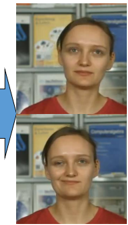
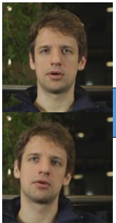
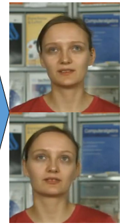
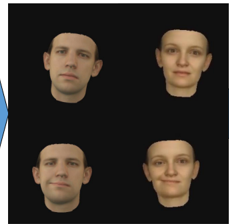
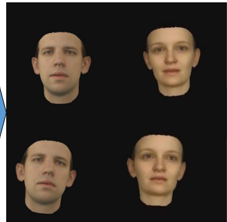
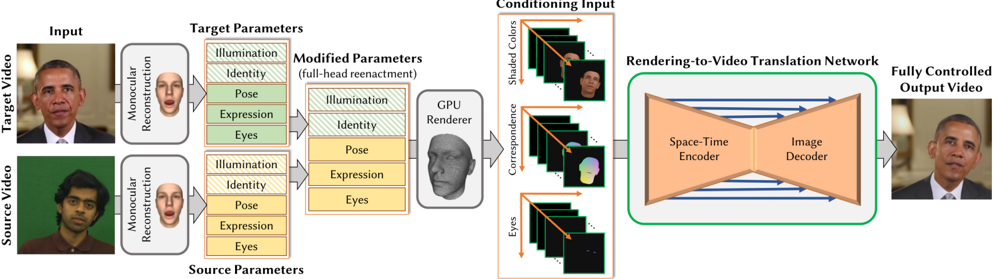
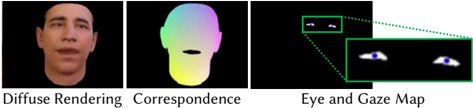
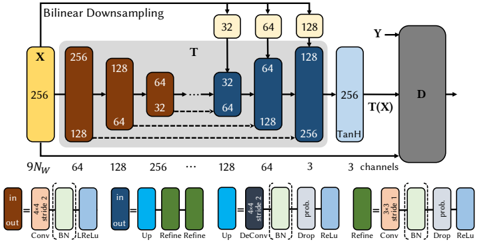
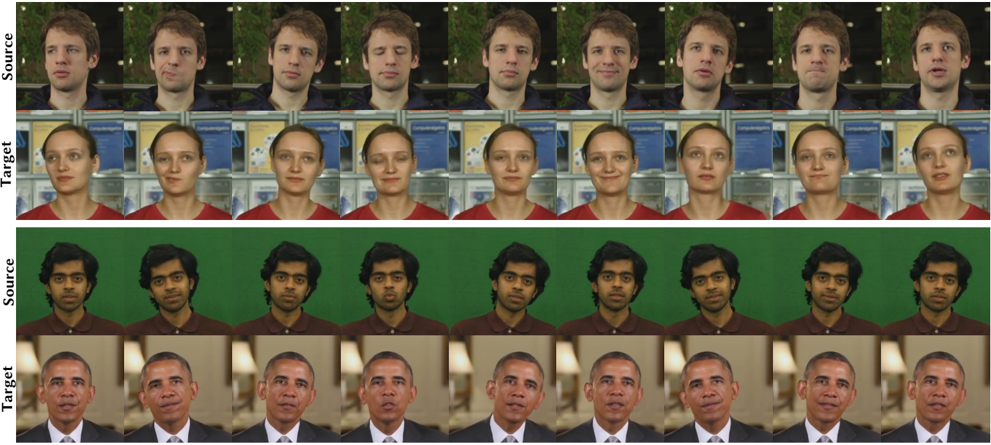
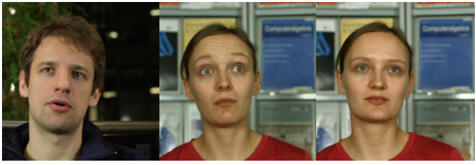
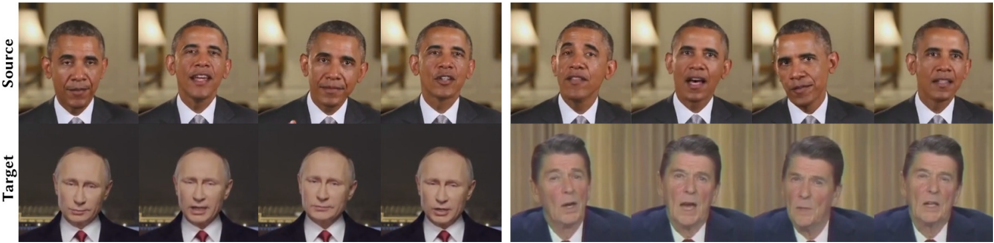
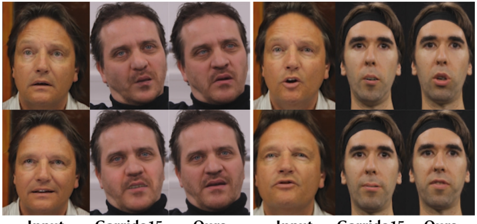
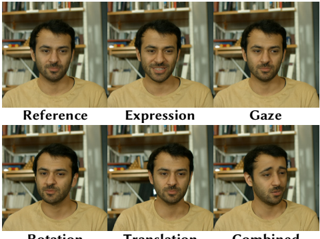
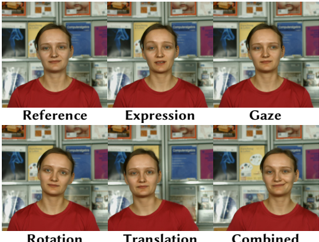
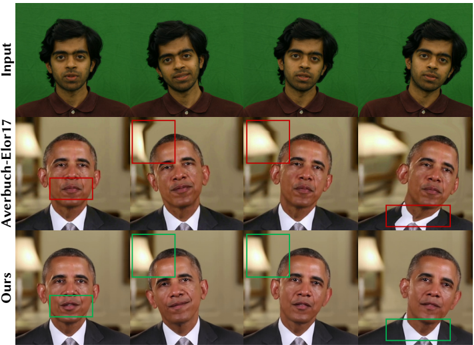
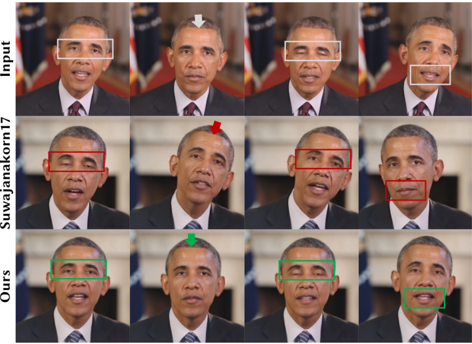
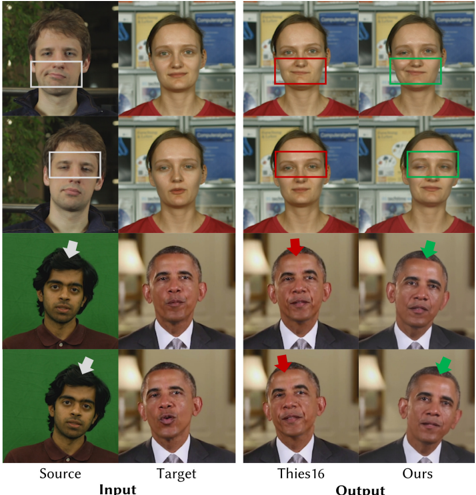
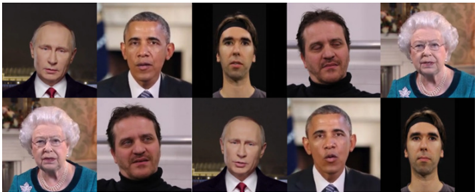
We present a novel approach that enables photo-realistic re-animation of portrait videos using only an input video. In contrast to existing approaches that are restricted to manipulations of facial expressions only, we are the first to transfer the full 3D head position, head rotation, face expression, eye gaze, and eye blinking from a source actor to a portrait video of a target actor. The core of our approach is a generative neural network with a novel space-time architecture. The network takes as input synthetic renderings of a parametric face model, based on which it predicts photo-realistic video frames for a given target actor. The realism in this rendering-to-video transfer is achieved by careful adversarial training, and as a result, we can create modified target videos that mimic the behavior of the synthetically-created input. In order to enable source-to-target video re-animation, we render a synthetic target video with the reconstructed head animation parameters from a source video, and feed it into the trained network - thus taking full control of the target. With the ability to freely recombine source and target parameters, we are able to demonstrate a large variety of video rewrite applications without explicitly modeling hair, body or background. For instance, we can reenact the full head using interactive user-controlled editing, and realize high-fidelity visual dubbing. To demonstrate the high quality of our output, we conduct an extensive series of experiments and evaluations, where for instance a user study shows that our video edits are hard to detect.
Overview
The claims and statistics of this paper haven’t been checked yet.
Free: it reads the open-access text and checks the first 5 claims that cite a source we can check. Create a free account to check every claim.
Integrity signals
Registry
Cites
Statistics
Figures












Verification
Claims the paper makes
The claims and statistics of this paper haven’t been checked yet.
Free: it reads the open-access text and checks the first 5 claims that cite a source we can check. Create a free account to check every claim.
Claims other papers make about this one
Each is checked against this paper’s own text: does it say what the citing paper says it does?
In the citing paper
“Unlike prior methods that manipulate facial expression, they are the first to transfer head position, rotation, and eye blinking from a source to a target video.”
From Deepfake video detection: challenges and opportunities (2024) · cites this paper as Kim et al. (2018)
In the citing paper
“Kim etal. (2018) has developed a method for reanimating portrait videos using only an input video.”
From Deepfake video detection: challenges and opportunities (2024) · cites this paper as Kim et al. (2018)
Self-check
Percentages, sums and reported differences re-computed from the paper’s own numbers.
The self-check needs the paper’s full text.
Citations
Cites
U-Net: Convolutional Networks for Biomedical Image Segmentation
Ronneberger, O., Fischer, P., & Brox, T. (2015) · Lecture notes in computer science · doi:10.1007/978-3-319-24574-4_28 · Cited by 99,404
Adam: A Method for Stochastic Optimization
Kingma, D. P., & Ba, J. (2014) · arXiv · doi:10.48550/arxiv.1412.6980 · Cited by 98,946
Unpaired image-to-image translation using cycle-consistent adversarial networks
Zhu, J.-Y., Park, T., Isola, P., & Efros, A. A. (2017) · 2017 IEEE International Conference on Computer Vision (ICCV) · doi:10.1109/iccv.2017.244 · Cited by 23,602
Image-to-Image Translation with Conditional Adversarial Networks
Isola, P., Zhu, J.-Y., Zhou, T., & Efros, A. A. (2017) · 2017 IEEE Conference on Computer Vision and Pattern Recognition (CVPR) · doi:10.1109/cvpr.2017.632 · Cited by 22,930
Reducing the dimensionality of data with neural networks
Hinton, G. E., & Salakhutdinov, R. R. (2006) · Science · doi:10.1126/science.1127647 · Cited by 20,928
GAN(Generative Adversarial Nets)
(2017) · Journal of Japan Society for Fuzzy Theory and Intelligent Informatics · doi:10.3156/jsoft.29.5_177_2 · Cited by 19,270
Unsupervised representation learning with deep convolutional generative adversarial networks
Radford, A., Metz, L., & Chintala, S. (2015) · arXiv · doi:10.48550/arxiv.1511.06434 · Cited by 12,235 · cited 2×
“2015], with adversarial loss functions [Goodfellow et al. 2014; Radford et al. 2016].”
BackgroundMethodConditional Generative Adversarial Nets
Mirza, M., & Osindero, S. (2014) · arXiv · doi:10.48550/arxiv.1411.1784 · Cited by 8,863
International Conference on Learning Representations (ICLR 2013)
松尾, 豊. (2013) · 人工知能学会誌 = Journal of Japanese Society for Artificial Intelligence · Cited by 6,286
High-Resolution Image Synthesis and Semantic Manipulation with Conditional GANs
Wang, T.-C., Liu, M.-Y., Zhu, J.-Y., Tao, A., Kautz, J., & Catanzaro, B. (2018) · 2018 IEEE/CVF Conference on Computer Vision and Pattern Recognition · doi:10.1109/cvpr.2018.00917 · Cited by 5,360
Research works printed but not linked: 2
- Ian J. Goodfellow Jean Pouget-Abadie Mehdi Mirza Bing Xu David Warde-Farley Sherjil Ozair Aaron Courville and Yoshua Bengio. 2014. Generative Adversarial Nets. In Advances in Neural Information Processing Systems. Ian J. Goodfellow Jean Pouget-Abadie Mehdi Mirza Bing Xu David Warde-Farley Sherjil Ozair Aaron Courville and Yoshua Bengio. 2014. Generative Adversarial Nets. In Advances in Neural Information Processing Systems.
- Ira Kemelmacher-Shlizerman , Aditya Sankar , Eli Shechtman , and Steven M. Seitz . 2010 . Being John Malkovich. In European Conference on Computer Vision (ECCV). 341--353 . Ira Kemelmacher-Shlizerman, Aditya Sankar, Eli Shechtman, and Steven M. Seitz. 2010. Being John Malkovich. In European Conference on Computer Vision (ECCV). 341--353.
Cited by
FaceForensics++: Learning to Detect Manipulated Facial Images
Rossler, A., Cozzolino, D., Verdoliva, L., Riess, C., Thies, J., & Niessner, M. (2019) · 2019 IEEE/CVF International Conference on Computer Vision (ICCV) · doi:10.1109/iccv.2019.00009 · Cited by 3,314
“[38] learn an image-to-image translation network to convert computer graphic renderings of faces to real images.”
BackgroundResultInfluentialSelf-citationCeleb-DF: A Large-Scale Challenging Dataset for DeepFake Forensics
Li, Y., Yang, X., Sun, P., Qi, H., & Lyu, S. (2020) · 2020 IEEE/CVF Conference on Computer Vision and Pattern Recognition (CVPR) · doi:10.1109/cvpr42600.2020.00327 · Cited by 1,846
“Although in recent years there have been many sophisticated algorithms for generating realistic synthetic face videos [9, 13, 46, 51, 26, 47, 37, 20, 23, 10, 21, 50], most of these have not been in mainstream as open-source software tools that anyone can use.”
BackgroundDeferred neural rendering: image synthesis using neural textures
Thies, J., Zollhöfer, M., & Nießner, M. (2019) · ACM Transactions on Graphics · doi:10.1145/3306346.3323035 · Cited by 1,356
Self-citationExposing Deep Fakes Using Inconsistent Head Poses
Yang, X., Li, Y., & Lyu, S. (2019) · ICASSP 2019 - 2019 IEEE International Conference on Acoustics, Speech and Signal Processing (ICASSP) · doi:10.1109/icassp.2019.8683164 · Cited by 1,196
Nerfies: Deformable Neural Radiance Fields
Park, K., Sinha, U., Barron, J. T., Bouaziz, S., Goldman, D. B., Seitz, S. M., & Martin-Brualla, R. (2021) · 2021 IEEE/CVF International Conference on Computer Vision (ICCV) · doi:10.1109/iccv48922.2021.00581 · Cited by 1,059
Media Forensics and DeepFakes: An Overview
Verdoliva, L. (2020) · IEEE Journal of Selected Topics in Signal Processing · doi:10.1109/jstsp.2020.3002101 · Cited by 979
Capsule-forensics: Using Capsule Networks to Detect Forged Images and Videos
Nguyen, H. H., Yamagishi, J., & Echizen, I. (2019) · ICASSP 2019 - 2019 IEEE International Conference on Acoustics, Speech and Signal Processing (ICASSP) · doi:10.1109/icassp.2019.8682602 · Cited by 951
The Creation and Detection of Deepfakes: A Survey
Mirsky, Y., & Lee, W. (2022) · ACM Computing Surveys · doi:10.1145/3425780 · Cited by 863
“video 1 1 1 1 • • • • text - • 256x256 [83] 2018 Deep Video Portr.”
BackgroundMethodResultInfluentialThe Creation and Detection of Deepfakes: A Survey
Mirsky, Y., & Lee, W. (2020) · arXiv · doi:10.48550/arxiv.2004.11138 · Cited by 863
Exploiting Visual Artifacts to Expose Deepfakes and Face Manipulations
Matern, F., Riess, C., & Stamminger, M. (2019) · 2019 IEEE Winter Applications of Computer Vision Workshops (WACVW) · doi:10.1109/wacvw.2019.00020 · Cited by 824
On the Detection of Digital Face Manipulation
Dang, H., Liu, F., Stehouwer, J., Liu, X., & Jain, A. K. (2020) · 2020 IEEE/CVF Conference on Computer Vision and Pattern Recognition (CVPR) · doi:10.1109/cvpr42600.2020.00582 · Cited by 764
Chan, C., Ginosar, S., Zhou, T., & Efros, A. (2019) · 2019 IEEE/CVF International Conference on Computer Vision (ICCV) · doi:10.1109/iccv.2019.00603 · Cited by 737
FSGAN: Subject Agnostic Face Swapping and Reenactment
Nirkin, Y., Keller, Y., & Hassner, T. (2019) · 2019 IEEE/CVF International Conference on Computer Vision (ICCV) · doi:10.1109/iccv.2019.00728 · Cited by 706
Neural volumes: learning dynamic renderable volumes from images
Lombardi, S., Simon, T., Saragih, J., Schwartz, G., Lehrmann, A., & Sheikh, Y. (2019) · ACM Transactions on Graphics · doi:10.1145/3306346.3323020 · Cited by 693
Few-Shot Adversarial Learning of Realistic Neural Talking Head Models
Zakharov, E., Shysheya, A., Burkov, E., & Lempitsky, V. (2019) · 2019 IEEE/CVF International Conference on Computer Vision (ICCV) · doi:10.1109/iccv.2019.00955 · Cited by 687
Learning an animatable detailed 3D face model from in-the-wild images
Feng, Y., Feng, H., Black, M. J., & Bolkart, T. (2021) · ACM Transactions on Graphics · doi:10.1145/3450626.3459936 · Cited by 660
HyperNeRF: a higher-dimensional representation for topologically varying neural radiance fields
Park, K., Sinha, U., Hedman, P., Barron, J. T., Bouaziz, S., Goldman, D. B., Martin-Brualla, R., & Seitz, S. M. (2021) · ACM Transactions on Graphics · doi:10.1145/3478513.3480487 · Cited by 618
DeeperForensics-1.0: A Large-Scale Dataset for Real-World Face Forgery Detection
Jiang, L., Li, R., Wu, W., Qian, C., & Loy, C. C. (2020) · 2020 IEEE/CVF Conference on Computer Vision and Pattern Recognition (CVPR) · doi:10.1109/cvpr42600.2020.00296 · Cited by 599
Deepfake Detection: A Systematic Literature Review
Rana, M. S., Nobi, M. N., Murali, B., & Sung, A. H. (2022) · IEEE Access · doi:10.1109/access.2022.3154404 · Cited by 573
DeepVoxels: Learning Persistent 3D Feature Embeddings
Sitzmann, V., Thies, J., Heide, F., Nießner, M., Wetzstein, G., & Zollhöfer, M. (2019) · 2019 IEEE/CVF Conference on Computer Vision and Pattern Recognition (CVPR) · doi:10.1109/cvpr.2019.00254 · Cited by 558
Self-citationMulti-task Learning For Detecting and Segmenting Manipulated Facial Images and Videos
Nguyen, H. H., Fang, F., Yamagishi, J., & Echizen, I. (2019) · arXiv · doi:10.48550/arxiv.1906.06876 · Cited by 551
Multi-task Learning for Detecting and Segmenting Manipulated Facial Images and Videos
Nguyen, H. H., Fang, F., Yamagishi, J., & Echizen, I. (2019) · 2019 IEEE 10th International Conference on Biometrics Theory, Applications and Systems (BTAS) · doi:10.1109/btas46853.2019.9185974 · Cited by 549
“Instead of using RGB videos as was done in previous work [30, 14], Averbuch et al. and Chung et al. used ID-type photos [4, 9], which are easily obtained on social networks.”
BackgroundMethodMasood, M., Nawaz, M., Malik, K. M., Javed, A., Irtaza, A., & Malik, H. (2023) · Applied Intelligence · doi:10.1007/s10489-022-03766-z · Cited by 543
Dynamic Neural Radiance Fields for Monocular 4D Facial Avatar Reconstruction
Gafni, G., Thies, J., Zollhofer, M., & Niesner, M. (2021) · 2021 IEEE/CVF Conference on Computer Vision and Pattern Recognition (CVPR) · doi:10.1109/cvpr46437.2021.00854 · Cited by 501
Self-citationFakeCatcher: Detection of Synthetic Portrait Videos using Biological Signals
Ciftci, U. A., Demir, I., & Yin, L. (2024) · IEEE Transactions on Pattern Analysis and Machine Intelligence · doi:10.1109/tpami.2020.3009287 · Cited by 499
Towards Fast, Accurate and Stable 3D Dense Face Alignment
Guo, J., Zhu, X., Yang, Y., Yang, F., Lei, Z., & Li, S. Z. (2020) · Lecture Notes in Computer Science · doi:10.1007/978-3-030-58529-7_10 · Cited by 462
3D Morphable Face Models—Past, Present, and Future
Egger, B., Smith, W. A. P., Tewari, A., Wuhrer, S., Zollhoefer, M., Beeler, T., Bernard, F., Bolkart, T., Kortylewski, A., Romdhani, S., et al. (2020) · ACM Transactions on Graphics · doi:10.1145/3395208 · Cited by 448
Self-citationOne-Shot Free-View Neural Talking-Head Synthesis for Video Conferencing
Wang, T.-C., Mallya, A., & Liu, M.-Y. (2021) · 2021 IEEE/CVF Conference on Computer Vision and Pattern Recognition (CVPR) · doi:10.1109/cvpr46437.2021.00991 · Cited by 444
X2Face: A Network for Controlling Face Generation Using Images, Audio, and Pose Codes
Wiles, O., Koepke, A. S., & Zisserman, A. (2018) · Lecture Notes in Computer Science · doi:10.1007/978-3-030-01261-8_41 · Cited by 435
Tretschk, E., Tewari, A., Golyanik, V., Zollhofer, M., Lassner, C., & Theobalt, C. (2021) · 2021 IEEE/CVF International Conference on Computer Vision (ICCV) · doi:10.1109/iccv48922.2021.01272 · Cited by 432
Self-citationState of the Art on Neural Rendering
Tewari, A., Fried, O., Thies, J., Sitzmann, V., Lombardi, S., Sunkavalli, K., Martin‐Brualla, R., Simon, T., Saragih, J., Nießner, M., et al. (2020) · Computer Graphics Forum · doi:10.1111/cgf.14022 · Cited by 430
Self-citation(2019) · Cited by 415
Deepfake Video Detection through Optical Flow Based CNN
Amerini, I., Galteri, L., Caldelli, R., & Del Bimbo, A. (2019) · 2019 IEEE/CVF International Conference on Computer Vision Workshop (ICCVW) · doi:10.1109/iccvw.2019.00152 · Cited by 424
Abdal, R., Zhu, P., Mitra, N. J., & Wonka, P. (2021) · ACM Transactions on Graphics · doi:10.1145/3447648 · Cited by 407
AD-NeRF: Audio Driven Neural Radiance Fields for Talking Head Synthesis
Guo, Y., Chen, K., Liang, S., Liu, Y.-J., Bao, H., & Zhang, J. (2021) · 2021 IEEE/CVF International Conference on Computer Vision (ICCV) · doi:10.1109/iccv48922.2021.00573 · Cited by 384
“Most approaches on this task rely on model-based facial performance capture [44, 45, 24, 23].”
BackgroundMethodNeural Voice Puppetry: Audio-Driven Facial Reenactment
Thies, J., Elgharib, M., Tewari, A., Theobalt, C., & Nießner, M. (2020) · Lecture Notes in Computer Science · doi:10.1007/978-3-030-58517-4_42 · Cited by 372
Self-citationPose-Controllable Talking Face Generation by Implicitly Modularized Audio-Visual Representation
Zhou, H., Sun, Y., Wu, W., Loy, C. C., Wang, X., & Liu, Z. (2021) · 2021 IEEE/CVF Conference on Computer Vision and Pattern Recognition (CVPR) · doi:10.1109/cvpr46437.2021.00416 · Cited by 370
StyleRig: Rigging StyleGAN for 3D Control Over Portrait Images
Tewari, A., Elgharib, M., Bharaj, G., Bernard, F., Seidel, H.-P., Perez, P., Zollhofer, M., & Theobalt, C. (2020) · 2020 IEEE/CVF Conference on Computer Vision and Pattern Recognition (CVPR) · doi:10.1109/cvpr42600.2020.00618 · Cited by 362
Self-citationHoloGAN: Unsupervised Learning of 3D Representations From Natural Images
Nguyen-Phuoc, T., Li, C., Theis, L., Richardt, C., & Yang, Y. (2019) · 2019 IEEE/CVF International Conference on Computer Vision (ICCV) · doi:10.1109/iccv.2019.00768 · Cited by 340
“Recent generative image models, in particular, generative adversarial networks (GANs), have achieved impressive results in generating images of high resolution and visual quality [1, 5, 27, 28, 62], while their conditional versions have achieved great progress in image-to-image translation [23, 50], image editing [11,…”
BackgroundSelf-citationZhang, W., Cun, X., Wang, X., Zhang, Y., Shen, X., Guo, Y., Shan, Y., & Wang, F. (2023) · 2023 IEEE/CVF Conference on Computer Vision and Pattern Recognition (CVPR) · doi:10.1109/cvpr52729.2023.00836 · Cited by 336
“Following previous work of deep video portrait [18], these methods utilize 3DMM information for face reconstruction and animation.”
MethodDisentangled and Controllable Face Image Generation via 3D Imitative-Contrastive Learning
Deng, Y., Yang, J., Chen, D., Wen, F., & Tong, X. (2020) · 2020 IEEE/CVF Conference on Computer Vision and Pattern Recognition (CVPR) · doi:10.1109/cvpr42600.2020.00520 · Cited by 329
DeepFake Detection Based on Discrepancies Between Faces and Their Context
Nirkin, Y., Wolf, L., Keller, Y., & Hassner, T. (2022) · IEEE Transactions on Pattern Analysis and Machine Intelligence · doi:10.1109/tpami.2021.3093446 · Cited by 312
“A few notable examples of such techniques are GANimation [32], GANnotation [33], and others [34], [35], [36], [37].”
BackgroundAdvancing High Fidelity Identity Swapping for Forgery Detection
Li, L., Bao, J., Yang, H., Chen, D., & Wen, F. (2020) · 2020 IEEE/CVF Conference on Computer Vision and Pattern Recognition (CVPR) · doi:10.1109/cvpr42600.2020.00512 · Cited by 288
“[20] separately models different videos using 3DMM to make the portraits controllable, while Nagano et al.”
MethodText-based Editing of Talking-head Video
Fried, O., Tewari, A., Zollhöfer, M., Finkelstein, A., Shechtman, E., Goldman, D. B., Genova, K., Jin, Z., Theobalt, C., & Agrawala, M. (2019) · ACM Transactions on Graphics · doi:10.1145/3306346.3323028 · Cited by 270
“Our method accepts text only as input for synthesis, yet builds on the Deep Video Portraits approach of Kim et al. [2018b] to craft synthetic video.”
BackgroundMethodResultInfluentialSelf-citationNeural actor: neural free-view synthesis of human actors with pose control
Liu, L., Habermann, M., Rudnev, V., Sarkar, K., Gu, J., & Theobalt, C. (2021) · ACM Transactions on Graphics · doi:10.1145/3478513.3480528 · Cited by 257
Self-citationA Survey on Deepfake Video Detection
Yu, P., Xia, Z., Fei, J., & Lu, Y. (2021) · IET Biometrics · doi:10.1049/bme2.12031 · Cited by 253
Generative Adversarial Networks for Image and Video Synthesis: Algorithms and Applications
Liu, M.-Y., Huang, X., Yu, J., Wang, T.-C., & Mallya, A. (2021) · Proceedings of the IEEE · doi:10.1109/jproc.2021.3049196 · Cited by 236
FaceShifter: Towards High Fidelity And Occlusion Aware Face Swapping
Li, L., Bao, J., Yang, H., Chen, D., & Wen, F. (2019) · arXiv · doi:10.48550/arxiv.1912.13457 · Cited by 236
Recurrent convolutional structures for audio spoof and video deepfake detection
Chintha, A., Thai, B., Sohrawardi, S. J., Bhatt, K., Hickerson, A., Wright, M., & Ptucha, R. (2020) · IEEE Journal of Selected Topics in Signal Processing · doi:10.1109/jstsp.2020.2999185 · Cited by 226
“Kim et al. [39] accomplished a similar transfer, with the difference being that they transfer expressions as well as 3D pose into a target image, creating a video in the process.”
BackgroundForensicTransfer: Weakly-supervised Domain Adaptation for Forgery Detection
Cozzolino, D., Thies, J., Rössler, A., Riess, C., Nießner, M., & Verdoliva, L. (2018) · arXiv · doi:10.48550/arxiv.1812.02510 · Cited by 221
Self-citationDeepfake video detection: challenges and opportunities
Kaur, A., Noori Hoshyar, A., Saikrishna, V., Firmin, S., & Xia, F. (2024) · Artificial Intelligence Review · doi:10.1007/s10462-024-10810-6 · Cited by 214
Anticipating and Addressing the Ethical Implications of Deepfakes in the Context of Elections
Diakopoulos, N., & Johnson, D. (2019) · SSRN Electronic Journal · doi:10.2139/ssrn.3474183 · Cited by 194
Neural Rendering and Reenactment of Human Actor Videos
Liu, L., Xu, W., Zollhöfer, M., Kim, H., Bernard, F., Habermann, M., Wang, W., & Theobalt, C. (2019) · ACM Transactions on Graphics · doi:10.1145/3333002 · Cited by 163
Self-citationMarioNETte: Few-Shot Face Reenactment Preserving Identity of Unseen Targets
Ha, S., Kersner, M., Kim, B., Seo, S., & Kim, D. (2020) · Proceedings of the AAAI Conference on Artificial Intelligence · doi:10.1609/aaai.v34i07.6721 · Cited by 157
Zhou, T., Wang, W., Liang, Z., & Shen, J. (2021) · 2021 IEEE/CVF Conference on Computer Vision and Pattern Recognition (CVPR) · doi:10.1109/cvpr46437.2021.00572 · Cited by 156
“Some alternatives [41, 65] thus alleviate this by combining graphics pipelines with learnable components, which can use imperfect 3D models for synthesis.”
MethodEAMM: One-Shot Emotional Talking Face via Audio-Based Emotion-Aware Motion Model
Ji, X., Zhou, H., Wang, K., Wu, Q., Wu, W., Xu, F., & Cao, X. (2022) · Special Interest Group on Computer Graphics and Interactive Techniques Conference Proceedings · doi:10.1145/3528233.3530745 · Cited by 155
High-resolution neural face swapping for visual effects
Naruniec, J., Helminger, L., Schroers, C., & Weber, R. M. (2020) · Computer Graphics Forum · doi:10.1111/cgf.14062 · Cited by 154
Learnable PINs: cross-modal embeddings for person identity
Nagrani, A., Albanie, S., & Zisserman, A. (2018) · Lecture notes in computer science · doi:10.1007/978-3-030-01261-8_5 · Cited by 151
A comprehensive overview of Deepfake: generation, detection, datasets, and opportunities
Seow, J. W., Lim, M. K., Phan, R. C. W., & Liu, J. K. (2022) · Neurocomputing · doi:10.1016/j.neucom.2022.09.135 · Cited by 149
FReTAL: Generalizing Deepfake Detection using Knowledge Distillation and Representation Learning
Kim, M., Tariq, S., & Woo, S. S. (2021) · 2021 IEEE/CVF Conference on Computer Vision and Pattern Recognition Workshops (CVPRW) · doi:10.1109/cvprw53098.2021.00111 · Cited by 118
HeadGAN: One-shot Neural Head Synthesis and Editing
Doukas, M. C., Zafeiriou, S., & Sharmanska, V. (2021) · 2021 IEEE/CVF International Conference on Computer Vision (ICCV) · doi:10.1109/iccv48922.2021.01413 · Cited by 117
“Visual data synthesis [44, 43], including talking head animation [45, 49, 48, 17, 33, 34, 23] are particularly exciting and thriving research areas, with countless applications in editing, games, social media, VR, teleconference and virtual assistance.”
BackgroundInfluentialFraga-Lamas, P., & Fernandez-Carames, T. M. (2020) · IT Professional · doi:10.1109/mitp.2020.2977589 · Cited by 111
Seeing What You Said: Talking Face Generation Guided by a Lip Reading Expert
Wang, J., Qian, X., Zhang, M., Tan, R. T., & Li, H. (2023) · 2023 IEEE/CVF Conference on Computer Vision and Pattern Recognition (CVPR) · doi:10.1109/cvpr52729.2023.01408 · Cited by 116
“It plays a significant role in many Human Robot Interaction (HRI) applications, such as film dubbing [1], video editing, face animation [2, 3], and communication with people who has hearing loss but master in lip-reading.”
BackgroundFace Forgery Detection by 3D Decomposition
Zhu, X., Wang, H., Fei, H., Lei, Z., & Li, S. Z. (2021) · 2021 IEEE/CVF Conference on Computer Vision and Pattern Recognition (CVPR) · doi:10.1109/cvpr46437.2021.00295 · Cited by 106
“Traditional meth-ods require sophisticated editing tools, domain expertise, and time-consuming processes [37, 38, 34, 35, 32, 19].”
BackgroundFReeNet: Multi-Identity Face Reenactment
Zhang, J., Zeng, X., Wang, M., Pan, Y., Liu, L., Liu, Y., Ding, Y., & Fan, C. (2020) · 2020 IEEE/CVF Conference on Computer Vision and Pattern Recognition (CVPR) · doi:10.1109/cvpr42600.2020.00537 · Cited by 111
Deepfakes generation and detection: a short survey
Akhtar, Z. (2023) · Journal of Imaging · doi:10.3390/jimaging9010018 · Cited by 106
“…and task-agnostic GANs-based schemes were designed by Kim et al. [83], Nirkin et al. [84], Zhang et al. [85], Doukas et al. [86], and Cao et al. [87], respectively. task-agnostic GANs-based schemes by Kim et al. [83], Nirkin et al. [84], Zhang et al. [85], Doukas et al. [86], and respectively.”
MethodLahiri, A., Kwatra, V., Frueh, C., Lewis, J., & Bregler, C. (2021) · 2021 IEEE/CVF Conference on Computer Vision and Pattern Recognition (CVPR) · doi:10.1109/cvpr46437.2021.00278 · Cited by 101
“Audio-driven Video Synthesis: These methods aim to generate visually plausible 2D talking head videos, conditioned on novel audio.”
BackgroundMethodInfluentialLe, T.-N., Nguyen, H. H., Yamagishi, J., & Echizen, I. (2021) · 2021 IEEE/CVF International Conference on Computer Vision (ICCV) · doi:10.1109/iccv48922.2021.00996 · Cited by 97
Testing human ability to detect ‘deepfake’ images of human faces
Bray, S. D., Johnson, S. D., & Kleinberg, B. (2023) · Journal of Cybersecurity · doi:10.1093/cybsec/tyad011 · Cited by 96
The detection of political deepfakes
Appel, M., & Prietzel, F. (2022) · Journal of Computer-Mediated Communication · doi:10.1093/jcmc/zmac008 · Cited by 95
Detecting DeepFake, FaceSwap and Face2Face facial forgeries using frequency CNN
Kohli, A., & Gupta, A. (2021) · Multimedia Tools and Applications · doi:10.1007/s11042-020-10420-8 · Cited by 90
ICface: Interpretable and Controllable Face Reenactment Using GANs
Tripathy, S., Kannala, J., & Rahtu, E. (2020) · 2020 IEEE Winter Conference on Applications of Computer Vision (WACV) · doi:10.1109/wacv45572.2020.9093474 · Cited by 88
“Face2Face [25],[14]), they require complex 3D face models and considerable efforts to capture all the subtle movements in the face.”
BackgroundDFDT: An End-to-End DeepFake Detection Framework Using Vision Transformer
Khormali, A., & Yuan, J.-S. (2022) · Applied Sciences · doi:10.3390/app12062953 · Cited by 88
iCaps-Dfake: An Integrated Capsule-Based Model for Deepfake Image and Video Detection
Khalil, S. S., Youssef, S. M., & Saleh, S. N. (2021) · Future Internet · doi:10.3390/fi13040093 · Cited by 67
Deepfake: definitions, performance metrics and standards, datasets, and a meta-review
Altuncu, E., Franqueira, V. N. L., & Li, S. (2024) · Frontiers in Big Data · doi:10.3389/fdata.2024.1400024 · Cited by 134
“…contains 1,737 videos with 1,666,816 frames, including 1,339,843 real frames and 326,973 fake frames generated using Deep Video Portraits (DVP) (Kim et al., 2018), i.e., a method that enables to transfer head pose, facial expression, and eye motion of the source while preserving the target’s…”
MethodDeepFake on Face and Expression Swap: A Review
Waseem, S., Abu Bakar, S. A. R. S., Ahmed, B. A., Omar, Z., Eisa, T. A. E., & Dalam, M. E. E. (2023) · IEEE Access · doi:10.1109/access.2023.3324403 · Cited by 65
Exploiting Prediction Error Inconsistencies through LSTM-based Classifiers to Detect Deepfake Videos
Amerini, I., & Caldelli, R. (2020) · Proceedings of the 2020 ACM Workshop on Information Hiding and Multimedia Security · doi:10.1145/3369412.3395070 · Cited by 64
“More recently deep learning techniques are employed like Deep Video Portraits [18], [7] and Deepfakes 1 on top.”
MethodDeep learning for visual speech analysis: A survey
Sheng, C., Kuang, G., Bai, L., Hou, C., Guo, Y., Xu, X., Pietikäinen, M., & Liu, L. (2024) · IEEE Transactions on Pattern Analysis and Machine Intelligence · doi:10.1109/tpami.2024.3376710 · Cited by 64
“Besides the 3D blendshape model, Kim et al. [175], [176] introduced 3D Morphable Model (3DMM) [177], a more dense 3 d face parametric representation, for video-oriented face2face translation.”
MethodFHDe2Net: Full High Definition Demoireing Network
He, B., Wang, C., Shi, B., & Duan, L.-Y. (2020) · Lecture Notes in Computer Science · doi:10.1007/978-3-030-58542-6_43 · Cited by 62
ADD: Attention-Based DeepFake Detection Approach
Khormali, A., & Yuan, J.-S. (2021) · Big Data and Cognitive Computing · doi:10.3390/bdcc5040049 · Cited by 55
“[23] presented deep video portraits that transfer both facial expression and 3D poses of the source image into the target image.”
BackgroundTowards DeepFake video forensics based on facial textural disparities in multi-color channels
Xia, Z., Qiao, T., Xu, M., Zheng, N., & Xie, S. (2022) · Information Sciences · doi:10.1016/j.ins.2022.06.003 · Cited by 47
Face Forgery Detection by 3D Decomposition and Composition Search
Zhu, X., Fei, H., Zhang, B., Zhang, T., Zhang, X., Li, S. Z., & Lei, Z. (2023) · IEEE Transactions on Pattern Analysis and Machine Intelligence · doi:10.1109/tpami.2022.3233586 · Cited by 41
Generalized zero and few-shot transfer for facial forgery detection
Aneja, S., & Nießner, M. (2020) · arXiv · doi:10.48550/arxiv.2006.11863 · Cited by 31
Watch Those Words: Video Falsification Detection Using Word-Conditioned Facial Motion
Agarwal, S., Hu, L., Ng, E., Darrell, T., Li, H., & Rohrbach, A. (2023) · 2023 IEEE/CVF Winter Conference on Applications of Computer Vision (WACV) · doi:10.1109/wacv56688.2023.00469 · Cited by 28
Videoforensicshq: Detecting High-Quality Manipulated Face Videos
Fox, G., Liu, W., Kim, H., Seidel, H.-P., Elgharib, M., & Theobalt, C. (2021) · 2021 IEEE International Conference on Multimedia and Expo (ICME) · doi:10.1109/icme51207.2021.9428101 · Cited by 22
Self-citationAn Overview of Deepfake: The Sword of Damocles in AI
Tong, X., Wang, L., Pan, X., & Wang, J. G. (2020) · 2020 International Conference on Computer Vision, Image and Deep Learning (CVIDL) · doi:10.1109/cvidl51233.2020.00-88 · Cited by 12
Memories are One-to-Many Mapping Alleviators in Talking Face Generation
Tang, A., He, T., Tan, X., Ling, J., & Song, L. (2022) · arXiv · doi:10.48550/arxiv.2212.05005 · Cited by 12
Understanding the Landscape of Online Deception
Hage, H., Aïmeur, E., & Guedidi, A. (2020) · Advances in Media, Entertainment, and the Arts · doi:10.4018/978-1-7998-2543-2.ch014 · Cited by 7
(2023) · doi:10.1109/icicis58388.2023.10391147 · Cited by 3
Metadata
- Authors
- Kim, H., Garrido, P., Tewari, A., Xu, W., Thies, J., Niessner, M., Pérez, P., Richardt, C., Zollhöfer, M., & Theobalt, C.
- Affiliations
- Max Planck Institute for Informatics, Germany
- Technicolor, France
- Technical University of Munich, Germany
- University of Bath, United Kingdom
- Stanford University
- Venue
- ACM Transactions on Graphics
- Published
- 2018-07-30
- Volume
- 37
- Issue
- 4
- Pages
- 1-14
- ISSN
- 0730-0301
- 1557-7368
- Cited by
- 475
- References
- 75
- Language
- en
- Funders
- ERC Starting Grant CapReal (335545)
- Google Faculty Award
- RCUK grant CAMERA (EP/M023281/1)
- Max Planck Center for Visual Computing and Communications
- TUM-IAS Rudolf Mößbauer Fellowship
About these checks
Registry, retraction, Cites and statistics results are computed, not judged, with one exception: a printed reference that no index lists is read once by a model before it counts as a citation error. Claims are extracted by a model and kept only when their quote appears verbatim in the text; each cited source is then checked, with a model’s help, for whether it says what the claim relies on. Those verdicts can be wrong — read the claim’s quote and the cited source before relying on one.
Statistics and arithmetic are recomputed, not judged.
Confidence bands are shown only for fields calibrated on our annotated test set. None is calibrated yet, so no band is shown.
What counts as a claim ›How we measure confidence ›How we check this ›
Are you an author, or do you see a problem with this page? Request a review
Data sources
Bibliographic data: Semantic Scholar, OpenAlex, Crossref.
Contains information from the Semantic Scholar Academic Graph Datasets, made available under the ODC Attribution License (ODC-BY 1.0).
Semantic Scholar’s data is described in: Kinney, R., et al. (2023). The Semantic Scholar Open Data Platform. arXiv:2301.10140.
