

Expert Discussions Improve Comprehension of Difficult Cases in Medical Image Assessment
Open accessThe DOI matches its Crossref record; 42 of the 42 references it cites were found in a registry or an index.
Abstract
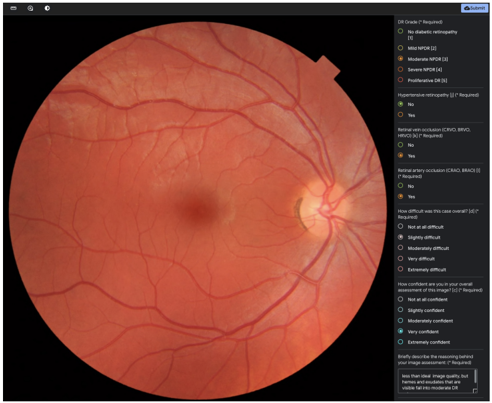
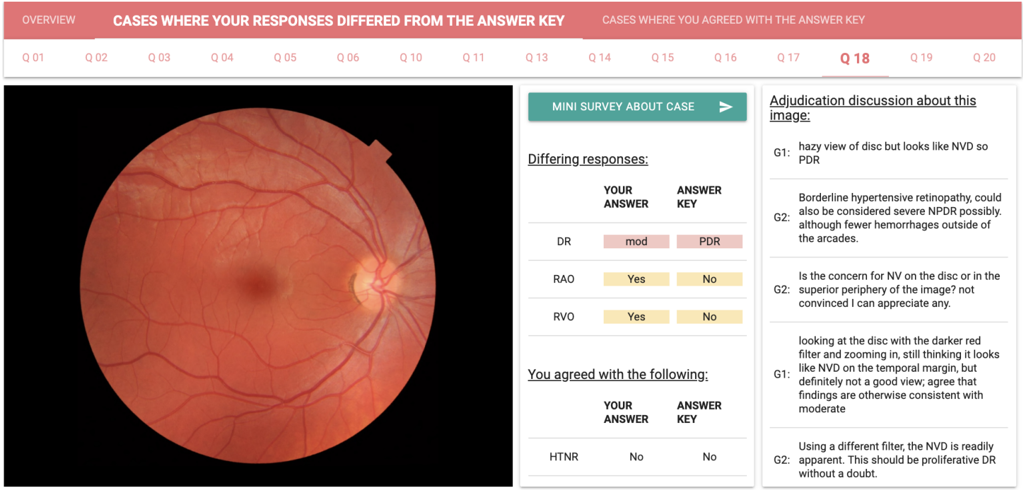
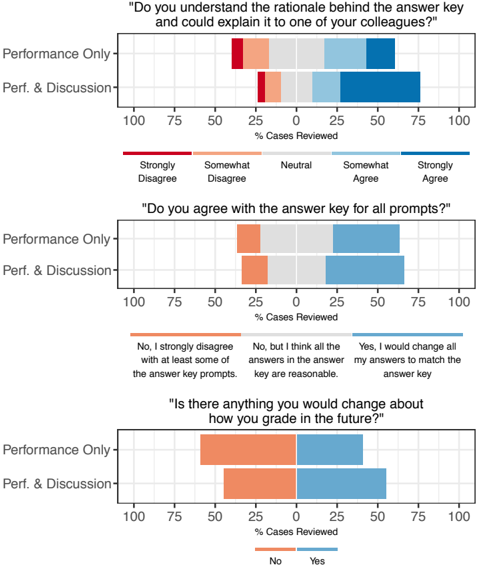
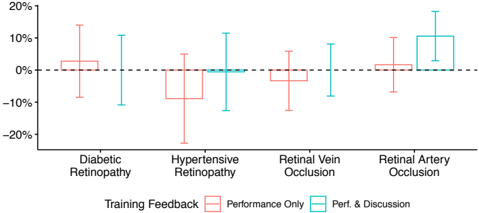
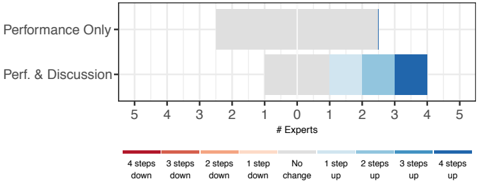
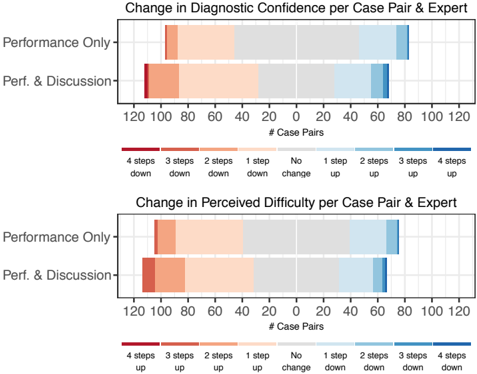
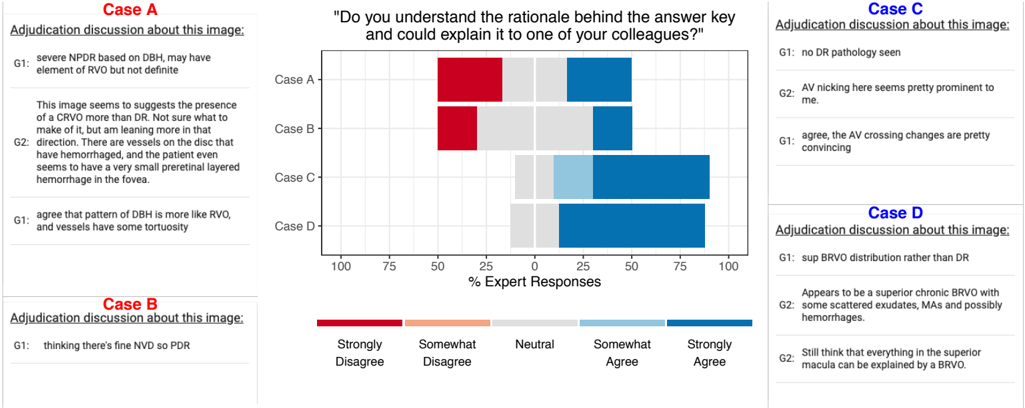
Medical data labeling workflows critically depend on accurate assessments from human experts. Yet human assessments can vary markedly, even among medical experts. Prior research has demonstrated benefits of labeler training on performance. Here we utilized two types of labeler training feedback: highlighting incorrect labels for difficult cases ("individual performance" feedback), and expert discussions from adjudication of these cases. We presented ten generalist eye care professionals with either individual performance alone, or individual performance and expert discussions from specialists. Compared to performance feedback alone, seeing expert discussions significantly improved generalists' understanding of the rationale behind the correct diagnosis while motivating changes in their own labeling approach; and also significantly improved average accuracy on one of four pathologies in a held-out test set. This work suggests that image adjudication may provide benefits beyond developing trusted consensus labels, and that exposure to specialist discussions can be an effective training intervention for medical diagnosis.
Overview
The claims and statistics of this paper haven’t been checked yet.
Free: it reads the open-access text and checks the first 5 claims that cite a source we can check. Create a free account to check every claim.
Integrity signals
Registry
Cites
Statistics
Figures
Verification
Claims the paper makes
The claims and statistics of this paper haven’t been checked yet.
Free: it reads the open-access text and checks the first 5 claims that cite a source we can check. Create a free account to check every claim.
Claims other papers make about this one
Each is checked against this paper’s own text: does it say what the citing paper says it does?
The source backs part of the claim, not all of it — or backs it for a different population, condition or comparison.
In the citing paper
“Individual-level bias can be addressed via expert discussion 145 and labeling adjudication 146 .”
From Deep learning-enabled medical computer vision (2021) · cites this paper as [145]
Experimental — accuracy not yet measured
Self-check
Percentages, sums and reported differences re-computed from the paper’s own numbers.
The self-check needs the paper’s full text.
Citations
Cites
Gulshan, V., Peng, L., Coram, M., Stumpe, M. C., Wu, D., Narayanaswamy, A., Venugopalan, S., Widner, K., Madams, T., Cuadros, J., et al. (2016) · JAMA · doi:10.1001/jama.2016.17216 · Cited by 7,697
Ting, D. S. W., Cheung, C. Y.-L., Lim, G., Tan, G. S. W., Quang, N. D., Gan, A., Hamzah, H., Garcia-Franco, R., San Yeo, I. Y., Lee, S. Y., et al. (2017) · JAMA · doi:10.1001/jama.2017.18152 · Cited by 2,402
Prevalence of Diabetic Retinopathy in the United States, 2005-2008
Zhang, X., Saaddine, J. B., Chou, C.-F., Cotch, M. F., Cheng, Y. J., Geiss, L. S., Gregg, E. W., Albright, A. L., Klein, B. E. K., & Klein, R. (2010) · JAMA · doi:10.1001/jama.2010.1111 · Cited by 1,196
Ting, D. S. W., Cheung, G. C. M., & Wong, T. Y. (2016) · Clinical & Experimental Ophthalmology · doi:10.1111/ceo.12696 · Cited by 1,066 · cited 1×
“In particular, retinal pathologies such as diabetic retinopathy (DR) rank among the leading causes of vision loss in many industrialized countries [44].”
BackgroundDunning, D. (2011) · Advances in Experimental Social Psychology · doi:10.1016/b978-0-12-385522-0.00005-6 · Cited by 806
Cardiologist-Level Arrhythmia Detection with Convolutional Neural Networks
Rajpurkar, P., Hannun, A., Haghpanahi, M., Bourn, C., & Ng, A. Y. (2017) · arXiv (Cornell University) · doi:10.48550/arxiv.1707.01836 · Cited by 595 · cited 1×
“A common way to produce these reference standards is to generate expensive gold standard consensus labels from panels of experts, rather than relying on noisy assessments from individual experts alone [16, 29, 30, 42].”
BackgroundSrinivasan, M., Wilkes, M., Stevenson, F., Nguyen, T., & Slavin, S. (2007) · Academic Medicine · doi:10.1097/01.acm.0000249963.93776.aa · Cited by 569 · cited 2×
“The idea that medical students may learn more effectively when engaging in group discussions with their peers has been implemented in the concepts of problem-based learning (PBL) and case-based learning (CBL) [11, 41].”
BackgroundKrause, J., Gulshan, V., Rahimy, E., Karth, P., Widner, K., Corrado, G. S., Peng, L., & Webster, D. R. (2018) · Ophthalmology · doi:10.1016/j.ophtha.2018.01.034 · Cited by 564 · cited 5×
“Various protocols have been described to facilitate and structure communication among discussion members, including in-person, face-to-face discussions [21] and remote, web-based discussions either in real-time [7, 37] or asynchronously [12, 35, 38].”
BackgroundInfluentialThe American Academy of Sleep Medicine Inter-scorer Reliability Program: Sleep Stage Scoring
Rosenberg, R. S., & Van Hout, S. (2013) · Journal of Clinical Sleep Medicine · doi:10.5664/jcsm.2350 · Cited by 456 · cited 1×
“Like any form of human interpretation, medical data analysis by human experts is a subjective process and can lead to con-flicting assessments among independent raters [2, 23, 31, 35].”
BackgroundSayres, R., Taly, A., Rahimy, E., Blumer, K., Coz, D., Hammel, N., Krause, J., Narayanaswamy, A., Rastegar, Z., Wu, D., et al. (2019) · Ophthalmology · doi:10.1016/j.ophtha.2018.11.016 · Cited by 418 · cited 1×
“While there exist alternative ways of measuring confidence, we used a 5-point scale for its granularity, following practices from prior clinical research [32].”
MethodSelf-citation
Research works printed but not linked: 12
- 10.1136/bjophthalmol-2012--302088 · doi:10.1136/bjophthalmol-2012--302088
- Robin Cohen, Mike Schaekermann, Sihao Liu, and Michael Cormier. 2019. Trusted AI and the Contribution of Trust Modeling in Multiagent Systems. In Proceedings of the 18th International Conference on Autonomous Agents and MultiAgent Systems (AAMAS '19). International Foundation for Autonomous Agents and Multiagent Systems, Richland, SC, 1644-1648. http://dl.acm.org/citation.cfm?id=3306127.3331890 · doi:10.5555/3306127.3331890
- 10.1111/j.1365--2929.2004.01914.x · doi:10.1111/j.1365--2929.2004.01914.x
- Ryan Drapeau, Lydia B. Chilton, Jonathan Bragg, and Daniel S. Weld. 2016. MicroTalk: Using Argumentation to Improve Crowdsourcing Accuracy. In Proceedings of the 4th AAAI Conference on Human Computation and Crowdsourcing (HCOMP).
- Joseph D Kronz, Mark A Silberman, William C Allsbrook, and Jonathan I Epstein. 2000. A web-based tutorial improves practicing pathologists' Gleason Paper 163 grading of images of prostate carcinoma specimens obtained by needle biopsy. Cancer 89, 8 (oct 2000), 1818-1823. DOI: http://dx.doi.org/10.1002/1097-0142(20001015)89: 8<1818::AID-CNCR23>3.0.CO;2-J · doi:10.1002/1097-0142(20001015)89
- 10.1016/s0009--9260(03)00063--1 · doi:10.1016/s0009--9260(03)00063--1
- 10.1038/s41562-017-0273--4 · doi:10.1038/s41562-017-0273--4
- 10.1038/s41746-019-0099--8 · doi:10.1038/s41746-019-0099--8
- Mike Schaekermann. 2016. Resolvable vs . Irresolvable Ambiguity : A New Hybrid Framework for Dealing with Uncertain Ground Truth. In ACM SIGCHI Workshop on Human-Centered Machine Learning, Marco Gillies and Rebecca Fiebrink (Eds.). ACM, San Jose. http://hcml2016.goldsmithsdigital.com/program/
- Mike Schaekermann, Edith Law, Kate Larson, and Andrew Lim. 2018. Expert Disagreement in Sequential Labeling: A Case Study on Adjudication in Medical Time Series Analysis. In 1st Workshop on Subjectivity, Ambiguity and Disagreement in Crowdsourcing at HCOMP 2018. Zurich, Switzerland.
- 10.1136/bjophthalmol-2014--305631 · doi:10.1136/bjophthalmol-2014--305631
- 10.1038/s41467-018-07229--3 · doi:10.1038/s41467-018-07229--3
Cited by
Deep learning-enabled medical computer vision
Esteva, A., Chou, K., Yeung, S., Naik, N., Madani, A., Mottaghi, A., Liu, Y., Topol, E., Dean, J., & Socher, R. (2021) · npj Digital Medicine · doi:10.1038/s41746-020-00376-2 · Cited by 1,406
“Individual-level bias can be addressed via expert discussion 145 and labeling adjudication 146 .”
BackgroundBreastScreening-AI: Evaluating medical intelligent agents for human-AI interactions
Calisto, F. M., Santiago, C., Nunes, N., & Nascimento, J. C. (2022) · Artificial Intelligence in Medicine · doi:10.1016/j.artmed.2022.102285 · Cited by 125
Calisto, F. M., Santiago, C., Nunes, N., & Nascimento, J. C. (2021) · International Journal of Human-Computer Studies · doi:10.1016/j.ijhcs.2021.102607 · Cited by 118
González-Gonzalo, C., Thee, E. F., Klaver, C. C. W., Lee, A. Y., Schlingemann, R. O., Tufail, A., Verbraak, F., & Sánchez, C. I. (2022) · Progress in Retinal and Eye Research · doi:10.1016/j.preteyeres.2021.101034 · Cited by 103
“Through surveys and qualitative feedback from graders, Schaekermann et al. (2020) showed that adju-dication provided an effective training intervention, as it significantly C. Gonz ´ alez-Gonzalo et al. improved the graders ’ accuracy and understanding of the rationale behind the correct diagnosis.”
Harnessing Biomedical Literature to Calibrate Clinicians’ Trust in AI Decision Support Systems
Yang, Q., Hao, Y., Quan, K., Yang, S., Zhao, Y., Kuleshov, V., & Wang, F. (2023) · Proceedings of the 2023 CHI Conference on Human Factors in Computing Systems · doi:10.1145/3544548.3581393 · Cited by 72
“When clinicians disagreed on a diagnosis or treatment, they often used literature as a shared source of truth [52, 59, 75].”
BackgroundDesigning Ground Truth and the Social Life of Labels
Muller, M., Wolf, C. T., Andres, J., Desmond, M., Joshi, N. N., Ashktorab, Z., Sharma, A., Brimijoin, K., Pan, Q., Duesterwald, E., et al. (2021) · Proceedings of the 2021 CHI Conference on Human Factors in Computing Systems · doi:10.1145/3411764.3445402 · Cited by 83
“However, ML models don’t work without human engagement [7, 43, 91].”
BackgroundForgetting Practices in the Data Sciences
Muller, M., & Strohmayer, A. (2022) · CHI Conference on Human Factors in Computing Systems · doi:10.1145/3491102.3517644 · Cited by 55
“Because labeling is a relatively expensive part of the data science cycle [67, 183, 193], there may be incentives to forget that contested labels might be less reliable than unanimous labels, and might require further labeling with a larger number of”
BackgroundGu, H., Liang, Y., Xu, Y., Williams, C. K., Magaki, S., Khanlou, N., Vinters, H., Chen, Z., Ni, S., Yang, C., et al. (2023) · ACM Transactions on Computer-Human Interaction · doi:10.1145/3577011 · Cited by 54
“, concepts) for training, while pathologists’ annotations are hard to acquire [71]; second, it adds di culties to training interpretable AI because its additional interpretable constraints [70].”
BackgroundAmbiguity-aware AI Assistants for Medical Data Analysis
Schaekermann, M., Beaton, G., Sanoubari, E., Lim, A., Larson, K., & Law, E. (2020) · Proceedings of the 2020 CHI Conference on Human Factors in Computing Systems · doi:10.1145/3313831.3376506 · Cited by 44
“In the context of medical data analysis, Schaekermann et al. [50] showed that discussion metadata produced by medical specialists can be re-used for the training of medical generalists to better calibrate their grading approach for difficult cases.”
Self-citationLessons Learned from Designing an AI-Enabled Diagnosis Tool for Pathologists
Gu, H., Huang, J., Hung, L., & Chen, X. '. (2021) · Proceedings of the ACM on Human-Computer Interaction · doi:10.1145/3449084 · Cited by 56
“However, labeling medical data is a non-trivial task, since it usually suffers from a high variance in tissue appearance [35], subjectivity in medical guidelines [12], and, most importantly, a rare availability of trained specialists [50].”
BackgroundA hunt for the Snark: Annotator Diversity in Data Practices
Kapania, S., Taylor, A. S., & Wang, D. (2023) · Proceedings of the 2023 CHI Conference on Human Factors in Computing Systems · doi:10.1145/3544548.3580645 · Cited by 50
“and evaluating many machine learning (ML) systems that exist today [38, 80, 83].”
BackgroundAI-Assisted Human Labeling: Batching for Efficiency without Overreliance
Ashktorab, Z., Desmond, M., Andres, J., Muller, M., Joshi, N. N., Brachman, M., Sharma, A., Brimijoin, K., Pan, Q., Wolf, C. T., et al. (2021) · Proceedings of the ACM on Human-Computer Interaction · doi:10.1145/3449163 · Cited by 45
“Subject Matter Expert labeling frameworks also exist [54], but there the labor force is small and likely extremely expensive.”
BackgroundHe, Z., Song, Y., Zhou, S., & Cai, Z. (2023) · CHI Conference on Human Factors in Computing Systems · doi:10.1145/3544548.3580983 · Cited by 34
“Among these, what motivates our designing of the shared mental model is that works like [66, 67] utilized textual knowledge and feature expressions to make AIs more causable for these explanations.”
BackgroundGu, Z., Jia, W., Piccardi, M., & Yu, P. (2025) · Artificial Intelligence in Medicine · doi:10.1016/j.artmed.2025.103078 · Cited by 32
Investigating and Mitigating Biases in Crowdsourced Data
Hettiachchi, D., Sanderson, M., Gonçalves, J., Hosio, S. J., Kazai, G., Lease, M., Schaekermann, M., & Yılmaz, E. (2021) · ACM Conference on Computer Supported Cooperative Work (CSCW) · doi:10.1145/3462204.3481729 · Cited by 28
“Mike Schaekermann [13, 32, 33] is an Applied Scientist in Amazon’s Human-in-the-Loop services.”
BackgroundSelf-citationIterative Quality Control Strategies for Expert Medical Image Labeling
Freeman, B., Hammel, N., Phene, S., Huang, A. E., Ackermann, R., Kanzheleva, O., Hutson, M., Taggart, C., Duong, Q., & Sayres, R. (2021) · Proceedings of the AAAI Conference on Human Computation and Crowdsourcing · doi:10.1609/hcomp.v9i1.18940 · Cited by 22
“Outside of the crowdsourcing domain, teams working in medical imaging have developed approaches to involving clinical experts in AI efforts to design effective product onboarding (Cai et al. 2019) and increase the accuracy of medical generalists (Schaekermann, Cai, et al. 2020).”
BackgroundMethodInfluentialSelf-citationEvaluating medical AI systems in dermatology under uncertain ground truth
Stutz, D., Cemgil, A. T., Roy, A. G., Matejovicova, T., Barsbey, M., Strachan, P., Schaekermann, M., Freyberg, J., Rikhye, R. V., Freeman, B., et al. (2025) · Medical Image Analysis · doi:10.1016/j.media.2025.103556 · Cited by 21
“However, recent work has explored domain-specific interactive approaches for resolving disagreement, involving discussions or deliberation [93, 92, 90, 88, 78, 27, 18, 97, 8] or relabeling [95], and reducing disagreement by co-designing labeling with experts [38].”
Self-citationA Reliable Framework for Human-in-the-Loop Anomaly Detection in Time Series
Deng, Z., Xuan, X., Ma, K., & Kong, Z. (2026) · ACM Transactions on Interactive Intelligent Systems · doi:10.1145/3778167 · Cited by 12
“For instance, if a model identifies normal time series as anomalies, it underscores a fundamental mis-understanding of the underlying anomalous features, leading to potential overlooking of real anomalies [25].”
Gamified Expert Annotation Systems: Meta-Requirements and Tentative Design
Warsinsky, S., Schmidt-Kraepelin, M., Thiebes, S., Wagner, M., & Sunyaev, A. (2022) · Lecture notes in computer science · doi:10.1007/978-3-031-06516-3_12 · Cited by 9
Human-Centered AI for Medical Imaging
Liang, Y., He, L., & Chen, X. (2021) · Human-computer interaction series · doi:10.1007/978-3-030-82681-9_16 · Cited by 8
Yarmand, M., Wang, B., Chen, C., Sherer, M. V., Hernandez, L., Murphy, J. D., & Weibel, N. (2023) · CHI Conference Extended Abstracts on Human Factors in Computing Systems (CHI EA) · doi:10.1145/3544549.3585894 · Cited by 6
Google and DeepMind: Deep Learning Systems in Ophthalmology
Liu, X., Mitani, A., Spitz, T., Wu, D. J., & Ledsam, J. R. (2021) · Springer eBooks · doi:10.1007/978-3-030-78601-4_12 · Cited by 4
Salimzadeh, S., Gadiraju, U., Hauff, C., & van Deursen, A. (2022) · ACM Conference on Hypertext and Social Media (HT) · doi:10.1145/3511095.3531282 · Cited by 5
“However, annotating data is an expensive and time-consuming process [64].”
BackgroundLeonelli, S., & Mussgnug, A. M. (2026) · Erkenntnis · doi:10.1007/s10670-026-01122-y · Cited by 1
The Consensus Trap: Dissecting Subjectivity and the “Ground Truth” Illusion in Data Annotation
Munir, S., Mah, B., Kalsi, K., Kapania, S., Posada, J., Law, E., Wang, D., & Ahmed, S. I. (2026) · ACM Conference on Fairness, Accountability, and Transparency (FAccT) · doi:10.1145/3805689.3806510 · Cited by 6
“To bridge the gap between conflicting labels, deliberative annotation moves beyond simple voting to include structured discussion and rationale-sharing [153, 212, 227, 274, 275, 283, 287].”
Deshpande, A. H., Borkar, S. S., & Baheti, J. (2025) · Algorithms for intelligent systems · doi:10.1007/978-981-96-3648-8_3 · Cited by 1
Convenience AIPreprint
Leonelli, S., & Mussgnug, A. M. (2025) · PhilSci-Archive (University of Pittsburgh) · Cited by 1
Saima, R., Ahmed, K. E. U., & O’Connor, M. (2026) · JMIR AI · doi:10.2196/71219
“Despite some progress [20], a significant gap remains in identifying risk factors that could enhance predictive capabilities [21-23].”
Metadata
- Authors
- Schaekermann, M., Cai, C. J., Huang, A. E., & Sayres, R.
- Affiliations
- Google (United States) (US)
- Venue
- Proceedings of the 2020 CHI Conference on Human Factors in Computing Systems
- Publisher
- ACM
- Published
- 2020-04-21
- Pages
- 1-13
- OpenAlex
- W3009312460
- Cited by
- 28
- References
- 37
- Citations by year
- 2026: 3 · 2025: 5 · 2023: 4 · 2022: 5 · 2021: 10 · 2020: 1
- FWCI
- 5.47
- Type
- conference paper
- Language
- en
- Open access
- hybrid
- doi.org
- Licence
- Locations
- CHI Conference on Human Factors in Computing Systems (publishedVersion, cc-by)
- Funders
- Google LLC
- Topics
- Health Sciences › Medicine › Radiology, Nuclear Medicine and Imaging › Retinal Imaging and Analysis
- Physical Sciences › Computer Science › Artificial Intelligence › Machine Learning and Data Classification
- Health Sciences › Medicine › Health Informatics › Artificial Intelligence in Healthcare and Education
- Keywords
- expert discussion
About these checks
Registry, retraction, Cites and statistics results are computed, not judged, with one exception: a printed reference that no index lists is read once by a model before it counts as a citation error. Claims are extracted by a model and kept only when their quote appears verbatim in the text; each cited source is then checked, with a model’s help, for whether it says what the claim relies on. Those verdicts can be wrong — read the claim’s quote and the cited source before relying on one.
Statistics and arithmetic are recomputed, not judged.
Confidence bands are shown only for fields calibrated on our annotated test set. None is calibrated yet, so no band is shown.
What counts as a claim ›How we measure confidence ›How we check this ›
Are you an author, or do you see a problem with this page? Request a review
Data sources
Bibliographic data: Semantic Scholar, OpenAlex, Crossref.
Contains information from the Semantic Scholar Academic Graph Datasets, made available under the ODC Attribution License (ODC-BY 1.0).
Semantic Scholar’s data is described in: Kinney, R., et al. (2023). The Semantic Scholar Open Data Platform. arXiv:2301.10140.
