

Exploring Generative Models with Middle School Students
Open accessThe DOI matches its Crossref record; 35 of the 35 references it cites were found in a registry or an index.
Abstract
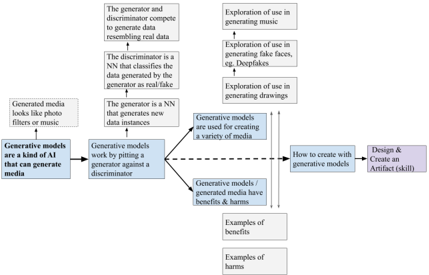
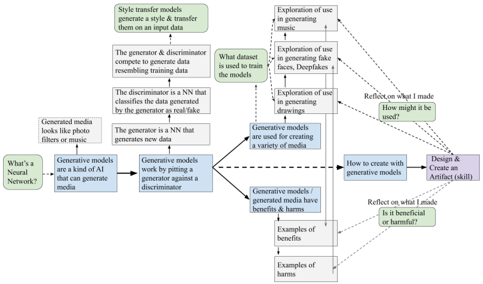
Applications of generative models such as Generative Adversarial Networks (GANs) have made their way to social media platforms that children frequently interact with. While GANs are associated with ethical implications pertaining to children, such as the generation of Deepfakes, there are negligible efforts to educate middle school children about generative AI. In this work, we present a generative models learning trajectory (LT), educational materials, and interactive activities for young learners with a focus on GANs, creation and application of machine-generated media, and its ethical implications. The activities were deployed in four online workshops with 72 students (grades 5-9). We found that these materials enabled children to gain an understanding of what generative models are, their technical components and potential applications, and benefits and harms, while reflecting on their ethical implications. Learning from our findings, we propose an improved learning trajectory for complex socio-technical systems.
Overview
The claims and statistics of this paper haven’t been checked yet.
Free: it reads the open-access text and checks the first 5 claims that cite a source we can check. Create a free account to check every claim.
Integrity signals
Registry
Cites
Statistics
Figures





Verification
Claims the paper makes
The claims and statistics of this paper haven’t been checked yet.
Free: it reads the open-access text and checks the first 5 claims that cite a source we can check. Create a free account to check every claim.
Claims other papers make about this one
Each is checked against this paper’s own text: does it say what the citing paper says it does?
The source backs part of the claim, not all of it — or backs it for a different population, condition or comparison.
In the citing paper
“This objective develops students' understanding of how AI works, their ability to assess truthfulness, detect bias, and recognize the limits of creativity.”
From A Systematic Review of Generative AI in K–12: Mapping Goals, Activities, Roles, and Outcomes via the 3P Model (2025) · cites this paper as [134]
Experimental — accuracy not yet measuredThe source backs part of the claim, not all of it — or backs it for a different population, condition or comparison.
In the citing paper
“Parents and teachers likewise raise questions about age appropriateness, ethical risk, and the costs of integration [103,116,121,123,134].”
From A Systematic Review of Generative AI in K–12: Mapping Goals, Activities, Roles, and Outcomes via the 3P Model (2025) · cites this paper as [134]
Experimental — accuracy not yet measuredThe source backs part of the claim, not all of it — or backs it for a different population, condition or comparison.
In the citing paper
“Our findings confirm that GenAI enhances motivation and self-efficacy, consistent with Ali et al. [134] previous work.”
From A Systematic Review of Generative AI in K–12: Mapping Goals, Activities, Roles, and Outcomes via the 3P Model (2025) · cites this paper as [134]
Experimental — accuracy not yet measuredThe source backs part of the claim, not all of it — or backs it for a different population, condition or comparison.
In the citing paper
“In our review, a few papers [2,6,23,30] explicitly raised concerns about the opaque nature of AI tools, with children and adults questioning where the AI-generated information comes from, why certain outputs were created, or how the system made decisions.”
From Child-AI Co-Creation: A Review of the Current Research Landscape and a Proposal for Six Design Considerations (2025) · cites this paper as [2]
Experimental — accuracy not yet measuredThe source backs part of the claim, not all of it — or backs it for a different population, condition or comparison.
In the citing paper
“However, due to the fast-paced, rapidly changing nature of the technology, the usability of generative AI tools and their applicability in educational settings has been under-explored [2].”
From Design implications of generative AI systems for visual storytelling for young learners (2023) · cites this paper as [2]
Experimental — accuracy not yet measured
3 more claims about this paper
Create a free account to see every claim other papers make about this one.
Self-check
Percentages, sums and reported differences re-computed from the paper’s own numbers.
The self-check needs the paper’s full text.
Citations
Cites
GAN(Generative Adversarial Nets)
(2017) · Journal of Japan Society for Fuzzy Theory and Intelligent Informatics · doi:10.3156/jsoft.29.5_177_2 · Cited by 19,270
(2001) · Cited by 13,930
Cognitive Load During Problem Solving: Effects on Learning
Sweller, J. (1988) · Cognitive Science · doi:10.1016/0364-0213(88)90023-7 · Cited by 11,048 · cited 1×
“Eforts were made to decrease cognitive load [50] and reduce the space of possibilities during game play.”
BackgroundWhat Video Games Have to Teach Us about Learning and Literacy
(2004) · Education + Training · doi:10.1108/et.2004.00446dae.002 · Cited by 6,674
Analyzing and Improving the Image Quality of StyleGAN
Karras, T., Laine, S., Aittala, M., Hellsten, J., Lehtinen, J., & Aila, T. (2020) · 2020 IEEE/CVF Conference on Computer Vision and Pattern Recognition (CVPR) · doi:10.1109/cvpr42600.2020.00813 · Cited by 6,332
Analyzing and Improving the Image Quality of StyleGAN
Karras, T., Laine, S., Aittala, M., Hellsten, J., Lehtinen, J., & Aila, T. (2019) · arXiv · doi:10.48550/arxiv.1912.04958 · Cited by 6,332
What video games have to teach us about learning and literacy
Gee, J. P. (2003) · Computers in Entertainment · doi:10.1145/950566.950595 · Cited by 5,735 · cited 1×
“We made use of game-based learning approaches to make abstract concepts concrete since games have shown to enhance content engagement [19, 20, 31].”
MethodWhat is AI Literacy? Competencies and Design Considerations
Long, D., & Magerko, B. (2020) · Proceedings of the 2020 CHI Conference on Human Factors in Computing Systems · doi:10.1145/3313831.3376727 · Cited by 3,241 · cited 1×
“Long and Magerko (2020) described AI literacy as “AI literacy as a set of competencies that enables individuals to critically evaluate AI technologies; communicate and collaborate efectively with AI; and use AI as a tool online, at home, and in the workplace" [36].”
BackgroundWinner, L. (2017) · Computer Ethics · doi:10.4324/9781315259697-21 · Cited by 2,317
Tutorial on Variational Autoencoders
Doersch, C. (2016) · arXiv · doi:10.48550/arxiv.1606.05908 · Cited by 1,470
Research works printed but not linked: 10
- Safinah Ali, Hae Won Park, and Cynthia Breazeal. 2020. A social robot’s influence on children’s figural creativity during gameplay. International Journal of Child-Computer Interaction (2020), 100234.
- Benjamin Samuel Bloom. 1956. Taxonomy of educational objectives: The classification of educational goals. Cognitive domain (1956).
- Leon A Gatys Alexander S Ecker and Matthias Bethge. 2015. A neural algorithm of artistic style. arXiv preprint arXiv:1508.06576(2015). · arXiv
- Ian Goodfellow Jean Pouget-Abadie Mehdi Mirza Bing Xu David Warde-Farley Sherjil Ozair Aaron Courville and Yoshua Bengio. 2014. Generative adversarial nets. In Advances in neural information processing systems. 2672–2680.
- Yotam Mann. 2016. AI duet. Experiments with Google. See, https://experiments. withgoogle. com/ai/ai-duet (2016).
- Thanh Thi Nguyen Cuong M Nguyen Dung Tien Nguyen Duc Thanh Nguyen and Saeid Nahavandi. 2019. Deep learning for deepfakes creation and detection. arXiv preprint arXiv:1909.11573(2019). · arXiv
- B.H. Payne. 2020. Can my algorithm be my opinion?: An AI + Ethics Curriculum for Middle School Students. Master’s thesis. Massachusetts Institute of Technology, Media Lab, Cambridge, MA, USA.
- Martin A Simon. 1995. Reconstructing mathematics pedagogy from a constructivist perspective. Journal for research in mathematics education (1995), 114–145.
- Danny Tang 2019. Empowering novices to understand and use machine learning with personalized image classification models intuitive analysis tools and MIT App Inventor. Ph.D. Dissertation. Massachusetts Institute of Technology.
- Robert Thornberg and Kathy Charmaz. 2014. Grounded theory and theoretical coding. The SAGE handbook of qualitative data analysis 5 (2014), 153–69.
Cited by
Bahroun, Z., Anane, C., Ahmed, V., & Zacca, A. (2023) · Sustainability · doi:10.3390/su151712983 · Cited by 784
“This section, therefore, covers a review of a wide range of applications and considerations regarding the integration of GAI in education, as discussed in Table 8 below: ) [117].”
BackgroundAI literacy in K-12: a systematic literature review
Casal-Otero, L., Catala, A., Fernández-Morante, C., Taboada, M., Cebreiro, B., & Barro, S. (2023) · International Journal of STEM Education · doi:10.1186/s40594-023-00418-7 · Cited by 724
“…how a robot equipped with AI components can be used in society (Eguchi & Okada, 2018), program conversational agents (Van Brummelen et al., 2021b), or learn to recognize credible but fake media products (video, photos), which have been generated using AI-based techniques (2021b; Ali et al., 2021a).”
BackgroundZhang, H., Lee, I., Ali, S., DiPaola, D., Cheng, Y., & Breazeal, C. (2023) · International Journal of Artificial Intelligence in Education · doi:10.1007/s40593-022-00293-3 · Cited by 396
Self-citationForero-Corba, W., & Bennásar, F. N. (2023) · RIED Revista Iberoamericana de Educación a Distancia · doi:10.5944/ried.27.1.37491 · Cited by 359
Scope of machine learning in materials research—A review
Mobarak, M. H., Mimona, M. A., Islam, M. A., Hossain, N., Zohura, F. T., Imtiaz, I., & Rimon, M. I. H. (2023) · Applied Surface Science Advances · doi:10.1016/j.apsadv.2023.100523 · Cited by 230
Metadata
- Authors
- Ali, S., DiPaola, D., Lee, I., Hong, J., & Breazeal, C.
- Affiliations
- MIT Media Lab (US)
- Massachusetts Institute of Technology (US)
- Venue
- Proceedings of the 2021 CHI Conference on Human Factors in Computing Systems
- Publisher
- ACM
- Published
- 2021-05-06
- Pages
- 1-13
- OpenAlex
- W3161501253
- Semantic Scholar
- f12664a05fab765fdc4e159689dae76bca15e728
- Cited by
- 82
- References
- 30
- Citations by year
- 2026: 11 · 2025: 24 · 2024: 22 · 2023: 18 · 2022: 5 · 2021: 2
- FWCI
- 9.74
- Type
- conference paper
- Language
- en
- Open access
- bronze
- doi.org
- Locations
- CHI Conference on Human Factors in Computing Systems (publishedVersion)
- DSpace@MIT (Massachusetts Institute of Technology) (submittedVersion, cc-by-nc)
- Funders
- National Science Foundation (2022502)
- Amazon Future Engineer
- Topics
- Social Sciences › Education › Artificial Intelligence in Education
- Physical Sciences › Computer Science › Computer Science Applications › Teaching and Learning Programming
- Physical Sciences › Computer Science › Artificial Intelligence › Ethics and Social Impacts of AI
- Keywords
- generative models, generative adversarial networks, junior high school students, deepfakes, AI ethics, learning trajectories, teaching materials, online workshops, socio-technical systems, social media use by children
About these checks
Registry, retraction, Cites and statistics results are computed, not judged, with one exception: a printed reference that no index lists is read once by a model before it counts as a citation error. Claims are extracted by a model and kept only when their quote appears verbatim in the text; each cited source is then checked, with a model’s help, for whether it says what the claim relies on. Those verdicts can be wrong — read the claim’s quote and the cited source before relying on one.
Statistics and arithmetic are recomputed, not judged.
Confidence bands are shown only for fields calibrated on our annotated test set. None is calibrated yet, so no band is shown.
What counts as a claim ›How we measure confidence ›How we check this ›
Are you an author, or do you see a problem with this page? Request a review
How to cite
Cite CoChat for the checks on this page, and the paper for its own findings.
- This page
- CoChat. (2026). Citation check: Exploring Generative Models with Middle School Students. https://app.cochat.ai/papers/10.1145/3411764.3445226
- The paper
- Ali, S., DiPaola, D., Lee, I., Hong, J., & Breazeal, C. (2021). Exploring Generative Models with Middle School Students. Proceedings of the 2021 CHI Conference on Human Factors in Computing Systems. https://doi.org/10.1145/3411764.3445226
Data sources
Bibliographic data: Semantic Scholar, OpenAlex, Crossref.
Contains information from the Semantic Scholar Academic Graph Datasets, made available under the ODC Attribution License (ODC-BY 1.0).
Semantic Scholar’s data is described in: Kinney, R., et al. (2023). The Semantic Scholar Open Data Platform. arXiv:2301.10140.
