

Exploring Generative Models with Middle School Students
Open accessThe DOI matches its Crossref record; 37 of the 37 references it cites were found in a registry or an index.
Abstract
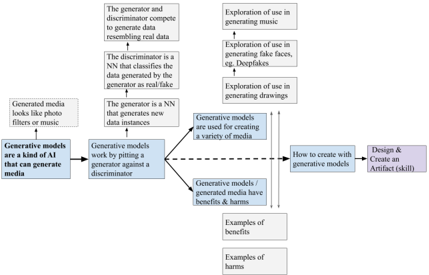
Applications of generative models such as Generative Adversarial Networks (GANs) have made their way to social media platforms that children frequently interact with. While GANs are associated with ethical implications pertaining to children, such as the generation of Deepfakes, there are negligible efforts to educate middle school children about generative AI. In this work, we present a generative models learning trajectory (LT), educational materials, and interactive activities for young learners with a focus on GANs, creation and application of machine-generated media, and its ethical implications. The activities were deployed in four online workshops with 72 students (grades 5-9). We found that these materials enabled children to gain an understanding of what generative models are, their technical components and potential applications, and benefits and harms, while reflecting on their ethical implications. Learning from our findings, we propose an improved learning trajectory for complex socio-technical systems.
Overview
The claims and statistics of this paper haven’t been checked yet.
Free: it reads the open-access text and checks the first 5 claims that cite a source we can check. Create a free account to check every claim.
Integrity signals
Registry
Cites
Statistics
Figures




Verification
Claims the paper makes
The claims and statistics of this paper haven’t been checked yet.
Free: it reads the open-access text and checks the first 5 claims that cite a source we can check. Create a free account to check every claim.
Claims other papers make about this one
Each is checked against this paper’s own text: does it say what the citing paper says it does?
The source backs part of the claim, not all of it — or backs it for a different population, condition or comparison.
In the citing paper
“This objective develops students' understanding of how AI works, their ability to assess truthfulness, detect bias, and recognize the limits of creativity.”
From A Systematic Review of Generative AI in K–12: Mapping Goals, Activities, Roles, and Outcomes via the 3P Model (2025) · cites this paper as [134]
Experimental — accuracy not yet measuredThe source backs part of the claim, not all of it — or backs it for a different population, condition or comparison.
In the citing paper
“Parents and teachers likewise raise questions about age appropriateness, ethical risk, and the costs of integration [103,116,121,123,134].”
From A Systematic Review of Generative AI in K–12: Mapping Goals, Activities, Roles, and Outcomes via the 3P Model (2025) · cites this paper as [134]
Experimental — accuracy not yet measuredThe source backs part of the claim, not all of it — or backs it for a different population, condition or comparison.
In the citing paper
“Our findings confirm that GenAI enhances motivation and self-efficacy, consistent with Ali et al. [134] previous work.”
From A Systematic Review of Generative AI in K–12: Mapping Goals, Activities, Roles, and Outcomes via the 3P Model (2025) · cites this paper as [134]
Experimental — accuracy not yet measuredThe source backs part of the claim, not all of it — or backs it for a different population, condition or comparison.
In the citing paper
“In our review, a few papers [2,6,23,30] explicitly raised concerns about the opaque nature of AI tools, with children and adults questioning where the AI-generated information comes from, why certain outputs were created, or how the system made decisions.”
From Child-AI Co-Creation: A Review of the Current Research Landscape and a Proposal for Six Design Considerations (2025) · cites this paper as [2]
Experimental — accuracy not yet measuredThe source backs part of the claim, not all of it — or backs it for a different population, condition or comparison.
In the citing paper
“However, due to the fast-paced, rapidly changing nature of the technology, the usability of generative AI tools and their applicability in educational settings has been under-explored [2].”
From Design implications of generative AI systems for visual storytelling for young learners (2023) · cites this paper as [2]
Experimental — accuracy not yet measured
3 more claims about this paper
Create a free account to see every claim other papers make about this one.
Self-check
Percentages, sums and reported differences re-computed from the paper’s own numbers.
The self-check needs the paper’s full text.
Citations
Cites
GAN(Generative Adversarial Nets)
(2017) · Journal of Japan Society for Fuzzy Theory and Intelligent Informatics · doi:10.3156/jsoft.29.5_177_2 · Cited by 19,270
(2001) · Cited by 13,930
Cognitive Load During Problem Solving: Effects on Learning
Sweller, J. (1988) · Cognitive Science · doi:10.1016/0364-0213(88)90023-7 · Cited by 11,048 · cited 1×
“Eforts were made to decrease cognitive load [50] and reduce the space of possibilities during game play.”
BackgroundWhat Video Games Have to Teach Us about Learning and Literacy
(2004) · Education + Training · doi:10.1108/et.2004.00446dae.002 · Cited by 6,674
Analyzing and Improving the Image Quality of StyleGAN
Karras, T., Laine, S., Aittala, M., Hellsten, J., Lehtinen, J., & Aila, T. (2020) · 2020 IEEE/CVF Conference on Computer Vision and Pattern Recognition (CVPR) · doi:10.1109/cvpr42600.2020.00813 · Cited by 6,332
Analyzing and Improving the Image Quality of StyleGAN
Karras, T., Laine, S., Aittala, M., Hellsten, J., Lehtinen, J., & Aila, T. (2019) · arXiv · doi:10.48550/arxiv.1912.04958 · Cited by 6,332 · cited 1×
“• This Person Does Not Exist: This tool utilizes StyleGan2 [29] and has been trained on human faces to generate fake human faces using GANs [53].”
MethodWhat video games have to teach us about learning and literacy
Gee, J. P. (2003) · Computers in Entertainment · doi:10.1145/950566.950595 · Cited by 5,735 · cited 1×
“We made use of game-based learning approaches to make abstract concepts concrete since games have shown to enhance content engagement [19, 20, 31].”
MethodWhat is AI Literacy? Competencies and Design Considerations
Long, D., & Magerko, B. (2020) · Proceedings of the 2020 CHI Conference on Human Factors in Computing Systems · doi:10.1145/3313831.3376727 · Cited by 3,241 · cited 1×
“Long and Magerko (2020) described AI literacy as “AI literacy as a set of competencies that enables individuals to critically evaluate AI technologies; communicate and collaborate efectively with AI; and use AI as a tool online, at home, and in the workplace" [36].”
BackgroundA Neural Algorithm of Artistic Style
Gatys, L., Ecker, A., & Bethge, M. (2016) · Journal of Vision · doi:10.1167/16.12.326 · Cited by 2,612
Winner, L. (2017) · Computer Ethics · doi:10.4324/9781315259697-21 · Cited by 2,317 · cited 1×
“However, in the case of knowledge about socio-technical systems (systems that constitute interactions between society’s complex infrastructures and human behaviour technical components), applications of the technology, and ethical implications are interconnected and inform each other [58].”
Background
Research works printed but not linked: 8
- 3. Safnah Ali, Hae Won Park, and Cynthia Breazeal. 2020. A social robot's infuence on children's fgural creativity during gameplay. International Journal of Child- Computer Interaction (2020), 100234.
- 9. Benjamin Samuel Bloom. 1956. Taxonomy of educational objectives: The classif- cation of educational goals. Cognitive domain (1956).
- 20. Ian Goodfellow, Jean Pouget-Abadie, Mehdi Mirza, Bing Xu, David Warde-Farley, Sherjil Ozair, Aaron Courville, and Yoshua Bengio. 2014. Generative adversarial nets. In Advances in neural information processing systems. 2672-2680.
- 37. Yotam Mann. 2016. AI duet. Experiments with Google. See, https://experiments. withgoogle. com/ai/ai-duet (2016).
- 39. Thanh Thi Nguyen, Cuong M Nguyen, Dung Tien Nguyen, Duc Thanh Nguyen, and Saeid Nahavandi. 2019. Deep learning for deepfakes creation and detection. arXiv preprint arXiv:1909.11573 (2019). CHI '21, May 8-13, 2021, Yokohama, Japan · arXiv
- 41. B.H. Payne. 2020. Can my algorithm be my opinion?: An AI + Ethics Curriculum for Middle School Students. Master's thesis. Massachusetts Institute of Technology, Media Lab, Cambridge, MA, USA.
- 47. Martin A Simon. 1995. Reconstructing mathematics pedagogy from a construc- tivist perspective. Journal for research in mathematics education (1995), 114-145.
- 51. Danny Tang et al. 2019. Empowering novices to understand and use machine learning with personalized image classifcation models, intuitive analysis tools, and MIT App Inventor. Ph.D. Dissertation. Massachusetts Institute of Technology.
Cited by
Bahroun, Z., Anane, C., Ahmed, V., & Zacca, A. (2023) · Sustainability · doi:10.3390/su151712983 · Cited by 784
“This section, therefore, covers a review of a wide range of applications and considerations regarding the integration of GAI in education, as discussed in Table 8 below: ) [117].”
BackgroundAI literacy in K-12: a systematic literature review
Casal-Otero, L., Catala, A., Fernández-Morante, C., Taboada, M., Cebreiro, B., & Barro, S. (2023) · International Journal of STEM Education · doi:10.1186/s40594-023-00418-7 · Cited by 724
“…how a robot equipped with AI components can be used in society (Eguchi & Okada, 2018), program conversational agents (Van Brummelen et al., 2021b), or learn to recognize credible but fake media products (video, photos), which have been generated using AI-based techniques (2021b; Ali et al., 2021a).”
BackgroundZhang, H., Lee, I., Ali, S., DiPaola, D., Cheng, Y., & Breazeal, C. (2023) · International Journal of Artificial Intelligence in Education · doi:10.1007/s40593-022-00293-3 · Cited by 396
“The three core domains were established by the project leadership team and informed by our team’s previous research on promoting AI education among young learners (e.g., Ali et al., 2019, 2021; DiPaola et al., 2020).”
MethodSelf-citationForero-Corba, W., & Bennásar, F. N. (2023) · RIED Revista Iberoamericana de Educación a Distancia · doi:10.5944/ried.27.1.37491 · Cited by 376
Scope of machine learning in materials research—A review
Mobarak, M. H., Mimona, M. A., Islam, M. A., Hossain, N., Zohura, F. T., Imtiaz, I., & Rimon, M. I. H. (2023) · Applied Surface Science Advances · doi:10.1016/j.apsadv.2023.100523 · Cited by 230
Rizvi, S., Waite, J., & Sentance, S. (2023) · Computers and Education: Artificial Intelligence · doi:10.1016/j.caeai.2023.100145 · Cited by 142
AI + Ethics Curricula for Middle School Youth: Lessons Learned from Three Project-Based Curricula
Williams, R., Ali, S., Devasia, N., DiPaola, D., Hong, J., Kaputsos, S. P., Jordan, B., & Breazeal, C. (2023) · International Journal of Artificial Intelligence in Education · doi:10.1007/s40593-022-00298-y · Cited by 204
“…focus/ AI- in- educa tion 328 International Journal of Artificial Intelligence in Education (2023) 33:325–383 1 3 algorithms even if they do not have the background knowledge or the resources to actually program the algorithm (Ali et al., 2021a; Lee et al., 2021; Payne, 2020; TechGirlz, 2018).”
BackgroundSelf-citationChildren as creators, thinkers and citizens in an AI-driven future
Ali, S., DiPaola, D., Lee, I., Sindato, V., Kim, G., Blumofe, R., & Breazeal, C. (2021) · Computers and Education: Artificial Intelligence · doi:10.1016/j.caeai.2021.100040 · Cited by 152
Self-citationLarge-scale Text-to-Image Generation Models for Visual Artists’ Creative Works
Ko, H.-K., Park, G., Jeon, H., Jo, J., Kim, J., & Seo, J. (2023) · Proceedings of the 28th International Conference on Intelligent User Interfaces · doi:10.1145/3581641.3584078 · Cited by 189
“For example, Deepfake has exacerbated a social problem of generating deception, propaganda, and disinformation [27, 87], which is not even decided in our society that who has the legal responsibility for such fake media [2].”
Background“How knowledge workers think generative AI will (not) transform their industries,”
Woodruff, A., Shelby, R., Kelley, P. G., Rousso-Schindler, S., Smith-Loud, J., & Wilcox, L. (2024) · Proceedings of the CHI Conference on Human Factors in Computing Systems · doi:10.1145/3613904.3642700 · Cited by 105
“A limited body of research has examined impacts on specific professional sectors, notably creative [44, 68, 77] and educational [5, 85, 100] domains.”
BackgroundDesign implications of generative AI systems for visual storytelling for young learners
Han, A., & Cai, Z. (2023) · Proceedings of the 22nd Annual ACM Interaction Design and Children Conference · doi:10.1145/3585088.3593867 · Cited by 127
“However, due to the fast-paced, rapidly changing nature of the technology, the usability of generative AI tools and their applicability in educational settings has been under-explored [2].”
BackgroundPotential Risks of Artificial Intelligence Integration into School Education: A Systematic Review
Karan, B., & Angadi, G. R. (2023) · Bulletin of Science, Technology & Society · doi:10.1177/02704676231224705 · Cited by 87
“Various social media (e.g., Instagram) has been overwhelmed with procre-ative AI system such as deepfakes and creative fi lters (Ali et al., 2021; Kaya, 2019), which can mislead young learners through sharing fake information faster than valid information (Vosoughi et al., 2018).”
BackgroundLi, L., Yu, F., & Zhang, E. (2024) · Computers and Education Artificial Intelligence · doi:10.1016/j.caeai.2024.100217 · Cited by 134
Zhang, H., Perry, A., & Lee, I. (2025) · International Journal of Artificial Intelligence in Education · doi:10.1007/s40593-024-00398-x · Cited by 75
“Yet many of the current efforts have focused on creating novel activities that are accessible and engaging for young learners (e.g., Ali et al., 2021; Egu-chi et al., 2021; Williams & Breazeal, 2020).”
Self-citationExploring AI-Generated text in student writing: How does AI help?
Woo, D. J., Susanto, H., Yeung, C. H., Guo, K., & Fung, A. K. Y. (2024) · Language Learning & Technology · doi:10.64152/10125/73577 · Cited by 39
Constructing Dreams Using Generative AI
Ali, S., Ravi, P., Williams, R., DiPaola, D., & Breazeal, C. (2024) · Proceedings of the AAAI Conference on Artificial Intelligence · doi:10.1609/aaai.v38i21.30374 · Cited by 69
Self-citationDeveloping middle school students’ understanding of machine learning in an African school
Sanusi, I. T., Oyelere, S. S., Vartiainen, H., Suhonen, J. T., & Tukiainen, M. (2023) · Computers and Education Artificial Intelligence · doi:10.1016/j.caeai.2023.100155 · Cited by 63
Family Learning Talk in AI Literacy Learning Activities
Long, D., Teachey, A., & Magerko, B. (2022) · CHI Conference on Human Factors in Computing Systems · doi:10.1145/3491102.3502091 · Cited by 53
“Numerous groups have developed AI-related learning interventions and assessed them using a variety of means, including collecting students’ daily refections and conducting interviews with students [37], asking learners to take pre/post tests or complete questionnaires [3, 69] or asking teachers for their impressions o…”
BackgroundAI Audit: A Card Game to Reflect on Everyday AI Systems
Ali, S., Kumar, V., & Breazeal, C. (2023) · Proceedings of the AAAI Conference on Artificial Intelligence · doi:10.1609/aaai.v37i13.26897 · Cited by 57
Self-citationKaate, I., Salminen, J. O., Santos, J. M., Jung, S., Olkkonen, R., & Jansen, B. J. J. (2023) · International Journal of Human-Computer Studies · doi:10.1016/j.ijhcs.2023.103096 · Cited by 46
“Towards the latter purpose, Safinah Ali et al. (2021) focused on the ethical implications of generative AI technologies, including deepfakes. The researchers organized four student workshops, finding that educational material about generative adversarial networks (GANs) helped the students understand how GAN models wo…”
BackgroundInfluentialExploring AI-Generated Text in Student Writing: How Does AI Help?
Woo, D. J., Susanto, H., Yeung, C. H., Guo, K., & Fung, A. K. Y. (2023) · arXiv · doi:10.48550/arxiv.2304.02478 · Cited by 39
“First, our study contributes a curricular effort to achieve both learning about AI and learning with AI (Ali et al., 2021; Williams et al., 2022).”
BackgroundAI: An Active and Innovative Tool for Artistic Creation
Avlonitou, C. C., & Papadaki, E. (2025) · Arts · doi:10.3390/arts14030052 · Cited by 45
“…curricula are increasingly focusing on fostering synergy between human creativity and AI, equipping students with AI-driven skills to enhance creativity, promote responsible use, and navigate emerging technologies such as GANs and deepfakes (How and Hung 2019; Ali et al. 2020, 2021a, 2021b).”
Ali, S., Ravi, P., Moore, K. S., Abelson, H., & Breazeal, C. (2024) · Proceedings of the AAAI Conference on Artificial Intelligence · doi:10.1609/aaai.v38i21.30373 · Cited by 48
Self-citationData-related concepts for artificial intelligence education in K-12
Olari, V., & Romeike, R. (2024) · Computers and Education Open · doi:10.1016/j.caeo.2024.100196 · Cited by 39
Ravi, P., Broski, A., Stump, G., Abelson, H., Klopfer, E. D., & Breazeal, C. (2023) · ICERI proceedings · doi:10.21125/iceri.2023.1716 · Cited by 35
“Scholars from recent studies have raised concerns about the extent to which K12 students are aware of the applications as well as consequences of AI in their daily lives [1, 2, 3, 4, 5].”
BackgroundSelf-citationJiao, J., Afroogh, S., Chen, K., Murali, A., Atkinson, D., & Dhurandhar, A. (2026) · SSRN Electronic Journal · doi:10.2139/ssrn.6836268 · Cited by 32
ARtonomous: Introducing Middle School Students to Reinforcement Learning Through Virtual Robotics
Dietz, G., Chen, J. K., Beason, J., Tarrow, M., Hilliard, A., & Shapiro, R. B. (2022) · ACM International Conference on Interaction Design and Children (IDC) · doi:10.1145/3501712.3529736 · Cited by 33
“Few tools for K–12 AI education exist that go beyond using or creating supervised learning classifiers, although those that do explore the teaching of k-means clustering, a form of unsupervised learning [55] or generative adversarial networks (GANs) [3].”
BackgroundFock, A., & Siller, H.-S. (2025) · International Journal of STEM Education · doi:10.1186/s40594-025-00589-5 · Cited by 30
“From the publications it is evident that three out of 183 publications addressed learning about generative AI (Ali et al., 2021; Vartiainen et al., 2025; Xie et al., 2024), while the remaining contributions focused on learning with generative AI.”
Generative artificial intelligence in K-12 education: A systematic review
Zhang, T., Lai, Y. C., & Yu, P. L. H. (2025) · Research and Practice in Technology Enhanced Learning · doi:10.58459/rptel.2026.21034 · Cited by 34
“…because it is difficult for developers to exclude all biased content in the datasets used to train LLMs. Additionally, participants were concerned about whether text-to-image models risk copyright infringement (Ali, DiPaola, Lee, Hong, et al., 2021; Monteiro et al., 2024; Vartiainen & Tedre, 2023).”
Lin, X., & Tan, H. (2025) · Systems · doi:10.3390/systems13100840 · Cited by 22
Cao, H. J., Choi, K., Park, C., & Lee, H. R. (2025) · Proceedings of the 2025 CHI Conference on Human Factors in Computing Systems · doi:10.1145/3706598.3713173 · Cited by 22
“In the HCI community, the discussion of accessible K-12 AI education, including the design of curricula and tools, has gained considerable attention [1, 44, 74, 75, 94].”
Writing creative stories with AI: learning designs for secondary school students
Woo, D. J., Guo, K., & Salas‐Pilco, S. Z. (2024) · Innovation in Language Learning and Teaching · doi:10.1080/17501229.2024.2384884 · Cited by 25
Olari, V., Tenório, K., & Romeike, R. (2023) · IFIP advances in information and communication technology · doi:10.1007/978-3-031-43393-1_21 · Cited by 27
“Approaches ranged across the spectrum, from assessing the societal impact of AI technologies [22] to examining algorithmic bias [26] and from describing the limitations of AI in real-world settings [27] to considering issues of data privacy [28].”
BackgroundDeveloping a Holistic AI Literacy Framework for Children
Jia, K., Leung, T. H. M., Cheung, N. Y. I., Li, Y., & Yu, J. (2025) · ACM Transactions on Computing Education · doi:10.1145/3727986 · Cited by 31
“For instance, the topics addressing AI’s technical foundations range from the workflow of a specific learning algorithm [3] to the full cycle of building an ML model [75].”
Khan, S., Iqbal, M., Osho, O., Singh, K., Derrick, K., Nelson, P., Li, L., Sidnam-Mauch, E., Bannister, N. A., Caine, K. E., et al. (2024) · CHI Conference on Human Factors in Computing Systems · doi:10.1145/3613904.3642460 · Cited by 25
“Furthermore, there exist several AI-related privacy education eforts for adolescents in the form of summer camps, workshops, or online self-learning [3, 8, 35].”
BackgroundSingh, B., Dutta, P. K., Gautam, R., & Kaunert, C. (2024) · Advances in logistics, operations, and management science book series · doi:10.4018/979-8-3693-4107-0.ch024 · Cited by 24
Singh, B., & Kaunert, C. (2024) · Engineering cyber-physical systems and critical infrastructures · doi:10.1007/978-3-031-65434-3_7 · Cited by 27
Data-related practices for creating Artificial Intelligence systems in K-12
Olari, V., & Romeike, R. (2024) · Workshop in Primary and Secondary Computing Education · doi:10.1145/3677619.3678115 · Cited by 18
“AI curricula suggest students work with images [14, 20, 37, 41, 47, 51, 72, 76, 78, 81], texts [3, 16, 41, 52, 58, 72, 77, 79, 81], tabular data [20], audio [76], video [12], and graph data [77].”
BackgroundCai, Z., Han, A., Zhou, X., Gazulla, E. D., & Peppler, K. (2025) · Proceedings of the 24th Interaction Design and Children · doi:10.1145/3713043.3731506 · Cited by 17
Cao, H. J., Lee, H. R., & Peng, W. (2025) · CHI Conference on Human Factors in Computing Systems · doi:10.1145/3706598.3713254 · Cited by 20
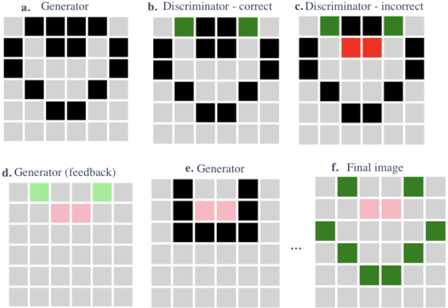
“Ali et al. [1] employed a generator-discriminator game where learners assumed the roles of either the generator or the discriminator.”
“Won’t somebody please (actually) think of the children?” AI Ethics for Children: A Scoping Review
Collyer-Hoar, G., & Rubegni, E. (2025) · ACM Journal on Responsible Computing · doi:10.1145/3745031 · Cited by 22
“Otherwise, various sources proposed enhancements to current pedagogy in differing manners, such as through the creation of new educational materials [8, 186], and several proof-of-concept studies exploring new methodologies for teaching [48, 49, 69, 80, 84, 93, 121, 133, 142, 160, 161, 176, 200] or…”
Kim, K., & Kwon, K. (2025) · Smart Learning Environments · doi:10.1186/s40561-025-00413-1 · Cited by 19
“However, early exposure to advanced AI concepts can spark interest in AI-related careers and prepare students for future job markets that increasingly require AI literacy (Ali et al., 2021; Dipaola et al., 2022).”
Introducing Variational Autoencoders to High School Students
Lyu, Z., Ali, S., & Breazeal, C. (2022) · Proceedings of the AAAI Conference on Artificial Intelligence · doi:10.1609/aaai.v36i11.21559 · Cited by 8
Self-citationSingh, B., Dutta, P. K., & Kaunert, C. (2024) · Advances in logistics, operations, and management science book series · doi:10.4018/979-8-3693-4107-0.ch014 · Cited by 18
Xu, R., Le, N., Park, R. H., Murray, L., Das, V., Kumar, D., & Goldberg, B. (2024) · arXiv (Cornell University) · doi:10.48550/arxiv.2405.02522 · Cited by 17
“The latter approach focuses on how individuals understand what is and is not trustworthy, and what user-level interventions or technological affordances can boost their ability to understand and assess GenAI trustworthiness (Xu, Fan, and Kankanhalli 2023; Ali et. al.”
BackgroundIt's like I'm the AI: Youth Sensemaking About AI through Metacognitive Embodiment
Greenwald, E., Krakowski, A., Hurt, T., Grindstaff, K., & Wang, N. (2024) · ACM International Conference on Interaction Design and Children (IDC) · doi:10.1145/3628516.3659395 · Cited by 17
Iqbal, M., Singh, K., Khan, S., Osho, O., Sidnam-Mauch, E., Bannister, N. A., Caine, K. E., & Knijnenburg, B. P. (2025) · Computers and Education Artificial Intelligence · doi:10.1016/j.caeai.2025.100425 · Cited by 16
Alsahli, M. A., Alanezi, F., Basri, W. S., Attar, R. W., Alghamdi, A., Alyahya, N. M., Albagmi, S., Almutairi, S. A., Alsedrah, I. T., Arif, W. M., et al. (2025) · Nutrition and Health · doi:10.1177/02601060241307770 · Cited by 13
“Arti fi cial intelligence (AI) offers new opportunities to meet SEN students ’ learning demands (Ali et al., 2021; Bozkurt et al., 2023).”
Exploring the Advancements and Challenges of Deepfake Face-swap: A Survey
Bakar, S. A. R. B. S. A., Waseem, S., Omar, Z., & Bilalashfaqahmed (2026) · Multimedia Tools and Applications · doi:10.1007/s11042-026-21285-8 · Cited by 15
Role of Video Content Generation in Education Systems Using Generative AI
Kumar, L., Singh, D. K., & Ansari, M. A. (2024) · Advances in educational technologies and instructional design book series · doi:10.4018/979-8-3693-2440-0.ch019 · Cited by 12
The Role of Generative AI in Empowering Generation Z in Higher Education
Zábojník, R., & Hromada, V. (2024) · Media & Marketing Identity · doi:10.34135/mmidentity-2024-75 · Cited by 15
DiPaola, D., Aidinoff, M., Marzilli, A., Berman, E., Champigny, M., Gundy, N., Yezzi, S., & Breazeal, C. (2024) · First Monday · doi:10.5210/fm.v29i12.13869 · Cited by 11
Self-citationKang, W., Lee, H., & Hong, J.-H. (2025) · Computers & Education · doi:10.1016/j.compedu.2025.105419 · Cited by 11
Self-citationA Review of Data Augmentation and Data Generation Using Artificial Intelligence in Education
Chui, K. T., Lee, L., Wang, F. L., Cheung, S. K. S., & Wong, L. P. (2023) · Communications in computer and information science · doi:10.1007/978-981-99-8255-4_21 · Cited by 12
Child Centred Ethics (CCE): A Practical Framework for Enhanced Child Participation in HCI
Read, J. C., Horton, M., Fitton, D., & Sim, G. (2025) · CHI Conference on Human Factors in Computing Systems · doi:10.1145/3706598.3714248 · Cited by 12
Khimi, W., Albarqi, K., Saif, K., & Elhag, S. (2024) · International Journal of Computers and Informatics · doi:10.59992/ijci.2024.v3n8p3 · Cited by 11
ActiveAI: The Effectiveness of an Interactive Tutoring System in Developing K-12 AI Literacy
Tseng, Y.-J., Yadav, G., Hou, X., Wu, M., Chou, Y.-S., Chen, C. C., Wu, C.-C., Chen, S.-G., Lin, Y.-J., Liao, G., et al. (2024) · Lecture notes in computer science · doi:10.1007/978-3-031-72315-5_31 · Cited by 12
YouthSafe: A Youth-Centric Safety Benchmark and Safeguard Model for Large Language Models
Yu, Y., Liu, Y., Zhang, Y., Huang, Y., & Wang, Y. (2025) · ACM SIGSAC Conference on Computer and Communications Security (CCS) · doi:10.1145/3719027.3765168 · Cited by 17
“Recent literature has highlighted emerging risks and safety concerns regarding minors interacting with GAI tools, such as AI-based chatbots and LLM-based content generation systems [2–4, 19, 23].”
Teaching and Learning AI in K-12 Informatics Education
Barendsen, E., Lonati, V., Quille, K., Altın, R., Divitini, M., Hooshangi, S., Karnalim, O., Kiesler, N., Melton, M., Montero, C. S., et al. (2024) · doi:10.1145/3708550.3730560 · Cited by 8
Generative AI: Concerns, usage, challenges, opportunities and sentiments
Twinomurinzi, H., & Gumbo, S. (2025) · South African Computer Journal · doi:10.18489/sacjv37i1/17890 · Cited by 6
Albakri, M. (2026) · Systems Research and Behavioral Science · doi:10.1002/sres.70057 · Cited by 5
Krämer, M., Bedenlier, S., & Kammerl, R. (2023) · MedienPädagogik Zeitschrift für Theorie und Praxis der Medienbildung · doi:10.21240/mpaed/jb19/2023.03.05.x · Cited by 5
What is the Minimum to Trust AI?—A Requirement Analysis for (Generative) AI-Based Texts
Tomitza, C., Schaschek, M., Straub, L., & Winkelmann, A. (2025) · Lecture notes in information systems and organisation · doi:10.1007/978-3-031-80119-8_14 · Cited by 7
YouthSafe: A Youth-Centric Safety Benchmark and Safeguard Model for Large Language ModelsPreprint
Yu, Y., Liu, Y., Zhang, J., Huang, Y., & Wang, Y. (2025) · arXiv (Cornell University) · doi:10.48550/arxiv.2509.08997 · Cited by 4
“Recent literature has highlighted emerging risks and safety concerns regarding minors interacting with GAI tools, such as AI-based chatbots and LLM-based content generation systems [2–4, 19, 23].”
Understanding Generative AI Risks for Youth: An Empirical Taxonomy for Safer Digital Futures
Yu, Y., Liu, Y., Zhang, J., Qian, Z., Huang, Y. M., & Yang, W. (2025) · Proceedings of the Association for Information Science and Technology · doi:10.1002/pra2.1526 · Cited by 3
“For example, Ali et al. (2021) documented middle school students' experiences with generative models, emphasizing new social and creative opportunities as well as potential risks.”
“Just Be Careful”: Exploring Middle School Students’ Views About Generative AI
Anderson, S. E., & Bauml, M. (2025) · RMLE Online · doi:10.1080/19404476.2025.2596551 · Cited by 3
“Effective instruction on using GenAI tools must address issues of accuracy, trustworthiness, and ethical matters surrounding their use (Ali et al., 2021).”
Constructing AI Literacy: A Hands-On Approach for School Children
Busuttil, L. (2025) · Informatics in Education · doi:10.15388/infedu.2025.26 · Cited by 5
Jha, S., & Singh, S. (2024) · Communications in computer and information science · doi:10.1007/978-3-031-68617-7_3 · Cited by 3
Singh, B., Kaunert, C., Jermsittiparsert, K., & Chandra, S. (2025) · IGI Global eBooks · doi:10.4018/979-8-3693-5350-9.ch011 · Cited by 2
Becoming Fei: An Educational Game for AI and Data Science Education for Novice Learners
Wang, N., Fu, B., Dinçer, B. H., Masur, O., Faizi, D., Ravindran, H., Wang, J., Lai, D., & Merchant, C. (2025) · Lecture notes in computer science · doi:10.1007/978-3-031-93746-0_6 · Cited by 2
AI Education for K-12: A Survey
Wang, N., & Lester, J. C. (2023) · Communications in computer and information science · doi:10.1007/978-3-031-36336-8_6 · Cited by 4
Carrasco, O. C. (2021) · Journal Boliviano de Ciencias · doi:10.52428/20758944.v17i51.110 · Cited by 2
Evaluating Interactive Technology with Children
Read, J. C., Horton, M., & Fitton, D. (2025) · CHI Conference Extended Abstracts on Human Factors in Computing Systems (CHI EA) · doi:10.1145/3706599.3706655 · Cited by 3
Making Original 2D Visual Deepfakes With a Generative AI Tool
Hai-Jew, S. (2024) · Advances in multimedia and interactive technologies book series · doi:10.4018/979-8-3693-2927-6.ch006 · Cited by 1
Ortí Martínez, J. A., Pardo Ríos, M., Burgueño López, J., & Plitt Stevens, J. (2024) · doi:10.36006/09643-1-05 · Cited by 1
Hanafi, Y., Nabila, A., Hayati, E. N., Alfarizzi, M., Sukur, A., Kusuma, A. D., Amalia, D., Hasan, Z., & Huda, M. A. N. (2024) · PERDIKAN (Journal of Community Engagement) · doi:10.19105/pjce.v6i2.15500 · Cited by 1
Hide-and-Seek GANs for Generation with Limited Data
He, Y., Ding, E. X., & Hou, R. J. (2025) · Lecture notes in computer science · doi:10.1007/978-981-96-6582-2_18 · Cited by 1
Exploring Methods Used in Face Swapping
Eklund, J. (2023) · Scholarly Horizons University of Minnesota Morris Undergraduate Journal · doi:10.61366/2576-2176.1120
Hai-Jew, S. (2023) · Advances in educational technologies and instructional design book series · doi:10.4018/979-8-3693-0074-9.ch005
A Vision for Introducing AI Topics: A Case Study
Štuikys, V., & Burbaitė, R. (2024) · Springer eBooks · doi:10.1007/978-3-031-48235-9_9
GENAI IN PRIMARY EDUCATION: THE CASE OF CHATGPT AND CONCEPT MAPPING WITH DYNALEARN
Gkreka, C., & Bredeweg, B. (2024) · ICERI proceedings · doi:10.21125/iceri.2024.2270
Singh, B., & Kaunert, C. (2025) · Wiley eBooks · doi:10.1002/9781394302932.ch11
Virtual Reflection: A Constructivist Platform for Middle School AI Ethics Education
Zhang, Y., Kou, W., Guo, H. L., & Chen, W. (2025) · Lecture notes in computer science · doi:10.1007/978-3-031-93864-1_21
Virtually Human: An Exhibit for Public AI Education
Wang, N., Hurt, T., Krakowski, A., Greenwald, E., Hammerman, J., Santos, S. D. L., Masur, O., Fu, B., & Merchant, C. (2025) · Communications in computer and information science · doi:10.1007/978-3-031-94171-9_42
FreshU-GAN: A Deep Learning model for determining beef freshness
Zhang, Y., Sun, J., Ding, E., & Hou, R. (2025) · Journal of High School Science · doi:10.64336/001c.143179
Ozcan, S. (2025) · SSRN Electronic Journal · doi:10.2139/ssrn.5384926
(n.d.)
Petrucco, C., Favino, F., & a., C. (2024) · Padua Research Archive (University of Padova)
Alessio, F. G., & Telloni, A. I. (2024) · Università Politecnica delle Marche (Università Politecnica delle Marche)
SPIED: A Human-Centred pedagogy for AI education at upper second level (Work in progress)
Conway, B. D., Nolan, K. E., & Quille, K. (2026) · Conference on Human Centred Artificial Intelligence - Education and Practice (HCAIep) · doi:10.1145/3777490.3777494
Quadros, P. D. S. (2026) · Springer eBooks · doi:10.1007/978-981-95-1875-3_5 · Cited by 1
Menetelmät syväväärennöskuvien tunnistamiseen sosiaalisessa mediassa
Kivioja, V. (2025) · Tampere University Institutional Repository (Tampere University)
ART AND ARTIFICIAL INTELLIGENCE IN SHAPING CONTEMPORARY VISUAL CULTURE
Gayathri, M., Harshini, R., Gayathri, B., Ashika Fathima., B., Prathiba, S., & Priyadharshini., S. (2026) · ShodhKosh Journal of Visual and Performing Arts · doi:10.29121/shodhkosh.v7.i3s.2026.7326
ARTIFICIAL INTELLIGENCE AS A CREATIVE COLLABORATOR IN CONTEMPORARY VISUAL AND PERFORMING ARTS
Pushpalatha, P., Sripada, P. N., Vinitha, M., Muninathan, N., Packirisamy, S., & Yang, Y. (2026) · ShodhKosh Journal of Visual and Performing Arts · doi:10.29121/shodhkosh.v7.i3s.2026.7310
Mapping Stakeholder Views on Generative AI in Education: A Review of 48 Studies
Vijithasena, K., & Saarela, M. (2026) · International Conference on Information and Education Technology (ICIET) · doi:10.1109/iciet69664.2026.11561659 · Cited by 1
“Meanwhile, instructional interventions demonstrate opportunities to cultivate ethical literacy even among younger learners [56].”
Orbiting the VirtueVerse: A Game for Practicing and Reflecting on AI Ethics
DiPaola, D., Pu, I. M., Zhou, Z., Morished, F. Y., Bono, S., Alghowinem, S., & Breazeal, C. (2026) · ACM International Conference on Interaction Design and Children (IDC) · doi:10.1145/3773077.3806143
Self-citationAI Literacy in Action: Develop Informed AI “Use” Through an ELA Debate and Argumentation Curriculum
Ma, C., Wang-Sun, J., DiPaola, D., Zhou, Z., & Breazeal, C. (2026) · ACM International Conference on Interaction Design and Children (IDC) · doi:10.1145/3773077.3812139
Self-citationThe 7th Patient: An Evaluation of an Educational Game for High-School AI and Probability Education
Pynadath, D. V., Wang, N., Greenwald, E., Mayfield-Ingram, K., Asturias, H., Cannady, M., Collins, M. A., Cavero, D. A., Hurt, T., Fu, B., et al. (2026) · Lecture notes in computer science · doi:10.1007/978-3-032-30784-2_27
Blackmore, B. (2023) · Otago University Research Archive (University of Otago) · Cited by 3
Metadata
- Authors
- Ali, S., DiPaola, D., Lee, I., Hong, J., & Breazeal, C.
- Affiliations
- MIT Media Lab (US)
- Massachusetts Institute of Technology (US)
- Venue
- Proceedings of the 2021 CHI Conference on Human Factors in Computing Systems
- Publisher
- ACM
- Published
- 2021-05-06
- Pages
- 1-13
- OpenAlex
- W3161501253
- Semantic Scholar
- f12664a05fab765fdc4e159689dae76bca15e728
- Cited by
- 82
- References
- 30
- Citations by year
- 2026: 11 · 2025: 24 · 2024: 22 · 2023: 18 · 2022: 5 · 2021: 2
- FWCI
- 9.74
- Type
- conference paper
- Language
- en
- Open access
- bronze
- doi.org
- Locations
- CHI Conference on Human Factors in Computing Systems (publishedVersion)
- DSpace@MIT (Massachusetts Institute of Technology) (submittedVersion, cc-by-nc)
- Funders
- National Science Foundation (2022502)
- Amazon Future Engineer
- Topics
- Social Sciences › Education › Artificial Intelligence in Education
- Physical Sciences › Computer Science › Computer Science Applications › Teaching and Learning Programming
- Physical Sciences › Computer Science › Artificial Intelligence › Ethics and Social Impacts of AI
- Keywords
- generative models, generative adversarial networks, junior high school students, deepfakes, AI ethics, learning trajectories, teaching materials, online workshops, socio-technical systems, social media use by children
About these checks
Registry, retraction, Cites and statistics results are computed, not judged, with one exception: a printed reference that no index lists is read once by a model before it counts as a citation error. Claims are extracted by a model and kept only when their quote appears verbatim in the text; each cited source is then checked, with a model’s help, for whether it says what the claim relies on. Those verdicts can be wrong — read the claim’s quote and the cited source before relying on one.
Statistics and arithmetic are recomputed, not judged.
Confidence bands are shown only for fields calibrated on our annotated test set. None is calibrated yet, so no band is shown.
What counts as a claim ›How we measure confidence ›How we check this ›
Are you an author, or do you see a problem with this page? Request a review
Data sources
Bibliographic data: Semantic Scholar, OpenAlex, Crossref.
Contains information from the Semantic Scholar Academic Graph Datasets, made available under the ODC Attribution License (ODC-BY 1.0).
Semantic Scholar’s data is described in: Kinney, R., et al. (2023). The Semantic Scholar Open Data Platform. arXiv:2301.10140.
