

“I Don’t Want To Shoot The Android”: Players Translate Real-Life Moral Intuitions to In-Game Decisions in Detroit: Become Human
Open accessThe DOI matches its Crossref record; 41 of the 41 references it cites were found in a registry or an index; 3 of the 73 sources its claims cite were checked for support.
Abstract
In interactive story games, players make decisions that advance and modify the unfolding story. In many cases, these decisions have a moral component. Examining decision-making in these games illuminates whether players mobilize their real-life morality to make in-game decisions and what impact this has in both the game world and real life. Using mixed-methods consisting of semi-structured interviews and the Moral Foundations Questionnaire (MFQ30), we collected data from 19 participants who played the game Detroit: Become Human. We analyzed how participants applied their real-life morals toward in-game decisions using thematic analysis and statistical analysis of the MFQ30 results. Qualitative findings indicate that participants mobilize their moral intuitions to make in-game decisions and how much participants cared about their game characters influenced their choices.
Overview
CoChat Summary
TL;DR
This mixed-methods study of 19 players of *Detroit: Become Human* finds that players apply their real-life moral intuitions to in-game decisions, at least on first playthroughs, and that attachment to game characters strongly shapes those choices. The MFQ30 questionnaire did not yield reliable or significant before/after differences at this sample size, so the paper's contribution rests mainly on its qualitative themes.
Key findings
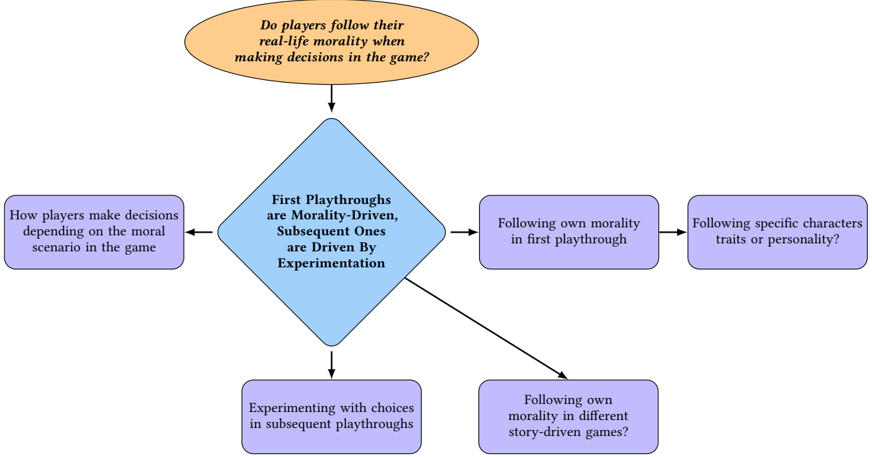
- All participants reported following their own morality at least on the first playthrough; 12 mentioned experimenting with choices in subsequent playthroughs to see different paths.
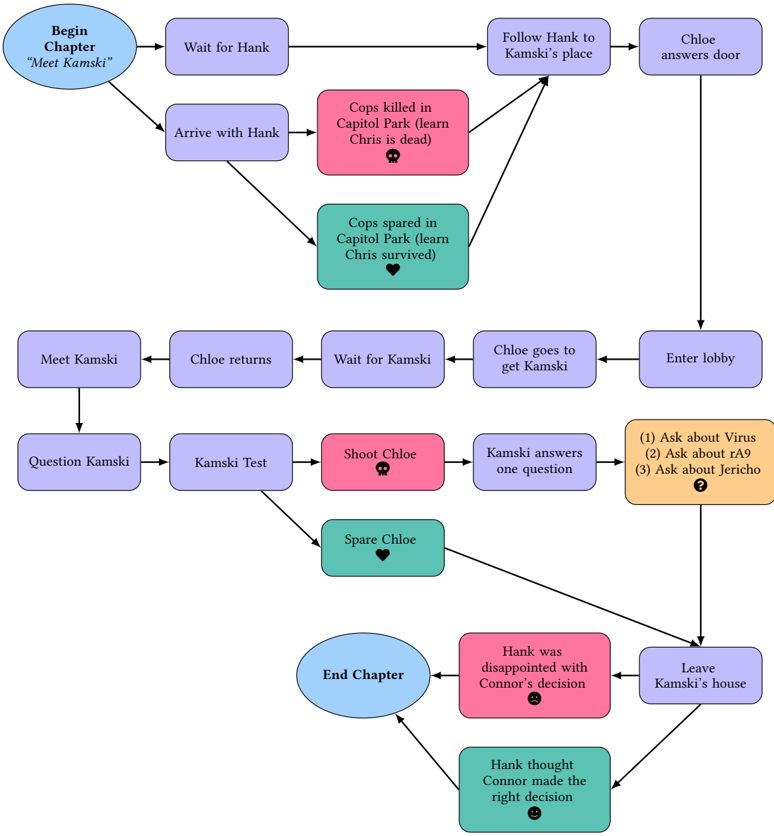
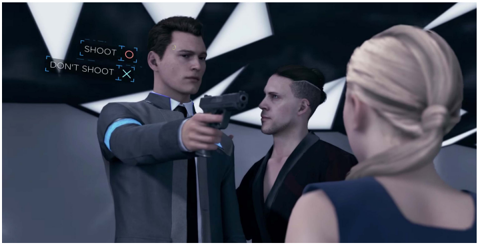
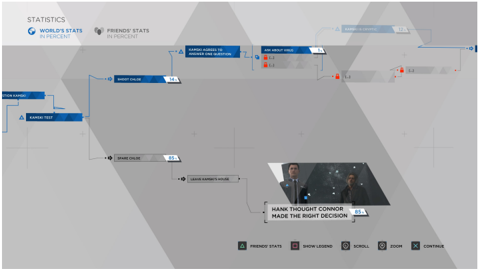
- When shown the "Meet Kamski" chapter, 15 of 19 participants said they had spared the android on their first playthrough — the same number who said they sided with the androids at the end of the game. The paper notes in-game world stats showing 85% of players spared the android.
- Character connection mattered: participants reported selecting choices to build positive relationships with Connor, Hank, and NPCs, and to avoid guilt or frustration when consequences harmed characters.
- MFQ30 reliability was acceptable only for Harm (before α = 0.684, after α = 0.811) and Purity (before α = 0.778, after α = 0.745); paired t-tests (n = 19) showed no significant before/after differences for Harm (p = 0.138) or Purity (p = 0.720). Qualitatively, participants emphasized harm/care and fairness/reciprocity over authority, ingroup/loyalty, and purity.
Methods
- Within-participants design: 19 participants (recruited via User Interviews, aged 18+, based in Canada, US, UK, who had played the game in the past six months and completed ≥60%) completed a demographic questionnaire, MFQ30 (before), watched an ~11-minute pre-recorded video of the "Meet Kamski" chapter, MFQ30 (after, from Connor's perspective), and a semi-structured interview (~60-minute sessions, $20 CAD remuneration).
- Qualitative analysis used reflexive thematic analysis (Braun & Clarke) conducted by a single coder, with transcripts managed in Dovetail.
- Quantitative analysis computed MFQ30 subscale scores and Cronbach's α, with paired t-tests only for subscales meeting the 0.7 reliability threshold.
Limitations
- Stated: single coder for the reflexive thematic analysis, which may bias results (though the authors note reflexive TA does not aim for coder consensus); small sample size (N = 19) may have negatively affected MFQ30 reliability; no prior knowledge of the MFQ30 being applied twice in one experiment; participants already knew the game, which could affect perception of character morality; only one chapter was shown; participants were recruited only from English-speaking countries (Canada, US, UK), so race and culture may have influenced MFQ30 results; current events (e.g., COVID-19) may have influenced responses.
- Evident from the text: the study could not have participants play the game due to COVID-19 restrictions and technological constraints, so participants watched pre-recorded gameplay rather than making live decisions; the MFQ30 "after" set asked about a character (Connor) whose in-game choice (sparing the android) was fixed by the video, which may constrain what the second measurement captures.
Model-written summary. Check it against the paper before relying on it.
Integrity signals
Registry
Cites
Statistics
Figures

Verification
Claims the paper makes
3 Valid · 4 Not valid · 52 Not checked · 130 Own results and interpretations
The cited sources support only part of this claim — read each source’s verdict below.
In the paper
“This is evidenced by the research of Heberlein and Adolphs [22], Morrison and Ziemke [34], Yee et al. [48] pointing to the fact that players would perceive game characters not as objects but as social entities with morality.”
§ "I Don't Want To Shoot The Android": Players Translate Real-Life Moral Intuitions to In-Game Decisions in Detroit: Become Human > 6.2 RQ2 -Participants' Connection with Game Characters
What the sources say
- Partly supportedcites [22] 22. Tilo Hartmann and Peter Vorderer. 2010. It's Okay to Shoot a Character: Moral Disengagement in Violent Video Games. Journal of communication 60, 1 (2010), 94-119. sourceExperimental — accuracy not yet measured
In the passage labeled Abstract (page not provided), Hartmann and Vorderer argue that players perceive game characters as quasi-social rather than simply as objects, drawing on the named research among other studies. They say such characters potentially have moral status; the claim presents that moral status more definitively than the source does. (LLM, conf=0.84)
- Not checked — no full text of the sourcecites [34] 34. Alex Mitchell and Kevin McGee. 2012. The Paradox of Rereading in Hypertext Fiction. In Proceedings of the 23rd ACM Conference on Hypertext and Social Media (Milwaukee, Wisconsin, USA) (HT '12). Association for Computing Machinery, New York, NY, USA, 103-112. https://doi.org/10.1145/2309996.2310014 source
- Not checked — no full text of the sourcecites [48] 48. Andrew J. Weaver and Nicky Lewis. 2012. Mirrored Morality: An Exploration of Moral Choice in Video Games. Cyberpsychology, Behavior, and Social Networking 15, 11 (2012), 610-614. https://doi.org/10.1089/cyber.2012.0235 source
hedgedstates an association- Asserted: passes — The authors put it forward as true.
- Checkable: passes — It can be checked against evidence.
- Load-bearing: passes — The paper’s conclusions depend on it.
- Based: passes — The paper gives a reason why it holds.
- Partly supported
A result the paper reports from its own data — it cites no other source for it, so there is none to check. The quote shows it is in the paper.
In the paper
“Qualitative fndings indicate that participants mobilize their moral intuitions to make in-game decisions”
- Also stated in: § 1 INTRODUCTION · hedged
“Our fndings suggest that players translate real life morality to in-game decisions”
§ "I Don't Want To Shoot The Android": Players Translate Real-Life Moral Intuitions to In-Game Decisions in Detroit: Become Human > Abstract
hedgedstates a cause- Asserted: passes — The authors put it forward as true.
- Checkable: passes — It can be checked against evidence.
- Load-bearing: passes — The paper’s conclusions depend on it.
- Based: passes — The paper gives a reason why it holds.
- Also stated in: § 1 INTRODUCTION · hedged
A result the paper reports from its own data — it cites no other source for it, so there is none to check. The quote shows it is in the paper.
In the paper
“how much participants cared about their game characters infuenced their choices”
- Also stated in: § 1 INTRODUCTION · hedged
“other factors (e.g., connection with characters) also afect their moral choices”
§ "I Don't Want To Shoot The Android": Players Translate Real-Life Moral Intuitions to In-Game Decisions in Detroit: Become Human > Abstract
plainstates a cause- Asserted: passes — The authors put it forward as true.
- Checkable: passes — It can be checked against evidence.
- Load-bearing: passes — The paper’s conclusions depend on it.
- Based: passes — The paper gives a reason why it holds.
- Also stated in: § 1 INTRODUCTION · hedged
A result the paper reports from its own data — it cites no other source for it, so there is none to check. The quote shows it is in the paper.
In the paper
“They felt they translated these aspects to in-game decisions when showing empathy and compassion towards the androids.”
§ "I Don't Want To Shoot The Android": Players Translate Real-Life Moral Intuitions to In-Game Decisions in Detroit: Become Human > 5.1.5 "Do No Harm" Above Authority-Driven Morality.
plainstates a cause- Asserted: passes — The authors put it forward as true.
- Checkable: passes — It can be checked against evidence.
- Load-bearing: passes — The paper’s conclusions depend on it.
- Based: passes — The paper gives a reason why it holds.
A result the paper reports from its own data — it cites no other source for it, so there is none to check. The quote shows it is in the paper.
In the paper
“15 of the 19 participants mentioned they decided to spare the android in their frst playthrough”
§ "I Don't Want To Shoot The Android": Players Translate Real-Life Moral Intuitions to In-Game Decisions in Detroit: Become Human > 5.1.1 First Playthroughs are Morality-Driven, Subsequent
plainn = 19- Asserted: passes — The authors put it forward as true.
- Checkable: passes — It can be checked against evidence.
- Load-bearing: passes — The paper’s conclusions depend on it.
- Based: passes — The paper gives a reason why it holds.
48 more claims
Create a free account to see all 189 claims and to verify the 1 reference still open.
- Probably not a substantial claim. 115
- It may state two separate claims as one. 51
- The quote only partly states this claim. 1
Self-check
Percentages, sums and reported differences re-computed from the paper’s own numbers.
Each contradiction between two passages listed here was confirmed by an independent check.
Rated minor: it would not touch a result — a value no result rests on, a p-value that stays on the same side of the significance level, or a conflict that is clerical, resolved elsewhere in the paper, or outside its own findings.
In the paper
§ "I Don't Want To Shoot The Android": Players Translate Real-Life Moral Intuitions to In-Game Decisions in Detroit: Become Human > 5.2 MFQ30 -Results
“The reliable scores are highlighted with *'s in Table 1.Therefore, we can conclude that this data collection methodology did not produce reliable results for items other than the Harm and Purity items (at or above the acceptable Cronbach's α threshold of 0.7)”
§ "I Don't Want To Shoot The Android": Players Translate Real-Life Moral Intuitions to In-Game Decisions in Detroit: Become Human > 8 CONCLUSION
“Harm 0.684* 0.811* | | | | Fairness | 0.251 | 0.539 | | In-Group | 0.491 | 0.496 | | Authority | 0.500 | 0.655*”
Rated minor: it would not touch a result — a value no result rests on, a p-value that stays on the same side of the significance level, or a conflict that is clerical, resolved elsewhere in the paper, or outside its own findings.
In the paper
§ "I Don't Want To Shoot The Android": Players Translate Real-Life Moral Intuitions to In-Game Decisions in Detroit: Become Human > 8 CONCLUSION
“| Harm 0.684* 0.811* | | | | Fairness | 0.251 | 0.539 | | In-Group | 0.491 | 0.496 | | Authority | 0.500 | 0.655* | | Purity | 0.778* | 0.745* |”
§ "I Don't Want To Shoot The Android": Players Translate Real-Life Moral Intuitions to In-Game Decisions in Detroit: Become Human > 5.2 MFQ30 -Results
“The reliable scores are highlighted with *'s in Table 1.Therefore, we can conclude that this data collection methodology did not produce reliable results for items other than the Harm and Purity items (at or above the acceptable Cronbach's α threshold of 0.7)”
Rated minor: it would not touch a result — a value no result rests on, a p-value that stays on the same side of the significance level, or a conflict that is clerical, resolved elsewhere in the paper, or outside its own findings.
In the paper
§ "I Don't Want To Shoot The Android": Players Translate Real-Life Moral Intuitions to In-Game Decisions in Detroit: Become Human > 3.9 Apparatus
“Demographic and Background Questionnaire MFQ30 (Before) Watch pre-recorded gameplay video ("Meet Kamski") MFQ30 (After) Participant Semi-structured Interview”
§ "I Don't Want To Shoot The Android": Players Translate Real-Life Moral Intuitions to In-Game Decisions in Detroit: Become Human > 3.10 Procedure
“Once participants fnished watching the video, the researcher conducted a semi-structured interview with questions about real life and in-game morality.”
Citations
Cites
Using thematic analysis in psychology
Braun, V., & Clarke, V. (2006) · Qualitative Research in Psychology · doi:10.1191/1478088706qp063oa · Cited by 194,414
Reflecting on reflexive thematic analysis
Braun, V., & Clarke, V. (2019) · Qualitative Research in Sport, Exercise and Health · doi:10.1080/2159676x.2019.1628806 · Cited by 19,677
S., N. L. (2017) · doi:10.1177/1609406917733847 · Cited by 14,051
One size fits all? What counts as quality practice in (reflexive) thematic analysis?
Braun, V., & Clarke, V. (2021) · Qualitative Research in Psychology · doi:10.1080/14780887.2020.1769238 · Cited by 9,727
Thematic analysis: A practical guide
Nieman, S. (2003) · Qualitative Social Work · doi:10.1177/14733250231170275 · Cited by 7,438
Thematic Analysis: A Practical Guide
Braun, V., & Clarke, V. (2022) · QMiP Bulletin · doi:10.53841/bpsqmip.2022.1.33.46 · Cited by 5,438
A worked example of Braun and Clarke’s approach to reflexive thematic analysis
Byrne, D. (2022) · Quality & Quantity · doi:10.1007/s11135-021-01182-y · Cited by 5,355
Braun, V., Clarke, V., Hayfield, N., & Terry, G. (2019) · Handbook of Research Methods in Health Social Sciences · doi:10.1007/978-981-10-5251-4_103 · Cited by 2,910
When Morality Opposes Justice: Conservatives Have Moral Intuitions that Liberals may not Recognize
Haidt, J., & Graham, J. (2007) · Social Justice Research · doi:10.1007/s11211-007-0034-z · Cited by 2,385 · cited 1×
“These foundations are present since birth and are later shaped by socialization experiences [18].”
Background(2005) · Architecture, Design and Conservation (Aarhus School of Architecture, Design School Kolding, The Royal Danish Academy of Fine Arts, Schools of Architecture, Design and Conservation (KADK)) · Cited by 2,150
Braun, V., Clarke, V., & Hayfield, N. (2022) · Qualitative Research in Psychology · doi:10.1080/14780887.2019.1670765 · Cited by 811
Selective Activation and Disengagement of Moral Control
Bandura, A. (1990) · Journal of Social Issues · doi:10.1111/j.1540-4560.1990.tb00270.x · Cited by 725 · cited 1×
“Hartmann and Vorderer [21] discuss the assumption that virtual violence can only be enjoyed by players if there is no cost or there are minimal consequences to their actions, “that is, if it does not violate inner moral standards and cause aversion or dissonance” [1, 21].”
BackgroundYee, N., Bailenson, J. N., Urbanek, M., Chang, F., & Merget, D. (2007) · CyberPsychology & Behavior · doi:10.1089/cpb.2006.9984 · Cited by 681
Haidt, J., & Joseph, C. (2008) · The Innate Mind, Volume 3 · doi:10.1093/acprof:oso/9780195332834.003.0019 · Cited by 650
Sicart, M. (2009) · The Ethics of Computer Games · doi:10.7551/mitpress/9780262012652.003.0004 · Cited by 437
It's Okay to Shoot a Character: Moral Disengagement in Violent Video Games
Hartmann, T., & Vorderer, P. (2010) · Journal of Communication · doi:10.1111/j.1460-2466.2009.01459.x · Cited by 251
Moral Intuition and Media Entertainment
Tamborini, R. (2011) · Journal of Media Psychology · doi:10.1027/1864-1105/a000031 · Cited by 167 · cited 11×
“Tamborini et al. [44] suggest that while both chronic and temporary moral intuitions can afect decision-making, accessibility to both prompts players to uphold their moral sensibilities rather than violate them.”
BackgroundInfluentialImpaired spontaneous anthropomorphizing despite intact perception and social knowledge
Heberlein, A. S., & Adolphs, R. (2004) · Proceedings of the National Academy of Sciences · doi:10.1073/pnas.0308220101 · Cited by 153
Just a Game? Unjustified Virtual Violence Produces Guilt in Empathetic Players
Hartmann, T., Toz, E., & Brandon, M. (2010) · Media Psychology · doi:10.1080/15213269.2010.524912 · Cited by 142 · cited 4×
“[20] when discussing the concept of moral disengagement.”
BackgroundInfluentialMirrored Morality: An Exploration of Moral Choice in Video Games
Weaver, A. J., & Lewis, N. (2012) · Cyberpsychology, Behavior, and Social Networking · doi:10.1089/cyber.2012.0235 · Cited by 113
Being Bad in a Video Game Can Make Us Morally Sensitive
Grizzard, M., Tamborini, R., Lewis, R. J., Wang, L., & Prabhu, S. (2014) · Cyberpsychology, Behavior, and Social Networking · doi:10.1089/cyber.2013.0658 · Cited by 108
How players manage moral concerns to make video game violence enjoyable
Klimmt, C., Schmid, H., Nosper, A., Hartmann, T., & Vorderer, P. (2006) · comm · doi:10.1515/commun.2006.020 · Cited by 102 · cited 1×
“[28] found that violent games facilitate their players’ moral disengagement in various ways because violence can reduce the enjoyment of games.”
Background(2013) · doi:10.7551/mitpress/9052.001.0001 · Cited by 101
Ethically Notable Videogames: Moral Dilemmas and Gameplay
Zagal, J. P. (2009) · DiGRA Digital Library · doi:10.26503/dl.v2009i1.362 · Cited by 92 · cited 1×
“…of player-based moral dilemmas rather than character-based ones, the player’s decisions may not be morally relevant if the game leads to similar results regardless of player choice or if the player is motivated by gameplay reasons rather than refecting on the consequences of their choices [49].”
BackgroundGut or Game? The Influence of Moral Intuitions on Decisions in Video Games
Joeckel, S., Bowman, N. D., & Dogruel, L. (2012) · Media Psychology · doi:10.1080/15213269.2012.727218 · Cited by 78
Reflexivity and the Practice of Qualitative Research
May, T., & Perry, B. (2014) · The SAGE Handbook of Qualitative Data Analysis · doi:10.4135/9781446282243.n8 · Cited by 74 · cited 6×
“The coder reflected on their assumptions and biases for the analysis f the collected data and the creation of the presented themes, as recomme ded for qualitative research [30].”
MethodInfluentialThe Influence of Morality Subcultures on the Acceptance and Appeal of Violence
Tamborini, R., Eden, A., Bowman, N. D., Grizzard, M., & Lachlan, K. A. (2012) · Journal of Communication · doi:10.1111/j.1460-2466.2011.01620.x · Cited by 73 · cited 11×
“Tamborini et al. [44] suggest that while both chronic and temporary moral intuitions can afect decision-making, accessibility to both prompts players to uphold their moral sensibilities rather than violate them.”
BackgroundMethodInfluentialBeyond choices: the design of ethical gameplay
(2014) · Choice Reviews Online · doi:10.5860/choice.51-4852 · Cited by 71
Playing with Trauma: Interreactivity, Empathy, and Complicity in The Walking Dead Video Game
Smethurst, T., & Craps, S. (2015) · Games and Culture · doi:10.1177/1555412014559306 · Cited by 70
Evaluation using cued-recall debrief to elicit information about a user's affective experiences
Bentley, T., Johnston, L., & von Baggo, K. (2005) · Australasian Computer-Human Interaction Conference · doi:10.1145/1108368.1108403 · Cited by 66
Krcmar, M., & Cingel, D. P. (2016) · Journal of Broadcasting & Electronic Media · doi:10.1080/08838151.2015.1127246 · Cited by 57 · cited 3×
“Although previous studies have researched moral decisions using diferent types of game genres [5, 13, 25, 29, 47], our work provides an opportunity to analyze a game where the core mechanic is decision-making and where moral dilemmas are implemented to advance the narrative.”
BackgroundEvaluation using cued-recall debrief to elicit information about a user's affective experiences
(2005) · Swinburne figshare (Swinburne University of Technology) · doi:10.5555/1108368.1108403 · Cited by 46
Tamborini, R., Bowman, N. D., Prabhu, S., Hahn, L., Klebig, B., Grall, C., & Novotny, E. R. (2016) · New Media & Society · doi:10.1177/1461444816664356 · Cited by 39
Temporal Presence Variation in Immersive Computer Games
Chung, J., & Gardner, H. J. (2012) · International Journal of Human-Computer Interaction · doi:10.1080/10447318.2011.627298 · Cited by 32 · cited 1×
“Moreover, Chung and Gardner [12] discussed the use of a video-cued-slider technique where participants recalled their experiences in a real versus virtual world.”
BackgroundMoral decision‐making in video games: A focus group study on player perceptions
Holl, E., Bernard, S., & Melzer, A. (2020) · Human Behavior and Emerging Technologies · doi:10.1002/hbe2.189 · Cited by 32 · cited 1×
“The motivation for eudaimonic play or the desire to explore a game may be at odds with emotional engagement or empathetic connections with the player-controlled character and non-playable characters (NPC) [23].”
BackgroundHow the Visual Design of Video Game Antagonists Affects Perception of Morality
Pradantyo, R., Birk, M. V., & Bateman, S. (2021) · Frontiers in Computer Science · doi:10.3389/fcomp.2021.531713 · Cited by 28
Joeckel, S., Bowman, N. D., & Dogruel, L. (2013) · Journal of Children and Media · doi:10.1080/17482798.2013.781513 · Cited by 23
Boyan, A., Grizzard, M., & Bowman, N. (2015) · Journal of Gaming & Virtual Worlds · doi:10.1386/jgvw.7.1.41_1 · Cited by 22 · cited 5×
“Previous work has looked into how players translate real life morality to in-game decisions [5, 25, 29, 47].”
BackgroundMethodInfluentialDechering, A., & Bakkes, S. (2018) · Proceedings of the 13th International Conference on the Foundations of Digital Games · doi:10.1145/3235765.3235779 · Cited by 14
The paradox of rereading in hypertext fiction
Mitchell, A., & McGee, K. (2012) · Proceedings of the 23rd ACM conference on Hypertext and social media · doi:10.1145/2309996.2310014 · Cited by 7
McGrath, J. H., & Gowans, C. W. (1990) · Noûs · doi:10.2307/2215538 · Cited by 1
Research works printed but not linked: 13
- 3. BioWare. 2007. Mass Efect. Game [Xbox360, PC, PS3]. Microsoft Games Studios, Redmond, Washington, US and Electronic Arts, Redwood City, CA, United States.
- 4. BioWare. 2010. Mass Efect 2. Game [Windows]. Electronic Arts, Redwood City, CA, United States.
- 14. Dontnod Entertainment & Deck Nine. 2015. Life is Strange. Game [Xbox One, PS4, PS3, Microsoft Windows, iOS, Android, MacOS, Linux]. Dontnod Entertainment, Paris, France & Deck Nine, Boulder, Colorado, US.
- 16. Playstation . Sony Interactive Entertainment, San Mateo, CA, United States.
- 17. A. R. Galloway. 2004. Social Realism in Gaming. http://gamestudies.org/0401/ galloway/. Accessed: 2021-09-06.
- 25. J. Huizinga. 1998. Homo Ludens. Routledge, London.
- 33. Metacritic. 2018. Detroit: Become Human -PlayStation 4. https://www.metacritic. com/game/playstation-4/detroit-become-human. Accessed: 2021-08-08.
- 35. India Morrison and Tom Ziemke. 2005. Empathy with Computer Game Charac- ters: A Cognitive Neuroscience Perspective. Virtual Social Agents -(01 2005).
- 36. John T Murray. 2018. Telltale Hearts: Encoding Cinematic Choice-based Adventure Games. Ph.D. Dissertation. University of California, Santa Cruz.
- 39. Quantic Dream. 2018. Detroit: Become Human. Game [PS4]. Quantic Dream, Paris, France. Last played July 2021.
- 43. Bethesda Games Studios. 2011. Skyrim. Game Microsoft Windows, PS3, Xbox360, PS4 XboxOne, Nintendo Switch, PS5, Xbox Series X/S]. Bethesda Games Studios, Rockville, Maryland, US.
- 47. Telltale Games, Skybound Games. 2012. The Walking Dead. Game [Windows]. Telltale Games, San Rafael, CA, United States.
- 51. Dolf Zillmann. 2000. Basal morality in drama appreciation. Moving images, culture, and the mind -(2000), 53-63.
Cited by
Wright, S., & Denisova, A. (2024) · Computers in Human Behavior · doi:10.1016/j.chb.2024.108424 · Cited by 36
Ladak, A., Harris, J., & Anthis, J. R. (2024) · CHI Conference on Human Factors in Computing Systems · doi:10.1145/3613904.3642403 · Cited by 24
The AI Double Standard: Humans Judge All AIs for the Actions of One
Manoli, A., Pauketat, J. V. T., & Anthis, J. R. (2025) · Proceedings of the ACM on Human-Computer Interaction · doi:10.1145/3711083 · Cited by 12
Tomé, F. P., Pires, A. C., Jiskrová, A., Saial, A. C., & Campos, P. (2024) · Proceedings of the ACM on Human-Computer Interaction · doi:10.1145/3677083 · Cited by 20
“Then, we showed the participants the 5-minute pre-recorded video of the cutscene depicting the moment when James discovers the truth about his wife, inspired by the methodology applied by Arrambide et al. [6].”
Zhou, M., Peng, X., Liu, B., Denisova, A., Barathi, S. C., Li, Z., Xie, X., Huang, J., & Tian, F. (2025) · CHI Conference on Human Factors in Computing Systems · doi:10.1145/3706598.3713899 · Cited by 10
“Cole, et al. [16] listed commercial games, such as Detroit: Become Human (see also [4, 23]), Fallout 4 (see [61]), and World War I in Valiant Hearts (see [15, 53]) as having significant potential to evoke deep emotional experiences through emotional challenge.”
Metadata
- Authors
- Arrambide, K., Yoon, J., MacArthur, C., Rogers, K., Luz, A., & Nacke, L. E.
- Affiliations
- University of Waterloo (CA)
- Venue
- CHI Conference on Human Factors in Computing Systems
- Publisher
- ACM
- Published
- 2022-04-29
- Pages
- 1-15
- OpenAlex
- W4224989403
- Cited by
- 12
- References
- 31
- Citations by year
- 2026: 2 · 2025: 4 · 2024: 5 · 2023: 1
- FWCI
- 7.76
- Type
- conference paper
- Language
- en
- Open access
- hybrid
- doi.org
- Licence
- Locations
- CHI Conference on Human Factors in Computing Systems (publishedVersion, cc-by-nc-nd)
- Funders
- NSERC Discovery Grant (2018-06576)
- Mitacs Accelerate
- NSERC CREATE SWaGUR grant
- Topics
- Social Sciences › Sociology and Political Science › Digital Games and Media
- Life Sciences › Neuroscience › Cognitive Neuroscience › Psychology of Moral and Emotional Judgment
- Physical Sciences › Computer Science › Artificial Intelligence › Artificial Intelligence in Games
- Keywords
- Detroit: Become Human, ethical decision-making, moral intuitions, ethical dilemmas, Moral Foundations Questionnaire, player experience, game design
About these checks
Registry, retraction, Cites and statistics results are computed, not judged, with one exception: a printed reference that no index lists is read once by a model before it counts as a citation error. Claims are extracted by a model and kept only when their quote appears verbatim in the text; each cited source is then checked, with a model’s help, for whether it says what the claim relies on. Those verdicts can be wrong — read the claim’s quote and the cited source before relying on one.
The claim verdicts this report counts are experimental: their accuracy is not yet measured.
A language model drew the claims from the paper on 2026-09-28, under version 3 of the claim definition (prompt extract-v3).
A second model labelled each claim on 2026-09-28 (model jev-1.13-20260917, definition revision gold-guideline-v0.2).
Cited sources are checked with a language model’s help (gpt-6-sol).
Statistics and arithmetic are recomputed, not judged.
Confidence bands are shown only for fields calibrated on our annotated test set. None is calibrated yet, so no band is shown.
What counts as a claim ›How we measure confidence ›How we check this ›
Are you an author, or do you see a problem with this page? Request a review
Data sources
Bibliographic data: Semantic Scholar, OpenAlex, Crossref.
Contains information from the Semantic Scholar Academic Graph Datasets, made available under the ODC Attribution License (ODC-BY 1.0).
Semantic Scholar’s data is described in: Kinney, R., et al. (2023). The Semantic Scholar Open Data Platform. arXiv:2301.10140.
