

The Climate of Early Mars
Open accessThe DOI matches its Crossref record; 158 of the 158 references it cites were found in a registry or an index; 15 of the 147 sources its claims cite were checked for support.
Abstract
The nature of the early martian climate is one of the major unanswered questions of planetary science. Key challenges remain, but a new wave of orbital and in situ observations and improvements in climate modeling have led to significant advances over the past decade. Multiple lines of geologic evidence now point to an episodically warm surface during the late Noachian and early Hesperian periods 3–4 Ga. The low solar flux received by Mars in its first billion years and inefficiency of plausible greenhouse gases such as CO2mean that the steady-state early martian climate was likely cold. A denser CO2atmosphere would have caused adiabatic cooling of the surface and hence migration of water ice to the higher-altitude equatorial and southern regions of the planet. Transient warming caused melting of snow and ice deposits and a temporarily active hydrological cycle, leading to erosion of the valley networks and other fluvial features. Precise details of the warming mechanisms remain unclear, but impacts, volcanism, and orbital forcing all likely played an important role. The lack of evidence for glaciation across much of Mars's ancient terrain suggests the late Noachian surface water inventory was not sufficient to sustain a northern ocean. Though mainly inhospitable on the surface, early Mars may nonetheless have presented significant opportunities for the development of microbial life.
Overview
CoChat Summary
TL;DR
This review argues that early Mars was likely mainly cold, with a denser CO₂ atmosphere and episodic warming events, rather than a long-lived warm and wet climate. It synthesizes geologic evidence for liquid water with climate-model constraints, especially the faint young Sun and the failure of CO₂–H₂O alone to warm early Mars.
Key findings
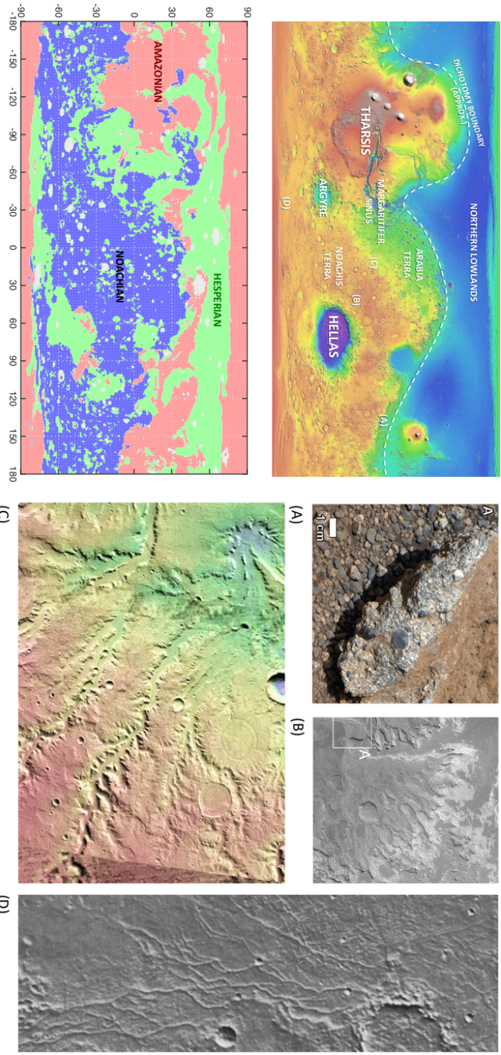
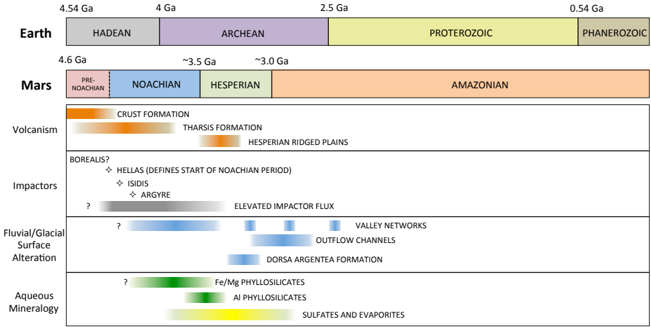
- Geologic evidence indicates liquid water modified Mars during the late Noachian and early Hesperian, but the record favors intermittent, not permanently warm, conditions; valley networks are common on Noachian terrain and rare later.
- With a solar luminosity about 75% of present at 3.8 Ga, Mars received roughly 441.1 W m⁻²; even with zero albedo the equilibrium temperature would be 210 K, implying a minimum greenhouse effect of about 65 K for marginally warm and wet conditions.
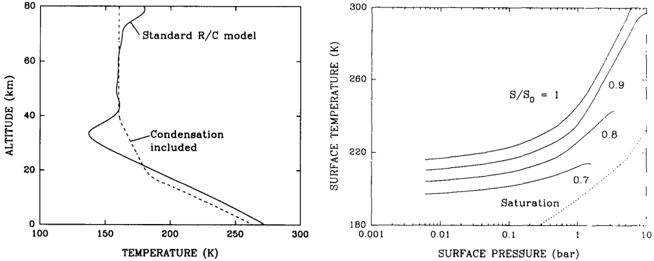
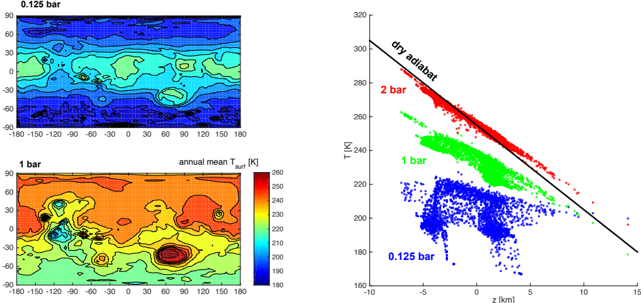
- Clear-sky CO₂–H₂O radiative-convective models give mean surface temperatures of 225 K or less, and a denser CO₂ atmosphere causes adiabatic cooling: about 30 K at 1 bar and about 40 K at 2 bar across the Hellas-to-highlands altitude range.
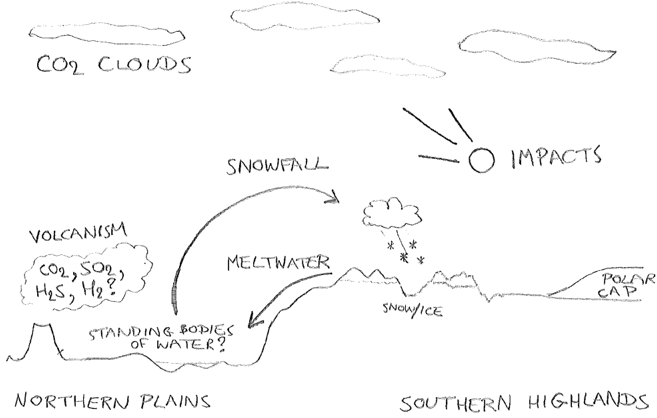
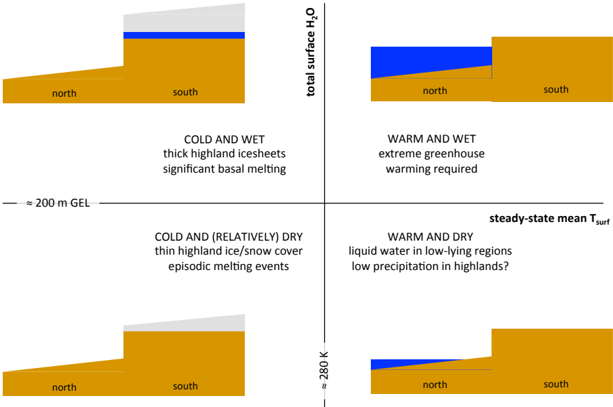
- The “icy highlands” scenario proposes that under a thicker atmosphere, snow and ice migrated to the equatorial Noachian highlands, where episodic melting carved valley networks; estimates of the late Noachian water inventory are low, including 137 m and 24 m global equivalent layer in cited studies, while a northern ocean shoreline would imply about 550 m GEL.
Methods
- Review article synthesizing orbital and in situ observations, geomorphology, geochemistry, and prior climate-modeling studies of early Mars.
- Draws on crater statistics, valley-network and crater-lake analyses, mineralogy, rover observations, atmospheric escape and outgassing estimates, and 1D radiative-convective and 3D general circulation model results.
- Main analysis is a narrative comparison of geologic evidence with climate-model constraints, including CO₂ greenhouse limits, cloud and aerosol effects, volcanic SO₂, impacts, and orbital forcing.
Limitations
- The paper states that the precise warming mechanism remains poorly constrained, atmospheric evolution is highly uncertain, and 3D cloud-forcing results disagree; no 3D simulation had yet addressed the impact of a snowy Tharsis on warm-and-wet stability.
- The paper notes that absolute dating of Martian surface units is subject to considerable uncertainty and that some atmospheric escape and carbonate-sequestration processes are poorly understood.
- As evident from the text, this is a review rather than a primary study, so its conclusions depend on published datasets and model results with their own parameterizations and uncertainties.
Model-written summary. Check it against the paper before relying on it.
Integrity signals
Registry
Cites
Statistics
Figures
Verification
Claims the paper makes
12 Valid · 12 Not valid · 84 Not checked · 108 Own results and interpretations
At least one cited source doesn’t support this claim or points to a different paper, and none confirmed it — see the verdicts below.
In the paper
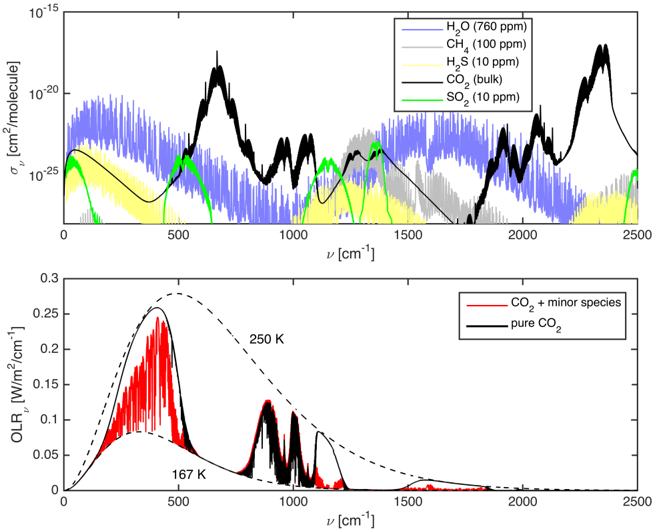
“Hence for pure clear-sky CO 2 -H 2 O atmospheres under early Martian conditions, modern radiativeconvective models obtain mean surface temperatures of 225 K or less (Wordsworth, Forget & Eymet 2010; Ramirez et al. 2014; Halevy & Head 2014).”
What the sources say
- Not checked — no full text of the sourcecites Wordsworth, Forget & Eymet 2010 matched to “Infrared collision-induced and far-line absorption in dense CO2 atmospheres” (2010) source
- Disputedcites Ramirez et al. 2014 matched to “Warming early Mars with CO2 and H2” (2014) sourceExperimental — accuracy not yet measured
In “Greenhouse warming by models that include H2,” the paper reports that its H2-free model reached up to 230 K, above the claimed ceiling of 225 K; it identifies ~225 K as a previously published result. The supplemental “Climate Model Description” reports that a revised solar calculation raised the baseline 5% N2 case to 246 K. The paper supports the broader point that CO2–H2O alone did not produce warm conditions, but not the stated temperature limit. (LLM, conf=0.88)
Checked by a reasoning model — may be wrong.
- Not checked — no full text of the sourcecites Halevy & Head 2014 matched to “Episodic warming of early Mars by punctuated volcanism” (2014) source
plainstates a cause- Asserted: passes — The authors put it forward as true.
- Checkable: passes — It can be checked against evidence.
- Load-bearing: passes — The paper’s conclusions depend on it.
- Based: passes — The paper gives a reason why it holds.
The sources with a verdict support this claim; the rest weren’t checked yet, have no full text we could read, or their verdicts aren’t rated yet.
In the paper
“One mineral, carbonate, is conspicuous by its low abundance on the Martian surface (Niles et al. 2013; Ehlmann & Edwards 2014).”
What the sources say
- Not checked — no full text of the sourcecites Niles et al. 2013 matched to “Geochemistry of Carbonates on Mars: Implications for Climate History and Nature of Aqueous Environments” (2013) source
- Supportedcites Ehlmann & Edwards 2014 matched to “Mineralogy of the Martian Surface” (2014) source
Section 4.8, “The Carbonate Puzzle,” describes a “lack of massive, widespread carbonate” and says carbonate-bearing rocks appear geographically restricted. This supports the claim that carbonate is conspicuously scarce on the Martian surface, while acknowledging localized detections. (LLM, conf=0.92)
plain- Asserted: passes — The authors put it forward as true.
- Checkable: passes — It can be checked against evidence.
- Load-bearing: passes — The paper’s conclusions depend on it.
- Based: passes — The paper gives a reason why it holds.
The cited sources support only part of this claim — read each source’s verdict below.
In the paper
“Other aqueous minerals such as sulphates, chlorides and silicas are found in more localized regions of the Noachian and Hesperian crust (Gendrin et al. 2005; Osterloo et al. 2010; Carter et al. 2013; Ehlmann & Edwards 2014).”
What the sources say
- Partly supportedcites Gendrin et al. 2005 matched to “Sulfates in Martian Layered Terrains: The OMEGA/Mars Express View” (2005) sourceExperimental — accuracy not yet measured
The paper reports sulfates in localized light-toned layered deposits dated to the Noachian and/or Hesperian (p. 2). It does not report detections of chlorides or silica: it says halite might be present but lacks a detectable spectral signature in these observations (p. 2). (LLM, conf=0.88)
- Not checked — no full text of the sourcecites Osterloo et al. 2010 matched to “Geologic context of proposed chloride‐bearing materials on Mars” (2010) source
- Not checked — no full text of the sourcecites Carter et al. 2013 matched to “Hydrous minerals on Mars as seen by the CRISM and OMEGA imaging spectrometers: Updated global view” (2013) source
plain- Asserted: passes — The authors put it forward as true.
- Checkable: passes — It can be checked against evidence.
- Load-bearing: unclear — It is unclear whether the paper’s conclusions depend on it.
- Based: passes — The paper gives a reason why it holds.
- Partly supported
The cited sources support only part of this claim — read each source’s verdict below.
In the paper
“This is important, because surface carbonate formation should be very efficient on a warm and wet planet with a basaltic crust and CO 2 -rich atmosphere (Pollack et al. 1987).”
What the sources say
- Partly supportedcites Pollack et al. 1987 matched to “The case for a wet, warm climate on early Mars” (1987) sourceExperimental — accuracy not yet measured
The passage under “The Case for a Wet, Warm Climate on Early Mars” (page unavailable) links a wet, warm, CO₂-rich early Mars to silicate weathering and carbonate rocks. It does not specify a basaltic crust or say that surface carbonate formation would be very efficient. (LLM, conf=0.78)
plainstates a cause- Asserted: passes — The authors put it forward as true.
- Checkable: passes — It can be checked against evidence.
- Load-bearing: passes — The paper’s conclusions depend on it.
- Based: passes — The paper gives a reason why it holds.
- Partly supported
The cited sources support only part of this claim — read each source’s verdict below.
In the paper
“The martian surface is sulfur-rich (Clark et al. 1976) and sulphates are abundant on Hesperian and Noachian terrain (Gendrin et al. 2005; Bibring et al. 2005; Ehlmann & Edwards 2014).”
What the sources say
- Partly supportedcites Gendrin et al. 2005 matched to “Sulfates in Martian Layered Terrains: The OMEGA/Mars Express View” (2005) sourceExperimental — accuracy not yet measured
The paper reports sulfate-rich layered deposits whose formation is dated to the Noachian and/or Hesperian epochs (p. 2). It also says that OMEGA detects sulfates in equatorial regions only in close association with light-toned layered deposits, not scattered across the surrounding terrain. Thus it supports abundance in particular deposits, but not across Hesperian and Noachian terrain generally. (LLM, conf=0.84)
- Not checked — no full text of the sourcecites Bibring et al. 2005 matched to “Mars Surface Diversity as Revealed by the OMEGA/Mars Express Observations” (2005) source
- Partly supportedcites Ehlmann & Edwards 2014 matched to “Mineralogy of the Martian Surface” (2014) sourceExperimental — accuracy not yet measured
Section 4.5 describes sulfate-bearing Hesperian sedimentary rocks and says the associated deposits are Hesperian-aged. The Summary Points say some late Noachian–early Hesperian paleolake basins contain sulfates, but do not establish that sulfates are abundant across Noachian terrain. (LLM, conf=0.86)
plain- Asserted: passes — The authors put it forward as true.
- Checkable: passes — It can be checked against evidence.
- Load-bearing: passes — The paper’s conclusions depend on it.
- Based: passes — The paper gives a reason why it holds.
- Partly supported
134 more claims · 6 with their cited sources checked
Create a free account to see all 216 claims and to verify the 40 references still open.
- It may state two separate claims as one. 48
- Probably not a substantial claim. 36
Self-check
Percentages, sums and reported differences re-computed from the paper’s own numbers.
Each contradiction between two passages listed here was confirmed by an independent check.
Rated minor: it would not touch a result — a value no result rests on, a p-value that stays on the same side of the significance level, or a conflict that is clerical, resolved elsewhere in the paper, or outside its own findings.
In the paper
§ 4.4. The periglacial paradox and the Noachian surface water inventory · p. 17
“Preliminary GCM studies using the model described in Wordsworth et al. (2015) suggest that this is indeed the case.”
§ Figure 7 · p. 25
“The warm and dry state has not yet been simulated numerically but may lead to little or no rainfall in the equatorial highlands.”
Rated minor: it would not touch a result — a value no result rests on, a p-value that stays on the same side of the significance level, or a conflict that is clerical, resolved elsewhere in the paper, or outside its own findings.
In the paper
§ 4.1. Adiabatic Cooling and the Icy Highlands Hypothesis · p. 14
“c p is the atmospheric specific heat capacity at constant pressure”
§ 4.1. Adiabatic Cooling and the Icy Highlands Hypothesis · p. 14
“with g gravity and c p the specific heat capacity at constant volume”
Citations
Cites
A Neoproterozoic Snowball Earth
Hoffman, P. F., Kaufman, A. J., Halverson, G. P., & Schrag, D. P. (1998) · Science · doi:10.1126/science.281.5381.1342 · Cited by 2,693
Habitable Zones around Main Sequence Stars
Kasting, J. F., Whitmire, D. P., & Reynolds, R. T. (1993) · Icarus · doi:10.1006/icar.1993.1010 · Cited by 2,501
A negative feedback mechanism for the long‐term stabilization of Earth's surface temperature
Walker, J. C. G., Hays, P. B., & Kasting, J. F. (1981) · Journal of Geophysical Research: Oceans · doi:10.1029/jc086ic10p09776 · Cited by 2,310
Arctic sea ice decline: Faster than forecast
Stroeve, J., Holland, M. M., Meier, W., Scambos, T., & Serreze, M. (2007) · Geophysical Research Letters · doi:10.1029/2007gl029703 · Cited by 1,857
Global Mineralogical and Aqueous Mars History Derived from OMEGA/Mars Express Data
Bibring, J.-P., Langevin, Y., Mustard, J. F., Poulet, F., Arvidson, R., Gendrin, A., Gondet, B., Mangold, N., Pinet, P., Forget, F., et al. (2006) · Science · doi:10.1126/science.1122659 · Cited by 1,667 · cited 3×
“Iron and magnesium rich phyllosilicates (clays) are found extensively over Noachian terrain (Poulet et al. 2005; Bibring et al. 2006; Mustard et al. 2008; Murchie et al. 2009; Carter et al. 2010).”
BackgroundA low mass for Mars from Jupiter’s early gas-driven migration
Walsh, K. J., Morbidelli, A., Raymond, S. N., O'Brien, D. P., & Mandell, A. M. (2011) · Nature · doi:10.1038/nature10201 · Cited by 1,241 · cited 1×
“Current thinking suggests Mars is best understood as a planetary embryo, whose development into a fully fledged terrestrial planet was arrested by some process such as instability in the configuration of the outer planets (Walsh et al. 2011).”
BackgroundLacis, A. A., & Oinas, V. (1991) · Journal of Geophysical Research: Atmospheres · doi:10.1029/90jd01945 · Cited by 1,051 · cited 1×
“Instead, recent 3D simulations have used the correlated-k method (Goody et al. 1989; Lacis & Oinas 1991).”
MethodThe origins and concentrations of water, carbon, nitrogen and noble gases on Earth
Marty, B. (2012) · Earth and Planetary Science Letters · doi:10.1016/j.epsl.2011.10.040 · Cited by 1,012
Long term evolution and chaotic diffusion of the insolation quantities of Mars
Laskar, J., Correia, A. C. M., Gastineau, M., Joutel, F., Levrard, B., & Robutel, P. (2004) · Icarus · doi:10.1016/j.icarus.2004.04.005 · Cited by 992 · cited 1×
“Mars’ orbital eccentricity and obliquity evolve chaotically on long timescales, however, and have probably varied over ranges of 0 – 0.125 and 10◦ – 60◦, respectively (Laskar et al. 2004).”
BackgroundInfluentialSulfates in Martian Layered Terrains: The OMEGA/Mars Express View
Gendrin, A., Mangold, N., Bibring, J.-P., Langevin, Y., Gondet, B., Poulet, F., Bonello, G., Quantin, C., Mustard, J., Arvidson, R., et al. (2005) · Science · doi:10.1126/science.1109087 · Cited by 986 · cited 2×
“The martian surface is sulfur-rich (Clark et al. 1976) and sulphates are abundant on Hesperian and Noachian terrain (Gendrin et al. 2005; Bibring et al. 2005; Ehlmann & Edwards 2014).”
Background
Research works printed but not linked: 4
- Ehlmann BL, 2015, Lunar Planet. Sci. Conf. Abstr., 46, 1635
- Forster P, 2007, Climate Change 2007: The Physical Science Basis. Contribution of Working Group I to the Fourth Assessment Report of the Intergovernmental Panel on Climate Change, 129
- Howard AD, 1981, Reports of Planetary Geology Program—1981, 286
- Kirschvink JL, 2002, Palaeontol. Electron., 4, 8
Cited by
Items 101–200 of 362
Rampe, E. B., Horgan, B. H. N., Smith, R. J., Scudder, N. A., Bamber, E. R., Rutledge, A. M., & Christoffersen, R. (2022) · Earth and Planetary Science Letters · doi:10.1016/j.epsl.2022.117471 · Cited by 24
Methane release on Early Mars by atmospheric collapse and atmospheric reinflation
Kite, E. S., Mischna, M. A., Gao, P., Yung, Y. L., & Turbet, M. (2020) · Planetary and Space Science · doi:10.1016/j.pss.2019.104820 · Cited by 25
“Such longevity is hard to reconcile with climate models that predict no lakes, or only short-lived lakes (Wordsworth, 2016; Hynek, 2016; Luo et al., 2017; Haberle et al., 2017; Vasavada, 2017; Kite et al., 2019; Kite, 2019).”
Tomkins, A. G., GENGE, M. J., Tait, A. W., Alkemade, S. L., Langendam, A., Perry, P. P., & Wilson, S. (2019) · Journal of Geophysical Research Planets · doi:10.1029/2019je006005 · Cited by 20
“During the late Noachian, and to a lesser extent the early Hesperian, Mars likely had a sufficiently dense atmosphere to allow water to periodically persist at the surface and precipitate as rain and/or snow (Carr & Head, 2015; Wordsworth, 2016).”
BackgroundValley Networks and the Record of Glaciation on Ancient Mars
Galofre, A. G., Whipple, K. X., Christensen, P. R., & Conway, S. J. (2022) · Geophysical Research Letters · doi:10.1029/2022gl097974 · Cited by 20
“Martian ice masses are interpreted to have been fundamentally cold-based throughout history, with little erosional action (e.g., Alley et al., 2019; Dyke, 1993; Wordsworth, 2016).”
BackgroundInfluentialReconstructing river flows remotely on Earth, Titan, and Mars
Birch, S., Parker, G., Corlies, P., Soderblom, J. M., Miller, J. W., Palermo, R. V., Lora, J. M., Ashton, A. D., Hayes, A. G., & Perron, J. T. (2023) · Proceedings of the National Academy of Sciences · doi:10.1073/pnas.2206837120 · Cited by 23
Interior Controls on the Habitability of Rocky Planets
Gillmann, C., Hakim, K., Lourenço, D. L., Quanz, S. P., & Sossi, P. A. (2024) · Space Science & Technology · doi:10.34133/space.0075 · Cited by 29
An Orbital Window into the Ancient Sun’s Mass
Spalding, C., Fischer, W. W., & Laughlin, G. (2018) · The Astrophysical Journal Letters · doi:10.3847/2041-8213/aaf219 · Cited by 19
“The favoured solution to the Faint Young Sun paradox is typically that early Earth and Mars possessed thick, greenhouse gas-rich atmospheres, in order to trap more heat than today (Sagan and Mullen 1972; Kasting et al. 1993; Charnay et al. 2013; Wordsworth 2016).”
BackgroundInfluentialCrater Mound Formation by Wind Erosion on Mars
Steele, L. J., Kite, E. S., & Michaels, T. I. (2017) · Journal of Geophysical Research Planets · doi:10.1002/2017je005459 · Cited by 19
“The timing of mound erosion (relative to atmospheric loss) is currently not well understood (Bennett and Bell, 2016), and nor is the climate at the time erosion might have occurred, as this can vary with orbital changes and atmospheric loss (e.g. Kite et al., 2014; Soto et al., 2015; Wordsworth, 2016; Ramirez, 2017).”
BackgroundTurbet, M., & Tran, H. (2017) · Journal of Geophysical Research Planets · doi:10.1002/2017je005373 · Cited by 20
“17; Wordsworth, 2016), making the formation of ancient valley networks and lakes even more difficult to explain.”
BackgroundCO 2 –CO 2 and CO 2 –Ar continua at millimeter wavelengths
Odintsova, T. A., Серов, Е. А., Balashov, A. A., Koshelev, M. A., Koroleva, A. O., Simonova, A. A., Tretyakov, M. Y., Филиппов, Н. Н., Chistikov, D. N., Finenko, A. A., et al. (2020) · Journal of Quantitative Spectroscopy and Radiative Transfer · doi:10.1016/j.jqsrt.2020.107400 · Cited by 19
Limits on Runoff Episode Duration for Early Mars: Integrating Lake Hydrology and Climate Models
de Quay, G. S., Goudge, T. A., Kite, E. S., Fassett, C. I., & Guzewich, S. D. (2021) · Geophysical Research Letters · doi:10.1029/2021gl093523 · Cited by 18
“Constraining the duration of periods for which liquid water was present on the surface of Mars has remained a fundamental challenge since evidence for ancient fluvial activity was first discovered (Carr, 1987; Kite, 2019; Wordsworth, 2016).”
BackgroundInfluentialChemical weathering over hundreds of millions of years of greenhouse conditions on Mars
Ye, B., & Michalski, J. R. (2022) · Communications Earth & Environment · doi:10.1038/s43247-022-00602-7 · Cited by 25
“Most of them have not been studied in considerable detail, and questions regarding the climatic evolution of Mars remain: (1) Are these weathering events local or global? (2) Do we see multiple events preserved in the same stratigraphy, or does each deposit record only one event? (3) What are the ages of the different…”
BackgroundMethodInfluentialJohansen, A., Ronnet, T., Schiller, M., Deng, Z., & Bizzarro, M. (2023) · Astronomy and Astrophysics · doi:10.1051/0004-6361/202142143 · Cited by 20
Cangi, E., Chaffin, M. S., Yelle, R. V., Gregory, B., & Deighan, J. (2023) · Journal of Geophysical Research Planets · doi:10.1029/2022je007713 · Cited by 21
“Plausible explanations could include periods of hydrodynamic 449 escape, a more EUV-active young sun driving greater photochemistry, extreme obliqui450 ties (Wordsworth, 2016; Laskar et al., 2004), or other as of yet unknown dynamics.”
BackgroundGravity‐Driven Differences in Fluvial Sediment Transport on Mars and Earth
Braat, L., Brückner, M., Sefton‐Nash, E., & Lamb, M. P. (2024) · Journal of Geophysical Research Planets · doi:10.1029/2023je007788 · Cited by 20
“Mars used to be more accommodating for fluid water in the Noachian and Early Hesperian, but most likely it has always been cold (Fairén, 2010; Wordsworth, 2016).”
BackgroundThe Hydrology of Mars Including a Potential Cryosphere
Lasue, J., Clifford, S. M., Conway, S. J., Mangold, N., & Butcher, F. (2018) · Elsevier eBooks · doi:10.1016/b978-0-12-804191-8.00007-6 · Cited by 27
Cassanelli, J. P., & Head, J. W., III (2018) · Icarus · doi:10.1016/j.icarus.2018.01.001 · Cited by 17
Mars as a time machine to Precambrian Earth
Lapôtre, M. G. A., Bishop, J. L., Ielpi, A., Lowe, D. R., Siebach, K. L., Sleep, N. H., & Tikoo-Schantz, S. M. (2022) · Journal of the Geological Society · doi:10.1144/jgs2022-047 · Cited by 24
“For a state-of-the-art overview ofMars’ climate history, we refer the reader to the review of Wordsworth (2016).”
BackgroundThomas, T. B., Hu, R., & Lo, D. (2023) · The Planetary Science Journal · doi:10.3847/psj/acb924 · Cited by 23
“A thicker ancient atmosphere with various additional components has been proposed to explain this evidence, but the size, composition, and warming mechanism remain unknown empirically (e.g., Wordsworth 2016).”
BackgroundHeng, K., & Kitzmann, D. (2017) · The Astrophysical Journal Supplement Series · doi:10.3847/1538-4365/aa8907 · Cited by 17
“A longstanding result, based on geomorphic evidence, that early Mars was able to harbor liquid water on its surface (see Wordsworth 2016 for a review), due to the scattering greenhouse effect (e.g., Pierrehumbert 2010; Heng et al. 2012) mediated by carbon-dioxide ice clouds (Forget & Pierrehumbert…”
BackgroundOcean Worlds in the Outer Regions of the Solar System (Review)
Shematovich, V. I. (2018) · Solar System Research · doi:10.1134/s0038094618050076 · Cited by 20
Liu, W., Li, J., Gu, W., Santos, L., Boman, J., Zhang, X., Tang, M., Wang, S., & Kong, X. (2021) · ACS Earth and Space Chemistry · doi:10.1021/acsearthspacechem.0c00339 · Cited by 18
Rubin, D. M., Lapôtre, M. G. A., Stevens, A. W., Lamb, M. P., Fedo, C. M., Grotzinger, J. P., Gupta, S., Stack, K. M., Vasavada, A. R., Banham, S. G., et al. (2022) · Journal of Geophysical Research Planets · doi:10.1029/2021je007162 · Cited by 21
“Some studies suggest that the 709 transition from an early, warm, dense, wet atmosphere occurred with episodic fluctuations rather 710 than monotonic change (Wordsworth, 2016).”
BackgroundFormation Mechanisms of the Molecular Ion Polar Plume and Its Contribution to Ion Escape From Mars
Sakakura, K., Seki, K., Sakai, S., Sakata, R., Shinagawa, H., Brain, D. A., McFadden, J. P., Halekas, J. S., DiBraccio, G. A., JAKOSKY, B. M., et al. (2022) · Journal of Geophysical Research Space Physics · doi:10.1029/2021ja029750 · Cited by 16
“However, geological evidence has suggested that Mars once had liquid water on its surface approximately 4 billion years ago (e.g., Jakosky & Phillips, 2001; Wordsworth, 2016).”
BackgroundEpisodic warm climates on early Mars primed by crustal hydration
Adams, D., Scheucher, M., Hu, R., Ehlmann, B. L., Thomas, T. B., Wordsworth, R., Scheller, E. L., Lillis, R. J., Smith, K., Rauer, H., et al. (2025) · Nature Geoscience · doi:10.1038/s41561-024-01626-8 · Cited by 25
Self-citationDaswani, M. M., & Kite, E. S. (2017) · Journal of Geophysical Research Planets · doi:10.1002/2017je005319 · Cited by 19
“Taken together, our results are consistent with Mars having a usually cold [Wordsworth, 2016], horizontally segregated hydrosphere [Gaidos and Marion, 2003; Head, 2012] by the time chlorides formed.”
ResultEffect of Mars Atmospheric Loss on Snow Melt Potential in a 3.5 Gyr Mars Climate Evolution Model
Mansfield, M., Kite, E. S., & Mischna, M. A. (2018) · Journal of Geophysical Research Planets · doi:10.1002/2017je005422 · Cited by 17
“Additionally, it is possible that at high pressures, water ice will be located near the equator for all obliquities (Wordsworth, 2016).”
BackgroundCassanelli, J. P., & Head, J. W., III (2018) · Icarus · doi:10.1016/j.icarus.2018.11.020 · Cited by 15
“These low meltwater temperatures (< ∼ 3°C) are consistent with a cold and icy early Mars environment (Forget et al., 2013; Wordsworth et al., 2013, 2015; Wordsworth, 2016; Palumbo et al., 2018) and could have been established by: (1) an origin as cool melt derived from surface snow and ice deposits with further heat l…”
BackgroundMethodInfluentialKranendonk, M. J. V., Djokic, T., Baumgartner, R. J., Bontognali, T. R. R., Sugitani, K., Kiyokawa, S., & Walter, M. R. (2021) · Elsevier eBooks · doi:10.1016/b978-0-12-820245-6.00013-6 · Cited by 19
Ranjan, S., Wordsworth, R., & Sasselov, D. D. (2017) · Astrobiology · doi:10.1089/ast.2016.1596 · Cited by 19
“…era due to the following: (1) evidence for at least transient liquid water on Mars around this time (Bristow et al., 2015; Grotzinger et al., 2015; Wordsworth, 2016); (2) this post-dates the potentially sterilizing Late Heavy Bombardment (Maher and Stevenson, 1988; Sleep et al., 1989); and (3)…”
InfluentialSelf-citationWordsworth, R., Ehlmann, B. L., Forget, F., Haberle, R. M., Head, J. W., III, & Kerber, L. (2018) · Nature Geoscience · doi:10.1038/s41561-018-0267-5 · Cited by 17
Self-citationMegevand, V., Viennet, J., Balan, E., Gauthier, M., Rosier, P., Morand, M., Garino, Y., Guillaumet, M., du Pont, S. C., Beyssac, O., et al. (2021) · Astrobiology · doi:10.1089/ast.2020.2340 · Cited by 20
H 2 O 2 -induced Greenhouse Warming on Oxidized Early Mars
Itō, Y., Hashimoto, G. L., Takahashi, Y. O., Ishiwatari, M., & Kuramoto, K. (2020) · The Astrophysical Journal · doi:10.3847/1538-4357/ab7db4 · Cited by 14
“When the atmosphere consists of H2O and CO2 (cyan), there are atmospheric windows at wavenumbers below 500cm−1 and around 1000cm−1, which are consistent with the results of previous climate models (e.g., Wordsworth 2016; Ramirez 2017).”
BackgroundResultInfluentialKoyama, S., Terada, N., Nakagawa, H., Kuroda, T., & Sekine, Y. (2021) · The Astrophysical Journal · doi:10.3847/1538-4357/abf0ac · Cited by 16
“Geological evidence, such as valley networks on the Martian surface and isotopic records in Martian meteorites, suggests that early Mars had a denser atmosphere than present-day Mars (Wordsworth 2016; Kurokawa et al. 2018).”
BackgroundViennet, J., Bultel, B., & Werner, S. C. (2019) · Chemical Geology · doi:10.1016/j.chemgeo.2019.07.009 · Cited by 14
“Yet, such atmosphere 104 is more favorable to sustain liquid water on the surface of Mars (Wordsworth, 2016).”
BackgroundNoachian climatic conditions on Mars inferred from valley network junction angles
Cang, X., & Luo, W. (2019) · Earth and Planetary Science Letters · doi:10.1016/j.epsl.2019.115768 · Cited by 15
“…debating on whether episodic warmth or non-precipitation dominated erosion can create the observed valley networks and trying to reconcile the geochemical and physical understanding of Mars with the geologic evidence of its watery past (Baker et al., 2015; Ehlmann et al., 2011; Wordsworth, 2016).”
BackgroundRelative Abundances of CO 2 , CO, and CH 4 in Atmospheres of Earth-like Lifeless Planets
Watanabe, Y., & Ozaki, K. (2024) · The Astrophysical Journal · doi:10.3847/1538-4357/ad10a2 · Cited by 17
“The climate of early Mars has been a subject of active discussion ( Pollack et al. 1987; Kasting 1991; Forget et al. 2013; Wordsworth 2016; Wordsworth et al. 2017; Ramirez & Craddock 2018; Kamada et al. 2020 ) .”
BackgroundHypothesis of an ancient northern ocean on Mars and insights from the Zhurong rover
Wang, L., & Huang, J. (2024) · Nature Astronomy · doi:10.1038/s41550-024-02343-3 · Cited by 18
“The climate of early Mars (during early Noachian and late Hesperian, ~4–3 Ga) has been debated for decades 68 .”
In a PICL: The sedimentary deposits and facies of perennially ice‐covered lakes
Rivera‐Hernández, F., Sumner, D. Y., Mackey, T., Hawes, I., & Andersen, D. T. (2018) · Sedimentology · doi:10.1111/sed.12522 · Cited by 17
“The recognition of PICL deposits in the Martian sedimentary record would provide specific information about the climate transition from a possibly warm–wet Mars to the current cold–dry conditions (e.g. Wordsworth, 2016, and references therein).”
BackgroundSalvatore, M. R., & Levy, J. S. (2021) · Elsevier eBooks · doi:10.1016/b978-0-12-820245-6.00011-2 · Cited by 23
Bernhardt, H., Reiss, D., Ivanov, M. A., Hauber, E., Hiesinger, H., Clark, J. D., & Orosei, R. (2018) · Icarus · doi:10.1016/j.icarus.2018.11.007 · Cited by 13
Palumbo, A. M., & Head, J. W., III (2019) · Icarus · doi:10.1016/j.icarus.2019.04.022 · Cited by 17
“…networks (Hynek et al., 2010) and open- and closed-basin lakes (Cabrol and Grin, 1999; Fassett and Head, 2008; Goudge et al., 2015), would have been formed through punctuated heating events and associated ice melting and surface runoff (Head et al., 2017a; Head et al., 2017b; Wordsworth, 2016).”
BackgroundSueoka, Y., Yamashita, S., Kouduka, M., & Suzuki, Y. (2019) · Frontiers in Microbiology · doi:10.3389/fmicb.2019.02793 · Cited by 16
“Unlike on Earth, the organic and inorganic products of ancient basalt-water interactions are known to be preserved under freeze-drying conditions without being altered by tectonic forces (Wordsworth, 2016).”
BackgroundRaguso, M. C., Mastrogiuseppe, M., Gambacorta, L., Achille, G. D., & Seu, R. (2023) · Icarus · doi:10.1016/j.icarus.2023.115803 · Cited by 12
Koyama, S., Kamada, A., Furukawa, Y., Terada, N., Nakamura, Y., Yoshida, T., Kuroda, T., & Vandaele, A. C. (2024) · Scientific Reports · doi:10.1038/s41598-024-52718-9 · Cited by 20
Lezcano, M. Á., Bornemann, T. L. V., Sánchez‐García, L., Carrizo, D., Adam, P. S., Esser, S. P., Cabrol, N. A., Probst, A. J., & Parro, V. (2024) · Microbiome · doi:10.1186/s40168-024-01878-x · Cited by 17
“, Jezero crater) [14], which have been suggested as potentially habitable before they underwent rapid evaporation due to a climate change ~3 Ga ago [20].”
BackgroundDissolution of nontronite in chloride brines and implications for the aqueous history of Mars
Steiner, M. H., Hausrath, E. M., Madden, M. E. E., Tschauner, O., Ehlmann, B. L., Olsen, A. A., Gainey, S. R., & Smith, J. S. (2016) · Geochimica et Cosmochimica Acta · doi:10.1016/j.gca.2016.08.035 · Cited by 15
Climates of Warm Earth-like Planets. III. Fractional Habitability from a Water Cycle Perspective
Genio, A. D. D., Way, M. J., Kiang, N. Y.-L., Aleinov, I., Puma, M. J., & Cook, B. I. (2019) · The Astrophysical Journal · doi:10.3847/1538-4357/ab57fd · Cited by 15
“…enough temperatures to sustain a primordial northern ocean and widespread habitability for an extended period of time (e.g., Rodriguez et al. 2015; Villanueva et al. 2015) or only episodic, localized clement conditions and liquid water (e.g., Wordsworth 2016; Kite et al. 2017) is still unclear.”
BackgroundA probabilistic case for a large missing carbon sink on Mars after 3.5 billion years ago
Heard, A. W., & Kite, E. S. (2019) · Earth and Planetary Science Letters · doi:10.1016/j.epsl.2019.116001 · Cited by 14
“25 bar CO2 atmospheres required sustained warm climates (Haberle et al., 2017; Kite, 2019; Mansfield et al., 2018; Ramirez et al., 2014; Urata and Toon, 2013; Wordsworth, 2016), greatly exceed the current exchangeable in-”
BackgroundA small S-MIF signal in Martian regolith pyrite: Implications for the atmosphere
Tomkins, A. G., Alkemade, S. L., Nutku, S. E., Stephen, N. R., Finch, M. A., & Jeon, H. (2020) · Geochimica et Cosmochimica Acta · doi:10.1016/j.gca.2020.07.022 · Cited by 13
“…during the late Noachian, the 63 Hesperian and into the early Amazonian (~4.0 – 2.8 Ga), Mars was likely warm with a 64 thicker atmosphere, rivers, lakes and glaciers, a groundwater system, and possibly a northern 65 ocean (cf. Hynek, 2016; Wordsworth, 2016; Kite, 2019; Lasue et al., 2019).”
BackgroundInfluentialIncision of Ma’adim Vallis (Mars) by dry volcanic megafloods effused from multiple highland sources
Leverington, D. W. (2020) · Planetary and Space Science · doi:10.1016/j.pss.2020.105021 · Cited by 13
“Dry origins for Martian highland channel networks are arguably further supported by recent difficulties in determining realistic driving mechanisms for the warming events and high atmospheric pressures required for aqueous development of channels by precipitation (Wordsworth, 2016).”
BackgroundZhang, M., Zhao, J., Xiao, L., Xu, Y., Bugiolacchi, R., & Wang, J. (2023) · Icarus · doi:10.1016/j.icarus.2023.115470 · Cited by 12
Bruschini, E., Ferrari, M., Mazzoni, C., Fazi, S., Chiocci, F. L., Mazzini, I., Costanzo, G., Angelis, S. D., Sanctis, M. C. D., Altieri, F., et al. (2024) · Planetary and Space Science · doi:10.1016/j.pss.2024.105893 · Cited by 12
Effects of surface and subsurface water/ice on spatial distributions of impact crater ejecta on Mars
Sokołowska, A. J., Thomas, N., & Wünnemann, K. (2024) · Icarus · doi:10.1016/j.icarus.2024.116150 · Cited by 12
What we can learn about Mars from the magnetism of returned samples
Weiss, B. P., Mansbach, E. N., Maurel, C., Sprain, C. J., Swanson‐Hysell, N. L., & Williams, W. (2025) · Proceedings of the National Academy of Sciences · doi:10.1073/pnas.2404259121 · Cited by 12
“For single-domain magnetite particles, 𝐻 " is dominated by crystalline anisotropy, which is calculated through single domain theory to be about 20 mT for randomly oriented particles (14).”
InfluentialSeismic evidence of liquid water at the base of Mars’ upper crust
Sun, W., Tkalčić, ., Malusa', M. G., & Pan, Y. (2025) · National Science Review · doi:10.1093/nsr/nwaf166 · Cited by 12
“However, as Mars transitioned to a colder and drier climate during the Amazonian period [2 ], the presence of liquid water significantly diminished.”
Nakagawa, M., Uchiyama, Y., Yamada, T., et al. (2021) · IEEE Transactions on Terahertz Science and Technology · doi:10.1109/tthz.2021.3095436 · Cited by 11
How did Mars lose its atmosphere and water?
JAKOSKY, B. M. (2022) · Physics Today · doi:10.1063/pt.3.4988 · Cited by 11
Accumulation of windblown sand in impact craters on Mars
Gunn, A., Rubanenko, L., & Lapôtre, M. G. A. (2022) · Geology · doi:10.1130/g49936.1 · Cited by 13
Revisiting subglacial hydrology as an origin for Mars' valley networks
Buffo, J., Ojha, L., Meyer, C., Ferrier, K. L., & Palucis, M. C. (2022) · Earth and Planetary Science Letters · doi:10.1016/j.epsl.2022.117699 · Cited by 10
Kim, D. W. (2022) · Aerospace · doi:10.3390/aerospace9120814 · Cited by 13
Constraints on the nature of the effusive volcanic eruptions that incised Ravi Vallis, Mars
Leverington, D. W. (2019) · Planetary and Space Science · doi:10.1016/j.pss.2019.01.002 · Cited by 13
Similarities and differences in the landing sites of ESA’s and NASA’s 2020 Mars rovers
Lakdawalla, E. (2019) · Nature Astronomy · doi:10.1038/s41550-019-0727-x · Cited by 11
Indexing of exoplanets in search for potential habitability: application to Mars-like worlds
Jagadeesh, M. K., Gudennavar, S. B., Doshi, U., & Safonova, M. (2017) · Astrophysics and Space Science · doi:10.1007/s10509-017-3131-y · Cited by 12
“For example, Earth at Mars distance would most probably still be habitable (Wordsworth 2016).”
BackgroundTerragni, J., Gordon, I. E., Adkins, E. M., Boulet, C., Campargue, A., Chistikov, D. N., Finenko, A. A., Finkenzeller, H., Fleurbaey, H., Hargreaves, R. J., et al. (2025) · Journal of Quantitative Spectroscopy and Radiative Transfer · doi:10.1016/j.jqsrt.2025.109631 · Cited by 18
Fernández-Martínez, M. Á., García‐Villadangos, M., Moreno‐Paz, M., Gangloff, V., Carrizo, D., Blanco, Y., González, S., Sánchez‐García, L., Prieto‐Ballesteros, O., Altshuler, I., et al. (2021) · Frontiers in Microbiology · doi:10.3389/fmicb.2021.670982 · Cited by 14
“…the climate model or what specific local circumstances allowed that liquid state – even at temperatures below 0°C – is not a consensus (Fairén, 2010; Wordsworth, 2016; Ramirez, 2017), the presence of liquid water points undoubtedly to the moment when life would have had the highest chance to…”
BackgroundRucker, H. R., Ely, T., LaRowe, D. E., Giovannelli, D., & Price, R. E. (2023) · Astrobiology · doi:10.1089/ast.2022.0064 · Cited by 12
Jaumann, R., Tirsch, D., Adeli, S., Bahia, R. S., Michael, G., Deit, L. L., Galofre, A. G., Head, J. W., III, Bohacek, E., Gross, C., et al. (2024) · Space Science Reviews · doi:10.1007/s11214-024-01076-z · Cited by 12
Intracrater Sediment Trapping and Transport in Arabia Terra, Mars
Dorn, T., & Day, M. (2020) · Journal of Geophysical Research Planets · doi:10.1029/2020je006581 · Cited by 10
Geology and history of the Malea Planum region: A new view of Mars’ oldest large volcanic province
Bernhardt, H., & Williams, D. A. (2021) · Icarus · doi:10.1016/j.icarus.2021.114518 · Cited by 11
Constraining the formation of paleolake inlet valleys across crater rims
Bamber, E. R., Goudge, T. A., Fassett, C. I., & Osinski, G. R. (2022) · Icarus · doi:10.1016/j.icarus.2022.114945 · Cited by 11
Numerical Analysis of Putative Rock Glaciers on Mount Sharp, Gale Crater, Mars
Williams, J. M., Scuderi, L. A., & NEWSOM, H. E. (2022) · Remote Sensing · doi:10.3390/rs14081887 · Cited by 12
Evolution of ice sheets on early Mars with subglacial river systems
Kamada, A., Kuroda, T., Kodama, T., Kasaba, Y., & Terada, N. (2022) · Icarus · doi:10.1016/j.icarus.2022.115117 · Cited by 12
Extreme Niche Partitioning and Microbial Dark Matter in a Mauna Loa Lava Tube
Fishman, C. B., Bevilacqua, J. G., Hahn, A. S., Morgan‐Lang, C., Wagner, N. Y., Gadson, O., McAdam, A. C., Bleacher, J. E., Achilles, C. N., Knudson, C. A., et al. (2023) · Journal of Geophysical Research Planets · doi:10.1029/2022je007283 · Cited by 13
“…through Hesperian epochs (∼3.7 billion years ago), and during this period, Mars also maintained a dense atmosphere and temperatures high enough to host oceans on the planet's surface (Baker et al., 1991; Carr & Head, 2010; Carter et al., 2015; Jakosky et al., 2017; Wordsworth, 2016; Zuber, 2001).”
BackgroundInfluentialMartian fan deposits: Insights on depositional processes and origin from mass balance survey
Vaz, D. A., Achille, G. D., Hynek, B. M., Nelson, W., & Williams, R. M. E. (2020) · Earth and Planetary Science Letters · doi:10.1016/j.epsl.2019.116049 · Cited by 9
Zaki, A. S., Davis, J. M., Edgett, K. S., Giegengack, R. F., Roigé, M., Conway, S. J., Schuster, M., Gupta, S., Salese, F., Sangwan, K. S., et al. (2022) · Journal of Geophysical Research Planets · doi:10.1029/2021je007087 · Cited by 10
“This warming epoch might have triggered both ice melting and hydrological cycle activation, forming valley networks, paleolakes, and fan-shaped deposits (e.g., Di Achille & Hynek, 2010; Goudge et al., 2012, 2018; Gulick, 2001; Kite, 2018; Mangold et al., 2004; Wordsworth, 2016).”
BackgroundTran, H., Auwera, J. V., Bertin, T., Fakhardji, W., Pirali, O., & Hartmann, J. (2022) · Icarus · doi:10.1016/j.icarus.2022.115093 · Cited by 12
Sakata, R., Seki, K., Sakai, S., Terada, N., Shinagawa, H., & Tanaka, T. (2022) · Journal of Geophysical Research Space Physics · doi:10.1029/2022ja030427 · Cited by 10
“It is thought that Mars had a warm and aqueous environment and experienced a drastic climate change during its early period (Kite, 2019; Wordsworth, 2016).”
BackgroundMoist Convection Is Most Vigorous at Intermediate Atmospheric Humidity
Seeley, J. T., & Wordsworth, R. (2023) · The Planetary Science Journal · doi:10.3847/psj/acb0cb · Cited by 13
“…a condensible substance — factors into the past and present evolution of the majority of solar system atmospheres, including Venus (Kasting 1988), Mars (Wordsworth 2016; Yamashita et al. 2016), Jupiter (Gierasch et al. 2000), Saturn (Li & Ingersoll 2015), the ice giants (Hueso et al. 2020), and…”
BackgroundSelf-citationGlobal Spatial Distribution of Hack's Law Exponent on Mars Consistent With Early Arid Climate
Luo, W., Luo, W., Howard, A. D., Craddock, R. A., Oliveira, E. A., & Pires, R. S. (2023) · Geophysical Research Letters · doi:10.1029/2022gl102604 · Cited by 10
“For example, it may have been that the early climate of Mars was only episodically warm and wet created by brief and strong volcanic activity and associated outgassing of greenhouse gasses and aerosols (Halevy & Head, 2014); or that VNs were formed by groundwater sapping associated with magma intrusion and hydrotherma…”
BackgroundSeasonal Thaws under Mid- to Low-pressure Atmospheres on Early Mars
Simonetti, P., Vladilo, G., Ivanovski, S. L., Silva, L., Biasiotti, L., MARIS, M., Murante, G., Bisesi, E., & Monai, S. (2023) · The Astrophysical Journal · doi:10.3847/1538-4357/acffba · Cited by 10
“On the other hand, the ability to support a large, open ocean under the FYS conditions is central in the debate between supporters of a warm-and-wet and a cold-and-icy Early Mars (see e.g. Wordsworth 2016).”
BackgroundInfluentialWood, S. R., Mussack, K., & Guzik, J. A. (2018) · Solar Physics · doi:10.1007/s11207-018-1334-1 · Cited by 10
“os Alamos National Laboratory, XTD-NTA, MS T-082, Los Alamos, NM 87545 USA SOLA: 20180702-PlanetConstraint.tex; 12 July 2018; 0:40; p. 1 Wood, Mussack, & Guzik et al., 2017; Bristow et al., 2017; Wordsworth, 2016), carbon cycle (Charnay etal., 2017), coronal mass ejections (Airapetian etal., 2016), more massive ea…”
BackgroundPerformance-driven design methodology for habitation shell design in extreme conditions on Mars
Dede, G. (2021) · Frontiers of Architectural Research · doi:10.1016/j.foar.2021.10.005 · Cited by 9
Barbieri, R., & Cavalazzi, B. (2018) · Astrobiology · doi:10.1089/ast.2017.1646 · Cited by 11
“…conditions that is among those hypothesized on Mars during the Noa-chian/Hesperian transition, a period in which the climate and hydrological cycle may have allowed fluvial–lacustrine conditions with plausible possibilities of being habitable ( e.g. , Grotzinger et al. , 2014; Wordsworth, 2016).”
Harris, C. M., Maclay, M. T., Lutz, K. A., Nathan, V., Dominguez, N. A. O., Leavitt, W. D., & Palucis, M. C. (2022) · Frontiers in Astronomy and Space Sciences · doi:10.3389/fspas.2022.849078 · Cited by 8
“…“warm and wet” (e.g. Ramirez and Craddock, 2018); “cold and wet” (Fairén, 2010), “icy/snowball with transient warming” (e.g., Wordsworth et al., 2013; Wordsworth, 2016), or semiarid to hyperarid (e.g., Horvath and Andrews-Hanna, 2017, 2021)] proposed for Late Noachian to Early Hesperian Mars.”
BackgroundInfluentialRaman analyses of Al and Fe/Mg‐rich clays: Challenges and possibilities for planetary missions
Demaret, L., Lerman, H. N., McHugh, M., Hutchinson, I. B., Fagel, N., Eppe, G., & Malherbe, C. (2023) · Journal of Raman Spectroscopy · doi:10.1002/jrs.6568 · Cited by 11
Hydrogen Reservoirs in Mars as Revealed by Martian Meteorites
Usui, T. (2018) · Elsevier eBooks · doi:10.1016/b978-0-12-804191-8.00004-0 · Cited by 11
Groundwater Flow to Gale Crater in an Episodically Warm Climate
Baum, M., & Wordsworth, R. (2020) · Journal of Geophysical Research Planets · doi:10.1029/2020je006397 · Cited by 8
“It has implications for the search for our understanding of the origins of life and planetary climate evolution (Haberle et al., 2017; Wordsworth, 2016).”
BackgroundInfluentialSelf-citationYin, A., Moon, S., & Day, M. (2021) · Icarus · doi:10.1016/j.icarus.2021.114332 · Cited by 9
“Even if glaciation did occur in the southern highlands, its inferred age at or prior to ~3.8 Ga (see Wordsworth, 2016 for a review) appears to be >300 Ma older than the glaciation event dated in our study area when all dating uncertainties are neglected.”
BackgroundInfluentialQuantifying the classification of exoplanets: in search for the right habitability metric
Safonova, M., Mathur, A., Basak, S., Bora, K., & Agrawal, S. (2021) · The European Physical Journal Special Topics · doi:10.1140/epjs/s11734-021-00211-z · Cited by 12
Meandering River Evolution in an Unvegetated Permafrost Environment
Levy, J. S., & Cvijanovich, B. (2023) · Geomorphology · doi:10.1016/j.geomorph.2023.108705 · Cited by 10
Deposits from giant floods in Gale crater and their implications for the climate of early Mars
Heydari, E., Schroeder, J. F., Calef, F. J., Beek, J. K. V., Rowland, S. K., Parker, T. J., & Fairén, A. G. (2020) · Scientific Reports · doi:10.1038/s41598-020-75665-7 · Cited by 11
Favaro, E. A., Balme, M. R., McNeil, J. D., Fawdon, P., Davis, J. M., Grindrod, P. M., & Lewis, S. R., Jr. (2023) · Earth and Planetary Science Letters · doi:10.1016/j.epsl.2023.118522 · Cited by 8
“…is likely that surface wind shear stress and sediment flux potential would have been greater in the past too, allowing large fields of aeolian bedforms to accumulate and disperse on (geologically) short timescales as climate varied (e.g, Halevy and Head, 2014; Wordsworth, 2016; Kite et al., 2017).”
Glacial sculpting of a martian cratered landscape on the northeastern flank of the Hellas basin
Galofre, A. G., Howard, A. D., Morgan, A. M., Wilson, S. A., & Moore, J. M. (2024) · Icarus · doi:10.1016/j.icarus.2024.116211 · Cited by 8
Paleolake Inlet Valley Formation: Factors Controlling Which Craters Breached on Early Mars
Bamber, E. R., Goudge, T. A., Fassett, C. I., Osinski, G. R., & de Quay, G. S. (2022) · Geophysical Research Letters · doi:10.1029/2022gl101097 · Cited by 8
“, rainfall, snowmelt, subglacial drainage, groundwater) remains debated (e.g., Boatwright & Head, 2021; Goldspiel & Squyres, 2000; Ramirez & Craddock, 2018; Wordsworth, 2016), but VN activity at regional-to-global scales ceased by the late Noachian-early Hesperian (∼3.”
BackgroundInfluentialImpact induced H2-rich climates on early Mars explored with a global climate model
Steakley, K., Kahre, M. A., Haberle, R. M., & Zahnle, K. J. (2022) · Icarus · doi:10.1016/j.icarus.2022.115401 · Cited by 9
Mello, F. D. S., & Friaça, A. C. S. (2023) · International Journal of Astrobiology · doi:10.1017/s1473550423000083 · Cited by 8
Life on Mars: Independent Genesis or Common Ancestor?
Dávila, A. F. (2021) · Astrobiology · doi:10.1089/ast.2020.2397 · Cited by 10
“Mars had a global magnetic field until * 3.9 Gyr ago (Acuna et al. , 1998) and a relatively thick atmosphere at least as far back as * 3.5 Gyr (Wordsworth, 2016).”
InfluentialEvidence of an oceanic impact and megatsunami sedimentation in Chryse Planitia, Mars
Rodriguez, J. A. P., Robertson, D. K., Kargel, J. S., Baker, V. R., Berman, D. C., Cohen, J., Costard, F., Komatsu, G., Lopez, A., Miyamoto, H., et al. (2022) · Scientific Reports · doi:10.1038/s41598-022-18082-2 · Cited by 8
Topography and mineralogy of clay deposits signify an epoch of warm and humid climate on early Mars
Klidaras, A., Navarre, R., Horgan, B. H. N., Farrand, W. H., Broz, A., Goudge, T. A., & Moore, R. (2025) · Geology · doi:10.1130/g52988.1 · Cited by 7
Metadata
- Authors
- Wordsworth, R. D.
- Affiliations
- Harvard University (US)
- Corresponding author
- Wordsworth, Robin D.
- ORCID
- Wordsworth, Robin D.
- Venue
- Annual Review of Earth and Planetary Sciences
- Publisher
- Annual Reviews
- Published
- 2016-06-29
- Volume
- 44
- Issue
- 1
- Pages
- 381-408
- ISSN
- 0084-6597 (ISSN-L)
- 1545-4495
- OpenAlex
- W2416138856
- Semantic Scholar
- 48a5c4e76dba61eb30e729b507d8cf6b8b4e3611
- Cited by
- 416
- References
- 153
- Citations by year
- 2026: 43 · 2025: 43 · 2024: 41 · 2023: 45 · 2022: 44 · 2021: 53 · 2020: 41 · 2019: 38 · 2018: 41 · 2017: 19 · 2016: 7
- FWCI
- 2.62
- Type
- journal article
- Language
- en
- Open access
- bronze
- doi.org
- Locations
- Annual Review of Earth and Planetary Sciences (publishedVersion)
- arXiv (Cornell University) (publishedVersion)
- Digital Access to Scholarship at Harvard (DASH) (Harvard University) (submittedVersion, cc-by)
- arXiv (Cornell University)
- Topics
- Physical Sciences › Earth and Planetary Sciences › Space and Planetary Science › Planetary Science and Exploration
- Physical Sciences › Earth and Planetary Sciences › Space and Planetary Science › Astro and Planetary Science
- Physical Sciences › Earth and Planetary Sciences › Atmospheric Science › Geology and Paleoclimatology Research
- Keywords
- early Mars climate, global warming, adiabatic cooling, valley networks, fluvial erosion, impact heating, orbital forcing, Late Noachian, Early Hesperian, glaciation, habitability, microorganisms, climate modeling
About these checks
Registry, retraction, Cites and statistics results are computed, not judged, with one exception: a printed reference that no index lists is read once by a model before it counts as a citation error. Claims are extracted by a model and kept only when their quote appears verbatim in the text; each cited source is then checked, with a model’s help, for whether it says what the claim relies on. Those verdicts can be wrong — read the claim’s quote and the cited source before relying on one.
The claim verdicts this report counts are experimental: their accuracy is not yet measured.
A language model drew the claims from the paper on 2026-10-10, under version 3 of the claim definition (model deepseek-v4.1-flash, prompt extract-v3).
A second model labelled each claim on 2026-10-10 (model jev-1.13-20260917, definition revision gold-guideline-v0.2).
Cited sources are checked with a language model’s help (gpt-6-sol).
Statistics and arithmetic are recomputed, not judged.
Confidence bands are shown only for fields calibrated on our annotated test set. None is calibrated yet, so no band is shown.
What counts as a claim ›How we measure confidence ›How we check this ›
Are you an author, or do you see a problem with this page? Request a review
Data sources
Bibliographic data: Semantic Scholar, OpenAlex, Crossref.
Contains information from the Semantic Scholar Academic Graph Datasets, made available under the ODC Attribution License (ODC-BY 1.0).
Semantic Scholar’s data is described in: Kinney, R., et al. (2023). The Semantic Scholar Open Data Platform. arXiv:2301.10140.
