

The Climate of Early Mars
Open accessThe DOI matches its Crossref record; 158 of the 158 references it cites were found in a registry or an index; 15 of the 147 sources its claims cite were checked for support.
Abstract
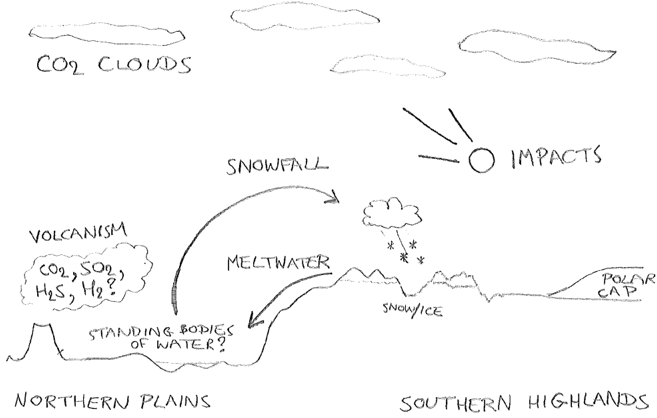
The nature of the early martian climate is one of the major unanswered questions of planetary science. Key challenges remain, but a new wave of orbital and in situ observations and improvements in climate modeling have led to significant advances over the past decade. Multiple lines of geologic evidence now point to an episodically warm surface during the late Noachian and early Hesperian periods 3–4 Ga. The low solar flux received by Mars in its first billion years and inefficiency of plausible greenhouse gases such as CO2mean that the steady-state early martian climate was likely cold. A denser CO2atmosphere would have caused adiabatic cooling of the surface and hence migration of water ice to the higher-altitude equatorial and southern regions of the planet. Transient warming caused melting of snow and ice deposits and a temporarily active hydrological cycle, leading to erosion of the valley networks and other fluvial features. Precise details of the warming mechanisms remain unclear, but impacts, volcanism, and orbital forcing all likely played an important role. The lack of evidence for glaciation across much of Mars's ancient terrain suggests the late Noachian surface water inventory was not sufficient to sustain a northern ocean. Though mainly inhospitable on the surface, early Mars may nonetheless have presented significant opportunities for the development of microbial life.
Overview
CoChat Summary
TL;DR
This review argues that early Mars was likely mainly cold, with a denser CO₂ atmosphere and episodic warming events, rather than a long-lived warm and wet climate. It synthesizes geologic evidence for liquid water with climate-model constraints, especially the faint young Sun and the failure of CO₂–H₂O alone to warm early Mars.
Key findings
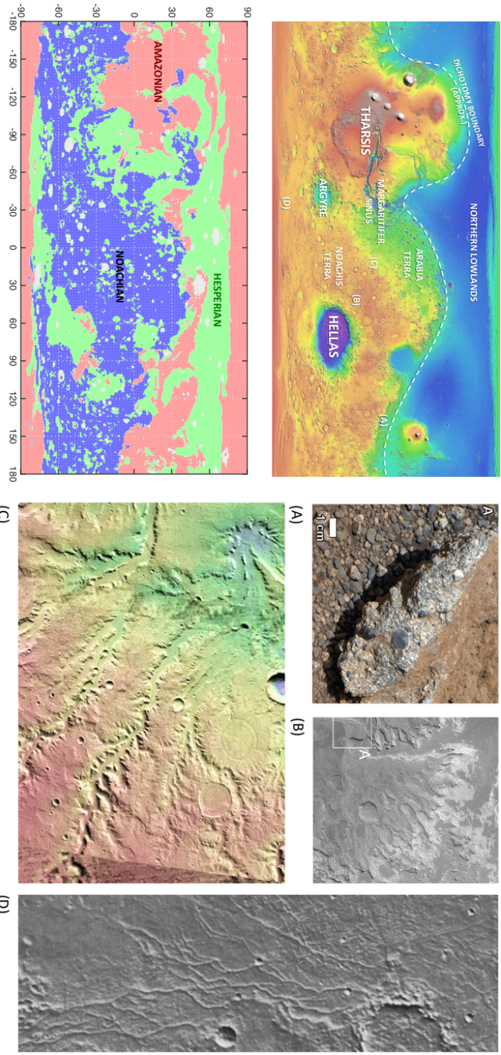
- Geologic evidence indicates liquid water modified Mars during the late Noachian and early Hesperian, but the record favors intermittent, not permanently warm, conditions; valley networks are common on Noachian terrain and rare later.
- With a solar luminosity about 75% of present at 3.8 Ga, Mars received roughly 441.1 W m⁻²; even with zero albedo the equilibrium temperature would be 210 K, implying a minimum greenhouse effect of about 65 K for marginally warm and wet conditions.
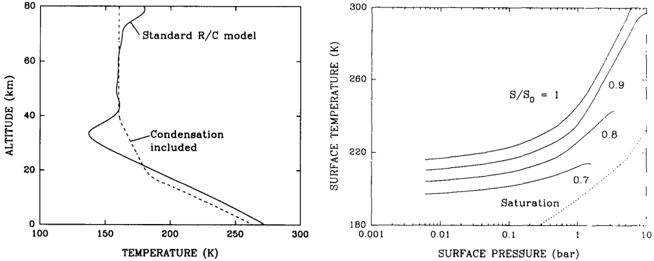
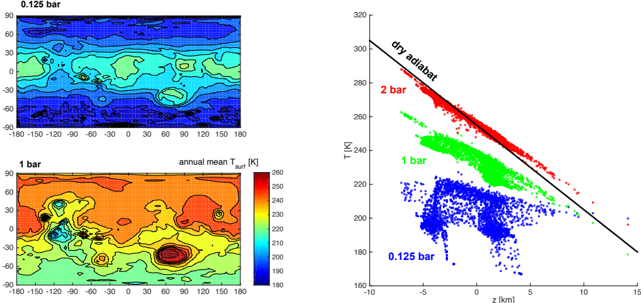
- Clear-sky CO₂–H₂O radiative-convective models give mean surface temperatures of 225 K or less, and a denser CO₂ atmosphere causes adiabatic cooling: about 30 K at 1 bar and about 40 K at 2 bar across the Hellas-to-highlands altitude range.
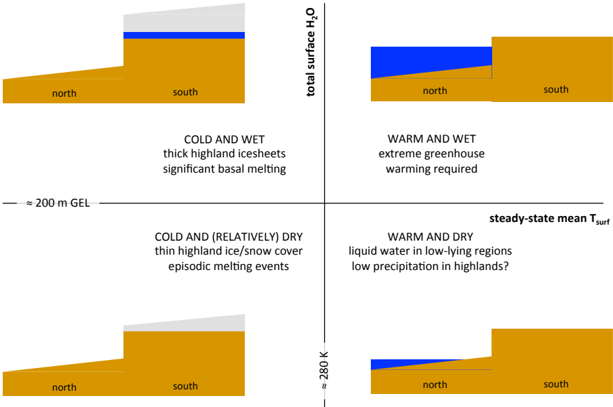
- The “icy highlands” scenario proposes that under a thicker atmosphere, snow and ice migrated to the equatorial Noachian highlands, where episodic melting carved valley networks; estimates of the late Noachian water inventory are low, including 137 m and 24 m global equivalent layer in cited studies, while a northern ocean shoreline would imply about 550 m GEL.
Methods
- Review article synthesizing orbital and in situ observations, geomorphology, geochemistry, and prior climate-modeling studies of early Mars.
- Draws on crater statistics, valley-network and crater-lake analyses, mineralogy, rover observations, atmospheric escape and outgassing estimates, and 1D radiative-convective and 3D general circulation model results.
- Main analysis is a narrative comparison of geologic evidence with climate-model constraints, including CO₂ greenhouse limits, cloud and aerosol effects, volcanic SO₂, impacts, and orbital forcing.
Limitations
- The paper states that the precise warming mechanism remains poorly constrained, atmospheric evolution is highly uncertain, and 3D cloud-forcing results disagree; no 3D simulation had yet addressed the impact of a snowy Tharsis on warm-and-wet stability.
- The paper notes that absolute dating of Martian surface units is subject to considerable uncertainty and that some atmospheric escape and carbonate-sequestration processes are poorly understood.
- As evident from the text, this is a review rather than a primary study, so its conclusions depend on published datasets and model results with their own parameterizations and uncertainties.
Model-written summary. Check it against the paper before relying on it.
Integrity signals
Registry
Cites
Statistics
Figures
Verification
Claims the paper makes
12 Valid · 12 Not valid · 84 Not checked · 108 Own results and interpretations
At least one cited source doesn’t support this claim or points to a different paper, and none confirmed it — see the verdicts below.
In the paper
“Hence for pure clear-sky CO 2 -H 2 O atmospheres under early Martian conditions, modern radiativeconvective models obtain mean surface temperatures of 225 K or less (Wordsworth, Forget & Eymet 2010; Ramirez et al. 2014; Halevy & Head 2014).”
What the sources say
- Not checked — no full text of the sourcecites Wordsworth, Forget & Eymet 2010 matched to “Infrared collision-induced and far-line absorption in dense CO2 atmospheres” (2010) source
- Disputedcites Ramirez et al. 2014 matched to “Warming early Mars with CO2 and H2” (2014) sourceExperimental — accuracy not yet measured
In “Greenhouse warming by models that include H2,” the paper reports that its H2-free model reached up to 230 K, above the claimed ceiling of 225 K; it identifies ~225 K as a previously published result. The supplemental “Climate Model Description” reports that a revised solar calculation raised the baseline 5% N2 case to 246 K. The paper supports the broader point that CO2–H2O alone did not produce warm conditions, but not the stated temperature limit. (LLM, conf=0.88)
Checked by a reasoning model — may be wrong.
- Not checked — no full text of the sourcecites Halevy & Head 2014 matched to “Episodic warming of early Mars by punctuated volcanism” (2014) source
plainstates a cause- Asserted: passes — The authors put it forward as true.
- Checkable: passes — It can be checked against evidence.
- Load-bearing: passes — The paper’s conclusions depend on it.
- Based: passes — The paper gives a reason why it holds.
The sources with a verdict support this claim; the rest weren’t checked yet, have no full text we could read, or their verdicts aren’t rated yet.
In the paper
“One mineral, carbonate, is conspicuous by its low abundance on the Martian surface (Niles et al. 2013; Ehlmann & Edwards 2014).”
What the sources say
- Not checked — no full text of the sourcecites Niles et al. 2013 matched to “Geochemistry of Carbonates on Mars: Implications for Climate History and Nature of Aqueous Environments” (2013) source
- Supportedcites Ehlmann & Edwards 2014 matched to “Mineralogy of the Martian Surface” (2014) source
Section 4.8, “The Carbonate Puzzle,” describes a “lack of massive, widespread carbonate” and says carbonate-bearing rocks appear geographically restricted. This supports the claim that carbonate is conspicuously scarce on the Martian surface, while acknowledging localized detections. (LLM, conf=0.92)
plain- Asserted: passes — The authors put it forward as true.
- Checkable: passes — It can be checked against evidence.
- Load-bearing: passes — The paper’s conclusions depend on it.
- Based: passes — The paper gives a reason why it holds.
The cited sources support only part of this claim — read each source’s verdict below.
In the paper
“Other aqueous minerals such as sulphates, chlorides and silicas are found in more localized regions of the Noachian and Hesperian crust (Gendrin et al. 2005; Osterloo et al. 2010; Carter et al. 2013; Ehlmann & Edwards 2014).”
What the sources say
- Partly supportedcites Gendrin et al. 2005 matched to “Sulfates in Martian Layered Terrains: The OMEGA/Mars Express View” (2005) sourceExperimental — accuracy not yet measured
The paper reports sulfates in localized light-toned layered deposits dated to the Noachian and/or Hesperian (p. 2). It does not report detections of chlorides or silica: it says halite might be present but lacks a detectable spectral signature in these observations (p. 2). (LLM, conf=0.88)
- Not checked — no full text of the sourcecites Osterloo et al. 2010 matched to “Geologic context of proposed chloride‐bearing materials on Mars” (2010) source
- Not checked — no full text of the sourcecites Carter et al. 2013 matched to “Hydrous minerals on Mars as seen by the CRISM and OMEGA imaging spectrometers: Updated global view” (2013) source
plain- Asserted: passes — The authors put it forward as true.
- Checkable: passes — It can be checked against evidence.
- Load-bearing: unclear — It is unclear whether the paper’s conclusions depend on it.
- Based: passes — The paper gives a reason why it holds.
- Partly supported
The cited sources support only part of this claim — read each source’s verdict below.
In the paper
“This is important, because surface carbonate formation should be very efficient on a warm and wet planet with a basaltic crust and CO 2 -rich atmosphere (Pollack et al. 1987).”
What the sources say
- Partly supportedcites Pollack et al. 1987 matched to “The case for a wet, warm climate on early Mars” (1987) sourceExperimental — accuracy not yet measured
The passage under “The Case for a Wet, Warm Climate on Early Mars” (page unavailable) links a wet, warm, CO₂-rich early Mars to silicate weathering and carbonate rocks. It does not specify a basaltic crust or say that surface carbonate formation would be very efficient. (LLM, conf=0.78)
plainstates a cause- Asserted: passes — The authors put it forward as true.
- Checkable: passes — It can be checked against evidence.
- Load-bearing: passes — The paper’s conclusions depend on it.
- Based: passes — The paper gives a reason why it holds.
- Partly supported
The cited sources support only part of this claim — read each source’s verdict below.
In the paper
“The martian surface is sulfur-rich (Clark et al. 1976) and sulphates are abundant on Hesperian and Noachian terrain (Gendrin et al. 2005; Bibring et al. 2005; Ehlmann & Edwards 2014).”
What the sources say
- Partly supportedcites Gendrin et al. 2005 matched to “Sulfates in Martian Layered Terrains: The OMEGA/Mars Express View” (2005) sourceExperimental — accuracy not yet measured
The paper reports sulfate-rich layered deposits whose formation is dated to the Noachian and/or Hesperian epochs (p. 2). It also says that OMEGA detects sulfates in equatorial regions only in close association with light-toned layered deposits, not scattered across the surrounding terrain. Thus it supports abundance in particular deposits, but not across Hesperian and Noachian terrain generally. (LLM, conf=0.84)
- Not checked — no full text of the sourcecites Bibring et al. 2005 matched to “Mars Surface Diversity as Revealed by the OMEGA/Mars Express Observations” (2005) source
- Partly supportedcites Ehlmann & Edwards 2014 matched to “Mineralogy of the Martian Surface” (2014) sourceExperimental — accuracy not yet measured
Section 4.5 describes sulfate-bearing Hesperian sedimentary rocks and says the associated deposits are Hesperian-aged. The Summary Points say some late Noachian–early Hesperian paleolake basins contain sulfates, but do not establish that sulfates are abundant across Noachian terrain. (LLM, conf=0.86)
plain- Asserted: passes — The authors put it forward as true.
- Checkable: passes — It can be checked against evidence.
- Load-bearing: passes — The paper’s conclusions depend on it.
- Based: passes — The paper gives a reason why it holds.
- Partly supported
134 more claims · 6 with their cited sources checked
Create a free account to see all 216 claims and to verify the 40 references still open.
- It may state two separate claims as one. 48
- Probably not a substantial claim. 36
Self-check
Percentages, sums and reported differences re-computed from the paper’s own numbers.
Each contradiction between two passages listed here was confirmed by an independent check.
Rated minor: it would not touch a result — a value no result rests on, a p-value that stays on the same side of the significance level, or a conflict that is clerical, resolved elsewhere in the paper, or outside its own findings.
In the paper
§ 4.4. The periglacial paradox and the Noachian surface water inventory · p. 17
“Preliminary GCM studies using the model described in Wordsworth et al. (2015) suggest that this is indeed the case.”
§ Figure 7 · p. 25
“The warm and dry state has not yet been simulated numerically but may lead to little or no rainfall in the equatorial highlands.”
Rated minor: it would not touch a result — a value no result rests on, a p-value that stays on the same side of the significance level, or a conflict that is clerical, resolved elsewhere in the paper, or outside its own findings.
In the paper
§ 4.1. Adiabatic Cooling and the Icy Highlands Hypothesis · p. 14
“c p is the atmospheric specific heat capacity at constant pressure”
§ 4.1. Adiabatic Cooling and the Icy Highlands Hypothesis · p. 14
“with g gravity and c p the specific heat capacity at constant volume”
Citations
Cites
A Neoproterozoic Snowball Earth
Hoffman, P. F., Kaufman, A. J., Halverson, G. P., & Schrag, D. P. (1998) · Science · doi:10.1126/science.281.5381.1342 · Cited by 2,693
Habitable Zones around Main Sequence Stars
Kasting, J. F., Whitmire, D. P., & Reynolds, R. T. (1993) · Icarus · doi:10.1006/icar.1993.1010 · Cited by 2,501
A negative feedback mechanism for the long‐term stabilization of Earth's surface temperature
Walker, J. C. G., Hays, P. B., & Kasting, J. F. (1981) · Journal of Geophysical Research: Oceans · doi:10.1029/jc086ic10p09776 · Cited by 2,310
Arctic sea ice decline: Faster than forecast
Stroeve, J., Holland, M. M., Meier, W., Scambos, T., & Serreze, M. (2007) · Geophysical Research Letters · doi:10.1029/2007gl029703 · Cited by 1,857
Global Mineralogical and Aqueous Mars History Derived from OMEGA/Mars Express Data
Bibring, J.-P., Langevin, Y., Mustard, J. F., Poulet, F., Arvidson, R., Gendrin, A., Gondet, B., Mangold, N., Pinet, P., Forget, F., et al. (2006) · Science · doi:10.1126/science.1122659 · Cited by 1,667 · cited 3×
“Iron and magnesium rich phyllosilicates (clays) are found extensively over Noachian terrain (Poulet et al. 2005; Bibring et al. 2006; Mustard et al. 2008; Murchie et al. 2009; Carter et al. 2010).”
BackgroundA low mass for Mars from Jupiter’s early gas-driven migration
Walsh, K. J., Morbidelli, A., Raymond, S. N., O'Brien, D. P., & Mandell, A. M. (2011) · Nature · doi:10.1038/nature10201 · Cited by 1,241 · cited 1×
“Current thinking suggests Mars is best understood as a planetary embryo, whose development into a fully fledged terrestrial planet was arrested by some process such as instability in the configuration of the outer planets (Walsh et al. 2011).”
BackgroundLacis, A. A., & Oinas, V. (1991) · Journal of Geophysical Research: Atmospheres · doi:10.1029/90jd01945 · Cited by 1,051 · cited 1×
“Instead, recent 3D simulations have used the correlated-k method (Goody et al. 1989; Lacis & Oinas 1991).”
MethodThe origins and concentrations of water, carbon, nitrogen and noble gases on Earth
Marty, B. (2012) · Earth and Planetary Science Letters · doi:10.1016/j.epsl.2011.10.040 · Cited by 1,012
Long term evolution and chaotic diffusion of the insolation quantities of Mars
Laskar, J., Correia, A. C. M., Gastineau, M., Joutel, F., Levrard, B., & Robutel, P. (2004) · Icarus · doi:10.1016/j.icarus.2004.04.005 · Cited by 992 · cited 1×
“Mars’ orbital eccentricity and obliquity evolve chaotically on long timescales, however, and have probably varied over ranges of 0 – 0.125 and 10◦ – 60◦, respectively (Laskar et al. 2004).”
BackgroundInfluentialSulfates in Martian Layered Terrains: The OMEGA/Mars Express View
Gendrin, A., Mangold, N., Bibring, J.-P., Langevin, Y., Gondet, B., Poulet, F., Bonello, G., Quantin, C., Mustard, J., Arvidson, R., et al. (2005) · Science · doi:10.1126/science.1109087 · Cited by 986 · cited 2×
“The martian surface is sulfur-rich (Clark et al. 1976) and sulphates are abundant on Hesperian and Noachian terrain (Gendrin et al. 2005; Bibring et al. 2005; Ehlmann & Edwards 2014).”
BackgroundThe effect of solar radiation variations on the climate of the Earth
Budyko, M. I. (1969) · Tellus A: Dynamic Meteorology and Oceanography · doi:10.3402/tellusa.v21i5.10109 · Cited by 984
Phyllosilicates on Mars and implications for early martian climate
The Omega Team, Poulet, F., Bibring, J.-P., Mustard, J. F., Gendrin, A., Mangold, N., Langevin, Y., Arvidson, R. E., Gondet, B., & Gomez, C. (2005) · Nature · doi:10.1038/nature04274 · Cited by 978 · cited 3×
“Iron and magnesium rich phyllosilicates (clays) are found extensively over Noachian terrain (Poulet et al. 2005; Bibring et al. 2006; Mustard et al. 2008; Murchie et al. 2009; Carter et al. 2010).”
BackgroundMars Surface Diversity as Revealed by the OMEGA/Mars Express Observations
Bibring, J.-P., Langevin, Y., Gendrin, A., Gondet, B., Poulet, F., Berthé, M., Soufflot, A., Arvidson, R., Mangold, N., Mustard, J., et al. (2005) · Science · doi:10.1126/science.1108806 · Cited by 973 · cited 1×
“The martian surface is sulfur-rich (Clark et al. 1976) and sulphates are abundant on Hesperian and Noachian terrain (Gendrin et al. 2005; Bibring et al. 2005; Ehlmann & Edwards 2014).”
BackgroundDistribution of Hydrogen in the Near Surface of Mars: Evidence for Subsurface Ice Deposits
Boynton, W. V., Feldman, W. C., Squyres, S. W., Prettyman, T. H., Brückner, J., Evans, L. G., Reedy, R. C., Starr, R., Arnold, J. R., Drake, D. M., et al. (2002) · Science · doi:10.1126/science.1073722 · Cited by 934 · cited 1×
“The majority of surface and subsurface water ice is found near the poles (Boynton et al. 2002).”
BackgroundCratering Chronology and the Evolution of Mars
Hartmann, W. K., & Neukum, G. (2001) · Space Science Reviews · doi:10.1023/a:1011945222010 · Cited by 909 · cited 1×
“The late Noachian is coincident with the early period of intense impactor flux known as the late heavy bombardment (e.g., Hartmann & Neukum 2001).”
BackgroundA Habitable Fluvio-Lacustrine Environment at Yellowknife Bay, Gale Crater, Mars
Grotzinger, J. P., Sumner, D. Y., Kah, L. C., Stack, K., Gupta, S., Edgar, L., Rubin, D., Lewis, K., Schieber, J., Mangold, N., et al. (2014) · Science · doi:10.1126/science.1242777 · Cited by 901 · cited 1×
“Mars provides us a glimpse of conditions during the earliest stages of the Solar System on a body that had an atmosphere, at least episodic surface liquid water, and in some locales, surface chemistry conducive to the survival of microbial life (e.g., Grotzinger et al. 2014).”
BackgroundSubsurface water and clay mineral formation during the early history of Mars
Ehlmann, B. L., Mustard, J. F., Murchie, S. L., Bibring, J.-P., Meunier, A., Fraeman, A. A., & Langevin, Y. (2011) · Nature · doi:10.1038/nature10582 · Cited by 868 · cited 3×
“Recently, however, it has been argued that in most cases their mineralogy may best represent subsurface formation in geothermally heated, water-poor systems (Ehlmann et al. 2011).”
BackgroundMethodSolar interior structure and luminosity variations
Gough, D. O. (1981) · Solar Physics · doi:10.1007/bf00151270 · Cited by 798 · cited 1×
“In addition, most of the minerals in open-basin crater lakes observed from orbit lack evidence of strong in situ chemical alteration (Goudge et al. 2012).”
BackgroundHydrated silicate minerals on Mars observed by the Mars Reconnaissance Orbiter CRISM instrument
Mustard, J. F., Murchie, S. L., Pelkey, S. M., Ehlmann, B. L., Milliken, R. E., Grant, J. A., Bibring, J.-P., Poulet, F., Bishop, J., Dobrea, E. N., et al. (2008) · Nature · doi:10.1038/nature07097 · Cited by 794 · cited 1×
“Iron and magnesium rich phyllosilicates (clays) are found extensively over Noachian terrain (Poulet et al. 2005; Bibring et al. 2006; Mustard et al. 2008; Murchie et al. 2009; Carter et al. 2010).”
BackgroundMagnetic Field and Plasma Observations at Mars: Initial Results of the Mars Global Surveyor Mission
Acuña, M. H., Connerney, J. E. P., Wasilewski, P., Lin, R. P., Anderson, K. A., Carlson, C. W., McFadden, J., Curtis, D. W., Mitchell, D., Reme, H., et al. (1998) · Science · doi:10.1126/science.279.5357.1676 · Cited by 786 · cited 1×
“Mars’ low mass relative to Earth led to an early shutdown of the magnetic dynamo (Acuna et al. 1998) and rapid cooling of the interior.”
BackgroundDistributions of Microbial Activities in Deep Subseafloor Sediments
D'Hondt, S., Jørgensen, B. B., Miller, D. J., Batzke, A., Blake, R., Cragg, B. A., Cypionka, H., Dickens, G. R., Ferdelman, T., Hinrichs, K.-U., et al. (2004) · Science · doi:10.1126/science.1101155 · Cited by 774
Mineralogy of the Martian Surface
Ehlmann, B. L., & Edwards, C. S. (2014) · Annual Review of Earth and Planetary Sciences · doi:10.1146/annurev-earth-060313-055024 · Cited by 761 · cited 3×
“( One mineral, carbonate, is conspicuous by its low abundance on the Martian surface (Niles et al. 2013; Ehlmann & Edwards 2014).”
BackgroundCarr, M. H., & Head, J. W. (2010) · Earth and Planetary Science Letters · doi:10.1016/j.epsl.2009.06.042 · Cited by 734 · cited 1×
“Although substantial resurfacing and formation of the Tharsis Montes shield volcanoes was ongoing during the Hesperian and Amazonian, the formation of Tharsis likely began early and was mainly complete by the late Noachian (Phillips et al. 2001; Carr & Head 2010; Fassett & Head 2011).”
BackgroundLine‐by‐line calculations of atmospheric fluxes and cooling rates: Application to water vapor
Clough, S. A., Iacono, M. J., & Moncet, J. (1992) · Journal of Geophysical Research: Atmospheres · doi:10.1029/92jd01419 · Cited by 728
A model for the hydrologic and climatic behavior of water on Mars
Clifford, S. M. (1993) · Journal of Geophysical Research: Planets · doi:10.1029/93je00225 · Cited by 709 · cited 1×
“Issues of specific importance to the 3D climate modeling include better representation of clouds, perhaps through a sub-gridscale parametrization scheme [e.g., Khairoutdinov & Randall (2001)] and coupling with subsurface hydrology models (Clifford 1993; Clifford & Parker 2001).”
BackgroundEhlmann, B. L., Mustard, J. F., Swayze, G. A., Clark, R. N., Bishop, J. L., Poulet, F., Des Marais, D. J., Roach, L. H., Milliken, R. E., Wray, J. J., et al. (2009) · Journal of Geophysical Research: Planets · doi:10.1029/2009je003339 · Cited by 705
Clifford, S. (2001) · Icarus · doi:10.1006/icar.2001.6671 · Cited by 685 · cited 1×
“Issues of specific importance to the 3D climate modeling include better representation of clouds, perhaps through a sub-gridscale parametrization scheme [e.g., Khairoutdinov & Randall (2001)] and coupling with subsurface hydrology models (Clifford 1993; Clifford & Parker 2001).”
BackgroundDeposition, exhumation, and paleoclimate of an ancient lake deposit, Gale crater, Mars
Grotzinger, J. P., Gupta, S., Malin, M. C., Rubin, D. M., Schieber, J., Siebach, K., Sumner, D. Y., Stack, K. M., Vasavada, A. R., Arvidson, R. E., et al. (2015) · Science · doi:10.1126/science.aac7575 · Cited by 637
Atmospheric Loss of Exoplanets Resulting from Stellar X-Ray and Extreme-Ultraviolet Heating
Lammer, H., Selsis, F., Ribas, I., Guinan, E. F., Bauer, S. J., & Weiss, W. W. (2003) · The Astrophysical Journal · doi:10.1086/380815 · Cited by 636 · cited 1×
“Mars’ reddish, hyperoxidised surface, which is extremely inhospitable to life, is a direct result of the escape of hydrogen to space over geologic time (Lammer et al. 2003).”
BackgroundMurchie, S. L., Mustard, J. F., Ehlmann, B. L., Milliken, R. E., Bishop, J. L., McKeown, N. K., Noe Dobrea, E. Z., Seelos, F. P., Buczkowski, D. L., Wiseman, S. M., et al. (2009) · Journal of Geophysical Research: Planets · doi:10.1029/2009je003342 · Cited by 630 · cited 1×
“Iron and magnesium rich phyllosilicates (clays) are found extensively over Noachian terrain (Poulet et al. 2005; Bibring et al. 2006; Mustard et al. 2008; Murchie et al. 2009; Carter et al. 2010).”
BackgroundHydrous minerals on Mars as seen by the CRISM and OMEGA imaging spectrometers: Updated global view
Carter, J., Poulet, F., Bibring, J. ‐., Mangold, N., & Murchie, S. (2013) · Journal of Geophysical Research: Planets · doi:10.1029/2012je004145 · Cited by 609 · cited 1×
“Other aqueous minerals such as sulphates, chlorides and silicas are found in more localized regions of the Noachian and Hesperian crust (Gendrin et al. 2005; Osterloo et al. 2010; Carter et al. 2013; Ehlmann & Edwards 2014).”
BackgroundGeologic map of the western equatorial region of Mars
(1986) · doi:10.3133/i1802a · Cited by 605
The case for rainfall on a warm, wet early Mars
Craddock, R. A., & Howard, A. D. (2002) · Journal of Geophysical Research: Planets · doi:10.1029/2001je001505 · Cited by 601 · cited 1×
“This geomorphology strongly suggests an origin due to a hydrological cycle driven by precipitation (as rain or snow) (Craddock & Howard 2002; Mangold et al. 2004; Stepinski & Stepinski 2005; Barnhart, Howard & Moore 2009; Hynek, Beach & Hoke 2010; Matsubara, Howard & Gochenour 2013) rather than…”
BackgroundCarbon dioxide cycling and implications for climate on ancient Earth
Sleep, N. H., & Zahnle, K. (2001) · Journal of Geophysical Research: Planets · doi:10.1029/2000je001247 · Cited by 592 · cited 2×
“…(2013) indicate that a 1 M⊕ planet at Mars’ orbit with an atmosphere dominated by CO2 and H2O would have a surface temperature of 288 K for an atmospheric pressure of around 3-5 bar – a small amount in comparison with Earth’s total carbon inventory (Sleep & Zahnle 2001; Hayes & Waldbauer 2006).”
BackgroundThe case for a wet, warm climate on early Mars
Pollack, J. B., Kasting, J. F., Richardson, S. M., & Poliakoff, K. (1987) · Icarus · doi:10.1016/0019-1035(87)90147-3 · Cited by 592 · cited 1×
“This is important, because surface carbonate formation should be very efficient on a warm and wet planet with a basaltic crust and CO2rich atmosphere (Pollack et al. 1987).”
BackgroundMaking the Terrestrial Planets: N-Body Integrations of Planetary Embryos in Three Dimensions
Chambers, J. E., & Wetherill, G. W. (1998) · Icarus · doi:10.1006/icar.1998.6007 · Cited by 583 · cited 1×
“Mars formed very rapidly compared to Earth (Dauphas & Pourmand 2011) and is smaller than predicted by standard formation models (Chambers & Wetherill 1998).”
BackgroundOn the rocks: the microbiology of Antarctic Dry Valley soils
Cary, S. C., McDonald, I. R., Barrett, J. E., & Cowan, D. A. (2010) · Nature Reviews Microbiology · doi:10.1038/nrmicro2281 · Cited by 580 · cited 1×
“Probably not: life on Earth clings tenaciously to almost any environment where we can look for it, including Antarctica’s Dry Valleys and deep below the seafloor (Cary et al. 2010; D’Hondt et al. 2004).”
BackgroundTanaka, K. L. (1986) · Journal of Geophysical Research: Solid Earth · doi:10.1029/jb091ib13p0e139 · Cited by 575 · cited 10×
“This geomorphology strongly suggests an origin due to a hydrological cycle driven by precipitation (as rain or snow) (Craddock & Howard 2002; Mangold et al. 2004; Stepinski & Stepinski 2005; Barnhart, Howard & Moore 2009; Hynek, Beach & Hoke 2010; Matsubara, Howard & Gochenour 2013) rather than e.g., groundwater sappi…”
BackgroundInfluentialThe chaotic obliquity of the planets
Laskar, J., & Robutel, P. (1993) · Nature · doi:10.1038/361608a0 · Cited by 573 · cited 1×
“Mars’ obliquity has varied significantly throughout the Amazonian, however (Laskar & Robutel 1993), and at high obliquities ice migration to equatorial (Mischna et al. 2003; Forget et al. 2006) and mid-latitude (Madeleine et al. 2009) regions is predicted.”
BackgroundCarr, M. H. (1996) · doi:10.1093/oso/9780195099386.001.0001 · Cited by 551
The correlated-k method for radiation calculations in nonhomogeneous atmospheres
Goody, R., West, R., Chen, L., & Crisp, D. (1989) · Journal of Quantitative Spectroscopy and Radiative Transfer · doi:10.1016/0022-4073(89)90044-7 · Cited by 521 · cited 2×
“Instead, recent 3D simulations have used the correlated-k method (Goody et al. 1989; Lacis & Oinas 1991).”
BackgroundMethodEvidence for Persistent Flow and Aqueous Sedimentation on Early Mars
Malin, M. C., & Edgett, K. S. (2003) · Science · doi:10.1126/science.1090544 · Cited by 513
Coastal geomorphology of the Martian northern plains
Parker, T. J., Gorsline, D. S., Saunders, R. S., Pieri, D. C., & Schneeberger, D. M. (1993) · Journal of Geophysical Research: Planets · doi:10.1029/93je00618 · Cited by 507
Ancient Geodynamics and Global-Scale Hydrology on Mars
Phillips, R. J., Zuber, M. T., Solomon, S. C., Golombek, M. P., Jakosky, B. M., Banerdt, W. B., Smith, D. E., Williams, R. M. E., Hynek, B. M., Aharonson, O., et al. (2001) · Science · doi:10.1126/science.1058701 · Cited by 506 · cited 1×
“Although substantial resurfacing and formation of the Tharsis Montes shield volcanoes was ongoing during the Hesperian and Amazonian, the formation of Tharsis likely began early and was mainly complete by the late Noachian (Phillips et al. 2001; Carr & Head 2010; Fassett & Head 2011).”
BackgroundUpdated global map of Martian valley networks and implications for climate and hydrologic processes
Hynek, B. M., Beach, M., & Hoke, M. R. T. (2010) · Journal of Geophysical Research: Planets · doi:10.1029/2009je003548 · Cited by 505
Formation of Glaciers on Mars by Atmospheric Precipitation at High Obliquity
Forget, F., Haberle, R. M., Montmessin, F., Levrard, B., & Head, J. W. (2006) · Science · doi:10.1126/science.1120335 · Cited by 483 · cited 1×
“Mars’ obliquity has varied significantly throughout the Amazonian, however (Laskar & Robutel 1993), and at high obliquities ice migration to equatorial (Mischna et al. 2003; Forget et al. 2006) and mid-latitude (Madeleine et al. 2009) regions is predicted.”
BackgroundThe carbon cycle and associated redox processes through time
Hayes, J. M., & Waldbauer, J. R. (2006) · Philosophical Transactions of the Royal Society B: Biological Sciences · doi:10.1098/rstb.2006.1840 · Cited by 482
Hf–W–Th evidence for rapid growth of Mars and its status as a planetary embryo
Dauphas, N., & Pourmand, A. (2011) · Nature · doi:10.1038/nature10077 · Cited by 476 · cited 1×
“Mars formed very rapidly compared to Earth (Dauphas & Pourmand 2011) and is smaller than predicted by standard formation models (Chambers & Wetherill 1998).”
BackgroundThe timing of martian valley network activity: Constraints from buffered crater counting
Fassett, C. I., & Head, J. W. (2008) · Icarus · doi:10.1016/j.icarus.2007.12.009 · Cited by 475 · cited 3×
“In general, low drainage ratios and a large number of open crater lakes indicate high precipitation rates and a wet climate (Fassett & Head 2008; Barnhart, Howard & Moore 2009).”
BackgroundWarming Early Mars with Carbon Dioxide Clouds That Scatter Infrared Radiation
Forget, F., & Pierrehumbert, R. T. (1997) · Science · doi:10.1126/science.278.5341.1273 · Cited by 475 · cited 1×
“Forget & Pierrehumbert (1997) proposed that infrared scattering by CO2 clouds in the high atmosphere could have led to significant, long-term greenhouse warming on early Mars.”
BackgroundKhairoutdinov, M. F., & Randall, D. A. (2001) · Geophysical Research Letters · doi:10.1029/2001gl013552 · Cited by 473
Tanaka, K. L., Skinner, J. A., Dohm, J. M., Irwin, R. P., Kolb, E. J., Fortezzo, C. M., Platz, T., Michael, G. G., & Hare, T. M. (2014) · Scientific Investigations Map · doi:10.3133/sim3292 · Cited by 463
Identification of Carbonate-Rich Outcrops on Mars by the Spirit Rover
Morris, R. V., Ruff, S. W., Gellert, R., Ming, D. W., Arvidson, R. E., Clark, B. C., Golden, D. C., Siebach, K., Klingelhöfer, G., Schröder, C., et al. (2010) · Science · doi:10.1126/science.1189667 · Cited by 447 · cited 1×
“Interestingly, carbonates have been discovered in outcrops in the Nili Fossae region by CRISM (Ehlmann et al. 2008) and in Gusev crater by the Spirit rover (Morris et al. 2010).”
BackgroundRadiative forcing from the 1991 Mount Pinatubo volcanic eruption
Stenchikov, G. L., Kirchner, I., Robock, A., Graf, H., Antuña, J. C., Grainger, R. G., Lambert, A., & Thomason, L. (1998) · Journal of Geophysical Research: Atmospheres · doi:10.1029/98jd00693 · Cited by 442 · cited 1×
“Similar climate effects have been observed in stratovolcano eruptions on Earth, such as that of Pinatubo in 1991 (Stenchikov et al. 1998).”
BackgroundPossible Ancient Oceans on Mars: Evidence from Mars Orbiter Laser Altimeter Data
Head, J. W., Hiesinger, H., Ivanov, M. A., Kreslavsky, M. A., Pratt, S., & Thomson, B. J. (1999) · Science · doi:10.1126/science.286.5447.2134 · Cited by 424
Ancient ocean on Mars supported by global distribution of deltas and valleys
Di Achille, G., & Hynek, B. M. (2010) · Nature Geoscience · doi:10.1038/ngeo891 · Cited by 417 · cited 5×
“Even with a northern ocean at the di Achille & Hynek (2010) shoreline, Mars would possess a far higher land to ocean ratio than Earth does, making the physics of a snowball transition quite different.”
BackgroundMethodInfluentialIrwin, R. P., Howard, A. D., Craddock, R. A., & Moore, J. M. (2005) · Journal of Geophysical Research: Planets · doi:10.1029/2005je002460 · Cited by 413
CO2 condensation and the climate of early Mars
Kasting, J. F. (1991) · Icarus · doi:10.1016/0019-1035(91)90137-i · Cited by 413 · cited 3×
“In a seminal paper, Kasting (1991) demonstrated that regardless of the atmospheric pressure, a clear-sky CO2-H2O atmosphere alone could not have warmed early Mars.”
BackgroundClay minerals in delta deposits and organic preservation potential on Mars
Ehlmann, B. L., Mustard, J. F., Fassett, C. I., Schon, S. C., Head III, J. W., Des Marais, D. J., Grant, J. A., & Murchie, S. L. (2008) · Nature Geoscience · doi:10.1038/ngeo207 · Cited by 401 · cited 2×
“Hydrated silicate minerals on Mars observed by the Mars Reconnaissance Orbiter CRISM instrument.”
BackgroundMartian Fluvial Conglomerates at Gale Crater
Williams, R. M. E., Grotzinger, J. P., Dietrich, W. E., Gupta, S., Sumner, D. Y., Wiens, R. C., Mangold, N., Malin, M. C., Edgett, K. S., Maurice, S., et al. (2013) · Science · doi:10.1126/science.1237317 · Cited by 381
Natural Transfer of Viable Microbes in Space 1. From Mars to Earth and Earth to Mars
Mileikowsky, C. (2000) · Icarus · doi:10.1006/icar.1999.6317 · Cited by 370
Wordsworth, R., Forget, F., Millour, E., Head, J. W., Madeleine, J.-B., & Charnay, B. (2013) · Icarus · doi:10.1016/j.icarus.2012.09.036 · Cited by 351 · cited 5×
“Wordsworth et al. (2015) tried both these approaches to study precipitation patterns on a warm and wet early Mars.”
BackgroundMethodInfluentialSelf-citationHoward, A. D., Moore, J. M., & Irwin, R. P. (2005) · Journal of Geophysical Research: Planets · doi:10.1029/2005je002459 · Cited by 351
EARLY CRUSTAL EVOLUTION OF MARS
Nimmo, F., & Tanaka, K. (2005) · Annual Review of Earth and Planetary Sciences · doi:10.1146/annurev.earth.33.092203.122637 · Cited by 342
Forget, F., Wordsworth, R., Millour, E., Madeleine, J.-B., Kerber, L., Leconte, J., Marcq, E., & Haberle, R. M. (2013) · Icarus · doi:10.1016/j.icarus.2012.10.019 · Cited by 341 · cited 6×
“This conclusion, which was reached by Kasting using a one-dimensional clear-sky radiativeconvective climate model, has recently been confirmed by three-dimensional climate models that include cloud effects (Forget et al. 2013; Wordsworth et al. 2013).”
BackgroundMethodInfluentialSelf-citationDistribution, Classification, and Ages of Martian Impact Crater Lakes
Cabrol, N. (1999) · Icarus · doi:10.1006/icar.1999.6191 · Cited by 334 · cited 1×
“As might be expected, analysis of the Noachian southern highlands has revealed abundant evidence for crater lakes interlinked with the valley networks (Cabrol & Grin 1999; Fassett & Head 2008).”
BackgroundPierrehumbert, R. T., Abbot, D. S., Voigt, A., & Koll, D. (2011) · Annual Review of Earth and Planetary Sciences · doi:10.1146/annurev-earth-040809-152447 · Cited by 333 · cited 1×
“It was also responsible for the snowball Earth global glaciations that occurred in the Neoproterozoic (Kirschvink 1992; Hoffman et al. 1998; Pierrehumbert et al. 2011).”
BackgroundStrong water isotopic anomalies in the martian atmosphere: Probing current and ancient reservoirs
Villanueva, G. L., Mumma, M. J., Novak, R. E., Käufl, H. U., Hartogh, P., Encrenaz, T., Tokunaga, A., Khayat, A., & Smith, M. D. (2015) · Science · doi:10.1126/science.aaa3630 · Cited by 331
Kargel, J. S., & Strom, R. G. (1992) · Geology · doi:10.1130/0091-7613(1992)020<0003:agom>2.3.co;2 · Cited by 326
New Perspectives on Ancient Mars
Solomon, S. C., Aharonson, O., Aurnou, J. M., Banerdt, W. B., Carr, M. H., Dombard, A. J., Frey, H. V., Golombek, M. P., Hauck, S. A., Head, J. W., et al. (2005) · Science · doi:10.1126/science.1101812 · Cited by 316 · cited 1×
“If plate tectonics ever initiated at all, it ceased rapidly (Connerney et al. 2001; Solomon et al. 2005).”
BackgroundEnvironmental Effects of Large Impacts on Mars
Segura, T. L., Toon, O. B., Colaprete, A., & Zahnle, K. (2002) · Science · doi:10.1126/science.1073586 · Cited by 304 · cited 1×
“Segura et al. (2002); Segura, Toon & Colaprete (2008) suggested that large impactors could have evaporated up to tens of meters of water into the atmosphere, which would then have caused erosion when it rained back down to the surface.”
BackgroundAmazonian northern mid-latitude glaciation on Mars: A proposed climate scenario
Madeleine, J.-B., Forget, F., Head, J. W., Levrard, B., Montmessin, F., & Millour, E. (2009) · Icarus · doi:10.1016/j.icarus.2009.04.037 · Cited by 304 · cited 1×
“Mars’ obliquity has varied significantly throughout the Amazonian, however (Laskar & Robutel 1993), and at high obliquities ice migration to equatorial (Mischna et al. 2003; Forget et al. 2006) and mid-latitude (Madeleine et al. 2009) regions is predicted.”
BackgroundUdry, S., Bonfils, X., Delfosse, X., Forveille, T., Mayor, M., Perrier, C., Bouchy, F., Lovis, C., Pepe, F., Queloz, D., et al. (2007) · Astronomy & Astrophysics · doi:10.1051/0004-6361:20077612 · Cited by 304 · cited 1×
“Several potentially rocky exoplanets and exoplanet candidates that receive approximately the same stellar flux as Mars have now been discovered [e.g., Udry et al. (2007); Quintana et al. (2014)].”
BackgroundWarming early Mars with CO2 and H2
Ramirez, R. M., Kopparapu, R., Zugger, M. E., Robinson, T. D., Freedman, R., & Kasting, J. F. (2014) · Nature Geoscience · doi:10.1038/ngeo2000 · Cited by 303 · cited 4×
“In a thought-provoking paper, Ramirez et al. (2014) proposed www.annualreviews.org • The Climate of Early Mars 9 that CO2-H2 absorption could have caused warming on early Mars in a similar fashion, perhaps sufficiently to put the climate into a warm and wet state.”
BackgroundMethodInfluentialIsotope Ratios of H, C, and O in CO 2 and H 2 O of the Martian Atmosphere
Webster, C. R., Mahaffy, P. R., Flesch, G. J., Niles, P. B., Jones, J. H., Leshin, L. A., Atreya, S. K., Stern, J. C., Christensen, L. E., Owen, T., et al. (2013) · Science · doi:10.1126/science.1237961 · Cited by 295 · cited 2×
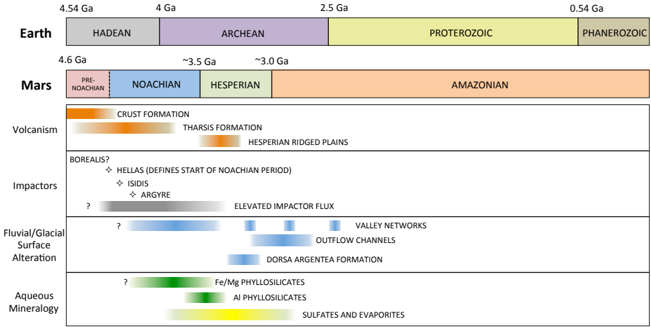
“…oxidising surface conditions and minimal weathering; the Hesperian (∼ 3.0−3.5 Ga), which contains evidence of extensive volcanism and catastrophic flooding, and the ancient Noachian (∼ 3.5−4.1 Ga), when alteration of the Martian surface by water was greatest [Werner & Tanaka (2011); also see Fig.”
BackgroundMethodInfluentialAn Earth-Sized Planet in the Habitable Zone of a Cool Star
Quintana, E. V., Barclay, T., Raymond, S. N., Rowe, J. F., Bolmont, E., Caldwell, D. A., Howell, S. B., Kane, S. R., Huber, D., Crepp, J. R., et al. (2014) · Science · doi:10.1126/science.1249403 · Cited by 292
The global magnetic field of Mars and implications for crustal evolution
Connerney, J. E. P., Acuña, M. H., Wasilewski, P. J., Kletetschka, G., Ness, N. F., Rème, H., Lin, R. P., & Mitchell, D. L. (2001) · Geophysical Research Letters · doi:10.1029/2001gl013619 · Cited by 290 · cited 1×
“If plate tectonics ever initiated at all, it ceased rapidly (Connerney et al. 2001; Solomon et al. 2005).”
BackgroundRedox State of Mars' Upper Mantle and Crust from Eu Anomalies in Shergottite Pyroxenes
Wadhwa, M. (2001) · Science · doi:10.1126/science.1057594 · Cited by 284 · cited 1×
“Analysis of Martian meteorites suggests Mars has a more reducing mantle than Earth, with an fO2 value between the iron-wüstite and quartzfayalite-magnetite buffers (Wadhwa 2001).”
BackgroundEarly Mars: How Warm and How Wet?
Squyres, S. W., & Kasting, J. F. (1994) · Science · doi:10.1126/science.265.5173.744 · Cited by 275 · cited 1×
“…Stepinski 2005; Barnhart, Howard & Moore 2009; Hynek, Beach & Hoke 2010; Matsubara, Howard & Gochenour 2013) rather than e.g., groundwater sapping (Squyres & Kasting 1994) or basal melting of thick icesheets (Carr & Head 2003). www.annualreviews.org • The Climate of Early Mars 3 Valley networks…”
BackgroundGeologic context of proposed chloride‐bearing materials on Mars
Osterloo, M. M., Anderson, F. S., Hamilton, V. E., & Hynek, B. M. (2010) · Journal of Geophysical Research: Planets · doi:10.1029/2010je003613 · Cited by 274 · cited 1×
“Other aqueous minerals such as sulphates, chlorides and silicas are found in more localized regions of the Noachian and Hesperian crust (Gendrin et al. 2005; Osterloo et al. 2010; Carter et al. 2013; Ehlmann & Edwards 2014).”
BackgroundEvidence for Precipitation on Mars from Dendritic Valleys in the Valles Marineris Area
Mangold, N., Quantin, C., Ansan, V., Delacourt, C., & Allemand, P. (2004) · Science · doi:10.1126/science.1097549 · Cited by 265 · cited 1×
“This geomorphology strongly suggests an origin due to a hydrological cycle driven by precipitation (as rain or snow) (Craddock & Howard 2002; Mangold et al. 2004; Stepinski & Stepinski 2005; Barnhart, Howard & Moore 2009; Hynek, Beach & Hoke 2010; Matsubara, Howard & Gochenour 2013) rather than…”
BackgroundMischna, M. A., Richardson, M. I., Wilson, R. J., & McCleese, D. J. (2003) · Journal of Geophysical Research: Planets · doi:10.1029/2003je002051 · Cited by 253 · cited 1×
“Mars’ obliquity has varied significantly throughout the Amazonian, however (Laskar & Robutel 1993), and at high obliquities ice migration to equatorial (Mischna et al. 2003; Forget et al. 2006) and mid-latitude (Madeleine et al. 2009) regions is predicted.”
BackgroundWater and processes of degradation in the Martian landscape
Milton, D. J. (1973) · Journal of Geophysical Research · doi:10.1029/jb078i020p04037 · Cited by 241
Head, J. W., & Pratt, S. (2001) · Journal of Geophysical Research: Planets · doi:10.1029/2000je001359 · Cited by 234
Widespread surface weathering on early Mars: A case for a warmer and wetter climate
Carter, J., Loizeau, D., Mangold, N., Poulet, F., & Bibring, J.-P. (2015) · Icarus · doi:10.1016/j.icarus.2014.11.011 · Cited by 224 · cited 2×
“This is one possible explanation for the presence of Al-rich clays on Mars (Carter et al. 2015).”
BackgroundComparison of “warm and wet” and “cold and icy” scenarios for early Mars in a 3‐D climate model
Wordsworth, R. D., Kerber, L., Pierrehumbert, R. T., Forget, F., & Head, J. W. (2015) · Journal of Geophysical Research: Planets · doi:10.1002/2015je004787 · Cited by 222 · cited 2×
“Radiativeconvective calculations using the model described in Wordsworth & Pierrehumbert (2013) indicate that a 1 M⊕ planet at Mars’ orbit with an atmosphere dominated by CO2 and H2O would have a surface temperature of 288 K for an atmospheric pressure of around 3-5 bar – a small amount in…”
BackgroundMethodSelf-citationEvidence for an ancient martian ocean in the topography of deformed shorelines
Perron, J. T., Mitrovica, J. X., Manga, M., Matsuyama, I., & Richards, M. A. (2007) · Nature · doi:10.1038/nature05873 · Cited by 219 · cited 1×
“Several of the putative shorelines show vertical variations of several kilometers, which is inconsistent with a fluid in hydrostatic equilibrium, although it has been argued that true polar wander could have caused surface deformation sufficient to explain this (Perron et al. 2007).”
BackgroundInorganic Analyses of Martian Surface Samples at the Viking Landing Sites
Clark, B. C., Baird, A. K., Rose, H. J., Toulmin, P., Keil, K., Castro, A. J., Kelliher, W. C., Rowe, C. D., & Evans, P. H. (1976) · Science · doi:10.1126/science.194.4271.1283 · Cited by 214 · cited 1×
“The martian surface is sulfur-rich (Clark et al. 1976) and sulphates are abundant on Hesperian and Noachian terrain (Gendrin et al. 2005; Bibring et al. 2005; Ehlmann & Edwards 2014).”
BackgroundDeep crustal carbonate rocks exposed by meteor impact on Mars
Michalski, J. R., & Niles, P. B. (2010) · Nature Geoscience · doi:10.1038/ngeo971 · Cited by 214
Early geochemical environment of Mars as determined from thermodynamics of phyllosilicates
Chevrier, V., Poulet, F., & Bibring, J.-P. (2007) · Nature · doi:10.1038/nature05961 · Cited by 208
Hydrogen-Nitrogen Greenhouse Warming in Earth's Early Atmosphere
Wordsworth, R., & Pierrehumbert, R. (2013) · Science · doi:10.1126/science.1225759 · Cited by 207 · cited 1×
“At several sites, Al-rich clays such as kaolinite are observed alongside or overlying Fe/Mg clays (Poulet et al. 2005; Wray et al. 2008; Ehlmann et al. 2009; Carter et al. 2015).”
BackgroundSelf-citationSeafloor weathering controls on atmospheric CO2 and global climate
Brady, P. V., & Gíslason, S. R. (1997) · Geochimica et Cosmochimica Acta · doi:10.1016/s0016-7037(96)00385-7 · Cited by 206
A Sulfur Dioxide Climate Feedback on Early Mars
Halevy, I., Zuber, M. T., & Schrag, D. P. (2007) · Science · doi:10.1126/science.1147039 · Cited by 202
Compositional stratigraphy of clay‐bearing layered deposits at Mawrth Vallis, Mars
Wray, J. J., Ehlmann, B. L., Squyres, S. W., Mustard, J. F., & Kirk, R. L. (2008) · Geophysical Research Letters · doi:10.1029/2008gl034385 · Cited by 200
Mars atmospheric escape and evolution; interaction with the solar wind
Chassefière, E., & Leblanc, F. (2004) · Planetary and Space Science · doi:10.1016/j.pss.2004.07.002 · Cited by 192 · cited 1×
“In contrast, escape processes occurring from the Hesperian onwards appear unambiguously ineffective: ion escape, plasma instability, sputtering and non-thermal processes combined could not have removed more than a few 100 mbar at most since 4 Ga (Chassefière & Leblanc 2004; Lammer et al. 2013).”
BackgroundGeologic map of the polar regions of Mars
(1987) · doi:10.3133/i1802c · Cited by 190
Niles, P. B., Catling, D. C., Berger, G., Chassefière, E., Ehlmann, B. L., Michalski, J. R., Morris, R., Ruff, S. W., & Sutter, B. (2013) · Space Science Reviews · doi:10.1007/s11214-012-9940-y · Cited by 184 · cited 2×
“( One mineral, carbonate, is conspicuous by its low abundance on the Martian surface (Niles et al. 2013; Ehlmann & Edwards 2014).”
BackgroundOutgassing History and Escape of the Martian Atmosphere and Water Inventory
Lammer, H., Chassefière, E., Karatekin, Ö., Morschhauser, A., Niles, P. B., Mousis, O., Odert, P., Möstl, U. V., Breuer, D., Dehant, V., et al. (2013) · Space Science Reviews · doi:10.1007/s11214-012-9943-8 · Cited by 180 · cited 2×
“The chemistry of this process has not been extensively studied and may be somewhat modeldependent (Lammer et al. 2013).”
BackgroundEpisodic warming of early Mars by punctuated volcanism
Halevy, I., & Head III, J. W. (2014) · Nature Geoscience · doi:10.1038/ngeo2293 · Cited by 179
Sequence and timing of conditions on early Mars
Fassett, C. I., & Head, J. W. (2011) · Icarus · doi:10.1016/j.icarus.2010.11.014 · Cited by 177 · cited 3×
“The Hellas impact is commonly taken to represent the pre-Noachian/Noachian boundary (Nimmo & Tanaka 2005; Fassett & Head 2011).”
BackgroundMethodVolcanic outgassing of CO2 and H2O on Mars
Grott, M., Morschhauser, A., Breuer, D., & Hauber, E. (2011) · Earth and Planetary Science Letters · doi:10.1016/j.epsl.2011.06.014 · Cited by 173 · cited 2×
“The outgassing of CO2 into the Martian atmosphere with time is a function of the rate of volcanic activity and the chemical composition of the mantle (Grott et al. 2011).”
BackgroundFairén, A. G. (2010) · Icarus · doi:10.1016/j.icarus.2010.01.006 · Cited by 163 · cited 1×
“…can combine to create marginally warm conditions and hence small amounts of episodic melting (Richardson & Mischna 2005; Wordsworth et al. 2013; Kite et al. 2013; Mischna et al. 2013; Wordsworth et al. 2015), particularly if the meltwater is assumed to be briny (Fairén et al. 2009; Fairén 2010).”
BackgroundDetection of Hydrated Silicates in Crustal Outcrops in the Northern Plains of Mars
Carter, J., Poulet, F., Bibring, J.-P., & Murchie, S. (2010) · Science · doi:10.1126/science.1189013 · Cited by 162 · cited 1×
“Iron and magnesium rich phyllosilicates (clays) are found extensively over Noachian terrain (Poulet et al. 2005; Bibring et al. 2006; Mustard et al. 2008; Murchie et al. 2009; Carter et al. 2010).”
BackgroundMartian surface/near‐surface water inventory: Sources, sinks, and changes with time
Carr, M. H., & Head, J. W. (2015) · Geophysical Research Letters · doi:10.1002/2014gl062464 · Cited by 160 · cited 1×
“In contrast, Carr & Head (2015) recently calculated the H2O loss/gain budget in the Hesperian and Amazonian and concluded that the late Noachian water GEL was as low as 24 m.”
BackgroundHydrogen isotope evidence for loss of water from Mars through time
Greenwood, J. P., Itoh, S., Sakamoto, N., Vicenzi, E. P., & Yurimoto, H. (2008) · Geophysical Research Letters · doi:10.1029/2007gl032721 · Cited by 160 · cited 1×
“The deuterium to hydrogen (D/H) ratio can be used to constrain the early Martian water inventory (Greenwood et al. 2008; Webster et al. 2013; Villanueva et al. 2015), although our lack of knowledge of the dominant escape process in the Noachian/Hesperian and of the cometary contribution to Mars’…”
BackgroundJuvenile chemical sediments and the long term persistence of water at the surface of Mars
Tosca, N. J., & Knoll, A. H. (2009) · Earth and Planetary Science Letters · doi:10.1016/j.epsl.2009.07.004 · Cited by 160 · cited 2×
“Indeed, global analysis of aqueous alteration products on the Martian surface suggests a predominance of juvenile or weakly modified minerals (Tosca & Knoll 2009).”
BackgroundWerner, S. C., & Tanaka, K. L. (2011) · Icarus · doi:10.1016/j.icarus.2011.07.024 · Cited by 158
Formation timescales of large Martian valley networks
Hoke, M. R. T., Hynek, B. M., & Tucker, G. E. (2011) · Earth and Planetary Science Letters · doi:10.1016/j.epsl.2011.09.053 · Cited by 158
Perrin, M.-Y., & Hartmann, J. (1989) · Journal of Quantitative Spectroscopy and Radiative Transfer · doi:10.1016/0022-4073(89)90077-0 · Cited by 154 · cited 1×
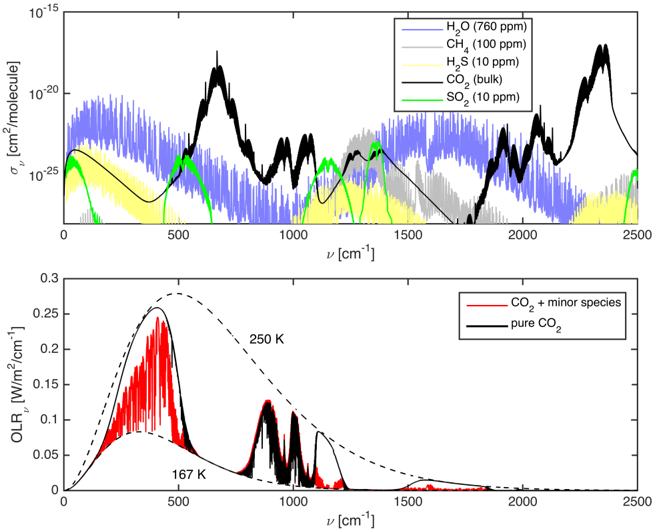
“Further complications arise from the fact that the sub-Lorentzian nature of absorption lines far from their centers must also be taken into account for accurate computation of CO2 absorption in climate models (Perrin & Hartmann 1989).”
BackgroundInfrared collision-induced and far-line absorption in dense CO2 atmospheres
Wordsworth, R., Forget, F., & Eymet, V. (2010) · Icarus · doi:10.1016/j.icarus.2010.06.010 · Cited by 154 · cited 22×
“While possible, this is unlikely, because such high 6 Robin Wordsworth mass loss is not observed in any nearby G or K class stars (Minton & Malhotra 2007).”
InfluentialSelf-citationMalin, M. C., & Edgett, K. S. (1999) · Geophysical Research Letters · doi:10.1029/1999gl002342 · Cited by 150
Goudge, T. A., Head, J. W., Mustard, J. F., & Fassett, C. I. (2012) · Icarus · doi:10.1016/j.icarus.2012.02.027 · Cited by 146 · cited 1×
“In addition, most of the minerals in open-basin crater lakes observed from orbit lack evidence of strong in situ chemical alteration (Goudge et al. 2012).”
BackgroundThe history of Martian volatiles
Jakosky, B. M., & Jones, J. H. (1997) · Reviews of Geophysics · doi:10.1029/96rg02903 · Cited by 144
Stability against freezing of aqueous solutions on early Mars
Fairén, A. G., Davila, A. F., Gago-Duport, L., Amils, R., & McKay, C. P. (2009) · Nature · doi:10.1038/nature07978 · Cited by 142 · cited 1×
“…can combine to create marginally warm conditions and hence small amounts of episodic melting (Richardson & Mischna 2005; Wordsworth et al. 2013; Kite et al. 2013; Mischna et al. 2013; Wordsworth et al. 2015), particularly if the meltwater is assumed to be briny (Fairén et al. 2009; Fairén 2010).”
BackgroundHaberle, R. M. (1998) · Journal of Geophysical Research: Planets · doi:10.1029/98je01396 · Cited by 139 · cited 1×
“( (Over the years, researchers have investigated various greenhouse gas combinations to achieve a warm and wet early Martian climate (Sagan 1977; Postawko & Kuhn 1986; Kasting 1997; Haberle 1998; von Paris et al. 2013; Ramirez et al. 2014).”
BackgroundBarnhart, C. J., Howard, A. D., & Moore, J. M. (2009) · Journal of Geophysical Research: Planets · doi:10.1029/2008je003122 · Cited by 139
Edwards, C. S., & Ehlmann, B. L. (2015) · Geology · doi:10.1130/g36983.1 · Cited by 134 · cited 1×
“Recently, it has been argued based on orbital observations that this reservoir is unlikely to allow more than a 500 mbar CO2 atmosphere during the late Noachian (Edwards & Ehlmann 2015).”
BackgroundVentilation of CO2 from a reduced mantle and consequences for the early Martian greenhouse
Hirschmann, M. M., & Withers, A. C. (2008) · Earth and Planetary Science Letters · doi:10.1016/j.epsl.2008.03.034 · Cited by 131
Kite, E. S., Halevy, I., Kahre, M. A., Wolff, M. J., & Manga, M. (2012) · Icarus · doi:10.1016/j.icarus.2012.11.034 · Cited by 129 · cited 2×
“…can combine to create marginally warm conditions and hence small amounts of episodic melting (Richardson & Mischna 2005; Wordsworth et al. 2013; Kite et al. 2013; Mischna et al. 2013; Wordsworth et al. 2015), particularly if the meltwater is assumed to be briny (Fairén et al. 2009; Fairén…”
BackgroundMethodInfluentialModeling the environmental effects of moderate‐sized impacts on Mars
Segura, T. L., Toon, O. B., & Colaprete, A. (2008) · Journal of Geophysical Research: Planets · doi:10.1029/2008je003147 · Cited by 125
Low palaeopressure of the martian atmosphere estimated from the size distribution of ancient craters
Kite, E. S., Williams, J.-P., Lucas, A., & Aharonson, O. (2014) · Nature Geoscience · doi:10.1038/ngeo2137 · Cited by 123 · cited 1×
“Recent analysis of the Dorsa Aeolis region near Gale crater using this technique has led to an approximate upper limit of 0.9-3.8 bars on atmospheric pressure 3.6 Ga (Kite et al. 2014).”
MethodInfluentialPhotochemical and climate consequences of sulfur outgassing on early Mars
Tian, F., Claire, M. W., Haqq-Misra, J. D., Smith, M., Crisp, D. C., Catling, D., Zahnle, K., & Kasting, J. F. (2010) · Earth and Planetary Science Letters · doi:10.1016/j.epsl.2010.04.016 · Cited by 123
Hyperspectral imaging of convective CO 2 ice clouds in the equatorial mesosphere of Mars
Montmessin, F., Gondet, B., Bibring, J. ‐., Langevin, Y., Drossart, P., Forget, F., & Fouchet, T. (2007) · Journal of Geophysical Research: Planets · doi:10.1029/2007je002944 · Cited by 123 · cited 1×
“5) — an effect that is observed in the Martian mesosphere today (Montmessin et al. 2007).”
BackgroundSulfur‐induced greenhouse warming on early Mars
Johnson, S. S., Mischna, M. A., Grove, T. L., & Zuber, M. T. (2008) · Journal of Geophysical Research: Planets · doi:10.1029/2007je002962 · Cited by 116
Fastook, J. L., & Head, J. W. (2015) · Planetary and Space Science · doi:10.1016/j.pss.2014.11.028 · Cited by 114
Urata, R. A., & Toon, O. B. (2013) · Icarus · doi:10.1016/j.icarus.2013.05.014 · Cited by 112 · cited 2×
“As previously discussed, Forget et al. (2013), Wordsworth et al. (2013) and Urata & Toon (2013) investigated the role of CO2 and H2O clouds in warming the early climate, and found both cloud fraction and mean particle size were critical factors in their radiative effect.”
BackgroundBaranov, Y. I., Lafferty, W. J., & Fraser, G. T. (2004) · Journal of Molecular Spectroscopy · doi:10.1016/j.jms.2004.04.010 · Cited by 110
Brines exposed to Europa surface conditions
McCord, T. B., Teeter, G. R., Hansen, G. B., Sieger, M. T., & Orlando, T. M. (2002) · Journal of Geophysical Research Atmospheres · doi:10.1029/2000je001453 · Cited by 110
Fastook, J. L., Head, J. W., Marchant, D. R., Forget, F., & Madeleine, J.-B. (2012) · Icarus · doi:10.1016/j.icarus.2012.02.013 · Cited by 103 · cited 2×
“As a result of this adiabatic cooling effect, for moderate values of Martian obliquity and atmospheric pressures above around 0.5 bar, the equatorial Noachian highlands (where most valley networks are observed) become cold traps, confirming a prior prediction by Fastook et al. (2012).”
BackgroundInfluentialThe climate history of early Mars: insights from the Antarctic McMurdo Dry Valleys hydrologic system
Head, J. W., & Marchant, D. R. (2014) · Antarctic Science · doi:10.1017/s0954102014000686 · Cited by 103
Kasting, J. F. (1997) · Science · doi:10.1126/science.276.5316.1213 · Cited by 100 · cited 1×
“( (Over the years, researchers have investigated various greenhouse gas combinations to achieve a warm and wet early Martian climate (Sagan 1977; Postawko & Kuhn 1986; Kasting 1997; Haberle 1998; von Paris et al. 2013; Ramirez et al. 2014).”
BackgroundLong-term evolution of transient liquid water on Mars
Richardson, M. I., & Mischna, M. A. (2005) · Journal of Geophysical Research: Planets · doi:10.1029/2004je002367 · Cited by 100
Gruszka, M., & Borysow, A. (1997) · Icarus · doi:10.1006/icar.1997.5773 · Cited by 94 · cited 1×
“For CO2, it occurs due to both induced dipole effects in the 0-250 cm−1 region (Gruszka & Borysow 1997), and dimer effects between 1200 and 1500 cm−1 (Baranov, Lafferty & Fraser 2004) (see Fig.”
BackgroundThe Formation of Martian River Valleys by Impacts
Toon, O. B., Segura, T., & Zahnle, K. (2010) · Annual Review of Earth and Planetary Sciences · doi:10.1146/annurev-earth-040809-152354 · Cited by 94
Effects of obliquity and water vapor/trace gas greenhouses in the early martian climate
Mischna, M. A., Baker, V., Milliken, R., Richardson, M., & Lee, C. (2013) · Journal of Geophysical Research: Planets · doi:10.1002/jgre.20054 · Cited by 84 · cited 4×
“In contrast to their result, recent 3D GCM studies find that in concentrations of under 10 ppm, SO2 warming cannot cause significant melting events on early Mars (Mischna et al. 2013; Kerber, Forget & Wordsworth 2015).”
BackgroundMethodResultInfluentialBasal melting of snow on early Mars: A possible origin of some valley networks
Carr, M. H., & Head, J. W. (2003) · Geophysical Research Letters · doi:10.1029/2003gl018575 · Cited by 77 · cited 1×
“…& Hoke 2010; Matsubara, Howard & Gochenour 2013) rather than e.g., groundwater sapping (Squyres & Kasting 1994) or basal melting of thick icesheets (Carr & Head 2003). www.annualreviews.org • The Climate of Early Mars 3 Valley networks are rare on Hesperian and Amazonian terrain but common on…”
BackgroundReducing greenhouses and the temperature history of Earth and Mars
SAGAN, C. (1977) · Nature · doi:10.1038/269224a0 · Cited by 76 · cited 2×
“Other researchers have looked at hydrogen as a greenhouse gas (Sagan 1977; Ramirez et al. 2014).”
BackgroundEffect of the greenhouse gases (CO2, H2O, SO2) on Martian paleoclimate
Postawko, S. E., & Kuhn, W. R. (1986) · Journal of Geophysical Research: Solid Earth · doi:10.1029/jb091ib04p0d431 · Cited by 74 · cited 2×
“( (Over the years, researchers have investigated various greenhouse gas combinations to achieve a warm and wet early Martian climate (Sagan 1977; Postawko & Kuhn 1986; Kasting 1997; Haberle 1998; von Paris et al. 2013; Ramirez et al. 2014).”
BackgroundAtmospheric conditions on early Mars and the missing layered carbonates
Bullock, M. A., & Moore, J. M. (2007) · Geophysical Research Letters · doi:10.1029/2007gl030688 · Cited by 71 · cited 1×
“Carbonate formation could have been suppressed by acidic surface conditions caused by dissolution of SO2 in water (Bullock & Moore 2007; Halevy, Zuber & Schrag 2007).”
BackgroundHydrology of early Mars: Valley network incision
Matsubara, Y., Howard, A. D., & Gochenour, J. P. (2013) · Journal of Geophysical Research: Planets · doi:10.1002/jgre.20081 · Cited by 69
Morphology of drainage basins as an indicator of climate on early Mars
Stepinski, T. F., & Stepinski, A. P. (2005) · Journal of Geophysical Research: Planets · doi:10.1029/2005je002448 · Cited by 69 · cited 1×
“…strongly suggests an origin due to a hydrological cycle driven by precipitation (as rain or snow) (Craddock & Howard 2002; Mangold et al. 2004; Stepinski & Stepinski 2005; Barnhart, Howard & Moore 2009; Hynek, Beach & Hoke 2010; Matsubara, Howard & Gochenour 2013) rather than e.g.,…”
BackgroundAssessing the Massive Young Sun Hypothesis to Solve the Warm Young Earth Puzzle
Minton, D. A., & Malhotra, R. (2007) · The Astrophysical Journal · doi:10.1086/514331 · Cited by 67 · cited 2×
“One possible way to avoid this outcome is if the Sun shed large amounts of its mass early on [over 2% in the first 2 Gyr; Minton & Malhotra (2007)].”
BackgroundAn impact-induced, stable, runaway climate on Mars
Segura, T. L., McKay, C. P., & Toon, O. B. (2012) · Icarus · doi:10.1016/j.icarus.2012.04.013 · Cited by 65
Radiative transfer in CO2‐rich paleoatmospheres
Halevy, I., Pierrehumbert, R. T., & Schrag, D. P. (2009) · Journal of Geophysical Research: Atmospheres · doi:10.1029/2009jd011915 · Cited by 62
Sulfur in the early martian atmosphere revisited: Experiments with a 3-D Global Climate Model
Kerber, L., Forget, F., & Wordsworth, R. (2015) · Icarus · doi:10.1016/j.icarus.2015.08.011 · Cited by 61
Self-citationA Paleogeographic Model for Vendian and Cambrian Time
Kirschvink, J. L. (1992) · The Proterozoic Biosphere · doi:10.1017/cbo9780511601064.014 · Cited by 58
CO2Greenhouse in the Early Martian Atmosphere: SO2Inhibits Condensation
Yung, Y. L., Nair, H., & Gerstell, M. F. (1997) · Icarus · doi:10.1006/icar.1997.5808 · Cited by 51
Martian atmospheric collapse: Idealized GCM studies
Soto, A., Mischna, M., Schneider, T., Lee, C., & Richardson, M. (2015) · Icarus · doi:10.1016/j.icarus.2014.11.028 · Cited by 49 · cited 2×
“Forget et al. (2013) and Soto et al. (2015) investigated collapse of CO2 atmospheres due to surface condensation.”
BackgroundN2-associated surface warming on early Mars
von Paris, P., Grenfell, J. L., Rauer, H., & Stock, J. W. (2013) · Planetary and Space Science · doi:10.1016/j.pss.2013.04.009 · Cited by 46
Fate of SO2 in the ancient Martian atmosphere: Implications for transient greenhouse warming
Johnson, S. S., Pavlov, A. A., & Mischna, M. A. (2009) · Journal of Geophysical Research: Planets · doi:10.1029/2008je003313 · Cited by 44
Kitzmann, D., Patzer, A. B. C., & Rauer, H. (2013) · Astronomy & Astrophysics · doi:10.1051/0004-6361/201220025 · Cited by 34
Cassanelli, J. P., & Head, J. W. (2015) · Icarus · doi:10.1016/j.icarus.2015.03.004 · Cited by 29 · cited 1×
“This conclusion was broadly confirmed by Cassanelli & Head (2015), who studied the influence of snow and firn thermal blanketing on ice sheet melting under a H2O-limited scenario only.”
ResultOrographic precipitation in valley network headwaters: Constraints on the ancient Martian atmosphere
Scanlon, K. E., Head, J. W., Madeleine, J., Wordsworth, R. D., & Forget, F. (2013) · Geophysical Research Letters · doi:10.1002/grl.50687 · Cited by 26
Self-citationRICHARDSON, J. D., McDonald, F. B., Stone, E. C., Wang, C., & Ashmall, J. (2005) · Journal of Geophysical Research Atmospheres · doi:10.1029/2005ja011156 · Cited by 19
Kahre, M. A., Vines, S. K., Haberle, R. M., & Hollingsworth, J. L. (2013) · Journal of Geophysical Research: Planets · doi:10.1002/jgre.20099 · Cited by 17
Baranov, Y. I. (2004) · Journal of Molecular Spectroscopy · doi:10.1016/s0022-2852(04)00139-0 · Cited by 6
(1969) · doi:10.1175/1520-0469(1969)026<1167:nsotac>2.0.co;2
(1992) · doi:10.1175/1520-0469(1992)049<2256:asotge>2.0.co;2
Research works printed but not linked: 4
- Ehlmann BL, 2015, Lunar Planet. Sci. Conf. Abstr., 46, 1635
- Forster P, 2007, Climate Change 2007: The Physical Science Basis. Contribution of Working Group I to the Fourth Assessment Report of the Intergovernmental Panel on Climate Change, 129
- Howard AD, 1981, Reports of Planetary Geology Program—1981, 286
- Kirschvink JL, 2002, Palaeontol. Electron., 4, 8
Cited by
Living at the Extremes: Extremophiles and the Limits of Life in a Planetary Context
Merino, N., Aronson, H. S., Bojanova, D. P., Feyhl-Buska, J., Wong, M. L., Zhang, S., & Giovannelli, D. (2019) · Frontiers in Microbiology · doi:10.3389/fmicb.2019.00780 · Cited by 658
Transient reducing greenhouse warming on early Mars
Wordsworth, R., Kalugina, Y., Lokshtanov, S., Vigasin, A., Ehlmann, B., Head, J., Sanders, C., & Wang, H. (2017) · Geophysical Research Letters · doi:10.1002/2016gl071766 · Cited by 264
“In combination with Mars’ distant orbit, this implies cold surface conditions: even given a planetary albedo of zero, early Mars would have had an equilibrium temperature of only 210 K [ Wordsworth , 2016].”
InfluentialSelf-citationOrigin and evolution of the atmospheres of early Venus, Earth and Mars
Lammer, H., Zerkle, A. L., Gebauer, S., Tosi, N., Noack, L., Scherf, M., Pilat-Lohinger, E., Güdel, M., Grenfell, J. L., Godolt, M., et al. (2018) · The Astronomy and Astrophysics Review · doi:10.1007/s00159-018-0108-y · Cited by 202
The Role of Meteorite Impacts in the Origin of Life
Osinski, G. R., Cockell, C. S., Pontefract, A., & Sapers, H. M. (2020) · Astrobiology · doi:10.1089/ast.2019.2203 · Cited by 183
“This hypothesis is more consistent with the faint young Sun hypothesis (Wordsworth, 2016), creating uncertainty around the habitability of early Mars.”
BackgroundResultInfluentialWay, M. J., & Del Genio, A. D. (2020) · Journal of Geophysical Research: Planets · doi:10.1029/2019je006276 · Cited by 171
Metadata
- Authors
- Wordsworth, R. D.
- Affiliations
- Harvard University (US)
- Corresponding author
- Wordsworth, Robin D.
- ORCID
- Wordsworth, Robin D.
- Venue
- Annual Review of Earth and Planetary Sciences
- Publisher
- Annual Reviews
- Published
- 2016-06-29
- Volume
- 44
- Issue
- 1
- Pages
- 381-408
- ISSN
- 0084-6597 (ISSN-L)
- 1545-4495
- OpenAlex
- W2416138856
- Cited by
- 416
- References
- 153
- Citations by year
- 2026: 43 · 2025: 43 · 2024: 41 · 2023: 45 · 2022: 44 · 2021: 53 · 2020: 41 · 2019: 38 · 2018: 41 · 2017: 19 · 2016: 7
- FWCI
- 2.62
- Type
- journal article
- Language
- en
- Open access
- bronze
- doi.org
- Locations
- Annual Review of Earth and Planetary Sciences (publishedVersion)
- arXiv (Cornell University) (publishedVersion)
- Digital Access to Scholarship at Harvard (DASH) (Harvard University) (submittedVersion, cc-by)
- arXiv (Cornell University)
- Topics
- Physical Sciences › Earth and Planetary Sciences › Space and Planetary Science › Planetary Science and Exploration
- Physical Sciences › Earth and Planetary Sciences › Space and Planetary Science › Astro and Planetary Science
- Physical Sciences › Earth and Planetary Sciences › Atmospheric Science › Geology and Paleoclimatology Research
- Keywords
- early Mars climate, global warming, adiabatic cooling, valley networks, fluvial erosion, impact heating, orbital forcing, Late Noachian, Early Hesperian, glaciation, habitability, microorganisms, climate modeling
About these checks
Registry, retraction, Cites and statistics results are computed, not judged, with one exception: a printed reference that no index lists is read once by a model before it counts as a citation error. Claims are extracted by a model and kept only when their quote appears verbatim in the text; each cited source is then checked, with a model’s help, for whether it says what the claim relies on. Those verdicts can be wrong — read the claim’s quote and the cited source before relying on one.
The claim verdicts this report counts are experimental: their accuracy is not yet measured.
A language model drew the claims from the paper on 2026-10-10, under version 3 of the claim definition (model deepseek-v4.1-flash, prompt extract-v3).
A second model labelled each claim on 2026-10-10 (model jev-1.13-20260917, definition revision gold-guideline-v0.2).
Cited sources are checked with a language model’s help (gpt-6-sol).
Statistics and arithmetic are recomputed, not judged.
Confidence bands are shown only for fields calibrated on our annotated test set. None is calibrated yet, so no band is shown.
What counts as a claim ›How we measure confidence ›How we check this ›
Are you an author, or do you see a problem with this page? Request a review
Data sources
Bibliographic data: Semantic Scholar, OpenAlex, Crossref.
Contains information from the Semantic Scholar Academic Graph Datasets, made available under the ODC Attribution License (ODC-BY 1.0).
Semantic Scholar’s data is described in: Kinney, R., et al. (2023). The Semantic Scholar Open Data Platform. arXiv:2301.10140.
