

The DOI matches its Crossref record; 98 of the 98 references it cites were found in a registry or an index.
Shift Work, Jet Lag, and Female Reproduction
Open accessAbstract
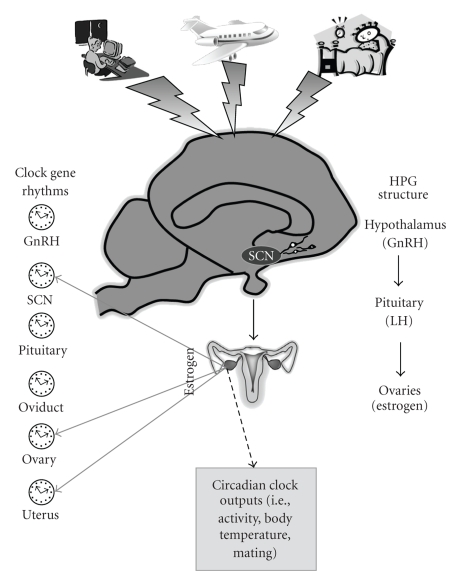
Circadian rhythms and “clock gene” expression are involved in successful reproductive cycles, mating, and pregnancy. Alterations or disruptions of biological rhythms, as commonly occurs in shift work, jet lag, sleep deprivation, or clock gene knock out models, are linked to significant disruptions in reproductive function. These impairments include altered hormonal secretion patterns, reduced conception rates, increased miscarriage rates and an increased risk of breast cancer. Female health may be particularly susceptible to the impact of desynchronizing work schedules as perturbed hormonal rhythms can further influence the expression patterns of clock genes. Estrogen modifies clock gene expression in the uterus, ovaries, and suprachiasmatic nucleus, the site of the primary circadian clock mechanism. Further work investigating clock genes, light exposure, ovarian hormones, and reproductive function will be critical for indentifying how these factors interact to impact health and susceptibility to disease.
Overview
The claims and statistics of this paper haven’t been checked yet.
Run the check — free, no account needed. It reads the open-access text and checks the sources it cites.
Integrity signals
Registry
Cites
Statistics
Figures
Verification
Claims the paper makes
The claims and statistics of this paper haven’t been checked yet.
Run the check — free, no account needed. It reads the open-access text and checks the sources it cites.
Claims other papers make about this one
Each is checked against this paper’s own text: does it say what the citing paper says it does?
In the citing paper
“Epidemiological studies report increased risks of preterm delivery, low birthweights and miscarriage in pregnant women who are chronic shift-workers37–40.”
From Rhythms of life: circadian disruption and brain disorders across the lifespan (2019) · cites this paper as [40]
Self-check
Percentages, sums and reported differences re-computed from the paper’s own numbers.
The self-check needs the paper’s full text.
Citations
Cites
The Physiology of Reproduction
Legendre, M., & Jalabert, B. (1988) · Annals of Internal Medicine · doi:10.7326/0003-4819-109-2-176_1 · Cited by 7,876
Resetting central and peripheral circadian oscillators in transgenic rats
Yamazaki, S., Numano, R., Abe, M., Hida, A., Takahashi, R.-I., Ueda, M., Block, G. D., Sakaki, Y., Menaker, M., & Tei, H. (2000) · Science · doi:10.1126/science.288.5466.682 · Cited by 1,907
Suprachiasmatic nucleus : the mind's clock
Klein, D. C., Moore, R. Y., & Reppert, S. M. (1991) · Cited by 1,715
Health disorders of shift workers
Knutsson, A. (2003) · Occupational Medicine · doi:10.1093/occmed/kqg048 · Cited by 1,218
Rotating night shifts and risk of breast cancer in women participating in the nurses׳ health study
Schernhammer, E. S., Laden, F., Speizer, F. E., Willett, W. C., Hunter, D. J., Kawachi, I., & Colditz, G. A. (2001) · JNCI Journal of the National Cancer Institute · doi:10.1093/jnci/93.20.1563 · Cited by 1,142
Night Shift Work, Light at Night, and Risk of Breast Cancer
Davis, S., Mirick, D. K., & Stevens, R. G. (2001) · JNCI Journal of the National Cancer Institute · doi:10.1093/jnci/93.20.1557 · Cited by 930
Shigeyoshi, Y., Taguchi, K., Yamamoto, S., Takekida, S., Yan, L., Tei, H., Moriya, T., Shibata, S., Loros, J. J., Dunlap, J. C., et al. (1997) · Cell · doi:10.1016/s0092-8674(00)80494-8 · Cited by 891
Zylka, M. J., Shearman, L. P., Weaver, D. R., & Reppert, S. M. (1998) · Neuron · doi:10.1016/s0896-6273(00)80492-4 · Cited by 865
Two period Homologs: Circadian Expression and Photic Regulation in the Suprachiasmatic Nuclei
Shearman, L. P., Zylka, M. J., Weaver, D. R., Kolakowski, L. F., & Reppert, S. M. (1997) · Neuron · doi:10.1016/s0896-6273(00)80417-1 · Cited by 781
Chrousos, G. P., Torpy, D. J., & Gold, P. W. (1998) · Annals of Internal Medicine · doi:10.7326/0003-4819-129-3-199808010-00012 · Cited by 711
Research works printed but not linked: 7
- 2001, American Journal of Physiology, 281, E384
- 1989, American Journal of Physiology, 257, R796
- 1984, Aviation Space and Environmental Medicine, 55, 1085
- 1994, Rhythms in reproduction
- 1993, American Journal of Physiology, 264, R1186
- 1993, Human Reproduction, 8, 77
- 1987, Obstetrics and Gynecology, 70, 852
Cited by
Sorted by citations
Rhythms of life: circadian disruption and brain disorders across the lifespan
Logan, R. W., & McClung, C. A. (2019) · Nature Reviews Neuroscience · doi:10.1038/s41583-018-0088-y · Cited by 713
Shift work and the assessment and management of shift work disorder (SWD)
Wright, K. P., Bogan, R. K., & Wyatt, J. K. (2013) · Sleep Medicine Reviews · doi:10.1016/j.smrv.2012.02.002 · Cited by 437
Fatigue and its management in the workplace
Caldwell, J. A., Caldwell, J. L., Thompson, L., & Lieberman, H. R. (2018) · Neuroscience & Biobehavioral Reviews · doi:10.1016/j.neubiorev.2018.10.024 · Cited by 444
Melatonin and stable circadian rhythms optimize maternal, placental and fetal physiology
Reiter, R. J., Tan, D. X., Korkmaz, A., & Rosales-Corral, S. A. (2014) · Human Reproduction Update · doi:10.1093/humupd/dmt054 · Cited by 371
Melatonin’s Impact on Antioxidative and Anti-Inflammatory Reprogramming in Homeostasis and Disease
Chitimus, D. M., Popescu, M. R., Voiculescu, S. E., Panaitescu, A. M., Pavel, B., Zagrean, L., & Zagrean, A.-M. (2020) · Biomolecules · doi:10.3390/biom10091211 · Cited by 354
Metadata
- Authors
- Mahoney, M. M.
- Affiliations
- University of Illinois Urbana-Champaign (US)
- Corresponding author
- Mahoney, Megan M.
- ORCID
- Mahoney, Megan M.
- Venue
- International Journal of Endocrinology
- Publisher
- Wiley
- Published
- 2010
- Volume
- 2010
- Pages
- 1-9
- ISSN
- 1687-8337 (ISSN-L)
- 1687-8345
- PMC
- PMC2834958
- OpenAlex
- W2092516139
- Cited by
- 209
- References
- 98
- Citations by year
- 2026: 7 · 2025: 11 · 2024: 13 · 2023: 19 · 2022: 10 · 2021: 15 · 2020: 19 · 2019: 19 · 2018: 17 · 2017: 7 · 2016: 9 · 2015: 9 · 2014: 13 · 2013: 14 · 2012: 12
- FWCI
- 5.95
- Type
- journal article
- Language
- en
- Open access
- gold
- doi.org
- Locations
- International Journal of Endocrinology (publishedVersion, cc-by)
- PubMed Central (publishedVersion, cc-by)
- PubMed (publishedVersion)
- DOAJ (DOAJ: Directory of Open Access Journals) (submittedVersion, cc-by-sa)
- Topics
- Life Sciences › Neuroscience › Endocrine and Autonomic Systems › Circadian rhythm and melatonin
- Social Sciences › Psychology › Experimental and Cognitive Psychology › Sleep and Work-Related Fatigue
- Health Sciences › Medicine › Reproductive Medicine › Reproductive Biology and Fertility
- Keywords
- shift work, jet lag, female reproduction, circadian rhythm, clock genes, reproductive hormones, estrogen, suprachiasmatic nucleus, sleep deprivation, miscarriage, breast cancer risk, ovarian hormones, light exposure
About these checks
Registry, retraction, Cites and statistics results are computed, not judged, with one exception: a printed reference that no index lists is read once by a model before it counts as a citation error. Claims are extracted by a model and kept only when their quote appears verbatim in the text; each cited source is then checked, with a model’s help, for whether it says what the claim relies on. Those verdicts can be wrong — read the claim’s quote and the cited source before relying on one.
Statistics and arithmetic are recomputed, not judged.
Confidence bands are shown only for fields calibrated on our annotated test set. None is calibrated yet, so no band is shown.
What counts as a claim ›How we measure confidence ›How we check this ›
Are you an author, or do you see a problem with this page? Request a review
