

Safety of Autonomous Vehicles
Open accessThe DOI matches its Crossref record; 91 of the 93 references it cites were found in a registry or an index.
Abstract
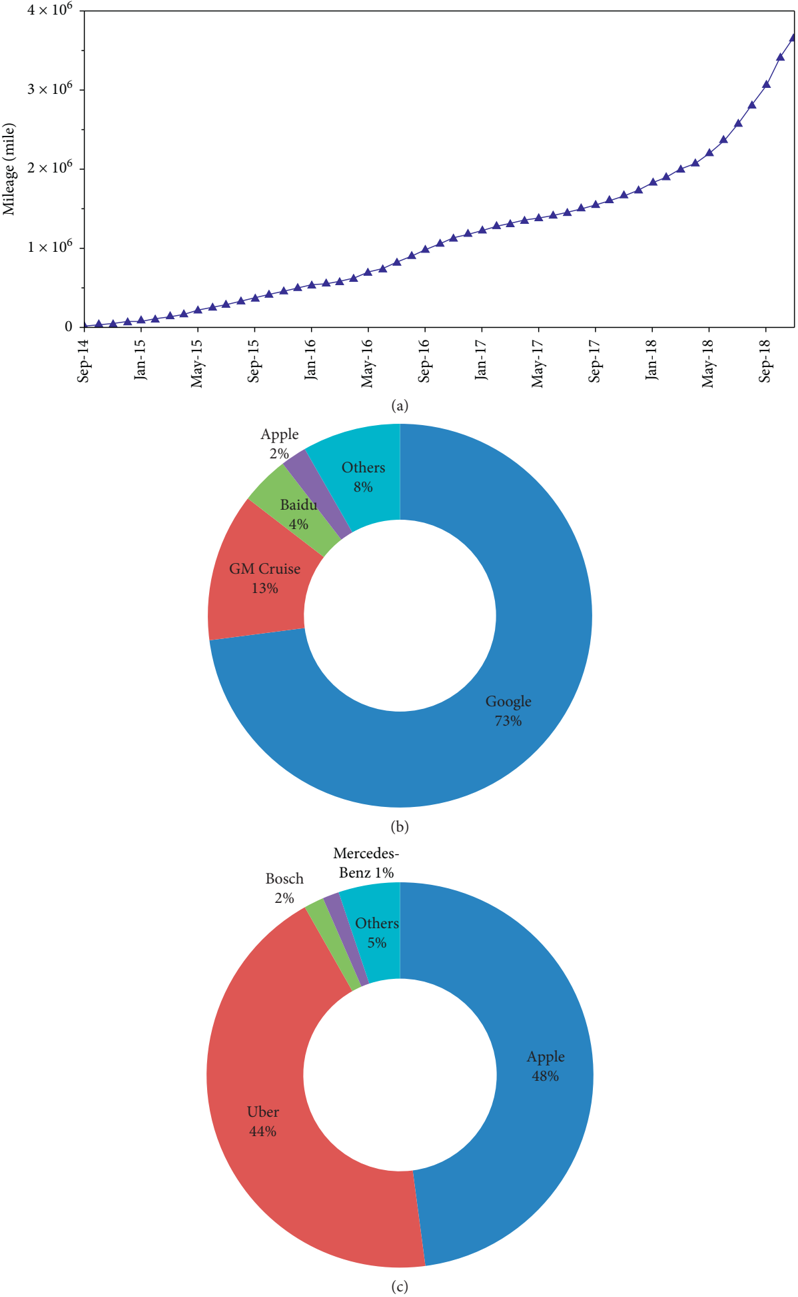
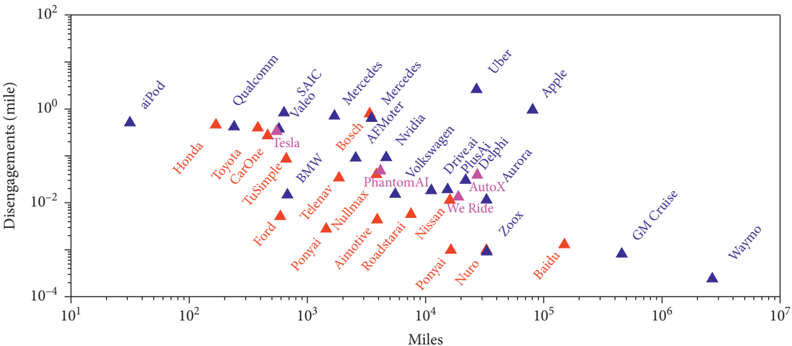
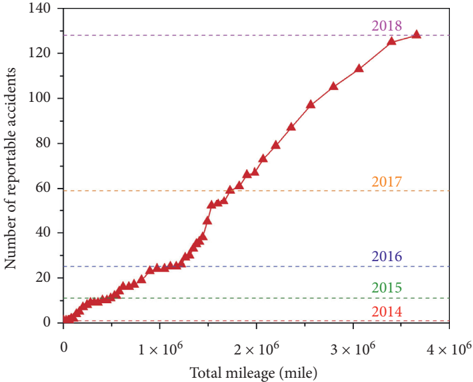
Autonomous vehicle (AV) is regarded as the ultimate solution to future automotive engineering; however, safety still remains the key challenge for the development and commercialization of the AVs. Therefore, a comprehensive understanding of the development status of AVs and reported accidents is becoming urgent. In this article, the levels of automation are reviewed according to the role of the automated system in the autonomous driving process, which will affect the frequency of the disengagements and accidents when driving in autonomous modes. Additionally, the public on-road AV accident reports are statistically analyzed. The results show that over 3.7 million miles have been tested for AVs by various manufacturers from 2014 to 2018. The AVs are frequently taken over by drivers if they deem necessary, and the disengagement frequency varies significantly from 2 × 10⁻⁴ to 3 disengagements per mile for different manufacturers. In addition, 128 accidents in 2014–2018 are studied, and about 63% of the total accidents are caused in autonomous mode. A small fraction of the total accidents (∼6%) is directly related to the AVs, while 94% of the accidents are passively initiated by the other parties, including pedestrians, cyclists, motorcycles, and conventional vehicles. These safety risks identified during on-road testing, represented by disengagements and actual accidents, indicate that the passive accidents which are caused by other road users are the majority. The capability of AVs to alert and avoid safety risks caused by the other parties and to make safe decisions to prevent possible fatal accidents would significantly improve the safety of AVs. Practical applications. This literature review summarizes the safety-related issues for AVs by theoretical analysis of the AV systems and statistical investigation of the disengagement and accident reports for on-road testing, and the findings will help inform future research efforts for AV developments.
Overview
The claims and statistics of this paper haven’t been checked yet.
Free: it reads the open-access text and checks the first 5 claims that cite a source we can check. Create a free account to check every claim.
Integrity signals
Registry
Cites
Statistics
Figures
Verification
Claims the paper makes
The claims and statistics of this paper haven’t been checked yet.
Free: it reads the open-access text and checks the first 5 claims that cite a source we can check. Create a free account to check every claim.
Claims other papers make about this one
Each is checked against this paper’s own text: does it say what the citing paper says it does?
The source backs part of the claim, not all of it — or backs it for a different population, condition or comparison.
In the citing paper
“However, several studies have been published on the performance of ADS-mounted sensors, but research analyzing the level of impact on the driving safety of AVs by ODD is still insufficient [16][17][18][19].”
From Evaluation of Autonomous Driving Safety by Operational Design Domains (ODD) in Mixed Traffic (2024) · cites this paper as [18]
Experimental — accuracy not yet measuredThe check wasn’t confident either way, so it gives no verdict — never disputed.
In the citing paper
“The inadequate evaluation of deep learning systems can have significant consequences, including risks to patient well-being [165] and safety [208].”
From A 2030 Roadmap for Software Engineering (2025) · cites this paper as [208]
Experimental — accuracy not yet measured
Self-check
Percentages, sums and reported differences re-computed from the paper’s own numbers.
The self-check needs the paper’s full text.
Citations
Cites
A model for types and levels of human interaction with automation
Parasuraman, R., Sheridan, T. B., & Wickens, C. D. (2000) · IEEE Transactions on Systems, Man, and Cybernetics - Part A: Systems and Humans · doi:10.1109/3468.844354 · Cited by 4,195 · cited 1×
“*e details of the ten levels of automation can be found elsewhere [33, 34].”
BackgroundPreparing a nation for autonomous vehicles: opportunities, barriers and policy recommendations
Fagnant, D. J., & Kockelman, K. (2015) · Transportation Research Part A: Policy and Practice · doi:10.1016/j.tra.2015.04.003 · Cited by 3,214 · cited 4×
“Audi, BMW, Mercedes-Benz, Volkswagen, Volvo, Ford, General Motors, Toyota, Nissan, as well as Google, Baidu, and other research institutes, have begun testing on- and off-road AVs [13, 28].”
BackgroundInfluentialA Review of Motion Planning Techniques for Automated Vehicles
Gonzalez, D., Perez, J., Milanes, V., & Nashashibi, F. (2016) · IEEE Transactions on Intelligent Transportation Systems · doi:10.1109/tits.2015.2498841 · Cited by 1,670 · cited 3×
“*e communication errors may come from errors resulted from the communication between the AVs and the corresponding infrastructure [57], other road users [44], and the Internet [60].”
BackgroundHuman and Computer Control of Undersea Teleoperators
Sheridan, T. B., & Verplank, W. L. (1978) · doi:10.21236/ada057655 · Cited by 1,227 · cited 3×
“*e details of the ten levels of automation can be found elsewhere [33, 34].”
BackgroundUser preferences regarding autonomous vehicles
Haboucha, C. J., Ishaq, R., & Shiftan, Y. (2017) · Transportation Research Part C: Emerging Technologies · doi:10.1016/j.trc.2017.01.010 · Cited by 996
Three Decades of Driver Assistance Systems: Review and Future Perspectives
Bengler, K., Dietmayer, K., Farber, B., Maurer, M., Stiller, C., & Winner, H. (2014) · IEEE Intelligent Transportation Systems Magazine · doi:10.1109/mits.2014.2336271 · Cited by 868
Internet of vehicles: From intelligent grid to autonomous cars and vehicular clouds
Gerla, M., Lee, E.-K., Pau, G., & Lee, U. (2014) · 2014 IEEE World Forum on Internet of Things (WF-IoT) · doi:10.1109/wf-iot.2014.6803166 · Cited by 828
(2015) · Cited by 809
Dissipation of stop-and-go waves via control of autonomous vehicles: Field experiments
Stern, R. E., Cui, S., Delle Monache, M. L., Bhadani, R., Bunting, M., Churchill, M., Hamilton, N., Haulcy, R., Pohlmann, H., Wu, F., et al. (2018) · Transportation Research Part C: Emerging Technologies · doi:10.1016/j.trc.2018.02.005 · Cited by 800 · cited 1×
“carried out a ring road experiment involving both autonomous and human-operated vehicles, and their results indicate that a single AV can be used to control the traffic flow of at least 20 human-operated vehicles with significant improvements in vehicle velocity standard deviation, excessive braking, and fuel economy…”
MethodPerceptions of autonomous vehicles: Relationships with road users, risk, gender and age
Hulse, L. M., Xie, H., & Galea, E. R. (2018) · Safety Science · doi:10.1016/j.ssci.2017.10.001 · Cited by 698 · cited 1×
“’s studies indicated that the youth with high salary and education male are the most optimistic about the AV safety [29], while western European countries are more pessimistic about the safety in comparison with Asian countries [30].”
Background
Research works printed but not linked: 4
- M. Bonner, R. Taylor, K. Fletcher, and C. Miller, "Adaptive automation and decision aiding in the military fast jet do- main," in Proceedings of the Conference on Human Perfor- mance, Situation Awareness and Automation: User Centered Design for the New Millenium, pp. 154-159, Savannah, GA, USA, October 2000.
- SAE International, Surface Vehicle Recommended Practice (R) Taxonomy and Definitions for Terms Related to Driving Au- tomation Systems for On-Road Motor Vehicles, SAE Inter- national, Pittsburgh, PA, USA, 2018.
- United States Department of Transportation, 2019, Automated Vehicles for Safety
- T. Nimmagadda, Building an Autonomous Ground Traffic System, Technical Report HR-09-09, e University of Texas, Austin, TX, USA, 2007.
Cited by
Khogali, H. O., & Mekid, S. (2023) · Technology in Society · doi:10.1016/j.techsoc.2023.102232 · Cited by 335
Autonomous Vehicles Enabled by the Integration of IoT, Edge Intelligence, 5G, and Blockchain
Biswas, A., & Wang, H.-C. (2023) · Sensors · doi:10.3390/s23041963 · Cited by 274
Multi-Modal 3D Object Detection in Autonomous Driving: A Survey and Taxonomy
Wang, L., Zhang, X., Song, Z., Bi, J., Zhang, G., Wei, H., Tang, L., Yang, L., Li, J., Jia, C., et al. (2023) · IEEE Transactions on Intelligent Vehicles · doi:10.1109/tiv.2023.3264658 · Cited by 269
“Therefore, autonomousdrivingisaimtoimprovesafedriving,increase trafficefficiencyandrelievedrivers’burden[2],[3],[4].”
Connected and Autonomous Vehicles and Infrastructures: A Literature Review
Rana, M. M., & Hossain, K. (2023) · International Journal of Pavement Research and Technology · doi:10.1007/s42947-021-00130-1 · Cited by 156
“7 million passing are found to happen in autonomous mode [38].”
BackgroundBlockchain and Autonomous Vehicles: Recent Advances and Future Directions
Jain, S., Ahuja, N. J., Srikanth, P., Bhadane, K. V., Nagaiah, B., Kumar, A., & Konstantinou, C. (2021) · IEEE Access · doi:10.1109/access.2021.3113649 · Cited by 168
“It has been observed in recent studies that many such critically social and environmental issues can be resolved using AVs, driving, or systems [153]–[155].”
BackgroundArtificial Intelligence in Surgery: The Future is Now
Guni, A., Varma, P., Zhang, J., Fehervari, M., & Ashrafian, H. (2024) · European Surgical Research · doi:10.1159/000536393 · Cited by 90
“A hierarchy of robotic autonomy has been conceptualised, often paralleled to driving autonomy that scales from level 0 (no automation) to level 5 (full driving automation) [90].”
Deployment of Autonomous Trains in Rail Transportation: Current Trends and Existing Challenges
Singh, P., Dulebenets, M. A., Pasha, J., González, E. D. R. S., Lau, Y., & Kampmann, R. (2021) · IEEE Access · doi:10.1109/access.2021.3091550 · Cited by 162
Alashqar, M. M., Abulehia, A. F. S., Elshobake, M. R. M., Abdul Rahim, A., & Abd Aziz, A. S. (2021) · Journal International Studies · doi:10.32890/jis · Cited by 132
A Survey on Sensor Failures in Autonomous Vehicles: Challenges and Solutions
Matos, F., Bernardino, J., Duraes, J. A., & Cunha, J. C. (2024) · Sensors · doi:10.3390/s24165108 · Cited by 121
“Notwithstanding the current disbelief and uncertainty about fully autonomous vehicles [4,5], the number of vehicles using some degree of autonomous driving is increasing every year [6].”
BackgroundAnomaly Detection in Connected and Autonomous Vehicles: A Survey, Analysis, and Research Challenges
Baccari, S., Hadded, M., Ghazzai, H., Touati, H., & Elhadef, M. (2024) · IEEE Access · doi:10.1109/access.2024.3361829 · Cited by 109
“The presence of outliers can result from various factors such as the presence of multiple objects with different profiles, especially in urban scenarios, the low accuracy of perception sensor measurements, the loss of data after the fusion process, etc. [20].”
BackgroundCybersecurity in Autonomous Vehicles—Are We Ready for the Challenge?
Durlik, I., Miller, T. I., Kostecka, E., Zwierzewicz, Z., & Łobodzińska, A. (2024) · Electronics · doi:10.3390/electronics13132654 · Cited by 109
Formal Certification Methods for Automated Vehicle Safety Assessment
Zhao, T., Yurtsever, E., Paulson, J. A., & Rizzoni, G. (2022) · IEEE Transactions on Intelligent Vehicles · doi:10.1109/tiv.2022.3170517 · Cited by 90
“…the various aspects of the technical challenges and implementation, such as ways to perform perception, decision making, vehicle control, human machine interaction[8], with a few reviews covering the issue of AV safety verification and validation[9], [10], [11], [12], [13], [14], [15], [16], [17].”
A Crash Injury Model Involving Autonomous Vehicle: Investigating of Crash and Disengagement Reports
Sinha, A., Vu, V., Chand, S., Wijayaratna, K. P., & Dixit, V. V. (2021) · Sustainability · doi:10.3390/su13147938 · Cited by 73
Systematic Literature Review: Anomaly Detection in Connected and Autonomous Vehicles
Solaas, J. R. V., Mariconti, E., & Tuptuk, N. (2024) · IEEE Transactions on Intelligent Transportation Systems · doi:10.1109/tits.2024.3495031 · Cited by 68
“Examples of such techniques include real-time sensor anomaly detection [2], detecting faults in the vehicle parts such as battery [3] and detecting driver behaviour anomalies [4].”
Patel, R. K., Etminani-Ghasrodashti, R., Kermanshachi, S., Rosenberger, J. M., Pamidimukkala, A., & Foss, A. W. (2023) · Transportation Research Interdisciplinary Perspectives · doi:10.1016/j.trip.2023.100785 · Cited by 60
Towards common ethical and safe ‘behaviour’ standards for automated vehicles
Papadimitriou, E., Farah, H., van de Kaa, G., de Sio, F. S., Hagenzieker, M., & van Gelder, P. H. A. J. M. (2022) · Accident Analysis & Prevention · doi:10.1016/j.aap.2022.106724 · Cited by 59
Cheng, Z., Zhu, J., Feng, Z., Yang, M., Zhang, W., & Jin, C. (2025) · IEEE Transactions on Intelligent Transportation Systems · doi:10.1109/tits.2025.3526820 · Cited by 64
“Wang et al. [115] designed a reference driver model, and by combining Monte Carlo tree search with model predictive control, this approach allows the model to make safer and more rational driving decisions by taking into account possible future risks and outcomes when making decisions.”
Autonomous driving test system under hybrid reality: The role of digital twin technology
Shoukat, M. U., Yan, L., Yan, Y., Zhang, F., Zhai, Y., Han, P., Nawaz, S. A., Raza, M. A., Akbar, M. W., & Hussain, A. (2024) · Internet of Things · doi:10.1016/j.iot.2024.101301 · Cited by 58
Crash and disengagement data of autonomous vehicles on public roads in California
Sinha, A., Chand, S., Vu, V., Chen, H., & Dixit, V. V. (2021) · Scientific Data · doi:10.1038/s41597-021-01083-7 · Cited by 57
Influence of perceived safety in the technology acceptance model
Yao, S., Xie, L., Chen, Y., Zhang, Y., Chen, Y., & Gao, M. (2023) · Transportation Research Part F Traffic Psychology and Behaviour · doi:10.1016/j.trf.2023.10.010 · Cited by 54
Zhang, T., Liu, H., Wang, W., & Wang, X. (2024) · Electronics · doi:10.3390/electronics13173486 · Cited by 54
Tamakloe, R., & Park, D. (2023) · Transport Policy · doi:10.1016/j.tranpol.2023.06.001 · Cited by 53
Advancing Autonomous Vehicle Safety: Machine Learning to Predict Sensor-Related Accident Severity
Shafique, R., Rustam, F., Murtala, S., Jurcut, A. D., & Choi, G. S. (2024) · IEEE Access · doi:10.1109/access.2024.3366990 · Cited by 51
“The advent of autonomous vehicles (AVs) has transformed the landscape of transportation, promising increased efficiency and safety on our roads [1].”
BackgroundAutomated lane change behavior prediction and environmental perception based on SLAM technology
Han, L., Wang, B., Shui, Z., Yang, P., & Liang, P. (2024) · Applied and Computational Engineering · doi:10.54254/2755-2721/67/2024ma0054 · Cited by 54
Artificial Intelligence for Software Engineering: The Journey So Far and the Road Ahead
Ahmed, I., Aleti, A., Cai, H., Chatzigeorgiou, A., He, P., Hu, X., Pezzè, M., Poshyvanyk, D., & Xia, X. (2025) · ACM Transactions on Software Engineering and Methodology · doi:10.1145/3719006 · Cited by 54
Design of Automotive HMI: New Challenges in Enhancing User Experience, Safety, and Security
Grobelna, I., Mailland, D., & Horwat, M. (2025) · Applied Sciences · doi:10.3390/app15105572 · Cited by 51
Work with AI and Work for AI: Autonomous Vehicle Safety Drivers’ Lived Experiences
Chu, M., Zong, K., Shu, X., Gong, J., Lu, Z., Guo, K., Dai, X., & Zhou, G. (2023) · CHI Conference on Human Factors in Computing Systems · doi:10.1145/3544548.3581564 · Cited by 43
Kumar, G., James, A. T., Choudhary, K., Sahai, R., & Song, W. K. (2022) · Technological Forecasting and Social Change · doi:10.1016/j.techfore.2022.122080 · Cited by 39
Road Safety Analysis of Autonomous Vehicles: An Overview
Szűcs, H., & Hézer, J. (2022) · Periodica Polytechnica Transportation Engineering · doi:10.3311/pptr.19605 · Cited by 41
From Traditional to Autonomous Vehicles: A Systematic Review of Data Availability
Masello, L., Sheehan, B., Murphy, F., Castignani, G., McDonnell, K., & Ryan, C. (2021) · Transportation Research Record Journal of the Transportation Research Board · doi:10.1177/03611981211057532 · Cited by 37
“Concerning AV accidents, in the majority of the cases, the reported accidents occurred at an intersection, with the AV being rear-ended, and no instances in which the vehicles involved were traveling in opposite directions (196, 197).”
BackgroundConvergence of Emerging Transportation Trends: A Comprehensive Review of Shared Autonomous Vehicles
Almaskati, D. N., Kermanshachi, S., & Pamidimukkala, A. (2024) · Journal of Intelligent and Connected Vehicles · doi:10.26599/jicv.2023.9210043 · Cited by 37
Impact of Autonomous Vehicles on Traffic Crashes in Comparison with Conventional Vehicles
Channamallu, S. S., Kermanshachi, S., & Pamidimukkala, A. (2023) · ASCE International Conference on Transportation and Development (ICTD) · doi:10.1061/9780784484876.005 · Cited by 35
Leveraging Cloud Computing to Make Autonomous Vehicles Safer
Schafhalter, P., Kalra, S., Xu, L., Gonzalez, J. E., & Stoica, I. G. (2023) · IEEE/RSJ International Conference on Intelligent Robots and Systems (IROS) · doi:10.1109/iros55552.2023.10341821 · Cited by 34
“However, to fulfill their potential, AVs must surpass the safety levels of human drivers and handle a diverse set of challenging driving scenarios [2,3].”
BackgroundAgrawal, S., Schuster, A. M., Britt, N., Mack, E. A., Tidwell, M. L., & Cotten, S. R. (2022) · Technology in Society · doi:10.1016/j.techsoc.2022.102186 · Cited by 33
Mayer, M. M., Buchner, A., & Bell, R. (2023) · Frontiers in Psychology · doi:10.3389/fpsyg.2022.1052729 · Cited by 31
“Even though it may yet take several years of development until fully autonomous driving will have reached an acceptable level of safety and reliability (for analyses of accident reports with autonomous vehicles see, e.g., Favarò et al., 2017; Wang et al., 2020), autonomous-driving technology promises to bring many ben…”
BackgroundPeng, W., & Robinson-Tay, K. (2025) · Transportation Research Part F Traffic Psychology and Behaviour · doi:10.1016/j.trf.2025.03.014 · Cited by 28
The formation of initial trust by potential passengers of self-driving taxis
Xie, H., David, A., Mamun, M. R. A., Prybutok, V. R., & Sidorova, A. (2022) · Journal of Decision System · doi:10.1080/12460125.2021.2023258 · Cited by 28
“Wang et al. (2020) focused on safety concerns and analysed public on-road reports of accidents involving autonomous vehicles between 2014 and 2018.”
BackgroundYuan, Q., Xu, X., Wang, T., & Chen, Y. (2022) · Journal of Intelligent and Connected Vehicles · doi:10.1108/jicv-04-2022-0012 · Cited by 28
A Survey of Decision-Making Safety Assessment Methods for Autonomous Vehicles
Pang, Z., Chen, Z., Lu, J., Zhang, M., Feng, X., Chen, Y., Yang, S., & Cao, Y. (2023) · IEEE Intelligent Transportation Systems Magazine · doi:10.1109/mits.2023.3292511 · Cited by 26
“AVs need to interact with other vehicles, pedestrians, and various obstacles on the road and make real-time decisions based on changes in the environment, with safety being the most important aspect [6], [7], [8], [9].”
BackgroundHuman–Machine Interfaces: A Review for Autonomous Electric Vehicles
Mandujano-Granillo, J. A., Candela-Leal, M. O., Ortiz-Vazquez, J. J., Ramírez-Moreno, M. A., Tudón-Martínez, J. C., Felix-Herran, L. C., Galvan-Galvan, A., & Lozoya-Santos, J. D. J. (2024) · IEEE Access · doi:10.1109/access.2024.3450439 · Cited by 26
“The challenges of HMI design involve improving users’ perceived safety, reliability, and experience to increase the acceptance of autonomous vehicles [18].”
BackgroundScene terrain classification for autonomous vehicle navigation based on semantic segmentation method
Fusic, S. J., Hariharan, K., Sitharthan, R., & Karthikeyan, S. (2021) · Transactions of the Institute of Measurement and Control · doi:10.1177/01423312211062972 · Cited by 26
“The error minimization in autonomous system navigation is improved by introducing a machine learning algorithm that trains the effective classifier for detecting and recognizing obstacles in the navigation path (Wang et al., 2020).”
MethodArtificial intelligence in modern clinical practice (Review)
Thomas, K., Edpuganti, S., Puthooran, D. M., Thomas, A., Joy, A., & Latheef, S. (2025) · Medicine International · doi:10.3892/mi.2025.289 · Cited by 25
Zakeri, S., Konstantas, D., Sorooshian, S., & Chatterjee, P. (2024) · Artificial Intelligence Review · doi:10.1007/s10462-024-10917-w · Cited by 26
The Impact of Autonomous Vehicles on Safety, Economy, Society, and Environment
Gherardini, L., & Cabri, G. (2024) · World Electric Vehicle Journal · doi:10.3390/wevj15120579 · Cited by 26
“Safety should also be addressed from a technological point of view [32,33].”
Autonomous vehicle safety: An advanced bagging classifier technique for crash injury prediction
Channamallu, S. S., Almaskati, D. N., Kermanshachi, S., & Pamidimukkala, A. (2025) · Multimodal Transportation · doi:10.1016/j.multra.2025.100189 · Cited by 25
Tang, W. T., Yu, W., Feng, C., & Mei, Z. (2023) · Sustainable Cities and Society · doi:10.1016/j.scs.2023.105016 · Cited by 23
A conceptual framework for automation disengagements
Nordhoff, S. (2024) · Scientific Reports · doi:10.1038/s41598-024-57882-6 · Cited by 23
A framework and teaching approach for IoT security risk management
Affia, A.-A. O. (2023) · DSpace repository (University of Tartu) · Cited by 25
Grosset, J., Fougères, A.-J., Djoko‐Kouam, M., & Bonnin, J. (2024) · Integrated Computer-Aided Engineering · doi:10.3233/ica-240735 · Cited by 21
“The level of vehicle autonomy is well characterized in the context of the road vehicle: six levels of autonomous driving have been proposed [7,8].”
A Survey on Autonomous Driving System Simulators
Zhou, J., Zhang, Y., Guo, S., & Guo, Y. P. (2022) · IEEE International Symposium on Software Reliability Engineering Workshops (ISSREW) · doi:10.1109/issrew55968.2022.00084 · Cited by 20
“An statistical analysis of 128 Autonomous Vehicle (AV) accidents from 2014 to 2018 revealed that 63% of the accidents occurred during the autonomous driving (AD) mode [3], and in 2020, AVs cause 9.1 accidents per million miles driving, 5 accidents more than human drivers [4].”
MethodInfluentialFerrarotti, L., Luca, M., Santin, G., Previati, G., Mastinu, G. R. M., Gobbi, M., Campi, E., Uccello, L., Albanese, A., Zalaya, P., et al. (2024) · IEEE Access · doi:10.1109/access.2024.3370469 · Cited by 20
“They can potentially alleviate some of the most persistent issues of modern urban transportation, from increasing safety [7], [8], [9], [10], [11] to optimizing traffic flow [12], [13], [14], [15].”
BackgroundASSESSING PUBLIC ACCEPTANCE OF AUTONOMOUS VEHICLES USING A NOVEL IRN PIPRECIA - IRN AROMAN MODEL
Song, M., Stević, Ž., Badi, I. A., Marinković, D., Lv, Y., & Zhong, K. (2025) · Facta Universitatis Series Mechanical Engineering · doi:10.22190/fume240729040s · Cited by 20
“For instance, despite AVs exhibiting elevated safety levels in comparison to human drivers, safety remains a predominant apprehension for many individuals [16,17].”
Ajao, Q. M., Oludamilare, O., & Prio, M. H. (2023) · International Journal of Science and Engineering Applications · doi:10.7753/ijsea1206.1001 · Cited by 20
A Model to Manage the Lane-Changing Conflict for Automated Vehicles Based on Game Theory
Zhu, L., Yang, D. Y., Cheng, Z., Yu, X., & Zheng, B. (2023) · Sustainability · doi:10.3390/su15043063 · Cited by 19
Benchmarking Behavior Prediction Models in Gap Acceptance Scenarios
Schumann, J. F., Kober, J., & Zgonnikov, A. (2023) · IEEE Transactions on Intelligent Vehicles · doi:10.1109/tiv.2023.3244280 · Cited by 20
“But despite all these investments, autonomous vehicles still suffer from many problems preventing widespread use [5], [6].”
BackgroundBeyond human drivers: understanding female tourists’ acceptance of autonomous vehicles in tourism
Wu, X., Yang, Z., Law, R., Gong, R., & Xu, H. (2025) · Journal of Travel & Tourism Marketing · doi:10.1080/10548408.2025.2472247 · Cited by 20
“In comparison to other technological innovations, such as service robots or virtual reality, the large-scale commercial operation of AVs poses direct personal safety risks due to the absence of human drivers in taxi services (J. Wang et al., 2020).”
InfluentialShatnawi, I., Gonzalez, J. N., & Masoud, N. (2025) · Research in Transportation Business & Management · doi:10.1016/j.rtbm.2025.101378 · Cited by 19
Evaluation of Autonomous Driving Safety by Operational Design Domains (ODD) in Mixed Traffic
Kim, H., Ko, J., Oh, C., & Kim, S. (2024) · Sustainability · doi:10.3390/su16229672 · Cited by 18
Wu, K.-W., Wu, W., Liao, C.-C., & Lin, W.-A. (2023) · Journal of Advanced Transportation · doi:10.1155/2023/3215817 · Cited by 18
“In the ADS risk assessment-related literature, Wang et al. [52] pointed out that 93.7% of ADS accidents are caused by other parties, including pedestrians, cyclists, motorcycles, and conventional vehicles.”
InfluentialLatent class analysis of autonomous vehicle crashes
Qiao, J., Wang, Y., Zhao, Z., Chen, D., Fu, Y., & Hou, J. (2024) · Journal of Safety Research · doi:10.1016/j.jsr.2024.11.014 · Cited by 18
Assessing the barriers and implications of autonomous vehicles: Implementation in sustainable cities
Ullah, I., Zheng, J., Severino, A. G., & Jamal, A. (2025) · Sustainable Futures · doi:10.1016/j.sftr.2025.100564 · Cited by 19
Explainable Machine Learning for Autonomous Vehicle Positioning Using SHAP
Onyekpe, U., Lu, Y., Apostolopoulou, E., Palade, V., Eyo, E., & Kanarachos, S. A. (2022) · Intelligent systems reference library · doi:10.1007/978-3-031-12807-3_8 · Cited by 17
Operational risk assessment of railway remote driving system
Boussif, A., Tonk, A., Beugin, J., & Collart-Dutilleul, S. (2023) · Safety and Reliability · doi:10.1080/09617353.2023.2226965 · Cited by 17
“As per Wang et al. (2020), the operational interactions of any autonomous transportation system are the major safety concern and these systems shall have the capability to perceive and avoid safety risks caused by such routine interactions.”
BackgroundRojas, J. F., Patil, P., Masterson, A., Bradley, T. H., Ekti, A. R., & Asher, Z. D. (2024) · IEEE Access · doi:10.1109/access.2024.3422266 · Cited by 17
“For instance, the California Department of Motor Vehicles (CDMV) reports an increase in recorded disengagements and accidents involving Autonomous Vehicles (AV) between 2014 and 2021 [5], [6].”
BackgroundAutonomous vehicle lane-changing dynamics and impact on the immediate follower
Ali, Y. (2025) · Analytic Methods in Accident Research · doi:10.1016/j.amar.2025.100388 · Cited by 17
University students’ perspectives on autonomous vehicle adoption: Adelaide case study
Soltani, A., Ananda, D., & Rith, M. (2021) · Case Studies on Transport Policy · doi:10.1016/j.cstp.2021.11.004 · Cited by 17
Effects of trip-level characteristics on autonomous vehicle ownership: A U.S. analysis
Tu, Y., Jabbari, P., Khan, N. A., & MacKenzie, D. (2022) · Transportation Research Part D Transport and Environment · doi:10.1016/j.trd.2022.103321 · Cited by 17
Motion inspires notion: self-supervised visual-LiDAR fusion for environment depth estimation
Li, D., Xu, J., Yang, Z., Zhang, Q., Ma, Q., Zhang, L., & Chen, P. (2022) · International Conference on Mobile Systems, Applications, and Services · doi:10.1145/3498361.3538918 · Cited by 17
“…maps, vehicles and drones can realize context-aware localization, navigation, intelligent interaction, and obstacle avoidance [16, 17, 23]; and according to recent reports, wrongly estimating the depth of ambient humans or objects causes a majority of autonomous driving accidents in 2020 [10, 47].”
BackgroundSelf-citationHuman Factor Risks in Driving Automation Crashes
Chu, Y., & Liu, P. (2023) · Lecture notes in computer science · doi:10.1007/978-3-031-35678-0_1 · Cited by 17
Learn to See Fast: Lessons Learned From Autonomous Racing on How to Develop Perception Systems
Sauerbeck, F., Huch, S., Fent, F., Karle, P., Kulmer, D., & Betz, J. (2023) · IEEE Access · doi:10.1109/access.2023.3272750 · Cited by 16
“An overview of the implications of the entire AV software stack on safety considerations was published by Wang et al. [32].”
BackgroundBelcher, M., Hwang, I., Bhattacharya, S., Hairston, W. D., & Metcalfe, J. S. (2022) · Transportation Engineering · doi:10.1016/j.treng.2022.100107 · Cited by 16
Investigation of the impacts of the deployment of autonomous vehicles on first responders
Almaskati, D. N., Pamidimukkala, A., Kermanshachi, S., Rosenberger, J. M., & Foss, A. W. (2024) · Smart and Resilient Transport · doi:10.1108/srt-05-2024-0005 · Cited by 16
“AVs are expected to wield a considerable impact on the future of transportation and mobility, and while these impacts are generally expected to be positive, particularly in the lens of traf fi c safety (Wang et al. , 2020), the impacts they will have on fi rst responders merit further study.”
BackgroundJayasekara, N., Kulathunge, B., Premaratne, H., Nilam, I., Rajapaksha, S., & Krishara, J. (2023) · Journal of Robotics and Control (JRC) · doi:10.18196/jrc.v5i1.20057 · Cited by 16
Geurts, M., Katriniok, A., Silvaş, E., Brouwer, N. J., & Heemels, W. P. M. H. (2024) · IEEE Transactions on Control Systems Technology · doi:10.1109/tcst.2024.3485306 · Cited by 15
“As a result, one of the greatest challenges identified in the literature is to plan safe and optimal trajectories for automated vehicles in complex and uncertain situations, with prior unknown movements of manually driven vehicles [18], [37].”
Cluster analysis of potential autonomous vehicle (AV) adopters in Indonesia’s new capital
Prasetio, E. A., Novizayanti, D., & Putri, A. N. A. (2025) · Transportation Research Interdisciplinary Perspectives · doi:10.1016/j.trip.2024.101318 · Cited by 16
Gao, J., Qiu, Y., & Chen, Z. (2025) · World Electric Vehicle Journal · doi:10.3390/wevj16100574 · Cited by 15
Multi-Target Vehicle Tracking Algorithm Based on Improved DeepSORT
Guo, D., Li, Z., Shuai, H., & Zhou, F. (2024) · Sensors · doi:10.3390/s24217014 · Cited by 14
Al-Hindawi, R., & Alhadidi, T. I. (2025) · Sustainable Futures · doi:10.1016/j.sftr.2025.100707 · Cited by 15
Deka, D., & Brown, C. T. (2021) · Journal of Transportation Technologies · doi:10.4236/jtts.2021.113023 · Cited by 14
Review on Vision-Based Control Using Artificial Intelligence in Autonomous Ground Vehicle
Thakur, A., & Mishra, S. (2023) · Algorithms for intelligent systems · doi:10.1007/978-981-19-8742-7_49 · Cited by 14
A 2030 Roadmap for Software Engineering
Pezzè, M., Abrahão, S., Penzenstadler, B., Poshyvanyk, D., Roychoudhury, A., & Yue, T. (2025) · ACM Transactions on Software Engineering and Methodology · doi:10.1145/3731559 · Cited by 13
Impacts of connected autonomous vehicle platoon breakdown on highway
Wu, X., Postorino, M. N., & Mantecchini, L. (2024) · Physica A Statistical Mechanics and its Applications · doi:10.1016/j.physa.2024.130005 · Cited by 13
A Conceptual Framework for Ethical Evaluation of Machine Learning Systems
Gupta, N. R., Hullman, J. R., & Subramonyam, H. (2024) · Proceedings of the AAAI/ACM Conference on AI Ethics and Society · doi:10.1609/aies.v7i1.31656 · Cited by 13
Using Models Based on Cognitive Theory to Predict Human Behavior in Traffic: A Case Study
Schumann, J. F., Srinivasan, A. R., Kober, J., Markkula, G. M., & Zgonnikov, A. (2023) · IEEE International Conference on Intelligent Transportation Systems (ITSC) · doi:10.1109/itsc57777.2023.10421837 · Cited by 14
“[6].”
BackgroundGabaire, M., Ghomi, H., & Hussein, M. (2024) · Accident Analysis & Prevention · doi:10.1016/j.aap.2024.107898 · Cited by 13
A Cyberpunk 2077 perspective on the prediction and understanding of future technology
López, M. B., & Casado, C. Á. (2025) · Entertainment Computing · doi:10.1016/j.entcom.2025.100952 · Cited by 12
Latest breakthroughs, research results, and challenges in intelligent control of autonomous vehicles
Achenef, T. B., Abera, S. N., Admas, Y. A., & Tegegne, S. Z. (2025) · Proceedings of the Institution of Mechanical Engineers Part D Journal of Automobile Engineering · doi:10.1177/09544070251327616 · Cited by 13
Aslantaş, M., Gündoğdu, F. K., & Moslem, S. (2025) · Transportation Engineering · doi:10.1016/j.treng.2025.100372 · Cited by 12
Machine Learning in Public Policy: The Perils and the Promise of Interpretability
Peet, E. D., Vegetabile, B., Cefalu, M. S., Pane, J., & Damberg, C. L. (2022) · RAND Corporation eBooks · doi:10.7249/pea828-1 · Cited by 12
Makadia, O. B., Patel, D. K., Shah, K. D., Raval, M. S., Zaveri, M. A., & Merchant, S. N. (2024) · International Conference on Communication Systems & Networks (COMSNETS) · doi:10.1109/comsnets59351.2024.10427300 · Cited by 12
“Autonomous vehicles communicate to vulnerable road users as a substitution for, for example, driver-pedestrian communication, which can lead to increased safety [3].”
BackgroundThe Environmental Sustainability Potential of Autonomous Vehicles: An Overview
Szűcs, H., & Szűcs, J. (2024) · Periodica Polytechnica Transportation Engineering · doi:10.3311/pptr.23933 · Cited by 12
“Thus, AVs could contrib - ute to achieving "Vision Zero" in transportation, aiming for completely accident-free travel (Wang et al., 2020; Winkle, 2016).”
BackgroundInitial Indications of Safety of Driverless Automated Driving SystemsPreprint
Chen, J. J., & Shladover, S. E. (2024) · arXiv (Cornell University) · doi:10.48550/arxiv.2403.14648 · Cited by 12
Weather Conditions Using Bayesian Networks: A Scene-Based Approach with CARLA Simulator
Al-Hindawi, R., & Alhadidi, T. I. (2024) · Lecture notes in networks and systems · doi:10.1007/978-981-97-3562-4_32 · Cited by 11
Autonomous Public Transport: Evolution, Benefits, and Challenges in the Future of Urban Mobility
Hafiz, D., AlKhafagy, M., & Zohdy, I. (2025) · World Electric Vehicle Journal · doi:10.3390/wevj16090482 · Cited by 12
Breaking through safety performance stagnation in autonomous vehicles with dense learning
Feng, S., Zhu, H., Sun, H.-W., Yan, X.-T., He, L., Yang, J.-X., Su, G., Li, B.-Q., Li, S., Wang, L., et al. (2026) · Nature Communications · doi:10.1038/s41467-026-69761-x · Cited by 13
“Addressing the CoR challenges associated with additionaldriving environment factors (such as weather conditions) and internal AV factors 42 necessitates further exploration.”
Reinforcement Learning for Predicting Traffic Accidents
Cho, I., Rajendran, P. K., Kim, T., & Har, D. (2023) · International Conference on Artificial Intelligence in Information and Communication (ICAIIC) · doi:10.1109/icaiic57133.2023.10067034 · Cited by 11
“related to driver safety that must be addressed [21].”
BackgroundSafety risk assessment for autonomous vehicle road testing
Tu, H., Wang, M., Li, H., & Sun, L. (2023) · Traffic Injury Prevention · doi:10.1080/15389588.2023.2235454 · Cited by 11
Finite element analysis regarding folding behaviour of different crashbox versions
Kertész, J., & Kovács, T. A. (2024) · European Journal of Mechanics - A/Solids · doi:10.1016/j.euromechsol.2024.105375 · Cited by 11
Kim, D., Mendoza, R. R. L., Chua, K. F. R., Chavez, M. A. A., Concepcion, R., & Vicerra, R. R. P. (2021) · IEEE International Conference on Humanoid, Nanotechnology, Information Technology, Communication and Control, Environment, and Management (HNICEM) · doi:10.1109/hnicem54116.2021.9731982 · Cited by 11
“In addition, according to [17] human drivers, as compared to fully automated AVs, possess a much faster reaction time, and would easily adapt to certain situations.”
BackgroundTan, X., & Zhang, Y. (2025) · Transportation Research Part C Emerging Technologies · doi:10.1016/j.trc.2025.105114 · Cited by 10
Metadata
- Authors
- Wang, J., Zhang, L., Huang, Y., Zhao, J., & Bella, F.
- Affiliations
- Mississippi State University (US)
- University of Waterloo (CA)
- Corresponding author
- Zhao, Jian
- Venue
- Journal of Advanced Transportation
- Publisher
- Wiley
- Published
- 2020-09-15
- Volume
- 2020
- Pages
- 1-13
- ISSN
- 0197-6729 (ISSN-L)
- 2042-3195
- OpenAlex
- W3091936287
- Cited by
- 261
- References
- 93
- Citations by year
- 2026: 38 · 2025: 68 · 2024: 67 · 2023: 55 · 2022: 18 · 2021: 13 · 2020: 1
- FWCI
- 8.05
- Type
- journal article
- Language
- en
- Open access
- gold
- doi.org
- Locations
- Journal of Advanced Transportation (publishedVersion, cc-by)
- DOAJ (DOAJ: Directory of Open Access Journals) (submittedVersion, cc-by-sa)
- Topics
- Physical Sciences › Engineering › Automotive Engineering › Autonomous Vehicle Technology and Safety
- Social Sciences › Human Factors and Ergonomics › Human-Automation Interaction and Safety
- Physical Sciences › Engineering › Safety, Risk, Reliability and Quality › Traffic and Road Safety
- Keywords
- autonomous vehicles, vehicle safety, levels of driving automation, road user interaction, pedestrian and cyclist safety, autonomous driving
About these checks
Registry, retraction, Cites and statistics results are computed, not judged, with one exception: a printed reference that no index lists is read once by a model before it counts as a citation error. Claims are extracted by a model and kept only when their quote appears verbatim in the text; each cited source is then checked, with a model’s help, for whether it says what the claim relies on. Those verdicts can be wrong — read the claim’s quote and the cited source before relying on one.
Statistics and arithmetic are recomputed, not judged.
Confidence bands are shown only for fields calibrated on our annotated test set. None is calibrated yet, so no band is shown.
What counts as a claim ›How we measure confidence ›How we check this ›
Are you an author, or do you see a problem with this page? Request a review
Data sources
Bibliographic data: Semantic Scholar, OpenAlex, Crossref.
Contains information from the Semantic Scholar Academic Graph Datasets, made available under the ODC Attribution License (ODC-BY 1.0).
Semantic Scholar’s data is described in: Kinney, R., et al. (2023). The Semantic Scholar Open Data Platform. arXiv:2301.10140.
