

Safety of Autonomous Vehicles
Open accessThe DOI matches its Crossref record; 91 of the 93 references it cites were found in a registry or an index.
Abstract
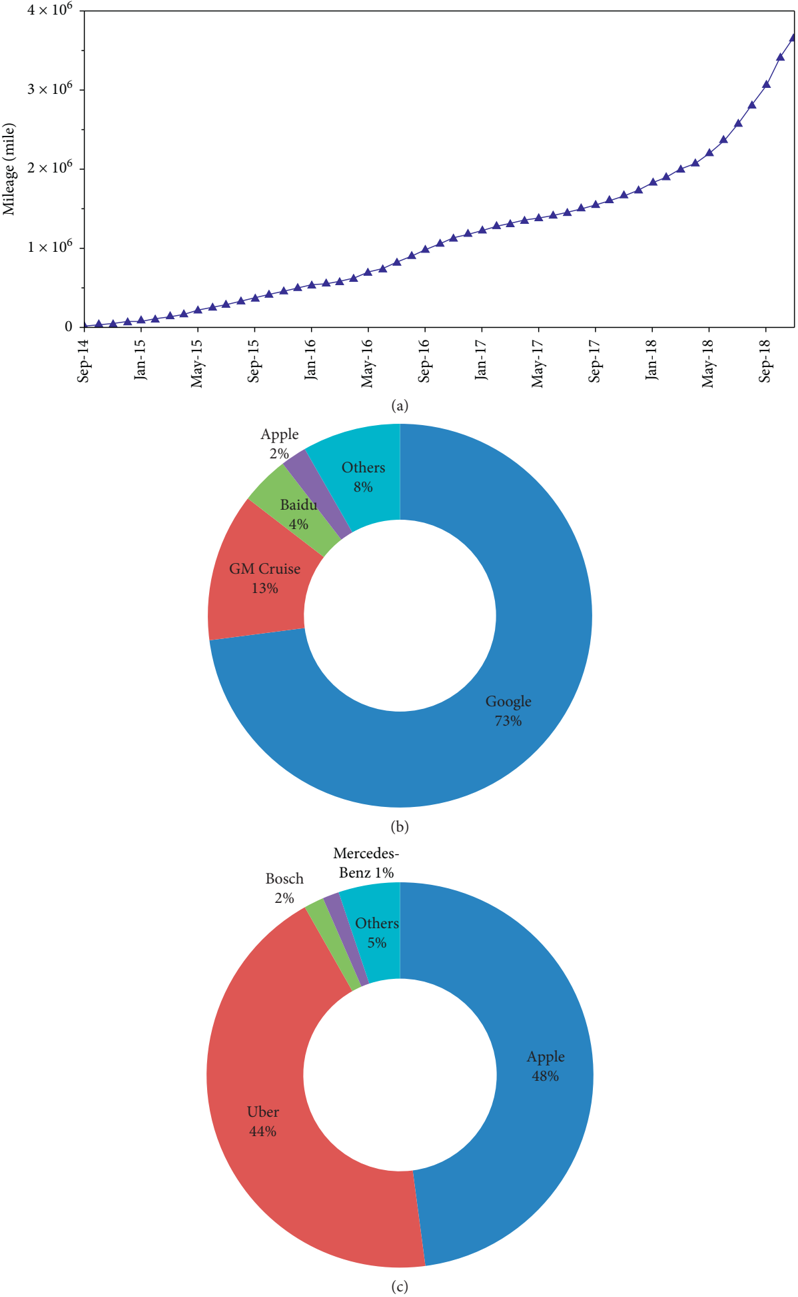
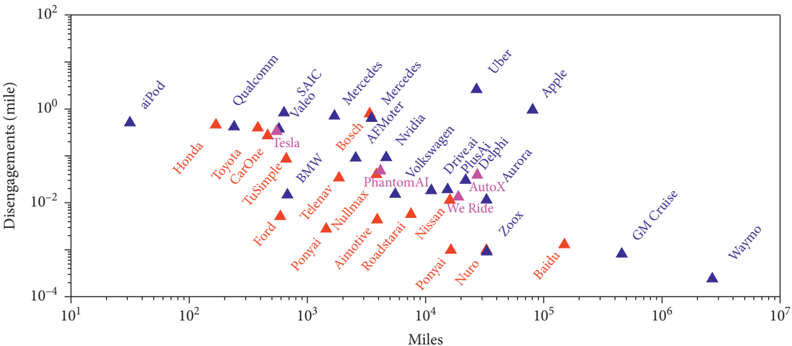
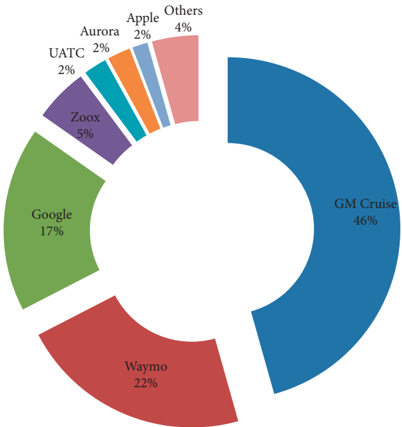
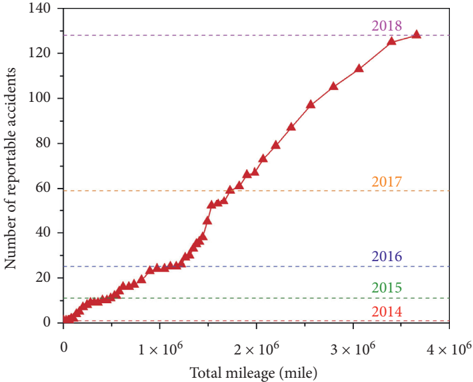
Autonomous vehicle (AV) is regarded as the ultimate solution to future automotive engineering; however, safety still remains the key challenge for the development and commercialization of the AVs. Therefore, a comprehensive understanding of the development status of AVs and reported accidents is becoming urgent. In this article, the levels of automation are reviewed according to the role of the automated system in the autonomous driving process, which will affect the frequency of the disengagements and accidents when driving in autonomous modes. Additionally, the public on-road AV accident reports are statistically analyzed. The results show that over 3.7 million miles have been tested for AVs by various manufacturers from 2014 to 2018. The AVs are frequently taken over by drivers if they deem necessary, and the disengagement frequency varies significantly from 2 × 10⁻⁴ to 3 disengagements per mile for different manufacturers. In addition, 128 accidents in 2014–2018 are studied, and about 63% of the total accidents are caused in autonomous mode. A small fraction of the total accidents (∼6%) is directly related to the AVs, while 94% of the accidents are passively initiated by the other parties, including pedestrians, cyclists, motorcycles, and conventional vehicles. These safety risks identified during on-road testing, represented by disengagements and actual accidents, indicate that the passive accidents which are caused by other road users are the majority. The capability of AVs to alert and avoid safety risks caused by the other parties and to make safe decisions to prevent possible fatal accidents would significantly improve the safety of AVs. Practical applications. This literature review summarizes the safety-related issues for AVs by theoretical analysis of the AV systems and statistical investigation of the disengagement and accident reports for on-road testing, and the findings will help inform future research efforts for AV developments.
Overview
The claims and statistics of this paper haven’t been checked yet.
Free: it reads the open-access text and checks the first 5 claims that cite a source we can check. Create a free account to check every claim.
Integrity signals
Registry
Cites
Statistics
Figures
Verification
Claims the paper makes
The claims and statistics of this paper haven’t been checked yet.
Free: it reads the open-access text and checks the first 5 claims that cite a source we can check. Create a free account to check every claim.
Claims other papers make about this one
Each is checked against this paper’s own text: does it say what the citing paper says it does?
The source backs part of the claim, not all of it — or backs it for a different population, condition or comparison.
In the citing paper
“However, several studies have been published on the performance of ADS-mounted sensors, but research analyzing the level of impact on the driving safety of AVs by ODD is still insufficient [16][17][18][19].”
From Evaluation of Autonomous Driving Safety by Operational Design Domains (ODD) in Mixed Traffic (2024) · cites this paper as [18]
Experimental — accuracy not yet measuredThe check wasn’t confident either way, so it gives no verdict — never disputed.
In the citing paper
“The inadequate evaluation of deep learning systems can have significant consequences, including risks to patient well-being [165] and safety [208].”
From A 2030 Roadmap for Software Engineering (2025) · cites this paper as [208]
Experimental — accuracy not yet measured
Self-check
Percentages, sums and reported differences re-computed from the paper’s own numbers.
The self-check needs the paper’s full text.
Citations
Cites
A model for types and levels of human interaction with automation
Parasuraman, R., Sheridan, T. B., & Wickens, C. D. (2000) · IEEE Transactions on Systems, Man, and Cybernetics - Part A: Systems and Humans · doi:10.1109/3468.844354 · Cited by 4,195 · cited 1×
“*e details of the ten levels of automation can be found elsewhere [33, 34].”
BackgroundPreparing a nation for autonomous vehicles: opportunities, barriers and policy recommendations
Fagnant, D. J., & Kockelman, K. (2015) · Transportation Research Part A: Policy and Practice · doi:10.1016/j.tra.2015.04.003 · Cited by 3,214 · cited 4×
“Audi, BMW, Mercedes-Benz, Volkswagen, Volvo, Ford, General Motors, Toyota, Nissan, as well as Google, Baidu, and other research institutes, have begun testing on- and off-road AVs [13, 28].”
BackgroundInfluentialA Review of Motion Planning Techniques for Automated Vehicles
Gonzalez, D., Perez, J., Milanes, V., & Nashashibi, F. (2016) · IEEE Transactions on Intelligent Transportation Systems · doi:10.1109/tits.2015.2498841 · Cited by 1,670 · cited 3×
“*e communication errors may come from errors resulted from the communication between the AVs and the corresponding infrastructure [57], other road users [44], and the Internet [60].”
BackgroundHuman and Computer Control of Undersea Teleoperators
Sheridan, T. B., & Verplank, W. L. (1978) · doi:10.21236/ada057655 · Cited by 1,227 · cited 3×
“*e details of the ten levels of automation can be found elsewhere [33, 34].”
BackgroundUser preferences regarding autonomous vehicles
Haboucha, C. J., Ishaq, R., & Shiftan, Y. (2017) · Transportation Research Part C: Emerging Technologies · doi:10.1016/j.trc.2017.01.010 · Cited by 996
Three Decades of Driver Assistance Systems: Review and Future Perspectives
Bengler, K., Dietmayer, K., Farber, B., Maurer, M., Stiller, C., & Winner, H. (2014) · IEEE Intelligent Transportation Systems Magazine · doi:10.1109/mits.2014.2336271 · Cited by 868
Internet of vehicles: From intelligent grid to autonomous cars and vehicular clouds
Gerla, M., Lee, E.-K., Pau, G., & Lee, U. (2014) · 2014 IEEE World Forum on Internet of Things (WF-IoT) · doi:10.1109/wf-iot.2014.6803166 · Cited by 828
(2015) · Cited by 809
Dissipation of stop-and-go waves via control of autonomous vehicles: Field experiments
Stern, R. E., Cui, S., Delle Monache, M. L., Bhadani, R., Bunting, M., Churchill, M., Hamilton, N., Haulcy, R., Pohlmann, H., Wu, F., et al. (2018) · Transportation Research Part C: Emerging Technologies · doi:10.1016/j.trc.2018.02.005 · Cited by 800 · cited 1×
“carried out a ring road experiment involving both autonomous and human-operated vehicles, and their results indicate that a single AV can be used to control the traffic flow of at least 20 human-operated vehicles with significant improvements in vehicle velocity standard deviation, excessive braking, and fuel economy…”
MethodPerceptions of autonomous vehicles: Relationships with road users, risk, gender and age
Hulse, L. M., Xie, H., & Galea, E. R. (2018) · Safety Science · doi:10.1016/j.ssci.2017.10.001 · Cited by 698 · cited 1×
“’s studies indicated that the youth with high salary and education male are the most optimistic about the AV safety [29], while western European countries are more pessimistic about the safety in comparison with Asian countries [30].”
Background
Research works printed but not linked: 4
- M. Bonner, R. Taylor, K. Fletcher, and C. Miller, "Adaptive automation and decision aiding in the military fast jet do- main," in Proceedings of the Conference on Human Perfor- mance, Situation Awareness and Automation: User Centered Design for the New Millenium, pp. 154-159, Savannah, GA, USA, October 2000.
- SAE International, Surface Vehicle Recommended Practice (R) Taxonomy and Definitions for Terms Related to Driving Au- tomation Systems for On-Road Motor Vehicles, SAE Inter- national, Pittsburgh, PA, USA, 2018.
- United States Department of Transportation, 2019, Automated Vehicles for Safety
- T. Nimmagadda, Building an Autonomous Ground Traffic System, Technical Report HR-09-09, e University of Texas, Austin, TX, USA, 2007.
Cited by
Items 101–200 of 389
Wu, X., Zheng, Y., & Wang, X. (2025) · Sustainability · doi:10.3390/su17125348 · Cited by 10
Barriers to autonomous vehicles adoption in Europe: Insights from literature and interviews
de Leo, G., & Miragliotta, G. (2026) · Journal of Urban Mobility · doi:10.1016/j.urbmob.2026.100194 · Cited by 10
Issler, M., Goss, Q., & Akbaş, M. İ. (2024) · Information · doi:10.3390/info15120772 · Cited by 10
“Ensuring the reliability and safety of AVs requires the development of comprehensive testing processes that embrace a diverse range of situations that authentically mirror the intricacies of real-world driving [5,6].”
Flying cars and hyperloops: A glimpse into the future sustainable vehicles
Hariram, N. P., Megalingam, A., & Sudhakar, K. (2025) · Sustainable Energy Technologies and Assessments · doi:10.1016/j.seta.2025.104196 · Cited by 11
Miniature Autonomy as Means to Find New Approaches in Reliable Autonomous Driving AI Method Design
Tiedemann, T., Schwalb, L., Kasten, M., Grotkasten, R., & Pareigis, S. (2022) · Frontiers in Neurorobotics · doi:10.3389/fnbot.2022.846355 · Cited by 10
“Accidents of autonomous vehicles (AVs) have been analyzed in many studies, including comparisons between incidents caused by AV and such caused by humans (Wang et al., 2020; Ren et al., 2021).”
BackgroundAlsisi, R. H., Vallappil, A. K., & Wajid, H. A. (2022) · International journal of electrical and computer engineering systems · doi:10.32985/ijeces.13.10.1 · Cited by 10
“Interestingly, these offer a much wider operating frequency range of [ 10-30 Wider operating frequency range of 10GHz to 45 GHz; • Peak gain between range 24.2 to 32.83 dBi for the above-mentioned frequency range; • bandwidth gain from 1 to 3 dB.”
InfluentialGlobal Clipper: Enhancing Safety and Reliability of Transformer-based Object Detection ModelsPreprint
Sha, Q. S., Paulitsch, M., Pattabiraman, K., Hagn, K., Oboril, F., Buerkle, C., Scholl, K.-U., Hinz, G., & Knoll, A. (2024) · arXiv (Cornell University) · doi:10.48550/arxiv.2406.03229 · Cited by 10
“The adoption of Deep Neural Networks (DNNs) has significantly impacted various sectors, including autonomous vehicles [1], aviation, healthcare [2], and space exploration [3], where high safety and reliability are crucial.”
BackgroundRobots and Dance: A Promising Young Alchemy
LaViers, A. (2024) · Annual Review of Control Robotics and Autonomous Systems · doi:10.1146/annurev-control-060923-100542 · Cited by 9
Wen, H., Sajid, Z., & Arunthavanathan, R. (2025) · AI · doi:10.3390/ai6080164 · Cited by 9
Rastin, Z., & Söffker, D. (2024) · Automation · doi:10.3390/automation5030019 · Cited by 9
“The development of AVs is still in the early stages, but it has the potential to significantly increase road safety by supporting the role of human drivers or assisting them to make better decisions [4,5].”
BackgroundYang, Y., Lu, X., Zhang, Z., Wu, Z., Li, G., Meng, L., Ding, Z., & Xue, Y. (2025) · IEEE Transactions on Intelligent Transportation Systems · doi:10.1109/tits.2025.3586608 · Cited by 9
“In this context, testing the safety of autonomous driving vehicles becomes crucial [9].”
LeoVR: Motion-Inspired Visual-LiDAR Fusion for Environment Depth Estimation
Li, D., Xu, J., Yang, Z., Ma, Q., Zhang, L., & Chen, P. (2023) · IEEE Transactions on Mobile Computing · doi:10.1109/tmc.2023.3334271 · Cited by 9
“Notably, recent reports suggest that incorrect depth estimation of ambient humans or objects has been identified as the primary cause of a majority of autonomous driving accidents since 2020 [13], [14], [15].”
BackgroundSelf-citationModel Predictive Control for Lane Merging Automation with Recursive Feasibility Guarantees
Geurts, M., Katriniok, A., Silvaş, E., & Heemels, W. P. M. H. (2023) · IFAC-PapersOnLine · doi:10.1016/j.ifacol.2023.10.1255 · Cited by 9
“…identified in the literature is to plan safe and optimal trajectories for automated vehicles in complex and uncertain situations, with prior unknown movements of manually driven vehicles (Khonji et al., 2020; Wang et al., 2020). autonomous vehicles will coexist with manually driven vehicles.”
Abohassan, M., & El‐Basyouny, K. (2024) · Sensors · doi:10.3390/s24020452 · Cited by 8
“Furthermore, the correct and timely response to the surprising loss of control incidents like skidding is not on par with human reactions [30].”
BackgroundTransport Transitions: Advancing Sustainable and Inclusive Mobility
McNally, C., Carroll, P., Martínez‐Pastor, B., Ghosh, B., Efthymiou, M., & Valantasis-Kanellos, N. (2025) · Lecture notes in mobility · doi:10.1007/978-3-032-06763-0 · Cited by 8
Information and Entropy Aspects of the Specifics of Regional Road Traffic Accident Rate in Russia
Petrov, A. I. (2023) · Information · doi:10.3390/info14020138 · Cited by 8
Shafiei, S., Dia, H., Wen, W., Grzybowska, H., & Qin, A. K. (2023) · IEEE Transactions on Intelligent Transportation Systems · doi:10.1109/tits.2023.3315338 · Cited by 8
“PAVs equipped with self-parking technology could reduce the risk of accidents caused by human error during parking maneuvers [29].”
BackgroundAre Self-driving Cars a Safer Solution?
Szatmáry, R., & Lazányi, K. R. (2024) · Advanced sciences and technologies for security applications · doi:10.1007/978-3-031-47990-8_39 · Cited by 8
Exploration on prior driving modes for automated vehicle collisions
Das, S., Kong, X., & Hossain, M. M. (2022) · International Journal of Urban Sciences · doi:10.1080/12265934.2022.2142650 · Cited by 8
“Wang, Zhang, Huang, and Zhao (2020) statistically analyzed AV crashes to connect the corresponding understandings in the context of other road users.”
BackgroundLearning to Drive in the NGSIM Simulator Using Proximal Policy Optimization
Zhou, Y., & Chen, Y. (2023) · Journal of Advanced Transportation · doi:10.1155/2023/4127486 · Cited by 8
“It is wildly accepted that autonomous driving (AD) may help alleviate the problem of trafc congestion and reduce vehicle accidents and drivers’ fatigue accompanied by manual driving [1, 2].”
Cheng, E. C., Cheng, J., & Siu, A. (2026) · arXiv (Cornell University) · doi:10.48550/arxiv.2601.06223 · Cited by 8
A Review Study on Functional Safety Verification and Validation for Autonomous Vehicles
Haspolat, C., Celik, E., Aygun, M., Ertaş, I. C., & Karaduman, M. (2023) · National Conference on Electrical and Electronics Engineering (ELECO) · doi:10.1109/eleco60389.2023.10416071 · Cited by 7
“As shown in numerous applications in non-automotive domains, AI-based solutions have the capability to work with complex systems and to learn even when there is insufficient information [2-7].”
BackgroundRadiation Reliability of System Reboots in Commercial Off-the-Shelf SoC
Frias-Dominguez, L., León, G., Badía, J. M., Belloch, J. A., García-Valderas, M., Lindoso, A., & Entrena, L. (2025) · IEEE Transactions on Nuclear Science · doi:10.1109/tns.2025.3539942 · Cited by 7
“Studies on autonomous vehicle disengagements highlight that failures in communication, sensor readings, or hardware can trigger system resets or disengagements [16], [17].”
Model-free sliding mode control for path following in autonomous vehicle
Yin, Y., Xu, Z., Wei, Y., Jiang, W., Yao, D., & Dong, Z. (2025) · Journal of the Franklin Institute · doi:10.1016/j.jfranklin.2025.107806 · Cited by 7
Automated lane change behavior prediction and environmental perception based on SLAM technology
Han, L., Wang, B., Shui, Z., Yang, P., & Liang, P. (2024) · Applied and Computational Engineering · doi:10.54254/2755-2721/77/2024ma0054 · Cited by 7
Safety by simulation: theorizing the future of robot regulation
Viljanen, M. (2023) · AI & Society · doi:10.1007/s00146-023-01730-0 · Cited by 7
“In line with other mobility robots (on autonomous vehicle architecture: Behere and Törngren 2016, p. 139; Liu et al. 2017; Wang et al. 2020, p. 5; Ahangar et al. 2021), an MASS ANS will likely contain two functionally interlocked subsystems.”
Security challenges in autonomous vehicles: a case study of Camera and LiDAR sensors
Ghliss, M., Kechiche, L., & Chabir, K. (2024) · International Conference on Advanced Technologies for Signal and Image Processing · doi:10.1109/atsip62566.2024.10638971 · Cited by 7
“[17] When the situational awareness of the autonomous vehicle improves, the level of autonomy increases.”
BackgroundInfluentialJin, W., Khudoyberdiev, A., & Kim, D. (2020) · IEEE Access · doi:10.1109/access.2020.3028852 · Cited by 7
Adane, B. Y., Hou, J., Peng, B., & Debalki, Y. A. (2022) · Transportation Research Record Journal of the Transportation Research Board · doi:10.1177/03611981221110570 · Cited by 7
Carneiro, P. S., Pereira, A. R., & da Silva, M. M. (2023) · International Journal of Transport Development and Integration · doi:10.18280/ijtdi.070304 · Cited by 7
Review and Analysis of Autonomous Vehicles - Current State and Challenges
Rajasekaran, S. B. (2023) · Journal of Engineering and Applied Sciences Technology · doi:10.47363/jeast/2023(5)187 · Cited by 6
“Technological progress: The objective is to enhance autonomous vehicle technology to adjust to circumstances [20].”
Wang, J., Chen, Y., Shun, L., Gao, Z., & Xiang, J. (2025) · Traffic Injury Prevention · doi:10.1080/15389588.2024.2439962 · Cited by 6
Self-citationXiang, J., Wang, Z., Chen, Y., Meng, Z., & Wang, J. (2025) · Accident Analysis & Prevention · doi:10.1016/j.aap.2025.108017 · Cited by 6
Self-citationGuo, R., Chen, Y., Zhang, Y., & Yi, F. (2025) · Traffic Injury Prevention · doi:10.1080/15389588.2025.2520006 · Cited by 6
“Among collisions with passenger cars, 58.14% of the AVs were in autonomous mode, consistent with existing research (Wang et al. 2020).”
InfluentialFerriès, E., Caroux, L., Rousseau, A., Valenti, C., Pujol, M., & Lemercier, C. (2025) · Transportation Research Part F Traffic Psychology and Behaviour · doi:10.1016/j.trf.2025.07.020 · Cited by 6
Context-dependent uncertainty-aware parking choices of autonomous car owners
Hu, Y., Zhao, Y., Li, X., & Feng, T. (2025) · Transport Policy · doi:10.1016/j.tranpol.2025.103797 · Cited by 6
Testing Autonomous Vehicles in Virtual Environments: A Review of Simulation Tools and Techniques
Uzzaman, A., Islam, M., & Hossain, M. S. (2025) · Control Systems and Optimization Letters · doi:10.59247/csol.v3i2.196 · Cited by 6
Mantouka, E. G., Vakrinou, K., Christidis, K., Magoutas, B., Kiousi, A. V., & Vlahogianni, E. I. (2026) · Sensors · doi:10.3390/s26041232 · Cited by 6
“The evolution of CCAM systems has the potential to transform the developments in the transportation industry, since they offer significant benefits to efficiency, sustainability, and road safety [1–4].”
Rojas, J. F., Kadav, P., Brown, N. E., Meyer, R., Bradley, T. H., & Asher, Z. D. (2023) · SAE technical papers on CD-ROM/SAE technical paper series · doi:10.4271/2023-01-0576 · Cited by 6
“According to Wang et al. the number of disengagements varies amongst AV manufacturers and ranges from 2x10 -4 to 3 disengage-ments per mile [6].”
BackgroundReview on the Safety and Sustainability of Autonomous Vehicles: Challenges and Future Directions
Uzzaman, A., Adam, M. I., Alam, S., & Basak, P. (2025) · Control Systems and Optimization Letters · doi:10.59247/csol.v3i1.185 · Cited by 6
“In the automotive and transportation industries, autonomous vehicles (AVs), often referred to as self-driving cars, have become one of the most revolutionary technologies [1].”
Feng, J., Feng, W., & Lin, S. (2021) · IEEE International Conference on Intelligent Transportation Systems (ITSC) · doi:10.1109/itsc48978.2021.9564763 · Cited by 6
Using Collision Momentum in Deep Reinforcement Learning based Adversarial Pedestrian Modeling
Chen, D., Yurtsever, E., Redmill, K., & Özgüner, Ü. (2023) · IEEE Intelligent Vehicles Symposium · doi:10.1109/iv55152.2023.10186642 · Cited by 6
“Most literature and research focuses on the non-adversarial behavior of traffic participants [9], [10], but to successfully and efficiently evaluate the performance of AVs in edge-case scenarios and identify potential weaknesses, it is crucial to incorporate the modeling of adversarial behavior.”
BackgroundInfluentialAutomated vehicles’ safety: The multidimensionality of disengagement reports
Lee, D., Long, L. A. N., & Choi, M. (2025) · Heliyon · doi:10.1016/j.heliyon.2025.e42747 · Cited by 5
DR-AIR: A data repository bridging the research gap in AI reliability
Zheng, S., Clark, J. M., Salboukh, F., Silva, P. M. D. C., da Mata, K. A., Pan, F., Min, J., Lian, J., King, C., Fiondella, L., et al. (2025) · Quality Engineering · doi:10.1080/08982112.2025.2539834 · Cited by 5
“This process provides a way for obtaining AV data through physical testing, as demonstrated by Wang et al. (2020), Min et al. (2022), and Zheng et al. (2025).”
Prospective study on challenges faced in a perception system
Rolen, L. R., Bhat, S. J., & Santhosh, K. V. (2024) · Cogent Engineering · doi:10.1080/23311916.2024.2353498 · Cited by 5
“Accident liability is due to the failure of the software to take accurate decisions (J. Wang, Zhang, et al., 2020).”
Haque, M. M., Ghobakhlou, A., & Narayanan, A. (2024) · Sensors · doi:10.3390/s24134194 · Cited by 5
“At level 4, a driver can focus on other tasks rather than driving; in the future, at level 5, everything can be controlled by the fully automated driving environment [1,2].”
BackgroundExploration of Traffic Accident-Based Pilot Zones for Autonomous Vehicle Safety Validation
Kim, S., Cho, M.-J., & Lee, Y. (2024) · Electronics · doi:10.3390/electronics13173390 · Cited by 5
Li, C., Gao, Y., Fu, R., & Chen, J. (2025) · IEEE International Conference on Acoustics Speech and Signal Processing · doi:10.1109/icassp49660.2025.10888200 · Cited by 5
“Autonomous driving (AD) technology has gained substantial attention in recent years, emerging as a prominent and highly-discussed topic within the technology sector [1].”
Ko, W., Park, S., Park, S., Jeong, H., & Yun, I. (2022) · PLoS ONE · doi:10.1371/journal.pone.0271532 · Cited by 5
“From traffic accident data related to AVs provided by the California DMV, it can be observed that a large number of traffic accidents are caused by vehicles other than AVs [4].”
BackgroundMethodKim, M.-J., & Kim, Y. (2023) · Sensors · doi:10.3390/s23020592 · Cited by 5
Onn, L. K., Atmaja, C. R., Aparow, V. R., Hong, C. J., Wai, A. A. Y. L., & Jawi, Z. M. (2023) · International Journal of Integrated Engineering · doi:10.30880/ijie.2023.15.05.029 · Cited by 5
A 3D World Interpreter System for Safe Autonomous Crane Operation
ter Haar, F. B., Ruis, F., & van Manen, B. (2024) · Robotics · doi:10.3390/robotics13020023 · Cited by 5
“The safety of autonomous systems, and vehicles in particular, is an extensively re-searched area [3,4], and the role of AI and machine learning techniques in these systems is under debate [5,6].”
A Novel Dataset and Approach for Adversarial Attack Detection in Connected and Automated Vehicles
Kim, T. H., Krichen, M., Alamro, M. A., & Sampedro, G. A. (2024) · Electronics · doi:10.3390/electronics13122420 · Cited by 5
“Numerous objects with distinct profiles, particularly in urban settings, the poor precision of perception sensor readings, data loss during the fusion process, and other issues can all lead to outliers [10].”
BackgroundDevelopment of Autonomous Vehicle System using ESP32 Microcontroller
Kanneboina, R. Y., Kumar, G. S., Vidyadhar, R. P., Reddy, V. K., & Tammineni, S. (2024) · Asia Pacific Conference on Innovation in Technology (APCIT) · doi:10.1109/apcit62007.2024.10673667 · Cited by 5
“The ESP32 is used in research by Wang et al. [5] to process data in real-time and fuse sensors in autonomous cars.”
MethodHossain, G., & Tarrant, J. (2023) · International Symposium on Digital Forensics and Security (ISDFS) · doi:10.1109/isdfs58141.2023.10131723 · Cited by 5
“…a solution to the problem, an artificial intelligence (AI) enabled smart transportation infrastructure with real-time traffic classification is introduced by Wang et al. [9], that incorporates some smart sensors with self-powering capabilities, and are commanded and controlled through AI system.”
BackgroundHow do Vehicle Automated Features Help or Hurt Driving Performance?
Easa, S. M., Wang, S., & Ma, Y. (2023) · Ergonomics International Journal · doi:10.23880/eoij-16000300 · Cited by 5
Katerishich, M., Kurenkov, M., Karaf, S., Nenashev, A., & Tsetserukou, D. (2023) · Conference proceedings/Conference proceedings - IEEE International Conference on Systems, Man, and Cybernetics · doi:10.1109/smc53992.2023.10394025 · Cited by 5
“Motion planning is crucial for self-driving cars to generate a safe and efficient path, but it is challenging due to the car’s complex shape, non-holonomic constraints, and changing environments [1].”
BackgroundA review on the estimation of vulnerable road user behavior for automated vehicles
Ara, J., Khan, M. B., Yasmin, S., & Bhuiyan, H. (2025) · International Journal of Sustainable Transportation · doi:10.1080/15568318.2025.2510413 · Cited by 4
“From this perspective, several earlier studies have argued that automated vehicles could be an effective solution for improving overall VRUs safety (Ondru � s et al., 2020; Wang et al., 2020).”
A deep learning-based anomaly detector for CAN bus networks in autonomous cars
Boumiza, S., & Braham, R. (2025) · Cluster Computing · doi:10.1007/s10586-025-05124-3 · Cited by 4
“Also, the so-called ‘‘driver assistance’’ systems assist the driver in a variety of ways and can sometimes partially control the vehicle in order to improve driving and more importantly passenger safety and road safety in general [1, 2].”
TRUCE-AV: A Multimodal Dataset for Trust and Comfort Estimation in Autonomous Vehicles
Bhalla, A., Hellert, C., Kasneci, E., & Becker, N. (2025) · Frontiers in artificial intelligence and applications · doi:10.3233/faia251122 · Cited by 4
Assessing public receptivity and preference formation in the transition to fully autonomous vehicles
Almaskati, D. N., Pamidimukkala, A., Kermanshachi, S., Rosenberger, J. M., Hladik, G., & Foss, A. W. (2025) · Transport Economics and Management · doi:10.1016/j.team.2025.11.003 · Cited by 4
Jing, Y., Zhang, X., Zhou, M., Ji, Y., Ding, Y., Yin, J., Jia, R., Xiong, Y., Zhao, K., Yang, J., et al. (2026) · IEEE Internet of Things Journal · doi:10.1109/jiot.2026.3668085 · Cited by 5
“Against this backdrop, autonomous driving technology has emerged to enhance driving safety, optimize tra ffi c flow e ffi ciency, and alleviate driver workload [2], [3], [4].”
Assessment of the state of the art in the performance and utilisation level of automated vehicles
Kurse, T. K., Gebresenbet, G., & Daba, G. F. (2024) · International Journal of Sustainable Engineering · doi:10.1080/19397038.2024.2366839 · Cited by 4
“Vehicle safety encompasses the physical vehicle itself, including its hardware and software (Nhtsa 2022; Wang et al. 2020).”
Tu, M. (2025) · Enterprise Information Systems · doi:10.1080/17517575.2025.2487023 · Cited by 4
“Real-time fault diagnosis is affected by sensor errors, environmental variability and communication failures, all of which affect system reliability (Wang et al. 2020).”
Opoku-Mensah, N., Qin, Z., Opoku‐Mensah, E., & Ankrah, S. T. (2025) · World Electric Vehicle Journal · doi:10.3390/wevj16060323 · Cited by 4
König, A. L., Boßow-Thies, S., & Krol, B. (2025) · Transportation Research Part F Traffic Psychology and Behaviour · doi:10.1016/j.trf.2025.06.019 · Cited by 4
An Inclusive Model for External Human Machine Interfaces of Autonomous Vehicles
Enam, M. A., Bastola, A., & Brinkley, J. (2024) · IEEE International Conference on Human-Machine Systems (ICHMS) · doi:10.1109/ichms59971.2024.10555718 · Cited by 4
“Even if we do the usability testing of this model, more questions will arrive when the level 5 AVs arrive, or even level 4 AVs will start to be manufactured [80].”
Deep Reinforcement Learning-Based (DRLB) Optimization for Autonomous Driving Vehicle Path Planning
Jin, H., Jin, Z., & Kim, Y.-G. (2024) · International Conference on Electronics and Sustainable Communication Systems (ICESC) · doi:10.1109/icesc60852.2024.10689874 · Cited by 4
“In addition, the field of autonomous driving has benefited significantly from rapid advances in the MADRL, enabling autonomous vehicles [6]-[11] to make the more intelligent decisions in complex traffic scenarios.”
BackgroundWoo, S., Woo, B., Chang, Y., & Tak, S. (2024) · IEEE Access · doi:10.1109/access.2024.3487353 · Cited by 4
Development of Tools for the Automatic Processing of Advanced Driver Assistance System Test Data
Licci, P., Giannoccaro, N. I., Palermo, D., Dollorenzo, M., Lomartire, S., & Dodde, V. (2024) · Machines · doi:10.3390/machines12120896 · Cited by 4
Investment and financing of roadway digital infrastructure for automated driving
Ahmadian, M. A., Bahrami, S., Nourinejad, M., & Yin, Y. (2025) · Transportation Research Part B Methodological · doi:10.1016/j.trb.2024.103146 · Cited by 4
Aggie Auto Shuttles: Technical Insights from the Public Road Demonstration
Matute-Peaspan, J. A., Searcy, S. E., & Karimoddini, A. (2025) · Transportation Engineering · doi:10.1016/j.treng.2025.100335 · Cited by 4
Effective lane width analysis for autonomous trucks
Fahad, M., & Richárd, N. (2023) · SN Applied Sciences · doi:10.1007/s42452-023-05446-0 · Cited by 4
“of perception of surrounding and reaction to unplanned events by autonomous vehicles still exist [2].”
BackgroundPolicy Efforts to Promote the Adoption of Autonomous Vehicles: Subsidy and AV Lanes
Liu, C., Jia, H., Lin, Y., Wang, G., Tian, J., Wu, R., & Gao, H. (2023) · Journal of Advanced Transportation · doi:10.1155/2023/5658495 · Cited by 4
Zhao, Y., & Ye, T. (2023) · Journal of Optics · doi:10.1007/s12596-023-01518-x · Cited by 4
Kovács, A., & Vajk, I. (2021) · Journal of Advanced Transportation · doi:10.1155/2021/1444396 · Cited by 4
“If human-driven cars are replaced with autonomous vehicles, accidents caused by human errors can be eliminated [1].”
Lin, S. (2024) · DR-NTU (Nanyang Technological University) · doi:10.32657/10356/181390 · Cited by 4
CORTEX-AVD: A Framework for CORner Case Testing and EXploration in Autonomous Vehicle DevelopmentPreprint
Shimanuki, G. K. G., Nascimento, A., Vismari, L. F., Junior, J. B. C., Junior, J. R. D. A., & Cugnasca, P. S. (2025) · arXiv (Cornell University) · doi:10.48550/arxiv.2504.03989 · Cited by 4
“The goals of the AV field include improving traffic safety and efficiency [3], [4] by reducing accidents commonly associated with human error [5]–[7].”
What does Waymo See? A Critical Inquiry into Urban Surveillance by Autonomous Vehicles
Ullmann, L. (2025) · eScholarship (California Digital Library) · Cited by 4
Human-Centered AI for Autonomous Vehicles: A Review of Interaction Strategies and Technologies
Kumar, A., Rana, K., Gupta, R., Gunta, D., Mahida, A., & Sonia, S. (2024) · IEEE Delhi Section Conference (DELCON) · doi:10.1109/delcon64804.2024.10866787 · Cited by 3
Choosing a driverless or conventional taxi: a quick or slow decision?
Pemberton, L., Sutcliffe, A., & Mehandjiev, N. (2025) · Behaviour and Information Technology · doi:10.1080/0144929x.2025.2504515 · Cited by 3
Pagliaroli, A., Strada, S. C., Scevaroli, S., & Savaresi, S. M. (2025) · Scientific Reports · doi:10.1038/s41598-025-17607-9 · Cited by 3
Xiaona, J., Tian, J., Zhang, H., Wu, D., Zhou, X., & Duan, Z. (2025) · IEEE Transactions on Cognitive Communications and Networking · doi:10.1109/tccn.2025.3620302 · Cited by 4
“Many delay-sensitive tasks in vehicular networks are critical to safety and reliability, requiring vehicles to respond both quickly and accurately [10].”
Safe Intelligent Vehicles: Intent Is What We Need
Zhong, R., Chiang, C.-Y., Fathy, Y., Slabaugh, G., & Jaber, M. (2026) · IEEE Intelligent Transportation Systems Magazine · doi:10.1109/mits.2026.3653697 · Cited by 3
“According to [2], from 2014 to 2018, there were at least 128 accidents involving IVs.”
Javines, T. I., Alejandro, D. P. C., Elamparo, J. M. S., Ong, A. K. S., Ragaza, J. T. Q., Ana, I. M. C. S., & Chavez, J. X. S. (2026) · Acta Psychologica · doi:10.1016/j.actpsy.2026.106680 · Cited by 3
Sarkandi, G., & Alecsandru, C. (2026) · IEEE Transactions on Intelligent Transportation Systems · doi:10.1109/tits.2026.3670714 · Cited by 3
“In contrast, FSMs and rule-based decision trees are often scenario-specific and may not generalize e ff ectively across diverse driving conditions [33], [34].”
Comparative review of advanced seatbelt detection: Infrared sensors vs. image-based systems
Lu, H., Pan, H., & Sun, Z. (2024) · Applied and Computational Engineering · doi:10.54254/2755-2721/53/20241311 · Cited by 3
An Optimal Control Framework for Influencing Human Driving Behavior in Mixed-Autonomy Traffic
Chari, A., Chen, R., Grover, J., & Liu, C. (2024) · Proceedings of the ... American Control Conference/Proceedings of the American Control Conference · doi:10.23919/acc60939.2024.10644162 · Cited by 3
Conflict Detection in Automated Vehicle Testing Through Gamification
Jegarian, M., Freyer, J., Hamarneh, Q., Klöck, L., Schyr, A., Schwammberger, M., & Düser, T. (2024) · IEEE International Automated Vehicle Validation Conference (IAVVC) · doi:10.1109/iavvc63304.2024.10786398 · Cited by 3
Messer, U., Pape, D., Lukas, N., & Peters, L. (2024) · Hawaii International Conference on System Sciences (HICSS) · doi:10.24251/hicss.2024.211 · Cited by 3
A Systematic Review of the Impact of Autonomous Vehicles on Transportation Networks
Adam, R., Alhammadi, A., Abdelfatah, A. S., & Ali, T. (2025) · Journal of Sustainable Development of Energy Water and Environment Systems · doi:10.13044/j.sdewes.d13.0583 · Cited by 3
“Furthermore, the acceptance of AVs by the public poses a significant challenge due to the fact that many individuals hold concerns regarding the safety of self-driving technology [23] .”
Chen, J., Zhu, B., Ling, X., Ruan, X., & Guo, N. (2025) · Proceedings of the Institution of Mechanical Engineers Part D Journal of Automobile Engineering · doi:10.1177/09544070251362075 · Cited by 3
Saini, V., Jain, A., Meduri, P., & GmbH, V. T. S. (2025) · SAE technical papers on CD-ROM/SAE technical paper series · doi:10.4271/2025-01-8138 · Cited by 3
Night Pedestrian Detection Using Thermal Image Feature Extraction Enhanced YOLOv3 (TIFEEY)
Tian, L., Chin, C.-T., Cheng, C., & Huang, R.-P. (2022) · International Conference on Image Processing, Computer Vision and Machine Learning (ICICML) · doi:10.1109/icicml57342.2022.10009888 · Cited by 3
“According to statistics, 500,000 people die in traffic each year worldwide, with pedestrian deaths accounting for 23% of all traffic fatalities [1,2].”
BackgroundZhao, Y., & Ye, T. (2024) · Journal of Intelligent & Fuzzy Systems · doi:10.3233/jifs-235863 · Cited by 3
RetractedSafety of Autonomous Systems Using Reinforcement Learning: A Comprehensive Survey
Manju, M., Rana, C., & Dahiya, M. (2023) · International Conference on Advances in Computation, Communication and Information Technology (ICAICCIT) · doi:10.1109/icaiccit60255.2023.10466182 · Cited by 3
“In this type of Machine learning some data is already labelled or trained with set of training examples so that supervised algorithm can analyse and give accurate outcome from the past experiences [8][12].”
BackgroundAn Approach of Adaptation of Autonomous Vehicle in the Indian Smart City
Ghazi, A., Sahrawat, A., Srivastava, D., & Yadav, D. (2024) · Evergreen · doi:10.5109/7183428 · Cited by 3
Safety and Security in AutonomousVehicles : A Systematic Literature Review
Soltaninejad, A., & Rashidfarokhi, M. A. (2023) · DiVA (Linnaeus University) · Cited by 3
Ensuring Safe Autonomy: Navigating the Future of Autonomous VehiclesPreprint
Wolf, P. (2024) · arXiv (Cornell University) · doi:10.13140/rg.2.2.31779.26407 · Cited by 3
Neuro-symbolic deep reinforcement learning for safe urban driving using low-cost sensors.
Albilani, M. (2024) · theses.fr (ABES) · doi:10.70675/ea6f5d11z7d78z4484zb809z38299a88535e · Cited by 3
Metadata
- Authors
- Wang, J., Zhang, L., Huang, Y., Zhao, J., & Bella, F.
- Affiliations
- Mississippi State University (US)
- University of Waterloo (CA)
- Corresponding author
- Zhao, Jian
- Venue
- Journal of Advanced Transportation
- Publisher
- Wiley
- Published
- 2020-09-15
- Volume
- 2020
- Pages
- 1-13
- ISSN
- 0197-6729 (ISSN-L)
- 2042-3195
- OpenAlex
- W3091936287
- Cited by
- 261
- References
- 93
- Citations by year
- 2026: 38 · 2025: 68 · 2024: 67 · 2023: 55 · 2022: 18 · 2021: 13 · 2020: 1
- FWCI
- 8.05
- Type
- journal article
- Language
- en
- Open access
- gold
- doi.org
- Locations
- Journal of Advanced Transportation (publishedVersion, cc-by)
- DOAJ (DOAJ: Directory of Open Access Journals) (submittedVersion, cc-by-sa)
- Topics
- Physical Sciences › Engineering › Automotive Engineering › Autonomous Vehicle Technology and Safety
- Social Sciences › Human Factors and Ergonomics › Human-Automation Interaction and Safety
- Physical Sciences › Engineering › Safety, Risk, Reliability and Quality › Traffic and Road Safety
- Keywords
- autonomous vehicles, vehicle safety, levels of driving automation, road user interaction, pedestrian and cyclist safety, autonomous driving
About these checks
Registry, retraction, Cites and statistics results are computed, not judged, with one exception: a printed reference that no index lists is read once by a model before it counts as a citation error. Claims are extracted by a model and kept only when their quote appears verbatim in the text; each cited source is then checked, with a model’s help, for whether it says what the claim relies on. Those verdicts can be wrong — read the claim’s quote and the cited source before relying on one.
Statistics and arithmetic are recomputed, not judged.
Confidence bands are shown only for fields calibrated on our annotated test set. None is calibrated yet, so no band is shown.
What counts as a claim ›How we measure confidence ›How we check this ›
Are you an author, or do you see a problem with this page? Request a review
Data sources
Bibliographic data: Semantic Scholar, OpenAlex, Crossref.
Contains information from the Semantic Scholar Academic Graph Datasets, made available under the ODC Attribution License (ODC-BY 1.0).
Semantic Scholar’s data is described in: Kinney, R., et al. (2023). The Semantic Scholar Open Data Platform. arXiv:2301.10140.
