

Extraction of Cellulose from Sugarcane Bagasse Optimization and Characterization
Open accessThe DOI matches its Crossref record; 53 of the 53 references it cites were found in a registry or an index.
Abstract
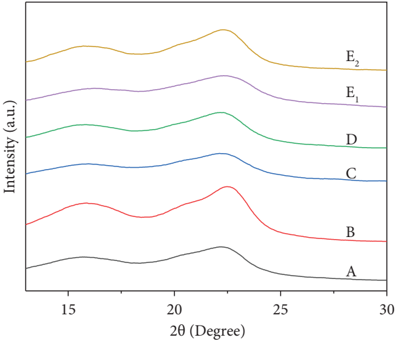
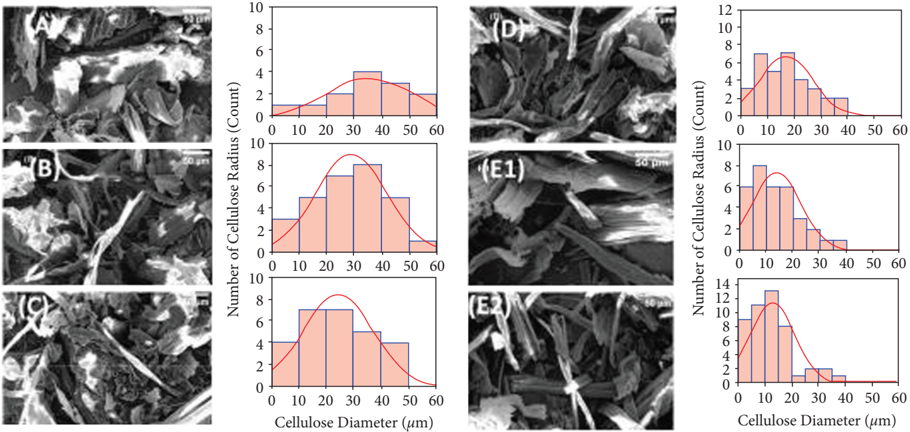
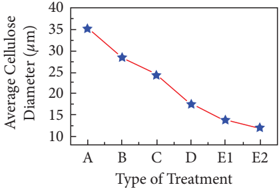
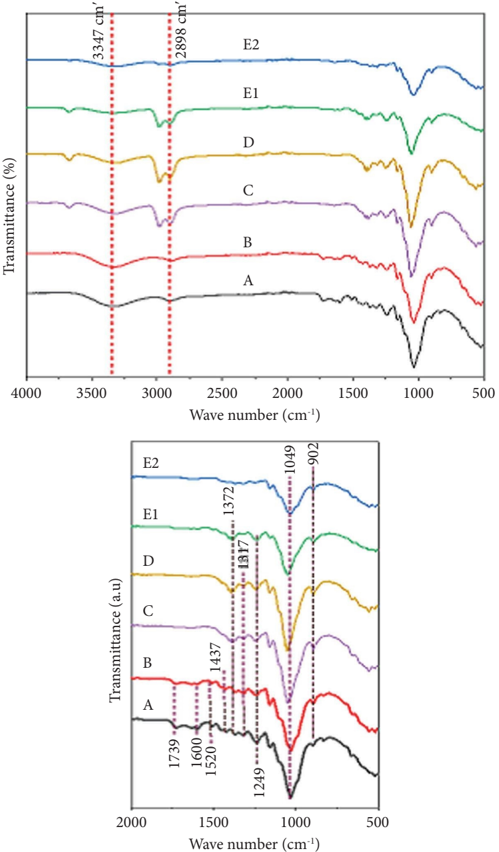
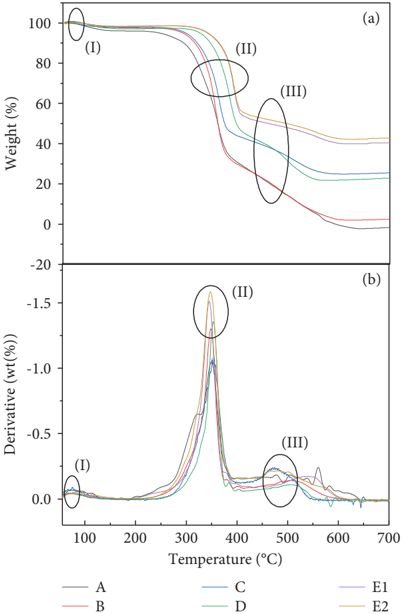
In this study, cellulose was extracted from sugarcane bagasse (SCB) through a convenient five-step treatment, and procedures were performed. During the alkaline curing process of the extraction of cellulose, NaOH has a concentration of (0.5, 1.5, 2.75, and 4%) and the extraction time (15, 30, and 45 min) at a constant temperature of 120°C were taken as variables and perfectly optimized by response surface methodology (RSM) for cellulose with the highest product. The optimum conditions were found to be 2.75% NaOH, 120°C, and 45 min with a cellulose yield of 73.71 ± 0.67% cellulose, 17.22 ± 0.82% hemicellulose, and 9.07 ± 0.95% lignin. Though most of the lignin was eliminated during the alkaline and dilute acid pretreatment process, the remaining lignin was removed by a solution treatment of 4% NaOH, and 21.92% H2O2 at 121°C for 44.97 min where the cellulose yield was found as 89.75 ± 0.64%, hemicellulose was 6.15 ± 0.83%, and lignin was 2.65 ± 0.66%. Morphological analysis revealed that the average diameter of the cellulose was 12.06 µm. Thermal and XRD diffraction analysis showed that the cellulose is thermally stable and has a crystallinity index of 31.63%. FTIR spectra demonstrate that cellulose was successfully extracted due to the removal of noncellulose components.
Overview
The claims and statistics of this paper haven’t been checked yet.
Free: it reads the open-access text and checks the first 5 claims that cite a source we can check. Create a free account to check every claim.
Integrity signals
Registry
Cites
Statistics
Figures

Verification
Claims the paper makes
The claims and statistics of this paper haven’t been checked yet.
Free: it reads the open-access text and checks the first 5 claims that cite a source we can check. Create a free account to check every claim.
Self-check
Percentages, sums and reported differences re-computed from the paper’s own numbers.
The self-check needs the paper’s full text.
Citations
Cites
Segal, L., Creely, J. J., Martin, A. E., & Conrad, C. M. (1959) · Textile Research Journal · doi:10.1177/004051755902901003 · Cited by 8,613 · cited 4×
“(en, the data on the composition analysis of the amount of SCB treated with dilute sulfuric acid of extracted cellulose, hemicellulose, and lignin were collected by gravimetry based on the method developed by Chesson [40], and the results are summarized in Table S2 in SI.”
InfluentialCharacteristics of hemicellulose, cellulose and lignin pyrolysis
Yang, H., Yan, R., Chen, H., Lee, D. H., & Zheng, C. (2007) · Fuel · doi:10.1016/j.fuel.2006.12.013 · Cited by 8,155 · cited 1×
“As shown in Figure 8(a), the initial decomposition happened at temperature between 60 and 150°C due to the evaporation of water molecules and low molecular weight components that were broken down [52].”
Cellulose: Fascinating Biopolymer and Sustainable Raw Material
Klemm, D., Heublein, B., Fink, H., & Bohn, A. (2005) · Angewandte Chemie International Edition · doi:10.1002/anie.200460587 · Cited by 7,551
Methods for Pretreatment of Lignocellulosic Biomass for Efficient Hydrolysis and Biofuel Production
Kumar, P., Barrett, D. M., Delwiche, M. J., & Stroeve, P. (2009) · Industrial & Engineering Chemistry Research · doi:10.1021/ie801542g · Cited by 3,772
Bio-nanocomposites for food packaging applications
Rhim, J.-W., Park, H.-M., & Ha, C.-S. (2013) · Progress in Polymer Science · doi:10.1016/j.progpolymsci.2013.05.008 · Cited by 1,980
Applications of Ultrasound to the Synthesis of Nanostructured Materials
Bang, J. H., & Suslick, K. S. (2010) · Advanced Materials · doi:10.1002/adma.200904093 · Cited by 1,895
A review on alkaline pretreatment technology for bioconversion of lignocellulosic biomass
Kim, J. S., Lee, Y. Y., & Kim, T. H. (2016) · Bioresource Technology · doi:10.1016/j.biortech.2015.08.085 · Cited by 1,581 · cited 2×
“Alkaline pretreatment process is to a greater extent appropriate for enzymatic hydrolysis as it effectively removes lignin and limits carbohydrate degradation compared to other similar methods [34].”
Microbial xylanases and their industrial applications: a review
Beg, Q. K., Kapoor, M., Mahajan, L., & Hoondal, G. S. (2001) · Applied Microbiology and Biotechnology · doi:10.1007/s002530100704 · Cited by 1,371 · cited 1×
“It is the result of the pyrolytic decomposition of the cellulose acetate polymer chain followed by deacetylation as well as the removal of the less stable lignin and hemicellulose polymer from the SCB during treatment processes [54].”
Van Dyk, J. S., & Pletschke, B. I. (2012) · Biotechnology Advances · doi:10.1016/j.biotechadv.2012.03.002 · Cited by 1,015 · cited 2×
“It has been reported that crystallinity is one of the most powerful factors in the efficiency of enzymatic hydrolysis for the reason that giant crystallinity of cellulose makes the biomass unreachable to enzymatic attack [45, 46].”
Cellulose nanocrystals and cellulose nanofibrils based hydrogels for biomedical applications
Du, H., Liu, W., Zhang, M., Si, C., Zhang, X., & Li, B. (2019) · Carbohydrate Polymers · doi:10.1016/j.carbpol.2019.01.020 · Cited by 949 · cited 1×
“(is leads to multiple technological uses of cellulose including transportation of drugs [17], polymer fillers [18], gases, Hindawi Advances in Materials Science and Engineering Volume 2022, Article ID 1712207, 10 pages https://doi.”
Research works printed but not linked: 1
- 10. J. A. R. Rodrigues, "From the mill to a biorefinery: the sugar factory as an industrial enterprise for the generation of biochemicals and biofuels," Química Nova, vol. 34, pp. 1242-1254, 2011.
Cited by
Items 101–120 of 120
Enhanced dye adsorption in LDH-reinforced sugarcane bagasse hybrid composites: a comparative study
Boukontar, N., Khanchaoui, A. E., Boussetta, A., Mansori, M., & Essoumhi, A. (2026) · Journal of Dispersion Science and Technology · doi:10.1080/01932691.2026.2661850
Chaitanoo, N., Vuthijumnonk, J., Junpong, A., Netsawang, P., Kongta, P., & Tatongjai, C. (2026) · Current Applied Science and Technology · doi:10.55003/cast.2026.267770
Citrus fruit peels: A sustainable bioresource for packaging
Seke, F., & Fawole, O. A. (2026) · Elsevier eBooks · doi:10.1016/b978-0-443-38329-8.00014-1
Nhu, P. N. H., Dong, B. P., Duy, N. B. A., Huy, N. T., Phu, P. Q., & Thanh, N. C. (2026) · Journal of Physics Conference Series · doi:10.1088/1742-6596/3245/1/012010
Agro and forest wastes valorization: the challenges toward sustainability in biofuels production
Fit, C. G., Area, M. C., & Clauser, N. M. (2026) · Biofuels Bioproducts and Biorefining · doi:10.1002/bbb.70185
Fabrication of humidity-sensitive biocomposite smart material by using an FGF process
Nahari, B. B. M. A. A., Zarbane, K., Beidouri, Z., Elhalil, A., & Kissi, B. (2026) · Archives of Materials Science and Engineering · doi:10.5604/01.3001.0055.7858
Synthesis and chemical modification of cellulosic biopolymers from non-edible biomass
Kikomeko, I., Lubwama, M., Yiga, V. A., Nalugo, R., Nassazi, D., & Wabwire, A. (2026) · Results in Chemistry · doi:10.1016/j.rechem.2026.103619
Raw sugarcane bagasse hydrochar outperforms carbon nanotubes in microbial fuel cell power generation
Sirajudeen, A. A. O., Katibi, K. K., Annuar, M. S. M., Ibrahim, S., Aliyu, M., Dele-Afolabi, T. T., Dar, M. A., & Majid, S. R. (2026) · Biomass Conversion and Biorefinery · doi:10.1007/s13399-026-07326-0
Faluyi, E. O., Rodríguez‐Jasso, R. M., Belmares, R. E., Ramos‐González, R., Cerqueira, M. Â., & Ruíz, H. A. (2026) · Applied Sciences · doi:10.3390/app16157495
Bansinge, M., Gomase, V., Tekade, P. V., Jugade, R., & Sillanpää, M. E. T. (2026) · Surfaces and Interfaces · doi:10.1016/j.surfin.2026.110256
Azhan, A. U., Rani, M. S. A., Hanibah, H., Shamsudin, I. J., Kechik, M. M. A., Karim, M. K. A., Kadir, M. F. Z., Abdan, K., & Holilah, H. (2026) · Journal of Polymer Research · doi:10.1007/s10965-026-05055-6
Gurusiddappa, L. H., M., N. R. N., Thabah, H., Bellari, K., & Gowda, B. (2026) · Nepal Journal of Biotechnology · doi:10.54796/njb.v14i1.449
Ebune, A. O. A., Bello, N. M., Ugbedeojo, A. A., Ameji, P. J., Eke, U. B., & Owalude, S. O. (2026) · Chemistry and Materials · doi:10.56425/cma.v5i3.139
Nisa, Y. Y. A., Musfiroh, I., Gazzali, A. M., Putra, O. N., Fakih, T. M., Paramitasari, D., Pudjianto, K., & Muchtaridi, M. (2026) · Polymers · doi:10.3390/polym18161963
“…minimal further processing, raw SCB contains substantially more non cellulosic impurities (20–25% hemicellulose, 18–24% lignin), necessitating a more elaborate multi step pretreatment (alkaline delignification, bleaching, and neutralization) to reach comparable purity [31].”
Rahat, H., Hashmi, I., Ismail, S., Qaiser, D., Ahmed, S., & Mehmood, T. (2026) · Biotechnology and Applied Biochemistry · doi:10.1002/bab.70207
Moudood, A., Islam, S., Mahamud, R., Islam, M. M., Huq, N. M. L., Öchsner, A. Ö., Khan, A. N., Rahman, A., & Francucci, G. (2026) · Journal of Natural Fibers · doi:10.1080/15440478.2026.2732236
Nanofiber Cellulose as New Generation Natural Materials for Biocomposite Filler
Asrofi, M., Pradiza, R. R., Abduh, M., Junus, S., & Alahmadi, M. (2024) · Journal of Fibers and Polymer Composites
Elizabeth, A., Henry, J. P., Salamon, J., Sahayaraj, A. F., & Kennedy, A. J. S. (2026) · Chemical Papers · doi:10.1007/s11696-026-05779-1
Mulovhedzi, R., Makgabutlane-Mhlongo, B., Ogunlaja, A. S., & Mhlanga, S. D. (2026) · Physics and Chemistry of the Earth Parts A/B/C · doi:10.1016/j.pce.2026.104920
Pujokaroni, A. S., Safri, M., Martutik, U., & Dewanti, M. A. P. (2026) · Mulawarman Agricultural Proceedings · doi:10.30872/mulagriproc.v1i1.5915
Metadata
- Authors
- Melesse, G. T., Hone, F. G., & Mekonnen, M. A.
- Affiliations
- Jimma University (ET)
- Addis Ababa University (ET)
- Corresponding author
- Mekonnen, Mulualem A.
- Venue
- Advances in Materials Science and Engineering
- Publisher
- Wiley
- Published
- 2022-10-10
- Volume
- 2022
- Pages
- 1-10
- ISSN
- 1687-8434 (ISSN-L)
- 1687-8442
- OpenAlex
- W4304114024
- Cited by
- 99
- References
- 53
- Citations by year
- 2026: 30 · 2025: 35 · 2024: 23 · 2023: 11
- FWCI
- 4.32
- Type
- journal article
- Language
- en
- Open access
- gold
- doi.org
- Locations
- Advances in Materials Science and Engineering (publishedVersion, cc-by)
- DOAJ (DOAJ: Directory of Open Access Journals) (submittedVersion, cc-by-sa)
- Funders
- Jimma Institute of Technology
- Topics
- Physical Sciences › Materials Science › Biomaterials › Advanced Cellulose Research Studies
- Physical Sciences › Engineering › Biomedical Engineering › Biofuel production and bioconversion
- Physical Sciences › Chemical Engineering › Process Chemistry and Technology › Lignin and Wood Chemistry
- Keywords
- cellulose extraction, sugarcane bagasse, alkaline pretreatment, NaOH concentration, dilute acid pretreatment, hydrogen peroxide bleaching, lignin removal, hemicellulose, crystallinity index, cellulose yield, agricultural waste valorization
About these checks
Registry, retraction, Cites and statistics results are computed, not judged, with one exception: a printed reference that no index lists is read once by a model before it counts as a citation error. Claims are extracted by a model and kept only when their quote appears verbatim in the text; each cited source is then checked, with a model’s help, for whether it says what the claim relies on. Those verdicts can be wrong — read the claim’s quote and the cited source before relying on one.
Statistics and arithmetic are recomputed, not judged.
Confidence bands are shown only for fields calibrated on our annotated test set. None is calibrated yet, so no band is shown.
What counts as a claim ›How we measure confidence ›How we check this ›
Are you an author, or do you see a problem with this page? Request a review
Data sources
Bibliographic data: Semantic Scholar, OpenAlex, Crossref.
Contains information from the Semantic Scholar Academic Graph Datasets, made available under the ODC Attribution License (ODC-BY 1.0).
Semantic Scholar’s data is described in: Kinney, R., et al. (2023). The Semantic Scholar Open Data Platform. arXiv:2301.10140.
