

Harmonizing and aligning M/EEG datasets with covariance-based techniques to enhance predictive regression modeling
Open accessPublished version of a preprint
The DOI matches its Crossref record; 65 of the 65 references it cites were found in a registry or an index.
Abstract
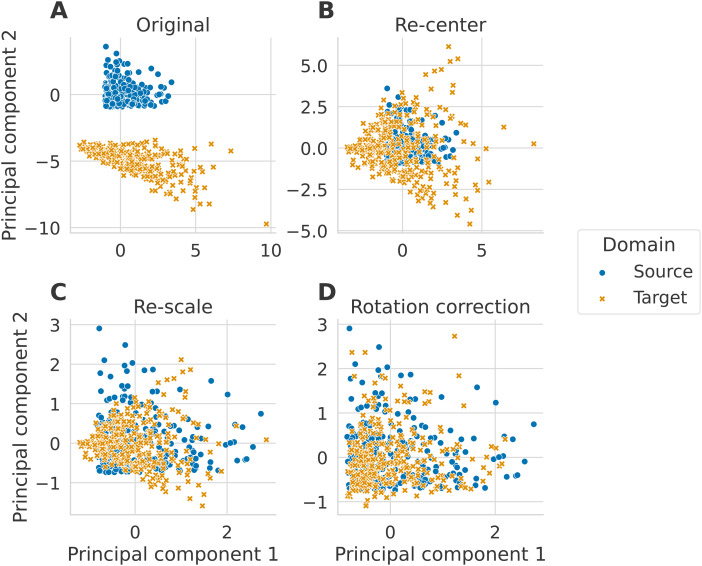
Abstract Neuroscience studies face challenges in gathering large datasets, which limits the use of machine learning (ML) approaches. One possible solution is to incorporate additional data from large public datasets; however, data collected in different contexts often exhibit systematic differences called dataset shifts. Various factors, for example, site, device type, experimental protocol, or social characteristics, can lead to substantial divergence of brain signals that can hinder the success of ML across datasets. In this work, we focus on dataset shifts in recordings of brain activity using MEG and EEG. State-of-the-art predictive approaches on magneto- and electroencephalography (M/EEG) signals classically represent the data by covariance matrices. Model-based dataset alignment methods can leverage the geometry of covariance matrices, leading to three steps: re-centering, re-scaling, and rotation correction. This work explains theoretically how differences in brain activity, anatomy, or device configuration lead to certain shifts in data covariances. Using controlled simulations, the different alignment methods are evaluated. Their practical relevance is evaluated for brain age prediction on one MEG dataset (Cam-CAN, n = 646) and two EEG datasets (TUAB, n = 1385; LEMON, n = 213). Among the same dataset (Cam-CAN), when training and test recordings were from the same subjects but performing different tasks, paired rotation correction was essential (δR2=+0.13 (rest-passive) or +0.17 (rest-smt)). When in addition to different tasks we included unseen subjects, re-centering led to improved performance (δR2=+0.096 for rest-passive, δR2=+0.045 for rest-smt). For generalization to an independent dataset sampled from a different population and recorded with a different device, re-centering was necessary to achieve brain age prediction performance close to within dataset prediction performance. This study demonstrates that the generalization of M/EEG-based regression models across datasets can be substantially enhanced by applying domain adaptation procedures that can statistically harmonize diverse datasets.
Overview
The claims and statistics of this paper haven’t been checked yet.
Free: it reads the open-access text and checks the first 5 claims that cite a source we can check. Create a free account to check every claim.
Integrity signals
Registry
Cites
Statistics
Figures


Verification
Claims the paper makes
The claims and statistics of this paper haven’t been checked yet.
Free: it reads the open-access text and checks the first 5 claims that cite a source we can check. Create a free account to check every claim.
Self-check
Percentages, sums and reported differences re-computed from the paper’s own numbers.
The self-check needs the paper’s full text.
Citations
Cites
Scikit-learn: Machine Learning in Python
Pedregosa, F., Varoquaux, G., Gramfort, A., Michel, V., Thirion, B., Grisel, O., Blondel, M., Müller, A., Nothman, J., Louppe, G., et al. (2012) · arXiv · doi:10.48550/arxiv.1201.0490 · Cited by 71,016
Self-citationMatplotlib: a 2D graphics environment
Hunter, J. D. (2007) · Computing in Science & Engineering · doi:10.1109/mcse.2007.55 · Cited by 39,249
SciPy 1.0: fundamental algorithms for scientific computing in Python
Virtanen, P., Gommers, R., Oliphant, T. E., Haberland, M., Reddy, T., Cournapeau, D., Burovski, E., Peterson, P., Weckesser, W., Bright, J., et al. (2020) · Nature Methods · doi:10.1038/s41592-019-0686-2 · Cited by 38,430
Harris, C. R., Millman, K. J., van der Walt, S. J., Gommers, R., Virtanen, P., Cournapeau, D., Wieser, E., Taylor, J., Berg, S., Smith, N. J., et al. (2020) · Nature · doi:10.1038/s41586-020-2649-2 · Cited by 23,826
Harris, C., Millman, K., van der Walt, S., Gommers, R., Virtanen, P., Cournapeau, D., Wieser, E., Taylor, J., Berg, S., Smith, N., et al. (2020) · RePEc: Research Papers in Economics · Cited by 17,844
Proceedings of the 24th international conference on Machine learning
(2007) · doi:10.1145/1273496 · Cited by 11,630
Scikit-learn: Machine Learning in Python
(2011) · Journal of Machine Learning Research · doi:10.5555/1953048.2078195 · Cited by 8,539
Generalized Cross-Validation as a Method for Choosing a Good Ridge Parameter
Golub, G. H., Heath, M., & Wahba, G. (1979) · Technometrics · doi:10.1080/00401706.1979.10489751 · Cited by 3,934
MEG and EEG data analysis with MNE-Python
Gramfort, A. (2013) · Frontiers in Neuroscience · doi:10.3389/fnins.2013.00267 · Cited by 3,784
Self-citationDeep learning with convolutional neural networks for EEG decoding and visualization
Schirrmeister, R. T., Springenberg, J. T., Fiederer, L. D. J., Glasstetter, M., Eggensperger, K., Tangermann, M., Hutter, F., Burgard, W., & Ball, T. (2017) · Human Brain Mapping · doi:10.1002/hbm.23730 · Cited by 3,751
A review of classification algorithms for EEG-based brain–computer interfaces: A 10 year update
Lotte, F., Bougrain, L., Cichocki, A., Clerc, M., Congedo, M., Rakotomamonjy, A., & Yger, F. (2018) · Journal of Neural Engineering · doi:10.1088/1741-2552/aab2f2 · Cited by 2,239
Author Correction: SciPy 1.0: fundamental algorithms for scientific computing in Python
Contributors, S. 1. 0., Virtanen, P., Gommers, R., Oliphant, T. E., Haberland, M., Reddy, T., Cournapeau, D., Burovski, E., Peterson, P., Weckesser, W., et al. (2020) · Nature Methods · doi:10.1038/s41592-020-0772-5 · Cited by 1,814
Dataset Shift in Machine Learning
(2008) · doi:10.7551/mitpress/9780262170055.001.0001 · Cited by 1,553
Deep learning-based electroencephalography analysis: a systematic review
Roy, Y., Banville, H., Albuquerque, I., Gramfort, A., Falk, T. H., & Faubert, J. (2019) · Journal of Neural Engineering · doi:10.1088/1741-2552/ab260c · Cited by 1,532
Self-citationSimulation physiologischer Regelkreise mit der objektorientierten Modellbibliothek “HumanLib”
Brunberg, A., Spillner, J., Autschbach, R., & Abel, D. (2011) · auto · doi:10.1524/auto.2011.0951 · Cited by 1,008
The log-dynamic brain: how skewed distributions affect network operations
Buzsáki, G., & Mizuseki, K. (2014) · Nature Reviews Neuroscience · doi:10.1038/nrn3687 · Cited by 981
Multiclass Brain–Computer Interface Classification by Riemannian Geometry
Barachant, A., Bonnet, S., Congedo, M., & Jutten, C. (2012) · IEEE Transactions on Biomedical Engineering · doi:10.1109/tbme.2011.2172210 · Cited by 878
Taylor, J. R., Williams, N., Cusack, R., Auer, T., Shafto, M. A., Dixon, M., Tyler, L. K., Cam-CAN, & Henson, R. N. (2017) · NeuroImage · doi:10.1016/j.neuroimage.2015.09.018 · Cited by 782
Epileptic Seizure Detection in EEGs Using Time–Frequency Analysis
Tzallas, A. T., Tsipouras, M. G., & Fotiadis, D. I. (2009) · IEEE Transactions on Information Technology in Biomedicine · doi:10.1109/titb.2009.2017939 · Cited by 744
A Differential Geometric Approach to the Geometric Mean of Symmetric Positive-Definite Matrices
Moakher, M. (2005) · SIAM Journal on Matrix Analysis and Applications · doi:10.1137/s0895479803436937 · Cited by 702
Autoreject: Automated artifact rejection for MEG and EEG data
Jas, M., Engemann, D. A., Bekhti, Y., Raimondo, F., & Gramfort, A. (2017) · NeuroImage · doi:10.1016/j.neuroimage.2017.06.030 · Cited by 598
Self-citationShrinkage Algorithms for MMSE Covariance Estimation
Chen, Y., Wiesel, A., Eldar, Y. C., & Hero, A. O. (2010) · IEEE Transactions on Signal Processing · doi:10.1109/tsp.2010.2053029 · Cited by 567
DeepJDOT: Deep Joint Distribution Optimal Transport for Unsupervised Domain Adaptation
Damodaran, B. B., Kellenberger, B., Flamary, R., Tuia, D., & Courty, N. (2018) · Lecture notes in computer science · doi:10.1007/978-3-030-01225-0_28 · Cited by 553
Applications of the signal space separation method
Taulu, S., Simola, J., & Kajola, M. (2005) · IEEE Transactions on Signal Processing · doi:10.1109/tsp.2005.853302 · Cited by 548
The temple university hospital EEG data corpus
Obeid, I., & Picone, J. (2016) · Frontiers in Neuroscience · doi:10.3389/fnins.2016.00196 · Cited by 528
Classification of covariance matrices using a Riemannian-based kernel for BCI applications
Barachant, A., Bonnet, S., Congedo, M., & Jutten, C. (2013) · Neurocomputing · doi:10.1016/j.neucom.2012.12.039 · Cited by 493
A Metric for Covariance Matrices
Förstner, W., & Moonen, B. (2003) · Geodesy-The Challenge of the 3rd Millennium · doi:10.1007/978-3-662-05296-9_31 · Cited by 460
Correlation Alignment for Unsupervised Domain Adaptation
Sun, B., Feng, J., & Saenko, K. (2017) · Advances in Computer Vision and Pattern Recognition · doi:10.1007/978-3-319-58347-1_8 · Cited by 417
Transfer Learning: A Riemannian Geometry framework with applications to Brain-Computer Interfaces
Zanini, P., Congedo, M., Jutten, C., Said, S., & Berthoumieu, Y. (2018) · IEEE Transactions on Biomedical Engineering · doi:10.1109/tbme.2017.2742541 · Cited by 412
Babayan, A., Erbey, M., Kumral, D., Reinelt, J. D., Reiter, A. M. F., Röbbig, J., Schaare, H. L., Uhlig, M., Anwander, A., Bazin, P.-L., et al. (2019) · Scientific Data · doi:10.1038/sdata.2018.308 · Cited by 364
U-Sleep: resilient high-frequency sleep staging
Perslev, M., Darkner, S., Kempfner, L., Nikolic, M., Jennum, P. J., & Igel, C. (2021) · npj Digital Medicine · doi:10.1038/s41746-021-00440-5 · Cited by 362
The quantitative extraction and topographic mapping of the abnormal components in the clinical EEG
Koles, Z. J. (1991) · Electroencephalography and Clinical Neurophysiology · doi:10.1016/0013-4694(91)90163-x · Cited by 353
Inferring imagined speech using EEG signals: a new approach using Riemannian manifold features
Nguyen, C. H., Karavas, G. K., & Artemiadis, P. (2018) · Journal of Neural Engineering · doi:10.1088/1741-2552/aa8235 · Cited by 289
Riemannian Procrustes Analysis: Transfer Learning for Brain–Computer Interfaces
Rodrigues, P. L. C., Jutten, C., & Congedo, M. (2019) · IEEE Transactions on Biomedical Engineering · doi:10.1109/tbme.2018.2889705 · Cited by 219
Self-citationJoint decorrelation, a versatile tool for multichannel data analysis
de Cheveigné, A., & Parra, L. C. (2014) · NeuroImage · doi:10.1016/j.neuroimage.2014.05.068 · Cited by 192
EEG-based measurement system for monitoring student engagement in learning 4.0
Apicella, A., Arpaia, P., Frosolone, M., Improta, G., Moccaldi, N., & Pollastro, A. (2022) · Scientific Reports · doi:10.1038/s41598-022-09578-y · Cited by 174
Brain age from the electroencephalogram of sleep
Sun, H., Paixão, L., Oliva, J. T., Goparaju, B., Carvalho, D. Z., van Leeuwen, K. G., Akeju, O., THOMAS, R. J., Cash, S. S., Bianchi, M. T., et al. (2018) · Neurobiology of Aging · doi:10.1016/j.neurobiolaging.2018.10.016 · Cited by 161
Predicting Age From Brain EEG Signals—A Machine Learning Approach
Al Zoubi, O., Ki Wong, C., Kuplicki, R. T., Yeh, H.-W., Mayeli, A., Refai, H., Paulus, M., & Bodurka, J. (2018) · Frontiers in Aging Neuroscience · doi:10.3389/fnagi.2018.00184 · Cited by 154
Hari, R., & Puce, A. (2017) · doi:10.1093/med/9780190497774.001.0001 · Cited by 139
MNE-BIDS: Organizing electrophysiological data into the BIDS format and facilitating their analysis
Appelhoff, S., Sanderson, M., Brooks, T., van Vliet, M., Quentin, R., Holdgraf, C., Chaumon, M., Mikulan, E., Tavabi, K., Höchenberger, R., et al. (2019) · Journal of Open Source Software · doi:10.21105/joss.01896 · Cited by 138
Self-citationEngemann, D. A., Kozynets, O., Sabbagh, D., Lemaître, G., Varoquaux, G., Liem, F., & Gramfort, A. (2020) · eLife · doi:10.7554/elife.54055 · Cited by 131
Self-citationThe TUH EEG CORPUS: A big data resource for automated EEG interpretation
Harati, A., Lopez, S., Obeid, I., Picone, J., Jacobson, M. P., & Tobochnik, S. (2014) · 2014 IEEE Signal Processing in Medicine and Biology Symposium (SPMB) · doi:10.1109/spmb.2014.7002953 · Cited by 126
Parallel Transport on the Cone Manifold of SPD Matrices for Domain Adaptation
Yair, O., Ben-Chen, M., & Talmon, R. (2019) · IEEE Transactions on Signal Processing · doi:10.1109/tsp.2019.2894801 · Cited by 113
Intersubject consistency of cortical MEG signals during movie viewing
Lankinen, K., Saari, J., Hari, R., & Koskinen, M. (2014) · NeuroImage · doi:10.1016/j.neuroimage.2014.02.004 · Cited by 111
A reusable benchmark of brain-age prediction from M/EEG resting-state signals
Engemann, D. A., Mellot, A., Höchenberger, R., Banville, H. J., Sabbagh, D., Gemein, L. A. W., Ball, T., & Gramfort, A. (2022) · NeuroImage · doi:10.1016/j.neuroimage.2022.119521 · Cited by 109
Self-citationDähne, S., Meinecke, F. C., Haufe, S., Höhne, J., Tangermann, M., Müller, K.-R., & Nikulin, V. V. (2014) · NeuroImage · doi:10.1016/j.neuroimage.2013.07.079 · Cited by 108
Multiway canonical correlation analysis of brain data
de Cheveigné, A., Liberto, G. M. D., Arzounian, D., Wong, D. D. E., Hjortkjær, J., Fuglsang, S. A., & Parra, L. C. (2018) · NeuroImage · doi:10.1016/j.neuroimage.2018.11.026 · Cited by 105
Predictive regression modeling with MEG/EEG: from source power to signals and cognitive states
Sabbagh, D., Ablin, P., Varoquaux, G. P., Gramfort, A., & Engemann, D. A. (2020) · NeuroImage · doi:10.1016/j.neuroimage.2020.116893 · Cited by 100
Self-citationPreventing dataset shift from breaking machine-learning biomarkers
Dockès, J., Varoquaux, G., & Poline, J.-B. (2021) · GigaScience · doi:10.1093/gigascience/giab055 · Cited by 86
Dmochowski, J., Ki, J. J., DeGuzman, P., Sajda, P., & Parra, L. C. (2017) · NeuroImage · doi:10.1016/j.neuroimage.2017.05.037 · Cited by 75
Harmonized-Multinational qEEG norms (HarMNqEEG)
Li, M., Wang, Y., Lopez-Naranjo, C., Hu, S., Reyes, R. G., Paz-Linares, D., Gonzalez, A. A., Hamid, A. I. A., Evans, A. C., Savostyanov, A. N., et al. (2022) · NeuroImage · doi:10.1016/j.neuroimage.2022.119190 · Cited by 73
Consistency and similarity of MEG- and fMRI-signal time courses during movie viewing
Lankinen, K., Saari, J., Hlushchuk, Y., Tikka, P., Parkkonen, L. T., Hari, R., & Koskinen, M. (2018) · NeuroImage · doi:10.1016/j.neuroimage.2018.02.045 · Cited by 70
Personal-Zscore: Eliminating Individual Difference for EEG-Based Cross-Subject Emotion Recognition
Chen, H., Sun, S., Li, J., Yu, R., Li, N., Li, X., & Hu, B. (2021) · IEEE Transactions on Affective Computing · doi:10.1109/taffc.2021.3137857 · Cited by 70
A New Generation of Brain-Computer Interface Based on Riemannian Geometry
Congedo, M., Barachant, A., & Andreev, A. (2013) · arXiv · doi:10.48550/arxiv.1310.8115 · Cited by 69
Xifra‐Porxas, A., Ghosh, A., Mitsis, G. D., & Boudrias, M. (2021) · NeuroImage · doi:10.1016/j.neuroimage.2021.117822 · Cited by 67
Manifold-regression to predict from MEG/EEG brain signals without source modelingPreprint
Sabbagh, D., Ablin, P., Varoquaux, G. P., Gramfort, A., & Engemann, D. A. (2019) · arXiv (Cornell University) · doi:10.48550/arxiv.1906.02687 · Cited by 66
Self-citationChambon, S., Galtier, M. N., Arnal, P. J., Wainrib, G., & Gramfort, A. (2018) · IEEE Transactions on Neural Systems and Rehabilitation Engineering · doi:10.1109/tnsre.2018.2813138 · Cited by 59
Self-citationalexandrebarachant/pyRiemann: Minor release with bugfix and dependencies update
Barachant, A., Barthélemy, Q., Berg, G. W. V., Gramfort, A., Chevallier, S., Jean-Rémi, K. I. N. G., Rodrigues, P. L. C., Junqueira Lopes, B., maxdolle, gcattan, et al. (2015) · HAL · doi:10.5281/zenodo.593816 · Cited by 41
Self-citationSliced-Wasserstein on Symmetric Positive Definite Matrices for M/EEG SignalsPreprint
Bonet, C., Malézieux, B., Rakotomamonjy, A., Drumetz, L., Moreau, T., Kowalski, M., & Courty, N. (2023) · HAL · doi:10.48550/arxiv.2303.05798 · Cited by 41
Dimensionality Transcending: A Method for Merging BCI Datasets With Different Dimensionalities
Rodrigues, P. L. C., Congedo, M., & Jutten, C. (2020) · IEEE Transactions on Biomedical Engineering · doi:10.1109/tbme.2020.3010854 · Cited by 25
Self-citationLi, Y., Wei, Q., Chen, Y., & Zhou, X. (2021) · IEEE Access · doi:10.1109/access.2020.3048683 · Cited by 25
Transfer Learning for the Riemannian Tangent Space: Applications to Brain-Computer Interfaces
Bleuzé, A., Mattout, J., & Congedo, M. (2021) · International Conference on Engineering and Emerging Technologies (ICEET) · doi:10.1109/iceet53442.2021.9659607 · Cited by 17
Domain Adaptation Using Riemannian Geometry of Spd Matrices
Maman, G., Yair, O., Eytan, D., & Talmon, R. (2019) · IEEE International Conference on Acoustics Speech and Signal Processing · doi:10.1109/icassp.2019.8682989 · Cited by 14
Hari, R., & Puce, A. (2017) · doi:10.1093/med/9780190497774.003.0001 · Cited by 6
barachant, A., Barthélemy, Q., Gramfort, A., Chevallier, S., Jean-Rémi, K. I. N. G., Rodrigues, P. L. C., Dave, Olivetti, E., Goncharenko, V., maxdolle, et al. (2023) · Zenodo · doi:10.5281/zenodo.8059038
Self-citation
Cited by
Machine learning of brain-specific biomarkers from EEG
Bomatter, P., Paillard, J., Garcés, P., Hipp, J. F., & Engemann, D. A. (2024) · EBioMedicine · doi:10.1016/j.ebiom.2024.105259 · Cited by 44
Self-citationKiessner, A.-K., Schirrmeister, R. T., Gemein, L. A. W., Boedecker, J., & Ball, T. (2023) · NeuroImage Clinical · doi:10.1016/j.nicl.2023.103482 · Cited by 38
Paillard, J., Hipp, J. F., & Engemann, D. A. (2025) · Patterns · doi:10.1016/j.patter.2025.101182 · Cited by 31
Self-citationComBat models for harmonization of resting-state EEG features in multisite studies
Jaramillo-Jiménez, A., Tovar, D., Mantilla-Ramos, Y.-J., Ochoa-Gomez, J. F., Bonanni, L., & Brønnick, K. (2024) · Clinical Neurophysiology · doi:10.1016/j.clinph.2024.09.019 · Cited by 17
Towards Explainable Deep Learning in Computational Neuroscience: Visual and Clinical Applications
Mehmood, A., Mehmood, F., & Kim, J. (2025) · Mathematics · doi:10.3390/math13203286 · Cited by 17
Metadata
- Authors
- Mellot, A., Collas, A., Rodrigues, P. L. C., Engemann, D., & Gramfort, A.
- Affiliations
- Institut national de recherche en sciences et technologies du numérique (FR)
- Institut polytechnique de Grenoble (FR)
- F. Hoffmann-La Roche AG (CH)
- Corresponding author
- Mellot, Apolline
- Venue
- Imaging Neuroscience
- Publisher
- MIT Press
- Published
- 2023-12
- Volume
- 1
- Pages
- 1-26
- ISSN
- 2837-6056 (ISSN-L)
- PMC
- PMC12007539
- OpenAlex
- W4388837728
- Cited by
- 16
- References
- 63
- Citations by year
- 2026: 7 · 2025: 5 · 2024: 3 · 2023: 1
- FWCI
- 2.40
- Type
- journal article
- Language
- en
- Open access
- diamond
- doi.org
- Licence
- Locations
- Imaging Neuroscience (publishedVersion, cc-by)
- bioRxiv (Cold Spring Harbor Laboratory) (acceptedVersion, cc-by)
- PubMed Central (publishedVersion, cc-by)
- PubMed (publishedVersion)
- HAL (submittedVersion, cc-by)
- Funders
- Agence Nationale de la Recherche (ANR-20-CHIA-0016, ANR-20-THIA-0013, ANR-20-IADJ-0002)
- Topics
- Life Sciences › Neuroscience › Cognitive Neuroscience › EEG and Brain-Computer Interfaces
- Physical Sciences › Computer Science › Artificial Intelligence › Domain Adaptation and Few-Shot Learning
- Life Sciences › Neuroscience › Cognitive Neuroscience › Neural dynamics and brain function
- Keywords
- distribution shift, MEG, EEG, covariance matrix, domain adaptation, brain age prediction, cross-dataset generalization, Cam-CAN, lemon
About these checks
Registry, retraction, Cites and statistics results are computed, not judged, with one exception: a printed reference that no index lists is read once by a model before it counts as a citation error. Claims are extracted by a model and kept only when their quote appears verbatim in the text; each cited source is then checked, with a model’s help, for whether it says what the claim relies on. Those verdicts can be wrong — read the claim’s quote and the cited source before relying on one.
Statistics and arithmetic are recomputed, not judged.
Confidence bands are shown only for fields calibrated on our annotated test set. None is calibrated yet, so no band is shown.
What counts as a claim ›How we measure confidence ›How we check this ›
Are you an author, or do you see a problem with this page? Request a review
Data sources
Bibliographic data: Semantic Scholar, OpenAlex, Crossref.
Contains information from the Semantic Scholar Academic Graph Datasets, made available under the ODC Attribution License (ODC-BY 1.0).
Semantic Scholar’s data is described in: Kinney, R., et al. (2023). The Semantic Scholar Open Data Platform. arXiv:2301.10140.
