

The DOI matches its Crossref record; 29 of the 29 references it cites were found in a registry or an index.
Specialized psychotherapies for adults with borderline personality disorder: A systematic review and meta-analysis
Abstract
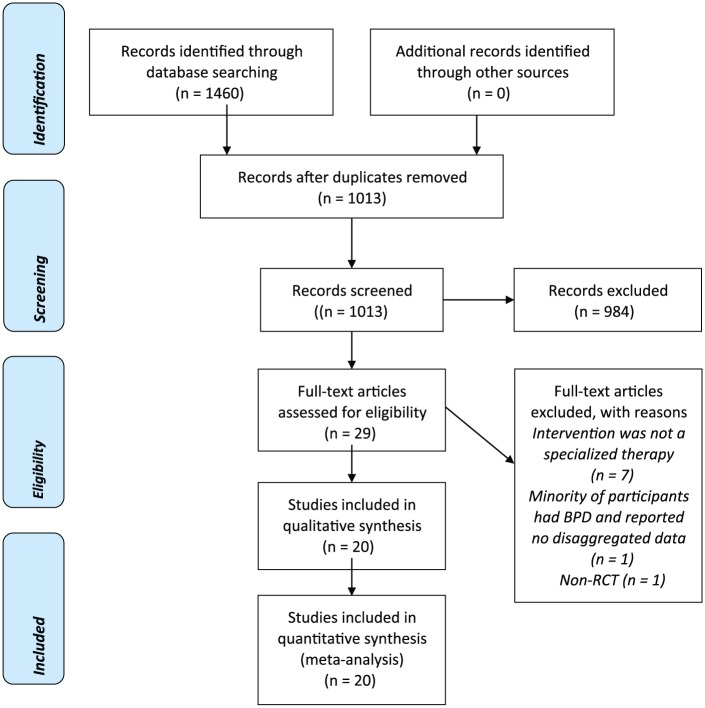
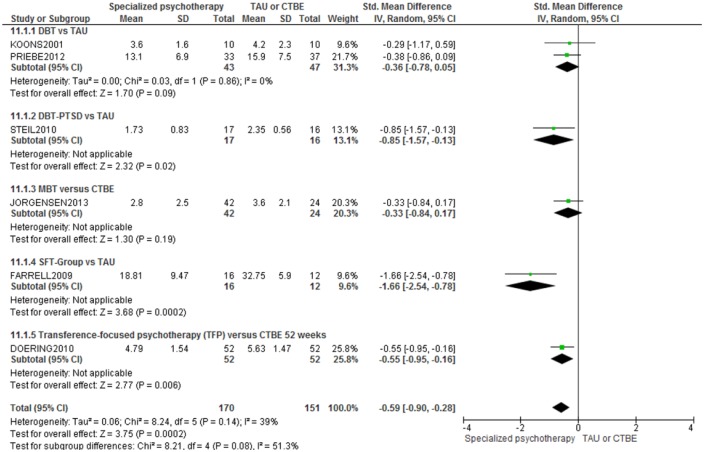
Objective: Borderline personality disorder affects up to 2% of the population and is associated with poor functioning, low quality of life and increased mortality. Psychotherapy is the treatment of choice, but it is unclear whether specialized psychotherapies (dialectical behavior therapy, mentalization-based treatment, transference-focused therapy and schema therapy) are more effective than non-specialized approaches (e.g. protocolized psychological treatment, general psychiatric management). The aim of this systematic review is to investigate the effectiveness of these psychotherapies. Methods: PubMed, PsycINFO, CINAHL, EMBASE and CENTRAL were searched from inception to November 2017. Included randomized controlled trials were assessed on risk of bias and outcomes were meta-analyzed. Confidence in the results was assessed using the Grading of Recommendations Assessment, Development and Evaluation method. The review has been reported following Preferred Reporting Items for Systematic Reviews and Meta-Analyses guidelines. Results: A total of 20 studies with 1375 participants were included. Specialized psychotherapies, when compared to treatment as usual or community treatment by experts, were associated with a medium effect based on moderate quality evidence on overall borderline personality disorder severity (standardized mean difference = –0.59 [95% confidence interval: –0.90, –0.28]), and dialectical behavior therapy, when compared to treatment as usual, with a small to medium effect on self-injury (standardized mean difference = –0.40 [95% confidence interval: –0.66, –0.13]). Other effect estimates were often inconclusive, mostly due to imprecision. Conclusion: There is moderate quality evidence that specialized psychotherapies are effective in reducing overall borderline personality disorder severity. However, further research should identify which patient groups profit most of the specialized therapies.
Overview
The claims and statistics of this paper haven’t been checked yet.
Run the check — free, no account needed. It reads the open-access text and checks the sources it cites.
Integrity signals
Registry
Cites
Statistics
Figures
Verification
Claims the paper makes
The claims and statistics of this paper haven’t been checked yet.
Run the check — free, no account needed. It reads the open-access text and checks the sources it cites.
Claims other papers make about this one
Each is checked against this paper’s own text: does it say what the citing paper says it does?
In the citing paper
“The most revealing datasets show significant differences in performance between models [16,38].”
From Large-scale simulation study of active learning models for systematic reviews (2025) · cites this paper as [38]
Self-check
Percentages, sums and reported differences re-computed from the paper’s own numbers.
The self-check needs the paper’s full text.
Citations
Cites
Reprint—Preferred Reporting Items for Systematic Reviews and Meta-Analyses: The PRISMA Statement
Moher, D., Liberati, A., Tetzlaff, J., Altman, D. G., & and the PRISMA Group (2009) · Physical Therapy · doi:10.1093/ptj/89.9.873 · Cited by 2,486
Cognitive-behavioral treatment of chronically parasuicidal borderline patients
Linehan, M. M. (1991) · Archives of General Psychiatry · doi:10.1001/archpsyc.1991.01810360024003 · Cited by 2,203
Linehan, M. M., Comtois, K. A., Murray, A. M., Brown, M. Z., Gallop, R. J., Heard, H. L., Korslund, K. E., Tutek, D. A., Reynolds, S. K., & Lindenboim, N. (2006) · Archives of General Psychiatry · doi:10.1001/archpsyc.63.7.757 · Cited by 2,025 · cited 4×
“…in effect between specialized psychotherapies and CTBE on suicidal behavior (k = 2; n = 193; SMD = –0.18 [95% CI: –0.52, 0.15]; Doering et al., 2010; Linehan et al., 2006) and self-injury (k = 1; n = 104; RR = 1.09 [95% CI: 0.84, 1.40]), although the CI was compatible with both a reduction and…”
BackgroundMethodInfluentialBateman, A., & Fonagy, P. (1999) · American Journal of Psychiatry · doi:10.1176/ajp.156.10.1563 · Cited by 1,416 · cited 11×
“Subgroup analysis provided moderate quality positive effects of MBT on suicidal behavior, self-injury and dysfunctional interpersonal patterns in comparison with SCM.”
BackgroundResultInfluentialEvaluating three treatments for borderline personality disorder: a multiwave study
Clarkin, J. F., Levy, K. N., Lenzenweger, M. F., & Kernberg, O. F. (2007) · American Journal of Psychiatry · doi:10.1176/ajp.2007.164.6.922 · Cited by 997 · cited 10×
“Our review included some relevant studies (Bohus et al., 2013; Clarkin et al., 2007; Feigenbaum et al., 2012; Giesen-Bloo et al., 2006; Harned et al., 2014; Linehan et al., 2015; Nadort et al., 2009; Steil et al., 2011) that were missing in the meta-analysis of Cristea et al.”
BackgroundMethodResultInfluentialBateman, A., & Fonagy, P. (2009) · American Journal of Psychiatry · doi:10.1176/appi.ajp.2009.09040539 · Cited by 961
Psychological therapies for people with borderline personality disorder.
Stoffers-Winterling, J. M., Völlm, B. A., Rücker, G., Timmer, A., Huband, N., & Lieb, K. (2012) · Cochrane Database of Systematic Reviews · doi:10.1002/14651858.cd005652.pub2 · Cited by 895 · cited 6×
“Australian & New Zealand Journal of Psychiatry, 52(10) may be superior to others (Bloom et al., 2012; Cristea et al., 2017; Kliem et al., 2010; Stoffers et al., 2012).”
BackgroundInfluentialMcMain, S. F., Links, P. S., Gnam, W. H., Guimond, T., Cardish, R. J., Korman, L., & Streiner, D. L. (2009) · American Journal of Psychiatry · doi:10.1176/appi.ajp.2009.09010039 · Cited by 729 · cited 8×
“Although we cannot conclude this directly from the meta-analysis, we hypothesize that protocolized psychological treatment (e.g. GPM) could be more feasible in community health teams for less complex BPD.”
BackgroundMethodResultInfluentialEfficacy of dialectical behavior therapy in women veterans with borderline personality disorder
Koons, C. R., Robins, C. J., Lindsey Tweed, J., Lynch, T. R., Gonzalez, A. M., Morse, J. Q., Bishop, G. K., Butterfield, M. I., & Bastian, L. A. (2001) · Behavior Therapy · doi:10.1016/s0005-7894(01)80009-5 · Cited by 700
Cristea, I. A., Gentili, C., Cotet, C. D., Palomba, D., Barbui, C., & Cuijpers, P. (2017) · JAMA Psychiatry · doi:10.1001/jamapsychiatry.2016.4287 · Cited by 655
Research works printed but not linked: 21
- 10.1136/bmj.319.7211.709a · DOI
- 10.1371/journal.pone.0107748 · DOI
- Cohen J, 1988, Statistical Power Analysis for the Behavioral Sciences
- 10.1037/ccp0000115 · DOI
- 10.1001/archpsyc.63.6.649 · DOI · Paper page
- 10.1016/j.jclinepi.2010.09.011 · DOI · Paper page
- 10.1176/ps.62.11.pss6211_1381 · DOI
- 10.1002/9780470712184 · DOI · Paper page
- 10.1111/j.1600-0447.2012.01923.x · DOI
- 10.1192/bjp.bp.108.062984 · DOI
- 10.1016/S0140-6736(04)16770-6 · DOI · Paper page
- Linehan MM, 1993, Cognitive-Behavioral Treatment of Borderline Personality Disorder
- 10.1001/jamapsychiatry.2014.3039 · DOI · Paper page
- NICE, 2009, Borderline Personality Disorder: Recognition and Management (Clinical Guideline [CG78])
- Nordic Cochrane Centre, 2014, Review Manager (Revman) Version 5.3
- 10.1159/000338897 · DOI
- 10.3109/09540261.2011.588200 · DOI
- Stoffers JM, 2012, Cochrane Database of Systematic Reviews, 8
- Torgersen S, 2012, The Oxford Handbook of Personality Disorders, 186
- 10.1016/j.brat.2004.09.008 · DOI
- Zanarini MC, 2010, Annals of Clinical Psychiatry, 22, 75
Cited by
Turecki, G., Brent, D. A., Gunnell, D., O’Connor, R. C., Oquendo, M. A., Pirkis, J., & Stanley, B. H. (2019) · Nature Reviews Disease Primers · doi:10.1038/s41572-019-0121-0 · Cited by 1,074
Psychological therapies for people with borderline personality disorder
Storebø, O. J., Stoffers-Winterling, J. M., Völlm, B. A., Kongerslev, M. T., Mattivi, J. T., Jørgensen, M. S., Faltinsen, E., Todorovac, A., Sales, C. P., Callesen, H. E., et al. (2020) · Cochrane Database of Systematic Reviews · doi:10.1002/14651858.cd012955.pub2 · Cited by 450
Psychotherapies for borderline personality disorder: a focused systematic review and meta-analysis
Stoffers-Winterling, J. M., Storebø, O. J., Kongerslev, M. T., Faltinsen, E., Todorovac, A., Sedoc Jørgensen, M., Sales, C. P., Edemann Callesen, H., Pereira Ribeiro, J., Völlm, B. A., et al. (2022) · The British Journal of Psychiatry · doi:10.1192/bjp.2021.204 · Cited by 156
Arntz, A., Jacob, G. A., Lee, C. W., Brand-de Wilde, O. M., Fassbinder, E., Harper, R. P., Lavender, A., Lockwood, G., Malogiannis, I. A., Ruths, F. A., et al. (2022) · JAMA Psychiatry · doi:10.1001/jamapsychiatry.2022.0010 · Cited by 114
Self-citationAn integrated model to assess and treat compulsive sexual behaviour disorder
Briken, P. (2020) · Nature Reviews Urology · doi:10.1038/s41585-020-0343-7 · Cited by 101
Rameckers, S. A., Verhoef, R. E. J., Grasman, R. P. P. P., Cox, W. R., van Emmerik, A. A. P., Engelmoer, I. M., & Arntz, A. (2021) · Journal of Clinical Medicine · doi:10.3390/jcm10235622 · Cited by 63
Self-citationChen, S., Cheng, Y., Zhao, W., & Zhang, Y. (2021) · Journal of Psychiatric and Mental Health Nursing · doi:10.1111/jpm.12797 · Cited by 50
Fassbinder, E., Assmann, N., Schaich, A., Heinecke, K., Wagner, T., Sipos, V., Jauch-Chara, K., Hüppe, M., Arntz, A., & Schweiger, U. (2018) · BMC Psychiatry · doi:10.1186/s12888-018-1905-6 · Cited by 33
Self-citationLarge-scale simulation study of active learning models for systematic reviews
Teijema, J. J., de Bruin, J., Bagheri, A., & van de Schoot, R. (2025) · International Journal of Data Science and Analytics · doi:10.1007/s41060-025-00777-0 · Cited by 13
Baggio, T., Teti, A., Rizzi, R., Grecucci, A., & Messina, I. (2026) · Frontiers in Human Neuroscience · doi:10.3389/fnhum.2026.1787003
Metadata
- Authors
- Oud, M., Arntz, A., Hermens, M. L., Verhoef, R., & Kendall, T.
- Venue
- Australian & New Zealand Journal of Psychiatry
- Publisher
- SAGE Publications
- Published
- 2018-08-09
- Volume
- 52
- Issue
- 10
- Pages
- 949-961
- ISSN
- 0004-8674
- 1440-1614
- PMC
- PMC6151959
- Cited by
- 134
- References
- 29
- Language
- en
- Funders
- Kwaliteitsontwikkeling GGz (PV130006)
About these checks
Registry, retraction, Cites and statistics results are computed, not judged, with one exception: a printed reference that no index lists is read once by a model before it counts as a citation error. Claims are extracted by a model and kept only when their quote appears verbatim in the text; each cited source is then checked, with a model’s help, for whether it says what the claim relies on. Those verdicts can be wrong — read the claim’s quote and the cited source before relying on one.
Statistics and arithmetic are recomputed, not judged.
Confidence bands are shown only for fields calibrated on our annotated test set. None is calibrated yet, so no band is shown.
What counts as a claim ›How we measure confidence ›How we check this ›
Are you an author, or do you see a problem with this page? Request a review
Data sources
Bibliographic data: Semantic Scholar, OpenAlex, Crossref.
Contains information from the Semantic Scholar Academic Graph Datasets, made available under the ODC Attribution License (ODC-BY 1.0).
Semantic Scholar’s data is described in: Kinney, R., et al. (2023). The Semantic Scholar Open Data Platform. arXiv:2301.10140.
