

Risk, Trust, and the Roles of Human Versus Virtual Influencers
Open accessThe DOI matches its Crossref record; 152 of the 153 references it cites were found in a registry or an index, and 1 are not checked yet; 15 of the 115 sources its claims cite were checked for support.
Abstract
Drawing on the theory of sociology of trust and risk, this study proposes and empirically tests a conceptual model of tourists’ new destination visit intentions. The model links tourists’ subjective knowledge to trust and risk perceptions and explores the moderating effects of social media influencers (human vs. virtual) and tourists’ psychographic factors in this context. Data were collected from two studies: Study 1, through a survey distributed to participants in Malaysia ( n = 493 valid responses); and Study 2, through a between-subjects design experiment with another sample of participants in Malaysia ( n = 470 valid responses). The findings expand knowledge in tourism research by showing that destination trust mediates how subjective knowledge influences perceived risk. Optimism and life satisfaction have significant moderating effects in this context. Furthermore, the relationship between destination trust and visit intention is moderated by human and virtual influencers, according to whether their message is positive or negative.
Verified 2026-11-22 · 1 reference not checked yet
Overview
CoChat Summary
TL;DR
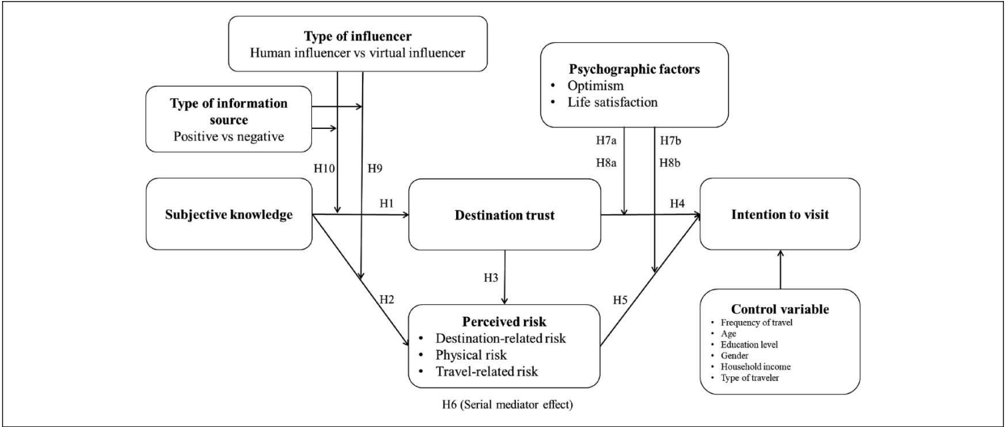
Drawing on the sociology of trust and risk, this paper tests a model linking tourists’ subjective knowledge to destination trust, perceived risk, and intention to visit a new destination, with moderation by human versus virtual influencers and psychographic factors. Across a survey and a 2 × 2 experiment with Malaysian travelers who had never visited China, destination trust mediated the effect of subjective knowledge on perceived risk, and optimism and life satisfaction moderated key paths.
Key findings
- In Study 1 (n = 493), subjective knowledge positively influenced destination trust (H1a: β = .404, p < .01; R² = 16.3%), while subjective knowledge (H2: β = −.107, p < .01, f² = 0.020) and destination trust (H3: β = −.489, p < .01, f² = 0.277) negatively influenced perceived risk; these relationships explained 29.3% of the variance in perceived risk.
- Destination trust positively influenced intention to visit (H4: β = .407, p < .01, f² = 0.169), perceived risk negatively influenced intention to visit (H5: β = −.212, p < .01, f² = 0.046), and the serial mediation of destination trust and perceived risk was significant (H6: β = .042, p < .01); these relationships explained 34.9% of the variance in intention to visit.
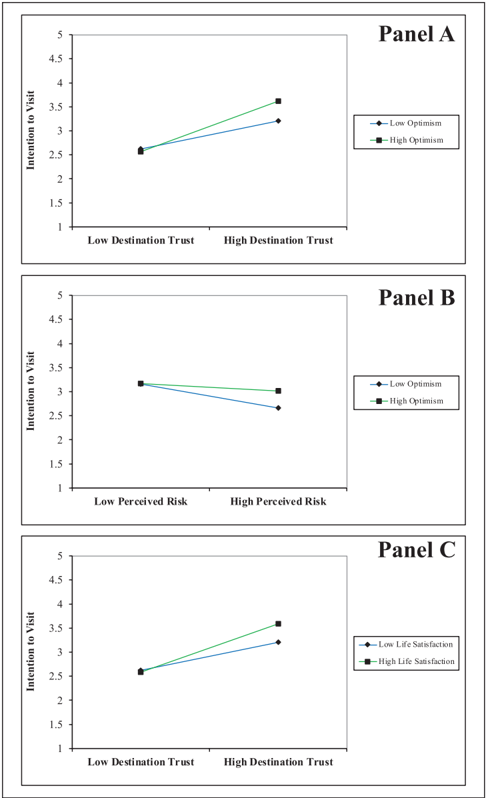
- Optimism moderated both destination trust → intention (β = .117, p < .05, f² = 0.028) and perceived risk → intention (β = .087, p < .05, f² = 0.020); life satisfaction moderated only destination trust → intention (β = .106, p < .05, f² = 0.021), not perceived risk → intention.
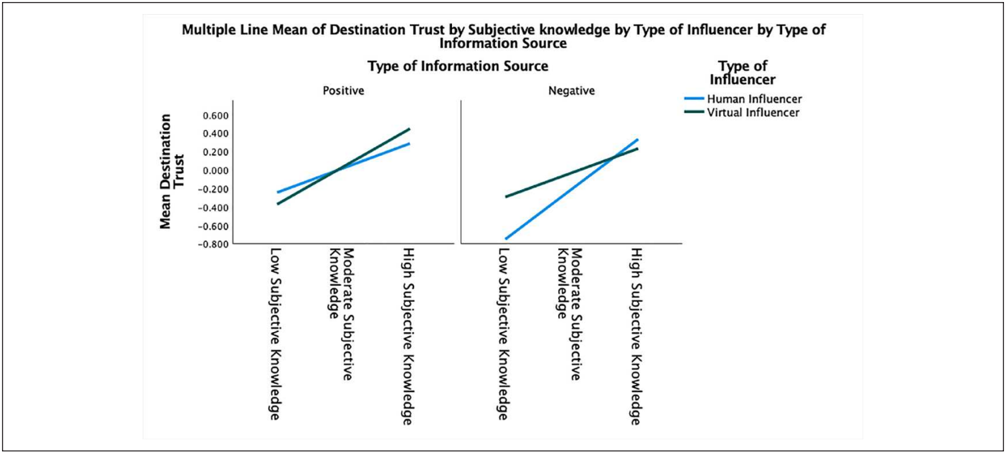
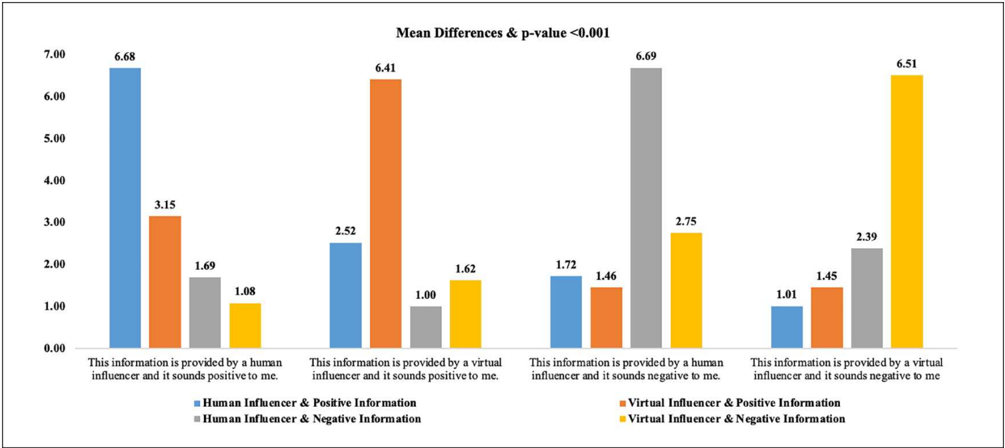
- In Study 2 (n = 470), the three-way subjective knowledge × influencer type × information type effect on destination trust was significant (H9: β = .124, p < .01; R² increased from 16.4% to 20.1%), but H9 was not supported due to contradictory interaction-plot outcomes; the effect on perceived risk was not significant (H10: β = −.091, p = .145), so H10 was not supported. The paper reports that virtual influencers were more effective with positive information, while human influencers were more effective with negative information.
Methods
- Study 1: survey of Malaysian travelers aged 20–40 who had never traveled to China; 600 invited, 543 completed, 50 removed for straight-lining/outliers, yielding 493 valid responses (82.17% response rate); data collected January 1–31, 2023; analyzed with PLS-SEM using SmartPLS, including common method bias checks.
- Study 2: 2 (influencer type: human vs. virtual) × 2 (information source: positive vs. negative) between-subjects experiment with 500 adults in Malaysia; 30 responses discarded after attention checks, yielding 470 usable responses; participants randomly assigned to four conditions, forced exposure for 1 min, and hypotheses tested with Hayes’ PROCESS Model 3 using 10,000 bootstrapped samples.
- Measures for subjective knowledge, destination trust, perceived risk (destination-related, physical, and travel-related risk), optimism, life satisfaction, and intention to visit were adapted from existing scales and rated on seven-point Likert scales; perceived risk was modeled as a reflective-formative second-order construct.
Limitations
- Stated in the paper: findings are limited to destinations tourists have not visited before (first-time visitors); the study analyzed only optimism and life satisfaction, with future research suggested on other factors such as political engagement; future work should explore virtual influencers in tourism, types of virtual influencers, tourists’ loneliness, and longitudinal conversion of subjective knowledge into objective knowledge after travel.
- Evident from the text: the samples are Malaysian travelers considering China in a post-pandemic context, which may limit generalizability to other destinations, traveler populations, or non-pandemic risk settings; Study 2’s H9 and H10 were not supported, and the paper notes contradictory interaction-plot outcomes for H9.
Model-written summary. Check it against the paper before relying on it.
Integrity signals
Registry
Cites
Statistics
Figures





Verification
Claims the paper makes
14 Valid · 0 Not valid · 71 Not checked · 61 Own results and interpretations
The cited sources support only part of this claim — read each source’s verdict below.
In the paper
“Instagram has been highlighted as a key potential online data site for tourism because it is relevant to influencer marketing and it has been found to influence tourists' decision making (Cohen et al., 2022; Femenia-Serra et al., 2022; He et al., 2022; Yılmaz et al., 2020).”
What the sources say
- Not matchedcites Cohen et al., 2022
An author–year citation the paper’s reference list doesn’t settle. We don’t search these by name.
- Partly supportedcites Femenia-Serra et al., 2022 matched to “Instagram travel influencers in #quarantine: Communicative practices and roles during COVID-19” (2022) sourceExperimental — accuracy not yet measured
The Literature review (Travel influencer marketing; page unavailable) reports that travel influencers can increase tourists’ destination-visit intentions, which supports an influence on potential travel choices. It does not establish that Instagram itself influences tourists’ decision-making; the Limitations and future research section says this study did not examine how audiences or potential tourists perceived the influencers’ messages. (LLM, conf=0.82)
- Not matchedcites He et al., 2022
This doesn’t read as a citation we can look up.
plainstates a cause- Asserted: passes — The authors put it forward as true.
- Checkable: passes — It can be checked against evidence.
- Load-bearing: unclear — It is unclear whether the paper’s conclusions depend on it.
- Based: passes — The paper gives a reason why it holds.
- Not matched
A result the paper reports from its own data — it cites no other source for it, so there is none to check. The quote shows it is in the paper.
In the paper
“The findings expand knowledge in tourism research by showing that destination trust mediates how subjective knowledge influences perceived risk.”
plainstates a cause- Asserted: passes — The authors put it forward as true.
- Checkable: passes — It can be checked against evidence.
- Load-bearing: passes — The paper’s conclusions depend on it.
- Based: passes — The paper gives a reason why it holds.
A result the paper reports from its own data — it cites no other source for it, so there is none to check. The quote shows it is in the paper.
In the paper
“Optimism and life satisfaction have significant moderating effects in this context.”
plainstates an association- Asserted: passes — The authors put it forward as true.
- Checkable: passes — It can be checked against evidence.
- Load-bearing: passes — The paper’s conclusions depend on it.
- Based: passes — The paper gives a reason why it holds.
A result the paper reports from its own data — it cites no other source for it, so there is none to check. The quote shows it is in the paper.
In the paper
“Third, we show the fundamental influence of optimism and life satisfaction on tourists' travel decisions.”
boostedstates a cause- Asserted: passes — The authors put it forward as true.
- Checkable: passes — It can be checked against evidence.
- Load-bearing: passes — The paper’s conclusions depend on it.
- Based: passes — The paper gives a reason why it holds.
A result the paper reports from its own data — it cites no other source for it, so there is none to check. The quote shows it is in the paper.
In the paper
“Furthermore, the relationship between destination trust and visit intention is moderated by human and virtual influencers, according to whether their message is positive or negative.”
plainstates an association- Asserted: passes — The authors put it forward as true.
- Checkable: passes — It can be checked against evidence.
- Load-bearing: passes — The paper’s conclusions depend on it.
- Based: passes — The paper gives a reason why it holds.
46 more claims
Create a free account to see all 146 claims and to verify the 31 references still open.
- Probably not a substantial claim. 69
- It may state two separate claims as one. 44
- The quote only partly states this claim. 2
Self-check
Percentages, sums and reported differences re-computed from the paper’s own numbers.
Each contradiction between two passages listed here was confirmed by an independent check.
Rated minor: it would not touch a result — a value no result rests on, a p-value that stays on the same side of the significance level, or a conflict that is clerical, resolved elsewhere in the paper, or outside its own findings.
In the paper
§ Evaluating the Structural Model
“Destination trust (H3: β = -.489, p -value > .01, f 2 = 0.277) was found to negatively influence perceived risk”
§ Measures
“| | H3: Destination trust → Perceived risk | -0.489 | 0.041 | -11.948 | .000 | -0.550 | -0.415 | 1.195 | 0.277 | | |”
Citations
Cites
The theory of planned behavior
Ajzen, I. (1991) · Organizational Behavior and Human Decision Processes · doi:10.1016/0749-5978(91)90020-t · Cited by 90,587
A primer on partial least squares structural equation modeling (PLS-SEM)
Leguina, A. (2015) · International Journal of Research & Method in Education · doi:10.1080/1743727x.2015.1005806 · Cited by 18,921
An integrative model of organizational trust
Mayer, R. C., Davis, J. H., & Schoorman, F. D. (1995) · The Academy of Management Review · doi:10.2307/258792 · Cited by 10,736
Common Method Bias in PLS-SEM: A Full Collinearity Assessment Approach
Kock, N. (2015) · International Journal of e-Collaboration · doi:10.4018/ijec.2015100101 · Cited by 10,215 · cited 2×
“To ensure robustness in the assessment for Study 1, two types of statistical assessments for common method bias were incorporated: Harman’s single-factor test (MacKenzie & Podsakoff, 2012) and the full collinearity test (Kock, 2015).”
BackgroundMethodInfluentialThe benefits of frequent positive affect: Does happiness lead to success?
Lyubomirsky, S., King, L., & Diener, E. (2005) · Psychological Bulletin · doi:10.1037/0033-2909.131.6.803 · Cited by 7,143
A Protection Motivation Theory of Fear Appeals and Attitude Change1
Rogers, R. W. (1975) · The Journal of Psychology · doi:10.1080/00223980.1975.9915803 · Cited by 6,805
Pandemics, tourism and global change: a rapid assessment of COVID-19
Gössling, S., Scott, D., & Hall, C. M. (2021) · Journal of Sustainable Tourism · doi:10.1080/09669582.2020.1758708 · Cited by 4,766
Predictive model assessment in PLS-SEM: guidelines for using PLSpredict
Shmueli, G., Sarstedt, M., Hair, J. F., Cheah, J.-H., Ting, H., Vaithilingam, S., & Ringle, C. M. (2019) · European Journal of Marketing · doi:10.1108/ejm-02-2019-0189 · Cited by 4,618 · cited 1×
“The Q 2 predict values for destination trust (0.153), perceived risk (0.085), and intention to visit (0.120) were greater than zero, demonstrating the predictive relevance of the model (Shmueli et al., 2019).”
InfluentialSelf-citationDimensions of Consumer Expertise
Alba, J. W., & Hutchinson, J. W. (1987) · Journal of Consumer Research · doi:10.1086/209080 · Cited by 4,375
The Uncanny Valley [From the Field]
Mori, M., MacDorman, K., & Kageki, N. (2012) · IEEE Robotics & Automation Magazine · doi:10.1109/mra.2012.2192811 · Cited by 3,542
Research works printed but not linked: 4
- Luhmann, N. (1979). Trust and power . Wiley.
- Marinao, E., Chasco, C., & Torres, E. (2012). Trust in tourist destinations. The role of local inhabitants and institutions. Academia. Revista Latinoamericana de Administraci'on , 51 , 27-47.
- Mori, M. (1970). Bukimi no tani [the uncanny valley]. Energy , 7 (4), 33-35.
- Roodurmun, J., & Juwaheer, T. D. (August, 2010). Influence of trust on destination loyalty: An empirical analysis the discussion of the research approach [Symposium]. International research symposium in service management (pp. 24-27). Le Meridien Hotel.
Cited by
The authentic virtual influencer: Authenticity manifestations in the metaverse
Koles, B., Audrezet, A., Moulard, J. G., Ameen, N., & McKenna, B. (2024) · Journal of Business Research · doi:10.1016/j.jbusres.2023.114325 · Cited by 254
Self-citationVirtual influencers and pro-environmental causes: The roles of message warmth and trust in experts
Gerrath, M. H. E. E., Olya, H., Shah, Z., & Li, H. (2024) · Journal of Business Research · doi:10.1016/j.jbusres.2024.114520 · Cited by 170
Yu, T., Teoh, A. P., Bian, Q., Liao, J., & Wang, C. (2024) · International Journal of Contemporary Hospitality Management · doi:10.1108/ijchm-03-2024-0358 · Cited by 135
Sorosrungruang, T., Ameen, N., & Hackley, C. (2024) · Psychology and Marketing · doi:10.1002/mar.22105 · Cited by 115
Self-citationFranke, C., & Groeppel‐Klein, A. (2024) · Journal of Business Research · doi:10.1016/j.jbusres.2024.114916 · Cited by 91
Bui, H. T., Filimonau, V., & Sezerel, H. (2024) · Journal of Destination Marketing & Management · doi:10.1016/j.jdmm.2024.100956 · Cited by 153
Virtual Influencers Versus Real Connections: Exploring the Phenomenon of Virtual Influencers
Mrad, M., Ramadan, Z. B., Tóth, Z., Nasr, L., & Karimi, S. (2024) · Journal of Advertising · doi:10.1080/00913367.2024.2393711 · Cited by 84
Zhang, K., Sun, X., & Li, G. (2024) · Annals of Tourism Research · doi:10.1016/j.annals.2024.103873 · Cited by 67
Does your company have the right influencer? Influencer type and tourism brand personality
Zhang, J., Shao, Z., & Wang, K. (2024) · Tourism Management · doi:10.1016/j.tourman.2024.105079 · Cited by 55
Virtual influencers: Definition and future research directions
Audrezet, A., Köles, B., Moulard, J. G., Ameen, N., & McKenna, B. (2025) · Journal of Business Research · doi:10.1016/j.jbusres.2025.115647 · Cited by 82
Self-citationLiu, X., Wan, L. C., & Mattila, A. S. (2025) · International Journal of Contemporary Hospitality Management · doi:10.1108/ijchm-06-2024-0886 · Cited by 55
Jhawar, A. (2024) · Journal of Travel Research · doi:10.1177/00472875241291144 · Cited by 46
Insta-fame or insta-flop? The pitfalls of using virtual influencers in tourism marketing
Xie-Carson, L., & Benckendorff, P. J. (2024) · Journal of Hospitality and Tourism Management · doi:10.1016/j.jhtm.2024.06.014 · Cited by 43
Zhang, Y., Zhu, J., Chen, H., & Jiang, Y. (2024) · Journal of Consumer Behaviour · doi:10.1002/cb.2423 · Cited by 46
Huang, D., So, K. K. F., Huang, J., & Huang, S. S. (2025) · Tourism Management · doi:10.1016/j.tourman.2025.105166 · Cited by 44
Rungruangjit, W., Mongkol, K., Piriyakul, I., & Charoenpornpanichkul, K. (2024) · Computers in Human Behavior Reports · doi:10.1016/j.chbr.2024.100523 · Cited by 63
Zhang, M., Yi, F., & Gürsoy, D. (2025) · International Journal of Hospitality Management · doi:10.1016/j.ijhm.2025.104452 · Cited by 51
The role of virtual influencers in environmental messaging: a case study of Noonoouri
Lan, D. H., Tung, T. M., Oanh, V. T. K., & Cuc, T. T. K. (2024) · Environmental Sociology · doi:10.1080/23251042.2024.2408702 · Cited by 29
Nazir, M., & Wani, T. A. (2025) · Management Research Review · doi:10.1108/mrr-08-2024-0630 · Cited by 34
Self‐Comparing With Virtual Influencers: Effects on Followers' Wellbeing
Nasr, L., Mousavi, S., & Michaelidou, N. (2024) · Psychology and Marketing · doi:10.1002/mar.22151 · Cited by 36
Bridging the virtual and real: emotional engagement in virtual influencer endorsements
Liu, H., Xu, J., Yu, K., & Gong, J. (2025) · Young Consumers Insight and Ideas for Responsible Marketers · doi:10.1108/yc-12-2024-2372 · Cited by 38
Luo, Z., Wang, L., & Liu, H. (2025) · Journal of Travel Research · doi:10.1177/00472875251322514 · Cited by 33
Vinoi, N., Shankar, A., Alzeiby, E. A., Gupta, P., & Agarwal, V. (2024) · Journal of Hospitality Marketing & Management · doi:10.1080/19368623.2024.2429505 · Cited by 35
Rehman, A. U., Kumar, S., Salam, M. A., & Virmani, N. (2025) · Technological Forecasting and Social Change · doi:10.1016/j.techfore.2025.124198 · Cited by 30
Liu, Y., Wang, L., Yang, S., & Wang, Y. (2025) · Information Systems Research · doi:10.1287/isre.2023.0024 · Cited by 43
Aldlimi, T., Priporas, C., & Chang, S.-W. (2025) · Journal of Consumer Behaviour · doi:10.1002/cb.2485 · Cited by 44
Yu, T., Teoh, A. P., Liao, J., & Wang, C. (2025) · Behaviour and Information Technology · doi:10.1080/0144929x.2025.2551579 · Cited by 31
Wan, C., Lee, D., Ng, P. M. L., & Leung, T. C. H. (2025) · International Journal of Human-Computer Interaction · doi:10.1080/10447318.2025.2561771 · Cited by 22
Deng, G., Kang, J., Li-juan, H., & Ying, X. (2025) · Journal of Retailing and Consumer Services · doi:10.1016/j.jretconser.2025.104248 · Cited by 20
Yao, Y., Liu, Q., & Guo, M. (2025) · Journal of Retailing and Consumer Services · doi:10.1016/j.jretconser.2025.104316 · Cited by 27
Understanding travel influencers’ video on instagram: A transfer learning approach
Son, H., & Park, Y. E. (2025) · Tourism Management · doi:10.1016/j.tourman.2025.105168 · Cited by 21
Guo, Z., Yang, H., & Yang, H. (2025) · Journal of Retailing and Consumer Services · doi:10.1016/j.jretconser.2025.104241 · Cited by 26
Huang, J., Huang, D., & Huang, K. (2025) · Tourism Management Perspectives · doi:10.1016/j.tmp.2025.101389 · Cited by 21
Game On: Enhancing Customer Engagement Through Influencers’ Gamified Messages
Kapoor, P. S., Balaji, M. S., & Maity, M. (2024) · Journal of Travel Research · doi:10.1177/00472875241289565 · Cited by 25
Travel influencers and their social identity: a phenomenological approach
Li, J., Jing, S., Shang, Y., Li, A., & Cheng, M. (2024) · Current Issues in Tourism · doi:10.1080/13683500.2024.2419554 · Cited by 22
Luo, X., Chang, J. Y., Cheah, J., Lim, W. M., & Lim, X. (2025) · Journal of Travel Research · doi:10.1177/00472875251349232 · Cited by 16
Self-citationJaved, A., Vardarsuyu, M., Can, A. S., & Ekinci, Y. (2025) · Anatolia · doi:10.1080/13032917.2025.2531563 · Cited by 39
Saini, H., Kumar, P., & Kalia, P. (2024) · Tourism and Hospitality Research · doi:10.1177/14673584241295561 · Cited by 12
Angmo, P., Mahajan, R., & Ranjitha, G. P. (2025) · Journal of Relationship Marketing · doi:10.1080/15332667.2025.2471668 · Cited by 26
Artificial influence: how AI and influencers shape choices in tourism and hospitality
Mesquita, E., Herrero, E., Lopes, E. L., Ribeiro, T. D. L. S., & Scrivano, P. (2025) · International Journal of Contemporary Hospitality Management · doi:10.1108/ijchm-12-2024-1898 · Cited by 17
Liu, F. (2025) · Journal of Retailing and Consumer Services · doi:10.1016/j.jretconser.2025.104593 · Cited by 12
Shi, Y., Zhang, X., Kim, J., & Ouyang, H. (2026) · Journal of Business Research · doi:10.1016/j.jbusres.2025.115964 · Cited by 12
Huang, H., Li, Y., Ruan, W.-Q., Zhang, S.-N., & Zhou, Y. (2024) · Current Issues in Tourism · doi:10.1080/13683500.2024.2361773 · Cited by 13
Li, D., Liao, J., Filieri, R., & Du, P. (2025) · European Journal of Marketing · doi:10.1108/ejm-09-2023-0720 · Cited by 13
Virtual faces, real bonds: perceived autonomy and brand attitude in hospitality
Zheng, X., Miao, M., Zhang, L., & Shi, J. J. (2025) · International Journal of Contemporary Hospitality Management · doi:10.1108/ijchm-01-2025-0100 · Cited by 7
New media literacy, self-acceptance, and psychological flexibility in enhancing Gen Z wellbeing
Lim, J. H., Ahmad, M. B., & Prihadi, K. D. (2024) · Psychology, Society & Education · doi:10.21071/pse.v16i3.17235 · Cited by 5
Yi, B., Li, F. S., Shi, D., & Pei, K. (2025) · Asia Pacific Journal of Tourism Research · doi:10.1080/10941665.2025.2486016 · Cited by 7
Cortés, L. C., Durán, M. V. C., & García, M. G. (2025) · Revista Mediterránea de Comunicación · doi:10.14198/medcom.28712 · Cited by 13
Asheq, A. A., Hasan, R., & Coughlan, J. P. (2025) · Journal of Travel Research · doi:10.1177/00472875251337718 · Cited by 14
Rashidin, M. S., & Javed, S. (2025) · International Journal of Human-Computer Interaction · doi:10.1080/10447318.2025.2581254 · Cited by 6
Jhawar, A. (2025) · Journal Of Vacation Marketing · doi:10.1177/13567667251382467 · Cited by 7
The Past, Present, and Future of Virtual Influencer Marketing
SHARMA, N. K., & Kumar, A. (2026) · International Journal of Consumer Studies · doi:10.1111/ijcs.70194 · Cited by 11
Influence of AI-generated avatars on consumer trust in the brand
Nalivaikė, J., & Miliukaitė, G. (2024) · Business and management · doi:10.3846/bm.2024.1191 · Cited by 6
Polyakova, A., Garnier, M., & Duchain, J. C. D. (2025) · Journal of Marketing Management · doi:10.1080/0267257x.2025.2526543 · Cited by 7
Virtual influencers as endorsers in hospitality green marketing
Huang, H., Yu, J., Jiang, D., & Wang, T. (2025) · International Journal of Hospitality Management · doi:10.1016/j.ijhm.2025.104455 · Cited by 6
Sun, B., Mohtar, M. S., & Moghavvemi, S. (2025) · Asia Pacific Journal of Tourism Research · doi:10.1080/10941665.2025.2568618 · Cited by 5
Lin, B., Huang, L., & Wang, C. (2025) · Journal of Vacation Marketing · doi:10.1177/13567667251400785 · Cited by 6
What makes virtual influencers effective: the role of different types of anthropomorphism
Dalmazi, M. D., Peggiani, G., & Lamberti, L. (2026) · International Journal of Contemporary Hospitality Management · doi:10.1108/ijchm-05-2025-0707 · Cited by 11
Song, M., Wang, Y., & Guo, R. (2026) · International Journal of Tourism Research · doi:10.1002/jtr.70218 · Cited by 6
Hitti, S., & Ramadan, A. (2025) · Competitiveness Review An International Business Journal incorporating Journal of Global Competitiveness · doi:10.1108/cr-03-2025-0104 · Cited by 7
Luo, X., Lim, W. M., Suh, A., Idris, I., Soon, P., Ma, L., & Cheah, J. (2026) · Journal of Business Research · doi:10.1016/j.jbusres.2026.116049 · Cited by 11
Self-citationJauffret, M.-N., Hallem, Y., & Aubrun, F. (2025) · Journal of Macromarketing · doi:10.1177/02761467251336762 · Cited by 3
Parasocial Interaction and Virtual Influencers: Building Connections in a Digital World
Akhtar, M. J., & Nagvanshi, S. (2025) · IGI Global eBooks · doi:10.4018/979-8-3373-0255-3.ch006 · Cited by 3
Yuan, Y., Nguyen, M., Shao, W., & Zhang, Y. (2025) · Marketing Intelligence & Planning · doi:10.1108/mip-03-2025-0281 · Cited by 10
Yin, J., Yi, C., & Gu, Q. (2026) · Journal Of Vacation Marketing · doi:10.1177/13567667261425037 · Cited by 4
An Exploration of the Influencing Factors of Virtual Influencers on Consumers' Purchase Intentions
Zhang, W. (2025) · Management · doi:10.62486/agma2025327 · Cited by 2
Kim, S., & Huang, L. (2025) · Journal of Global Marketing · doi:10.1080/08911762.2025.2580341 · Cited by 4
Mălăescu, S. (2025) · Tourism and Hospitality · doi:10.3390/tourhosp6020090 · Cited by 3
Chen, S., Li, X., Xu, Y., Law, R., & Zuo, Y. (2026) · Tourism Management · doi:10.1016/j.tourman.2026.105467 · Cited by 5
Khin, T. O., & Adderley, S. (2026) · AI & Society · doi:10.1007/s00146-026-02889-y · Cited by 6
Travel influencers in tourism and hospitality: a narrative review and future research agenda
Zhao, Z., Cheng, M., Huang, L., & Waluyo, L. S. (2026) · Asia Pacific Journal of Tourism Research · doi:10.1080/10941665.2026.2622400 · Cited by 6
Lai, K., Na, Y., & Wang, H. (2026) · Current Psychology · doi:10.1007/s12144-025-08583-4 · Cited by 2
The decline of trust: why do tourists no longer believe in travel social media influencers?
Luong, T. (2025) · Tourism Recreation Research · doi:10.1080/02508281.2025.2569861 · Cited by 1
Huang, Y., & Jiao, J. (2026) · Journal of Hospitality Marketing & Management · doi:10.1080/19368623.2026.2642016 · Cited by 2
Liu, R., Lin, L., & Liu, S. (2025) · Lecture notes in business information processing · doi:10.1007/978-3-031-94187-0_18 · Cited by 1
Li, S., Han, X., Liu, H., & Zhang, M. (2026) · Tourism Management Perspectives · doi:10.1016/j.tmp.2026.101457 · Cited by 2
Jhawar, A. (2025) · Current Issues in Tourism · doi:10.1080/13683500.2025.2608263 · Cited by 1
Wu, G., Zhou, Y., Jiang, A., Chen, Z., & Su, X. (2026) · Asia Pacific Journal of Tourism Research · doi:10.1080/10941665.2025.2609968 · Cited by 3
Beyond intention: gendered and tourist-type perceptions of post-GenAI-usage satisfaction
Tay, K. X., Mujin, K. A., & Chan, J. K. L. (2026) · International Journal of Tourism Cities · doi:10.1080/20565607.2026.2692049 · Cited by 2
Zhang, Y., Liu, W., Wang, W., Chen, M., & Yaoyu, Y. (2026) · Leisure Sciences · doi:10.1080/01490400.2026.2658079 · Cited by 1
Metahuman social media influencers and the endorsement of cultural city brands
Can, A. S., Javed, A., & Ekinci, Y. (2025) · Journal of Research in Interactive Marketing · doi:10.1108/jrim-07-2025-0409 · Cited by 2
Weng, L., Guo, M., & Li, F. (. (2026) · Journal Of Vacation Marketing · doi:10.1177/13567667261453721 · Cited by 1
Interactive Narrative-Enabled Immersion in Virtual Destination Promotion
Santoso, H. B., Windasari, N. A., Wang, J., Prabawati, A. G., & Changkew, L. (2025) · Journal of Computer Information Systems · doi:10.1080/08874417.2025.2500994 · Cited by 2
Amırlı, H., FETTAHLİOĞLU, Ö. O., GÜL, N., & Tatlı, H. S. (2025) · SAGE Open · doi:10.1177/21582440251403306 · Cited by 1
Bernaki, W. (2026) · Journal of Marketing Analytics · doi:10.1057/s41270-026-00527-6
Climate Change Mitigation Behaviors in Tourists in Chinese Mountains
Huang, Y., Liao, W., & Chao, R.-F. (2025) · Sustainability · doi:10.3390/su172210386
Cioccio, M. D., Pozharliev, R., & Angelis, M. D. (2026) · Journal of Retailing and Consumer Services · doi:10.1016/j.jretconser.2026.104895
Ruan, C., Chen, D., Zhang, X., Lin, W., Hu, Q., & Chen, E.-H. (2025) · Behaviour and Information Technology · doi:10.1080/0144929x.2025.2531398 · Cited by 2
Influencer marketing in hospitality and tourism: a systematic literature review and research agenda
Alizadeh, M., Leung, D., & Gürsoy, D. (2026) · International Journal of Contemporary Hospitality Management · doi:10.1108/ijchm-08-2025-1293 · Cited by 6
Huh, J. (., Cuevas, L. M., Kim, H.-Y., Kao, Y. R., & Im, J. (2026) · Young Consumers Insight and Ideas for Responsible Marketers · doi:10.1108/yc-11-2025-2843 · Cited by 1
Rizzo, C., & Troise, C. (2026) · Emerald Group Publishing Limited eBooks · doi:10.1108/978-1-83742-288-320261004
Le, H. N. (2026) · AI & Society · doi:10.1007/s00146-026-02874-5 · Cited by 4
Millennial Choices in Digital Finance: Drivers of DANA E-Wallet Adoption in Indonesia
Sholehah, F. N., & Candiwan, C. (2026) · Studies in systems, decision and control · doi:10.1007/978-3-032-13119-5_63
Why does tourist risk perception differ from actual risk? A social construction theory perspective
Lv, W., Zhang, J., WANG, W. J., & Chen, M. (2026) · Journal of Hospitality and Tourism Management · doi:10.1016/j.jhtm.2026.101405
Impact of virtual influencers on brands promotion: A normative study
Sukumar, G., Ramakrishnan, M., Gurusamy, B., Nagaraj, S. B. P., & Arivazhagan, V. (2025) · AIP conference proceedings · doi:10.1063/5.0269764 · Cited by 1
Kim, H., Ham, J., & Eastin, M. S. (2026) · Journal of Interactive Advertising · doi:10.1080/15252019.2026.2652290 · Cited by 1
Gutuleac, R., Rizzo, C., & Baima, G. (2026) · Developments in marketing science: proceedings of the Academy of Marketing Science · doi:10.1007/978-3-032-19947-8_20
Liu, F., Wu, M., & Dai, J. (2026) · International Journal of Tourism Research · doi:10.1002/jtr.70257 · Cited by 2
Metadata
- Authors
- Ameen, N., Cheah, J.-H., Ali, F., El-Manstrly, D., & Kulyciute, R.
- Affiliations
- University of London (GB)
- University of East Anglia (GB)
- University of South Florida (US)
- University of Sheffield (GB)
- Corresponding author
- Ameen, Nisreen
- Venue
- Journal of Travel Research
- Publisher
- SAGE Publications
- Published
- 2023-08-19
- Volume
- 63
- Issue
- 6
- Pages
- 1370-1394
- ISSN
- 0047-2875 (ISSN-L)
- 1552-6763
- OpenAlex
- W4386001327
- Cited by
- 133
- References
- 147
- Citations by year
- 2026: 51 · 2025: 59 · 2024: 22 · 2023: 1
- FWCI
- 57.11
- Type
- journal article
- Language
- en
- Open access
- hybrid
- doi.org
- Locations
- Journal of Travel Research (publishedVersion, cc-by)
- White Rose Research Online (University of Leeds, The University of Sheffield, University of York) (submittedVersion)
- UEA Digital Repository (University of East Anglia) (submittedVersion)
- Topics
- Social Sciences › Business, Management and Accounting › Tourism, Leisure and Hospitality Management › Diverse Aspects of Tourism Research
- Social Sciences › Business, Management and Accounting › Marketing › Digital Marketing and Social Media
- Social Sciences › Business, Management and Accounting › Tourism, Leisure and Hospitality Management › Adventure Sports and Sensation Seeking
- Keywords
- destination trust, risk perception, social media influencers, virtual influencers, human influencers, visit intention, subjective knowledge, optimism, life satisfaction, tourist decision-making
About these checks
Registry, retraction, Cites and statistics results are computed, not judged, with one exception: a printed reference that no index lists is read once by a model before it counts as a citation error. Claims are extracted by a model and kept only when their quote appears verbatim in the text; each cited source is then checked, with a model’s help, for whether it says what the claim relies on. Those verdicts can be wrong — read the claim’s quote and the cited source before relying on one.
The claim verdicts this report counts are experimental: their accuracy is not yet measured.
A language model drew the claims from the paper on 2026-10-10, under version 3 of the claim definition (model deepseek-v4.1-flash, prompt extract-v3).
A second model labelled each claim on 2026-10-10 (model jev-1.13-20260917, definition revision gold-guideline-v0.2).
Cited sources are checked with a language model’s help (gpt-6-sol).
Statistics and arithmetic are recomputed, not judged.
Confidence bands are shown only for fields calibrated on our annotated test set. None is calibrated yet, so no band is shown.
What counts as a claim ›How we measure confidence ›How we check this ›
Are you an author, or do you see a problem with this page? Request a review
Data sources
Bibliographic data: Semantic Scholar, OpenAlex, Crossref.
Contains information from the Semantic Scholar Academic Graph Datasets, made available under the ODC Attribution License (ODC-BY 1.0).
Semantic Scholar’s data is described in: Kinney, R., et al. (2023). The Semantic Scholar Open Data Platform. arXiv:2301.10140.
