

Risk, Trust, and the Roles of Human Versus Virtual Influencers
Open accessThe DOI matches its Crossref record; 152 of the 153 references it cites were found in a registry or an index, and 1 are not checked yet; 15 of the 115 sources its claims cite were checked for support.
Abstract
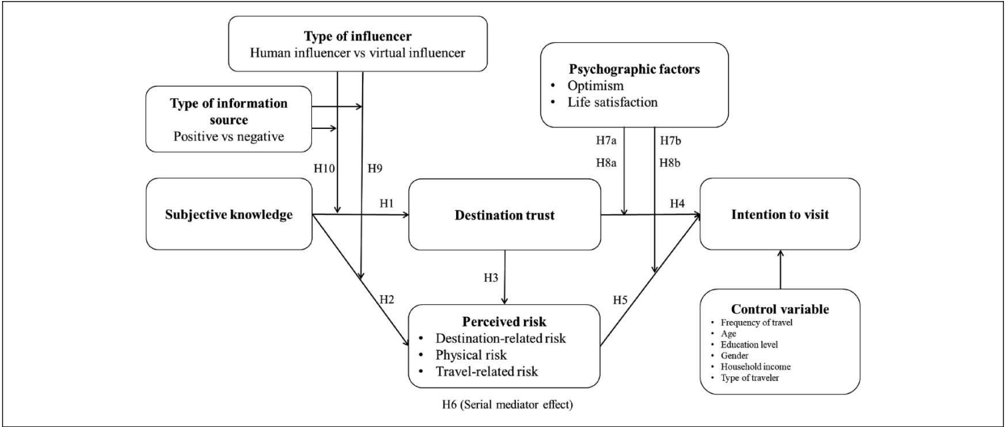
Drawing on the theory of sociology of trust and risk, this study proposes and empirically tests a conceptual model of tourists’ new destination visit intentions. The model links tourists’ subjective knowledge to trust and risk perceptions and explores the moderating effects of social media influencers (human vs. virtual) and tourists’ psychographic factors in this context. Data were collected from two studies: Study 1, through a survey distributed to participants in Malaysia ( n = 493 valid responses); and Study 2, through a between-subjects design experiment with another sample of participants in Malaysia ( n = 470 valid responses). The findings expand knowledge in tourism research by showing that destination trust mediates how subjective knowledge influences perceived risk. Optimism and life satisfaction have significant moderating effects in this context. Furthermore, the relationship between destination trust and visit intention is moderated by human and virtual influencers, according to whether their message is positive or negative.
Verified 2026-11-22 · 1 reference not checked yet
Overview
CoChat Summary
TL;DR
Drawing on the sociology of trust and risk, this paper tests a model linking tourists’ subjective knowledge to destination trust, perceived risk, and intention to visit a new destination, with moderation by human versus virtual influencers and psychographic factors. Across a survey and a 2 × 2 experiment with Malaysian travelers who had never visited China, destination trust mediated the effect of subjective knowledge on perceived risk, and optimism and life satisfaction moderated key paths.
Key findings
- In Study 1 (n = 493), subjective knowledge positively influenced destination trust (H1a: β = .404, p < .01; R² = 16.3%), while subjective knowledge (H2: β = −.107, p < .01, f² = 0.020) and destination trust (H3: β = −.489, p < .01, f² = 0.277) negatively influenced perceived risk; these relationships explained 29.3% of the variance in perceived risk.
- Destination trust positively influenced intention to visit (H4: β = .407, p < .01, f² = 0.169), perceived risk negatively influenced intention to visit (H5: β = −.212, p < .01, f² = 0.046), and the serial mediation of destination trust and perceived risk was significant (H6: β = .042, p < .01); these relationships explained 34.9% of the variance in intention to visit.
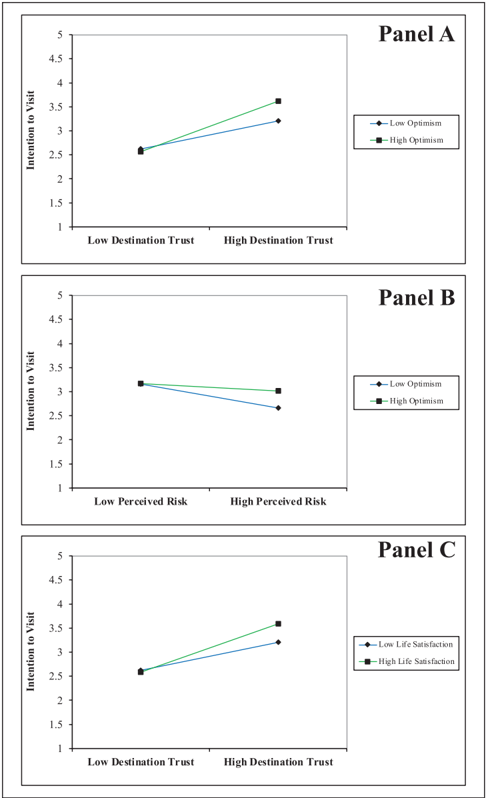
- Optimism moderated both destination trust → intention (β = .117, p < .05, f² = 0.028) and perceived risk → intention (β = .087, p < .05, f² = 0.020); life satisfaction moderated only destination trust → intention (β = .106, p < .05, f² = 0.021), not perceived risk → intention.
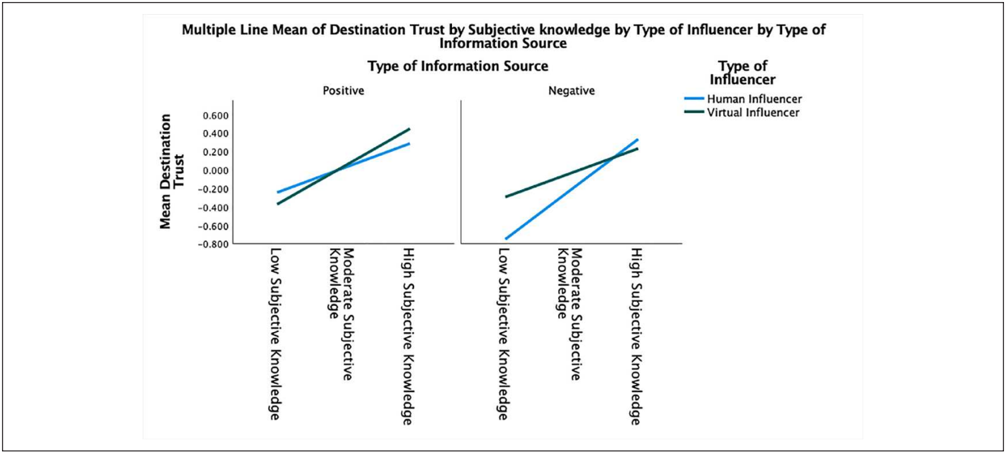
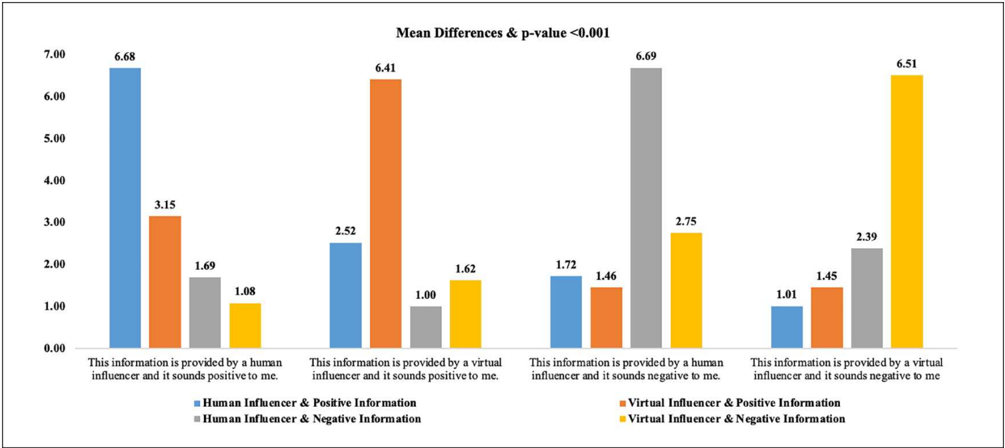
- In Study 2 (n = 470), the three-way subjective knowledge × influencer type × information type effect on destination trust was significant (H9: β = .124, p < .01; R² increased from 16.4% to 20.1%), but H9 was not supported due to contradictory interaction-plot outcomes; the effect on perceived risk was not significant (H10: β = −.091, p = .145), so H10 was not supported. The paper reports that virtual influencers were more effective with positive information, while human influencers were more effective with negative information.
Methods
- Study 1: survey of Malaysian travelers aged 20–40 who had never traveled to China; 600 invited, 543 completed, 50 removed for straight-lining/outliers, yielding 493 valid responses (82.17% response rate); data collected January 1–31, 2023; analyzed with PLS-SEM using SmartPLS, including common method bias checks.
- Study 2: 2 (influencer type: human vs. virtual) × 2 (information source: positive vs. negative) between-subjects experiment with 500 adults in Malaysia; 30 responses discarded after attention checks, yielding 470 usable responses; participants randomly assigned to four conditions, forced exposure for 1 min, and hypotheses tested with Hayes’ PROCESS Model 3 using 10,000 bootstrapped samples.
- Measures for subjective knowledge, destination trust, perceived risk (destination-related, physical, and travel-related risk), optimism, life satisfaction, and intention to visit were adapted from existing scales and rated on seven-point Likert scales; perceived risk was modeled as a reflective-formative second-order construct.
Limitations
- Stated in the paper: findings are limited to destinations tourists have not visited before (first-time visitors); the study analyzed only optimism and life satisfaction, with future research suggested on other factors such as political engagement; future work should explore virtual influencers in tourism, types of virtual influencers, tourists’ loneliness, and longitudinal conversion of subjective knowledge into objective knowledge after travel.
- Evident from the text: the samples are Malaysian travelers considering China in a post-pandemic context, which may limit generalizability to other destinations, traveler populations, or non-pandemic risk settings; Study 2’s H9 and H10 were not supported, and the paper notes contradictory interaction-plot outcomes for H9.
Model-written summary. Check it against the paper before relying on it.
Integrity signals
Registry
Cites
Statistics
Figures



Verification
Claims the paper makes
14 Valid · 0 Not valid · 71 Not checked · 61 Own results and interpretations
The cited sources support only part of this claim — read each source’s verdict below.
In the paper
“Instagram has been highlighted as a key potential online data site for tourism because it is relevant to influencer marketing and it has been found to influence tourists' decision making (Cohen et al., 2022; Femenia-Serra et al., 2022; He et al., 2022; Yılmaz et al., 2020).”
What the sources say
- Not matchedcites Cohen et al., 2022
An author–year citation the paper’s reference list doesn’t settle. We don’t search these by name.
- Partly supportedcites Femenia-Serra et al., 2022 matched to “Instagram travel influencers in #quarantine: Communicative practices and roles during COVID-19” (2022) sourceExperimental — accuracy not yet measured
The Literature review (Travel influencer marketing; page unavailable) reports that travel influencers can increase tourists’ destination-visit intentions, which supports an influence on potential travel choices. It does not establish that Instagram itself influences tourists’ decision-making; the Limitations and future research section says this study did not examine how audiences or potential tourists perceived the influencers’ messages. (LLM, conf=0.82)
- Not matchedcites He et al., 2022
This doesn’t read as a citation we can look up.
plainstates a cause- Asserted: passes — The authors put it forward as true.
- Checkable: passes — It can be checked against evidence.
- Load-bearing: unclear — It is unclear whether the paper’s conclusions depend on it.
- Based: passes — The paper gives a reason why it holds.
- Not matched
A result the paper reports from its own data — it cites no other source for it, so there is none to check. The quote shows it is in the paper.
In the paper
“The findings expand knowledge in tourism research by showing that destination trust mediates how subjective knowledge influences perceived risk.”
plainstates a cause- Asserted: passes — The authors put it forward as true.
- Checkable: passes — It can be checked against evidence.
- Load-bearing: passes — The paper’s conclusions depend on it.
- Based: passes — The paper gives a reason why it holds.
A result the paper reports from its own data — it cites no other source for it, so there is none to check. The quote shows it is in the paper.
In the paper
“Optimism and life satisfaction have significant moderating effects in this context.”
plainstates an association- Asserted: passes — The authors put it forward as true.
- Checkable: passes — It can be checked against evidence.
- Load-bearing: passes — The paper’s conclusions depend on it.
- Based: passes — The paper gives a reason why it holds.
A result the paper reports from its own data — it cites no other source for it, so there is none to check. The quote shows it is in the paper.
In the paper
“Third, we show the fundamental influence of optimism and life satisfaction on tourists' travel decisions.”
boostedstates a cause- Asserted: passes — The authors put it forward as true.
- Checkable: passes — It can be checked against evidence.
- Load-bearing: passes — The paper’s conclusions depend on it.
- Based: passes — The paper gives a reason why it holds.
A result the paper reports from its own data — it cites no other source for it, so there is none to check. The quote shows it is in the paper.
In the paper
“Furthermore, the relationship between destination trust and visit intention is moderated by human and virtual influencers, according to whether their message is positive or negative.”
plainstates an association- Asserted: passes — The authors put it forward as true.
- Checkable: passes — It can be checked against evidence.
- Load-bearing: passes — The paper’s conclusions depend on it.
- Based: passes — The paper gives a reason why it holds.
46 more claims
Create a free account to see all 146 claims and to verify the 31 references still open.
- Probably not a substantial claim. 69
- It may state two separate claims as one. 44
- The quote only partly states this claim. 2
Self-check
Percentages, sums and reported differences re-computed from the paper’s own numbers.
Each contradiction between two passages listed here was confirmed by an independent check.
Rated minor: it would not touch a result — a value no result rests on, a p-value that stays on the same side of the significance level, or a conflict that is clerical, resolved elsewhere in the paper, or outside its own findings.
In the paper
§ Evaluating the Structural Model
“Destination trust (H3: β = -.489, p -value > .01, f 2 = 0.277) was found to negatively influence perceived risk”
§ Measures
“| | H3: Destination trust → Perceived risk | -0.489 | 0.041 | -11.948 | .000 | -0.550 | -0.415 | 1.195 | 0.277 | | |”
Citations
Cites
The theory of planned behavior
Ajzen, I. (1991) · Organizational Behavior and Human Decision Processes · doi:10.1016/0749-5978(91)90020-t · Cited by 90,587
A primer on partial least squares structural equation modeling (PLS-SEM)
Leguina, A. (2015) · International Journal of Research & Method in Education · doi:10.1080/1743727x.2015.1005806 · Cited by 18,921
An integrative model of organizational trust
Mayer, R. C., Davis, J. H., & Schoorman, F. D. (1995) · The Academy of Management Review · doi:10.2307/258792 · Cited by 10,736
Common Method Bias in PLS-SEM: A Full Collinearity Assessment Approach
Kock, N. (2015) · International Journal of e-Collaboration · doi:10.4018/ijec.2015100101 · Cited by 10,215 · cited 2×
“To ensure robustness in the assessment for Study 1, two types of statistical assessments for common method bias were incorporated: Harman’s single-factor test (MacKenzie & Podsakoff, 2012) and the full collinearity test (Kock, 2015).”
BackgroundMethodInfluentialThe benefits of frequent positive affect: Does happiness lead to success?
Lyubomirsky, S., King, L., & Diener, E. (2005) · Psychological Bulletin · doi:10.1037/0033-2909.131.6.803 · Cited by 7,143
A Protection Motivation Theory of Fear Appeals and Attitude Change1
Rogers, R. W. (1975) · The Journal of Psychology · doi:10.1080/00223980.1975.9915803 · Cited by 6,805
Pandemics, tourism and global change: a rapid assessment of COVID-19
Gössling, S., Scott, D., & Hall, C. M. (2021) · Journal of Sustainable Tourism · doi:10.1080/09669582.2020.1758708 · Cited by 4,766
Predictive model assessment in PLS-SEM: guidelines for using PLSpredict
Shmueli, G., Sarstedt, M., Hair, J. F., Cheah, J.-H., Ting, H., Vaithilingam, S., & Ringle, C. M. (2019) · European Journal of Marketing · doi:10.1108/ejm-02-2019-0189 · Cited by 4,618 · cited 1×
“The Q 2 predict values for destination trust (0.153), perceived risk (0.085), and intention to visit (0.120) were greater than zero, demonstrating the predictive relevance of the model (Shmueli et al., 2019).”
InfluentialSelf-citationDimensions of Consumer Expertise
Alba, J. W., & Hutchinson, J. W. (1987) · Journal of Consumer Research · doi:10.1086/209080 · Cited by 4,375
The Uncanny Valley [From the Field]
Mori, M., MacDorman, K., & Kageki, N. (2012) · IEEE Robotics & Automation Magazine · doi:10.1109/mra.2012.2192811 · Cited by 3,542
Research works printed but not linked: 4
- Luhmann, N. (1979). Trust and power . Wiley.
- Marinao, E., Chasco, C., & Torres, E. (2012). Trust in tourist destinations. The role of local inhabitants and institutions. Academia. Revista Latinoamericana de Administraci'on , 51 , 27-47.
- Mori, M. (1970). Bukimi no tani [the uncanny valley]. Energy , 7 (4), 33-35.
- Roodurmun, J., & Juwaheer, T. D. (August, 2010). Influence of trust on destination loyalty: An empirical analysis the discussion of the research approach [Symposium]. International research symposium in service management (pp. 24-27). Le Meridien Hotel.
Cited by
Items 101–125 of 125
Korzyński, P., Protsiuk, O., Wang, F., Krzaczek, I., & Sands, S. (2026) · Review of Managerial Science · doi:10.1007/s11846-026-01061-6
Chen, L., Li, X., Zhang, J., Zhang, M., & Liu, S. (2026) · Journal of Hospitality and Tourism Management · doi:10.1016/j.jhtm.2026.101545 · Cited by 1
Exploring Influencer-Content Congruence in Creative Tourism: Behavioral and EEG Evidence
Chengkun, T., Wang, L., & Fang, Y. D. (2026) · Journal of Travel Research · doi:10.1177/00472875261454665
Humano ou virtual? Como escolher o influenciador certo
Facó, M. H. (2026) · GV executivo \b (Impresso)/GV Executivo · doi:10.12660/gvexec.v25n2.2026.94330
Li, N., Yuan, L., & Xie, L. (2026) · Muallim Journal of Social Science and Humanities · doi:10.33306/mjssh/448
Social Media Influencers Shaping Ecotourism Destination Branding
Rehman, S., Arshad, N., Ullah, A., & Noor, N. (2024) · Advances in hospitality, tourism and the services industry (AHTSI) book series · doi:10.4018/979-8-3693-6700-1.ch002 · Cited by 1
How Digital Technology Shapes Traveler Awareness and Engagement in Sustainable Tourism in IndonesiaPreprint
Sukma, A., Rochman, D. D., Murnawan, M., Nugraha, U., & Anggakarti, D. M. (2025) · SSRN Electronic Journal · doi:10.2139/ssrn.5148321
Nejat, S., Goudarzi, F. A., Khanjanzadeh, N., & Firoozjaei, A. A. (2026) · Journal of Islamic marketing · doi:10.1108/jima-08-2025-0524 · Cited by 1
REAL VS. RENDERED: A SCOPING REVIEW ON HUMAN AND VIRTUAL SOCIAL MEDIA INFLUENCERS
Coşkun, M. (2026) · Dokuz Eylül Üniversitesi Sosyal Bilimler Enstitüsü Dergisi · doi:10.16953/deusosbil.1778927
Zhang, Y. (2025) · Journal of Information Systems Engineering & Management · doi:10.52783/jisem.v10i38s.7058
Liang, S., Xu, J. B., & Gao, B. W. (2026) · Information Technology & Tourism · doi:10.1007/s40558-026-00405-y
Khalfallah, D. (2026) · Frontiers in Communication · doi:10.3389/fcomm.2026.1894984
Qiu, W., Yu, X., Fu, X., Cheng, M., Zhang, Y., & Yao, T. (2026) · Tourism Management · doi:10.1016/j.tourman.2026.105503
Virtual Influencer Strategies on Tourism Marketing Communication in Indonesia
Patria, L., Puspita, V., Fajar, A. N., & Bakar, W. A. W. A. (2026) · Studies in systems, decision and control · doi:10.1007/978-3-032-11612-3_34
From Virtual Influencer to Self‑Sustaining Brand: Navigating the Transition to Creator Marketing
Karunanayake, R. K. T., Stibe, A., & Siriwardana, A. (2025) · Lecture notes in computer science · doi:10.1007/978-3-032-02060-4_19 · Cited by 1
Exploring the Perception Gap: Human Vs. Virtual Influencers in Social Media Marketing
Angmo, P., & Mahajan, R. S. (2026) · International Journal of Strategic Communication · doi:10.1080/1553118x.2026.2666316
da Costa, A. V., Gammarano, I. D. J. L. P., Santo, R. B. D. E., Gomes, F. N., Neto, H. H. P. B., & do Ó, M. A. L. A. (2025) · Caderno Pedagógico · doi:10.54033/cadpedv22n8-008
Beyond the human frame: Meta-analytic insights into virtual influencers in tourism
Shen, H. J., Lin, J., & Yu, J. (2026) · Journal of Hospitality and Tourism Management · doi:10.1016/j.jhtm.2026.101473
Jang, Y., Min, K. S., Green, Y. N. J., & Yoo, M. (2025) · Journal of Travel Research · doi:10.1177/00472875251346931 · Cited by 2
Old roots, new faces: virtual influencers in legacy restaurants
Kallmuenzer, A., & Mahasuar, K. (2026) · International Journal of Contemporary Hospitality Management · doi:10.1108/ijchm-06-2025-0893
Steils, N., & Toti, J.-F. (2026) · Recherche et Applications en Marketing (English Edition) · doi:10.1177/20515707261452588 · Cited by 1
Liu, J., & Li, F. S. (2025) · Journal of Hospitality and Tourism Management · doi:10.1016/j.jhtm.2025.101365 · Cited by 1
Effectiveness (and Failures) of DMOs' Marketing Strategies on Instagram Using Virtual Influencers
Pascual-Fraile, M. D. P., & Suárez-Álvarez, R. (2025) · IGI Global eBooks · doi:10.4018/979-8-3693-9939-2.ch008
“Trust me, I’m virtual”: understanding consumer engagement with influencers and travel intentions
Nie, Y., Barnes, S. J., So, K. K. F., Shin, H., Yoon, J.-H., & Kim, M. J. (2026) · Asia Pacific Journal of Tourism Research · doi:10.1080/10941665.2026.2714235
da Costa, A. V., Gammarano, I. D. J. L. P., Neto, H. H. P. B., Gomes, F. N., do Ó, M. A. L. A., & Santo, R. B. D. E. (2025) · Caderno Pedagógico · doi:10.54033/cadpedv22n7-352 · Cited by 1
Metadata
- Authors
- Ameen, N., Cheah, J.-H., Ali, F., El-Manstrly, D., & Kulyciute, R.
- Affiliations
- University of London (GB)
- University of East Anglia (GB)
- University of South Florida (US)
- University of Sheffield (GB)
- Corresponding author
- Ameen, Nisreen
- Venue
- Journal of Travel Research
- Publisher
- SAGE Publications
- Published
- 2023-08-19
- Volume
- 63
- Issue
- 6
- Pages
- 1370-1394
- ISSN
- 0047-2875 (ISSN-L)
- 1552-6763
- OpenAlex
- W4386001327
- Cited by
- 133
- References
- 147
- Citations by year
- 2026: 51 · 2025: 59 · 2024: 22 · 2023: 1
- FWCI
- 57.11
- Type
- journal article
- Language
- en
- Open access
- hybrid
- doi.org
- Locations
- Journal of Travel Research (publishedVersion, cc-by)
- White Rose Research Online (University of Leeds, The University of Sheffield, University of York) (submittedVersion)
- UEA Digital Repository (University of East Anglia) (submittedVersion)
- Topics
- Social Sciences › Business, Management and Accounting › Tourism, Leisure and Hospitality Management › Diverse Aspects of Tourism Research
- Social Sciences › Business, Management and Accounting › Marketing › Digital Marketing and Social Media
- Social Sciences › Business, Management and Accounting › Tourism, Leisure and Hospitality Management › Adventure Sports and Sensation Seeking
- Keywords
- destination trust, risk perception, social media influencers, virtual influencers, human influencers, visit intention, subjective knowledge, optimism, life satisfaction, tourist decision-making
About these checks
Registry, retraction, Cites and statistics results are computed, not judged, with one exception: a printed reference that no index lists is read once by a model before it counts as a citation error. Claims are extracted by a model and kept only when their quote appears verbatim in the text; each cited source is then checked, with a model’s help, for whether it says what the claim relies on. Those verdicts can be wrong — read the claim’s quote and the cited source before relying on one.
The claim verdicts this report counts are experimental: their accuracy is not yet measured.
A language model drew the claims from the paper on 2026-10-10, under version 3 of the claim definition (model deepseek-v4.1-flash, prompt extract-v3).
A second model labelled each claim on 2026-10-10 (model jev-1.13-20260917, definition revision gold-guideline-v0.2).
Cited sources are checked with a language model’s help (gpt-6-sol).
Statistics and arithmetic are recomputed, not judged.
Confidence bands are shown only for fields calibrated on our annotated test set. None is calibrated yet, so no band is shown.
What counts as a claim ›How we measure confidence ›How we check this ›
Are you an author, or do you see a problem with this page? Request a review
Data sources
Bibliographic data: Semantic Scholar, OpenAlex, Crossref.
Contains information from the Semantic Scholar Academic Graph Datasets, made available under the ODC Attribution License (ODC-BY 1.0).
Semantic Scholar’s data is described in: Kinney, R., et al. (2023). The Semantic Scholar Open Data Platform. arXiv:2301.10140.
