

Do Narcissism and Emotional Intelligence Win Us Friends? Modeling Dynamics of Peer Popularity Using Inferential Network Analysis
Open accessThe DOI matches its Crossref record; 93 of the 93 references it cites were found in a registry or an index; 3 of the 22 sources its claims cite were checked for support.
Abstract
This research investigated effects of narcissism and emotional intelligence (EI) on popularity in social networks. In a longitudinal field study, we examined the dynamics of popularity in 15 peer groups in two waves ( N = 273). We measured narcissism, ability EI, and explicit and implicit self-esteem. In addition, we measured popularity at zero acquaintance and 3 months later. We analyzed the data using inferential network analysis (temporal exponential random graph modeling, TERGM) accounting for self-organizing network forces. People high in narcissism were popular, but increased less in popularity over time than people lower in narcissism. In contrast, emotionally intelligent people increased more in popularity over time than less emotionally intelligent people. The effects held when we controlled for explicit and implicit self-esteem. These results suggest that narcissism is rather disadvantageous and that EI is rather advantageous for long-term popularity.
Overview
CoChat Summary
TL;DR
In 15 natural peer groups followed from zero acquaintance to 3 months later, narcissism predicted initial popularity but less popularity growth over time, whereas ability emotional intelligence (EI) predicted greater popularity growth over time. The effects held when controlling for explicit and implicit self-esteem and when accounting for self-organizing network forces via temporal exponential random graph modeling.
Key findings
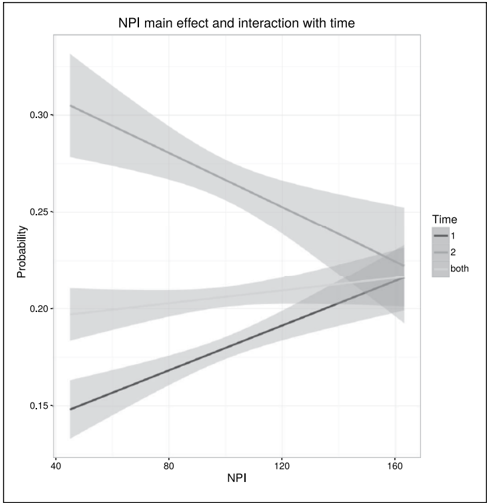
- Narcissism was positively associated with received liking nominations overall, but the Narcissism: receiver × Time period interaction was negative: the odds of a friendship tie were reduced by 17% if narcissism increased by one standard deviation and time progressed to the second wave. High narcissists did not lose friends, but they gained new friends at a lower rate than low narcissists.
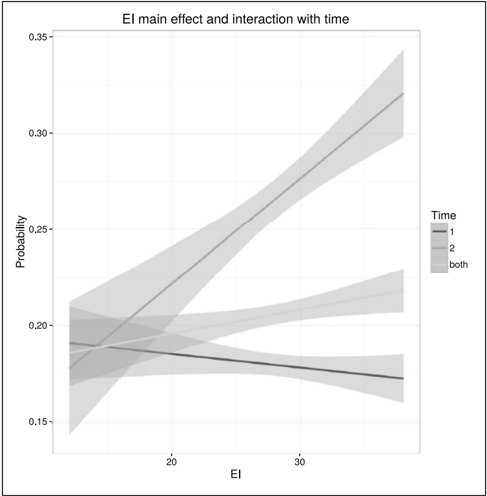
- EI showed a positive EI: receiver × Time period interaction: the odds of a friendship tie increased by around 13% if EI increased by one standard deviation and time progressed to the second wave.
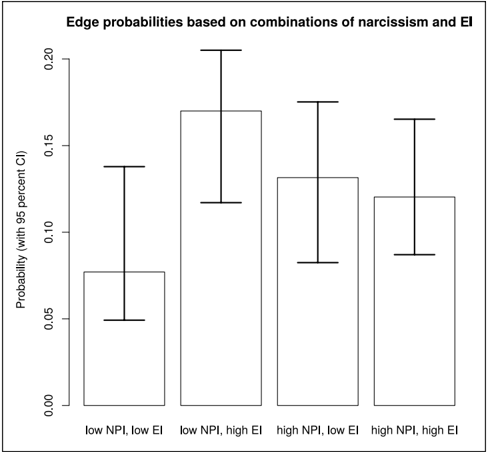
- Narcissism and EI were not significantly related (\(r = .06, p = .17\)). A two-way Narcissism × EI interaction was significant and negative; low narcissism paired with high EI had the highest probability of being nominated as a friend, while low narcissism paired with low EI had the lowest probability, significantly lower than any other group (all \(ps < .003\)). The three-way Narcissism × EI × Time interaction was not significant.
- Explicit self-esteem did not account for the effects and was dropped; implicit self-esteem (receiver) significantly and positively predicted receiving more liking nominations.
Methods
- Longitudinal field study in 15 mixed-sex student groups from southern Polish public universities, assessed at zero acquaintance in the first week of the semester and again 3 months later. Total \(N = 273\) (98 male; mean age \(= 20.10\), \(SD = 3.22\)); 170 participants (62%) provided data at the second measurement.
- Popularity was measured by within-group liking nominations with no limit on nominees. Narcissism was measured with the Polish NPI (34 items, \(\alpha = .91\)); ability EI with the TIE (24 items, \(\alpha = .88\)); explicit self-esteem with the RSES (\(\alpha = .80\)); implicit self-esteem via signature size.
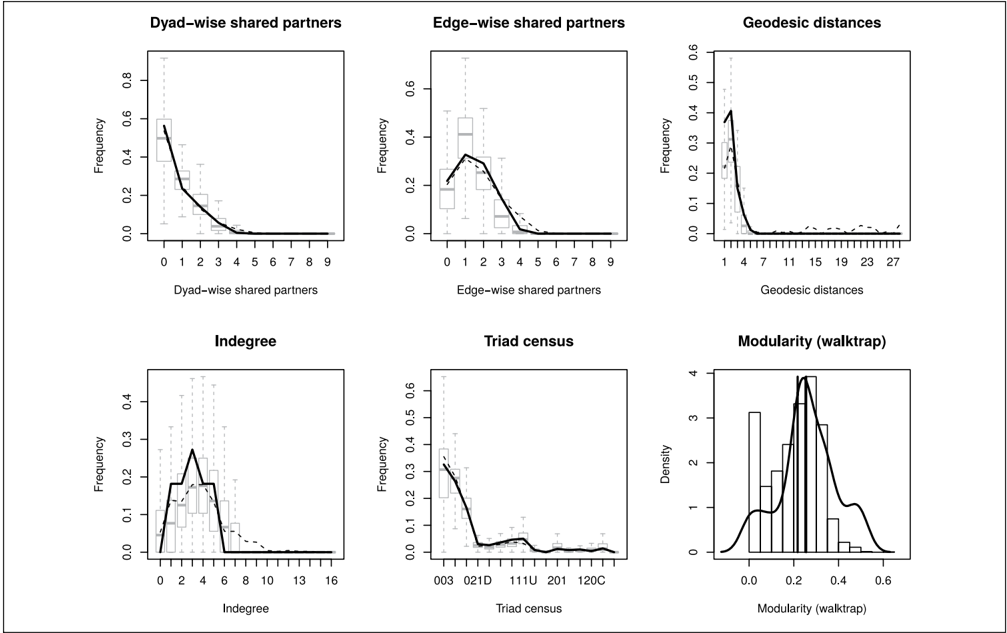
- Data were analyzed with temporal exponential random graph modeling (TERGM), estimated by MCMC-MLE in the R xergm suite, pooling 30 networks (15 groups × 2 waves). Models included exogenous personality/ability terms and endogenous network controls: reciprocity, GWESP, GWODegree, two-paths, cyclic triplets, plus age and sex effects and homophily terms.
Limitations
- The paper states that it did not elucidate mediators of the observed interpersonal effects, such as concrete behavioral processes; it suggests charming/aggressive behaviors may account for narcissism–(un)popularity links and empathic/prosocial behaviors for EI–popularity links.
- Evident from the text: second-wave attrition was substantial (170 of 273, 62%), although dropouts did not differ systematically from completers on any variable (all \(ps > .35\)).
- Evident from the text: the TERGM setup pooled 15 independent networks and modeled time via interaction terms, which the authors describe as somewhat unusual; they note that out-of-sample comparison with a stochastic actor-oriented model was not feasible in this context.
Model-written summary. Check it against the paper before relying on it.
Integrity signals
Registry
Cites
Statistics
Figures
Verification
Claims the paper makes
2 Valid · 0 Not valid · 12 Not checked · 66 Own results and interpretations
The cited sources support only part of this claim — read each source’s verdict below.
In the paper
“Indeed narcissism predicts initial popularity (Back, Schmukle, & Egloff, 2010; Carlson, Vazire, & Oltmanns, 2011; Dufner et al., 2012; Dufner, Rauthmann, Czarna, & Denissen, 2013; Friedman, Oltmanns, Gleason, & Turkheimer, 2006, Wurst et al., 2016)”
What the sources say
- Supportedcites Back, Schmukle, & Egloff, 2010 matched to “Why are narcissists so charming at first sight? Decoding the narcissism–popularity link at zero acquaintance.” (2010) source
In ‘The Popularity of Narcissists at First Sight’ (p. 10), the authors state that their predictions were confirmed and that narcissism-related appearance and behavior led to popularity at zero acquaintance. Table 4 on the same page also reports a positive association between narcissism and popularity at first sight. (LLM, conf=0.94)
- Supportedcites Carlson, Vazire, & Oltmanns, 2011 matched to “You probably think this paper’s about you: narcissists’ perceptions of their personality and reputation.” (2011) source
In Study 1 Results, new acquaintances rated people scoring higher on narcissism as more likeable (β = .13), while close others rated them as slightly less likeable. The paper also describes narcissists as making positive first impressions. The supplied passages do not provide page numbers. (LLM, conf=0.90)
- Not matchedcites Dufner et al., 2012
An author–year citation the paper’s reference list doesn’t settle. We don’t search these by name.
plainstates a cause- Asserted: passes — The authors put it forward as true.
- Checkable: passes — It can be checked against evidence.
- Load-bearing: passes — The paper’s conclusions depend on it.
- Based: passes — The paper gives a reason why it holds.
- Supported
A result the paper reports from its own data — it cites no other source for it, so there is none to check. The quote shows it is in the paper.
In the paper
“if two individuals had the same sex, they were more likely to be tied (significant positive Sex: node match effect).”
hedgedstates an association- Asserted: passes — The authors put it forward as true.
- Checkable: passes — It can be checked against evidence.
- Load-bearing: unclear — It is unclear whether the paper’s conclusions depend on it.
- Based: passes — The paper gives a reason why it holds.
A result the paper reports from its own data — it cites no other source for it, so there is none to check. The quote shows it is in the paper.
In the paper
“friendships between group members of the same sex were more likely than friendships between group members of opposite sexes.”
plainstates an association- Asserted: passes — The authors put it forward as true.
- Checkable: passes — It can be checked against evidence.
- Load-bearing: unclear — It is unclear whether the paper’s conclusions depend on it.
- Based: passes — The paper gives a reason why it holds.
A result the paper reports from its own data — it cites no other source for it, so there is none to check. The quote shows it is in the paper.
In the paper
“People high in narcissism were popular”
- Also stated in: § Results · plain
“people high in narcissism had more incoming friendship ties than people low in narcissism”
plainstates an associationn = 273- Asserted: passes — The authors put it forward as true.
- Checkable: passes — It can be checked against evidence.
- Load-bearing: passes — The paper’s conclusions depend on it.
- Based: passes — The paper gives a reason why it holds.
- Also stated in: § Results · plain
A result the paper reports from its own data — it cites no other source for it, so there is none to check. The quote shows it is in the paper.
In the paper
“increased less in popularity over time than people lower in narcissism”
- Also stated in: § Results · plain
“group members with high narcissism levels found significantly fewer friends over time than group members with low narcissism levels”
- Also stated in: § Results · plain
“the interaction effect between time and the narcissism score of the potential receiver was significant and negative”
plainstates a causen = 273- Asserted: passes — The authors put it forward as true.
- Checkable: passes — It can be checked against evidence.
- Load-bearing: passes — The paper’s conclusions depend on it.
- Based: passes — The paper gives a reason why it holds.
- Also stated in: § Results · plain
41 more claims
Create a free account to see all 80 claims and to verify the 1 reference still open.
- Probably not a substantial claim. 19
- It may state two separate claims as one. 18
Claims other papers make about this one
Each is checked against this paper’s own text: does it say what the citing paper says it does?
In the citing paper
“There are ample characterizations of narcissism as an impulsive trait having fluctuating emotions and wellbeing (Rose 2002;Hickman et al. 1996;Czarna et al. 2016).”
From Grandiose narcissism and performance in organizations: mediating role of subjective wellbeing (2020) · cites this paper as Czarna et al. 2016
Self-check
Percentages, sums and reported differences re-computed from the paper’s own numbers.
Each contradiction between two passages listed here was confirmed by an independent check.
Rated minor: it would not touch a result — a value no result rests on, a p-value that stays on the same side of the significance level, or a conflict that is clerical, resolved elsewhere in the paper, or outside its own findings.
In the paper
§ Results
“The main receiver effect of EI was marginally significant”
§ Results
“| EI: receiver | 0.0151 (0.0188) |”
Rated minor: it would not touch a result — a value no result rests on, a p-value that stays on the same side of the significance level, or a conflict that is clerical, resolved elsewhere in the paper, or outside its own findings.
In the paper
§ Results
“(((exp(0.0243)-1)*5.08) = .13)”
§ Results
“| EI: receiver × Time period | 0.0256 (0.0073) a |”
Cited works that were retracted
Works this paper cites that were later retracted, from the retraction notices publishers deposit. Major when the notice came out before this paper was published.
Rated major: it would touch a result — a value a result rests on, reported and recomputed p-values on opposite sides of the significance level, two passages that conflict with no sign which is right, or a cited work retracted before this paper was published.
In the paper
“The size of the smallest square covering the whole handwritten signature served as a measure of their ISE (Rudman, Dohn, & Fairchild, 2007; Stapel & Blanton, 2004; Zweigenhaft, 1977; Zweigenhaft & Marlowe, 1973).”
Cited work 10.1037/0022-3514.87.4.468 · retracted 2013-01-01 · notice 10.1037/a0031410 · this paper published 2016-09-28
Citations
Cites
1 retracted
From Seeing to Being: Subliminal Social Comparisons Affect Implicit and Explicit Self-Evaluations.
Stapel, D. A., & Blanton, H. (2004) · Journal of Personality and Social Psychology · doi:10.1037/0022-3514.87.4.468 · Cited by 179 · cited 2×
“The size of the smallest square covering the whole handwritten signature served as a measure of their ISE (Rudman, Dohn, & Fairchild, 2007; Stapel & Blanton, 2004; Zweigenhaft, 1977; Zweigenhaft & Marlowe, 1973).”
BackgroundMethodRetractedR: A Language and Environment for Statistical Computing
R Core Team (2025) · doi:10.32614/r.manuals · Cited by 352,181
Society and the Adolescent Self-Image
Rosenberg, M. (1965) · doi:10.1515/9781400876136 · Cited by 30,126
The need to belong: Desire for interpersonal attachments as a fundamental human motivation.
Baumeister, R. F., & Leary, M. R. (1995) · Psychological Bulletin · doi:10.1037//0033-2909.117.3.497 · Cited by 23,245 · cited 1×
“This question is of major theoretical and practical importance, given that social inclusion is a basic human need and a major predictor of an array of adjustment outcomes (Baumeister & Leary, 1995).”
BackgroundThe psychology of interpersonal relations.
Heider, F. (1958) · doi:10.1037/10628-000 · Cited by 13,457
Modularity and community structure in networks
Newman, M. E. J. (2006) · Proceedings of the National Academy of Sciences · doi:10.1073/pnas.0601602103 · Cited by 12,256
The Psychology of Interpersonal Relations.
Newcomb, T., & Heider, F. (1958) · American Sociological Review · doi:10.2307/2089062 · Cited by 11,822
Salovey, P., & Mayer, J. D. (1990) · Imagination, Cognition and Personality · doi:10.2190/dugg-p24e-52wk-6cdg · Cited by 10,484
Self-citationEmotional intelligence meets traditional standards for an intelligence
Mayer, J. D., Caruso, D. R., & Salovey, P. (1999) · Intelligence · doi:10.1016/s0160-2896(99)00016-1 · Cited by 2,864
Self-citationIntroduction to stochastic actor-based models for network dynamics
Snijders, T. A. B., van de Bunt, G. G., & Steglich, C. E. G. (2010) · Social Networks · doi:10.1016/j.socnet.2009.02.004 · Cited by 2,103
Research works printed but not linked: 4
- Bazińska, R., & Drat-Ruszczak, K. (2000). Struktura narcyzmu w polskiej adaptacji kwestionariusza NPI Raskina i Halla [The structure of narcissism measured with Polish adaptation of Raskin and Hall NPI]. Czasopismo Psychologiczne , 6 , 171-187.
- Campbell, W. K. (2005). When you love a man who loves himself: How to deal with a one way relationship . Chicago, IL: Sourcebooks Casablanca.
- Jauk, E., Freudenthaler, H. H., & Neubauer, A. C. (2016). The dark triad and trait versus ability emotional intelligence. Journal of Individual Differences , 37 , 112-118. doi:10.1027/1614-0001/ a000195 · doi:10.1027/1614-0001/
- Śmieja, M., Orzechowski, J., & Beauvale, A. (2007). TIE Test Inteligencji Emocjonalnej [TIE - Test of Emotional Intelligence]. Studia Psychologiczne , 54 , 80-99.
Cited by
Ashkanasy, N. M., & Dorris, A. D. (2017) · Annual Review of Organizational Psychology and Organizational Behavior · doi:10.1146/annurev-orgpsych-032516-113231 · Cited by 438
Temporal Exponential Random Graph Models with btergm: Estimation and Bootstrap Confidence Intervals
Leifeld, P., Cranmer, S. J., & Desmarais, B. A. (2018) · Journal of Statistical Software · doi:10.18637/jss.v083.i06 · Cited by 244
Self-citationUpsides to Dark and Downsides to Bright Personality: A Multidomain Review and Future Research Agenda
Smith, M. B., Hill, A. D., Wallace, J. C., Recendes, T., & Judge, T. A. (2018) · Journal of Management · doi:10.1177/0149206317733511 · Cited by 203
Miao, C., Humphrey, R. H., Qian, S., & Pollack, J. M. (2018) · Journal of Research in Personality · doi:10.1016/j.jrp.2018.12.004 · Cited by 158
Zajenkowski, M., & Szymaniak, K. (2021) · Current Psychology · doi:10.1007/s12144-019-0147-1 · Cited by 62
Czarna, A. Z., Zajenkowski, M., Maciantowicz, O., & Szymaniak, K. (2021) · Current Psychology · doi:10.1007/s12144-019-00504-6 · Cited by 59
Self-citationHow Does It Feel to Be a Narcissist? Narcissism and Emotions
Czarna, A. Z., Zajenkowski, M., & Dufner, M. (2018) · Springer eBooks · doi:10.1007/978-3-319-92171-6_27 · Cited by 80
Self-citationRogoza, R., Cieciuch, J., & Strus, W. (2021) · Journal of Research in Personality · doi:10.1016/j.jrp.2021.104167 · Cited by 70
Nonlinear information data mining based on time series for fractional differential operators
Wu, S. (2019) · Chaos An Interdisciplinary Journal of Nonlinear Science · doi:10.1063/1.5085430 · Cited by 57
The structure of the Dark Triad traits: A network analysis
Trahair, C., Baran, L. N., Flakus, M., Kowalski, C. M., & Rogoza, R. (2020) · Personality and Individual Differences · doi:10.1016/j.paid.2020.110265 · Cited by 72
Leckelt, M., Geukes, K., Küfner, A. C. P., Niemeyer, L. M., Hutteman, R., Hirschmüller, S., Egloff, B., Nestler, S., & Back, M. D. (2019) · Personality and Social Psychology Bulletin · doi:10.1177/0146167219872477 · Cited by 50
Personality predictors of social status attainment
Grosz, M. P., Leckelt, M., & Back, M. D. (2019) · Current Opinion in Psychology · doi:10.1016/j.copsyc.2019.07.023 · Cited by 52
Down to Earth: Planetary Health and Biophilosophy in the Symbiocene Epoch
Prescott, S., & Logan, A. (2017) · Challenges · doi:10.3390/challe8020019 · Cited by 47
Zajenkowski, M., Maciantowicz, O., Szymaniak, K., & Urban, P. (2018) · Frontiers in Psychology · doi:10.3389/fpsyg.2018.01606 · Cited by 48
Emotions and Emotional Regulation in HRM: A Multi-Level Perspective
Ashkanasy, N. M., Troth, A. C., Lawrence, S. A., & Jordan, P. J. (2017) · Emerald Group Publishing Limited eBooks · doi:10.1108/s0742-730120170000035002 · Cited by 53
How MPs ties to interest groups matter for legislative co-sponsorship
Fischer, M., Varone, F., Gava, R., & Sciarini, P. (2018) · Social Networks · doi:10.1016/j.socnet.2018.12.001 · Cited by 33
On the Popularity of Agentic and Communal Narcissists: The Tit-for-Tat Hypothesis
Rentzsch, K., & Gebauer, J. E. (2019) · Personality and Social Psychology Bulletin · doi:10.1177/0146167218824359 · Cited by 38
Homophily in the formation and development of learning networks among university students
Weber, H., Schwenzer, M., & Hillmert, S. (2020) · Network Science · doi:10.1017/nws.2020.10 · Cited by 33
Gómez‐Leal, R., Gutiérrez‐Cobo, M. J., Cabello, R., Megías‐Robles, A., & Fernández‐Berrocal, P. (2018) · Frontiers in Psychiatry · doi:10.3389/fpsyt.2018.00307 · Cited by 35
The effects of similarity in the dark triad traits on the relationship quality in dating couples
Kardum, I., Hudek‐Knežević, J., Mehić, N., & Pilek, M. (2018) · Personality and Individual Differences · doi:10.1016/j.paid.2018.04.020 · Cited by 30
The Role of Exporters’ Emotional Intelligence in Building Foreign Customer Relationships
Leonidou, L. C., Aykol, B., Fotiadis, T. A., Zeriti, A., & Christodoulides, P. (2019) · Journal of International Marketing · doi:10.1177/1069031x19876642 · Cited by 40
Self-serving social strategies: A systematic review of social cognition in narcissism
Eddy, C. M. (2021) · Current Psychology · doi:10.1007/s12144-021-01661-3 · Cited by 32
Chukwuorji, J. C., Uzuegbu, C. N., Agbo, F., Ifeagwazi, C. M., & Ebulum, G. C. (2020) · Current Psychology · doi:10.1007/s12144-018-9881-z · Cited by 27
“…a positive correlation of narcissism with trait self report emotional intelligence (Austin et al. 2014; Nagler et al. 2014; Petrides et al. 2011; Vonk et al. 2013; Zhang et al. 2015); and negative association with performance ability EI (Czarna et al. 2016; Jauk et al. 2016; Zhang et al. 2015).”
BackgroundEmotional intelligence and social interaction: foreign studies
Бочкова, М. Н., & Meshkova, N. V. (2018) · Journal of Modern Foreign Psychology · doi:10.17759/jmfp.2018070205 · Cited by 26
Rogoza, R., Danieluk, B., Kowalski, C. M., Kwiatkowska, K., & Kwiatkowska, M. M. (2020) · Journal of Personality · doi:10.1111/jopy.12585 · Cited by 29
Rogoza, R., & Danieluk, B. (2021) · Journal of Research in Personality · doi:10.1016/j.jrp.2021.104129 · Cited by 16
Mielke, I., Humberg, S., Leckelt, M., Geukes, K., & Back, M. D. (2020) · Social Psychological and Personality Science · doi:10.1177/1948550620930543 · Cited by 18
Zhang, H., Li, R., & Schutte, N. S. (2019) · The Journal of Social Psychology · doi:10.1080/00224545.2019.1662759 · Cited by 23
Ahmed, I., & Islam, T. (2022) · Kybernetes · doi:10.1108/k-05-2022-0765 · Cited by 19
Vulnerable and grandiose narcissism in adolescence: Associations with anger and hostility
Maciantowicz, O., Zajenkowski, M., & Thomaes, S. (2022) · Current Psychology · doi:10.1007/s12144-019-00556-8 · Cited by 14
Rogoza, R. (2018) · Social Psychological Bulletin · doi:10.5964/spb.v13i2.26623 · Cited by 14
Narcissism and friendship quality: A longitudinal approach to long-term friendships
Wehner, C., & Ziegler, M. (2023) · Journal of Social and Personal Relationships · doi:10.1177/02654075221122023 · Cited by 13
“While previous studies mainly observed short-term acquaintances (e.g., Czarna et al., 2016; Leckelt et al., 2015) we focused on intraindividual changes in long-term friendships that had existed for at least 2 years.”
BackgroundResultWhy Narcissism Reduces Distress: The Consequences of Narcissistic Intellectual Self-Confidence
Leniarska, M., & Zajenkowski, M. (2022) · Frontiers in Psychology · doi:10.3389/fpsyg.2021.668257 · Cited by 20
Social network analysis in social psychological ressearch (1990–2020): A scoping review
Mehrpour, A., Widmer, E. D., & Staerklé, C. (2025) · British Journal of Social Psychology · doi:10.1111/bjso.12833 · Cited by 14
Are intelligent peers liked more? Assessing peer-reported liking through the network analysis
Flakus, M., Danieluk, B., Baran, L. N., Kwiatkowska, K., Rogoza, R., & Schermer, J. A. (2021) · Personality and Individual Differences · doi:10.1016/j.paid.2021.110844 · Cited by 11
Stronge, S., & Sibley, C. G. (2021) · Journal of Research in Personality · doi:10.1016/j.jrp.2021.104162 · Cited by 11
Grandiose narcissism and performance in organizations: mediating role of subjective wellbeing
Sakkar Sudha, K., & Shahnawaz, M. G. (2020) · Leadership, Education, Personality: An Interdisciplinary Journal · doi:10.1365/s42681-020-00015-0 · Cited by 7
“There are ample characterizations of narcissism as an impulsive trait having fluctuating emotions and wellbeing (Rose 2002; Hickman et al. 1996; Czarna et al. 2016).”
BackgroundTheoretical Perspectives on Narcissism and Social Media: The Big (and Beautiful) Picture
Campbell, W. K., & McCain, J. (2018) · Springer eBooks · doi:10.1007/978-3-319-92171-6_48 · Cited by 13
When Do Team Members Share the Lead? A Social Network Analysis
Tillmann, S., Huettermann, H., Sparr, J. L., & Boerner, S. (2022) · Frontiers in Psychology · doi:10.3389/fpsyg.2022.866500 · Cited by 9
Doroszuk, M., Kupis, M., & Czarna, A. Z. (2019) · Springer eBooks · doi:10.1007/978-3-319-28099-8_712-1 · Cited by 11
Self-citationUnderstanding and Coping in Social Relationships with Narcissists
Brunell, A. B., & Hermann, A. D. (2024) · Cambridge University Press eBooks · doi:10.1017/9781108908306 · Cited by 5
Haag, C., Poirier, C., & Bellinghausen, L. (2024) · Frontiers in Psychology · doi:10.3389/fpsyg.2024.1459997 · Cited by 8
Those Who Gift Only Themselves: An Analysis of Gifted Narcissists as Ultimate Self-Transactionalists
Desmet, O. A., & Sternberg, R. J. (2023) · Roeper Review · doi:10.1080/02783193.2023.2285042 · Cited by 7
Does mental well-being predict being perceived as a happy peer? A longitudinal social network study
Tejada‐Gallardo, C., Blasco‐Belled, A., & Alsinet, C. (2022) · Personality and Individual Differences · doi:10.1016/j.paid.2022.111988 · Cited by 8
Zajenkowski, M., & Gignac, G. E. (2020) · Personality and Individual Differences · doi:10.1016/j.paid.2020.110579 · Cited by 5
Promotion by others through social networks
Lynch, B. P., Meisel, M. K., Campbell, W. K., & vanDellen, M. R. (2018) · Self and Identity · doi:10.1080/15298868.2018.1505652 · Cited by 6
Modeling Network DynamicsPreprint
Marcum, C. S., & Schaefer, D. R. (2017) · SocArXiv (OSF Preprints) · doi:10.31235/osf.io/6rm9q · Cited by 6
Degro, G. M., Fehn, T., Schneider, S., & Schütz, A. (2021) · Personality and Individual Differences · doi:10.1016/j.paid.2021.110865 · Cited by 3
Beyaz Yakalılarda Duygusal Zekâ ve Narsisizm İlişkisi
ÖZKAN, S., Çoban, H., & İrmiş, A. (2024) · İş ve İnsan Dergisi · doi:10.18394/iid.1429411 · Cited by 4
So, C., Yao, Q., Lin, X., & Du, J. (2023) · Psychological Reports · doi:10.1177/00332941231200424 · Cited by 6
Narcissists are not more egocentric: evidence from a performance-based perspective-taking measurePreprint
Bukowski, H., Bigot, A., & Samson, D. (2022) · PsyArXiv (OSF Preprints) · doi:10.31234/osf.io/rtyfm · Cited by 4
Czarna, A. Z., & Nevicka, B. (2019) · Springer eBooks · doi:10.1007/978-3-319-28099-8_2334-1 · Cited by 8
Self-citationDo Objective and Peer-perceived Qualities Moderate the Effect of Narcissism on Social Outcomes?
Kraft, L., Czarna, A. Z., Utesch, K., Back, M. D., & Dufner, M. (2024) · Collabra Psychology · doi:10.1525/collabra.92325 · Cited by 3
Self-citationComparison of TERGM and SAOM : Statistical analysis of student network data
Han, Y., & Kim, J. (2023) · Korean Journal of Applied Statistics · doi:10.5351/kjas.2023.36.1.001 · Cited by 2
Too Good to be Liked? When and How Prosocial Others are Disliked
Boileau, L. L.-A., Grüning, D. J., & Bless, H. (2021) · Frontiers in Psychology · doi:10.3389/fpsyg.2021.701689 · Cited by 4
Czarna, A. Z., & Nevicka, B. (2020) · Springer eBooks · doi:10.1007/978-3-319-24612-3_2334 · Cited by 2
Self-citationLyons, M. T. (2019) · Elsevier eBooks · doi:10.1016/b978-0-12-814291-2.00005-x · Cited by 2
The envy-contempt spiral: affective self-regulation in grandiose narcissism
Raftopoulos, A., & Unterrainer, H. (2025) · Frontiers in Psychiatry · doi:10.3389/fpsyt.2025.1620201 · Cited by 2
Quintana‐Orts, C., Ferreira, P. C., Casas, J. A., Simão, A. M. V., & Rey, R. D. (2024) · The Journal of Psychology · doi:10.1080/00223980.2024.2414287 · Cited by 4
Jiang, X., Liu, C., Xiao, X., & Zhan, Y. (2024) · European Journal of Developmental Psychology · doi:10.1080/17405629.2024.2325173 · Cited by 2
Teaching relationship science: Continuity and change in the craft
Verette‐Lindenbaum, J., Bartolic, S. K., & Miller, R. S. (2023) · Personal Relationships · doi:10.1111/pere.12509 · Cited by 1
Establishing the role of Ahamkara in interpersonal relationships
Tayal, N., & Sharma, N. R. (2021) · International Journal of Advanced Academic Studies · doi:10.33545/27068919.2021.v3.i4a.637 · Cited by 1
Dark Personality Features and Employment
Czarna, A. Z., & Zajas, A. (2020) · Springer eBooks · doi:10.1007/978-3-319-24612-3_2094 · Cited by 2
Self-citationDoroszuk, M., Kupis, M., & Czarna, A. Z. (2020) · Springer eBooks · doi:10.1007/978-3-319-24612-3_712 · Cited by 1
Self-citationThe case for strategic emotional intelligence: extension and test of a model
Bausseron, E. (2018) · The University of Queensland · doi:10.14264/uql.2018.352 · Cited by 3
Trait Narcissism and Social Networks
Clifton, A. D. (2018) · Springer eBooks · doi:10.1007/978-3-319-92171-6_45 · Cited by 2
Czarna, A. Z. (2016) · Springer eBooks · doi:10.1007/978-3-319-28099-8_2138-1 · Cited by 1
Self-citationbtergm: Temporal Exponential Random Graph Models by Bootstrapped Pseudolikelihood
Leifeld, P. (2015) · doi:10.32614/cran.package.btergm · Cited by 1
Self-citationSeidman, G., & Chopik, W. J. (2026) · Journal of Personality · doi:10.1111/jopy.70065
The power of (Duchenne) smiles for first impressions and relationship development in groupsPreprint
Mauersberger, H., Ziegler, M. D., & Heß, U. (2026) · SSRN Electronic Journal · doi:10.2139/ssrn.6999921
Lynch, J., Giacomin, M., Jordan, C. H., & Benson, A. J. (2025) · Journal of Research in Personality · doi:10.1016/j.jrp.2025.104664
The relationship between emotional intelligence and propensity to victim behavior in adolescence
Derksen, K. S. (2025) · Vestnik Universiteta · doi:10.26425/1816-4277-2025-2-203-210
Lynch, J., Giacomin, M., Jordan, C. H., et al. (2025) · SSRN Electronic Journal · doi:10.2139/ssrn.5269443
Mielke, I., Humberg, S., Leckelt, M., et al. (2020) · doi:10.31234/osf.io/vfmkp
Czarna, A. Z. (2020) · Springer eBooks · doi:10.1007/978-3-319-24612-3_2138
Self-citation(2019) · Elsevier eBooks · doi:10.1016/b978-0-12-814291-2.10000-2
Dark Personality Features and Employment
Czarna, A. Z., & Zajas, A. (2018) · Springer eBooks · doi:10.1007/978-3-319-28099-8_2094-1 · Cited by 1
Self-citation
Metadata
- Authors
- Czarna, A. Z., Leifeld, P., Śmieja, M., Dufner, M., & Salovey, P.
- Affiliations
- Jagiellonian University (PL)
- University of Glasgow (GB)
- Leipzig University (DE)
- Yale University (US)
- Corresponding author
- Czarna, Anna Z.
- Venue
- Personality and Social Psychology Bulletin
- Publisher
- SAGE Publications
- Published
- 2016-09-28
- Volume
- 42
- Issue
- 11
- Pages
- 1588-1599
- ISSN
- 0146-1672 (ISSN-L)
- 1552-7433
- OpenAlex
- W2524700218
- Semantic Scholar
- 0ca73b6320cbb32f4df3bd2e4e403ede7c945b05
- Cited by
- 76
- References
- 81
- Citations by year
- 2026: 3 · 2025: 4 · 2024: 6 · 2023: 4 · 2022: 7 · 2021: 8 · 2020: 10 · 2019: 13 · 2018: 15 · 2017: 5 · 2016: 1
- FWCI
- 12.68
- Type
- journal article
- Language
- en
- Open access
- green
- journals.sagepub.com
- Licence
- other-oa
- journals.sagepub.com/page/policies/text-and-data-mining-license (tdm)
- Locations
- Personality and Social Psychology Bulletin (publishedVersion)
- PubMed (publishedVersion)
- ENLIGHTEN (Jurnal Bimbingan dan Konseling Islam) (acceptedVersion)
- Jagiellonian University Repository (Jagiellonian University) (submittedVersion, other-oa)
- Research Explorer (The University of Manchester) (submittedVersion)
- Funders
- University of Bern
- European Commission
- Eidgenössische Anstalt für Wasserversorgung Abwasserreinigung und Gewässerschutz
- Topics
- Social Sciences › Psychology › Clinical Psychology › Personality Traits and Psychology
- Social Sciences › Psychology › Social Psychology › Emotional Intelligence and Performance
- Social Sciences › Psychology › Social Psychology › Bullying, Victimization, and Aggression
- Keywords
- narcissism, emotional intelligence, peer popularity, social network dynamics, self-esteem, peer groups
About these checks
Registry, retraction, Cites and statistics results are computed, not judged, with one exception: a printed reference that no index lists is read once by a model before it counts as a citation error. Claims are extracted by a model and kept only when their quote appears verbatim in the text; each cited source is then checked, with a model’s help, for whether it says what the claim relies on. Those verdicts can be wrong — read the claim’s quote and the cited source before relying on one.
The claim verdicts this report counts are experimental: their accuracy is not yet measured.
A language model drew the claims from the paper on 2026-10-10, under version 3 of the claim definition (model deepseek-v4.1-flash, prompt extract-v3).
A second model labelled each claim on 2026-10-10 (model jev-1.13-20260917, definition revision gold-guideline-v0.2).
Cited sources are checked with a language model’s help (gpt-6-sol).
Statistics and arithmetic are recomputed, not judged.
Confidence bands are shown only for fields calibrated on our annotated test set. None is calibrated yet, so no band is shown.
What counts as a claim ›How we measure confidence ›How we check this ›
Are you an author, or do you see a problem with this page? Request a review
Data sources
Bibliographic data: Semantic Scholar, OpenAlex, Crossref.
Contains information from the Semantic Scholar Academic Graph Datasets, made available under the ODC Attribution License (ODC-BY 1.0).
Semantic Scholar’s data is described in: Kinney, R., et al. (2023). The Semantic Scholar Open Data Platform. arXiv:2301.10140.
