

The conceptual models and mechanisms of action that underpin advance care planning for cancer patients: A systematic review of randomised controlled trials
Open accessThe DOI matches its Crossref record; 57 of the 57 references it cites were found in a registry or an index.
Abstract
Background: No systematic review has focused on conceptual models underpinning advance care planning for patients with advanced cancer, and the mechanisms of action in relation to the intended outcomes. Aim: To appraise conceptual models and develop a logic model of advance care planning for advanced cancer patients, examining the components, processes, theoretical underpinning, mechanisms of action and linkage with intended outcomes. Design: A systematic review of randomised controlled trials was conducted, and was prospectively registered on PROSPERO. Narrative synthesis was used for data analysis. Data sources: The data sources were MEDLINE, CINAHL, PsycINFO, EMBASE, CENTRAL, PROSPERO, CareSearch, and OpenGrey with reference chaining and hand-searching from inception to 31 March 2017, including all randomised controlled trials with advance care planning for cancer patients in the last 12 months of life. Cochrane quality assessment tool was used for quality appraisal. Results: Nine randomised controlled trials were included, with only four articulated conceptual models. Mechanisms through which advance care planning improved outcomes comprised (1) increasing patients’ knowledge of end-of-life care, (2) strengthening patients’ autonomous motivation, (3) building patients’ competence to undertake end-of-life discussions and (4) enhancing shared decision-making in a trustful relationship. Samples were largely highly educated Caucasian. Conclusion: The use of conceptual models underpinning the development of advance care planning is uncommon. When used, they identify the individual behavioural change. Strengthening patients’ motivation and competence in participating advance care planning discussions are key mechanisms of change. Understanding cultural feasibility of the logic model for different educational levels and ethnicities in non-Western countries should be a research priority.
Overview
The claims and statistics of this paper haven’t been checked yet.
Free: it reads the open-access text and checks the first 5 claims that cite a source we can check. Create a free account to check every claim.
Integrity signals
Registry
Cites
Statistics
Figures
Verification
Claims the paper makes
The claims and statistics of this paper haven’t been checked yet.
Free: it reads the open-access text and checks the first 5 claims that cite a source we can check. Create a free account to check every claim.
Self-check
Percentages, sums and reported differences re-computed from the paper’s own numbers.
The self-check needs the paper’s full text.
Citations
Cites
Ryan, R. M., & Deci, E. L. (2000) · American Psychologist · doi:10.1037//0003-066x.55.1.68 · Cited by 54,599
Liberati, A., Altman, D. G., Tetzlaff, J., Mulrow, C., Gøtzsche, P. C., Ioannidis, J. P. A., Clarke, M., Devereaux, P. J., Kleijnen, J., & Moher, D. (2009) · PLoS Medicine · doi:10.1371/journal.pmed.1000100 · Cited by 28,164
Developing and evaluating complex interventions: the new Medical Research Council guidance
Craig, P., Dieppe, P., Macintyre, S., Michie, S., Nazareth, I., & Petticrew, M. (2008) · BMJ · doi:10.1136/bmj.a1655 · Cited by 10,995
Liberati, A., Altman, D. G., Tetzlaff, J., Mulrow, C., Gøtzsche, P. C., Ioannidis, J. P. A., Clarke, M., Devereaux, P. J., Kleijnen, J., & Moher, D. (2009) · Journal of Clinical Epidemiology · doi:10.1016/j.jclinepi.2009.06.006 · Cited by 10,578
Hoffmann, T. C., Glasziou, P. P., Boutron, I., Milne, R., Perera, R., Moher, D., Altman, D. G., Barbour, V., Macdonald, H., Johnston, M., et al. (2014) · BMJ · doi:10.1136/bmj.g1687 · Cited by 10,548
Process evaluation of complex interventions: Medical Research Council guidance
Moore, G. F., Audrey, S., Barker, M., Bond, L., Bonell, C., Hardeman, W., Moore, L., O'Cathain, A., Tinati, T., Wight, D., et al. (2015) · BMJ · doi:10.1136/bmj.h1258 · Cited by 6,204
Charles, C., Gafni, A., & Whelan, T. (1997) · Social Science & Medicine · doi:10.1016/s0277-9536(96)00221-3 · Cited by 4,137
How does communication heal? Pathways linking clinician–patient communication to health outcomes
Street, R. L., Makoul, G., Arora, N. K., & Epstein, R. M. (2009) · Patient Education and Counseling · doi:10.1016/j.pec.2008.11.015 · Cited by 2,465
Detering, K. M., Hancock, A. D., Reade, M. C., & Silvester, W. (2010) · BMJ · doi:10.1136/bmj.c1345 · Cited by 2,332 · cited 1×
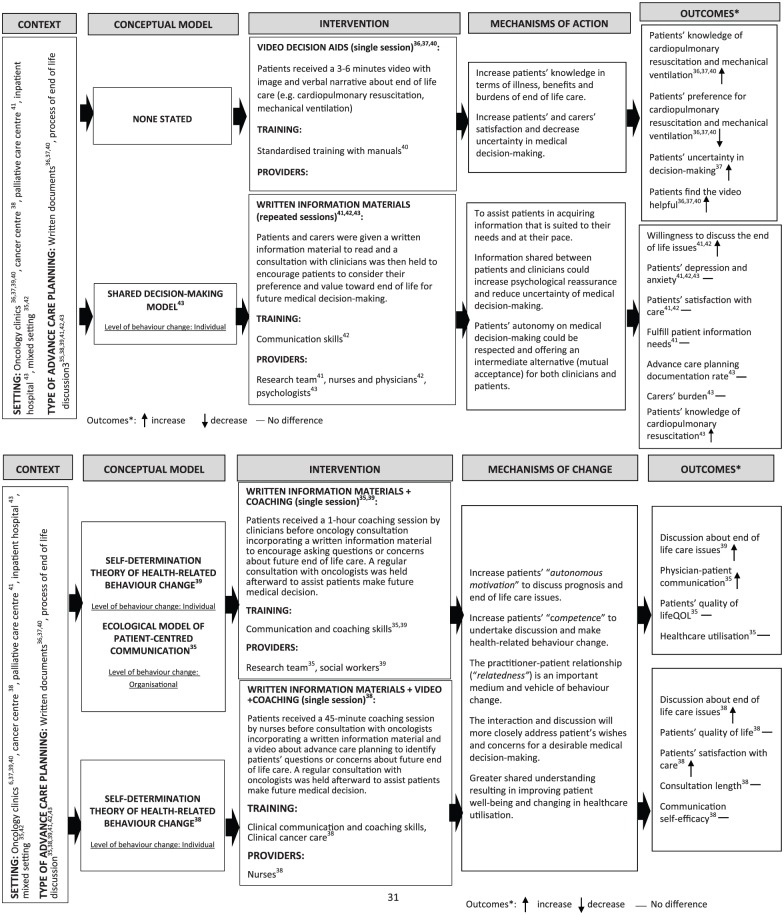
“Mechanisms through which advance care planning improved outcomes comprised (1) increasing patients’ knowledge of end-of-life care, (2) strengthening patients’ autonomous motivation, (3) building patients’ competence to undertake end-of-life discussions and (4) enhancing shared decision-making in a trustful relationshi…”
BackgroundSudore, R. L., Lum, H. D., You, J. J., Hanson, L. C., Meier, D. E., Pantilat, S. Z., Matlock, D. D., Rietjens, J. A. C., Korfage, I. J., Ritchie, C. S., et al. (2017) · Journal of Pain and Symptom Management · doi:10.1016/j.jpainsymman.2016.12.331 · Cited by 1,726
The effects of advance care planning on end-of-life care: A systematic review
Brinkman-Stoppelenburg, A., Rietjens, J. A., & van der Heide, A. (2014) · Palliative Medicine · doi:10.1177/0269216314526272 · Cited by 1,480
Advance Directives for Medical Care — A Case for Greater Use
Emanuel, L. L., Barry, M. J., Stoeckle, J. D., Ettelson, L. M., & Emanuel, E. J. (1991) · New England Journal of Medicine · doi:10.1056/nejm199103283241305 · Cited by 775
Efficacy of advance care planning: a systematic review and meta-analysis.
Houben, C. H. M., Spruit, M. A., Groenen, M. T. J., Wouters, E. F. M., & Janssen, D. J. A. (2014) · Journal of the American Medical Directors Association · doi:10.1016/j.jamda.2014.01.008 · Cited by 765
De Silva, M. J., Breuer, E., Lee, L., Asher, L., Chowdhary, N., Lund, C., & Patel, V. (2014) · Trials · doi:10.1186/1745-6215-15-267 · Cited by 738
Meta‐Analysis in Medical Research: The Handbook for the Understanding and Practice of Meta‐Analysis
(2005) · Wiley eBooks · doi:10.1002/9780470994894 · Cited by 687
What is missing from descriptions of treatment in trials and reviews?
Glasziou, P., Meats, E., Heneghan, C., & Shepperd, S. (2008) · BMJ · doi:10.1136/bmj.39590.732037.47 · Cited by 614
A Prospective Study of Advance Directives for Life-Sustaining Care
Danis, M., Southerland, L. I., Garrett, J. M., Smith, J. L., Hielema, F., Pickard, C. G., Egner, D. M., & Patrick, D. L. (1991) · New England Journal of Medicine · doi:10.1056/nejm199103283241304 · Cited by 485
Using theory of change to design and evaluate public health interventions: a systematic review
Breuer, E., Lee, L., De Silva, M., & Lund, C. (2015) · Implementation Science · doi:10.1186/s13012-016-0422-6 · Cited by 425
What are the components of effective stroke unit care?
Langhorne, P. (2002) · Age and Ageing · doi:10.1093/ageing/31.5.365 · Cited by 378
Clayton, J. M., Butow, P. N., Tattersall, M. H. N., Devine, R. J., Simpson, J. M., Aggarwal, G., Clark, K. J., Currow, D. C., Elliott, L. M., Lacey, J., et al. (2007) · Journal of Clinical Oncology · doi:10.1200/jco.2006.06.7827 · Cited by 359
The mental capacity act (2008): code of practice
Menon, S. (2009) · The Singapore Family Physician · Cited by 330
Epstein, R. M., Duberstein, P. R., Fenton, J. J., Fiscella, K., Hoerger, M., Tancredi, D. J., Xing, G., Gramling, R., Mohile, S., Franks, P., et al. (2016) · JAMA Oncology · doi:10.1001/jamaoncol.2016.4373 · Cited by 316
Johnson, S., Butow, P., Kerridge, I., & Tattersall, M. (2016) · Psycho-Oncology · doi:10.1002/pon.3926 · Cited by 276
The Effects of Advance Care Planning Interventions on Nursing Home Residents: A Systematic Review
Martin, R. S., Hayes, B., Gregorevic, K., & Lim, W. K. (2016) · Journal of the American Medical Directors Association · doi:10.1016/j.jamda.2015.12.017 · Cited by 271
Dy, S. M., Kiley, K. B., Ast, K., Lupu, D., Norton, S. A., McMillan, S. C., Herr, K., Rotella, J. D., & Casarett, D. J. (2015) · Journal of Pain and Symptom Management · doi:10.1016/j.jpainsymman.2015.01.012 · Cited by 267
El-Jawahri, A., Podgurski, L. M., Eichler, A. F., Plotkin, S. R., Temel, J. S., Mitchell, S. L., Chang, Y., Barry, M. J., & Volandes, A. E. (2010) · Journal of Clinical Oncology · doi:10.1200/jco.2009.24.7502 · Cited by 256
Lovell, A., & Yates, P. (2014) · Palliative Medicine · doi:10.1177/0269216314531313 · Cited by 244
How to read a paper: The Medline database
Greenhalgh, T. (1997) · BMJ · doi:10.1136/bmj.315.7101.180 · Cited by 229
Beyond Autonomy: Diversifying End‐of‐Life Decision‐Making Approaches to Serve Patients and Families
Winzelberg, G. S., Hanson, L. C., & Tulsky, J. A. (2005) · Journal of the American Geriatrics Society · doi:10.1111/j.1532-5415.2005.53317.x · Cited by 221
Robinson, L., Dickinson, C., Rousseau, N., Beyer, F., Clark, A., Hughes, J., Howel, D., & Exley, C. (2012) · Age and Ageing · doi:10.1093/ageing/afr148 · Cited by 221
An introduction to advance care planning in practice
Mullick, A., Martin, J., & Sallnow, L. (2013) · BMJ · doi:10.1136/bmj.f6064 · Cited by 219
Why are trials in palliative care so difficult?
Grande, G. E., & Todd, C. J. (2000) · Palliative Medicine · doi:10.1191/026921600677940614 · Cited by 215
Weathers, E., O’Caoimh, R., Cornally, N., Fitzgerald, C., Kearns, T., Coffey, A., Daly, E., O’Sullivan, R., McGlade, C., & Molloy, D. W. (2016) · Maturitas · doi:10.1016/j.maturitas.2016.06.016 · Cited by 212
Volandes, A. E., Paasche-Orlow, M. K., Mitchell, S. L., El-Jawahri, A., Davis, A. D., Barry, M. J., Hartshorn, K. L., Jackson, V. A., Gillick, M. R., Walker-Corkery, E. S., et al. (2013) · Journal of Clinical Oncology · doi:10.1200/jco.2012.43.9570 · Cited by 170
Preconditions for successful advance care planning in nursing homes: A systematic review.
Gilissen, J., Pivodic, L., Smets, T., Gastmans, C., Vander Stichele, R., Deliens, L., & Van den Block, L. (2017) · International Journal of Nursing Studies · doi:10.1016/j.ijnurstu.2016.12.003 · Cited by 156
Clayton, J. M., Butow, P. N., Tattersall, M., Chye, R., Noel, M., Davis, J. M., & Glare, P. A. (2003) · British Journal of Cancer · doi:10.1038/sj.bjc.6601380 · Cited by 154
Walczak, A., Butow, P. N., Tattersall, M. H. N., Davidson, P. M., Young, J. M., Epstein, R. M., Costa, D. S. J., & Clayton, J. M. (2016) · International Journal of Nursing Studies · doi:10.1016/j.ijnurstu.2016.10.008 · Cited by 127
Let me talk – an advance care planning programme for frail nursing home residents
Chan, H. Y., & Pang, S. M. (2010) · Journal of Clinical Nursing · doi:10.1111/j.1365-2702.2010.03353.x · Cited by 113
Interventions to promote the use of advance directives: An overview of systematic reviews
Tamayo-Velázquez, M.-I., Simón-Lorda, P., Villegas, R., Callejón, C. H., García-Gutiérrez, J. F., Martínez-Pecino, F., & Barrio-Cantalejo, I. M. (2009) · Patient Education and Counseling · doi:10.1016/j.pec.2009.09.027 · Cited by 104
Implementing an Advance Care Planning Program in German Nursing Homes
in der Schmitten, J., Lex, K., Mellert, C., Rothärmel, S., Wegscheider, K., & Marckmann, G. (2014) · Deutsches Ärzteblatt international · doi:10.3238/arztebl.2014.0050 · Cited by 100
Stein, R. A., Sharpe, L., Bell, M. L., Boyle, F. M., Dunn, S. M., & Clarke, S. J. (2013) · Journal of Clinical Oncology · doi:10.1200/jco.2011.40.8872 · Cited by 98
Epstein, A. S., Volandes, A. E., Chen, L. Y., Gary, K. A., Li, Y., Agre, P., Levin, T. T., Reidy, D. L., Meng, R. D., Segal, N. H., et al. (2013) · Journal of Palliative Medicine · doi:10.1089/jpm.2012.0524 · Cited by 91
Rodenbach, R. A., Brandes, K., Fiscella, K., Kravitz, R. L., Butow, P. N., Walczak, A., Duberstein, P. R., Sullivan, P., Hoh, B., Xing, G., et al. (2017) · Journal of Clinical Oncology · doi:10.1200/jco.2016.68.5651 · Cited by 91
Acceptability of an advance care planning interview schedule: a focus group study
Barnes, K., Jones, L., Tookman, A., & King, M. (2007) · Palliative Medicine · doi:10.1177/0269216306073638 · Cited by 90
Video decision aids to assist with advance care planning: a systematic review and meta-analysis
Jain, A., Corriveau, S., Quinn, K., Gardhouse, A., Vegas, D. B., & You, J. J. (2015) · BMJ Open · doi:10.1136/bmjopen-2014-007491 · Cited by 90
Hammes, B. J., Rooney, B. L., Gundrum, J. D., Hickman, S. E., & Hager, N. (2012) · Journal of Palliative Medicine · doi:10.1089/jpm.2011.0178 · Cited by 77
Advance Care Planning in End of Life Care
Thomas, K. (2010) · Oxford University Press eBooks · doi:10.1093/acprof:oso/9780199561636.001.0001 · Cited by 75
Upstreaming and Normalizing Advance Care Planning Conversations—A Public Health Approach
Prince‐Paul, M., & DiFranco, E. (2017) · Behavioral Sciences · doi:10.3390/bs7020018 · Cited by 75
Barnes, K. A., Barlow, C. A., Harrington, J., Ornadel, K., Tookman, A., King, M., & Jones, L. (2011) · Palliative and Supportive Care · doi:10.1017/s1478951510000568 · Cited by 70
Respecting Choices ® and Advance Directives in a Diverse Community
Pecanac, K. E., Repenshek, M. F., Tennenbaum, D., & Hammes, B. J. (2014) · Journal of Palliative Medicine · doi:10.1089/jpm.2013.0047 · Cited by 69
Jones, L., Harrington, J., Barlow, C. A., Tookman, A., Drake, R., Barnes, K., & King, M. (2011) · Palliative and Supportive Care · doi:10.1017/s1478951510000490 · Cited by 56
Intervention Synthesis: A Missing Link between a Systematic Review and Practical Treatment(s)
Glasziou, P. P., Chalmers, I., Green, S., & Michie, S. (2014) · PLoS Medicine · doi:10.1371/journal.pmed.1001690 · Cited by 55
Advance care planning and end of life decision making.
Cartwright, C., & Parker, M. (2004) · PubMed · Cited by 43
Advance care planning in Australia: what does the law say?
Carter, R. Z., Detering, K. M., Silvester, W., & Sutton, E. (2015) · Australian Health Review · doi:10.1071/ah15120 · Cited by 36
Zager, B. S., & Yancy, M. (2011) · Worldviews on Evidence-Based Nursing · doi:10.1111/j.1741-6787.2011.00222.x · Cited by 36
Stanford, J., Sandberg, D. M., Gwyther, L., & Harding, R. (2013) · Journal of Palliative Medicine · doi:10.1089/jpm.2013.0051 · Cited by 23
Self-citationInterventions for promoting the use of advance directives for end-of-life decisions in adults
Simón-Lorda, P., Barrio-Cantalejo, I. M., García-Gutiérrez, J. F., Tamayo-Velázquez, M. I., Villegas, R., Callejón, C. H., & Martínez-Pecino, F. (2012) · Cochrane Database of Systematic Reviews · doi:10.1002/14651858.cd007460.pub2 · Cited by 1
Research works printed but not linked: 13
- Ke LS Wang SP. The effectiveness of advance care planning for hospitalized elderly patients: a systematic review. Taiwan J Hospice Palliat Care 2012; 17: 48– 61.
- Henry C Seymour J Ryder S. Advance care planning: a guide for health and social care staff. Leicester: The National Council of Palliative Care, 2008.
- Higgins J Green S. Cochrane handbook for systematic reviews of intervention version 5.1.0. London: The Cochrane Collaboration, 2011.
- Popay J Roberts H Sowden A et al Guidance on the conduct of narrative synthesis in systematic reviews, version 1. 2006, pp. 1– 92.
- Lin CP Evans CJ Koffman J et al The conceptual models that underpin advance care planning for advanced cancer patients and their mechanisms of action: a systematic review of randomised controlled trials. PROSPERO 2017: CRD42017067628, http://www.crd.york.ac.uk/PROSPERO/display_record.php?ID=CRD42017067628 PMC6291906 30362897
- O’Connor D Green S Higgins JP. Defining the review question and developing criteria for including studies. In: Higgins JP Green S (eds) Cochrane handbook for systematic reviews of interventions version 5.1.0. London: The Cochrane Collaboration, 2011, pp. 81– 94.
- Endnote. EndNote X8 for Windows. Philadelphia, PA: Clarivate Analytics, 2016.
- Cochrane Consumers Communication Review Group. Data extraction template for included studies Australia. London: The Cochrane Collaboration, 2016.
- Review Manager. Review manager (RevMan) version 5.3. Copenhagen: The Nordic Cochrane Centre and The Cochrane Collaboration, 2014.
- Gillick MR Volandes AE. The psychology of using and creating video decision aids for advance care planning. In: Lynch TE (ed.) Psychology of decision making in medicine and health care. New York: Nova Science Publishers, 2007, pp. 193– 206.
- Ryan RM Patrick H Deci EL et al Facilitating health behaviour change and its maintenance: interventions based on Self-Determination Theory. Euro Health Psycol 2008; 10: 2– 5.
- Lord Chancellor. Mental Capacity Act 2005: code of practice. London: TSO, 2007.
- Laws and Regulations Databases of The Republic of China. Patient autonomy act. Taipei, Taiwan: Ministry of Health and Welfare, 2016.
Cited by
Korfage, I. J., Carreras, G., Christensen, C. A., Billekens, P., Bramley, L., Briggs, L. A., Bulli, F., Caswell, G., Červ, B., van Delden, J. J. M., et al. (2020) · PLoS Medicine · doi:10.1371/journal.pmed.1003422 · Cited by 178
“We updated a 2019 systematic review of randomised controlled trials (RCTs) about ACP for patients with advanced cancer [10] and identified 6 RCTs of complex ACP interventions for advanced cancer patients: 1 conducted in the UK (n = 77) [11], 2 in Australia (n = 120–208) [12,13], and 3 in the US (n = 155–278) [14–16].”
MethodLin, C., Evans, C., Koffman, J., Sheu, S., Hsu, S.-H., & Harding, R. (2019) · Palliative Medicine · doi:10.1177/0269216319866641 · Cited by 79
“patients weighing up perceived benefits to others as more important than benefits for themselves; and (3) ‘no opportunity to choose”
BackgroundMethodSelf-citationMcCauley, R., McQuillan, R., Ryan, K., & Foley, G. (2021) · Palliative Medicine · doi:10.1177/0269216321999962 · Cited by 91
Palliative Care in the Greater China Region: A Systematic Review of Needs, Models, and Outcomes
Chung, H., Harding, R., & Guo, P. (2020) · Journal of Pain and Symptom Management · doi:10.1016/j.jpainsymman.2020.08.040 · Cited by 64
Self-citationBradshaw, A., Dunleavy, L., Walshe, C., Preston, N. J., Cripps, R. L., Hocaoğlu, M., Bajwah, S., Maddocks, M. M., Oluyase, A. O., Sleeman, K. E., et al. (2021) · Palliative Medicine · doi:10.1177/02692163211017387 · Cited by 54
Self-citation
Metadata
- Authors
- Lin, C.-P., Evans, C. J., Koffman, J., Armes, J., Murtagh, F. E. M., & Harding, R.
- Affiliations
- King's College London (GB)
- University of Surrey (GB)
- Corresponding author
- Lin, Cheng-Pei
- Venue
- Palliative Medicine
- Publisher
- SAGE Publications
- Published
- 2018-10-26
- Volume
- 33
- Issue
- 1
- Pages
- 5-23
- ISSN
- 0269-2163 (ISSN-L)
- 1477-030X
- PMC
- PMC6291906
- OpenAlex
- W2898307076
- Cited by
- 77
- References
- 57
- Citations by year
- 2026: 5 · 2025: 6 · 2024: 12 · 2023: 9 · 2022: 7 · 2021: 17 · 2020: 13 · 2019: 7 · 2018: 1
- FWCI
- 1.72
- Type
- journal article
- Language
- en
- Open access
- hybrid
- doi.org
- Licence
- cc-by-nc
- journals.sagepub.com/page/policies/text-and-data-mining-license (tdm)
- Locations
- Palliative Medicine (publishedVersion, cc-by-nc)
- Europe PMC (PubMed Central) (publishedVersion, cc-by-nc)
- PubMed Central (publishedVersion, cc-by-nc)
- PubMed (publishedVersion)
- Research Portal (King's College London) (publishedVersion, cc-by-nc)
- Surrey Research Insight Open Access (The University of Surrey) (submittedVersion)
- Repository@Hull (Worktribe) (University of Hull) (submittedVersion, cc-by-nc)
- Funders
- National Institute for Health and Care Research (ICA-SCL-2015-01-001)
- Department of Health and Social Care
- Topics
- Health Sciences › Medicine › Public Health, Environmental and Occupational Health › Palliative Care and End-of-Life Issues
- Health Sciences › Medicine › Public Health, Environmental and Occupational Health › Palliative and Oncologic Care
- Health Sciences › Medicine › Public Health, Environmental and Occupational Health › Ethics and bioethics in healthcare
- Keywords
- advance care planning, advanced cancer, end-of-life care, conceptual model, logic model, mechanisms of change, shared decision-making, patient autonomy, end-of-life discussions, patient knowledge, behavior change
- MeSH terms
- Adult, Aged, Aged, 80 and over, Decision Making, Female, Humans, Male, Middle Aged, Neoplasms, Patient Participation, Terminal Care, Randomized Controlled Trials as Topic, Advance Care Planning
About these checks
Registry, retraction, Cites and statistics results are computed, not judged, with one exception: a printed reference that no index lists is read once by a model before it counts as a citation error. Claims are extracted by a model and kept only when their quote appears verbatim in the text; each cited source is then checked, with a model’s help, for whether it says what the claim relies on. Those verdicts can be wrong — read the claim’s quote and the cited source before relying on one.
Statistics and arithmetic are recomputed, not judged.
Confidence bands are shown only for fields calibrated on our annotated test set. None is calibrated yet, so no band is shown.
What counts as a claim ›How we measure confidence ›How we check this ›
Are you an author, or do you see a problem with this page? Request a review
Data sources
Bibliographic data: Semantic Scholar, OpenAlex, Crossref.
Contains information from the Semantic Scholar Academic Graph Datasets, made available under the ODC Attribution License (ODC-BY 1.0).
Semantic Scholar’s data is described in: Kinney, R., et al. (2023). The Semantic Scholar Open Data Platform. arXiv:2301.10140.
