

Propranolol for the treatment of anxiety disorders: Systematic review and meta-analysis
Open accessThe DOI matches its Crossref record; 65 of the 65 references it cites were found in a registry or an index.
Abstract
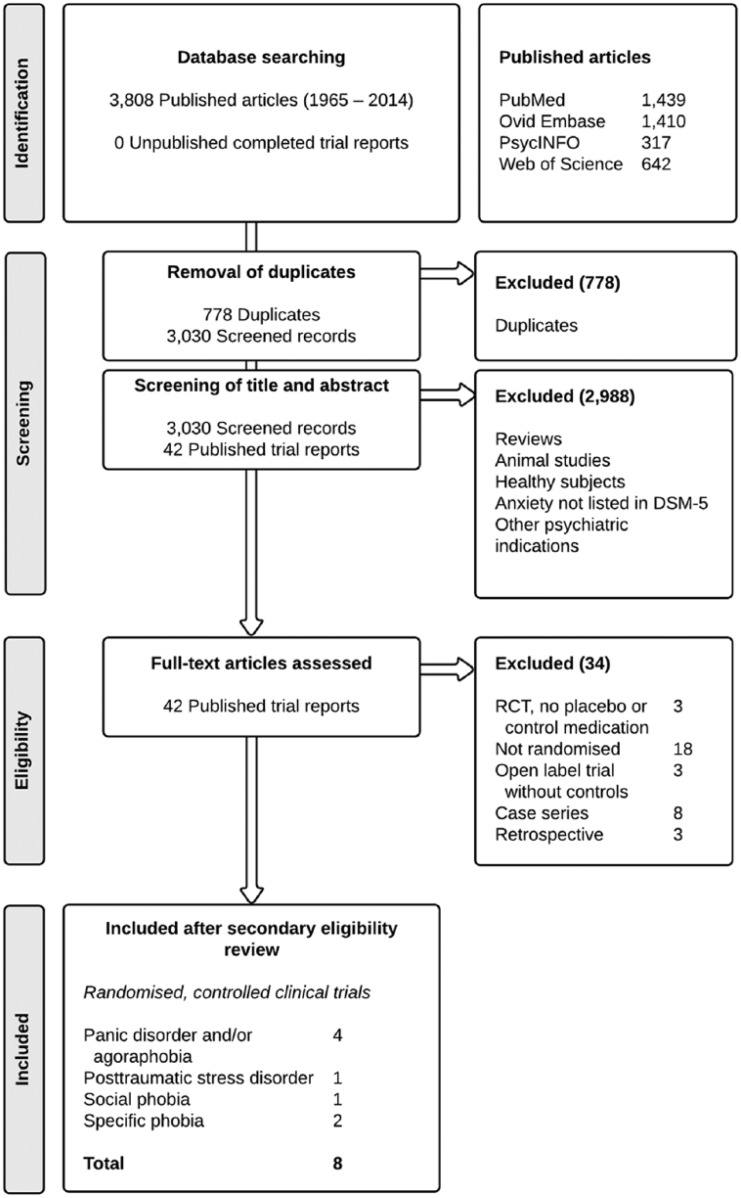
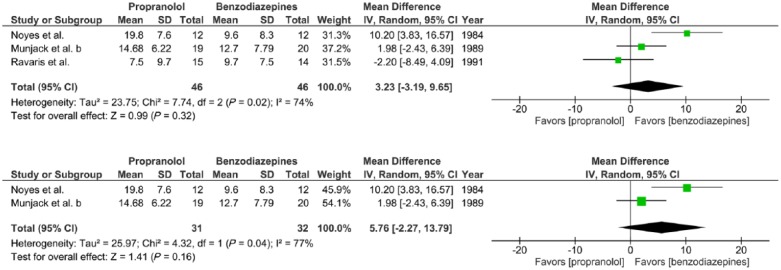
The effects of propranolol in the treatment of anxiety disorders have not been systematically evaluated previously. The aim was to conduct a systematic review and meta-analysis of randomised controlled trials, addressing the efficacy of oral propranolol versus placebo or other medication as a treatment for alleviating either state or trait anxiety in patients suffering from anxiety disorders. Eight studies met the inclusion criteria. These studies concerned panic disorder with or without agoraphobia (four studies, total n = 130), specific phobia (two studies, total n = 37), social phobia (one study, n = 16), and posttraumatic stress disorder (PTSD) (one study, n = 19). Three out of four panic disorder trials qualified for pooled analyses. These meta-analyses found no statistically significant differences between the efficacy of propranolol and benzodiazepines regarding the short-term treatment of panic disorder with or without agoraphobia. Also, no evidence was found for effects of propranolol on PTSD symptom severity through inhibition of memory reconsolidation. In conclusion, the quality of evidence for the efficacy of propranolol at present is insufficient to support the routine use of propranolol in the treatment of any of the anxiety disorders.
Overview
The claims and statistics of this paper haven’t been checked yet.
Free: it reads the open-access text and checks the first 5 claims that cite a source we can check. Create a free account to check every claim.
Integrity signals
Registry
Cites
Statistics
Figures




Verification
Claims the paper makes
The claims and statistics of this paper haven’t been checked yet.
Free: it reads the open-access text and checks the first 5 claims that cite a source we can check. Create a free account to check every claim.
Claims other papers make about this one
Each is checked against this paper’s own text: does it say what the citing paper says it does?
The source backs part of the claim, not all of it — or backs it for a different population, condition or comparison.
In the citing paper
“There is some evidence that patients with 'performance only' social anxiety disorder may respond to beta-adrenergic blockers (such as propranolol or atenolol) 98 .”
From The clinical characterization of the adult patient with an anxiety or related disorder aimed at personalization of management (2021) · cites this paper as [98]
Experimental — accuracy not yet measuredIn the citing paper
“Subsequent trials were negative, and one meta-analysis concluded that there was no evidence for the utility of propranolol in limiting PTSD development 156 .”
From Post‐traumatic stress disorder: a state‐of‐the‐art review of evidence and challenges (2019) · cites this paper as [156]
Self-check
Percentages, sums and reported differences re-computed from the paper’s own numbers.
The self-check needs the paper’s full text.
Citations
Cites
Diagnostic and Statistical Manual of Mental Disorders
American Psychiatric Association (2013) · doi:10.1176/appi.books.9780890425596 · Cited by 116,369
Preferred Reporting Items for Systematic Reviews and Meta-Analyses: the PRISMA statement
Moher, D., Liberati, A., Tetzlaff, J., Altman, D. G., & for the PRISMA Group (2009) · BMJ · doi:10.1136/bmj.b2535 · Cited by 83,823
Preferred Reporting Items for Systematic Reviews and Meta-Analyses: The PRISMA Statement
Moher, D., Liberati, A., Tetzlaff, J., Altman, D. G., & The PRISMA Group (2009) · PLoS Medicine · doi:10.1371/journal.pmed.1000097 · Cited by 64,042
Preferred reporting items for systematic reviews and meta-analyses: the PRISMA Statement.
(2009) · PubMed Central · Cited by 44,859
Cochrane Handbook for Systematic Reviews of Interventions: Cochrane Book Series
(2008) · doi:10.1002/9780470712184 · Cited by 25,048
Preferred Reporting Items for Systematic Reviews and Meta-Analyses: The PRISMA Statement
Moher, D., Liberati, A., Tetzlaff, J., & Altman, D. G. (2009) · Journal of Clinical Epidemiology · doi:10.1016/j.jclinepi.2009.06.005 · Cited by 19,575
Wang, G., Ma, R., Qiao, G., Wada, K., Aizawa, Y., & Satoh, T. (2015) · Integrative Medicine International · doi:10.1159/000368408 · Cited by 18,657
The assessment of anxiety states by rating
HAMILTON, M. (1959) · British Journal of Medical Psychology · doi:10.1111/j.2044-8341.1959.tb00467.x · Cited by 11,455
January, C. T., Wann, L. S., Alpert, J. S., Calkins, H., Cigarroa, J. E., Cleveland, J. C., Conti, J. B., Ellinor, P. T., Ezekowitz, M. D., Field, M. E., et al. (2014) · Circulation · doi:10.1161/cir.0000000000000041 · Cited by 7,115
Diagnostic and Statistical Manual of Mental Disorders, 5th Edition
(2013) · American Psychiatric Association Publishing eBooks · doi:10.1176/appi.books.9780890425596.893619 · Cited by 4,383
Research works printed but not linked: 1
- Roy-Byrne P Stein M Hermann R (2013) Pharmacotherapy for panic disorder.In: Post T (ed.) UpToDate®. Waltham, MA: UpToDate® Available at: http://www.uptodate.com/contents/pharmacotherapy-for-panic-disorder (accessed 9 July 2015).
Cited by
Items 201–237 of 237
Psychiatric Disorders and Respiratory Failure: Key Concept
Bhattacharya, D., Esquinas, A. M., & Mandal, M. (2023) · Springer eBooks · doi:10.1007/978-3-031-27968-3_4
Arfania, M., Nissa, A. K., Haniatin, K., & Andriyani, N. (2023) · Eureka Herba Indonesia · doi:10.37275/ehi.v4i3.83
The Relationship between β-blockers and Mental Health
Joshi, Y. M., & Mammarella, B. (2023) · Sciential - McMaster Undergraduate Science Journal · doi:10.15173/sciential.v1i10.3392
Journal, S. (2023) · Sciential - McMaster Undergraduate Science Journal · doi:10.15173/sciential.v1i10.3517
Poisoning patients’ clinical features according to the blood level of propranolol
Kim, S., So, B. H., Kim, H. M., Cha, K., Song, H., & Jeong, W. J. (2023) · Journal of the Korean society of clinical toxicology · doi:10.22537/jksct.2023.00010
RESPONSE TO SYMPTOMATIC TREATMENT IN MITRAL VALVE PROLAPSE, AN EXPERIENCE AT KHYBER PAKHTOONKHWA
Khan, I., Zeb, S., Ullah, H., Khan, M. I., Waleed, M., & Salman, M. (2023) · Journal of Khyber College of Dentistry · doi:10.33279/jkcd.v13i1.102
“It was previously shown that adrenergic receptor is upregulated in MVP, so it may respond to treatment with B-blockers.(14,23,24) This antiadrenergic be sympathetic tone may be responsible for symptomatic treatment with B-blokers.”
BackgroundBiomedical and public health studies on susceptibility to post-traumatic stress disorder
Jowf, G. I. A. (2023) · Research Publications (Maastricht University) · doi:10.26481/dis.20230906ga
Can’t get you out of my head: impairing and improving suppression of unwanted memories
Ashton, S. M. (2024) · Research Publications (Maastricht University) · doi:10.26481/dis.20240321sa
Cardiovascular medications and its relations with COVID-19 survival
Butt, S., Eltalib, D. M. N., Alim, S., Duric, B., Shankar, M., & Bayatpoor, Y. (2024) · Elsevier eBooks · doi:10.1016/b978-0-443-19091-9.00009-3 · Cited by 1
Open MDMA: An Open Source Framework and Practical Guide for the Therapeutic use of MDMAPreprint
Groeneveld, M., & Harper, T. (2024) · PsyArXiv (OSF Preprints) · doi:10.31234/osf.io/aps5g
ADVANCEMENTS IN UNDERSTANDING AND TREATING ANXIETY DISORDER
(2024) · International Journal of Biology Pharmacy and Allied Sciences · doi:10.31032/ijbpas/2024/13.8.8220
Medications for Anxiety Disorders
Narita, Z. C., Fujimoto, M., Winter, E., Nestadt, P. S., & Sawa, A. (2024) · Springer eBooks · doi:10.1007/978-3-030-51366-5_136
(2024) · Elsevier eBooks · doi:10.1016/b978-0-443-23565-8.09996-8
Anisman, H., Hayley, S. P., & Kusnecov, A. W. (2024) · Elsevier eBooks · doi:10.1016/b978-0-443-23565-8.00010-7
Groeneveld, M., & Harper, T. (2024) · PsyArXiv (OSF Preprints) · doi:10.31234/osf.io/aps5g_v1
Groeneveld, M., & Harper, T. (2025) · PsyArXiv (OSF Preprints) · doi:10.31234/osf.io/aps5g_v3
Melefa, T. D., Andong, F. A., Hinmikaiye, F. F., Ozota, E. E., Nwoko, M.-C., Ubah, V. C. S., Ugwu, G. N., & Nwani, C. D. (2025) · Journal of Aquatic Animal Health · doi:10.1093/jahafs/vsaf004 · Cited by 1
Rouhzendeh, S., Mousavi, Z., Mashayekh‐Amiri, S., Shaseb, E., Mirmolaei, S. T., & Mirghafourvand, M. (2025) · Journal of Pharmaceutical Health Care and Sciences · doi:10.1186/s40780-025-00466-x
Groeneveld, M., & Harper, T. (2025) · PsyArXiv (OSF Preprints) · doi:10.31234/osf.io/aps5g_v4 · Cited by 1
Quarto, F. H. A., de Almeida, J. M., Cunha, P. A. R., & Martins, T. A. (2025) · STUDIES IN HEALTH SCIENCES · doi:10.54022/shsv6n3-019
Apolipoproteins and cardiovascular disease: Risk factors, biomarkers, and potential treatments
Kaur, R., & Chaudhary, P. (2024) · The Applied Biology & Chemistry Journal · doi:10.52679/tabcj.2024.0009
Ahari, N. J., & Fonzo, G. A. (2025) · Frontiers in Psychiatry · doi:10.3389/fpsyt.2025.1665770 · Cited by 1
Emerging Therapeutic Approaches and Drugs for Anxiety and Related Disorders
Kumar, V., Nahari, S. T. M. A. A., Singh, S. K., Kumar, A., Wadhwa, P. K., Duggal, N., & Tewari, D. (2025) · World Journal of Traditional Chinese Medicine · doi:10.4103/wjtcm.wjtcm_47_25
Gao, Y., Wu, L., Zheng, H., Fang, X., Zhang, E., Li, S., Guo, B., Li, S., Zhu, G., Han, W., et al. (2025) · Neuroscience · doi:10.1016/j.neuroscience.2025.10.007
Rao, H. S. P., & Elamvazhuthi, P. (2025) · Journal of Molecular Structure · doi:10.1016/j.molstruc.2025.145030
Almarri, F. K., Alaseem, A. M., Alanazi, M. S., Alyahya, S., Alsanad, N. H., Alswayed, K. E., Alanazi, J., Alharby, T. N., & Alghamdi, S. A. (2022) · Figshare · doi:10.6084/m9.figshare.21557567
Shvalbo, B. B., Scarlat, S., Sakis, N., Trachtenberg, E., Sandbank, E., Weil, M., Eckerling, A., Cole, S. W., & Ben‐Eliyahu, S. (2026) · Brain Behavior & Immunity - Health · doi:10.1016/j.bbih.2026.101228 · Cited by 1
“However, in the current study, which employed a 48-h psychological stress paradigm, the protective effects of propranolol may have also been related to its central nervous system anxiolytic effects (Steenen et al., 2016).”
Tonooka, K., Sasaki, C., Terada, M., Satoh, F., & Shinozuka, T. (2026) · American Journal of Analytical Chemistry · doi:10.4236/ajac.2026.174008
Uddin, T., Bhuiyan, O. H., Misha, M. M., Sharma, S., Sharmin, F., Tasnim, S., Aktar, S., Sarker, R., Nipun, R. S., Ghosh, K. Y., et al. (2026) · Exploration of Neuroprotective Therapy · doi:10.37349/ent.2026.1004155
Pinky, Neha, Kaushik, M., Tiwari, P., El‐Tanani, M., Rabbani, S. A., & Parvez, S. (2026) · Frontiers in Aging Neuroscience · doi:10.3389/fnagi.2026.1729046
“Thus, PRO seems to have an anti-anxiety (Steenen et al., 2016) and anti-amnesic eect.”
Genetic perspectives on the comorbidity of anxiety and mood disorders with cardiovascular disease
de Geus, E. J. C., Treur, J. L., & Penninx, B. W. J. H. (2026) · Nature Cardiovascular Research · doi:10.1038/s44161-026-00822-6 · Cited by 1
“A meta-analysis of eight RCTs testing propranolol in patients with anxiety disorder also did not demonstrate a beneficial anxiolytic effect 160 .”
Evolving paradigms in cardiovascular pharmacology: advances and clinical significance
Pandey, R., & Singh, P. (2026) · Current Problems in Cardiology · doi:10.1016/j.cpcardiol.2026.103388 · Cited by 1
Mela, M., Hinz, T., Chicoine, C., Zidenberg, A. M., Lim, H. J., Madampage, C. A., & Menzies, R. (2026) · The European Journal of Psychiatry · doi:10.1016/j.ejpsy.2026.100363
Alzoubi, M., Safadi, W. A., Sorour, S., Ammori, R., Ahmad, A., Dawud, Y., Shalash, F., Mohammad, M., & MOHAMMAD, M. (2026) · Healthcare · doi:10.3390/healthcare14152257
“This perceived effectiveness is likely related to the reduction in physical symptoms of anxiety (e.g., heart rate, tremor), rather than an effect on psychological anxiety, leading users to overestimate the drug’s overall benefit [39].”
Boileau, K., Stanson, N., Bakker, E., Boland, A. K., Hansen, U., Barbeau, K., Comeau, G., & Smith, A. (2026) · Psychological Reports · doi:10.1177/00332941261484083
Mureşan, L., Cismaru, G., Popa, S., Roşu, R., Guşetu, G., Puiu, M., Mada, R. O., Muresan, C., Bouar, R. L., Schiau, S., et al. (2026) · American Journal of Cardiovascular Drugs · doi:10.1007/s40256-026-00828-2
The Serenity Spectrum: Integrating Anxiolytic and Antidepressant Mechanisms for Stress relief
Harini., M. B., & Verma, P. (2026) · Asian Journal of Research in Pharmaceutical Sciences · doi:10.52711/2231-5659.2026.00063
Metadata
- Authors
- Steenen, S. A., van Wijk, A. J., van der Heijden, G. J., van Westrhenen, R., de Lange, J., & de Jongh, A.
- Affiliations
- Amsterdam UMC Location University of Amsterdam (NL)
- Department of Social Dentistry and Behavioural Sciences, Academic Centre for Dentistry Amsterdam, University of Amsterdam and VU University, Amsterdam, the Netherlands
- Department of Psychiatry, Erasmus University Medical Centre, Rotterdam, the Netherlands
- Department of Oral and Maxillofacial Surgery, Academic Medical Centre, University of Amsterdam, Amsterdam, the Netherlands
- Corresponding author
- Steenen, Serge A
- ORCID
- Steenen, Serge A
- Venue
- Journal of Psychopharmacology
- Publisher
- SAGE Publications
- Published
- 2015-10-20
- Volume
- 30
- Issue
- 2
- Pages
- 128-139
- ISSN
- 0269-8811 (ISSN-L)
- 1461-7285
- PMC
- PMC4724794
- OpenAlex
- W2266059207
- Cited by
- 237
- References
- 65
- Citations by year
- 2026: 14 · 2025: 29 · 2024: 31 · 2023: 24 · 2022: 28 · 2021: 24 · 2020: 17 · 2019: 20 · 2018: 24 · 2017: 18 · 2016: 7 · 2015: 1
- FWCI
- 2.17
- Type
- journal article
- Language
- en
- Open access
- hybrid
- doi.org
- Licence
- cc-by-nc
- journals.sagepub.com/page/policies/text-and-data-mining-license (tdm)
- Locations
- Journal of Psychopharmacology (publishedVersion, cc-by-nc)
- PubMed Central (publishedVersion, cc-by-nc)
- PubMed (publishedVersion)
- UvA-DARE (University of Amsterdam) (publishedVersion, cc-by-nc)
- EUR Research Repository (Erasmus University Rotterdam) (publishedVersion)
- VU Research Portal (publishedVersion, other-oa)
- Data Archiving and Networked Services (DANS) (submittedVersion)
- EUR Research Repository (Erasmus University Rotterdam) (submittedVersion)
- RePub (Erasmus University Rotterdam) (submittedVersion, other-oa)
- UvA-DARE (University of Amsterdam) (submittedVersion, cc-by-nc)
- Pure Amsterdam UMC (submittedVersion, other-oa)
- Data Archiving and Networked Services (DANS) (submittedVersion, other-oa)
- Funders
- Universiteit van Amsterdam
- Topics
- Social Sciences › Psychology › Experimental and Cognitive Psychology › Anxiety, Depression, Psychometrics, Treatment, Cognitive Processes
- Health Sciences › Medicine › Cardiology and Cardiovascular Medicine › Cardiac Health and Mental Health
- Health Sciences › Medicine › Public Health, Environmental and Occupational Health › Maternal Mental Health During Pregnancy and Postpartum
- Keywords
- propranolol, anxiety disorders, panic disorder, agoraphobia, specific phobia, social anxiety disorder, post-traumatic stress disorder, benzodiazepines, memory reconsolidation, state anxiety, trait anxiety, beta-blockers
- MeSH terms
- Administration, Oral, Adrenergic beta-Antagonists, Anxiety Disorders, Humans, Propranolol, Severity of Illness Index, Anti-Anxiety Agents, Randomized Controlled Trials as Topic
About these checks
Registry, retraction, Cites and statistics results are computed, not judged, with one exception: a printed reference that no index lists is read once by a model before it counts as a citation error. Claims are extracted by a model and kept only when their quote appears verbatim in the text; each cited source is then checked, with a model’s help, for whether it says what the claim relies on. Those verdicts can be wrong — read the claim’s quote and the cited source before relying on one.
Statistics and arithmetic are recomputed, not judged.
Confidence bands are shown only for fields calibrated on our annotated test set. None is calibrated yet, so no band is shown.
What counts as a claim ›How we measure confidence ›How we check this ›
Are you an author, or do you see a problem with this page? Request a review
Data sources
Bibliographic data: Semantic Scholar, OpenAlex, Crossref.
Contains information from the Semantic Scholar Academic Graph Datasets, made available under the ODC Attribution License (ODC-BY 1.0).
Semantic Scholar’s data is described in: Kinney, R., et al. (2023). The Semantic Scholar Open Data Platform. arXiv:2301.10140.
