

The DOI matches its Crossref record; 86 of the 86 references it cites were found in a registry or an index; 16 of the 39 sources its claims cite were checked for support.
Diffusion policy: Visuomotor policy learning via action diffusion
Abstract
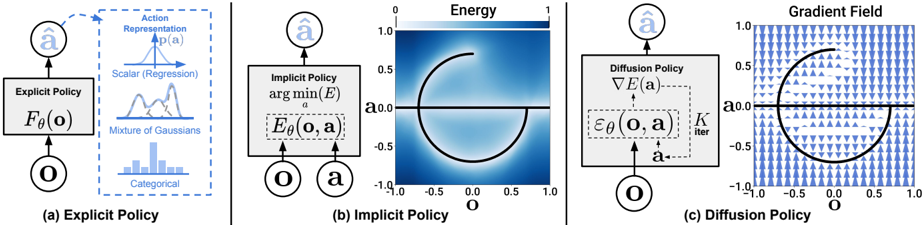
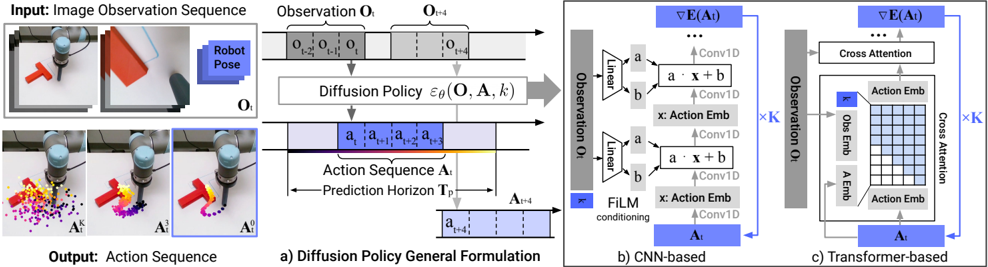
This paper introduces Diffusion Policy, a new way of generating robot behavior by representing a robot’s visuomotor policy as a conditional denoising diffusion process. We benchmark Diffusion Policy across 15 different tasks from 4 different robot manipulation benchmarks and find that it consistently outperforms existing state-of-the-art robot learning methods with an average improvement of 46.9%. Diffusion Policy learns the gradient of the action-distribution score function and iteratively optimizes with respect to this gradient field during inference via a series of stochastic Langevin dynamics steps. We find that the diffusion formulation yields powerful advantages when used for robot policies, including gracefully handling multimodal action distributions, being suitable for high-dimensional action spaces, and exhibiting impressive training stability. To fully unlock the potential of diffusion models for visuomotor policy learning on physical robots, this paper presents a set of key technical contributions including the incorporation of receding horizon control, visual conditioning, and the time-series diffusion transformer. We hope this work will help motivate a new generation of policy learning techniques that are able to leverage the powerful generative modeling capabilities of diffusion models. Code, data, and training details are available (diffusion-policy.cs.columbia.edu).
Overview
CoChat Summary
TL;DR
Diffusion Policy represents a visuomotor policy as a conditional denoising diffusion process over action sequences, using receding-horizon control, visual conditioning, and CNN or transformer backbones. Across 15 tasks from 4 benchmarks it reports an average 46.9% improvement over prior state-of-the-art, with strong real-world manipulation results.
Key findings
- Across 15 tasks from 4 robot manipulation benchmarks, Diffusion Policy consistently outperforms prior state-of-the-art with an average improvement of 46.9%; in simulation it reports best/average success rates such as 1.00/1.00 on Lift ph and 1.00/0.87 on ToolHang ph for DiffusionPolicy-T (Table 1).
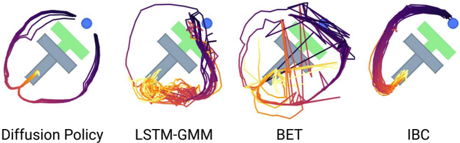
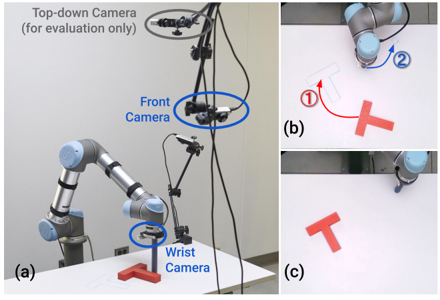
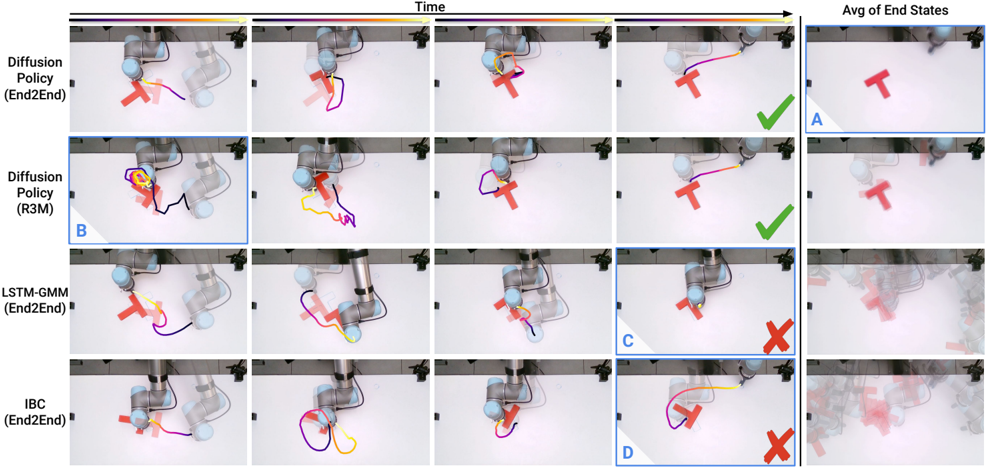
- Real-world Push-T: 95% success and 0.8 average IoU vs human 1.00 success and 0.84 IoU; best IBC and LSTM-GMM variants reached 0% and 20% success.
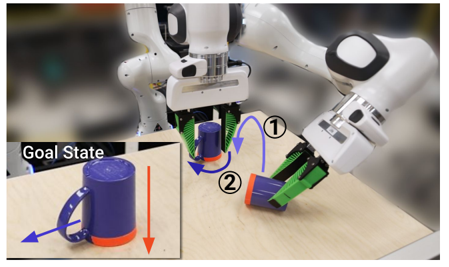
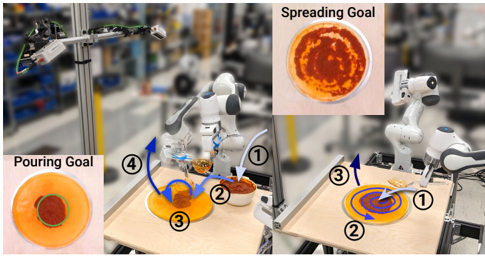
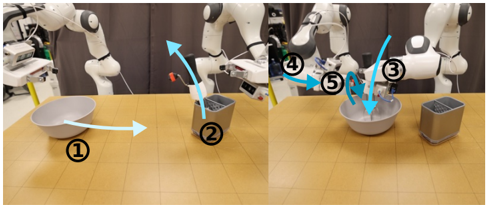
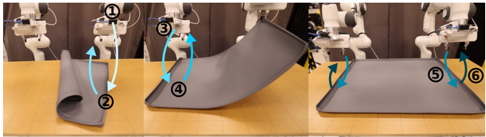
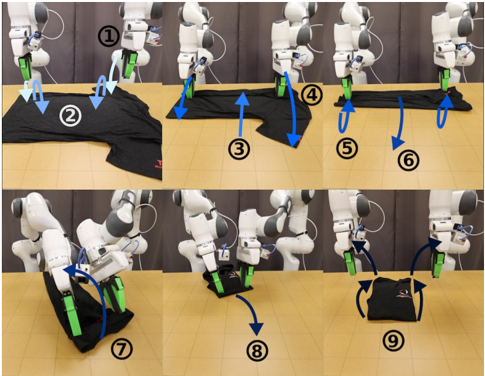
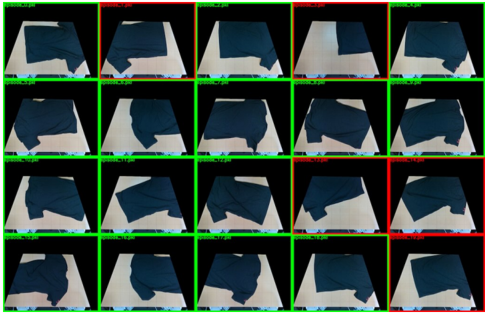
- Other real-world tasks: Mug Flipping 90% success over 20 trials (LSTM-GMM 0%); Sauce Pouring 0.74 IoU / 0.79 success vs human 0.79 / 1.00; Sauce Spreading 0.77 coverage / 1.00 success vs human 0.79 / 1.00; bimanual Egg Beater 55%, Mat Unrolling 75%, Shirt Folding 75%, each over 20 trials.
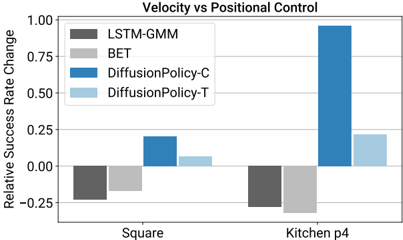
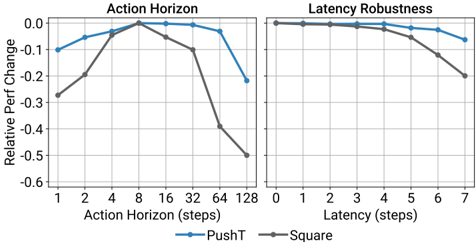
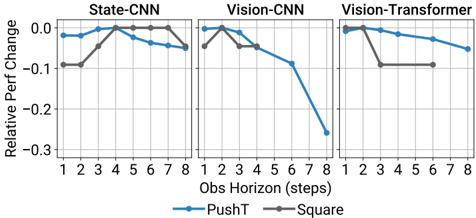
- Ablations: action horizon of 8 steps was optimal for most tested tasks; Diffusion Policy maintained peak performance with latency up to 4 steps; position control outperformed velocity control; DDIM with 100 training and 10 inference iterations enabled 0.1 s inference latency on an Nvidia 3080 GPU.
Methods
- Design: conditional DDPM/DDIM policy \(p(A_t|O_t)\) that predicts action sequences; uses receding-horizon control, visual conditioning, and either a CNN with FiLM or a time-series diffusion transformer.
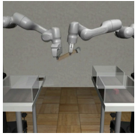
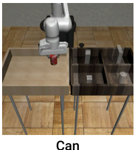
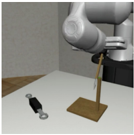
- Data/evaluation: 15 tasks from 4 benchmarks (Robomimic, Push-T, Block Push, Kitchen) plus real-world single-arm and bimanual tasks; simulation results averaged over 3 training seeds and 50 environment initial conditions (1500 experiments total; robomimic used 22 initializations due to an evaluation-code bug).
- Analysis: compares against LSTM-GMM, IBC, and BET; metrics include success rate, target-area coverage/IoU, and ablations on action horizon, latency, action space, vision encoder, and architecture.
Limitations
- Stated: inherits behavior cloning limitations such as suboptimal performance with inadequate demonstration data; higher computational cost and inference latency than simpler methods like LSTM-GMM, which action-sequence prediction only partially mitigates and may not suffice for high-rate control.
- Stated: transformer backbone is more sensitive to hyperparameters; CNN backbone performs poorly when action sequences change quickly and sharply through time, such as velocity command action space.
- Evident: real-world evaluations often use small trial counts (e.g., 20 trials per task), and bimanual success rates were 55–75%; simulation robomimic used only 22 initializations due to a bug; frozen pretrained vision encoders performed poorly, and ViT from scratch reached only 22% success on square.
Model-written summary. Check it against the paper before relying on it.
Integrity signals
Registry
Cites
Statistics
Figures


Verification
Claims the paper makes
12 Valid · 4 Not valid · 14 Not checked · 115 Own results and interpretations
The cited sources support only part of this claim — read each source’s verdict below.
In the paper
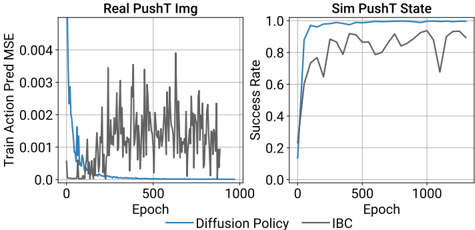
“In contrast, IBC Florence et al. (2021) is prone to training instability.”
What the sources say
- Partly supportedcites Florence et al. (2021) sourceExperimental — accuracy not yet measured
Section B.3.1 (page unavailable) says the authors use spectral normalization and gradient penalties for additional training stability, which supports stability being a concern for their Langevin-based approach. It does not say that IBC generally is prone to training instability; the Limitations section instead names computational cost and implementation complexity. (LLM, conf=0.82)
plain- Asserted: passes — The authors put it forward as true.
- Checkable: passes — It can be checked against evidence.
- Load-bearing: passes — The paper’s conclusions depend on it.
- Based: passes — The paper gives a reason why it holds.
- Partly supported
The cited sources support only part of this claim — read each source’s verdict below.
In the paper
“Expressing multimodal action distributions. By learning the gradient of the action score function Song and Ermon (2019) and performing Stochastic Langevin Dynamics sampling on this gradient field, Diffusion policy can express arbitrary normalizable distributions Neal et al. (2011), which includes multimodal action distributions, a well-known challenge for policy learning.”
- Also stated in: § 4.1 Model Multi-Modal Action Distributions · p. 4 · boosted
“Diffusion Policy's ability to express multimodal distributions naturally and precisely is one of its key advantages.”
What the sources say
- Supportedcites Song and Ermon (2019) source
Section 2.2 (p. 3) describes learning a distribution’s score and using Langevin dynamics to sample from it. Section 4.3 (p. 7) demonstrates sampling from a two-mode Gaussian mixture. The paper supports the cited method and its ability to represent multimodal distributions; applying it to action distributions is the citing authors’ context, not a result claimed by this source. (LLM, conf=0.88)
- Not matchedcites Neal et al. (2011)
Couldn’t be matched to a paper in Crossref, so it can’t be checked.
boostedstates a cause- Asserted: passes — The authors put it forward as true.
- Checkable: passes — It can be checked against evidence.
- Load-bearing: passes — The paper’s conclusions depend on it.
- Based: passes — The paper gives a reason why it holds.
- Also stated in: § 4.1 Model Multi-Modal Action Distributions · p. 4 · boosted
The cited sources support only part of this claim — read each source’s verdict below.
In the paper
“However, existing implicit policies (Florence et al. 2021) are unstable to train due to the necessity of drawing negative samples when computing the underlying Info-NCE loss.”
What the sources say
- Partly supportedcites Florence et al. 2021 sourceExperimental — accuracy not yet measured
Section 2 says the implicit models are trained with negative counter-examples and an InfoNCE-style loss. Appendix B.3.1 discusses measures for additional training stability, but neither passage says that drawing negative samples makes these policies unstable to train. The claimed cause of instability is therefore unsupported. (LLM, conf=0.87)
plainstates a cause- Asserted: passes — The authors put it forward as true.
- Checkable: passes — It can be checked against evidence.
- Load-bearing: passes — The paper’s conclusions depend on it.
- Based: passes — The paper gives a reason why it holds.
- Partly supported
Every source the paper cites for this claim was checked and supports it.
In the paper
“In our control tasks, we empirically found that the Square Cosine Schedule proposed in iDDPM Nichol and Dhariwal (2021) works best for our tasks.”
What the sources say
- Supportedcites Nichol and Dhariwal (2021) source
The citation identifies the origin of the squared-cosine noise schedule; the citing authors describe its performance on their control tasks as their own empirical finding. Section 3.2 (p. 4) proposes a cosine schedule and specifies the use of cos². (LLM, conf=0.92)
plainstates a cause- Asserted: passes — The authors put it forward as true.
- Checkable: passes — It can be checked against evidence.
- Load-bearing: unclear — It is unclear whether the paper’s conclusions depend on it.
- Based: passes — The paper gives a reason why it holds.
- Supported
The cited sources that could be checked couldn’t confirm or dispute this claim.
In the paper
“This shows that in order to perfectly clone a behavior that depends on the state, the learner must implicitly learn a (task-relevant) dynamics model Subramanian and Mahajan (2019); Zhang et al. (2020).”
What the sources say
- Not checked — no full text of the sourcecites Subramanian and Mahajan (2019) source
- Could not verifycites Zhang et al. (2020) sourceExperimental — accuracy not yet measured
The Introduction describes a representation that predicts task-relevant future states, and the method trains a latent dynamics model for reinforcement learning. Neither passage says that perfectly cloning state-dependent behavior requires a learner to implicitly learn such a model. Searches for imitation learning, behavior cloning, and that necessity claim found no supporting passage in our copy. (LLM, conf=0.76)
boostedstates a cause- Asserted: passes — The authors put it forward as true.
- Checkable: passes — It can be checked against evidence.
- Load-bearing: unclear — It is unclear whether the paper’s conclusions depend on it.
- Based: passes — The paper gives a reason why it holds.
79 more claims · 3 with their cited sources checked
Create a free account to see all 145 claims and to verify the 5 references still open.
- It may state two separate claims as one. 39
- Probably not a substantial claim. 33
- The quote only partly states this claim. 4
Claims other papers make about this one
Each is checked against this paper’s own text: does it say what the citing paper says it does?
The cited source doesn’t support the claim as written.
In the citing paper
“Inspired in part by human motor control [33], action chunking has recently emerged as the de facto standard in imitation learning for visuomotor control [68, 11].”
From Real-Time Execution of Action Chunking Flow Policies (2025) · cites this paper as [11]
Checked by a reasoning model — may be wrong.
Experimental — accuracy not yet measuredThe source backs part of the claim, not all of it — or backs it for a different population, condition or comparison.
In the citing paper
“Most simulated imitation learning benchmarks are quasi-static, and standard chunked execution with a long enough execution horizon can achieve near-perfect success rates [11].”
From Real-Time Execution of Action Chunking Flow Policies (2025) · cites this paper as [11]
Experimental — accuracy not yet measuredThe source backs part of the claim, not all of it — or backs it for a different population, condition or comparison.
In the citing paper
“This action head predicts a 'chunk”
From Octo: An Open-Source Generalist Robot Policy (2024) · cites this paper as [17]
Experimental — accuracy not yet measuredThe cited source says what the claim attributes to it.
In the citing paper
“Prior transformer-based policy designs typically encode input images with large ResNetstyle [32] encoders and fuse the resulting image features with a comparatively small transformer [10, 67, 81, 17, 98, 61, 83].”
From Octo: An Open-Source Generalist Robot Policy (2024) · cites this paper as [17]
The cited source says what the claim attributes to it.
In the citing paper
“While action chunking has enabled temporal consistency in high-frequency control tasks, it does not fully address the latency problem, leading to pauses or out-of-distribution jerky movements at chunk boundaries.”
From Real-Time Execution of Action Chunking Flow Policies (2025) · cites this paper as [11]
Self-check
Percentages, sums and reported differences re-computed from the paper’s own numbers.
Each contradiction between two passages listed here was confirmed by an independent check.
Rated minor: it would not touch a result — a value no result rests on, a p-value that stays on the same side of the significance level, or a conflict that is clerical, resolved elsewhere in the paper, or outside its own findings.
In the paper
§ 3.4 Accelerating Inference for Real-time Control · p. 4
“In our real-world experiments, using DDIM with 100 training iterations and 10 inference iterations enables 0.1s inference latency on a Nvidia 3080 GPU.”
§ A.4 Hyperparameters · p. 16
“We used DDIM Song et al. (2021) on realworld benchmarks to reduce the inference denoising iterations to 16 therefore reducing inference latency.”
Rated minor: it would not touch a result — a value no result rests on, a p-value that stays on the same side of the significance level, or a conflict that is clerical, resolved elsewhere in the paper, or outside its own findings.
In the paper
§ 5.1 Simulation Environments and datasets · p. 7
“the Franka Kitchen environment contains 7 objects for interaction and comes with a human demonstration dataset of 566 demonstrations”
§ 5.1 Simulation Environments and datasets · p. 7
“| Kitchen | 1 | 7 | 9 | 656 | 0 | 280 | No | No |”
Citations
Cites
Deep Residual Learning for Image Recognition
He, K., Zhang, X., Ren, S., & Sun, J. (2016) · 2016 IEEE Conference on Computer Vision and Pattern Recognition (CVPR) · doi:10.1109/cvpr.2016.90 · Cited by 235,474 · cited 1×
“Speci fi cally, we evaluated three different architectures: ResNet-18, ResNet-34 (He et al., 2016), and ViT-B/16 (Dosovitskiy et al., 2020).”
Vaswani, A., Shazeer, N., Parmar, N., Uszkoreit, J., Jones, L., Gomez, A. N., Kaiser, L., & Polosukhin, I. (2017) · arXiv · doi:10.48550/arxiv.1706.03762 · Cited by 120,404
U-Net: Convolutional Networks for Biomedical Image Segmentation
Ronneberger, O., Fischer, P., & Brox, T. (2015) · Lecture notes in computer science · doi:10.1007/978-3-319-24574-4_28 · Cited by 99,404 · cited 1×
“In this work, we examine two common network architecture types, convolutional neural networks (CNNs) (Ronneberger et al., 2015) and Transformers (Vaswani et al., 2017), and compare their performance and training characteristics.”
ImageNet: A large-scale hierarchical image database
Deng, J., Dong, W., Socher, R., Li, L.-J., Li, K., & Fei-Fei, L. (2009) · 2009 IEEE Conference on Computer Vision and Pattern Recognition · doi:10.1109/cvpr.2009.5206848 · Cited by 65,333
An Image is Worth 16x16 Words: Transformers for Image Recognition at Scale
Dosovitskiy, A., Beyer, L., Kolesnikov, A., Weissenborn, D., Zhai, X., Unterthiner, T., Dehghani, M., Minderer, M., Heigold, G., Gelly, S., et al. (2020) · arXiv · doi:10.48550/arxiv.2010.11929 · Cited by 47,472
Momentum Contrast for Unsupervised Visual Representation LearningPreprint
He, K., Fan, H., Wu, Y., Xie, S., & Girshick, R. B. (2019) · Computer Vision and Pattern Recognition · doi:10.48550/arxiv.1911.05722 · Cited by 16,321
Learning Transferable Visual Models From Natural Language Supervision
Radford, A., Kim, J. W., Hallacy, C., Ramesh, A., Goh, G., Agarwal, S., Sastry, G., Askell, A., Mishkin, P., Clark, J., et al. (2021) · arXiv · doi:10.48550/arxiv.2103.00020 · Cited by 15,293
Advances in neural information processing systems 7
(1996) · Computers & Mathematics with Applications · doi:10.1016/s0898-1221(96)90463-0 · Cited by 14,281
Advances in Neural Information Processing Systems 29
Teymur, O., Zygalakis, K., & Calderhead, B. (2016) · Cited by 13,886
Momentum Contrast for Unsupervised Visual Representation Learning
He, K., Fan, H., Wu, Y., Xie, S., & Girshick, R. (2020) · 2020 IEEE/CVF Conference on Computer Vision and Pattern Recognition (CVPR) · doi:10.1109/cvpr42600.2020.00975 · Cited by 13,347
Research works printed but not linked: 4
- Janner M Du Y Tenenbaum J et al. (2022b) Planning with diffusion for flexible behavior synthesis. In: Chaudhuri K Jegelka S Song L et al. (eds) In: Proceedings of the 39th international conference on machine learning proceedings of machine learning research Baltimore MD 17–23 July 2022. PMLR.
- 10.1007/978-3-540-30301-5 · doi:10.1007/978-3-540-30301-5
- Wang Z Hunt JJ Zhou M (2023) Diffusion policies as an expressive policy class for offline reinforcement learning. In: The eleventh international conference on learning representations Vienna Austria 1 May 2023. URL: https://openreview.net/forum?id=AHvFDPi-FA.
- Welling M Teh YW (2011) Bayesian learning via stochastic gradient Langevin dynamics. In: Proceedings of the 28th international conference on machine learning (ICML-11) Bellevue WA 28 June–2 July 2011 pp. 681–688.
Cited by
π₀: A Vision-Language-Action Flow Model for General Robot Control
Black, K., Brown, N., Driess, D., Esmail, A., Equi, M., Finn, C., Fusai, N., Groom, L., Hausman, K., Ichter, B., et al. (2025) · Robotics: Science and Systems XXI · doi:10.15607/rss.2025.xxi.010 · Cited by 295
Understanding World or Predicting Future? A Comprehensive Survey of World Models
Ding, J., Zhang, Y., Shang, Y., Zhang, Y., Zong, Z., Feng, J., Yuan, Y., Su, H., Li, N., Sukiennik, N., et al. (2026) · ACM Computing Surveys · doi:10.1145/3746449 · Cited by 169
Octo: An Open-Source Generalist Robot Policy
Ghosh, D., Walke, H., Pertsch, K., Black, K., Mees, O., Dasari, S., Hejna, J., Kreiman, T., Xu, C., Luo, J., et al. (2024) · Robotics: Science and Systems XX · doi:10.15607/rss.2024.xx.090 · Cited by 129
Generative AI Empowered Network Digital Twins: Architecture, Technologies, and Applications
Li, T., Long, Q., Chai, H., Zhang, S., Jiang, F., Liu, H., Huang, W., Jin, D., & Li, Y. (2025) · ACM Computing Surveys · doi:10.1145/3711682 · Cited by 143
Precise and dexterous robotic manipulation via human-in-the-loop reinforcement learning
Luo, J., Xu, C., Wu, J., & Levine, S. (2025) · Science Robotics · doi:10.1126/scirobotics.ads5033 · Cited by 194
Metadata
- Authors
- Chi, C., Xu, Z., Feng, S., Cousineau, E., Du, Y., Burchfiel, B., Tedrake, R., & Song, S.
- Affiliations
- Columbia University (US)
- Toyota Research Institute (US)
- Massachusetts Institute of Technology (US)
- Corresponding author
- Chi, Cheng
- ORCID
- Venue
- The International Journal of Robotics Research
- Publisher
- SAGE Publications
- Published
- 2024-10-11
- Volume
- 44
- Issue
- 10-11
- Pages
- 1684-1704
- ISSN
- 0278-3649 (ISSN-L)
- 1741-3176
- OpenAlex
- W4403337227
- Semantic Scholar
- bdba3bd30a49ea4c5b20b43dbd8f0eb59e9d80e2
- Cited by
- 613
- References
- 40
- Citations by year
- 2026: 335 · 2025: 259 · 2024: 17
- FWCI
- 89.79
- Type
- journal article
- Language
- en
- Open access
- closed
- Licence
- journals.sagepub.com/page/policies/text-and-data-mining-license (tdm)
- Locations
- The International Journal of Robotics Research (publishedVersion)
- Funders
- Division of Civil, Mechanical and Manufacturing Innovation (2037101)
- Toyota Research Institute
- Division of Information and Intelligent Systems (2132519)
- Topics
- Physical Sciences › Computer Science › Artificial Intelligence › Reinforcement Learning in Robotics
- Physical Sciences › Engineering › Control and Systems Engineering › Robot Manipulation and Learning
- Physical Sciences › Computer Science › Artificial Intelligence › Domain Adaptation and Few-Shot Learning
- Keywords
- diffusion policy, visuomotor policy learning, robotic manipulation, Langevin dynamics, visual conditioning, model predictive control, high-dimensional action spaces, physical robots
About these checks
Registry, retraction, Cites and statistics results are computed, not judged, with one exception: a printed reference that no index lists is read once by a model before it counts as a citation error. Claims are extracted by a model and kept only when their quote appears verbatim in the text; each cited source is then checked, with a model’s help, for whether it says what the claim relies on. Those verdicts can be wrong — read the claim’s quote and the cited source before relying on one.
The claim verdicts this report counts are experimental: their accuracy is not yet measured.
A language model drew the claims from the paper on 2026-10-10, under version 3 of the claim definition (model deepseek-v4.1-flash, prompt extract-v3).
A second model labelled each claim on 2026-10-10 (model jev-1.13-20260917, definition revision gold-guideline-v0.2).
Cited sources are checked with a language model’s help (gpt-6-sol).
Statistics and arithmetic are recomputed, not judged.
Confidence bands are shown only for fields calibrated on our annotated test set. None is calibrated yet, so no band is shown.
What counts as a claim ›How we measure confidence ›How we check this ›
Are you an author, or do you see a problem with this page? Request a review
How to cite
Cite CoChat for the checks on this page, and the paper for its own findings.
- This page
- CoChat. (2026). Citation check: Diffusion policy: Visuomotor policy learning via action diffusion. https://app.cochat.ai/papers/10.1177/02783649241273668
- The paper
- Chi, C., Xu, Z., Feng, S., Cousineau, E., Du, Y., Burchfiel, B., Tedrake, R., & Song, S. (2025). Diffusion policy: Visuomotor policy learning via action diffusion. The International Journal of Robotics Research. https://doi.org/10.1177/02783649241273668
Data sources
Bibliographic data: Semantic Scholar, OpenAlex, Crossref.
Contains information from the Semantic Scholar Academic Graph Datasets, made available under the ODC Attribution License (ODC-BY 1.0).
Semantic Scholar’s data is described in: Kinney, R., et al. (2023). The Semantic Scholar Open Data Platform. arXiv:2301.10140.
