

Diffusion policy: Visuomotor policy learning via action diffusion
The DOI matches its Crossref record; 84 of the 87 references it cites were found in a registry or an index; 16 of the 39 sources its claims cite were checked for support.
Abstract
This paper introduces Diffusion Policy, a new way of generating robot behavior by representing a robot’s visuomotor policy as a conditional denoising diffusion process. We benchmark Diffusion Policy across 15 different tasks from 4 different robot manipulation benchmarks and find that it consistently outperforms existing state-of-the-art robot learning methods with an average improvement of 46.9%. Diffusion Policy learns the gradient of the action-distribution score function and iteratively optimizes with respect to this gradient field during inference via a series of stochastic Langevin dynamics steps. We find that the diffusion formulation yields powerful advantages when used for robot policies, including gracefully handling multimodal action distributions, being suitable for high-dimensional action spaces, and exhibiting impressive training stability. To fully unlock the potential of diffusion models for visuomotor policy learning on physical robots, this paper presents a set of key technical contributions including the incorporation of receding horizon control, visual conditioning, and the time-series diffusion transformer. We hope this work will help motivate a new generation of policy learning techniques that are able to leverage the powerful generative modeling capabilities of diffusion models. Code, data, and training details are available (diffusion-policy.cs.columbia.edu).
Overview
CoChat Summary
TL;DR
Diffusion Policy represents a visuomotor policy as a conditional denoising diffusion process over action sequences, using receding-horizon control, visual conditioning, and CNN or transformer backbones. Across 15 tasks from 4 benchmarks it reports an average 46.9% improvement over prior state-of-the-art, with strong real-world manipulation results.
Key findings
- Across 15 tasks from 4 robot manipulation benchmarks, Diffusion Policy consistently outperforms prior state-of-the-art with an average improvement of 46.9%; in simulation it reports best/average success rates such as 1.00/1.00 on Lift ph and 1.00/0.87 on ToolHang ph for DiffusionPolicy-T (Table 1).
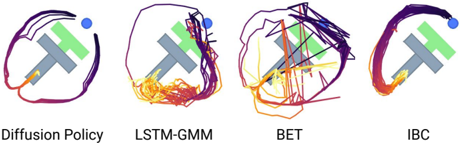
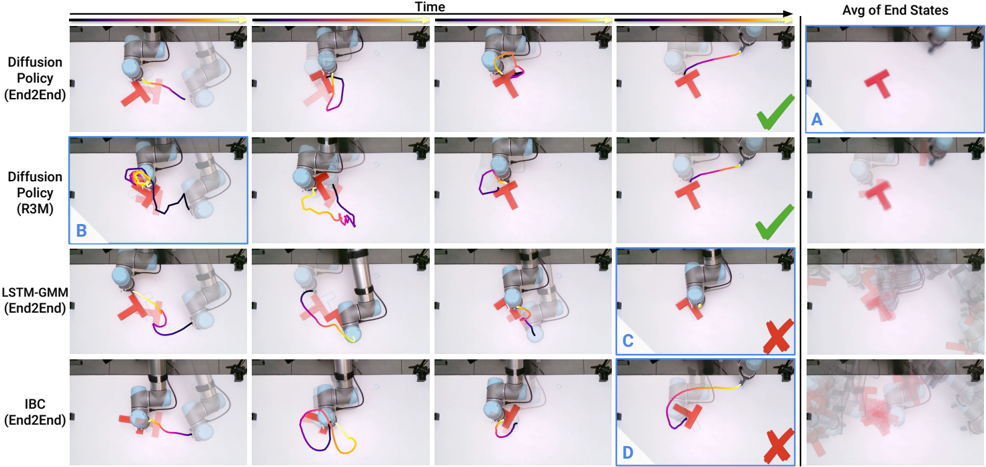
- Real-world Push-T: 95% success and 0.8 average IoU vs human 1.00 success and 0.84 IoU; best IBC and LSTM-GMM variants reached 0% and 20% success.
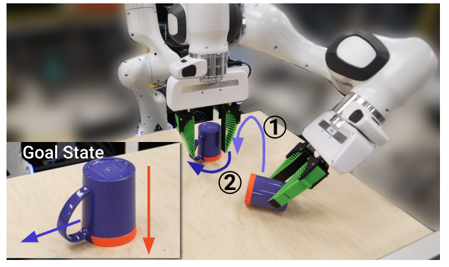
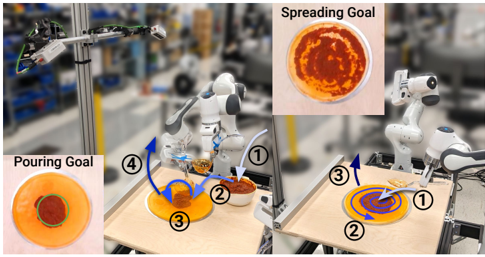
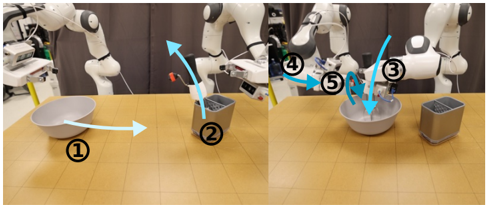
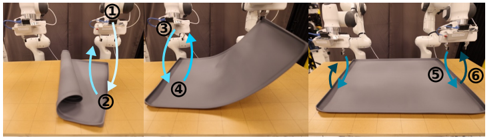
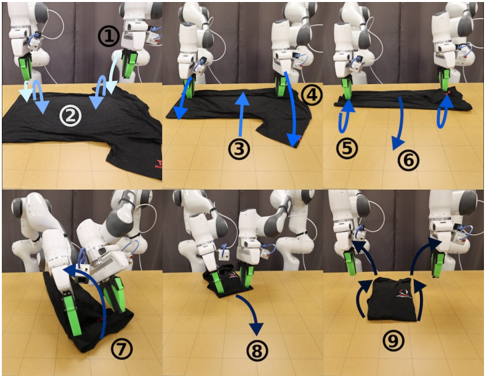
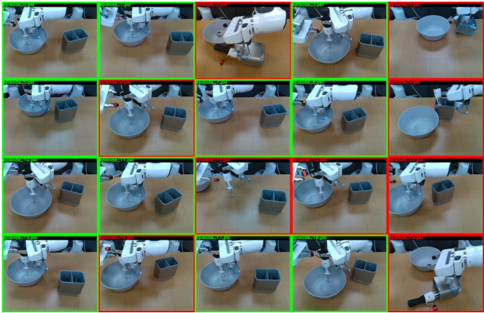
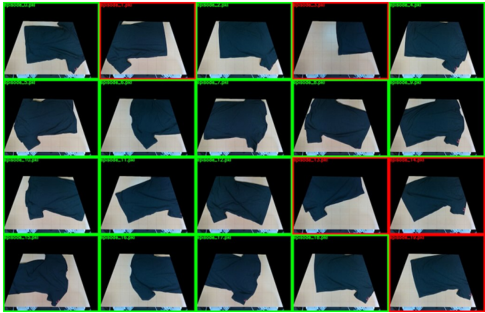
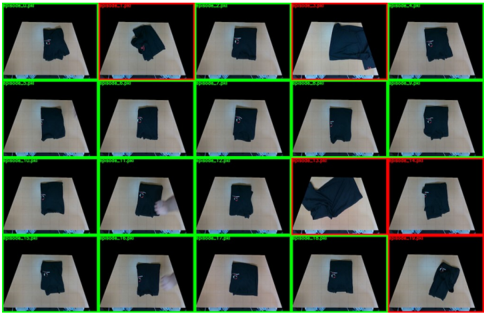
- Other real-world tasks: Mug Flipping 90% success over 20 trials (LSTM-GMM 0%); Sauce Pouring 0.74 IoU / 0.79 success vs human 0.79 / 1.00; Sauce Spreading 0.77 coverage / 1.00 success vs human 0.79 / 1.00; bimanual Egg Beater 55%, Mat Unrolling 75%, Shirt Folding 75%, each over 20 trials.
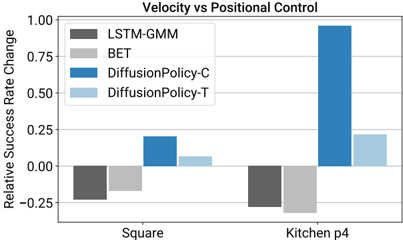
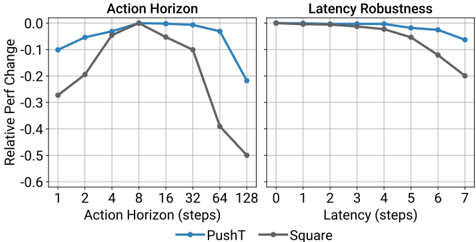
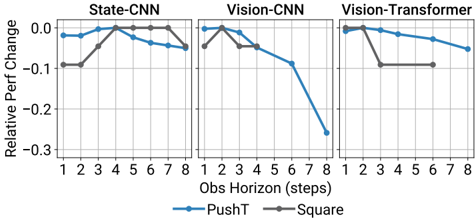
- Ablations: action horizon of 8 steps was optimal for most tested tasks; Diffusion Policy maintained peak performance with latency up to 4 steps; position control outperformed velocity control; DDIM with 100 training and 10 inference iterations enabled 0.1 s inference latency on an Nvidia 3080 GPU.
Methods
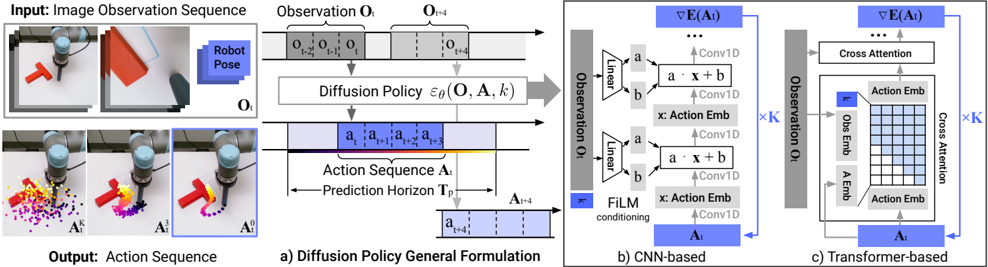
- Design: conditional DDPM/DDIM policy \(p(A_t|O_t)\) that predicts action sequences; uses receding-horizon control, visual conditioning, and either a CNN with FiLM or a time-series diffusion transformer.
- Data/evaluation: 15 tasks from 4 benchmarks (Robomimic, Push-T, Block Push, Kitchen) plus real-world single-arm and bimanual tasks; simulation results averaged over 3 training seeds and 50 environment initial conditions (1500 experiments total; robomimic used 22 initializations due to an evaluation-code bug).
- Analysis: compares against LSTM-GMM, IBC, and BET; metrics include success rate, target-area coverage/IoU, and ablations on action horizon, latency, action space, vision encoder, and architecture.
Limitations
- Stated: inherits behavior cloning limitations such as suboptimal performance with inadequate demonstration data; higher computational cost and inference latency than simpler methods like LSTM-GMM, which action-sequence prediction only partially mitigates and may not suffice for high-rate control.
- Stated: transformer backbone is more sensitive to hyperparameters; CNN backbone performs poorly when action sequences change quickly and sharply through time, such as velocity command action space.
- Evident: real-world evaluations often use small trial counts (e.g., 20 trials per task), and bimanual success rates were 55–75%; simulation robomimic used only 22 initializations due to a bug; frozen pretrained vision encoders performed poorly, and ViT from scratch reached only 22% success on square.
Model-written summary. Check it against the paper before relying on it.
Integrity signals
Registry
Cites
Statistics
Figures
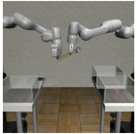
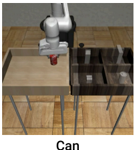
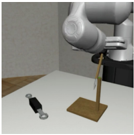
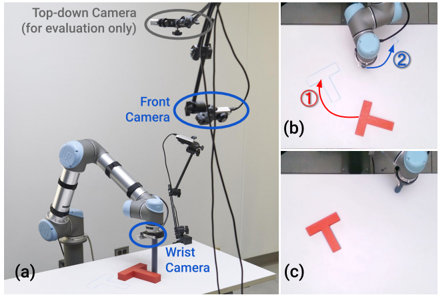
Verification
Claims the paper makes
12 Valid · 4 Not valid · 14 Not checked · 115 Own results and interpretations
The cited sources support only part of this claim — read each source’s verdict below.
In the paper
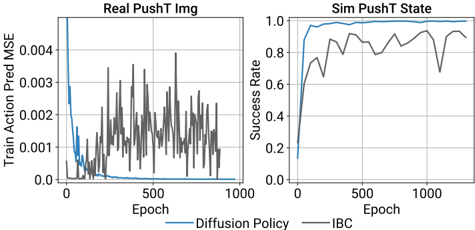
“In contrast, IBC Florence et al. (2021) is prone to training instability.”
What the sources say
- Partly supportedcites Florence et al. (2021) matched to “Implicit Behavioral Cloning” (2021) sourceExperimental — accuracy not yet measured
Section B.3.1 (page unavailable) says the authors use spectral normalization and gradient penalties for additional training stability, which supports stability being a concern for their Langevin-based approach. It does not say that IBC generally is prone to training instability; the Limitations section instead names computational cost and implementation complexity. (LLM, conf=0.82)
plain- Asserted: passes — The authors put it forward as true.
- Checkable: passes — It can be checked against evidence.
- Load-bearing: passes — The paper’s conclusions depend on it.
- Based: passes — The paper gives a reason why it holds.
- Partly supported
The cited sources support only part of this claim — read each source’s verdict below.
In the paper
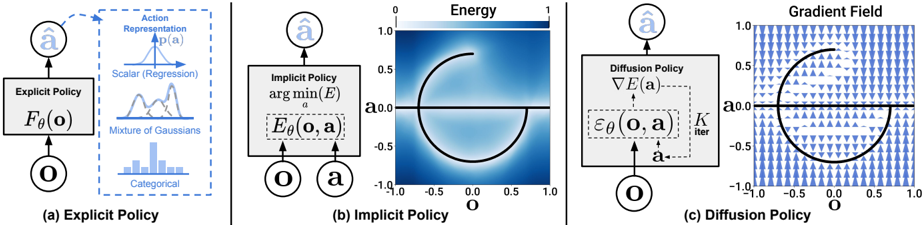
“Expressing multimodal action distributions. By learning the gradient of the action score function Song and Ermon (2019) and performing Stochastic Langevin Dynamics sampling on this gradient field, Diffusion policy can express arbitrary normalizable distributions Neal et al. (2011), which includes multimodal action distributions, a well-known challenge for policy learning.”
- Also stated in: § 4.1 Model Multi-Modal Action Distributions · p. 4 · boosted
“Diffusion Policy's ability to express multimodal distributions naturally and precisely is one of its key advantages.”
What the sources say
- Supportedcites Song and Ermon (2019) matched to “Generative Modeling by Estimating Gradients of the Data Distribution” (2019) source
Section 2.2 (p. 3) describes learning a distribution’s score and using Langevin dynamics to sample from it. Section 4.3 (p. 7) demonstrates sampling from a two-mode Gaussian mixture. The paper supports the cited method and its ability to represent multimodal distributions; applying it to action distributions is the citing authors’ context, not a result claimed by this source. (LLM, conf=0.88)
- Not matchedcites Neal et al. (2011)
An author–year citation the paper’s reference list doesn’t settle. We don’t search these by name.
boostedstates a cause- Asserted: passes — The authors put it forward as true.
- Checkable: passes — It can be checked against evidence.
- Load-bearing: passes — The paper’s conclusions depend on it.
- Based: passes — The paper gives a reason why it holds.
- Also stated in: § 4.1 Model Multi-Modal Action Distributions · p. 4 · boosted
The cited sources support only part of this claim — read each source’s verdict below.
In the paper
“However, existing implicit policies (Florence et al. 2021) are unstable to train due to the necessity of drawing negative samples when computing the underlying Info-NCE loss.”
What the sources say
- Partly supportedcites Florence et al. 2021 matched to “Implicit Behavioral Cloning” (2021) sourceExperimental — accuracy not yet measured
Section 2 says the implicit models are trained with negative counter-examples and an InfoNCE-style loss. Appendix B.3.1 discusses measures for additional training stability, but neither passage says that drawing negative samples makes these policies unstable to train. The claimed cause of instability is therefore unsupported. (LLM, conf=0.87)
plainstates a cause- Asserted: passes — The authors put it forward as true.
- Checkable: passes — It can be checked against evidence.
- Load-bearing: passes — The paper’s conclusions depend on it.
- Based: passes — The paper gives a reason why it holds.
- Partly supported
Every source the paper cites for this claim was checked and supports it.
In the paper
“In our control tasks, we empirically found that the Square Cosine Schedule proposed in iDDPM Nichol and Dhariwal (2021) works best for our tasks.”
What the sources say
- Supportedcites Nichol and Dhariwal (2021) matched to “Improved Denoising Diffusion Probabilistic Models” (2021) source
The citation identifies the origin of the squared-cosine noise schedule; the citing authors describe its performance on their control tasks as their own empirical finding. Section 3.2 (p. 4) proposes a cosine schedule and specifies the use of cos². (LLM, conf=0.92)
plainstates a cause- Asserted: passes — The authors put it forward as true.
- Checkable: passes — It can be checked against evidence.
- Load-bearing: unclear — It is unclear whether the paper’s conclusions depend on it.
- Based: passes — The paper gives a reason why it holds.
- Supported
The cited sources that could be checked couldn’t confirm or dispute this claim.
In the paper
“This shows that in order to perfectly clone a behavior that depends on the state, the learner must implicitly learn a (task-relevant) dynamics model Subramanian and Mahajan (2019); Zhang et al. (2020).”
What the sources say
- Not checked — no full text of the sourcecites Subramanian and Mahajan (2019) matched to “Approximate information state for partially observed systems” (2019) source
- Could not verifycites Zhang et al. (2020) matched to “Learning Invariant Representations for Reinforcement Learning without Reconstruction” (2020) sourceExperimental — accuracy not yet measured
The Introduction describes a representation that predicts task-relevant future states, and the method trains a latent dynamics model for reinforcement learning. Neither passage says that perfectly cloning state-dependent behavior requires a learner to implicitly learn such a model. Searches for imitation learning, behavior cloning, and that necessity claim found no supporting passage in our copy. (LLM, conf=0.76)
boostedstates a cause- Asserted: passes — The authors put it forward as true.
- Checkable: passes — It can be checked against evidence.
- Load-bearing: unclear — It is unclear whether the paper’s conclusions depend on it.
- Based: passes — The paper gives a reason why it holds.
79 more claims · 3 with their cited sources checked
Create a free account to see all 145 claims and to verify the 5 references still open.
- It may state two separate claims as one. 39
- Probably not a substantial claim. 33
- The quote only partly states this claim. 4
Claims other papers make about this one
Each is checked against this paper’s own text: does it say what the citing paper says it does?
The cited source doesn’t support the claim as written.
In the citing paper
“Inspired in part by human motor control [33], action chunking has recently emerged as the de facto standard in imitation learning for visuomotor control [68, 11].”
From Real-Time Execution of Action Chunking Flow Policies (2025) · cites this paper as [11]
Checked by a reasoning model — may be wrong.
Experimental — accuracy not yet measuredThe source backs part of the claim, not all of it — or backs it for a different population, condition or comparison.
In the citing paper
“Most simulated imitation learning benchmarks are quasi-static, and standard chunked execution with a long enough execution horizon can achieve near-perfect success rates [11].”
From Real-Time Execution of Action Chunking Flow Policies (2025) · cites this paper as [11]
Experimental — accuracy not yet measuredThe source backs part of the claim, not all of it — or backs it for a different population, condition or comparison.
In the citing paper
“This action head predicts a 'chunk”
From Octo: An Open-Source Generalist Robot Policy (2024) · cites this paper as [17]
Experimental — accuracy not yet measuredThe cited source says what the claim attributes to it.
In the citing paper
“Prior transformer-based policy designs typically encode input images with large ResNetstyle [32] encoders and fuse the resulting image features with a comparatively small transformer [10, 67, 81, 17, 98, 61, 83].”
From Octo: An Open-Source Generalist Robot Policy (2024) · cites this paper as [17]
The cited source says what the claim attributes to it.
In the citing paper
“While action chunking has enabled temporal consistency in high-frequency control tasks, it does not fully address the latency problem, leading to pauses or out-of-distribution jerky movements at chunk boundaries.”
From Real-Time Execution of Action Chunking Flow Policies (2025) · cites this paper as [11]
Self-check
Percentages, sums and reported differences re-computed from the paper’s own numbers.
Each contradiction between two passages listed here was confirmed by an independent check.
Rated minor: it would not touch a result — a value no result rests on, a p-value that stays on the same side of the significance level, or a conflict that is clerical, resolved elsewhere in the paper, or outside its own findings.
In the paper
§ 3.4 Accelerating Inference for Real-time Control · p. 4
“In our real-world experiments, using DDIM with 100 training iterations and 10 inference iterations enables 0.1s inference latency on a Nvidia 3080 GPU.”
§ A.4 Hyperparameters · p. 16
“We used DDIM Song et al. (2021) on realworld benchmarks to reduce the inference denoising iterations to 16 therefore reducing inference latency.”
Rated minor: it would not touch a result — a value no result rests on, a p-value that stays on the same side of the significance level, or a conflict that is clerical, resolved elsewhere in the paper, or outside its own findings.
In the paper
§ 5.1 Simulation Environments and datasets · p. 7
“the Franka Kitchen environment contains 7 objects for interaction and comes with a human demonstration dataset of 566 demonstrations”
§ 5.1 Simulation Environments and datasets · p. 7
“| Kitchen | 1 | 7 | 9 | 656 | 0 | 280 | No | No |”
Citations
Cites
Deep Residual Learning for Image Recognition
He, K., Zhang, X., Ren, S., & Sun, J. (2016) · 2016 IEEE Conference on Computer Vision and Pattern Recognition (CVPR) · doi:10.1109/cvpr.2016.90 · Cited by 235,474 · cited 1×
“Speci fi cally, we evaluated three different architectures: ResNet-18, ResNet-34 (He et al., 2016), and ViT-B/16 (Dosovitskiy et al., 2020).”
Vaswani, A., Shazeer, N., Parmar, N., Uszkoreit, J., Jones, L., Gomez, A. N., Kaiser, L., & Polosukhin, I. (2017) · arXiv · doi:10.48550/arxiv.1706.03762 · Cited by 120,404
U-Net: Convolutional Networks for Biomedical Image Segmentation
Ronneberger, O., Fischer, P., & Brox, T. (2015) · Lecture notes in computer science · doi:10.1007/978-3-319-24574-4_28 · Cited by 99,404 · cited 1×
“In this work, we examine two common network architecture types, convolutional neural networks (CNNs) (Ronneberger et al., 2015) and Transformers (Vaswani et al., 2017), and compare their performance and training characteristics.”
ImageNet: A large-scale hierarchical image database
Deng, J., Dong, W., Socher, R., Li, L.-J., Li, K., & Fei-Fei, L. (2009) · 2009 IEEE Conference on Computer Vision and Pattern Recognition · doi:10.1109/cvpr.2009.5206848 · Cited by 65,333
An Image is Worth 16x16 Words: Transformers for Image Recognition at Scale
Dosovitskiy, A., Beyer, L., Kolesnikov, A., Weissenborn, D., Zhai, X., Unterthiner, T., Dehghani, M., Minderer, M., Heigold, G., Gelly, S., et al. (2020) · arXiv · doi:10.48550/arxiv.2010.11929 · Cited by 47,472
U-Net: Convolutional Networks for Biomedical Image SegmentationPreprint
Ronneberger, O., Fischer, P., & Brox, T. (2015) · arXiv (Cornell University) · doi:10.48550/arxiv.1505.04597 · Cited by 17,820
Momentum Contrast for Unsupervised Visual Representation LearningPreprint
He, K., Fan, H., Wu, Y., Xie, S., & Girshick, R. B. (2019) · Computer Vision and Pattern Recognition · doi:10.48550/arxiv.1911.05722 · Cited by 16,321
Learning Transferable Visual Models From Natural Language Supervision
Radford, A., Kim, J. W., Hallacy, C., Ramesh, A., Goh, G., Agarwal, S., Sastry, G., Askell, A., Mishkin, P., Clark, J., et al. (2021) · arXiv · doi:10.48550/arxiv.2103.00020 · Cited by 15,293
Advances in neural information processing systems 7
(1996) · Computers & Mathematics with Applications · doi:10.1016/s0898-1221(96)90463-0 · Cited by 14,281
Advances in Neural Information Processing Systems 29
Teymur, O., Zygalakis, K., & Calderhead, B. (2016) · Cited by 13,887
Momentum Contrast for Unsupervised Visual Representation Learning
He, K., Fan, H., Wu, Y., Xie, S., & Girshick, R. (2020) · 2020 IEEE/CVF Conference on Computer Vision and Pattern Recognition (CVPR) · doi:10.1109/cvpr42600.2020.00975 · Cited by 13,347
Denoising Diffusion Probabilistic Models
Ho, J., Jain, A., & Abbeel, P. (2020) · arXiv · doi:10.48550/arxiv.2006.11239 · Cited by 8,712 · cited 6×
“As shown in Ho et al. (2020), minimizing the loss function in Eq (3) also minimizes the variational lower bound of the KL-divergence between the data distribution p ( x 0 ) and the distribution of samples drawn from the DDPM q ( x 0 ) using Eq (1).”
InfluentialDeep Residual Learning for Image Recognition
He, K., Zhang, X., Ren, S., & Sun, J. (2015) · arXiv · doi:10.48550/arxiv.1512.03385 · Cited by 4,196
Wu, Y., & He, K. (2020) · International Journal of Computer Vision · doi:10.1007/s11263-019-01198-w · Cited by 3,601 · cited 1×
“(2) Replace BatchNorm with GroupNorm (Wu and He, 2018) for stable training.”
Corke, P., Roberts, J., Cunningham, J., & Hainsworth, D. (2008) · Springer Handbook of Robotics · doi:10.1007/978-3-540-30301-5_50 · Cited by 3,543
A survey of robot learning from demonstration
Argall, B. D., Chernova, S., Veloso, M., & Browning, B. (2009) · Robotics and Autonomous Systems · doi:10.1016/j.robot.2008.10.024 · Cited by 3,227 · cited 1×
“Creating capable robots without requiring explicit programming of behaviors is a longstanding challenge in the field [3, 2, 38].”
BackgroundEnd to End Learning for Self-Driving Cars
Bojarski, M., Del Testa, D., Dworakowski, D., Firner, B., Flepp, B., Goyal, P., Jackel, L. D., Monfort, M., Muller, U., Zhang, J., et al. (2016) · arXiv · doi:10.48550/arxiv.1604.07316 · Cited by 3,198
Khatib, O. (1987) · IEEE Journal on Robotics and Automation · doi:10.1109/jra.1987.1087068 · Cited by 2,940 · cited 1×
“The controller is formulated using Operational Space Control (Khatib, 1987) as a Quadratic Program operating at 200 Hz, where position, velocity, and torque limits are added as constraints, and the primary spatial objective and secondary null-space posture objectives are posed as costs.”
Advances in Neural Information Processing Systems 37
(2024) · doi:10.52202/079017 · Cited by 2,791
ImageNet: A large-scale hierarchical image database
Deng, J. H., Dong, W. F., Socher, R., Li, L.-J., Li, K., & Fei-Fei, L. (2009) · IEEE Computer Society Conference on Computer Vision and Pattern Recognition/Proceedings - IEEE Computer Society Conference on Computer Vision and Pattern Recognition/Proceedings · doi:10.1109/cvprw.2009.5206848 · Cited by 2,714
Deep Unsupervised Learning using Nonequilibrium Thermodynamics
Sohl-Dickstein, J., Weiss, E. A., Maheswaranathan, N., & Ganguli, S. (2015) · arXiv · doi:10.48550/arxiv.1503.03585 · Cited by 2,637 · cited 2×
“Diffusion models [44, 18] have recently been applied to solve various different control tasks [20, 51, 1].”
MCMC Using Hamiltonian Dynamics
Neal, R. M. (2011) · Handbook of Markov Chain Monte Carlo · doi:10.1201/b10905-6 · Cited by 2,574
Denoising Diffusion Implicit Models
Song, J., Meng, C., & Ermon, S. (2020) · arXiv · doi:10.48550/arxiv.2010.02502 · Cited by 2,507 · cited 4×
“In our real-world experiments, using DDIM with 100 training iterations and 10 inference iterations enables 0.1 s inference latency on an Nvidia 3080 GPU.”
InfluentialFilm: Visual reasoning with a general conditioning layer
Perez, E., Strub, F., De Vries, H., Dumoulin, V., & Courville, A. (2018) · Proceedings of the AAAI Conference on Artificial Intelligence · doi:10.1609/aaai.v32i1.11671 · Cited by 2,490 · cited 3×
“b) In the CNN-based Diffusion Policy, FiLM (Feature-wise Linear Modulation) [35] conditioning of the observation feature Ot is applied to every convolution layer, channel-wise.”
MethodInfluential(2016) · Springer Handbooks · doi:10.1007/978-3-319-32552-1 · Cited by 2,122
A Reduction of Imitation Learning and Structured Prediction to No-Regret Online Learning
Ross, S., Gordon, G. J., & Bagnell, J. A. (2018) · Carnegie Mellon University · doi:10.1184/r1/6550949 · Cited by 1,941
Improved Denoising Diffusion Probabilistic Models
Nichol, A., & Dhariwal, P. (2021) · arXiv · doi:10.48550/arxiv.2102.09672 · Cited by 1,550 · cited 3×
“The noise schedule, de fi ned by σ , α , γ and the additive Gaussian Noise ε k as functions of k , has been actively studied (Ho et al., 2020; Nichol and Dhariwal, 2021).”
Fourier Features Let Networks Learn High Frequency Functions in Low Dimensional Domains
Tancik, M., Srinivasan, P. P., Mildenhall, B., Fridovich-Keil, S., Raghavan, N., Singhal, U., Ramamoorthi, R., Barron, J. T., & Ng, R. (2020) · arXiv · doi:10.48550/arxiv.2006.10739 · Cited by 1,459 · cited 2×
“To reduce the over-smoothing effect in CNN models (Tancik et al., 2020), we introduce a novel transformer-based DDPM which adopts the transformer architecture from minGPT (Sha fi ullah et al., 2022) for action prediction.”
Generative Modeling by Estimating Gradients of the Data Distribution
Song, Y., & Ermon, S. (2019) · arXiv · doi:10.48550/arxiv.1907.05600 · Cited by 1,453 · cited 2×
“By learning the gradient of the action score function (Song and Ermon, 2019) and performing Stochastic Langevin Dynamics sampling on this gradient fi eld, Diffusion policy can express arbitrary normalizable distributions (Neal, 2011), which includes multimodal action distributions, a well-known…”
ALVINN: An autonomous land vehicle in a neural network
Pomerleau, D. A. (2018) · Carnegie Mellon University · doi:10.1184/r1/6603146.v1 · Cited by 1,340
On the Continuity of Rotation Representations in Neural Networks
Zhou, Y., Barnes, C., Lu, J., Yang, J., & Li, H. (2019) · 2019 IEEE/CVF Conference on Computer Vision and Pattern Recognition (CVPR) · doi:10.1109/cvpr.2019.00589 · Cited by 1,255 · cited 1×
“We used the 6D rotation representation proposed in Zhou et al. (2019) for all environments (real-world and simulation) with positional control action space.”
(1994) · Aston Publications Explorer (Aston University) · Cited by 1,245
ImageNet-21K Pretraining for the MassesPreprint
Ridnik, T., Ben-Baruch, E., Noy, A., & Zelnik‐Manor, L. (2021) · arXiv (Cornell University) · doi:10.48550/arxiv.2104.10972 · Cited by 1,095
Recent Advances in Robot Learning from Demonstration
Ravichandar, H., Polydoros, A. S., Chernova, S., & Billard, A. (2020) · Annual Review of Control, Robotics, and Autonomous Systems · doi:10.1146/annurev-control-100819-063206 · Cited by 752 · cited 1×
“Creating capable robots without requiring explicit programming of behaviors is a longstanding challenge in the field [3, 2, 38].”
BackgroundElucidating the Design Space of Diffusion-Based Generative Models
Karras, T., Aittala, M., Aila, T., & Laine, S. (2022) · arXiv · doi:10.48550/arxiv.2206.00364 · Cited by 702
Deep Imitation Learning for Complex Manipulation Tasks from Virtual Reality Teleoperation
Zhang, T., McCarthy, Z., Jow, O., Lee, D., Chen, X., Goldberg, K., & Abbeel, P. (2017) · arXiv · doi:10.48550/arxiv.1710.04615 · Cited by 618
Deep Imitation Learning for Complex Manipulation Tasks from Virtual Reality Teleoperation
Zhang, T., McCarthy, Z., Jow, O., Lee, D., Chen, X., Goldberg, K., & Abbeel, P. (2018) · 2018 IEEE International Conference on Robotics and Automation (ICRA) · doi:10.1109/icra.2018.8461249 · Cited by 609
Robot Learning from Demonstration
(2012) · SpringerReference · doi:10.1007/springerreference_302487 · Cited by 532
Diffusion Policy: Visuomotor Policy Learning via Action Diffusion
Chi, C., Feng, S., Du, Y., Xu, Z., Cousineau, E., Burchfiel, B., & Song, S. (2023) · Robotics: Science and Systems XIX · doi:10.15607/rss.2023.xix.026 · Cited by 530
Self-citation(2007) · The MIT Press eBooks · doi:10.7551/mitpress/7443.001.0001 · Cited by 525
R3M: A Universal Visual Representation for Robot Manipulation
Nair, S., Rajeswaran, A., Kumar, V., Finn, C., & Gupta, A. (2022) · arXiv · doi:10.48550/arxiv.2203.12601 · Cited by 492 · cited 2×
“We tested Diffusion Policy with frozen pretrained vision encoders (ImageNet (Deng et al., 2009) and R3M (Nair et al., 2022)), as seen in Table 6.”
IDQL: Implicit Q-Learning as an Actor-Critic Method with Diffusion PoliciesPreprint
Hansen-Estruch, P., Kostrikov, I., Janner, M., Kuba, J. G., & Levine, S. (2023) · arXiv (Cornell University) · doi:10.48550/arxiv.2304.10573 · Cited by 412
Goal-Conditioned Imitation Learning using Score-based Diffusion PoliciesPreprint
Reuss, M., Li, M., Jia, X., & Lioutikov, R. (2023) · Robotics: Science and Systems Conference · doi:10.48550/arxiv.2304.02532 · Cited by 354
Goal-Conditioned Imitation Learning using Score-based Diffusion Policies
Reuss, M., Li, M. X., Jia, X., & Lioutikov, R. (2023) · Robotics: Science and Systems · doi:10.15607/rss.2023.xix.028 · Cited by 340
Understanding the Difficulty of Training TransformersPreprint
Liu, L., Liu, X.-D., Gao, J.-F., Chen, W.-Z., & Han, J. (2020) · Conference on Empirical Methods in Natural Language Processing · doi:10.48550/arxiv.2004.08249 · Cited by 332
Imitating Human Behaviour with Diffusion ModelsPreprint
Pearce, T., Rashid, T., Kanervisto, A., Bignell, D., Sun, M., Georgescu, R., Macua, S. V., Tan, S. Z., Momennejad, I., Hofmann, K., et al. (2023) · Research Explorer (The University of Manchester) · doi:10.48550/arxiv.2301.10677 · Cited by 329
Rahmatizadeh, R., Abolghasemi, P., Bölöni, L., & Levine, S. (2017) · IEEE International Conference on Robotics and Automation · doi:10.48550/arxiv.1707.02920 · Cited by 310
Compositional Visual Generation with Composable Diffusion Models
Liu, N., Li, S., Du, Y., Torralba, A., & Tenenbaum, J. B. (2022) · arXiv · doi:10.48550/arxiv.2206.01714 · Cited by 295
Self-citationCompositional Visual Generation with Composable Diffusion Models
Liu, N., Li, S., Du, Y., Torralba, A., & Tenenbaum, J. B. (2022) · Lecture Notes in Computer Science · doi:10.1007/978-3-031-19790-1_26 · Cited by 282
Self-citationOn the Importance of Noise Scheduling for Diffusion ModelsPreprint
Chen, T. (2023) · arXiv (Cornell University) · doi:10.48550/arxiv.2301.10972 · Cited by 274
LeCun, Y., Chopra, S., Hadsell, R., Ranzato, M., & Huang, F. J. (2007) · Predicting Structured Data · doi:10.7551/mitpress/7443.003.0014 · Cited by 256
Rahmatizadeh, R., Abolghasemi, P., Boloni, L., & Levine, S. (2018) · 2018 IEEE International Conference on Robotics and Automation (ICRA) · doi:10.1109/icra.2018.8461076 · Cited by 205 · cited 2×
“The simplest form of explicit policies maps from world state or observation directly to action (Pomerleau, 1988; Zhang et al., 2018; Florence et al., 2020; Ross et al., 2011; Toyer et al., 2020; Rahmatizadeh et al., 2018); Bojarski et al., 2016).”
Transporter Networks: Rearranging the Visual World for Robotic Manipulation
Zeng, A., Florence, P., Tompson, J., Welker, S., Chien, J., Attarian, M., Armstrong, T., Krasin, I., Duong, D., Wahid, A., et al. (2020) · arXiv · doi:10.48550/arxiv.2010.14406 · Cited by 200
Diffusion-based Generation, Optimization, and Planning in 3D Scenes
Huang, S., Wang, Z., Li, P., Jia, B., Liu, T., Zhu, Y., Liang, W., & Zhu, S.-C. (2023) · 2023 IEEE/CVF Conference on Computer Vision and Pattern Recognition (CVPR) · doi:10.1109/cvpr52729.2023.01607 · Cited by 192 · cited 1×
“In particular, Janner et al. (2022a) and Huang et al. (2023) explore how diffusion models may be used in the context of planning and infer a trajectory of actions that may be executed in a given environment.”
FiLM: Visual Reasoning with a General Conditioning Layer
Perez, E., Strub, F., de Vries, H., Dumoulin, V., & Courville, A. C. (2017) · arXiv (Cornell University) · doi:10.48550/arxiv.1709.07871 · Cited by 184
Understanding the Difficulty of Training Transformers
Liu, L., Liu, X., Gao, J., Chen, W., & Han, J. (2020) · Proceedings of the 2020 Conference on Empirical Methods in Natural Language Processing (EMNLP) · doi:10.18653/v1/2020.emnlp-main.463 · Cited by 170 · cited 1×
“The difficulty of transformer training [25] is not unique to Diffusion Policy and could potentially be resolved in the future with improved transformer training techniques or increased data scale.”
BackgroundLearning Invariant Representations for Reinforcement Learning without Reconstruction
Zhang, A., McAllister, R., Calandra, R., Gal, Y., & Levine, S. (2020) · arXiv · doi:10.48550/arxiv.2006.10742 · Cited by 165
Song, Y., Dhariwal, P., Chen, M., & Sutskever, I. (2023) · arXiv · doi:10.48550/arxiv.2303.01469 · Cited by 155
Relay Policy Learning: Solving Long-Horizon Tasks via Imitation and Reinforcement Learning
Gupta, A., Kumar, V., Lynch, C., Levine, S., & Hausman, K. (2019) · arXiv · doi:10.48550/arxiv.1910.11956 · Cited by 153 · cited 3×
“We systematically evaluate Diffusion Policy across 15 tasks from 4 different benchmarks (Florence et al., 2021; Gupta et al., 2019; Mandlekar et al., 2021; Sha fi ullah et al., 2022) under the behavior cloning formulation.”
Planning with Diffusion for Flexible Behavior Synthesis
Janner, M., Du, Y., Tenenbaum, J. B., & Levine, S. (2022) · arXiv · doi:10.48550/arxiv.2205.09991 · Cited by 140
Self-citationFlorence, P., Lynch, C., Zeng, A., Ramirez, O., Wahid, A., Downs, L., Wong, A., Lee, J., Mordatch, I., & Tompson, J. (2021) · arXiv · doi:10.48550/arxiv.2109.00137 · Cited by 131
Learning the Stein Discrepancy for Training and Evaluating Energy-Based Models without SamplingPreprint
Grathwohl, W., Wang, K.-C. J., Jacobsen, J.-H., Duvenaud, D., & Zemel, R. S. (2020) · arXiv (Cornell University) · doi:10.48550/arxiv.2002.05616 · Cited by 123
Self-Supervised Correspondence in Visuomotor Policy Learning
Florence, P., Manuelli, L., & Tedrake, R. (2020) · IEEE Robotics and Automation Letters · doi:10.1109/lra.2019.2956365 · Cited by 110 · cited 4×
“The simplest form of explicit policies maps from world state or observation directly to action (Pomerleau, 1988; Zhang et al., 2018; Florence et al., 2020; Ross et al., 2011; Toyer et al., 2020; Rahmatizadeh et al., 2018); Bojarski et al., 2016).”
InfluentialSelf-citationUrain, J., Funk, N., Peters, J., & Chalvatzaki, G. (2022) · arXiv · doi:10.48550/arxiv.2209.03855 · Cited by 101
Urain, J., Funk, N., Peters, J., & Chalvatzaki, G. (2023) · 2023 IEEE International Conference on Robotics and Automation (ICRA) · doi:10.1109/icra48891.2023.10161569 · Cited by 99
SpeedFolding: Learning Efficient Bimanual Folding of Garments
Avigal, Y., Berscheid, L., Asfour, T., Kröger, T., & Goldberg, K. (2022) · 2022 IEEE/RSJ International Conference on Intelligent Robots and Systems (IROS) · doi:10.1109/iros47612.2022.9981402 · Cited by 95 · cited 4×
“A popular approach to model multimodal action distributions while maintaining the simplicity of direction action mapping is convert the regression task into classi fi cation by discretizing the action space (Zeng et al., 2021; Wu et al., 2020; Avigal et al., 2022).”
InfluentialGTI: Learning to Generalize across Long-Horizon Tasks from Human Demonstrations
Mandlekar, A., Xu, D., Martín-Martín, R., Savarese, S., & Fei-Fei, L. (2020) · Robotics: Science and Systems XVI · doi:10.15607/rss.2020.xvi.061 · Cited by 90 · cited 6×
“While conceptually simple, behavior cloning has shown surprising promise on an array of real-world robot tasks, including manipulation [60, 13, 28, 27, 59, 37, 4] and autonomous driving [36, 6].”
InfluentialImplicit Generation and Generalization in Energy-Based Models
Du, Y., & Mordatch, I. (2019) · arXiv (Cornell University) · doi:10.48550/arxiv.1903.08689 · Cited by 88
Self-citationDiffusion Policies as an Expressive Policy Class for Offline Reinforcement Learning
Wang, Z., Hunt, J. J., & Zhou, M. (2022) · arXiv · doi:10.48550/arxiv.2208.06193 · Cited by 83 · cited 2×
“In the context of Reinforcement Learning, Wang et al. (2022) use diffusion model for policy representation and regularization with state-based observations.”
Mandlekar, A., Ramos, F., Boots, B., Savarese, S., Fei-Fei, L., Garg, A., & Fox, D. (2020) · 2020 IEEE International Conference on Robotics and Automation (ICRA) · doi:10.1109/icra40945.2020.9196935 · Cited by 78 · cited 3×
“This surprising result stands in contrast to the majority of recent behavior cloning work that generally relies on velocity control (Mandlekar et al., 2021; Sha fi ullah et al., 2022; Zhang et al., 2018; Florence et al., 2020; Mandlekar et al., 2020a, 2020b).”
Spatial Action Maps for Mobile Manipulation
Wu, J., Sun, X., Zeng, A., Song, S., Lee, J., Rusinkiewicz, S., & Funkhouser, T. (2020) · Robotics: Science and Systems XVI · doi:10.15607/rss.2020.xvi.035 · Cited by 70 · cited 2×
“A popular approach to model multimodal action distributions while maintaining the simplicity of direction action mapping is convert the regression task into classi fi cation by discretizing the action space (Zeng et al., 2021; Wu et al., 2020; Avigal et al., 2022).”
Self-citationReceding horizon control of nonlinear systems
Mayne, D. Q., & Michalska, H. (2003) · Proceedings of the 27th IEEE Conference on Decision and Control · doi:10.1109/cdc.1988.194354 · Cited by 67
What Matters in Learning from Offline Human Demonstrations for Robot Manipulation
Mandlekar, A., Xu, D., Wong, J., Nasiriany, S., Wang, C., Kulkarni, R., Fei-Fei, L., Savarese, S., Zhu, Y., & Martín-Martín, R. (2021) · arXiv · doi:10.48550/arxiv.2108.03298 · Cited by 66 · cited 17×
“In addition, we report the average of best-performing checkpoints for robomimic and Push-T tasks to be consistent with the evaluation methodology of their respective original papers (Mandlekar et al., 2021; Florence et al., 2021).”
InfluentialIs Conditional Generative Modeling all you need for Decision-Making?
Ajay, A., Du, Y., Gupta, A., Tenenbaum, J., Jaakkola, T., & Agrawal, P. (2022) · arXiv · doi:10.48550/arxiv.2211.15657 · Cited by 61 · cited 1×
“Diffusion models (Ho et al., 2020; Sohl-Dickstein et al., 2015) have recently been applied to solve various different control tasks (Ajay et al., 2022; Janner et al., 2022a; Urain et al., 2022).”
Self-citationExponential Family Estimation via Adversarial Dynamics EmbeddingPreprint
Dai, B., Liu, Z., Dai, H., He, N., Gretton, A., Song, L., & Schuurmans, D. (2019) · arXiv (Cornell University) · doi:10.48550/arxiv.1904.12083 · Cited by 44
Receding horizon control of nonlinear systems
Michalska, H., & Mayne, D. Q. (2003) · Proceedings of the 28th IEEE Conference on Decision and Control · doi:10.1109/cdc.1989.70083 · Cited by 40 · cited 1×
“Our formulation also allows receding horizon control (Mayne and Michalska, 1988) to further improve action smoothness by warm-starting the next inference setup with previous action sequence prediction when the prediction horizon is greater than the action horizon.”
Improved Contrastive Divergence Training of Energy Based Models
Du, Y., Li, S., Tenenbaum, J., & Mordatch, I. (2020) · arXiv · doi:10.48550/arxiv.2012.01316 · Cited by 36 · cited 3×
“In practice, the inaccuracy of negative sampling is known to cause training instability for EBMs (Du et al., 2020; Ta et al., 2022).”
Self-citationMultiple Interactions Made Easy (MIME): Large Scale Demonstrations Data for Imitation
Sharma, P., Mohan, L., Pinto, L., & Gupta, A. (2018) · arXiv (Cornell University) · doi:10.48550/arxiv.1810.07121 · Cited by 31
Approximate information state for partially observed systems
Subramanian, J., & Mahajan, A. (2019) · 2019 IEEE 58th Conference on Decision and Control (CDC) · doi:10.1109/cdc40024.2019.9029898 · Cited by 23 · cited 1×
“But interestingly, it need only learn the task-relevant dynamics (Subramanian and Mahajan, 2019; Zhang et al., 2020); in the linear dynamics example here, if K has a column that is all zeros, then leftmost multiplication by K means that the associated state dynamics are not relevant to the task and…”
Learning Periodic Tasks from Human Demonstrations
Yang, J., Zhang, J., Settle, C., Rai, A., Antonova, R., & Bohg, J. (2022) · 2022 International Conference on Robotics and Automation (ICRA) · doi:10.1109/icra46639.2022.9812402 · Cited by 21 · cited 1×
“Periodic motions are known to be dif fi cult to learn and therefore are often addressed by specialized action representations (Yang et al., 2022).”
Learning to Generalize Across Long-Horizon Tasks from Human Demonstrations
Mandlekar, A., Xu, D., Martín-Martín, R., Savarese, S., & Fei-Fei, L. (2020) · arXiv · doi:10.48550/arxiv.2003.06085 · Cited by 17 · cited 6×
“While conceptually simple, behavior cloning has shown surprising promise on an array of real-world robot tasks, including manipulation [60, 13, 28, 27, 59, 37, 4] and autonomous driving [36, 6].”
InfluentialStrictly Batch Imitation Learning by Energy-based Distribution Matching
Jarrett, D., Bica, I., & van der Schaar, M. (2020) · arXiv · doi:10.48550/arxiv.2006.14154 · Cited by 17
Diffusion Policy: Visuomotor Policy Learning via Action Diffusion
Chi, C., Xu, Z., Feng, S., Cousineau, E., Du, Y., Burchfiel, B., Tedrake, R., & Song, S. (2023) · arXiv · doi:10.48550/arxiv.2303.04137 · Cited by 12
Self-citationDiffusion-based Generation, Optimization, and Planning in 3D ScenesPreprint
Huang, S., Wang, Z., Li, P., et al. (2023) · arXiv (Cornell University) · doi:10.48550/arxiv.2301.06015 · Cited by 6
The MAGICAL Benchmark for Robust Imitation
Toyer, S., Shah, R., Critch, A., & Russell, S. (2020) · arXiv (Cornell University) · doi:10.48550/arxiv.2011.00401 · Cited by 6
Learning Periodic Tasks from Human DemonstrationsPreprint
Yang, J., Zhang, J., Settle, C., et al. (2021) · arXiv (Cornell University) · doi:10.48550/arxiv.2109.14078 · Cited by 4
Conditional Energy-Based Models for Implicit Policies: The Gap between Theory and Practice
Ta, D.-N., Cousineau, E., Zhao, H., & Feng, S. (2022) · arXiv · doi:10.48550/arxiv.2207.05824 · Cited by 2 · cited 5×
“However, achieving reliable and highperformance results from IBC in practice is challenging due to IBC’s inherent training instability [48].”
InfluentialSelf-citation
Research works printed but not linked: 3
- Janner M, Du Y, Tenenbaum J and Levine S (2022b) Planning with diffusion for flexible behavior synthesis. In: Chaudhuri K, Jegelka S, Song L, Szepesvari C, Niu G and Sabato S (eds.) Proceedings of the 39th International Conference on Machine Learning , Proceedings of Machine Learning Research. PMLR.
- Wang Z, Hunt JJ and Zhou M (2023) Diffusion policies as an expressive policy class for offline reinforcement learning. In: The Eleventh International Conference on Learning Representations . URL https://openreview.net/ forum?id=AHvFDPi-FA .
- Welling M and Teh YW (2011) Bayesian learning via stochastic gradient langevin dynamics. In: Proceedings of the 28th international conference on machine learning (ICML-11) . pp. 681-688.
Cited by
π₀: A Vision-Language-Action Flow Model for General Robot Control
Black, K., Brown, N., Driess, D., Esmail, A., Equi, M., Finn, C., Fusai, N., Groom, L., Hausman, K., Ichter, B., et al. (2025) · Robotics: Science and Systems XXI · doi:10.15607/rss.2025.xxi.010 · Cited by 295
Understanding World or Predicting Future? A Comprehensive Survey of World Models
Ding, J., Zhang, Y., Shang, Y., Zhang, Y., Zong, Z., Feng, J., Yuan, Y., Su, H., Li, N., Sukiennik, N., et al. (2026) · ACM Computing Surveys · doi:10.1145/3746449 · Cited by 169
Octo: An Open-Source Generalist Robot Policy
Ghosh, D., Walke, H., Pertsch, K., Black, K., Mees, O., Dasari, S., Hejna, J., Kreiman, T., Xu, C., Luo, J., et al. (2024) · Robotics: Science and Systems XX · doi:10.15607/rss.2024.xx.090 · Cited by 129
Generative AI Empowered Network Digital Twins: Architecture, Technologies, and Applications
Li, T., Long, Q., Chai, H., Zhang, S., Jiang, F., Liu, H., Huang, W., Jin, D., & Li, Y. (2025) · ACM Computing Surveys · doi:10.1145/3711682 · Cited by 146
Precise and dexterous robotic manipulation via human-in-the-loop reinforcement learning
Luo, J., Xu, C., Wu, J., & Levine, S. (2025) · Science Robotics · doi:10.1126/scirobotics.ads5033 · Cited by 385
Metadata
- Authors
- Chi, C., Xu, Z., Feng, S., Cousineau, E., Du, Y., Burchfiel, B., Tedrake, R., & Song, S.
- Affiliations
- Columbia University (US)
- Toyota Research Institute (US)
- Massachusetts Institute of Technology (US)
- Corresponding author
- Chi, Cheng
- ORCID
- Venue
- The International Journal of Robotics Research
- Publisher
- SAGE Publications
- Published
- 2024-10-11
- Volume
- 44
- Issue
- 10-11
- Pages
- 1684-1704
- ISSN
- 0278-3649 (ISSN-L)
- 1741-3176
- OpenAlex
- W4403337227
- Semantic Scholar
- bdba3bd30a49ea4c5b20b43dbd8f0eb59e9d80e2
- Cited by
- 613
- References
- 40
- Citations by year
- 2026: 335 · 2025: 259 · 2024: 17
- FWCI
- 89.79
- Type
- journal article
- Language
- en
- Open access
- closed
- Licence
- journals.sagepub.com/page/policies/text-and-data-mining-license (tdm)
- Locations
- The International Journal of Robotics Research (publishedVersion)
- Funders
- Division of Civil, Mechanical and Manufacturing Innovation (2037101)
- Toyota Research Institute
- Division of Information and Intelligent Systems (2132519)
- Topics
- Physical Sciences › Computer Science › Artificial Intelligence › Reinforcement Learning in Robotics
- Physical Sciences › Engineering › Control and Systems Engineering › Robot Manipulation and Learning
- Physical Sciences › Computer Science › Artificial Intelligence › Domain Adaptation and Few-Shot Learning
- Keywords
- diffusion policy, visuomotor policy learning, robotic manipulation, Langevin dynamics, visual conditioning, model predictive control, high-dimensional action spaces, physical robots
About these checks
Registry, retraction, Cites and statistics results are computed, not judged, with one exception: a printed reference that no index lists is read once by a model before it counts as a citation error. Claims are extracted by a model and kept only when their quote appears verbatim in the text; each cited source is then checked, with a model’s help, for whether it says what the claim relies on. Those verdicts can be wrong — read the claim’s quote and the cited source before relying on one.
The claim verdicts this report counts are experimental: their accuracy is not yet measured.
A language model drew the claims from the paper on 2026-10-10, under version 3 of the claim definition (model deepseek-v4.1-flash, prompt extract-v3).
A second model labelled each claim on 2026-10-10 (model jev-1.13-20260917, definition revision gold-guideline-v0.2).
Cited sources are checked with a language model’s help (gpt-6-sol).
Statistics and arithmetic are recomputed, not judged.
Confidence bands are shown only for fields calibrated on our annotated test set. None is calibrated yet, so no band is shown.
What counts as a claim ›How we measure confidence ›How we check this ›
Are you an author, or do you see a problem with this page? Request a review
Data sources
Bibliographic data: Semantic Scholar, OpenAlex, Crossref.
Contains information from the Semantic Scholar Academic Graph Datasets, made available under the ODC Attribution License (ODC-BY 1.0).
Semantic Scholar’s data is described in: Kinney, R., et al. (2023). The Semantic Scholar Open Data Platform. arXiv:2301.10140.
