

Diffusion policy: Visuomotor policy learning via action diffusion
The DOI matches its Crossref record; 84 of the 87 references it cites were found in a registry or an index; 16 of the 39 sources its claims cite were checked for support.
Abstract
This paper introduces Diffusion Policy, a new way of generating robot behavior by representing a robot’s visuomotor policy as a conditional denoising diffusion process. We benchmark Diffusion Policy across 15 different tasks from 4 different robot manipulation benchmarks and find that it consistently outperforms existing state-of-the-art robot learning methods with an average improvement of 46.9%. Diffusion Policy learns the gradient of the action-distribution score function and iteratively optimizes with respect to this gradient field during inference via a series of stochastic Langevin dynamics steps. We find that the diffusion formulation yields powerful advantages when used for robot policies, including gracefully handling multimodal action distributions, being suitable for high-dimensional action spaces, and exhibiting impressive training stability. To fully unlock the potential of diffusion models for visuomotor policy learning on physical robots, this paper presents a set of key technical contributions including the incorporation of receding horizon control, visual conditioning, and the time-series diffusion transformer. We hope this work will help motivate a new generation of policy learning techniques that are able to leverage the powerful generative modeling capabilities of diffusion models. Code, data, and training details are available (diffusion-policy.cs.columbia.edu).
Overview
CoChat Summary
TL;DR
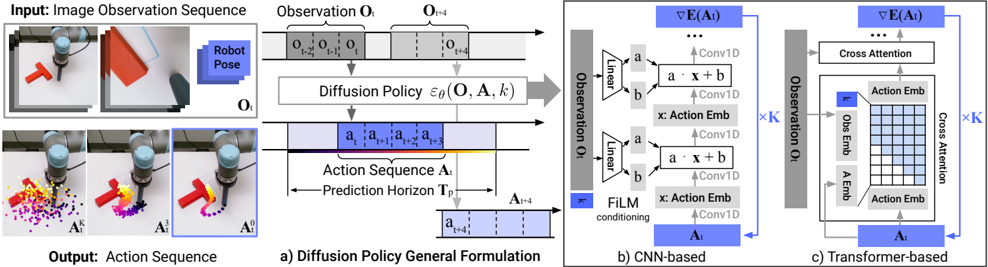
Diffusion Policy represents a visuomotor policy as a conditional denoising diffusion process over action sequences, using receding-horizon control, visual conditioning, and CNN or transformer backbones. Across 15 tasks from 4 benchmarks it reports an average 46.9% improvement over prior state-of-the-art, with strong real-world manipulation results.
Key findings
- Across 15 tasks from 4 robot manipulation benchmarks, Diffusion Policy consistently outperforms prior state-of-the-art with an average improvement of 46.9%; in simulation it reports best/average success rates such as 1.00/1.00 on Lift ph and 1.00/0.87 on ToolHang ph for DiffusionPolicy-T (Table 1).
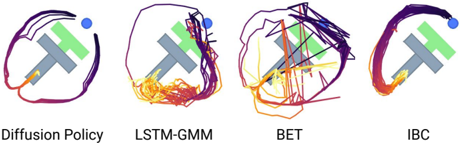
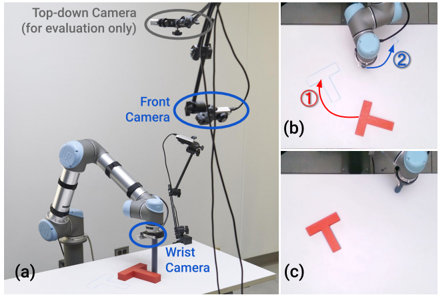
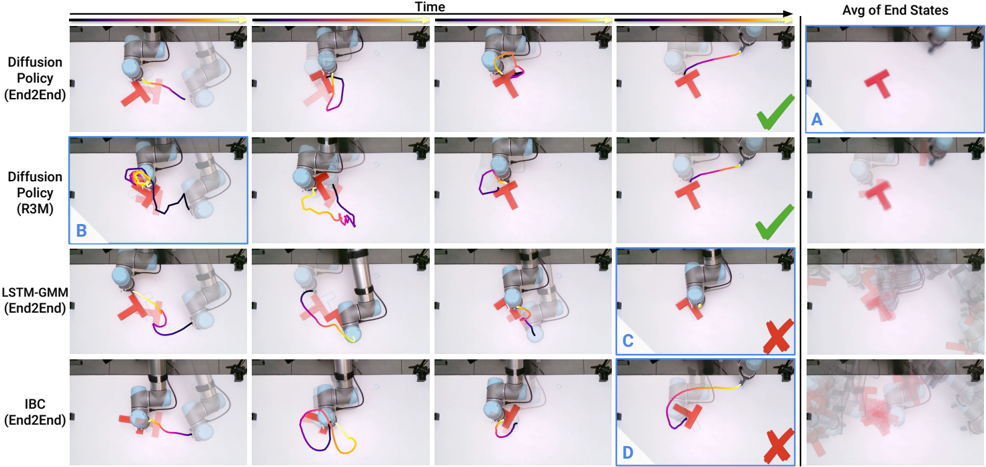
- Real-world Push-T: 95% success and 0.8 average IoU vs human 1.00 success and 0.84 IoU; best IBC and LSTM-GMM variants reached 0% and 20% success.
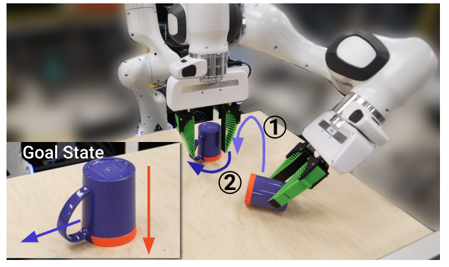
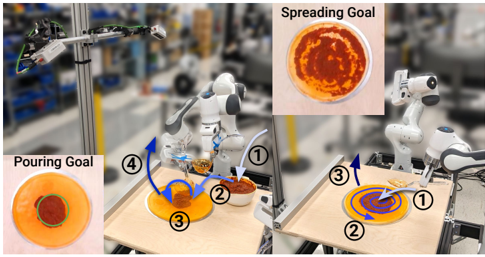
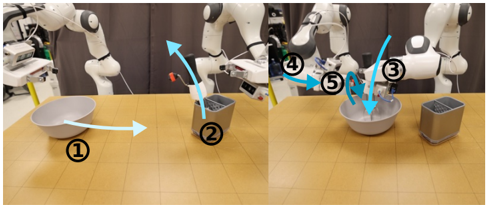
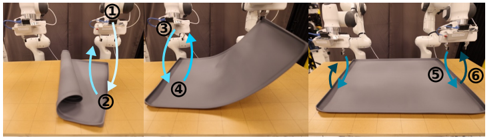
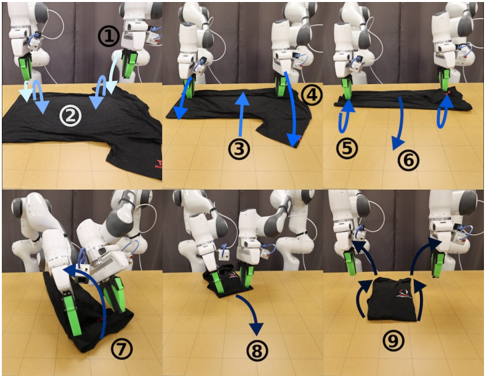
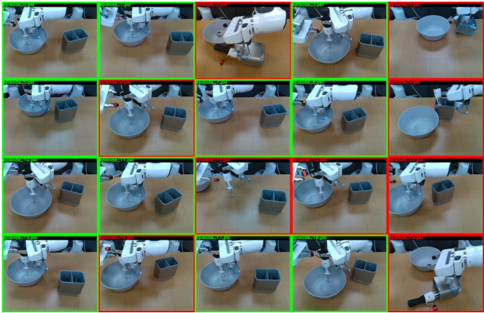
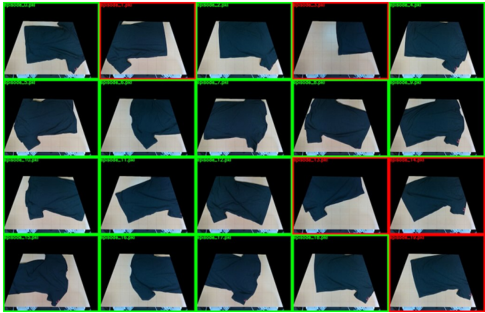
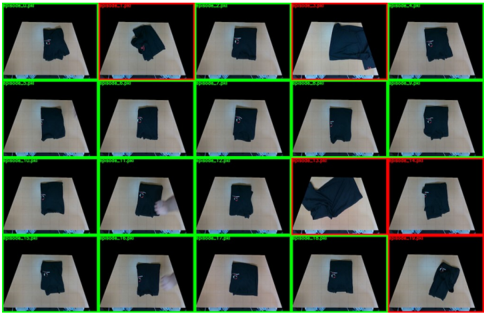
- Other real-world tasks: Mug Flipping 90% success over 20 trials (LSTM-GMM 0%); Sauce Pouring 0.74 IoU / 0.79 success vs human 0.79 / 1.00; Sauce Spreading 0.77 coverage / 1.00 success vs human 0.79 / 1.00; bimanual Egg Beater 55%, Mat Unrolling 75%, Shirt Folding 75%, each over 20 trials.
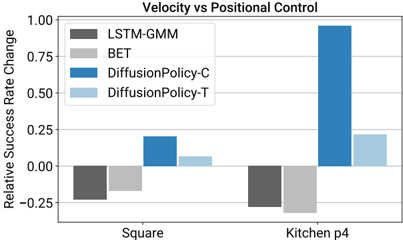
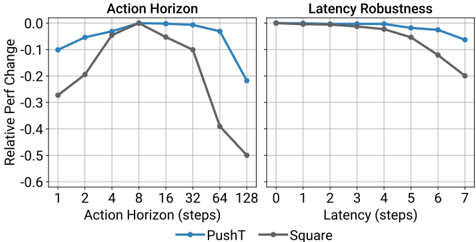
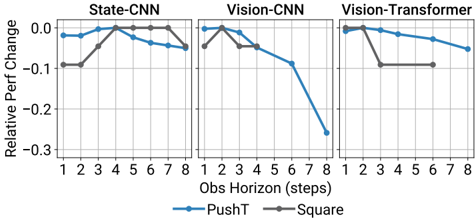
- Ablations: action horizon of 8 steps was optimal for most tested tasks; Diffusion Policy maintained peak performance with latency up to 4 steps; position control outperformed velocity control; DDIM with 100 training and 10 inference iterations enabled 0.1 s inference latency on an Nvidia 3080 GPU.
Methods
- Design: conditional DDPM/DDIM policy \(p(A_t|O_t)\) that predicts action sequences; uses receding-horizon control, visual conditioning, and either a CNN with FiLM or a time-series diffusion transformer.
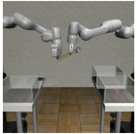
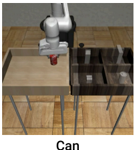
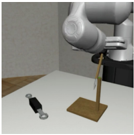
- Data/evaluation: 15 tasks from 4 benchmarks (Robomimic, Push-T, Block Push, Kitchen) plus real-world single-arm and bimanual tasks; simulation results averaged over 3 training seeds and 50 environment initial conditions (1500 experiments total; robomimic used 22 initializations due to an evaluation-code bug).
- Analysis: compares against LSTM-GMM, IBC, and BET; metrics include success rate, target-area coverage/IoU, and ablations on action horizon, latency, action space, vision encoder, and architecture.
Limitations
- Stated: inherits behavior cloning limitations such as suboptimal performance with inadequate demonstration data; higher computational cost and inference latency than simpler methods like LSTM-GMM, which action-sequence prediction only partially mitigates and may not suffice for high-rate control.
- Stated: transformer backbone is more sensitive to hyperparameters; CNN backbone performs poorly when action sequences change quickly and sharply through time, such as velocity command action space.
- Evident: real-world evaluations often use small trial counts (e.g., 20 trials per task), and bimanual success rates were 55–75%; simulation robomimic used only 22 initializations due to a bug; frozen pretrained vision encoders performed poorly, and ViT from scratch reached only 22% success on square.
Model-written summary. Check it against the paper before relying on it.
Integrity signals
Registry
Cites
Statistics
Figures
Verification
Claims the paper makes
12 Valid · 4 Not valid · 14 Not checked · 115 Own results and interpretations
The cited sources support only part of this claim — read each source’s verdict below.
In the paper
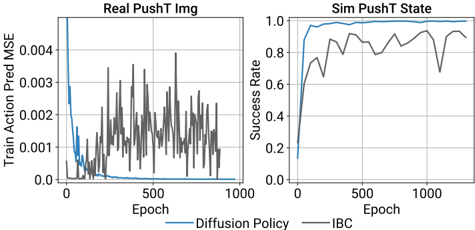
“In contrast, IBC Florence et al. (2021) is prone to training instability.”
What the sources say
- Partly supportedcites Florence et al. (2021) matched to “Implicit Behavioral Cloning” (2021) sourceExperimental — accuracy not yet measured
Section B.3.1 (page unavailable) says the authors use spectral normalization and gradient penalties for additional training stability, which supports stability being a concern for their Langevin-based approach. It does not say that IBC generally is prone to training instability; the Limitations section instead names computational cost and implementation complexity. (LLM, conf=0.82)
plain- Asserted: passes — The authors put it forward as true.
- Checkable: passes — It can be checked against evidence.
- Load-bearing: passes — The paper’s conclusions depend on it.
- Based: passes — The paper gives a reason why it holds.
- Partly supported
The cited sources support only part of this claim — read each source’s verdict below.
In the paper
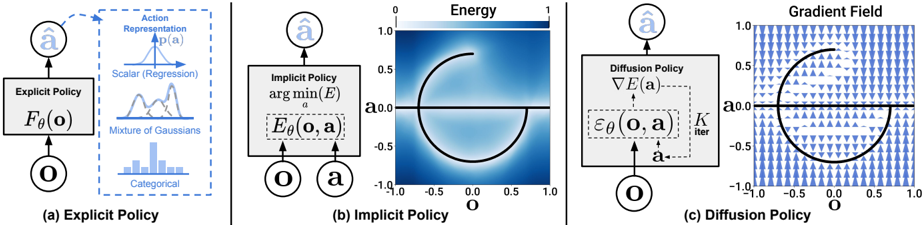
“Expressing multimodal action distributions. By learning the gradient of the action score function Song and Ermon (2019) and performing Stochastic Langevin Dynamics sampling on this gradient field, Diffusion policy can express arbitrary normalizable distributions Neal et al. (2011), which includes multimodal action distributions, a well-known challenge for policy learning.”
- Also stated in: § 4.1 Model Multi-Modal Action Distributions · p. 4 · boosted
“Diffusion Policy's ability to express multimodal distributions naturally and precisely is one of its key advantages.”
What the sources say
- Supportedcites Song and Ermon (2019) matched to “Generative Modeling by Estimating Gradients of the Data Distribution” (2019) source
Section 2.2 (p. 3) describes learning a distribution’s score and using Langevin dynamics to sample from it. Section 4.3 (p. 7) demonstrates sampling from a two-mode Gaussian mixture. The paper supports the cited method and its ability to represent multimodal distributions; applying it to action distributions is the citing authors’ context, not a result claimed by this source. (LLM, conf=0.88)
- Not matchedcites Neal et al. (2011)
An author–year citation the paper’s reference list doesn’t settle. We don’t search these by name.
boostedstates a cause- Asserted: passes — The authors put it forward as true.
- Checkable: passes — It can be checked against evidence.
- Load-bearing: passes — The paper’s conclusions depend on it.
- Based: passes — The paper gives a reason why it holds.
- Also stated in: § 4.1 Model Multi-Modal Action Distributions · p. 4 · boosted
The cited sources support only part of this claim — read each source’s verdict below.
In the paper
“However, existing implicit policies (Florence et al. 2021) are unstable to train due to the necessity of drawing negative samples when computing the underlying Info-NCE loss.”
What the sources say
- Partly supportedcites Florence et al. 2021 matched to “Implicit Behavioral Cloning” (2021) sourceExperimental — accuracy not yet measured
Section 2 says the implicit models are trained with negative counter-examples and an InfoNCE-style loss. Appendix B.3.1 discusses measures for additional training stability, but neither passage says that drawing negative samples makes these policies unstable to train. The claimed cause of instability is therefore unsupported. (LLM, conf=0.87)
plainstates a cause- Asserted: passes — The authors put it forward as true.
- Checkable: passes — It can be checked against evidence.
- Load-bearing: passes — The paper’s conclusions depend on it.
- Based: passes — The paper gives a reason why it holds.
- Partly supported
Every source the paper cites for this claim was checked and supports it.
In the paper
“In our control tasks, we empirically found that the Square Cosine Schedule proposed in iDDPM Nichol and Dhariwal (2021) works best for our tasks.”
What the sources say
- Supportedcites Nichol and Dhariwal (2021) matched to “Improved Denoising Diffusion Probabilistic Models” (2021) source
The citation identifies the origin of the squared-cosine noise schedule; the citing authors describe its performance on their control tasks as their own empirical finding. Section 3.2 (p. 4) proposes a cosine schedule and specifies the use of cos². (LLM, conf=0.92)
plainstates a cause- Asserted: passes — The authors put it forward as true.
- Checkable: passes — It can be checked against evidence.
- Load-bearing: unclear — It is unclear whether the paper’s conclusions depend on it.
- Based: passes — The paper gives a reason why it holds.
- Supported
The cited sources that could be checked couldn’t confirm or dispute this claim.
In the paper
“This shows that in order to perfectly clone a behavior that depends on the state, the learner must implicitly learn a (task-relevant) dynamics model Subramanian and Mahajan (2019); Zhang et al. (2020).”
What the sources say
- Not checked — no full text of the sourcecites Subramanian and Mahajan (2019) matched to “Approximate information state for partially observed systems” (2019) source
- Could not verifycites Zhang et al. (2020) matched to “Learning Invariant Representations for Reinforcement Learning without Reconstruction” (2020) sourceExperimental — accuracy not yet measured
The Introduction describes a representation that predicts task-relevant future states, and the method trains a latent dynamics model for reinforcement learning. Neither passage says that perfectly cloning state-dependent behavior requires a learner to implicitly learn such a model. Searches for imitation learning, behavior cloning, and that necessity claim found no supporting passage in our copy. (LLM, conf=0.76)
boostedstates a cause- Asserted: passes — The authors put it forward as true.
- Checkable: passes — It can be checked against evidence.
- Load-bearing: unclear — It is unclear whether the paper’s conclusions depend on it.
- Based: passes — The paper gives a reason why it holds.
79 more claims · 3 with their cited sources checked
Create a free account to see all 145 claims and to verify the 5 references still open.
- It may state two separate claims as one. 39
- Probably not a substantial claim. 33
- The quote only partly states this claim. 4
Claims other papers make about this one
Each is checked against this paper’s own text: does it say what the citing paper says it does?
The cited source doesn’t support the claim as written.
In the citing paper
“Inspired in part by human motor control [33], action chunking has recently emerged as the de facto standard in imitation learning for visuomotor control [68, 11].”
From Real-Time Execution of Action Chunking Flow Policies (2025) · cites this paper as [11]
Checked by a reasoning model — may be wrong.
Experimental — accuracy not yet measuredThe source backs part of the claim, not all of it — or backs it for a different population, condition or comparison.
In the citing paper
“Most simulated imitation learning benchmarks are quasi-static, and standard chunked execution with a long enough execution horizon can achieve near-perfect success rates [11].”
From Real-Time Execution of Action Chunking Flow Policies (2025) · cites this paper as [11]
Experimental — accuracy not yet measuredThe source backs part of the claim, not all of it — or backs it for a different population, condition or comparison.
In the citing paper
“This action head predicts a 'chunk”
From Octo: An Open-Source Generalist Robot Policy (2024) · cites this paper as [17]
Experimental — accuracy not yet measuredThe cited source says what the claim attributes to it.
In the citing paper
“Prior transformer-based policy designs typically encode input images with large ResNetstyle [32] encoders and fuse the resulting image features with a comparatively small transformer [10, 67, 81, 17, 98, 61, 83].”
From Octo: An Open-Source Generalist Robot Policy (2024) · cites this paper as [17]
The cited source says what the claim attributes to it.
In the citing paper
“While action chunking has enabled temporal consistency in high-frequency control tasks, it does not fully address the latency problem, leading to pauses or out-of-distribution jerky movements at chunk boundaries.”
From Real-Time Execution of Action Chunking Flow Policies (2025) · cites this paper as [11]
Self-check
Percentages, sums and reported differences re-computed from the paper’s own numbers.
Each contradiction between two passages listed here was confirmed by an independent check.
Rated minor: it would not touch a result — a value no result rests on, a p-value that stays on the same side of the significance level, or a conflict that is clerical, resolved elsewhere in the paper, or outside its own findings.
In the paper
§ 3.4 Accelerating Inference for Real-time Control · p. 4
“In our real-world experiments, using DDIM with 100 training iterations and 10 inference iterations enables 0.1s inference latency on a Nvidia 3080 GPU.”
§ A.4 Hyperparameters · p. 16
“We used DDIM Song et al. (2021) on realworld benchmarks to reduce the inference denoising iterations to 16 therefore reducing inference latency.”
Rated minor: it would not touch a result — a value no result rests on, a p-value that stays on the same side of the significance level, or a conflict that is clerical, resolved elsewhere in the paper, or outside its own findings.
In the paper
§ 5.1 Simulation Environments and datasets · p. 7
“the Franka Kitchen environment contains 7 objects for interaction and comes with a human demonstration dataset of 566 demonstrations”
§ 5.1 Simulation Environments and datasets · p. 7
“| Kitchen | 1 | 7 | 9 | 656 | 0 | 280 | No | No |”
Citations
Cites
Deep Residual Learning for Image Recognition
He, K., Zhang, X., Ren, S., & Sun, J. (2016) · 2016 IEEE Conference on Computer Vision and Pattern Recognition (CVPR) · doi:10.1109/cvpr.2016.90 · Cited by 235,474 · cited 1×
“Speci fi cally, we evaluated three different architectures: ResNet-18, ResNet-34 (He et al., 2016), and ViT-B/16 (Dosovitskiy et al., 2020).”
Vaswani, A., Shazeer, N., Parmar, N., Uszkoreit, J., Jones, L., Gomez, A. N., Kaiser, L., & Polosukhin, I. (2017) · arXiv · doi:10.48550/arxiv.1706.03762 · Cited by 120,404
U-Net: Convolutional Networks for Biomedical Image Segmentation
Ronneberger, O., Fischer, P., & Brox, T. (2015) · Lecture notes in computer science · doi:10.1007/978-3-319-24574-4_28 · Cited by 99,404 · cited 1×
“In this work, we examine two common network architecture types, convolutional neural networks (CNNs) (Ronneberger et al., 2015) and Transformers (Vaswani et al., 2017), and compare their performance and training characteristics.”
ImageNet: A large-scale hierarchical image database
Deng, J., Dong, W., Socher, R., Li, L.-J., Li, K., & Fei-Fei, L. (2009) · 2009 IEEE Conference on Computer Vision and Pattern Recognition · doi:10.1109/cvpr.2009.5206848 · Cited by 65,333
An Image is Worth 16x16 Words: Transformers for Image Recognition at Scale
Dosovitskiy, A., Beyer, L., Kolesnikov, A., Weissenborn, D., Zhai, X., Unterthiner, T., Dehghani, M., Minderer, M., Heigold, G., Gelly, S., et al. (2020) · arXiv · doi:10.48550/arxiv.2010.11929 · Cited by 47,472
U-Net: Convolutional Networks for Biomedical Image SegmentationPreprint
Ronneberger, O., Fischer, P., & Brox, T. (2015) · arXiv (Cornell University) · doi:10.48550/arxiv.1505.04597 · Cited by 17,820
Momentum Contrast for Unsupervised Visual Representation LearningPreprint
He, K., Fan, H., Wu, Y., Xie, S., & Girshick, R. B. (2019) · Computer Vision and Pattern Recognition · doi:10.48550/arxiv.1911.05722 · Cited by 16,321
Learning Transferable Visual Models From Natural Language Supervision
Radford, A., Kim, J. W., Hallacy, C., Ramesh, A., Goh, G., Agarwal, S., Sastry, G., Askell, A., Mishkin, P., Clark, J., et al. (2021) · arXiv · doi:10.48550/arxiv.2103.00020 · Cited by 15,293
Advances in neural information processing systems 7
(1996) · Computers & Mathematics with Applications · doi:10.1016/s0898-1221(96)90463-0 · Cited by 14,281
Advances in Neural Information Processing Systems 29
Teymur, O., Zygalakis, K., & Calderhead, B. (2016) · Cited by 13,887
Research works printed but not linked: 3
- Janner M, Du Y, Tenenbaum J and Levine S (2022b) Planning with diffusion for flexible behavior synthesis. In: Chaudhuri K, Jegelka S, Song L, Szepesvari C, Niu G and Sabato S (eds.) Proceedings of the 39th International Conference on Machine Learning , Proceedings of Machine Learning Research. PMLR.
- Wang Z, Hunt JJ and Zhou M (2023) Diffusion policies as an expressive policy class for offline reinforcement learning. In: The Eleventh International Conference on Learning Representations . URL https://openreview.net/ forum?id=AHvFDPi-FA .
- Welling M and Teh YW (2011) Bayesian learning via stochastic gradient langevin dynamics. In: Proceedings of the 28th international conference on machine learning (ICML-11) . pp. 681-688.
Cited by
π₀: A Vision-Language-Action Flow Model for General Robot Control
Black, K., Brown, N., Driess, D., Esmail, A., Equi, M., Finn, C., Fusai, N., Groom, L., Hausman, K., Ichter, B., et al. (2025) · Robotics: Science and Systems XXI · doi:10.15607/rss.2025.xxi.010 · Cited by 295
Understanding World or Predicting Future? A Comprehensive Survey of World Models
Ding, J., Zhang, Y., Shang, Y., Zhang, Y., Zong, Z., Feng, J., Yuan, Y., Su, H., Li, N., Sukiennik, N., et al. (2026) · ACM Computing Surveys · doi:10.1145/3746449 · Cited by 169
Octo: An Open-Source Generalist Robot Policy
Ghosh, D., Walke, H., Pertsch, K., Black, K., Mees, O., Dasari, S., Hejna, J., Kreiman, T., Xu, C., Luo, J., et al. (2024) · Robotics: Science and Systems XX · doi:10.15607/rss.2024.xx.090 · Cited by 129
Generative AI Empowered Network Digital Twins: Architecture, Technologies, and Applications
Li, T., Long, Q., Chai, H., Zhang, S., Jiang, F., Liu, H., Huang, W., Jin, D., & Li, Y. (2025) · ACM Computing Surveys · doi:10.1145/3711682 · Cited by 146
Precise and dexterous robotic manipulation via human-in-the-loop reinforcement learning
Luo, J., Xu, C., Wu, J., & Levine, S. (2025) · Science Robotics · doi:10.1126/scirobotics.ads5033 · Cited by 385
CoT-VLA: Visual Chain-of-Thought Reasoning for Vision-Language-Action Models
Zhao, Q., Lu, Y., Kim, M. J., Fu, Z., Zhang, Z., Wu, Y., Li, Z., Ma, Q., Han, S., Finn, C., et al. (2025) · IEEE Computer Society Conference on Computer Vision and Pattern Recognition/Proceedings - IEEE Computer Society Conference on Computer Vision and Pattern Recognition/Proceedings · doi:10.1109/cvpr52734.2025.00166 · Cited by 734
“Diffusion Policy [8], a state-of-the-art imitation learning algorithm, is trained from scratch for each test scenario in LIBERO and Franka-Tabletop.”
Surgical embodied intelligence for generalized task autonomy in laparoscopic robot-assisted surgery
Long, Y., Lin, A., Kwok, D. H. C., Zhang, L., Yang, Z., Shi, K., Song, L., Fu, J., Lin, H., Wang, W., et al. (2025) · Science Robotics · doi:10.1126/scirobotics.adt3093 · Cited by 104
Zhang, J., Zhao, H., Chen, K., Fei, G., Li, X., Wang, Y., Yang, Z., Zheng, S., Liu, S., & Ding, H. (2025) · Robotics and Computer-Integrated Manufacturing · doi:10.1016/j.rcim.2025.103021 · Cited by 67
OpenVLA: An Open-Source Vision-Language-Action Model
Kim, M. J., Pertsch, K., Karamcheti, S., Xiao, T., Balakrishna, A., Nair, S., Rafailov, R., Foster, E., Lam, G., Sanketi, P., et al. (2024) · arXiv · doi:10.48550/arxiv.2406.09246 · Cited by 62
“We compare to Diffusion Policy [3], a state-of-the-art data-efficient imitation learning approach, trained from scratch.”
BackgroundMethodSelf-citationSteering towards safe self-driving laboratories
Leong, S. X., Griesbach, C. E., Zhang, R., Darvish, K., Zhao, Y., Mandal, A., Zou, Y., Hao, H., Bernales, V., & Aspuru‐Guzik, A. (2025) · Nature Reviews Chemistry · doi:10.1038/s41570-025-00747-x · Cited by 96
“Developing intuitive and natural interfaces, such as teleoperation systems 180 or hand-held manipulation interfaces 181 , can facilitate direct skill transfer and improve policy learning by serving as valuable tools for data collection.”
From screens to scenes: A survey of embodied AI in healthcare
Liu, Y., Cao, X., Chen, T., Jiang, Y., You, J., Wu, M., Wang, X., Feng, M., Jin, Y., & Chen, J. (2025) · Information Fusion · doi:10.1016/j.inffus.2025.103033 · Cited by 91
Wu, D., Zheng, P., Zhao, Q., Zhang, S., Qi, J., Hu, J., Zhu, G., & Wang, L. (2025) · Robotics and Computer-Integrated Manufacturing · doi:10.1016/j.rcim.2025.103064 · Cited by 52
SayPlan: Grounding Large Language Models using 3D Scene Graphs for Scalable Robot Task Planning
Rana, K., Haviland, J., Garg, S., Abou-Chakra, J., Reid, I., & Suenderhauf, N. (2023) · arXiv · doi:10.48550/arxiv.2307.06135 · Cited by 29
Scaling Up and Distilling Down: Language-Guided Robot Skill Acquisition
Ha, H., Florence, P., & Song, S. (2023) · arXiv · doi:10.48550/arxiv.2307.14535 · Cited by 24
“To enable effective learning of high entropy, diverse robot trajectories, we extend the diffusion policy [12] to handle language-based conditioning for multi-task learning.”
BackgroundMethodInfluentialSelf-citationGu, Z., Li, J., Shen, W., Yu, W., Xie, Z., McCrory, S., Cheng, X., Shamsah, A., Griffin, R. J., Liu, C. K., et al. (2026) · IEEE/ASME Transactions on Mechatronics · doi:10.1109/tmech.2025.3579247 · Cited by 201
“, Tesla and Toyota Research [204].”
Adaptive Compliance Policy: Learning Approximate Compliance for Diffusion Guided Control
Hou, Y., Liu, Z., Chi, C., Cousineau, E. A., Kuppuswamy, N. S., Feng, S., Burchfiel, B., & Song, S. (2025) · Proceedings - IEEE International Conference on Robotics and Automation/Proceedings · doi:10.1109/icra55743.2025.11128452 · Cited by 141
“…four policies, all trained on the same dataset with the same number of epochs: • ACP: Adaptive Compliance Policy, our approach; • ACP w.o. FFT: same as ACP but with force encoded using temporal convolution [37, 26] instead of FFT. • Stiff policy: Diffusion policy [6, 7] with additional force input.”
Self-citationLearning contact-rich whole-body manipulation with example-guided reinforcement learning
Barreiros, J. A. L., Önol, A. Ö., Zhang, M., Creasey, S., Goncalves, A., Beaulieu, A., Bhat, A. D., Tsui, K., & Alspach, A. N. (2025) · Science Robotics · doi:10.1126/scirobotics.ads6790 · Cited by 46
Brain–computer interface control with artificial intelligence copilots
Lee, J. Y., Lee, S., Mishra, A., Xu, Y., McMahan, B., Gaisford, B., Kobashigawa, C., Qu, M., Xie, C., & Kao, J. C. (2025) · Nature Machine Intelligence · doi:10.1038/s42256-025-01090-y · Cited by 65
“Future work should develop more advanced copilots that assist in executing robotic arm trajectories towards objects and precise manipulation based on object dynamics 12,53 .”
Zhao, C., Zhang, R., Wang, J., Niyato, D. T., Sun, G., Du, H., Li, Z., Jamalipour, A., & Kim, D. I. (2025) · IEEE Transactions on Mobile Computing · doi:10.1109/tmc.2025.3647029 · Cited by 23
“Furthermore, diffusion policy has emerged as a promising GenAI framework for sequential decision-making [29].”
Robotic Compliant Object Prying Using Diffusion Policy Guided by Vision and Force Observations
Kang, J. H., Joshi, S., Huang, R., & Gupta, S. K. (2025) · IEEE Robotics and Automation Letters · doi:10.1109/lra.2025.3553689 · Cited by 40
“In [4], it has already been seen that for multi-modal tasks, diffusion policy outperforms other behavior cloning approaches like LSTM-GMM [20], IBC [16], and BET [19].”
PointVLA: Injecting the 3D World Into Vision-Language-Action Models
Li, C., Wen, J., Peng, Y., Peng, Y., & Zhu, Y. (2026) · IEEE Robotics and Automation Letters · doi:10.1109/lra.2026.3653303 · Cited by 174
“Baseline: In our experiments, we compared against many state-of-the-art models, including the Diffusion Policy (DP) [39], 3D Diffusion Policy (DP3) [21], ScaleDP-1B [32], a variant of scaling up diffusion policy to 1B parameters, Octo [40], OpenVLA [4], and DexVLA [7].”
Hierarchically depicting vehicle trajectory with stability in complex environments
Han, Z., Tian, M., Gongye, Z., Xue, D., Xing, J., Wang, Q., Gao, Y., Wang, J., Xu, C., & Gao, F. (2025) · Science Robotics · doi:10.1126/scirobotics.ads4551 · Cited by 31
MoManipVLA: Transferring Vision-language-action Models for General Mobile Manipulation
Wu, Z., Zhou, Y., Xu, X., Wang, Z., & Yan, H. (2025) · IEEE Computer Society Conference on Computer Vision and Pattern Recognition/Proceedings - IEEE Computer Society Conference on Computer Vision and Pattern Recognition/Proceedings · doi:10.1109/cvpr52734.2025.00167 · Cited by 69
“Chi et al. [4] and Huange et al. [13] train neural networks to generate collision-free trajectories through imitation learning from human or expert demonstrations, eliminating the need for manually defined constraints or explicit environmental modeling.”
Pan, M., Zhang, J., Wu, T., Zhao, Y., Gao, W., & Dong, H. (2025) · IEEE Computer Society Conference on Computer Vision and Pattern Recognition/Proceedings - IEEE Computer Society Conference on Computer Vision and Pattern Recognition/Proceedings · doi:10.1109/cvpr52734.2025.01618 · Cited by 128
SplatSim: Zero-Shot Sim2Real Transfer of RGB Manipulation Policies Using Gaussian Splatting
Qureshi, M. N., Garg, S., Yandún, F., Held, D., Kantor, G. A., & Silwal, A. (2025) · Proceedings - IEEE International Conference on Robotics and Automation/Proceedings · doi:10.1109/icra55743.2025.11128339 · Cited by 114
“Now that we are able to render individual rigid bodies in the scene, we can use this to represent any simulated trajectory τ E with photorealistic accuracy.”
Liu, S., Liu, Y., Hu, L., Zhou, Z., Xie, Y., Zhao, Z., Li, W., & Gan, Z. (2024) · Knowledge-Based Systems · doi:10.1016/j.knosys.2024.112190 · Cited by 22
Safe, Task-Consistent Manipulation with Operational Space Control Barrier Functions
Morton, D., & Pavone, M. (2025) · IEEE/RSJ International Conference on Intelligent Robots and Systems (IROS) · doi:10.1109/iros60139.2025.11246389 · Cited by 43
“Enforcing safety while retaining performance is particularly relevant for recent learning-based controllers, which may be quite versatile, but do not provide guarantees on safety [1].”
Liu, X., Wang, Z., Li, J., Cangelosi, A., & Yang, C. (2023) · IEEE Transactions on Instrumentation and Measurement · doi:10.1109/tim.2023.3288240 · Cited by 18
“Although some neural network models, such as CVAE [34], GAN, and diffusion [35], can obtain more accurate fitting results, they require a large amount of data for training, which is time-consuming.”
MethodZhao, J., Kuppuswamy, N. S., Feng, S., Burchfiel, B., & Adelson, E. H. (2025) · Proceedings - IEEE International Conference on Robotics and Automation/Proceedings · doi:10.1109/icra55743.2025.11128816 · Cited by 50
“In particular, policy synthesis through supervised behavior learning from human demonstrations is emerging as a powerful alternative to traditional methods in achieving the necessary skill diversity [1–3].”
Self-citationControlling diverse robots by inferring Jacobian fields with deep networks
Li, S., Zhang, A., Chen, B., Matusik, H., Liu, C., Rus, D. L., & Sitzmann, V. (2025) · Nature · doi:10.1038/s41586-025-09170-0 · Cited by 37
Qi, J., Lu, L., Wang, F., Lee, H.-Y., Navarro-Alarcón, D., Zhang, Z., & Zhou, P. (2025) · Robotics and Computer-Integrated Manufacturing · doi:10.1016/j.rcim.2025.103096 · Cited by 22
A robot operating system framework for using large language models in embodied AI
Mower, C. E., Wan, Y., Yu, H., Grosnit, A., Gonzalez-Billandon, J., Zimmer, M., Liu, P., Palenicek, D., Tateo, D., Peters, J., et al. (2026) · Nature Machine Intelligence · doi:10.1038/s42256-026-01186-z · Cited by 79
A phased robotic assembly policy based on a PL-LSTM-SAC algorithm
Wang, Q., Liu, Y., Zhu, Z., Zhang, L., & Wang, L. (2024) · Journal of Manufacturing Systems · doi:10.1016/j.jmsy.2024.12.008 · Cited by 14
Visual-tactile pretraining and online multitask learning for humanlike manipulation dexterity
Ye, Q., Liu, Q., Wang, S., Chen, J., Cui, Y., Jin, K., Chen, H., Cai, X., Li, G., & Chen, J. (2026) · Science Robotics · doi:10.1126/scirobotics.ady2869 · Cited by 33
RoboGround: Robotic Manipulation with Grounded Vision-Language Priors
Huang, H., Chen, X., Chen, Y., Li, H., Han, X., Wang, Z., Wang, T., Pang, J., & Zhao, Z. (2025) · IEEE Computer Society Conference on Computer Vision and Pattern Recognition/Proceedings - IEEE Computer Society Conference on Computer Vision and Pattern Recognition/Proceedings · doi:10.1109/cvpr52734.2025.02099 · Cited by 88
“The early low-level policies for manipulation [8, 25, 38, 50] primarily relied on imitation learning from collected demonstrations, focusing on acquiring specific skills within predefined scenes.”
AnySkin: Plug-and-Play Skin Sensing for Robotic Touch
Bhirangi, R., Pattabiraman, V., Erciyes, E., Cao, Y., Hellebrekers, T., & Pinto, L. (2025) · Proceedings - IEEE International Conference on Robotics and Automation/Proceedings · doi:10.1109/icra55743.2025.11128638 · Cited by 83
“Prominent works and current state-of-the-art in robot learning primarily utilize vision sensing with proprioception to train manipulation skills [3], [4], [5], [6], often ignoring touch.”
$π_0$: A Vision-Language-Action Flow Model for General Robot Control
Black, K., Brown, N., Driess, D., Esmail, A., Equi, M., Finn, C., Fusai, N., Groom, L., Hausman, K., Ichter, B., et al. (2024) · arXiv · doi:10.48550/arxiv.2410.24164 · Cited by 13
“We also compare to ACT [57] and Diffusion Policy [9], which are designed specifically for learning dexterous tasks from smaller datasets.”
InfluentialFang, H., Yu, P., Liu, X., Liu, J., Qu, Z., Wang, Y., Li, W., Guo, S., & Wu, C. (2025) · IEEE Transactions on Network Science and Engineering · doi:10.1109/tnse.2025.3627391 · Cited by 11
“DiffusionPolicy[74],Diffuser[75],andDiffusion-QL[76] haveshownstrongresultsinroboticsandreinforcementlearning bylearningcomplexvisuomotorandplanningpolicies.”
Dexterous Manipulation Through Imitation Learning: A Survey
An, S., Meng, Z., Tang, C., Zhou, Y., Liu, T., Ding, F., Zhang, S., Mu, Y., Song, R., Zhang, W., et al. (2025) · IEEE Transactions on Automation Science and Engineering · doi:10.1109/tase.2025.3646183 · Cited by 71
“…which combined deep reinforcement learning(DRL) with human demonstrations to solve high-dimensional dexterous manipulation tasks; Implicit Behavioral Cloning [26] which focused on improving robot policy learning from a mathematical perspective; Hive-former [31], which explored creating…”
InfluentialPark, Y., Jun, W., & Lee, S. (2025) · Applied Sciences · doi:10.3390/app15126838 · Cited by 18
Active Vision Might Be All You Need: Exploring Active Vision in Bimanual Robotic Manipulation
Chuang, I., Lee, A., Gao, D., Naddaf-Sh, M.-M., & Soltani, I. (2025) · Proceedings - IEEE International Conference on Robotics and Automation/Proceedings · doi:10.1109/icra55743.2025.11128253 · Cited by 56
“Recent advances in robot learning architectures [1], [2] along with the development of low-cost, open-source meth-ods for easier robot data collection [1], [3], have led to an accelerated advancement for robot learning using imitation learning methods [4], [5], [6].”
Motion Tracks: A Unified Representation for Human-Robot Transfer in Few-Shot Imitation Learning
Ren, J., Sundaresan, P., Sadigh, D., Choudhury, S., & Bohg, J. (2025) · Proceedings - IEEE International Conference on Robotics and Automation/Proceedings · doi:10.1109/icra55743.2025.11128834 · Cited by 49
OpenVR: Teleoperation for manipulation
George, A., Bartsch, A., & Farimani, A. B. (2025) · SoftwareX · doi:10.1016/j.softx.2025.102054 · Cited by 21
A survey on imitation learning for contact-rich tasks in robotics
Tsuji, T., Kato, Y., Solak, G., Zhang, H., Petrič, T., Nori, F., & Ajoudani, A. (2026) · The International Journal of Robotics Research · doi:10.1177/02783649261417694 · Cited by 76
Transferring Foundation Models for Generalizable Robotic Manipulation
Yang, J., Tan, W., Jin, C., Yao, K., Liu, B., Fu, J., Song, R., Wu, G., & Wang, L. (2025) · IEEE Winter Conference on Applications of Computer Vision · doi:10.1109/wacv61041.2025.00201 · Cited by 56
“As for model architecture, several works [20,28] point out that convolution-based models tend to outperform transformer-based models and [6,79] demonstrates the superiority of generative modeling of the policy.”
DARE: Diffusion Policy for Autonomous Robot Exploration
Cao, Y., Lew, J., Liang, J., Cheng, J., & Sartoretti, G. (2025) · Proceedings - IEEE International Conference on Robotics and Automation/Proceedings · doi:10.1109/icra55743.2025.11128196 · Cited by 26
“Our method builds upon diffusion policy [25, 26], which uses a supervised behavior cloning approach and consistently outperforms previous state-of-the-art methods in robotic manipulator behavior cloning benchmarks.”
InfluentialSong, W., Chen, J., Ding, P., Zhao, H., Zhao, W., Zhong, Z., Ge, Z., Li, Z., Wang, D., Wang, L., et al. (2025) · IEEE/RSJ International Conference on Intelligent Robots and Systems (IROS) · doi:10.1109/iros60139.2025.11247519 · Cited by 111
“Some studies find this approach improves manipulation performance and execution inference in imitation learning [15], diffusion policies [26], [27], and VLA models [14].”
InfluentialLEGATO: Cross-Embodiment Imitation Using a Grasping Tool
Seo, M., Park, H. A., Yuan, S., Zhu, Y., & Sentis, L. (2025) · IEEE Robotics and Automation Letters · doi:10.1109/lra.2025.3535182 · Cited by 11
“• Diffusion Policy: a baseline that employs a receding-horizon visual-motor policy based on a diffusion model, as introduced by Chi et al. [53].”
BackgroundG3Flow: Generative 3D Semantic Flow for Pose-aware and Generalizable Object Manipulation
Chen, T., Mu, Y., Liang, Z., Chen, Z., Peng, S., Chen, Q., Xu, M., Hu, R., Zhang, H., Li, X., et al. (2025) · IEEE Computer Society Conference on Computer Vision and Pattern Recognition/Proceedings - IEEE Computer Society Conference on Computer Vision and Pattern Recognition/Proceedings · doi:10.1109/cvpr52734.2025.00169 · Cited by 21
“In robotics, diffusion-based policies [1, 2, 8, 12– 14, 18, 20, 23, 27, 39] have demonstrated impressive performance in learning complex manipulation skills from demonstrations.”
Self-Improving Autonomous Underwater Manipulation
Liu, R., Ha, H., Hou, M., Song, S., & Vondrick, C. (2025) · Proceedings - IEEE International Conference on Robotics and Automation/Proceedings · doi:10.1109/icra55743.2025.11128759 · Cited by 22
“Findings: for this task, we evaluate the performance of learned policy with three different policy decoder architectures, including vanilla MLP, Diffusion Policy (DP) [53], and Action Chunk Transformers (ACT) [54].”
BackgroundMethodInfluentialSelf-citationLi, S., Liu, C., Zhao, J., Zheng, P., Wang, X. V., & Wang, L. (2026) · Advanced Engineering Informatics · doi:10.1016/j.aei.2026.104370 · Cited by 14
MADiff: Motion-Aware Mamba Diffusion Models for Hand Trajectory Prediction on Egocentric Videos
Ma, J., Chen, X., Bao, W., Xu, J., & Wang, H. (2025) · IEEE Transactions on Pattern Analysis and Machine Intelligence · doi:10.1109/tpami.2025.3633453 · Cited by 35
“…and should not be reconstructed as hand state features in the diffusion process (demonstrated in Section V-E), and 2) anchoring deterministic conditional information while denoising features enhances the stability of the optimization process [20], [80], [81] and reduces the computation [82].”
Real-Time Execution of Action Chunking Flow Policies
Black, K., Galliker, M., & Levine, S. (2025) · Advances in Neural Information Processing Systems 38 · doi:10.52202/085713-1122 · Cited by 12
Gemini Robotics: Bringing AI into the Physical World
Gemini Robotics Team, Abeyruwan, S., Ainslie, J., Alayrac, J.-B., Arenas, M. G., Armstrong, T., Balakrishna, A., Baruch, R., Bauza, M., Blokzijl, M., et al. (2025) · arXiv · doi:10.48550/arxiv.2503.20020 · Cited by 8
Self-citationConditional variational auto encoder based dynamic motion for multitask imitation learning
Xu, B.-Z., Din, M. U., & Hussain, I. (2024) · Scientific Reports · doi:10.1038/s41598-025-93888-4 · Cited by 10
“We define an error between the normalized trajectory and the via-point(including the endpoint).”
Ou, Y., & Tavakoli, M. (2025) · IEEE Transactions on Automation Science and Engineering · doi:10.1109/tase.2025.3576731 · Cited by 18
“Other imitation learning approaches, such as diffusion policy [50] and action chunking with transformers [51], [52], can be further incorporated in future work.”
Welte, E., & Rayyes, R. (2025) · Frontiers in Robotics and AI · doi:10.3389/frobt.2025.1682437 · Cited by 25
“Current state-of-the-art diffusion policies [16, 17, 79] require more than 100 human-recorded demonstrations for effective training.”
Hydra-NeXt: Robust Closed-Loop Driving with Open-Loop Training
Li, Z., Wang, S. G., Lan, S., Yu, Z., Wu, Z., & Álvarez, J. M. (2025) · IEEE/CVF International Conference on Computer Vision (ICCV) · doi:10.1109/iccv51701.2025.02535 · Cited by 59
“Nevertheless, involving the Diffusion Policy π dp for refining trajectories results in an efficiency degradation, which is an inherent limitation of the iterative denoising process [8] and deserves further optimization.”
InfluentialCoA-VLA: Improving Vision-Language-Action Models via Visual-Textual Chain-of-Affordance
Li, J., Zhu, Y., Tang, Z., Wen, J., Zhu, M., Liu, X., Li, C., Cheng, R., Peng, Y., Peng, Y., et al. (2025) · IEEE/CVF International Conference on Computer Vision (ICCV) · doi:10.1109/iccv51701.2025.00910 · Cited by 70
“Specifically, on the LIBERO [30] benchmark, our proposed CoA-VLA outperforms several other state-of-the-art approaches, including the Diffusion Policy [10], Octo [36], and OpenVLA [22].”
ICRT: In-Context Imitation Learning via Next-Token Prediction
Fu, M., Huang, H., Datta, G., Chen, L. Y., Panitch, W., Liu, F., Li, H., & Goldberg, K. Y. (2025) · Proceedings - IEEE International Conference on Robotics and Automation/Proceedings · doi:10.1109/icra55743.2025.11128272 · Cited by 94
“In recent years, alternative architectures such as energy-based models [31] and diffusion models [1] have also been proposed.”
Teng, T., Wu, X., Li, Z., et al. (2024) · Journal of Field Robotics · doi:10.1002/rob.22464 · Cited by 6
“…during task execution under this shared control framework to train the robot's autonomous learning models, enhancing the robot system's capability for autonomy and collaborative skills in logistics scenarios (Ling et al. 2024; Zhao et al. 2019; Xie et al. 2022; Teng et al. 2023; Chi et al. 2024).”
Survey of Path Planning for Aerial Drone Inspection of Multiple Moving Objects
Sikora, T., & Papić, V. (2024) · Drones · doi:10.3390/drones8120705 · Cited by 8
Huang, X., Hu, J., Liu, Q., Zhao, G., Deng, W., & Liu, W. (2025) · Knowledge-Based Systems · doi:10.1016/j.knosys.2025.113738 · Cited by 9
A survey on learning an autonomous dynamic system for human–robot skills transfer from demonstration
Fu, J., Huang, H., Jin, Z., Liu, A., Zhang, W.-A., Yu, L. J., Si, W., & Yang, C. (2025) · Robotics and Computer-Integrated Manufacturing · doi:10.1016/j.rcim.2025.103092 · Cited by 8
SwarmDiff: Swarm Robotic Trajectory Planning in Cluttered Environments via Diffusion Transformer
Ding, K., Jiao, C., Hu, Y., Zhou, K., Wu, P., Mu, Y., & Liu, C. (2025) · IEEE/CVF Conference on Computer Vision and Pattern Recognition Workshops (CVPRW) · doi:10.1109/cvprw67362.2025.00400 · Cited by 19
“Additionally, [34] explored diffusion models for policy learning in reinforcement learning, while [9] focused on visuomotor control via action diffusion.”
Human-intelligent trajectory optimization for robotic manipulators with hybrid PSO-PS algorithm
Yagüe, M. P., Sierra-García, J. E., & Peñas, M. S. (2025) · Advanced Engineering Informatics · doi:10.1016/j.aei.2025.103941 · Cited by 6
Diffusion Trajectory-Guided Policy for Long-Horizon Robot Manipulation
Fan, S., Yang, Q., Liu, Y., Wu, K., Che, Z., Liu, Q., & Wan, M. (2025) · IEEE Robotics and Automation Letters · doi:10.1109/lra.2025.3619794 · Cited by 34
“I MITATION Learning (IL) demonstrates significant potential in addressing manipulation tasks within real robotic systems, this is evidenced by its ability to acquire diverse behaviors such as preparing coffee [1] and flipping mugs [2] through learning from expert demonstrations.”
InfluentialPredictive Planner for Autonomous Driving with Consistency Models
Li, A., Bae, S., Isele, D., Beeson, R., & Tariq, F. M. (2025) · IEEE International Conference on Intelligent Transportation Systems (ITSC) · doi:10.1109/itsc60802.2025.11423304 · Cited by 19
“As a result, Diffusion models have been applied to robot policy learning [23], [1], [10] and trajectory generation [28], [27], [54].”
A careful examination of large behavior models for multitask dexterous manipulation
Barreiros, J. A. L., Beaulieu, A., Bhat, A. D., Cory, R., Cousineau, E. A., Dai, H., Fang, C.-H., Hashimoto, K., Irshad, M. Z., Itkina, M., et al. (2026) · Science Robotics · doi:10.1126/scirobotics.aea6201 · Cited by 184
Self-citationHori, K., Suzuki, K., & Ogata, T. (2025) · Scientific Reports · doi:10.1038/s41598-025-91448-4 · Cited by 11
“On the other hand, the spread of inexpensive robot hardware and the development of imitation learning technology have made it possible to perform a variety of robot tasks 7–9 .”
VITaL Pretraining: Visuo-Tactile Pretraining for Tactile and Non-Tactile Manipulation Policies
George, A., Gano, S., Katragadda, P., & Farimani, A. B. (2025) · Proceedings - IEEE International Conference on Robotics and Automation/Proceedings · doi:10.1109/icra55743.2025.11128336 · Cited by 60
“2) Diffusion Policy: To address the challenge of complex multi-modal action spaces, Diffusion Policy [11] formulates control policies as Denoising Diffusion Probabilistic Models (DDPM) [35], generating action sequences conditioned on observations, p ( O t | A t ) , through iterative denoising of…”
InfluentialShukla, R., Moode, S., Talan, R., & Gupta, S. K. (2025) · Manufacturing Letters · doi:10.1016/j.mfglet.2025.06.171 · Cited by 10
Umbrella Reinforcement Learning – computationally efficient tool for hard non-linear problems
Nuzhin, E. E., & Brilliantov, N. V. (2025) · Communications in Nonlinear Science and Numerical Simulation · doi:10.1016/j.cnsns.2024.108583 · Cited by 6
Dual-Arm Fabric Manipulation Learning With Grasp Pose Constraints
Zhu, Z., Guo, Z., Hu, Q., Zhou, Y., & He, B. (2025) · IEEE Robotics and Automation Letters · doi:10.1109/lra.2025.3541911 · Cited by 13
“Recent advancements in deformable object manipulation based on imitation learning primarily focus on transformer [32], [33], diffusion models [34], [35] and large robotic manipulation datasets [36] to achieve broad generalization, which have shown promising results for learning end-to-end robot…”
Policy-Space Diffusion for Physics-Based Character Animation
Rocca, M., Darkner, S., Erleben, K., & Andrews, S. (2025) · ACM Transactions on Graphics · doi:10.1145/3732285 · Cited by 10
Inference-Time Policy Steering Through Human Interactions
Wang, Y., Wang, L., Du, Y., Sundaralingam, B., Yang, X., Chao, Y.-W., Pérez-D’Arpino, C., Fox, D., & Shah, J. (2025) · Proceedings - IEEE International Conference on Robotics and Automation/Proceedings · doi:10.1109/icra55743.2025.11127931 · Cited by 73
“To address this, we propose an MCMC procedure [21] for diffusion policy [6] that alleviates distribution shift during interaction-guided sampling, achieving the best alignment-2025 for j = 1 , . . . , M : // sampling steps 4: ϵ ← π θ ( τ i ) // denoising gradient 5: δ ← ∇ ξ ( τ i , z ) // alignment…”
InfluentialSelf-citationSemi-Supervised Unconstrained Head Pose Estimation in the Wild
Zhou, H., Jiang, F., Yuan, J. S., Rui, Y., Lu, H. T., & Jia, K. (2025) · IEEE Transactions on Pattern Analysis and Machine Intelligence · doi:10.1109/tpami.2025.3631642 · Cited by 10
A survey of robotic manipulation: From bottom-up approaches to end-to-end paradigms with LLMs
Peng, K., Li, Q., He, Z., Zhang, B., Fu, X., Li, B., Wang, X., Cheng, Z.-Q., Yan, Y., & Peng, X. (2026) · Neurocomputing · doi:10.1016/j.neucom.2026.132921 · Cited by 11
A hierarchical trajectory planning framework based on diffusion models for autonomous vehicles
Xu, Y., Wei, C., Hu, L., Chow, W. T., & Hu, J. (2026) · Advanced Engineering Informatics · doi:10.1016/j.aei.2026.104541 · Cited by 6
Moto: Latent Motion Token as the Bridging Language for Learning Robot Manipulation from Videos
Chen, Y., Ge, Y., Tang, W., Li, Y., Ge, Y., Ding, M., Shan, Y., & Liu, X. (2025) · IEEE/CVF International Conference on Computer Vision (ICCV) · doi:10.1109/iccv51701.2025.01837 · Cited by 153
“Beyond VLA models, several studies improve robot manipulation by incorporating multi-perspective views and depth information [7, 35, 59], and employing techniques like action chunking and policy diffusion for precision [11, 22, 26].”
FDPP: Fine-Tune Diffusion Policy with Human Preference
Chen, Y., Jha, D. K., Tomizuka, M., & Romeres, D. (2025) · Proceedings - IEEE International Conference on Robotics and Automation/Proceedings · doi:10.1109/icra55743.2025.11128127 · Cited by 22
“Recently, the rapid advancement of generative models has highlighted their remarkable ability to synthesize complex, high-dimensional distributions, offering new opportunities for enhancing policy learning [3].”
InfluentialDiscrete Policy: Learning Disentangled Action Space for Multi-Task Robotic Manipulation
Wu, K., Zhu, Y., Li, J., Wen, J., Liu, N., Xu, Z., & Tang, J. (2025) · Proceedings - IEEE International Conference on Robotics and Automation/Proceedings · doi:10.1109/icra55743.2025.11127630 · Cited by 36
“Our results demonstrate that our method, Discrete Policy, significantly outperforms Diffusion Policy [5], a strong baseline, by a considerable margin.”
Self-citationRobot Utility Models: General Policies for Zero-Shot Deployment in New Environments
Etukuru, H., Naka, N., Hu, Z., Lee, S., Mehu, J., Edsinger, A., Paxton, C., Chintala, S., Pinto, L., & Shafiullah, N. M. M. (2025) · Proceedings - IEEE International Conference on Robotics and Automation/Proceedings · doi:10.1109/icra55743.2025.11127857 · Cited by 63
“We train policies on these diverse datasets with state-of-the-art multi-modal behavior learning algorithms [23, 24] and show how they can absorb and scale with large-scale demonstration data.”
GR00T N1: An Open Foundation Model for Generalist Humanoid Robots
NVIDIA, :, Bjorck, J., Castañeda, F., Cherniadev, N., Da, X., Ding, R., Fan, L. "., Fang, Y., Fox, D., et al. (2025) · arXiv · doi:10.48550/arxiv.2503.14734 · Cited by 10
Self-citationMimicGen: A Data Generation System for Scalable Robot Learning using Human Demonstrations
Mandlekar, A., Nasiriany, S., Wen, B., Akinola, I., Narang, Y., Fan, L., Zhu, Y., & Fox, D. (2023) · arXiv · doi:10.48550/arxiv.2310.17596 · Cited by 226
“We trained Diffusion Policy [100], a recent state-of-the-art imitation learning model, on our real-world Stack dataset.”
MethodShould We Learn Contact-Rich Manipulation Policies From Sampling-Based Planners?
Zhu, H., Zhao, T., Ni, X., Wang, J., Fang, K., Righetti, L., & Pang, T. (2025) · IEEE Robotics and Automation Letters · doi:10.1109/lra.2025.3564701 · Cited by 23
A Hybrid Framework Using Diffusion Policy and Residual RL for Force-Sensitive Robotic Manipulation
Li, Y., Lyu, Q., Yang, J., Salam, Y., & Wang, W. (2025) · IEEE Robotics and Automation Letters · doi:10.1109/lra.2025.3596487 · Cited by 6
“Diffusion policies, originally developed to generate smooth trajectories by iteratively denoising expert demonstrations [15], [16], [17], [18], [19], [20], [21], [22], excel at producing temporally coherent actions from data and are well-suited for long-horizon tasks like cleaning that require…”
Prior Does Matter: Visual Navigation via Denoising Diffusion Bridge Models
Ren, H., Zeng, Y., Bi, Z., Wan, Z., Huang, J., & Cheng, H. (2025) · IEEE Computer Society Conference on Computer Vision and Pattern Recognition/Proceedings - IEEE Computer Society Conference on Computer Vision and Pattern Recognition/Proceedings · doi:10.1109/cvpr52734.2025.01130 · Cited by 32
“The network is modulated by c t through Feature-wise Linear Modulation (FiLM) [36] and performs k iterations of denoising, following an approach similar to that of [13].”
ManiDP: Manipulability-Aware Diffusion Policy for Posture-Dependent Bimanual Manipulation
Li, Z., Liu, J., Li, D., Teng, T., Li, M., Calinon, S., Caldwell, D. G., & Chen, F. (2025) · IEEE/RSJ International Conference on Intelligent Robots and Systems (IROS) · doi:10.1109/iros60139.2025.11246034 · Cited by 11
“…distribution for generating bimanual actions with the observation condition O . from It can be learned using a conditional diffusion model [7] expert demonstrations with an iterative denoising process: where ˆ t is the reproduced expert BMEs from SPD-GMR, and B t is the calculated BMEs of…”
InfluentialEMMA: Scaling Mobile Manipulation via Egocentric Human Data
Zhu, L., Kuppili, P., Punamiya, R., Aphiwetsa, P., Patel, D., Kareer, S., Ha, S., & Xu, D. (2026) · IEEE Robotics and Automation Letters · doi:10.1109/lra.2026.3653320 · Cited by 45
“Recent advances have shown remarkable results [10], [11], [12], [13], [14], [15], including the promise of building general-purpose policies by learning from large-scale datasets [11], [15], [16].”
A Review of Contact-Based Robotic Micromanipulation Systems: Technology and Applications
Long, Y., Weng, T., Wang, T., Li, J., Xiao, S., Li, B., & Yang, L. (2025) · Journal of Intelligent & Robotic Systems · doi:10.1007/s10846-025-02299-0 · Cited by 7
“Although recent IL advancements, incorporating generative models like Variational AutoEncoder (VAE) [186] and diffusion model [187], have improved policy generalization, they still rely on high-quality and divers demonstration data.”
Learning IMU Bias with Diffusion Model
Zhou, S., Katragadda, S., & Huang, G. P. (2025) · Proceedings - IEEE International Conference on Robotics and Automation/Proceedings · doi:10.1109/icra55743.2025.11128152 · Cited by 11
“To model this complex distribution, we leverage diffusion model, which has shown promising results in capturing distributions with high uncertainity in tasks such as action planning [8] and human trajectory prediction [9].”
Evaluating Real-World Robot Manipulation Policies in Simulation
Li, X., Hsu, K., Gu, J., Pertsch, K., Mees, O., Walke, H. R., Fu, C., Lunawat, I., Sieh, I., Kirmani, S., et al. (2024) · arXiv · doi:10.48550/arxiv.2405.05941 · Cited by 4
“Much recent work in robotic manipulation has demonstrated impressive tasks that go beyond rigid object manipulation [20, 10, 33].”
Nonlinear Model Predictive Control for Robotic Pushing of Planar Objects With Generic Shape
Federico, S., Costanzo, M., Simone, M. D., et al. (2025) · IEEE Robotics and Automation Letters · doi:10.1109/lra.2025.3539092 · Cited by 3
“Chi et al. [6] employed diffusion models for visuomotor policy learning, proving the effectiveness of their method on several manipulation tasks, including the so-called Push-T, aimed to push a T-shaped object to reach a target pose.”
BOSS: Benchmark for Observation Space Shift in Long-Horizon Task
Yang, Y. F., Zhao, L., Ding, M., Bertasius, G., & Szafir, D. J. (2025) · IEEE Robotics and Automation Letters · doi:10.1109/lra.2025.3585390 · Cited by 14
“1, which involves two skills: PlaceOb-ject(potato, bowl) and MoveContainer(bowl, cabinet) .”
Cascaded Diffusion Models for Neural Motion Planning
Sharma, M. K., Fishman, A., Kumar, V., Paxton, C., & Kroemer, O. (2025) · Proceedings - IEEE International Conference on Robotics and Automation/Proceedings · doi:10.1109/icra55743.2025.11127413 · Cited by 7
“Fortunately, there exists a class of models that are well suited to this sort of multimodal, high-dimensional data: diffusion models [8], [9], [10], [11].”
InfluentialQuadWBG: Generalizable Quadrupedal Whole-Body Grasping
Wang, J., Rajabov, J., Xu, C., Zheng, Y., & Wang, H. (2025) · Proceedings - IEEE International Conference on Robotics and Automation/Proceedings · doi:10.1109/icra55743.2025.11128027 · Cited by 15
“For the IK solver, we apply a differential kinematics approach, as outlined in [47], to ensure continuous and smooth motion.”
Yuan, C., Joshi, S., Zhu, S., Su, H., Zhao, H., & Gao, Y. (2025) · IEEE/RSJ International Conference on Intelligent Robots and Systems (IROS) · doi:10.1109/iros60139.2025.11247097 · Cited by 30
UltraDP: Generalizable Carotid Ultrasound Scanning with Force-Aware Diffusion Policy
Chen, R., Yan, X., Lv, K., et al. (2025) · IEEE/RSJ International Conference on Intelligent Robots and Systems (IROS) · doi:10.1109/iros60139.2025.11246769 · Cited by 3
“Recently, Diffusion Policy (DP) has shown strong potential in learning multi-modal action distributions and generating smooth trajectories in robotic manipulation tasks [12], [13].”
Wang, Y., Yu, W., Wu, H. B., Guo, H., & Dong, H. (2025) · IEEE Transactions on Automation Science and Engineering · doi:10.1109/tase.2025.3634725 · Cited by 6
Metadata
- Authors
- Chi, C., Xu, Z., Feng, S., Cousineau, E., Du, Y., Burchfiel, B., Tedrake, R., & Song, S.
- Affiliations
- Columbia University (US)
- Toyota Research Institute (US)
- Massachusetts Institute of Technology (US)
- Corresponding author
- Chi, Cheng
- ORCID
- Venue
- The International Journal of Robotics Research
- Publisher
- SAGE Publications
- Published
- 2024-10-11
- Volume
- 44
- Issue
- 10-11
- Pages
- 1684-1704
- ISSN
- 0278-3649 (ISSN-L)
- 1741-3176
- OpenAlex
- W4403337227
- Semantic Scholar
- bdba3bd30a49ea4c5b20b43dbd8f0eb59e9d80e2
- Cited by
- 613
- References
- 40
- Citations by year
- 2026: 335 · 2025: 259 · 2024: 17
- FWCI
- 89.79
- Type
- journal article
- Language
- en
- Open access
- closed
- Licence
- journals.sagepub.com/page/policies/text-and-data-mining-license (tdm)
- Locations
- The International Journal of Robotics Research (publishedVersion)
- Funders
- Division of Civil, Mechanical and Manufacturing Innovation (2037101)
- Toyota Research Institute
- Division of Information and Intelligent Systems (2132519)
- Topics
- Physical Sciences › Computer Science › Artificial Intelligence › Reinforcement Learning in Robotics
- Physical Sciences › Engineering › Control and Systems Engineering › Robot Manipulation and Learning
- Physical Sciences › Computer Science › Artificial Intelligence › Domain Adaptation and Few-Shot Learning
- Keywords
- diffusion policy, visuomotor policy learning, robotic manipulation, Langevin dynamics, visual conditioning, model predictive control, high-dimensional action spaces, physical robots
About these checks
Registry, retraction, Cites and statistics results are computed, not judged, with one exception: a printed reference that no index lists is read once by a model before it counts as a citation error. Claims are extracted by a model and kept only when their quote appears verbatim in the text; each cited source is then checked, with a model’s help, for whether it says what the claim relies on. Those verdicts can be wrong — read the claim’s quote and the cited source before relying on one.
The claim verdicts this report counts are experimental: their accuracy is not yet measured.
A language model drew the claims from the paper on 2026-10-10, under version 3 of the claim definition (model deepseek-v4.1-flash, prompt extract-v3).
A second model labelled each claim on 2026-10-10 (model jev-1.13-20260917, definition revision gold-guideline-v0.2).
Cited sources are checked with a language model’s help (gpt-6-sol).
Statistics and arithmetic are recomputed, not judged.
Confidence bands are shown only for fields calibrated on our annotated test set. None is calibrated yet, so no band is shown.
What counts as a claim ›How we measure confidence ›How we check this ›
Are you an author, or do you see a problem with this page? Request a review
Data sources
Bibliographic data: Semantic Scholar, OpenAlex, Crossref.
Contains information from the Semantic Scholar Academic Graph Datasets, made available under the ODC Attribution License (ODC-BY 1.0).
Semantic Scholar’s data is described in: Kinney, R., et al. (2023). The Semantic Scholar Open Data Platform. arXiv:2301.10140.
