

When Is an Adolescent an Adult? Assessing Cognitive Control in Emotional and Nonemotional Contexts
Open accessThe DOI matches its Crossref record; 47 of the 47 references it cites were found in a registry or an index; 15 of the 38 sources its claims cite were checked for support.
Abstract
Assesses cognitive control in emotional and nonemotional contexts across adolescents and young adults (ages 13-25), demonstrating diminished cognitive control under emotional arousal in 18- to 21-year-olds relative to older adults, linked to neurobiological maturation of fronto-parietal and ventromedial prefrontal circuitry.
Overview
CoChat Summary
TL;DR
In a 13- to 25-year-old community sample, 18- to 21-year-olds showed diminished cognitive control under negative emotional arousal relative to adults over 21, while neutral and positive conditions showed different age patterns. This behavioral effect was paralleled by altered prefrontal activity and connectivity, suggesting continued development of cognitive control in emotional contexts into young adulthood.
Key findings
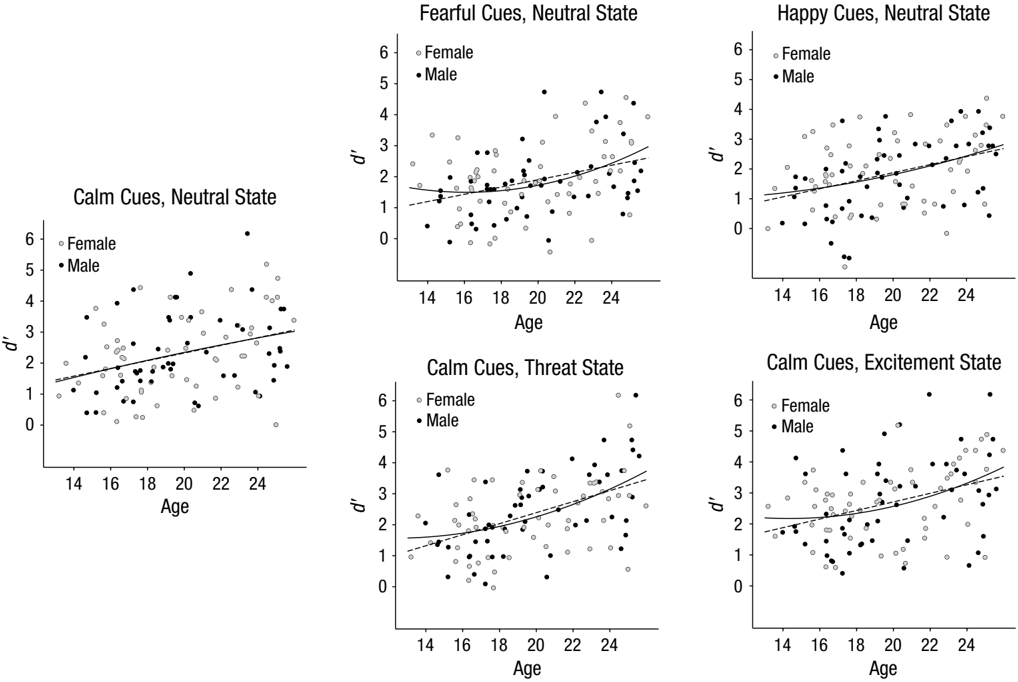
- In neutral-state blocks, age group affected performance for fearful cues, \(F(2, 98) = 11.11, p < .001, \eta_p^2 = .16\); happy cues, \(F(2, 98) = 10.90, p < .001, \eta_p^2 = .15\); and calm cues, \(F(2, 98) = 7.81, p < .001, \eta_p^2 = .10\). For fearful cues, teens and 18- to 21-year-olds performed worse than adults over 21; for happy cues, young adults and adults performed better than teens; for calm cues, only teens and adults differed significantly.
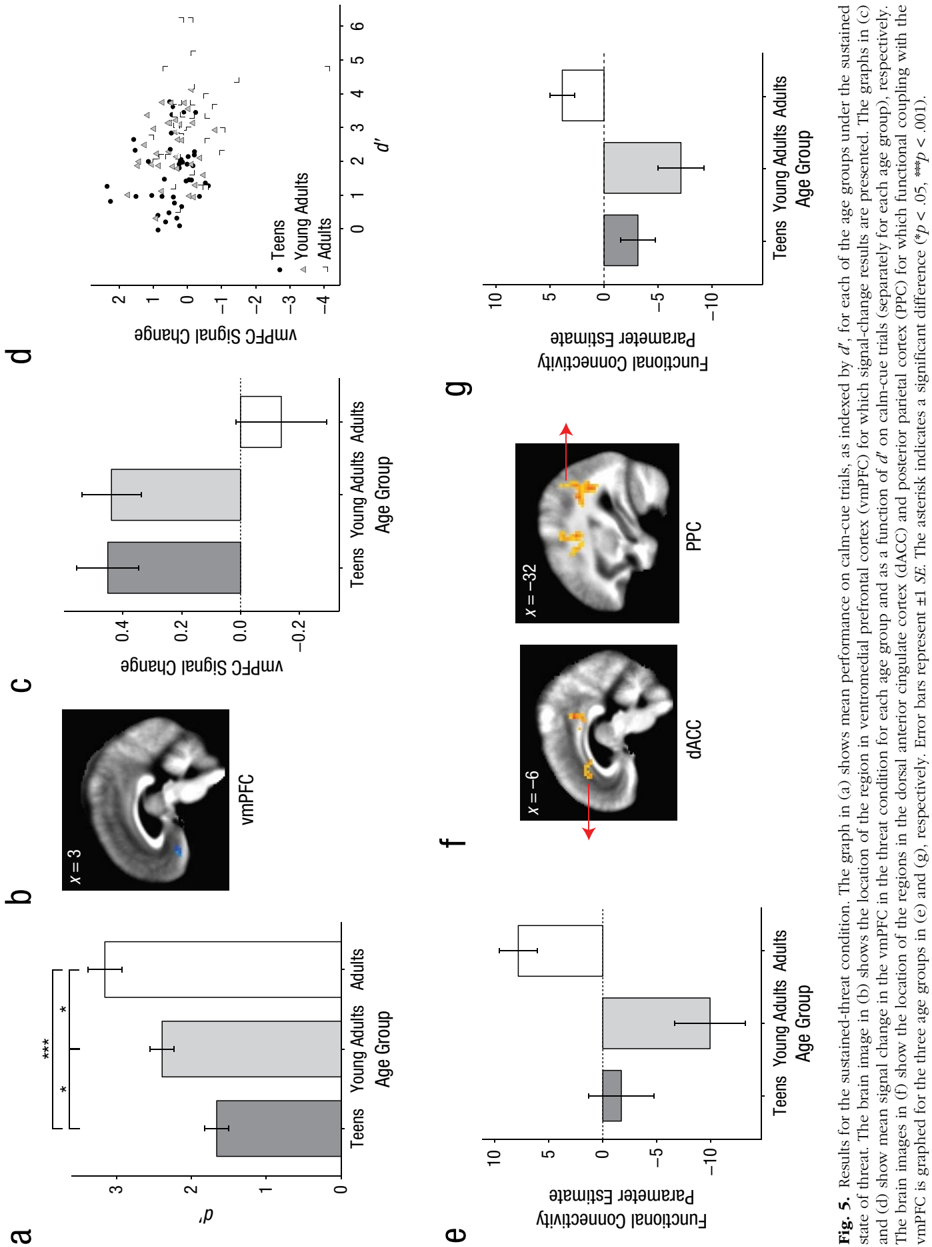
- Under sustained threat, age group affected performance to calm cues, \(F(2, 98) = 17.57, p < .001, \eta_p^2 = .24\); teens and young adults both showed diminished performance relative to adults (teens vs. adults: \(t(60.47) = 5.40, p < .001, d = 1.24\); young adults vs. adults: \(t(59.51) = 2.75, p = .014, d = 0.66\)). Under excitement, the age-group effect was \(F(2, 98) = 8.65, p < .001, \eta_p^2 = .13\), with only teens and adults differing significantly.
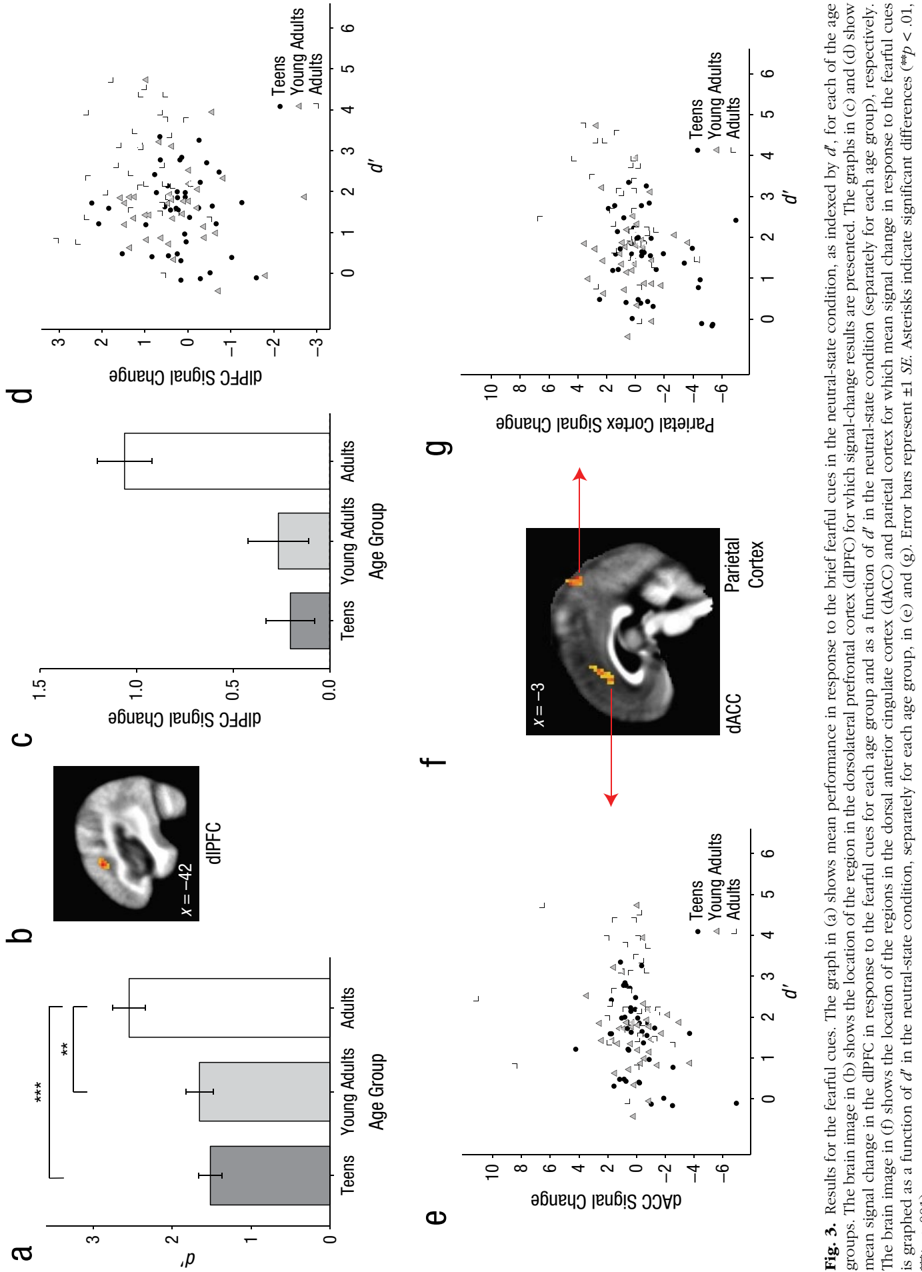
- For fearful cues, teens and young adults showed less activity than adults in right dlPFC (47 voxels; \(Z = -4.66, p < .02\), corrected) and right thalamus (57 voxels; \(Z = -3.88, p < .02\), corrected). Under threat, a vmPFC cluster survived PFC correction (13 voxels; \(Z = 3.58, p < .05\), PFC corrected), and vmPFC signal change was negatively correlated with threat-condition performance, \(r(108) = -.308, p = .001\), remaining significant when controlling for age, \(r(107) = -.215, p = .023\).
- Whole-brain gPPI analyses found nine clusters showing less functional coupling with vmPFC in teens and young adults than in adults across the threat condition, including dACC and posterior parietal cortex.
Methods
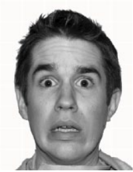
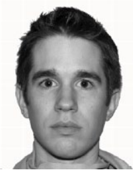
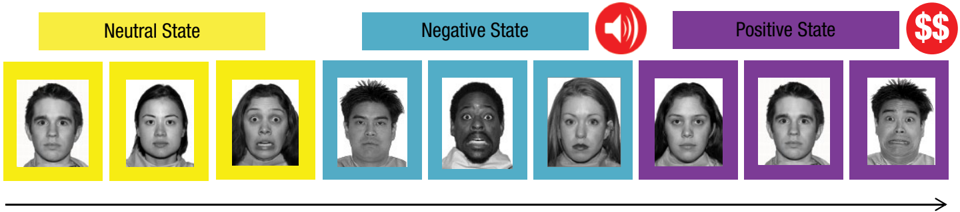
- Participants were 110 individuals from a larger sample of 147 healthy, right-handed 13- to 25-year-olds recruited from New York City and Los Angeles: 41 teens ages 13–17 (\(M = 16.19, SD = 1.20\)), 35 young adults ages 18–21 (\(M = 19.88, SD = 1.09\)), and 34 adults ages 22–25 (\(M = 24.08, SD = 1.04\)). They completed an adapted emotional go/no-go task (Cognitive Control Under Emotion task) during fMRI under sustained threat, excitement, and neutral states, with happy, fearful, and calm faces as go/no-go cues.
- Behavioral accuracy was indexed by \(d'\) and analyzed with ANOVA models including sex and scanning site, Bonferroni-adjusted alpha of .01, plus linear and quadratic models with age continuous. fMRI data were preprocessed and analyzed in AFNI using GLMs and group linear mixed-effects models with sex and site as between-subjects variables; whole-brain voxel threshold was \(p = .005\), cluster threshold \(p = .05\) corrected, with an anatomical PFC ROI for the threat condition and gPPI connectivity analyses using dlPFC and vmPFC seeds.
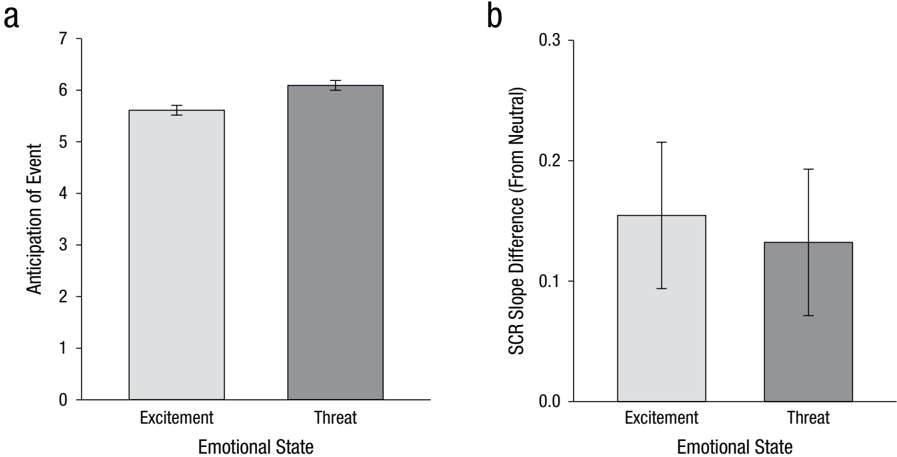
- Debriefing questions and skin conductance response (SCR) were used to validate the emotional-state manipulation.
Limitations
- The paper states that behaviors were measured within a controlled research setting and that the experimentally manipulated emotional conditions did not capture the complex real-world situations in which individuals typically make decisions.
- The paper states that the sample, although community based and representative of the racial and ethnic distribution in Los Angeles and New York City, was relatively small, with 110 participants ages 13 to 25, and that replication is warranted.
- Evident from the text: the study is cross-sectional, so it cannot directly establish within-person developmental change; additionally, portions of data from 38 adults in this sample are included in a separate report focusing on different experimental questions.
Model-written summary. Check it against the paper before relying on it.
Integrity signals
Registry
Cites
Statistics
Figures

Verification
Claims the paper makes
12 Valid · 3 Not valid · 7 Not checked · 105 Own results and interpretations
The cited sources support only part of this claim — read each source’s verdict below.
In the paper
“Studies show that adolescence, typically defined as ages 13 through 17, is a time of heightened sensitivity to motivational, social, and emotional information (Casey, 2015; Steinberg, 2010).”
What the sources say
- Not checked — no full text of the sourcecites Casey, 2015 matched to “Beyond simple models of self-control to circuit-based accounts of adolescent behavior” (2015) source
- Partly supportedcites Steinberg, 2010 matched to “A dual systems model of adolescent risk‐taking” (2010) sourceExperimental — accuracy not yet measured
The Introduction links adolescence to increased reward-seeking and activity in the socioemotional system, and the Discussion reports heightened reward-seeking most clearly in mid-adolescence. The paper does not define adolescence as ages 13–17 or establish heightened sensitivity to motivational, social, and emotional information generally; its Participants section studies ages 10–30. (LLM, conf=0.86)
plainstates an association- Asserted: passes — The authors put it forward as true.
- Checkable: passes — It can be checked against evidence.
- Load-bearing: passes — The paper’s conclusions depend on it.
- Based: passes — The paper gives a reason why it holds.
The cited sources support only part of this claim — read each source’s verdict below.
In the paper
“which shows marked change into the early 20s (Gogtay et al., 2004; Sowell et al., 2004).”
What the sources say
- Partly supportedcites Gogtay et al., 2004 matched to “Dynamic mapping of human cortical development during childhood through early adulthood” (2004) sourceExperimental — accuracy not yet measured
The Results report that the prefrontal cortex matures late and that orbitofrontal regions continued to mature until the oldest age studied; the Methods give the study’s age range as 4–21 years. This supports structural prefrontal change into the early 20s, but the paper maps cortical gray matter rather than measuring prefrontal circuitry. (LLM, conf=0.83)
- Not checked yetcites Sowell et al., 2004 matched to “Longitudinal Mapping of Cortical Thickness and Brain Growth in Normal Children” (2004) source
Checked before — its earlier verdict is held back until a new check runs.
plainstates an association- Asserted: passes — The authors put it forward as true.
- Checkable: passes — It can be checked against evidence.
- Load-bearing: passes — The paper’s conclusions depend on it.
- Based: passes — The paper gives a reason why it holds.
- Partly supported
The sources with a verdict support this claim; the rest weren’t checked yet, have no full text we could read, or their verdicts aren’t rated yet.
In the paper
“Behavioral regulation in response to these inputs has been shown to rely on prefrontal circuitry (Dreyfuss et al., 2014; Hare et al., 2008; Somerville et al., 2011)”
What the sources say
- Not checked yetcites Dreyfuss et al., 2014 matched to “Teens impulsively react rather than retreat from threat” (2014) source
Checked before — its earlier verdict is held back until a new check runs.
- Not checked — no full text of the sourcecites Hare et al., 2008 matched to “Biological Substrates of Emotional Reactivity and Regulation in Adolescence During an Emotional Go-Nogo Task” (2008) source
- Supportedcites Somerville et al., 2011 matched to “Frontostriatal maturation predicts cognitive control failure to appetitive cues in adolescents” (2011) source
The Discussion describes interactions involving the prefrontal cortex as critical to regulating motivated behavior and links frontostriatal engagement to suppressing responses to happy faces. The Conclusion also describes a prefrontal regulatory system involved in controlling approach behavior. The supplied passages do not give page numbers. (LLM, conf=0.87)
plainstates a cause- Asserted: passes — The authors put it forward as true.
- Checkable: passes — It can be checked against evidence.
- Load-bearing: passes — The paper’s conclusions depend on it.
- Based: passes — The paper gives a reason why it holds.
- Not checked yet
The cited sources support only part of this claim — read each source’s verdict below.
In the paper
“Specifically, during adolescence, cognitive-control capacities and decision making appear to be especially influenced by incentives (Galvan et al., 2006; Geier, Terwilliger, Teslovich, Velanova, & Luna, 2010; Somerville, Hare, & Casey, 2011; Van Leijenhorst et al., 2010), threats (CohenGilbert & Thomas, 2013; Dreyfuss et al., 2014; GroseFifer, Rodrigues, Hoover, &”
What the sources say
- Not checked — no full text of the sourcecites Galvan et al., 2006 matched to “Earlier development of the accumbens relative to orbitofrontal cortex might underlie risk-taking behavior in adolescents.” (2006) source
- Not checked — no full text of the sourcecites Hare et al., 2008 matched to “Biological Substrates of Emotional Reactivity and Regulation in Adolescence During an Emotional Go-Nogo Task” (2008) source
- Partly supportedcites Chein et al., 2011 matched to “Peers increase adolescent risk taking by enhancing activity in the brain’s reward circuitry” (2011) sourceExperimental — accuracy not yet measured
The Discussion reports that peers influenced adolescents’ risky decisions through increased reward-system activity. It also says cognitive-control activity was insensitive to peer context, so this source does not support peer influence on cognitive-control capacities. The incentive and threat citations in the printed sentence appear to be separate from this source. (LLM, conf=0.88)
hedgedstates an association- Asserted: passes — The authors put it forward as true.
- Checkable: passes — It can be checked against evidence.
- Load-bearing: passes — The paper’s conclusions depend on it.
- Based: passes — The paper gives a reason why it holds.
The cited sources support only part of this claim — read each source’s verdict below.
In the paper
“Resting-state functional-connectivity data show prolonged development of long-range cortical connectivity that does not stabilize until the 20s (Dosenbach et al., 2011; Fair et al., 2009).”
What the sources say
- Not matchedcites Dosenbach et al., 2011
An author–year citation the paper’s reference list doesn’t settle. We don’t search these by name.
- Partly supportedcites Fair et al., 2009 matched to “Functional brain networks develop from a local to distributed organization” (2009) sourceExperimental — accuracy not yet measured
The Results (Figure 5; page unavailable) report that many long-range functional connections strengthen from childhood to adulthood. The Methods compare children with an adult group averaging about 25 years old, but the paper does not establish when those connections stabilize; in fact, it notes that many long-range connections do not change significantly with age. (LLM, conf=0.86)
plainstates an association- Asserted: passes — The authors put it forward as true.
- Checkable: passes — It can be checked against evidence.
- Load-bearing: passes — The paper’s conclusions depend on it.
- Based: passes — The paper gives a reason why it holds.
- Not matched
64 more claims · 2 with their cited sources checked
Create a free account to see all 127 claims and to verify the 6 references still open.
- Probably not a substantial claim. 42
- It may state two separate claims as one. 31
Claims other papers make about this one
Each is checked against this paper’s own text: does it say what the citing paper says it does?
The cited source says what the claim attributes to it.
In the citing paper
“In contrast to subcortical changes, activity in ventromedial prefrontal cortex and its connectivity, show more protracted changes with age [18,35].”
From Development of the emotional brain (2019) · cites this paper as [18]
In the citing paper
“Teens showed diminished cognitive control relative to adults under both negative and positive emotional states. Like teens, young adults showed diminished performance relative to adults over 21, but only in the context of negatively valenced arousal.”
From Development of the emotional brain (2019) · cites this paper as [18]
In the citing paper
“This behavioral pattern was paralleled by enhanced ventromedial prefrontal activity associated with emotional regulation and diminished lateral prefrontal activity implicated in cognitive control in the teens and young adults.”
From Development of the emotional brain (2019) · cites this paper as [18]
Statistics that don’t add up
Each reported p-value recomputed from its test statistic and degrees of freedom, each partial η² from its F, and each ratio, mean difference or B printed with a p checked against its own confidence interval.
Rated minor: it would not touch a result — a value no result rests on, a p-value that stays on the same side of the significance level, or a conflict that is clerical, resolved elsewhere in the paper, or outside its own findings.
In the paper
“r (107) = .277, p = .002”
Reported p = .002 · recomputed p = .004
Rated minor: it would not touch a result — a value no result rests on, a p-value that stays on the same side of the significance level, or a conflict that is clerical, resolved elsewhere in the paper, or outside its own findings.
In the paper
“r (107) = .166, p = .081”
Reported p = .081 · recomputed p = .085
Rated minor: it would not touch a result — a value no result rests on, a p-value that stays on the same side of the significance level, or a conflict that is clerical, resolved elsewhere in the paper, or outside its own findings.
In the paper
“r (107) = -.215, p = .023”
Reported p = .023 · recomputed p = .025
Rated minor: it would not touch a result — a value no result rests on, a p-value that stays on the same side of the significance level, or a conflict that is clerical, resolved elsewhere in the paper, or outside its own findings.
In the paper
“F (2, 98) = 10.90, p < .001, η p 2 = .15”
Reported ηp² = .15 · recomputed ηp² = .1820
Rated minor: it would not touch a result — a value no result rests on, a p-value that stays on the same side of the significance level, or a conflict that is clerical, resolved elsewhere in the paper, or outside its own findings.
In the paper
“F (2, 98) = 7.81, p < .001, η p 2 = .10”
Reported ηp² = .10 · recomputed ηp² .1374–.1375
3 more findings
Create a free account to see every finding of this check.
Statistics recomputed
Every reported test result, recomputed from its test statistic and degrees of freedom. A result shows as not adding up only once an independent check has confirmed it.
- Doesn’t add upr(107) = 0.166reported p = .081 · recomputed p = .085
“r (107) = .166, p = .081”
- Doesn’t add upr(107) = 0.277reported p = .002 · recomputed p = .004
“r (107) = .277, p = .002”
- Doesn’t add upr(107) = -0.215reported p = .023 · recomputed p = .025
“r (107) = -.215, p = .023”
- Not confirmedt(74) = 1.92reported p = .029 · recomputed p = .059
“t (74) = 1.92, p = .029”
- Not confirmedt(74) = 1.65reported p = .051 · recomputed p = .103
“t (74) = 1.65, p = .051”
44 more recomputed tests
Create a free account to see every test the Stats check recomputed.
Self-check
Percentages, sums and reported differences re-computed from the paper’s own numbers.
Each contradiction between two passages listed here was confirmed by an independent check.
Rated minor: it would not touch a result — a value no result rests on, a p-value that stays on the same side of the significance level, or a conflict that is clerical, resolved elsewhere in the paper, or outside its own findings.
In the paper
§ Behavioral and psychophysiological data acquisition · p. 5
“SCR data were acquired from all the participants.”
§ Behavioral data analysis · p. 6
“Six subjects had no SCR data because of technical difficulties in the collection of these data”
Citations
Cites
R: A Language and Environment for Statistical Computing
R Core Team (2025) · doi:10.32614/r.manuals · Cited by 352,181
Advances in functional and structural MR image analysis and implementation as FSL
Smith, S. M., Jenkinson, M., Woolrich, M. W., Beckmann, C. F., Behrens, T. E. J., Johansen-Berg, H., Bannister, P. R., De Luca, M., Drobnjak, I., Flitney, D. E., et al. (2004) · NeuroImage · doi:10.1016/j.neuroimage.2004.07.051 · Cited by 13,630
AFNI: Software for analysis and visualization of functional magnetic resonance neuroimages
Cox, R. W. (1996) · Computers and Biomedical Research · doi:10.1006/cbmr.1996.0014 · Cited by 10,913
Dynamic mapping of human cortical development during childhood through early adulthood
Gogtay, N., Giedd, J. N., Lusk, L., Hayashi, K. M., Greenstein, D., Vaituzis, A. C., Nugent, T. F., Herman, D. H., Clasen, L. S., Toga, A. W., et al. (2004) · Proceedings of the National Academy of Sciences · doi:10.1073/pnas.0402680101 · Cited by 5,604 · cited 3×
“, 2014), whereas development of prefrontal cortex (PFC) exhibits a roughly linear trajectory (Galvan et al., 2006; Gogtay et al., 2004; Sowell et al., 2004).”
BackgroundResultCasey, B. J., Jones, R. M., & Hare, T. A. (2008) · Annals of the New York Academy of Sciences · doi:10.1196/annals.1440.010 · Cited by 3,345
Self-citationGardner, M., & Steinberg, L. (2005) · Developmental Psychology · doi:10.1037/0012-1649.41.4.625 · Cited by 2,218
Self-citationPrediction of individual brain maturity using fMRI
Dosenbach, N. U. F., Nardos, B., Cohen, A. L., Fair, D. A., Power, J. D., Church, J. A., Nelson, S. M., Wig, G. S., Vogel, A. C., Lessov-Schlaggar, C. N., et al. (2010) · Science · doi:10.1126/science.1194144 · Cited by 2,183 · cited 1×
“Resting-state functional-connectivity data show prolonged development of long-range cortical connectivity that does not stabilize until the 20s (Dosenbach et al., 2011; Fair et al., 2009).”
BackgroundSelf-citationConflict monitoring versus selection-for-action in anterior cingulate cortex
Botvinick, M., Nystrom, L. E., Fissell, K., Carter, C. S., & Cohen, J. D. (1999) · Nature · doi:10.1038/46035 · Cited by 2,044
Evidence for a Frontoparietal Control System Revealed by Intrinsic Functional Connectivity
Vincent, J. L., Kahn, I., Snyder, A. Z., Raichle, M. E., & Buckner, R. L. (2008) · Journal of Neurophysiology · doi:10.1152/jn.90355.2008 · Cited by 1,869 · cited 1×
“When presented with fearful cues, teens and young adults showed less activity than older adults in dlPFC, a region implicated in affective and cognitive regulation (Silvers et al., 2015; Vincent et al., 2008), and in the dACC and parietal cortex.”
BackgroundCasey, B. J., Getz, S., & Galvan, A. (2008) · Developmental Review · doi:10.1016/j.dr.2007.08.003 · Cited by 1,810
Self-citation
Research works printed but not linked: 2
- Scott, E. S. (2013). 'Children are different': Constitutional values and justice policy. Ohio State Journal of Criminal Law , 11 , 71-105.
- Taylor-Thompson, K. (2014). Minority rule: Redefining the age of criminality. N.Y.U. Review of Law & Social Change , 38 , 143-200.
Cited by
Items 201–275 of 275
Kwon, M., Kim, H., Yang, J., et al. (2021) · bioRxiv (Cold Spring Harbor Laboratory) · doi:10.1101/2021.02.17.431718 · Cited by 1
Leon, M. D. C., Moreira, J. F. G., Saragosa-Harris, N. M., Waizman, Y. H., Sedykin, A. E., Peris, T. S., & Silvers, J. A. (2020) · doi:10.31234/osf.io/kesj5 · Cited by 1
Owen-Boukra, E. (2021) · Cronfa (Swansea University) · doi:10.23889/suthesis.58701 · Cited by 2
Duarte, C. E. M. (2021) · Gredos (University of Salamanca) · doi:10.14201/gredos.149617 · Cited by 1
Han, L., Rolls, E. T., Liu, H., Stein, D. J., Sahakian, B. J., Elliott, R., Jia, T., Xie, C., Xiang, S., Wang, N., et al. (2024) · bioRxiv (Cold Spring Harbor Laboratory) · doi:10.1101/2024.09.16.612982 · Cited by 1
The role of adolescence in geographic variation in violent aggression
Marsh, A. A. (2017) · Behavioral and Brain Sciences · doi:10.1017/s0140525x16001059
The Influence Factors of Cognitive Control
高, 莹. (2018) · Advances in Psychology · doi:10.12677/ap.2018.81002
Increasing Psychiatric Treatment Engagement and Adherence in the College Population
Bardin, A., Cheney, B., & Braider, L. (2019) · Springer eBooks · doi:10.1007/978-3-030-12665-0_5 · Cited by 1
Alpers, L., & Fondacaro, M. R. (2019) · CUNY Academic Works (City University of New York)
Silva, K., & Miller, V. A. (2019) · Applied Developmental Science · doi:10.1080/10888691.2019.1700797 · Cited by 2
“For instance, when individuals are exposed to negative or threatening emotional cues, adolescents’ ability to resist impulsive reactions is relatively compromised (Cohen et al., 2016).”
BackgroundInfluentialPeer Presence Makes Adolescents More Risk Taking: Evidence from Brain Science Research
程, 丹. (2020) · Advances in Psychology · doi:10.12677/ap.2020.107107
Neurolaw in Australia: The use of neuroscience in Australian criminal proceedingsPreprint
Alimardani, A., & Chin, J. M. (2018) · doi:10.31228/osf.io/8v9fp
Lying strategies in juveniles during Behavior Analysis Interviews
Bettens, T. (2021) · UTC Scholar (University of Tennessee at Chattanooga)
Personality And Criminal Trajectories In Young Adults Held In Chilean Prisons
Pérez-Luco, R., Armijo, C. A., Estrada, A., Alarcón, P., Wenger, L., & Chesta, S. A. (2021) · The European Proceedings of Social & Behavioural Sciences · doi:10.15405/epsbs.2021.06.04.31
“From the psychological perspective of the development of maturity, Cohen et al. (2016) report that deviation in antisocial behavior is due to an inclination towards incentives and risk-taking, presenting difficulties in suppressing attention and actions towards emotional stimuli, even when they are…”
BackgroundBekaert, S. (2021) · Demeter Press eBooks · doi:10.2307/j.ctv1s2t0hn.46
Brain Development and the Risk for Substance Abuse
Heitzeg, M. M., & Casey, B. J. (2017) · Oxford University Press eBooks · doi:10.1093/med/9780190681425.003.0047 · Cited by 1
Self-citationParents versus peers: Assessing the impact of social agents on decision making in young adulthoodPreprint
Moreira, J. F. G., Tashjian, S. M., Galván, A., & Silvers, J. A. (2017) · PsyArXiv (OSF Preprints) · doi:10.31234/osf.io/v8epx
Self-citationPerino, M. T., Moreira, J. F. G., McCormick, E. M., et al. (2018) · doi:10.31234/osf.io/u68et
Distinct and similar patterns of emotional development in adolescents and young adultsPreprint
Bos, D. J., Dreyfuss, M., Tottenham, N., Hare, T. A., Galván, A., Casey, B. J., & Jones, R. M. (2019) · PsyArXiv (OSF Preprints) · doi:10.31234/osf.io/s98mh
Self-citationThe Timing of Brain Maturation, Early Experience and the Human Social NichePreprint
Uchiyama, R., & Finlay, B. L. (2020) · PsyArXiv (OSF Preprints) · doi:10.31234/osf.io/r9mce
Deans, E., Abdo, J., Ravulo, J., et al. (2022) · Research Square · doi:10.21203/rs.3.rs-2032338/v1
Desenvolvimento e validação da versão preliminar da escala da pós-adolescência
Maroni, C. T. (2022) · Digital Library of Theses and Dissertations (Universidade de São Paulo) · doi:10.11606/d.47.2022.tde-16112022-185052 · Cited by 1
Dual and multi-process models of adolescent risk taking
Edelson, S. M., & Reyna, V. F. (2022) · Elsevier eBooks · doi:10.1016/b978-0-12-818872-9.00150-3 · Cited by 2
Assessment and Treatment of Adolescents and Emerging Adults in Jails
Feingold, Z. R., Cruise, K. R., & Glover, A. C. (2023) · Oxford University Press eBooks · doi:10.1093/oso/9780197524794.003.0011
Applying Functional MRI to Study Adolescent Substance Use
Crum, K. I., Bixler, K., & Hulvershorn, L. A. (2023) · Neuromethods · doi:10.1007/978-1-0716-3267-3_5
Kilkelly, U., Forde, L., Lambert, S., & Swirak, K. (2023) · Palgrave critical studies in human rights and criminology · doi:10.1007/978-3-031-36652-9_3
Adolescents and Youth Justice: Framing the Developmental Research
Grisso, T. (2023) · Oxford University Press eBooks · doi:10.1093/oxfordhb/9780197549513.013.19
Santos‐Silva, T. (2023) · Digital Library of Theses and Dissertations (Universidade de São Paulo) · doi:10.11606/t.17.2023.tde-10112023-160657
Transitioning to Adulthood in the Legal System: The Creation of Young Adult Courts
Gillespie, M. L., Riano, N. S., & Cauffman, E. E. (2023) · Oxford University Press eBooks · doi:10.1093/oxfordhb/9780197549513.013.22 · Cited by 1
Sari, D. K., & Abidin, M. N. B. Z. (2023) · Journal of Professional Teacher Education · doi:10.12928/jprotect.v1i2.623 · Cited by 3
“If these negative emotions are not controlled, they will then lead to negative emotions and negative impacts such as drug abuse, difficulty socializing, and self-destructive actions (Cohen et al., 2016; Schweizer et al., 2020).”
BackgroundBevan, M. (2024) · Oxford University Press eBooks · doi:10.1093/oso/9780192855497.003.0005
Schedule of Police Station Observations
Bevan, M. (2024) · Oxford University Press eBooks · doi:10.1093/oso/9780192855497.005.0002
Conclusion: Rethinking the Use of Police Custody for Children
Bevan, M. (2024) · Oxford University Press eBooks · doi:10.1093/oso/9780192855497.003.0007
(2024) · Oxford University Press eBooks · doi:10.1093/oso/9780192855497.002.0004
Bringing Child Suspects into the Light
Bevan, M. (2024) · Oxford University Press eBooks · doi:10.1093/oso/9780192855497.003.0001
(2024) · Oxford University Press eBooks · doi:10.1093/oso/9780192855497.002.0012
(2024) · Oxford University Press eBooks · doi:10.1093/oso/9780192855497.002.0011
(2024) · Oxford University Press eBooks · doi:10.1093/oso/9780192855497.002.0010
The Child as Legal Actor: Understanding and Exercising Rights
Bevan, M. (2024) · Oxford University Press eBooks · doi:10.1093/oso/9780192855497.003.0003
Schedule of Young Participant Interviews
Bevan, M. (2024) · Oxford University Press eBooks · doi:10.1093/oso/9780192855497.005.0001
(2024) · Oxford University Press eBooks · doi:10.1093/oso/9780192855497.002.0006
The Early Stages: Adversity and Adversariality in Collision
Bevan, M. (2024) · Oxford University Press eBooks · doi:10.1093/oso/9780192855497.003.0002
Making Good the Imbalance? Examining the Appropriate Adult Role
Bevan, M. (2024) · Oxford University Press eBooks · doi:10.1093/oso/9780192855497.003.0004
Police Interview: A Counterproductive Process?
Bevan, M. (2024) · Oxford University Press eBooks · doi:10.1093/oso/9780192855497.003.0006
(2024) · Oxford University Press eBooks · doi:10.1093/oso/9780192855497.002.0005
Becoming Connected - Adolescent Social-Cognitive Development in the Peer Context
Hollarek, M. (2024) · doi:10.5463/thesis.492 · Cited by 1
Hercules, K., Liu, Z., Wei, J., Venegas, G., Ciocca, O., Dyer, A., Lee, G., Santini-Bishop, S., Shappell, H. M., Gee, D. G., et al. (2024) · bioRxiv (Cold Spring Harbor Laboratory) · doi:10.1101/2024.09.13.612668
Vaughan, A. M., & Perone, S. (2024) · Personality and Individual Differences · doi:10.1016/j.paid.2024.112899 · Cited by 1
Deans, E., Abdo, J., Ravulo, J. J., & Conroy, E. (2024) · Child Protection and Practice · doi:10.1016/j.chipro.2024.100068 · Cited by 2
Kuhney, F. S., Mittal, V. A., & Damme, K. S. F. (2024) · SSRN Electronic Journal · doi:10.2139/ssrn.5004109
Clough, I. M., & Thomas, A. G. (2024) · Crime & Delinquency · doi:10.1177/00111287241298690
“…consequences when making stressful and time-sensitive decisions, and are influenced by social factors that do not similarly affect adults’ decision-making (e.g., peer pressure; Albert et al., 2013; Cauffman & Steinberg, 1995; Chein et al., 2011; Cohen et al., 2016; Gardner & Steinberg, 2005).”
Psychological and Brain Development
Schleim, S. (2024) · Palgrave Studies in Law, Neuroscience, and Human Behavior · doi:10.1007/978-3-031-72362-9_2
The effect of SNAP benefit distribution on subjective well-being
Engel, K. (2025) · Review of Economics of the Household · doi:10.1007/s11150-024-09755-0 · Cited by 1
Parents versus peers: Assessing the impact of social agents on decision making in young adulthoodPreprint
Moreira, J. F. G., Tashjian, S. M., Galván, A., & Silvers, J. A. (2017) · PsyArXiv (OSF Preprints) · doi:10.31234/osf.io/v8epx_v1
Self-citationSelf-Regulation in Eating Disorders
Shevlin, B. R. K., Chester, M. A., Qiu, J. L., Lou, S., & Berner, L. A. (2025) · Oxford University Press eBooks · doi:10.1093/9780197675212.003.0013
Gonzalez, M. S., Triedman, M., Mandapati, A., Tanzer, J. R., Rosen, R. K., Jelalian, E., & Jandasek, B. N. (2025) · Frontiers in Adolescent Medicine · doi:10.3389/fradm.2025.1667649
Unveiling the Psychological Dimensions of Child Labor
dos Santos, E. F. M. D. P., & Colagrossi, A. L. R. (2024) · Emerald Group Publishing Limited eBooks · doi:10.1108/979-8-88730-582-020251014
Kuhney, F. S., Mittal, V. A., & Damme, K. S. F. (2026) · JAACAP Open · doi:10.1016/j.jaacop.2025.12.006
Laugalis, V. R. (2026) · Behavioral Sciences & the Law · doi:10.1002/bsl.70047
Herring, T. T., Ingram, P. B., & Rogers, C. R. (2026) · Journal of Clinical and Experimental Neuropsychology · doi:10.1080/13803395.2026.2624581
Dinh, H. V., & Le, Q. M. (2026) · Journal of Tourism Futures · doi:10.1108/jtf-04-2025-0085
Fowles, H. E., & Allen, P. (2026) · Journal of Robustness Reports · doi:10.21468/jrobustrep.3-rr1
“We sub-sampled participants between 18-21 years as [8-10] found differences in emotion processing and regulation between adolescence and adulthood.”
L'influence du contexte social sur le contrôle inhibiteur et la créativité au cours du développement
Bouhours, L. (2018) · theses.fr (ABES) · doi:10.70675/302dfd17z8214z4263z8df5zf30855e8a5d1 · Cited by 1
Social cognition under threat anxiety-inducing contexts
Beaurenaut, M. (2021) · theses.fr (ABES) · doi:10.70675/036de6dez39e8z4267zb060z66d81110d596
Effects of working memory and reward reactivity on externalizing behaviors in the ABCD study
Schettini, E. M., Cheavens, J. S., & Saygin, Z. M. (2026) · Developmental Cognitive Neuroscience · doi:10.1016/j.dcn.2026.101743
“The EN-back task has been used to elicit neural activation to working memory (Cohen et al., 2016; Owen et al., 2005).”
Riachi, M., Spivak, B., McEwan, T. E., & Papalia, N. L. (2026) · Journal of Interpersonal Violence · doi:10.1177/08862605261444015
“The inclusion of young people up to 25 years old reflects the increasing recognition of delayed brain maturation for individuals into their twenties (Cohen et al., 2016; Scott et al., 2016) and that many services for youth provide support to young people up until the age of 25 years (McGorry et…”
Zhang, T., Gong, Y., & Zhao, X. (2026) · Child Development · doi:10.1093/chidev/aacag107
Ta, V. P., Swafford, I. M., Lindsey, P., Efinger, L., Kohler, J., Fernandez, M., Torres, V. A., Gulliver, S. B., & Morissette, S. B. (2026) · PLoS ONE · doi:10.1371/journal.pone.0350551
“In high-stress occupations such as emergency call taking and dispatching, elevated emotional reactivity can compromise decision-making and executive function [35,36], increase impulsivity [37], and facilitate threat-biased judgments [38].”
A Developmental Neuroscience Framework for Youth-Centered Digital Media and Implications for Policy
Telzer, E. H., Burnell, K., Maheux, A. J., Vaccaro, A. G., & Prinstein, M. J. (2026) · Policy Insights from the Behavioral and Brain Sciences · doi:10.1177/23727322261471447 · Cited by 1
“This can increase vulnerability to impulsive decisions and compromised cognitive control, particularly in emotionally or socially salient contexts (Cohen et al., 2016).”
Integrating developmental and antiracist perspectives into juvenile legal system research
Simmons, C., Cavanagh, C., & Krupa, J. M. (2026) · Developmental Review · doi:10.1016/j.dr.2026.101302
Metadata
- Authors
- Cohen, A. O., Breiner, K., Steinberg, L., Bonnie, R. J., Scott, E. S., Taylor-Thompson, K., Rudolph, M. D., Chein, J., Richeson, J. A., Heller, A. S., Silverman, M. R., Dellarco, D. V., Fair, D. A., Galván, A., & Casey, B. J.
- Affiliations
- Weill Cornell Medicine (US)
- University of California, Los Angeles (US)
- Temple University (US)
- University of Virginia (US)
- Columbia University (US)
- New York University School of Law, New York University
- Oregon Health & Science University (US)
- Northwestern University (US)
- University of Miami (US)
- Corresponding author
- Casey, B. J.
- ORCID
- Venue
- Psychological Science
- Publisher
- SAGE Publications
- Published
- 2016-02-24
- Volume
- 27
- Issue
- 4
- Pages
- 549-562
- ISSN
- 0956-7976 (ISSN-L)
- 1467-9280
- OpenAlex
- W2276111811
- Semantic Scholar
- 91967831cac862d6102be8355188a9ce476f44c5
- Cited by
- 272
- References
- 46
- Citations by year
- 2026: 20 · 2025: 13 · 2024: 38 · 2023: 35 · 2022: 29 · 2021: 25 · 2020: 27 · 2019: 31 · 2018: 18 · 2017: 25 · 2016: 10
- FWCI
- 17.77
- Type
- journal article
- Language
- en
- Update notices
- correction (2017-02-13)
- Open access
- green
- escholarship.org
- Licence
- journals.sagepub.com/page/policies/text-and-data-mining-license (tdm)
- Locations
- Psychological Science (publishedVersion)
- PubMed (publishedVersion)
- eScholarship (California Digital Library) (submittedVersion)
- Topics
- Life Sciences › Neuroscience › Cognitive Neuroscience › Neural and Behavioral Psychology Studies
- Social Sciences › Psychology › Clinical Psychology › Child and Adolescent Psychosocial and Emotional Development
- Social Sciences › Psychology › Clinical Psychology › Historical and Modern Theater Studies
- Keywords
- cognitive control, adolescence, emotional arousal, negative emotions, positive emotions, emotional go/no-go task, ventromedial prefrontal cortex, cognitive development, brain activity
- MeSH terms
- Adolescent, Adult, Arousal, Brain, Brain Mapping, Cognition, Emotions, Female, Humans, Image Processing, Computer-Assisted, Magnetic Resonance Imaging, Male, Nerve Net, New York City, Reaction Time, Los Angeles, Young Adult
About these checks
Registry, retraction, Cites and statistics results are computed, not judged, with one exception: a printed reference that no index lists is read once by a model before it counts as a citation error. Claims are extracted by a model and kept only when their quote appears verbatim in the text; each cited source is then checked, with a model’s help, for whether it says what the claim relies on. Those verdicts can be wrong — read the claim’s quote and the cited source before relying on one.
The claim verdicts this report counts are experimental: their accuracy is not yet measured.
A language model drew the claims from the paper on 2026-10-10, under version 3 of the claim definition (model deepseek-v4.1-flash, prompt extract-v3).
A second model labelled each claim on 2026-10-10 (model jev-1.13-20260917, definition revision gold-guideline-v0.2).
Cited sources are checked with a language model’s help (gpt-6-sol).
Statistics and arithmetic are recomputed, not judged.
Confidence bands are shown only for fields calibrated on our annotated test set. None is calibrated yet, so no band is shown.
What counts as a claim ›How we measure confidence ›How we check this ›
Are you an author, or do you see a problem with this page? Request a review
Data sources
Bibliographic data: Semantic Scholar, OpenAlex, Crossref.
Contains information from the Semantic Scholar Academic Graph Datasets, made available under the ODC Attribution License (ODC-BY 1.0).
Semantic Scholar’s data is described in: Kinney, R., et al. (2023). The Semantic Scholar Open Data Platform. arXiv:2301.10140.
