

The DOI matches its Crossref record; 4 of the 4 references it cites were found in a registry or an index.
Selecting, Optimizing, and Compensating During Lockdown: How Older Consumers Use Social Networking Services to Improve Social Well-Being
Abstract
During the COVID-19 pandemic, older consumers have increased their usage of social networking services (SNSs) to avoid social isolation, yet this behavior remains unexplored. Through selective optimization with compensation theory, the authors combine concepts from gerontology and marketing to investigate the following research question: How does older consumers’ usage of SNSs during the pandemic interrelate with the constructs of social well-being? The research draws on qualitative data collated during lockdown in the United Kingdom, including 14 semistructured interviews from participants age 65–80 and six months of netnographic data from an online forum geared toward older people. The findings reveal how older consumers leverage three strategies—selection, optimization, and compensation—to improve their use of SNSs and social interactions during lockdowns. Such behaviors in turn interrelate with the dimensions of social well-being: social acceptance, social integration, social contribution, social actualization, and social coherence. This research contributes to the marketing literature by (1) introducing a framework for transformative SNSs into transformative service research, (2) utilizing theory from gerontology studies to further understand the older consumer, and (3) enhancing the sparse understanding of older consumers’ use of SNSs. Future research directions and managerial implication are suggested for both marketers and developers of SNSs for aging consumers.
Overview
The claims and statistics of this paper haven’t been checked yet.
Run the check — free, no account needed. It reads the open-access text and checks the sources it cites.
Integrity signals
Registry
Cites
Statistics
Figures
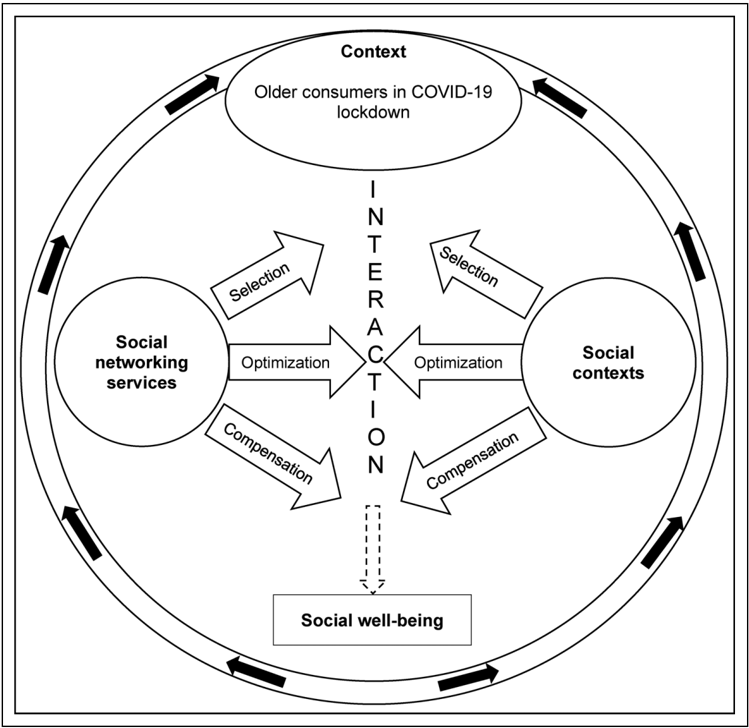
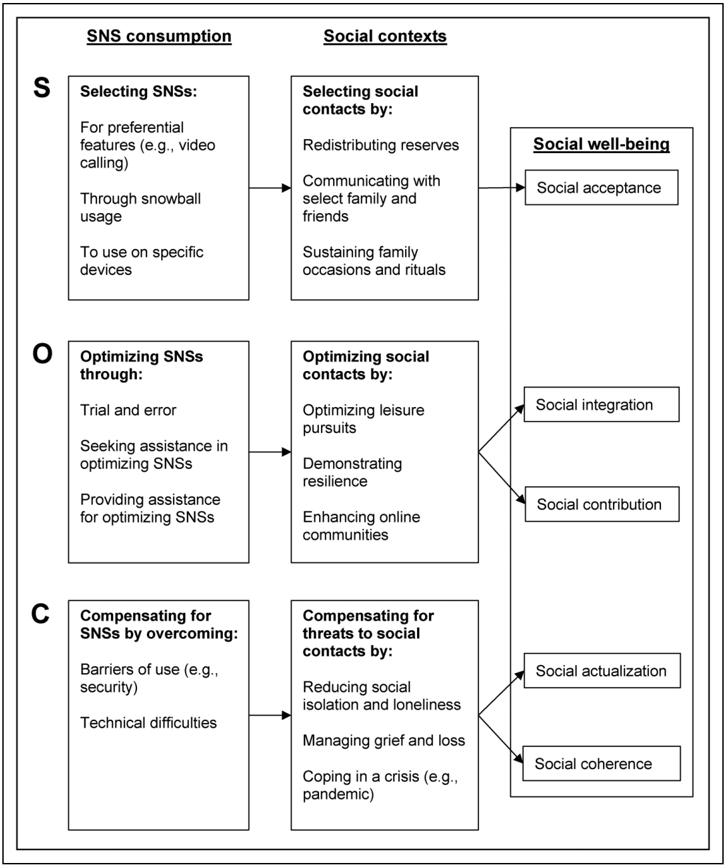
Verification
Claims the paper makes
The claims and statistics of this paper haven’t been checked yet.
Run the check — free, no account needed. It reads the open-access text and checks the sources it cites.
Claims other papers make about this one
Each is checked against this paper’s own text: does it say what the citing paper says it does?
The source backs part of the claim, not all of it — or backs it for a different population, condition or comparison.
In the citing paper
“Emotional trust in AI, comparable to trust in human relationships, contributes to users' emotional security, thereby enhancing overall social well-being (Wilson-Nash et al., 2023).”
From I love you, my AI companion! Do you? Perspectives from the Triangular Theory of Love and Attachment Theory (2026) · cites this paper as Wilson-Nash et al., 2023
Experimental — accuracy not yet measured
Self-check
Percentages, sums and reported differences re-computed from the paper’s own numbers.
The self-check needs the paper’s full text.
Citations
Cites
Quality of life from the perspectives of older people
GABRIEL, Z., & BOWLING, A. (2004) · Ageing and Society · doi:10.1017/s0144686x03001582 · Cited by 697
Social media use of older adults: a mini-review
Leist, A. K. (2013) · Gerontology · doi:10.1159/000346818 · Cited by 378
Kim, C., & Shen, C. (2020) · Computers in Human Behavior · doi:10.1016/j.chb.2019.106222 · Cited by 102
Pera, R., Quinton, S., & Baima, G. (2020) · Psychology & Marketing · doi:10.1002/mar.21337 · Cited by 69 · cited 13×
“…psychological well-being, which Ryff dimensionalizes as including self-acceptance, relationships, autonomy, environmental mastery, purpose in life, and personal growth, to explore older consumers ’ photo sharing on social media (Pera, Quinton, and Baima 2020) and use of SNS (Kim and Shen 2020).”
BackgroundMethodInfluential
Research works printed but not linked: 73
- 10.1177/1461444820958717 · DOI
- 10.3389/fpsyg.2015.01127 · DOI
- 10.1016/j.ijhm.2018.09.005 · DOI
- 10.1177/1094670515591316 · DOI
- 10.1016/j.jbusres.2012.08.013 · DOI
- 10.1108/JSM-05-2020-0174 · DOI
- 10.1017/CBO9780511665684.003 · DOI · Paper page
- 10.1108/JSM-05-2020-0177 · DOI
- 10.1093/jcmc/zmy012 · DOI
- 10.1080/10400435.2021.1945705 · DOI · Paper page
- 10.1016/j.chb.2012.12.004 · DOI · Paper page
- Braun Virginia, 2021, Thematic Analysis: A Practical Guide
- 10.4135/9781529716665.n5 · DOI
- 10.1016/j.chb.2021.106783 · DOI
- 10.1108/JSM-01-2021-0009 · DOI
- 10.1016/j.chb.2021.106716 · DOI
- 10.1037/a0023113 · DOI
- 10.1108/IJCHM-11-2020-1329 · DOI
- Day Ralph L., 1978, Marketing and the Quality of Life, 11
- Day Ralph L., 1987, Marketing and Quality-of-Life Interface, 289
- 10.1080/1369118X.2019.1631367 · DOI
- 10.5040/9781472545244 · DOI
- 10.1108/JSM-10-2018-0294 · DOI
- 10.1177/160940690600500107 · DOI · Paper page
- 10.1016/j.ijresmar.2020.06.002 · DOI
- 10.1016/j.jretconser.2021.102570 · DOI
- 10.1177/1468794111426607 · DOI
- 10.1093/ageing/afy154 · DOI
- 10.1024/1421-0185/a000243 · DOI
- 10.1159/000508824 · DOI
- 10.1016/j.chb.2016.02.080 · DOI
- 10.1080/10447318.2020.1749817 · DOI
- Kamin Stefan T., 2017, Gerontechnology: Research, Practice, and Principles in the Field of Technology and Aging, 35
- 10.2307/2787065 · DOI · Paper page
- 10.1016/j.chb.2020.106388 · DOI
- Kozinets Robert V., 2019, Netnography: The Essential Guide to Qualitative Social Media Research
- 10.1177/10541373211038084 · DOI
- 10.1111/joca.12302 · DOI
- 10.1080/13527266.2015.1036100 · DOI
- 10.1108/13522750710740790 · DOI
- 10.1111/jpim.12176 · DOI · Paper page
- 10.1177/0276146702238219 · DOI
- 10.1177/027614679101100102 · DOI
- 10.1057/s41270-017-0011-9 · DOI
- 10.1080/21639159.2019.1613907 · DOI
- 10.1108/09590550911005010 · DOI
- 10.1016/j.chb.2016.10.001 · DOI
- Mick David G., 2006, Advances in Consumer Research, 33, 1, 10.1086/504121 · DOI
- 10.1002/mar.20504 · DOI
- 10.1111/j.1745-6606.2011.01213.x · DOI
- 10.1145/2696869 · DOI
- 10.1093/geronb/gbz111 · DOI
- 10.1177/0743915619858939 · DOI
- 10.1016/j.ijinfomgt.2020.102171 · DOI · Paper page
- 10.1002/mar.20949 · DOI
- 10.1108/JSM-05-2016-0197 · DOI
- 10.1108/JSM-05-2014-0154 · DOI
- 10.1159/000212161 · DOI
- 10.1177/1354856520930905 · DOI · Paper page
- 10.1080/0267257X.2020.1850511 · DOI
- 10.4135/9781526416070.n15 · DOI
- 10.1037/0022-3514.57.6.1069 · DOI · Paper page
- 10.15358/0344-1369-2020-3-37 · DOI
- 10.1057/jma.2013.5 · DOI
- 10.1007/s10551-007-9363-y · DOI
- 10.1108/APJML-05-2020-0352 · DOI
- 10.1108/JSM-11-2019-0453 · DOI
- 10.1016/j.intmar.2021.07.001 · DOI
- 10.1108/JSM-10-2019-0386 · DOI
- Widlund Matilda (2021), “Product-Led Growth—The Future of User Acquisition, Expansion and Retention for SaaS Companies,” master’s thesis, Department of Information Technology, Disciplinary Domain of Science and Technology, Mathematics and Computer Science, Uppsala University, Sweden.
- 10.1080/0267257X.2021.1945662 · DOI
- 10.1080/0267257X.2013.778324 · DOI
- 10.1057/jt.2009.29 · DOI
Cited by
Sorted by citations
Ng, P. M. L., Wan, C., Lee, D., Garnelo-Gomez, I., & Lau, M. M. (2026) · Internet Research · doi:10.1108/intr-11-2024-1783 · Cited by 27
Metadata
- Authors
- Wilson-Nash, C., Pavlopoulou, I., & Wang, Z.
- Venue
- Journal of Interactive Marketing
- Publisher
- SAGE Publications
- Published
- 2023-02-12
- Volume
- 58
- Issue
- 2-3
- Pages
- 301-320
- ISSN
- 1094-9968
- 1520-6653
- Cited by
- 33
- References
- 4
- Language
- en
About these checks
Registry, retraction, Cites and statistics results are computed, not judged, with one exception: a printed reference that no index lists is read once by a model before it counts as a citation error. Claims are extracted by a model and kept only when their quote appears verbatim in the text; each cited source is then checked, with a model’s help, for whether it says what the claim relies on. Those verdicts can be wrong — read the claim’s quote and the cited source before relying on one.
Statistics and arithmetic are recomputed, not judged.
Confidence bands are shown only for fields calibrated on our annotated test set. None is calibrated yet, so no band is shown.
What counts as a claim ›How we measure confidence ›How we check this ›
Are you an author, or do you see a problem with this page? Request a review
