

The DOI matches its Crossref record; 35 of the 47 references it cites were found in a registry or an index.
What should autism research focus upon? Community views and priorities from the United Kingdom
Open accessAbstract
The rise in the measured prevalence of autism has been accompanied by much new research and research investment internationally. This study sought to establish whether the pattern of current UK autism research funding maps on to the concerns of the autism community. Interviews and focus groups were conducted with autistic adults, family members, practitioners and researchers to identify their priorities for research. We also captured the views of a large number of stakeholders via an online survey. There was a clear disparity between the United Kingdom’s pattern of funding for autism research and the priorities articulated by the majority of participants. There was general consensus that future priorities for autism research should lie in those areas that make a difference to people’s day-to-day lives. There needs to be greater involvement of the autism community both in priority setting and in research more broadly to ensure that resources reach where they are most needed and can make the most impact.
Overview
The claims and statistics of this paper haven’t been checked yet.
Run the check — free, no account needed. It reads the open-access text and checks the sources it cites.
Integrity signals
Registry
Cites
Statistics
Figures
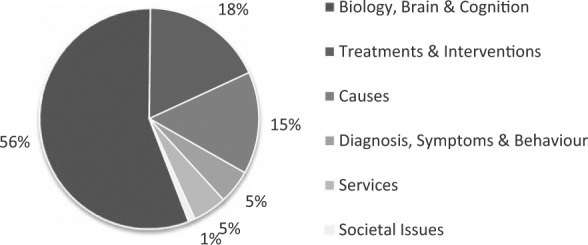
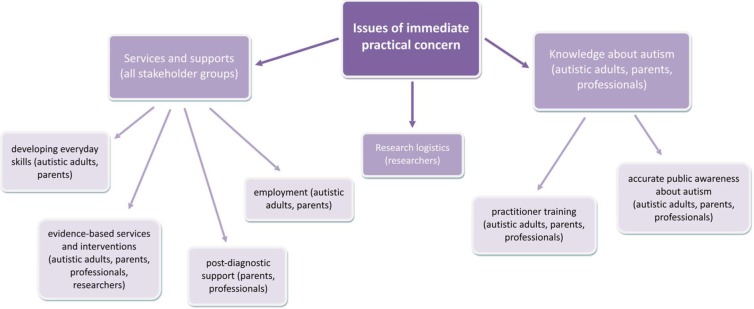
Verification
Claims the paper makes
The claims and statistics of this paper haven’t been checked yet.
Run the check — free, no account needed. It reads the open-access text and checks the sources it cites.
Claims other papers make about this one
Each is checked against this paper’s own text: does it say what the citing paper says it does?
The cited source says what the claim attributes to it.
In the citing paper
“Fostering trust and mutual respect in the process of developing research results in higher quality products that are useful to the community, as exemplified by research priorities developed in collaboration with the autism community in the United Kingdom (e.g. Pellicano et al., 2014; Warner et al., 2019).”
From Listening to the autistic voice: Mental health priorities to guide research and practice in autism from a stakeholder-driven project (2020) · cites this paper as Pellicano et al., 2014
Self-check
Percentages, sums and reported differences re-computed from the paper’s own numbers.
The self-check needs the paper’s full text.
Citations
Cites
Using thematic analysis in psychology
Braun, V., & Clarke, V. (2006) · Qualitative Research in Psychology · doi:10.1191/1478088706qp063oa · Cited by 194,414 · cited 1×
“The resulting data were analysed using thematic analysis (Braun and Clarke, 2006).”
MethodGlobal Prevalence of Autism and Other Pervasive Developmental Disorders
Elsabbagh, M., Divan, G., Koh, Y., Kim, Y. S., Kauchali, S., Marcín, C., Montiel‐Nava, C., Patel, V., Paula, C. S., Wang, C., et al. (2012) · Autism Research · doi:10.1002/aur.239 · Cited by 2,636 · cited 1×
“…in the United Kingdom (UK) has an autism spectrum condition (Baird et al., 2006; Brugha et al., 2011) – more than a 20-fold increase from the results of the first epidemiological study (Lotter, 1966) – and such estimates are similar in other parts of the world (e.g. Elsabbagh et al., 2012).”
ResultBaird, G., Simonoff, E., Pickles, A., Chandler, S., Loucas, T., Meldrum, D., & Charman, T. (2006) · The Lancet · doi:10.1111/j.1365-2214.2006.00706_3.x · Cited by 2,363 · cited 2×
“Recent figures estimate that approximately 1% of the population in the United Kingdom (UK) has an autism spectrum condition (Baird et al., 2006; Brugha et al., 2011) – more than a 20-fold increase from the results of the first epidemiological study (Lotter, 1966) – and such estimates are similar in…”
ResultSelf-citationFrederickson, R. (1997) · Molecular Therapy · doi:10.1016/j.ymthe.2005.01.001 · Cited by 2,221 · cited 2×
“The snowball sampling technique we used has advantages (of accessing previously ‘hidden’ populations; Atkinson and Flint, 2001) but is potentially biased towards the inclusion of individuals with greater inter-connections (e.”
MethodAdult outcome for children with autism
Howlin, P., Goode, S., Hutton, J., & Rutter, M. (2004) · Journal of Child Psychology and Psychiatry · doi:10.1111/j.1469-7610.2004.00215.x · Cited by 1,813 · cited 1×
“Autistic people are less likely to have a well-paying job than non-autistic people; many have fewer social contacts and connections outside their immediate family and many also struggle with their mental health and material well-being (e.g. Howlin et al., 2004, 2013; Howlin and Moss, 2012).”
BackgroundEpidemiology of Autism Spectrum Disorders in Adults in the Community in England
Brugha, T. S., McManus, S., Bankart, J., Scott, F., Purdon, S., Smith, J., Bebbington, P., Jenkins, R., & Meltzer, H. (2011) · Archives of General Psychiatry · doi:10.1001/archgenpsychiatry.2011.38 · Cited by 903 · cited 2×
“Recent figures estimate that approximately 1% of the population in the United Kingdom (UK) has an autism spectrum condition (Baird et al., 2006; Brugha et al., 2011) – more than a 20-fold increase from the results of the first epidemiological study (Lotter, 1966) – and such estimates are similar in…”
ResultEpidemiology of autistic conditions in young children: 1. Prevalence
Lotter, V. (1966) · Social Psychiatry · doi:10.1007/bf00584048 · Cited by 780 · cited 2×
“…in the United Kingdom (UK) has an autism spectrum condition (Baird et al., 2006; Brugha et al., 2011) – more than a 20-fold increase from the results of the first epidemiological study (Lotter, 1966) – and such estimates are similar in other parts of the world (e.g. Elsabbagh et al., 2012).”
ResultAdults with Autism Spectrum Disorders
Howlin, P., & Moss, P. (2012) · The Canadian Journal of Psychiatry · doi:10.1177/070674371205700502 · Cited by 559 · cited 1×
“Autistic people are less likely to have a well-paying job than non-autistic people; many have fewer social contacts and connections outside their immediate family and many also struggle with their mental health and material well-being (e.g. Howlin et al., 2004, 2013; Howlin and Moss, 2012).”
BackgroundThe Relation between Funding by the National Institutes of Health and the Burden of Disease
Gross, C. P., Anderson, G. F., & Powe, N. R. (1999) · New England Journal of Medicine · doi:10.1056/nejm199906173402406 · Cited by 509 · cited 1×
“Defining the value of a human life in monetary terms is obviously far from straightforward (Gross et al., 1999), often involving multiple and valueladen assumptions.”
BackgroundHowlin, P., Moss, P., Savage, S., & Rutter, M. L. (2013) · Journal of the American Academy of Child & Adolescent Psychiatry · doi:10.1016/j.jaac.2013.02.017 · Cited by 462 · cited 1×
“Autistic people are less likely to have a well-paying job than non-autistic people; many have fewer social contacts and connections outside their immediate family and many also struggle with their mental health and material well-being (e.g. Howlin et al., 2004, 2013; Howlin and Moss, 2012).”
Background
Research works printed but not linked: 7
- 10.1016/S0140-6736(06)69041-7 · DOI · Paper page
- Charman T, 2004, Mapping Autism Research: Identifying UK Priorities for the Future
- Dawson G, 2013, Archives of General Psychiatry, 70, 9
- Milton DEM, 2013, Medical Sociology Online, 7, 61
- Ne’eman A, 2011, Talk about Autism Q&A: Ari Ne’eman –
- Pellicano E, 2013, A future made together: Shaping autism research in the UK
- Pellicano E, PLOS One
Cited by
Sorted by citations
Items 701–714 of 714
Liminal Brains in Uncertain Futures
Choudhury, S., & Berson, J. (2020) · Cambridge University Press eBooks · doi:10.1017/9781108695374.020 · Cited by 1
Neuroscience and its Contribution to Neuroeducation for Individuals with Autism Spectrum Disorder
Lisa, J. S., & Shyman, E. (2020) · OBM Neurobiology · doi:10.21926/obm.neurobiol.2001051
Reflective Practitioners and Participant Observers in Autism Services
Long, J. J. (2020) · Anthropology in Action · doi:10.3167/aia.2020.270104 · Cited by 3
Barrett, M., & Brugha, T. (2020) · Oxford Textbook of the Psychiatry of Intellectual Disability · doi:10.1093/med/9780198794585.003.0007
Frazier, T. W. (2019) · Springer eBooks · doi:10.1007/978-1-4614-6435-8_102338-1 · Cited by 1
Woods, R., & Waldock, K. E. (2019) · Springer eBooks · doi:10.1007/978-1-4614-6435-8_102297-1 · Cited by 3
Autism Spectrum Disorders in the work of General Practitioners: a systematic narrative reviewPreprint
Coughlan, B., Duschinsky, R., O'Connor, M., & Woolgar, M. (2019) · doi:10.21203/rs.2.17270/v1
Alghadier, M., Alsedrani, R., Alhabib, N., Alnafea, T., Alramady, M., Alasraj, M., & Alsaaidi, S. (2026) · Journal of Disability Research · doi:10.57197/jdr-2026-0936
Autism Acceptance, Peer Belonging, and Mental Health in U.S. High Schools
Oduro, P., Asamoah, B. K., & Khan, A. (2025) · Open Journal of Social Sciences · doi:10.4236/jss.2025.1310037 · Cited by 1
Autism and the ‘double empathy problem’
Milton, D., Waldock, K., & Keates, N. (2023) · Conversations on Empathy · doi:10.4324/9781003189978-6
Chay, P. Y., Yam, S.-Y.-A., Cheok, C., & Magiati, I. (2020) · Research in Autism · doi:10.1016/j.rasd.2019.101451
Kirmayer, L. J., Worthman, C. M., Kitayama, S., Lemelson, R., & Cummings, C. A. (2020) · Cambridge University Press eBooks · doi:10.1017/9781108695374.029
Kirmayer, L. J., Worthman, C. M., Kitayama, S., Lemelson, R., & Cummings, C. A. (2020) · Cambridge University Press eBooks · doi:10.1017/9781108695374.001
Metadata
- Authors
- Pellicano, E., Dinsmore, A., & Charman, T.
- Affiliations
- University of London (GB)
- King's College London (GB)
- Corresponding author
- Pellicano, Elizabeth
- Venue
- Autism
- Publisher
- SAGE Publications
- Published
- 2014-04-30
- Volume
- 18
- Issue
- 7
- Pages
- 756-770
- ISSN
- 1362-3613 (ISSN-L)
- 1461-7005
- PMC
- PMC4230972
- OpenAlex
- W2155427676
- Cited by
- 800
- References
- 47
- Citations by year
- 2026: 83 · 2025: 89 · 2024: 88 · 2023: 70 · 2022: 78 · 2021: 73 · 2020: 109 · 2019: 58 · 2018: 58 · 2017: 39 · 2016: 27 · 2015: 23 · 2014: 5
- FWCI
- 17.48
- Type
- journal article
- Language
- en
- Open access
- hybrid
- doi.org
- Locations
- Autism (publishedVersion, cc-by)
- Europe PMC (PubMed Central) (publishedVersion, cc-by)
- PubMed Central (publishedVersion, cc-by)
- PubMed (publishedVersion)
- Research Portal (King's College London) (publishedVersion, other-oa)
- UWA Profiles and Research Repository (UWA) (submittedVersion, other-oa)
- Funders
- Waterloo Foundation
- Wolfson Foundation
- Topics
- Life Sciences › Neuroscience › Cognitive Neuroscience › Autism Spectrum Disorder Research
- Health Sciences › Health Professions › General Health Professions › Mental Health and Patient Involvement
- Social Sciences › Psychology › Clinical Psychology › Family and Disability Support Research
- Keywords
- research funding, autism community, stakeholder perspectives, autistic adults, priority setting, community-engaged research, research investment, United Kingdom
- MeSH terms
- Adolescent, Adult, Aged, Aged, 80 and over, Attitude to Health, Autistic Disorder, Child, Child, Preschool, Female, United Kingdom, Health Services Needs and Demand, Humans, Interviews as Topic, Male, Middle Aged, Research, Residence Characteristics, Patient Satisfaction, Focus Groups, Young Adult
About these checks
Registry, retraction, Cites and statistics results are computed, not judged, with one exception: a printed reference that no index lists is read once by a model before it counts as a citation error. Claims are extracted by a model and kept only when their quote appears verbatim in the text; each cited source is then checked, with a model’s help, for whether it says what the claim relies on. Those verdicts can be wrong — read the claim’s quote and the cited source before relying on one.
Statistics and arithmetic are recomputed, not judged.
Confidence bands are shown only for fields calibrated on our annotated test set. None is calibrated yet, so no band is shown.
What counts as a claim ›How we measure confidence ›How we check this ›
Are you an author, or do you see a problem with this page? Request a review
