

Laboratory Protocol and Pilot Results for Dynamic Interference Testing of Continuous Glucose Monitoring Sensors
Open accessThe DOI matches its Crossref record, with a small difference in title or year; 16 of the 16 references it cites were found in a registry or an index.
Abstract
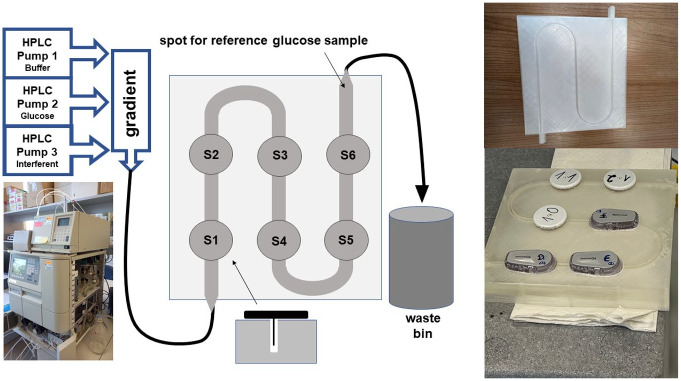
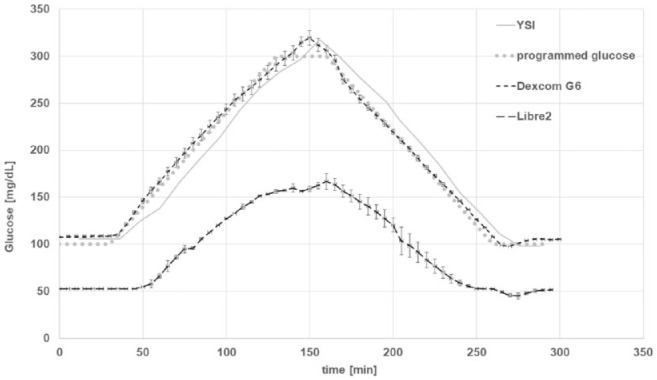
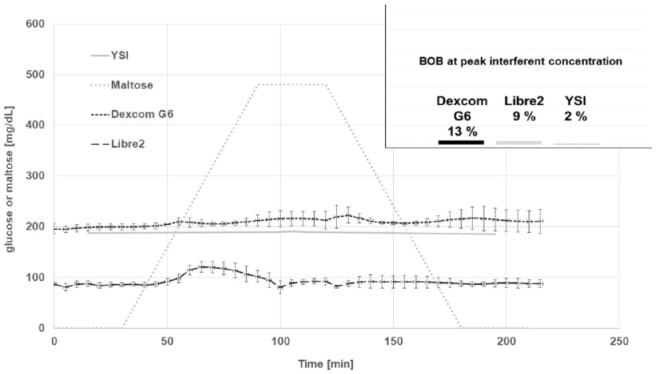
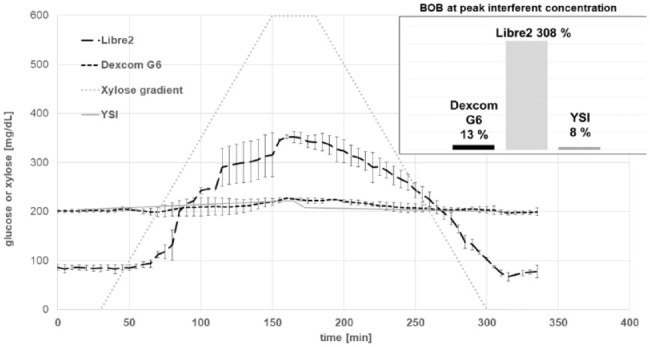
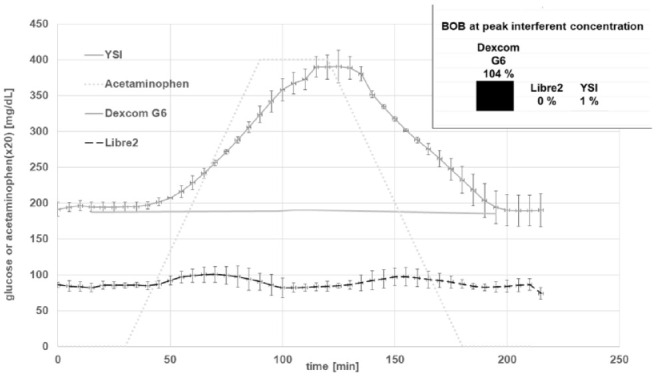
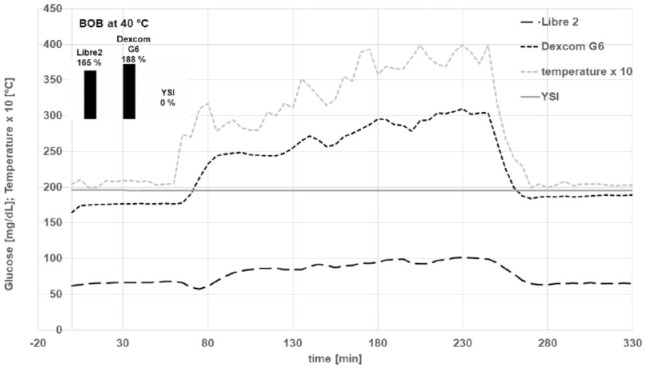
Background: Testing the potential influence of interfering substances on the measurement performance of needle sensors for continuous glucose monitoring (CGM) is a challenging task. For proper function, the sensors need an almost stable fluidic environment. Previously published in vitro interference experiments were measuring under static concentration conditons. Our experimental setup allows for interference testing with dynamic changes of the interferent concentrations. Methods: We designed a macrofluidic test stand that is fueled by several high-pressure liquid chromatography (HPLC) pumps generating programmable glucose and/or interferent gradients in phosphate-buffered saline (PBS). After optimizing experimental parameters (channel dimensions, temperature, flow rates, gradient slopes, buffer, pH etc.), we validated the setup using Dexcom G6 (G6) and Freestyle Libre 2 (L2) sensors with/without interferents, and using YSI 2300 Stat plus as the reference glucose device at room temperature. Results: Both sensors tracked the programmed glucose changes. After calibration, G6 results closely matched glucose reference readings, while L2 routinely showed ~50% to 60% lower readings, most likely because of the factory-based calibration and temperature compensation. Gradients of maltose, acetaminophen, and xylose were employed to further validate the setup. As expected, both sensors were not affected by maltose. We confirmed previous findings regarding susceptibility of G6 readings to acetaminophen and L2 readings to xylose. Signals from both sensors are influenced by temperature in a linear fashion. Conclusions: Our experimental in vitro setup and protocol may provide a useful method to dynamically test CGM sensors for interfering substances. This may help to improve the accuracy of future CGM sensor generations.
Overview
The claims and statistics of this paper haven’t been checked yet.
Free: it reads the open-access text and checks the first 5 claims that cite a source we can check. Create a free account to check every claim.
Integrity signals
Registry
Cites
Statistics
Figures
Verification
Claims the paper makes
The claims and statistics of this paper haven’t been checked yet.
Free: it reads the open-access text and checks the first 5 claims that cite a source we can check. Create a free account to check every claim.
Claims other papers make about this one
Each is checked against this paper’s own text: does it say what the citing paper says it does?
In the citing paper
“Hydroxyurea, used for myeloproliferative disorders and hematologic conditions, is one of the most recently identified interfering substances that cause a temporary increase in sensor glucose values discrepant from actual glucose values (129-134).”
From 7. Diabetes Technology: Standards of Care in Diabetes—2025 (2025) · cites this paper as [132]
Self-check
Percentages, sums and reported differences re-computed from the paper’s own numbers.
The self-check needs the paper’s full text.
Citations
Cites
Continuous glucose monitoring and intensive treatment of type 1 diabetes
(2008) · New England Journal of Medicine · doi:10.1056/nejmoa0805017 · Cited by 1,559
Breton, M. D., & Kovatchev, B. P. (2010) · Journal of Diabetes Science and Technology · doi:10.1177/193229681000400309 · Cited by 103
Effect of Acetaminophen on CGM Glucose in an Outpatient Setting
Maahs, D. M., DeSalvo, D., Pyle, L., Ly, T., Messer, L., Clinton, P., Westfall, E., Wadwa, R. P., & Buckingham, B. (2015) · Diabetes Care · doi:10.2337/dc15-1096 · Cited by 102
Basu, A., Veettil, S., Dyer, R., Peyser, T., & Basu, R. (2016) · Diabetes Technology & Therapeutics · doi:10.1089/dia.2015.0410 · Cited by 93 · cited 1×
“10 At the same time, the manufacturers tried to solve known interference issues and in 2018, Calhoun and coworkers reported a next generation CGM device (G6), where acet-aminophen interference appeared to be solved by use of a novel permselective membrane coating for the needle sensor.”
BackgroundReal-time continuous glucose monitoring system for treatment of diabetes: a systematic review
Hoeks, L. B. E. A., Greven, W. L., & de Valk, H. W. (2011) · Diabetic Medicine · doi:10.1111/j.1464-5491.2010.03177.x · Cited by 88
Lorenz, C., Sandoval, W., & Mortellaro, M. (2018) · Diabetes Technology & Therapeutics · doi:10.1089/dia.2018.0028 · Cited by 80
Continuous Glucose Monitor Interference With Commonly Prescribed Medications: A Pilot Study
Basu, A., Slama, M. Q., Nicholson, W. T., Langman, L., Peyser, T., Carter, R., & Basu, R. (2017) · Journal of Diabetes Science and Technology · doi:10.1177/1932296817697329 · Cited by 77 · cited 2×
“9 Blood and microdialysate ISF samples were collected periodically and analyzed for glucose and acetaminophen concentrations before and after oral ingestion of 1g of acetaminophen.”
MethodResultJoubert, M., & Reznik, Y. (2012) · Diabetes Research and Clinical Practice · doi:10.1016/j.diabres.2011.12.010 · Cited by 70
Interferences with CGM systems: practical relevance?
Heinemann, L. (2022) · Journal of Diabetes Science and Technology · doi:10.1177/19322968211065065 · Cited by 65 · cited 2×
“16 Only few reports exist in the current literature about such issues.”
BackgroundResistance to Acetaminophen Interference in a Novel Continuous Glucose Monitoring System
Calhoun, P., Johnson, T. K., Hughes, J., Price, D., & Balo, A. K. (2018) · Journal of Diabetes Science and Technology · doi:10.1177/1932296818755797 · Cited by 58 · cited 1×
“9 This may explain the difference between our findings and the work of Calhoun et al. 17 Still, Denham D reported increasing MARD values for the G6 sensors with multiple consecutive uptakes of doses of 1 g of acetamino-phen every 4 hours.”
Result
Cited by
7. Diabetes Technology: Standards of Care in Diabetes—2025
American Diabetes Association Professional Practice Committee, ElSayed, N. A., McCoy, R. G., Aleppo, G., Balapattabi, K., Beverly, E. A., Briggs Early, K., Bruemmer, D., Echouffo-Tcheugui, J. B., Ekhlaspour, L., et al. (2025) · Diabetes Care · doi:10.2337/dc25-s007 · Cited by 348
7. Diabetes Technology: Standards of Care in Diabetes — 2023
ElSayed, N. A., Aleppo, G., Aroda, V. R., Bannuru, R. R., Brown, F. M., Bruemmer, D., Collins, B. S., Hilliard, M. E., Isaacs, D., Johnson, E. L., et al. (2023) · Diabetes Care · doi:10.2337/dc23-s007 · Cited by 301
7. Diabetes Technology: Standards of Care in Diabetes—2024
American Diabetes Association Professional Practice Committee, ElSayed, N. A., Aleppo, G., Bannuru, R. R., Bruemmer, D., Collins, B. S., Ekhlaspour, L., Hilliard, M. E., Johnson, E. L., Khunti, K., et al. (2024) · Diabetes Care · doi:10.2337/dc24-s007 · Cited by 281
7. Diabetes Technology: Standards of Care in Diabetes—2026
Bajaj, M. S., McCoy, R. G., Balapattabi, K., Bannuru, R. R., Bellini, N. J., Bennett, A. K., Beverly, E. A., Early, K. B., ChallaSivaKanaka, S., Echouffo-Tcheugui, J. B., et al. (2025) · Diabetes Care · doi:10.2337/dc26-s007 · Cited by 293
A Consensus Statement for Continuous Glucose Monitoring Metrics for Inpatient Clinical Trials
Spanakis, E. K., Cook, C. B., Kulasa, K. M., Aloi, J., Bally, L., Davis, G. M., Dungan, K. M., Galindo, R. J., Mendez, C. E., Pasquel, F. J., et al. (2023) · Journal of Diabetes Science and Technology · doi:10.1177/19322968231191104 · Cited by 93
Tauschmann, M., Cardona‐Hernandez, R., DeSalvo, D. J., Hood, K. K., Лаптев, Д. Н., Olinder, A. L., Wheeler, B. J., & Smart, C. E. (2025) · Hormone Research in Paediatrics · doi:10.1159/000543156 · Cited by 83
“While CGM measures are predictive of subsequent T1D, they are less robust than OGTT-derived variables, and despite their practical bene fi ts, there is currently insuf fi cient evidence to entirely substitute OGTT measures in clinical trial settings [118].”
The Use of Continuous Glucose Monitoring to Diagnose Stage 2 Type 1 Diabetes
Mader, J. K., Wong, J. C., Freckmann, G., Garcia‐Tirado, J., Hirsch, I. B., Johnson, S. B., Kerr, D. E., Kim, S. H., Lal, R., Montaser, E., et al. (2025) · Journal of Diabetes Science and Technology · doi:10.1177/19322968251333441 · Cited by 32
“71 However, substance concentrations, like those in the CLSI (Clinical and Laboratory Standards Institute) EP37 standard, 72 are often defined for blood rather than ISF, so the identification of adequate concentrations may limit the interpretation of such bench tests’ results.”
Pleus, S., Eichenlaub, M., Dabla, P. K., Diem, P., Boija, E. E., Fokkert, M. J., Hinzmann, R., JENDLE, J. H., Klonoff, D. C., Lu, J., et al. (2025) · Clinica Chimica Acta · doi:10.1016/j.cca.2025.120728 · Cited by 27
Hauss, O., Hinzmann, R., & Huffman, B. (2022) · Journal of Diabetes Science and Technology · doi:10.1177/19322968221140420 · Cited by 17
“Interference in CGM is even more complex, 32 in particular because concentrations in the interstitial fluid can be quite different from blood concentrations.”
BackgroundIn Vitro System for Evaluation of Biosensors in Controlled Dynamic Environmental Conditions
Ko, B. S., Zavareh, A. T., & McShane, M. J. (2023) · IEEE Transactions on Instrumentation and Measurement · doi:10.1109/tim.2023.3334366 · Cited by 10
“More recently, Pfützner et al. [28] presented a flowthrough system designed to evaluate the effects of different interferents such as maltose, ace-tominophen, and xylose on the performance of commercial continuous glucose monitors.”
BackgroundMethodJensch, H., Setford, S. J., Thomé, N., Srikanthamoorthy, G., Weingärtner, L., Grady, M., Holt, E., & Pfützner, A. (2025) · Sensors · doi:10.3390/s25071985 · Cited by 11
Self-citationPfützner, A., Tencer, B., Stamm, B., Mehta, M., Sharma, P., Gilyazev, R., Jensch, H., Thomé, N., & Huth, M. (2023) · Sensors · doi:10.3390/s23094541 · Cited by 5
“However, the current glucose sensors need to be replaced every 10 to 14 days, and they have interference and accuracy issues [14–16].”
BackgroundSelf-citationHolt, E., Nguyen, H., Bispham, J. A., Liu, J., CHAPMAN, K. S. M., & Grady, M. (2023) · Clinical Diabetes · doi:10.2337/cd23-0005 · Cited by 5
Setford, S. J. (2025) · Journal of Diabetes Science and Technology · doi:10.1177/19322968251377019 · Cited by 2
Pfützner, A., Kalasauske, D., Hanna, M., Sachsenheimer, D., Raab, G., Weissenbacher, S., & Thomé, N. (2023) · Journal of Diabetes Science and Technology · doi:10.1177/19322968231201862 · Cited by 2
“21 Before drawing ultimate conclusions regarding the clinical relevance of our findings, it is required to perform confirmatory clinical studies with oral xylose uptake and SMBG use in accordance with the IFU.”
Self-citationSetford, S. J. (2025) · Journal of Diabetes Science and Technology · doi:10.1177/19322968251377027 · Cited by 2
“18 Estimates of in vivo substance concentrations in ISF are often taken to be the same as in blood, but this takes no account of physiological differences between the two compartments.”
Dynamic Interference Testing Results with the Dexcom G6 Continuous Glucose Monitoring Device
Thomé, N., Jensch, H., Srikanthamoorthy, G., Weingärtner, L., Grady, M., Setford, S. J., Holt, E., & Pfützner, A. (2025) · Diabetes Technology and Obesity Medicine · doi:10.1089/dtom.2024.0009 · Cited by 1
Self-citationVitebskaya, A. V., & Oganisian, T. A. (2025) · Meditsinskiy sovet = Medical Council · doi:10.21518/ms2025-215
Saybani, K., Mudiyanselage, I. A. A. M. S., & Arshad, A. (2026) · BMJ Open Quality · doi:10.1136/bmjoq-2025-004114 · Cited by 1
“13 14 Taken together, these findings illustrate that gaps between guideline recommendations and real-world practice are driven not by a lack of evidence, but by system-related, workforce-related, safety-related and equity-related challenges that impede effective implementation.”
Toward Trustworthy Diabetes Technologies: A Dynamic Platform for Safety and Security Evaluation
Bird, A. R., Mohan, V., Wei, K., Cao, Z., Ng, S. H., Mulay, M. M., Schlegel, V., Moffett, M. G., Moore, J. E., Chang, C.-H., et al. (2026) · BME Frontiers · doi:10.34133/bmef.0317
“Recent work has begun to formalize dynamic in vitro CGM testing protocols that expose sensors to controlled, time-varying analyte concentrations, flow conditions, and interferents [ 9 – 11 ].”
Metadata
- Authors
- Pfützner, A., Jensch, H., Cardinal, C., Srikanthamoorthy, G., Riehn, E., & Thomé, N.
- Affiliations
- TH Bingen University of Applied Sciences (DE)
- Pfützner Science & Health Institute, Mainz, Germany
- Corresponding author
- Pfützner, Andreas
- ORCID
- Pfützner, Andreas
- Venue
- Journal of Diabetes Science and Technology
- Publisher
- SAGE Publications
- Published
- 2022-05-13
- Volume
- 18
- Issue
- 1
- Pages
- 59-65
- ISSN
- 1932-2968 (ISSN-L)
- PMC
- PMC10899833
- OpenAlex
- W4280533815
- Cited by
- 20
- References
- 16
- Citations by year
- 2026: 2 · 2025: 9 · 2024: 1 · 2023: 6 · 2022: 2
- FWCI
- 3.34
- Type
- journal article
- Language
- en
- Open access
- hybrid
- doi.org
- Licence
- cc-by-nc
- creativecommons.org/licenses/by-nc/4.0/ (unspecified)
- journals.sagepub.com/page/policies/text-and-data-mining-license (tdm)
- Locations
- Journal of Diabetes Science and Technology (publishedVersion, cc-by-nc)
- PubMed Central (publishedVersion, cc-by-nc)
- PubMed (publishedVersion)
- Zenodo (CERN European Organization for Nuclear Research) (cc-by)
- Funders
- H2020 Innovation Grant (951933 (ForgetDiabetes))
- Lifescan Global Corporation (Unrestricted Grant)
- Topics
- Health Sciences › Medicine › Endocrinology, Diabetes and Metabolism › Diabetes Management and Research
- Physical Sciences › Chemistry › Analytical Chemistry › Electrochemical sensors and biosensors
- Health Sciences › Health Professions › Medical Laboratory Technology › Clinical Laboratory Practices and Quality Control
- Keywords
- continuous glucose monitoring, acetaminophen interference, maltose, Dexcom G6, FreeStyle Libre 2, temperature compensation, sensor calibration, glucose measurement accuracy
- MeSH terms
- Acetaminophen, Continuous Glucose Monitoring, Blood Glucose, Diabetes Mellitus, Type 1, Glucose, Humans, Maltose, Xylose, Blood Glucose Self-Monitoring, Reproducibility of Results
About these checks
Registry, retraction, Cites and statistics results are computed, not judged, with one exception: a printed reference that no index lists is read once by a model before it counts as a citation error. Claims are extracted by a model and kept only when their quote appears verbatim in the text; each cited source is then checked, with a model’s help, for whether it says what the claim relies on. Those verdicts can be wrong — read the claim’s quote and the cited source before relying on one.
Statistics and arithmetic are recomputed, not judged.
Confidence bands are shown only for fields calibrated on our annotated test set. None is calibrated yet, so no band is shown.
What counts as a claim ›How we measure confidence ›How we check this ›
Are you an author, or do you see a problem with this page? Request a review
Data sources
Bibliographic data: Semantic Scholar, OpenAlex, Crossref.
Contains information from the Semantic Scholar Academic Graph Datasets, made available under the ODC Attribution License (ODC-BY 1.0).
Semantic Scholar’s data is described in: Kinney, R., et al. (2023). The Semantic Scholar Open Data Platform. arXiv:2301.10140.
