

Algorithmic governance: Developing a research agenda through the power of collective intelligence
Open accessThe DOI matches its Crossref record; 39 of the 39 references it cites were found in a registry or an index; 2 of the 27 sources its claims cite were checked for support.
Abstract
We are living in an algorithmic age where mathematics and computer science are coming together in powerful new ways to influence, shape and guide our behaviour and the governance of our societies. As these algorithmic governance structures proliferate, it is vital that we ensure their effectiveness and legitimacy. That is, we need to ensure that they are an effective means for achieving a legitimate policy goal that are also procedurally fair, open and unbiased. But how can we ensure that algorithmic governance structures are both? This article shares the results of a collective intelligence workshop that addressed exactly this question. The workshop brought together a multidisciplinary group of scholars to consider (a) barriers to legitimate and effective algorithmic governance and (b) the research methods needed to address the nature and impact of specific barriers. An interactive management workshop technique was used to harness the collective intelligence of this multidisciplinary group. This method enabled participants to produce a framework and research agenda for those who are concerned about algorithmic governance. We outline this research agenda below, providing a detailed map of key research themes, questions and methods that our workshop felt ought to be pursued. This builds upon existing work on research agendas for critical algorithm studies in a unique way through the method of collective intelligence.
Overview
CoChat Summary
TL;DR
This article reports a collective intelligence/interactive management workshop held at NUI Galway in March 2016 to identify barriers to legitimate and effective algorithmic governance and to build a research agenda. The workshop produced 12 barrier categories plus an interdisciplinarity challenge, linked to at least 48 research questions and 65 research applications.
Key findings
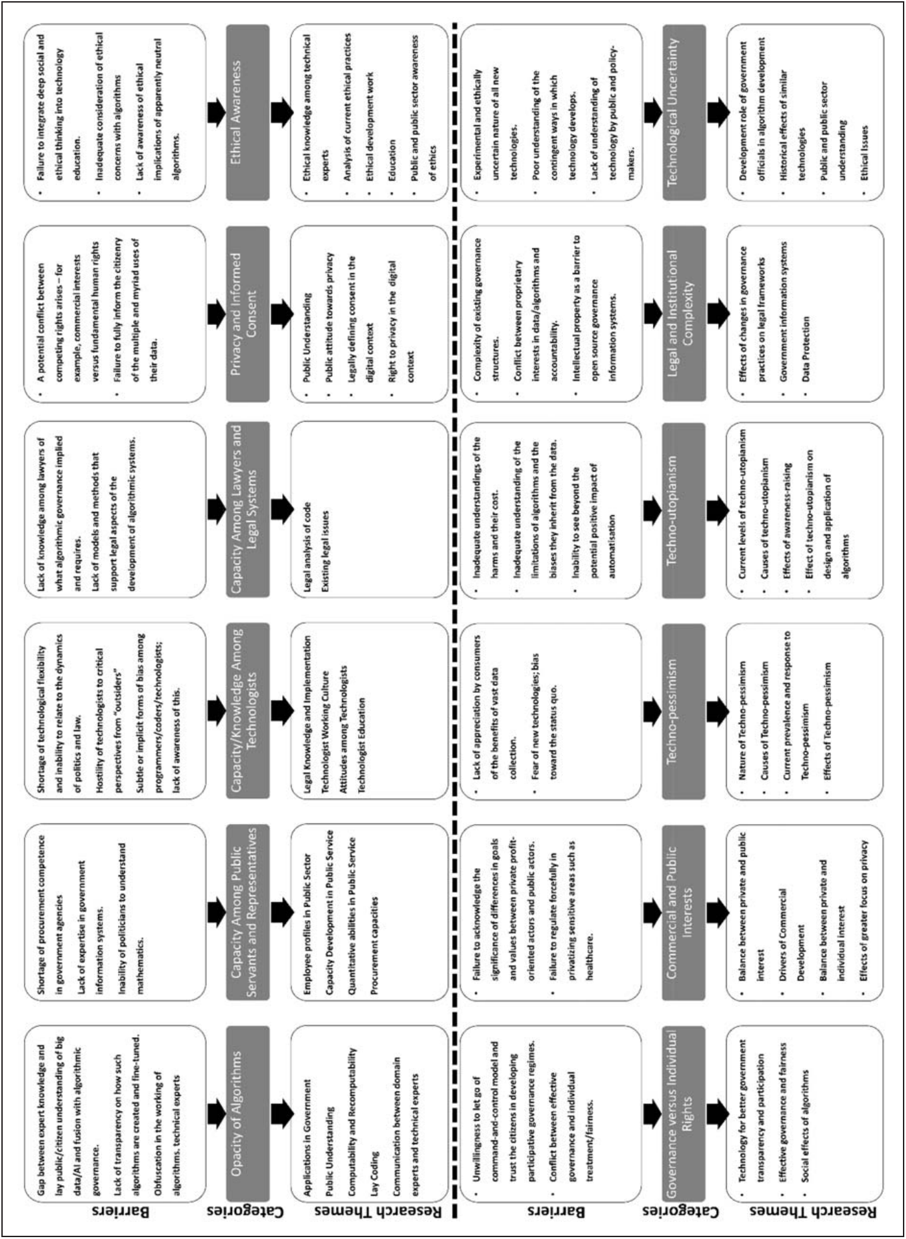
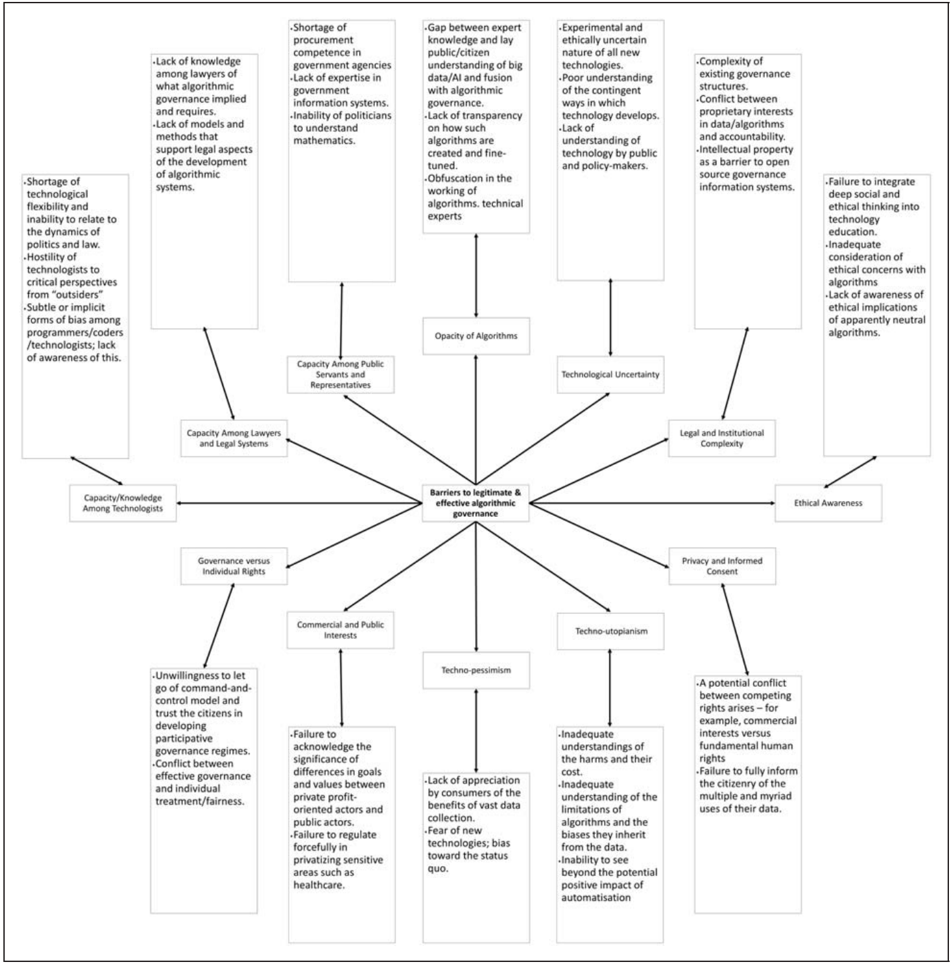
- Participants identified 12 major categories of barriers to effective and legitimate algorithmic governance, plus an additional challenge of interdisciplinarity; barriers included opacity of algorithms, techno-utopianism, techno-pessimism, technological uncertainty, capacity/knowledge among technologists, public servants, and lawyers/legal systems, legal and institutional complexity, commercial/public interests, effective governance versus individual rights, ethical awareness, and privacy/informed consent.
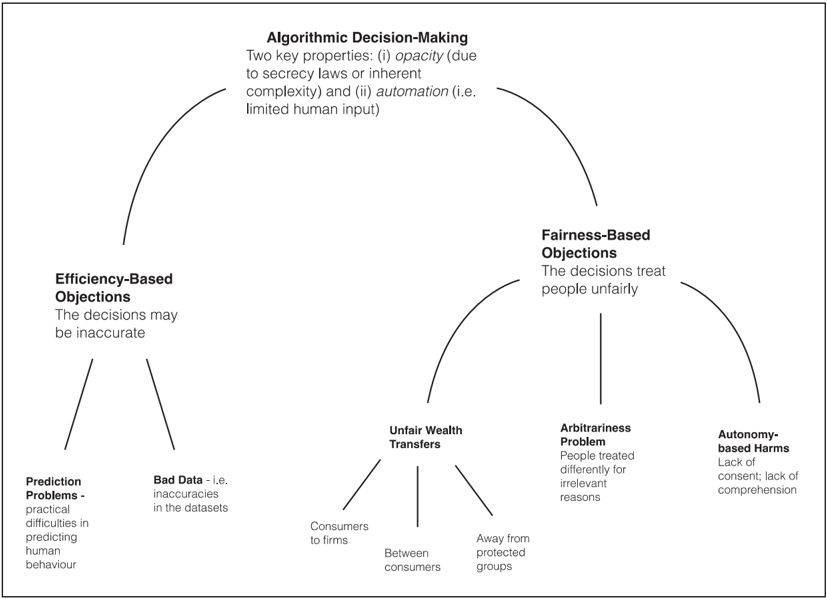
- The resulting research agenda contained at least 48 distinct research questions and 65 research applications; the authors compare this with Kitchin’s framework (one research focus, three challenges, six methodological approaches) and Zarsky’s efficiency/fairness taxonomy.
- Proposed methods included studying coders in real time via video-streaming services or hackathons, forensic and ethnographic analysis, surveys, interviews, focus groups, case studies, citizen science, visual qualitative methods, FOI requests, actor-network theory, experimental moot courts, blockchain pilots, and an open-source charter of algorithmic ethics.
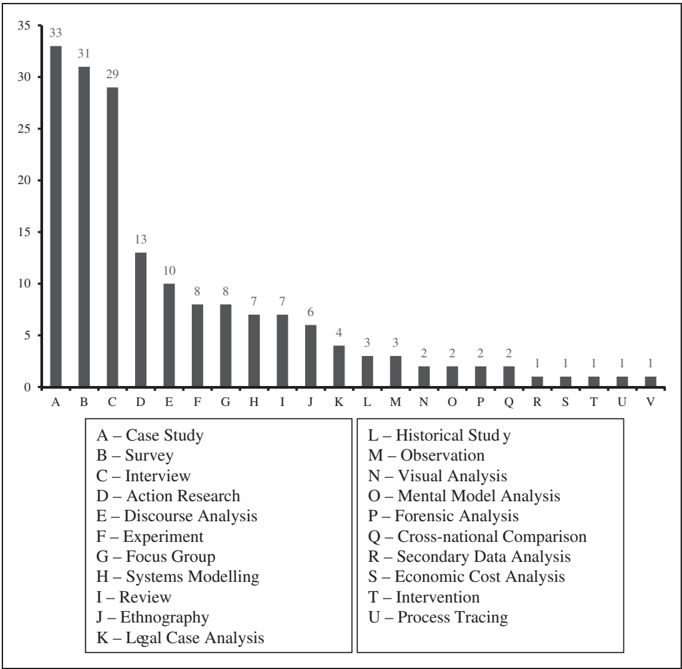
- The workshop categorized 57 barrier ideas using paired comparison and three interdependent coders; Figure 4 reports a frequency count of proposed research methods.
Methods
- Design: collective intelligence workshop using interactive management (IM), combining modified nominal group technique, ideawriting, and field representations; held at NUI Galway in March 2016.
- Sample: 15 invited participants (10 men, 5 women) from computer science, law, library science, philosophy, geography, psychology, data science, political science, and information systems; 20 were invited, 15 attended, and 2 were self-selecting; one was a former elected official, three had programming/industry backgrounds, and one was employed by a company with a commercial interest (declared).
- Procedure/analysis: barriers were generated via email NGT and clarified in the first hour; 57 ideas were categorized by three coders into field representations using paired comparison; a 2-hour ideawriting session generated research options; sheets were transcribed and analysed to synthesize the agenda, with Figure 4 providing a frequency count of proposed methods.
Limitations
- Stated: group representativeness was limited—participants were selected for academic and technical expertise; only 1 of 15 was currently employed in industry, while 14 were in academia; minority perspectives were not explicitly sought; the agenda came from a particular group on a particular day; critical/radical perspectives may be missing; and the legitimacy/effectiveness framing had a mainstream liberal orientation.
- Stated: the agenda is not complete or final; future CI workshops with different groups are needed; groupwork can lead to convergent thinking and reliance on common knowledge, though IM techniques were designed to mitigate this.
- Evident from the text: this was a single workshop with no independent replication or validation, and the proposed agenda and frequency counts are descriptive outputs of one facilitated group rather than empirically tested outcomes.
Model-written summary. Check it against the paper before relying on it.
Integrity signals
Registry
Cites
Statistics
Figures
Verification
Claims the paper makes
2 Valid · 3 Not valid · 14 Not checked · 63 Own results and interpretations
The cited sources support only part of this claim — read each source’s verdict below.
In the paper
“Whether we like it or not, algorithms are increasingly being used to nudge, bias, guide, provoke, control, manipulate and constrain human behaviour.”
What the sources say
- Partly supportedcites Danaher, 2016 matched to “The threat of algocracy: reality, resistance and accommodation” (2016) sourceExperimental — accuracy not yet measured
The Abstract describes increasing reliance on algorithms in public decision-making and warns that algocratic systems may constrain human participation. Section 3 also says self-tracking apps can help with goal setting and habit formation. These passages support the broad point that algorithms increasingly guide or constrain behaviour, but they do not establish the full list of effects, particularly provoking and manipulating people. (LLM, conf=0.82)
- Not checked — no full text of the sourcecites Pasquale, 2015 matched to “The Black Box Society: The Secret Algorithms That Control Money and Information” (2015) source
- Not checked — no full text of the sourcecites Zarsky, 2016 matched to “The Trouble with Algorithmic Decisions: An Analytic Road Map to Examine Efficiency and Fairness in Automated and Opaque Decision Making” (2016) source
plainstates a cause- Asserted: passes — The authors put it forward as true.
- Checkable: passes — It can be checked against evidence.
- Load-bearing: passes — The paper’s conclusions depend on it.
- Based: passes — The paper gives a reason why it holds.
- Partly supported
In the paper
“The barriers identified in our CI workshop covered much of the same territory, with participants also highlighting specific concerns about inefficiencies, biases, lack of transparency and unfairness in the implementation of these systems.”
What the sources say
- Not matchedcites Zarsky
This doesn’t read as a citation we can look up.
plainstates an association- Asserted: passes — The authors put it forward as true.
- Checkable: passes — It can be checked against evidence.
- Load-bearing: passes — The paper’s conclusions depend on it.
- Based: passes — The paper gives a reason why it holds.
- Not matched
A result the paper reports from its own data — it cites no other source for it, so there is none to check. The quote shows it is in the paper.
In the paper
“This method enabled participants to produce a framework and research agenda for those who are concerned about algorithmic governance.”
plainstates a cause- Asserted: passes — The authors put it forward as true.
- Checkable: passes — It can be checked against evidence.
- Load-bearing: passes — The paper’s conclusions depend on it.
- Based: passes — The paper gives a reason why it holds.
A result the paper reports from its own data — it cites no other source for it, so there is none to check. The quote shows it is in the paper.
In the paper
“It is worth noting that such perspectives are not entirely absent from what has been produced.”
plain- Asserted: passes — The authors put it forward as true.
- Checkable: passes — It can be checked against evidence.
- Load-bearing: unclear — It is unclear whether the paper’s conclusions depend on it.
- Based: passes — The paper gives a reason why it holds.
In the paper
“But the participants went much further than Zarsky, highlighting how the efficiency and fairness problems were connected to other problems in education, public understanding, technical competence, recruitment, institutional complexity, gaps in legal standards and more.”
What the sources say
- Not matchedcites Zarsky
This doesn’t read as a citation we can look up.
plainstates an association- Asserted: passes — The authors put it forward as true.
- Checkable: passes — It can be checked against evidence.
- Load-bearing: passes — The paper’s conclusions depend on it.
- Based: passes — The paper gives a reason why it holds.
- Not matched
9 more claims
Create a free account to see all 82 claims and to verify the 1 reference still open.
- Probably not a substantial claim. 59
- It may state two separate claims as one. 19
- The quote only partly states this claim. 1
Claims other papers make about this one
Each is checked against this paper’s own text: does it say what the citing paper says it does?
In the citing paper
“Deep learning is our term for deeply layered neural networks, and this is the machine learning approach used by the AI economist I use as an example, as well as by Google's AlphaGo and AlphaZero [31,28,32,1].”
From A shallow defence of a technocracy of artificial intelligence: Examining the political harms of algorithmic governance in the domain of government (2020) · cites this paper as [32]
Citations
Cites
The magical number seven, plus or minus two: Some limits on our capacity for processing information.
Miller, G. A. (1956) · Psychological Review · doi:10.1037/h0043158 · Cited by 17,812
Grossman, P. (2009) · Discrete Mathematics for Computing · doi:10.1007/978-0-230-37405-8_1 · Cited by 8,834
The Black Box Society: The Secret Algorithms That Control Money and Information
Pasquale, F. (2015) · doi:10.4159/harvard.9780674736061 · Cited by 3,796
How the machine “thinks”: Understanding opacity in machine learning algorithms
Burrell, J. (2016) · Big Data & Society · doi:10.1177/2053951715622512 · Cited by 3,196
The Data Revolution: Big Data, Open Data, Data Infrastructures & Their Consequences
Kitchin, R. (2014) · doi:10.4135/9781473909472 · Cited by 1,469 · cited 2×
“This network produces ever-larger datasets of potentially useful information, updated in real time (Kitchin, 2014; Mayer-Schonberger and Cukier, 2013).”
Thinking critically about and researching algorithms
Kitchin, R. (2017) · Information, Communication & Society · doi:10.1080/1369118x.2016.1154087 · Cited by 1,186 · cited 2×
“This table was created by the lead author based on the discussion in Kitchin (2017).”
BackgroundMethodHacking, I. (2006) · Cambridge University Press eBooks · doi:10.1017/cbo9780511817557 · Cited by 1,028
Idea Generation in Groups: A Basis for Creativity in Organizations
Paulus, P. B., & Yang, H.-C. (2000) · Organizational Behavior and Human Decision Processes · doi:10.1006/obhd.2000.2888 · Cited by 833
The ethics of big data: current and foreseeable issues in biomedical contexts
Mittelstadt, B. D., & Floridi, L. (2016) · Science and Engineering Ethics · doi:10.1007/s11948-015-9652-2 · Cited by 714 · cited 1×
“There are other studies expressing concerns about the emerging ‘Big Data divide’ which ensures that only large institutions can realize the benefits of the data revolution (Mittelstadt and Floridi, 2016).”
What makes Big Data, Big Data? Exploring the ontological characteristics of 26 datasets
Kitchin, R., & McArdle, G. (2016) · Big Data & Society · doi:10.1177/2053951716631130 · Cited by 606
Research works printed but not linked: 10
- Ashby WR (1958) Requisite variety and its implications for the control of complex systems. Cybernetica 1(2): 1-17.
- Carr N (2015) The Glass Cage: Where Automation is Taking Us . London: The Bodley Head.
- Citron D and Pasquale F (2014) The scored society: Due process for automated predictions. Washington Law Review 86: 101.
- Coke JG and Moore CM (1981) Coping with a budgetary crisis: Helping a city council decide where expenditure cuts should be made. In: Building City Council Leadership Skills: A Casebook of Models and Methods , Washington, DC: National League of Cities, pp. 72-85.
- Domingos P (2015) The Master Algorithm: How the Quest for Ultimate Machine Learning will Remake Our World . New York, NY: Basic Books.
- Keever DB (1989, April) Cultural complexities in the participative design of a computer-based organization information system. Paper presented at the International Conference on Support, Society and Culture: Mutual Uses of Cybernetics and Science, Amsterdam, The Netherlands.
- Kellermeit D and Obodovski D (2013) The Silent Intelligence: The Internet of Things . DND Ventures LLC.
- Polonetsky J and Tene O (2013) Privacy and Big Data: Making ends meet. Stanford Law Review 66: 25-33.
- Weber M (1947) The Theory of Social and Economic Organzation . New York, NY: The Free Press.
- Zarsky T (2013) Transparent prediction. University of Illinois Law Review 4: 1504.
Cited by
Items 101–200 of 358
Futures-oriented drugs policy research: Events, trends, and speculating on what might become
Rhodes, T., & Lancaster, K. (2021) · International Journal of Drug Policy · doi:10.1016/j.drugpo.2021.103332 · Cited by 25
ICT in social protection schemes: deinstitutionalising subsidy-based welfare programmes
Masiero, S., & Prakash, A. (2019) · Information Technology and People · doi:10.1108/itp-02-2018-0086 · Cited by 32
What drives the performance of tax administrations? Evidence from selected european countries
Milosavljević, M., Radovanović, S., & Delibašić, B. (2023) · Economic Modelling · doi:10.1016/j.econmod.2023.106217 · Cited by 38
Elam, M. J., Solli, A., & Mäkitalo, Å. (2018) · Discourse Studies in the Cultural Politics of Education · doi:10.1080/01596306.2018.1549704 · Cited by 35
Big data, algoritmos y política: las ciencias sociales en la era de las redes digitales
González, F. (2019) · Cinta de moebio · doi:10.4067/s0717-554x2019000200267 · Cited by 23
Prospectus and limitations of algorithmic governance: an ecological evaluation of algorithmic trends
Shin, D., Fotiadis, A., & Yu, H. (2019) · Digital Policy Regulation and Governance · doi:10.1108/dprg-03-2019-0017 · Cited by 25
A MapReduce-based K-means clustering algorithm
Mao, Y., Gan, D., Mwakapesa, D. S., Nanehkaran, Y. A., Tao, T., & Huang, X. (2021) · The Journal of Supercomputing · doi:10.1007/s11227-021-04078-8 · Cited by 25
Kersing, M., van Zoonen, L., Putters, K., & Oldenhof, L. (2022) · Data & Policy · doi:10.1017/dap.2022.16 · Cited by 24
“This shows that the dashboard can potentially have a performative nature because it does not merely describe reality but creates and defines reality (Danaher et al., 2017, p. 5; Kitchin, 2017; Zook, 2017).”
BackgroundThe Ethics of Algorithmic Outsourcing in Everyday Life
Danaher, J. (2019) · Oxford University Press eBooks · doi:10.1093/oso/9780198838494.003.0005 · Cited by 35
“…protection (Polonetsky and Tene 2013; Hartzog 2018), on biased and unequal access to social services and goods (Noble 2018; Eubanks 2018, O’Neil 2016), and on the transparency and legitimacy of public and political decision-making (Danaher 2016; Danaher et al 2017; Burrell 2016; Pasquale 2015).”
BackgroundSelf-citationAlgorithmic agencing in platform markets
Wei, R., & Geiger, S. (2024) · Marketing Theory · doi:10.1177/14705931241275558 · Cited by 25
“Technical experts may not recognize their own subconscious biases and how these in fl uence their development process, and they might resist external input from those who do not possess their technical knowledge (Danaher et al., 2017).”
Locating the Social in Social Justice
Lake, R. W. (2017) · Annals of the American Association of Geographers · doi:10.1080/24694452.2017.1374827 · Cited by 17
Calderon, E. D. V., James, T. L., & Lowry, P. B. (2023) · Data and Information Management · doi:10.1016/j.dim.2023.100042 · Cited by 24
“The opacity of algorithms combined with limited human input into the decisions they make has led to calls for and discussions about algorithmic governance to address and protect society from algorithmic decisions that are inaccurate or unfair [29, 32].”
BackgroundFilgueiras, F. D. B. (2021) · Reforma y democracia. · doi:10.69733/clad.ryd.n79.a221 · Cited by 64
“Por ejem-plo, la red interconectada de dispositivos de recolección de datos proporciona una herramienta fundamental para mejorar las políticas y los servicios públicos (Greengard, 2015; Danaher …[et al], 2017).”
BackgroundShankar, S., & Tewari, V. (2021) · Vision The Journal of Business Perspective · doi:10.1177/09722629211012256 · Cited by 25
“Just as an individual, if a group or team is studied as a single entity, the study of its multiple composite elements of variation becomes easier/possible (Danaher et al., 2017).”
BackgroundExamining the impact of generative artificial intelligence on work dynamics
Lozie, D. R., Omasa, R., Hesami, S., Zaman, S., Kajbaf, M., & Malik, A. R. (2024) · Human Resources Management and Services · doi:10.18282/hrms.v6i2.3420 · Cited by 31
China’s Authoritarian Internet and Digital Orientalism
Mayer, M. (2019) · Springer eBooks · doi:10.1007/978-3-030-27957-8_13 · Cited by 33
Innovative response initiatives in the European Union to mitigate the effects of COVID-19
Almeida, F. L. (2021) · Journal of Enabling Technologies · doi:10.1108/jet-09-2020-0039 · Cited by 18
The quantified-self archive: documenting lives through self-tracking data
Trace, C. B., & Zhang, Y. (2019) · Journal of Documentation · doi:10.1108/jd-04-2019-0064 · Cited by 21
Sherman, U., Rousseau, D. M., Carbery, R., McDonnell, A., Duggan, J., & MORLEY, M. J. (2025) · Human Resource Management Journal · doi:10.1111/1748-8583.12599 · Cited by 20
A Typology of AI Applications in Politics
Sætra, H. S. (2021) · Advanced sciences and technologies for security applications · doi:10.1007/978-3-030-88972-2_3 · Cited by 26
Aue, L. C. (2020) · International Political Sociology · doi:10.1093/ips/olaa018 · Cited by 17
Protected how? Problem representations of risk in the General Data Protection Regulation (GDPR)
Padden, M., & Öjehag‐Pettersson, A. (2021) · Critical Policy Studies · doi:10.1080/19460171.2021.1927776 · Cited by 30
“Profiling is also used in marketing to ‘nudge, bias, guide, provoke, control, manipulate and constrain human behavior’ (Danaher et al. 2017, 1).”
MethodYaksic, E. (2020) · Journal of Criminal Psychology · doi:10.1108/jcp-09-2019-0032 · Cited by 14
“The revolution will not be supervised”: Consent and open secrets in data science
Carrigan, C. M., Green, M. W., & Rahman-Davies, A. (2021) · Big Data & Society · doi:10.1177/20539517211035673 · Cited by 20
Beyond evidence: Anticipatory regimes in law
Stokes, E. (2020) · Law & Policy · doi:10.1111/lapo.12159 · Cited by 17
Televisión, audiencias y debates electorales: hacia la multipantalla
Araújo, J. R., & Quintas‐Froufe, N. (2020) · El Profesional de la Informacion · doi:10.3145/epi.2020.mar.01 · Cited by 22
DoCarmo, T. E., Rea, S. C., Conaway, E., Emery, J. R., & Raval, N. (2021) · Law & Policy · doi:10.1111/lapo.12164 · Cited by 21
Worker exploitation in the Australian gig economy: emerging mechanisms of social control
Marmo, M., Sinopoli, E. A., & Guo, S. (2022) · Griffith Law Review · doi:10.1080/10383441.2022.2076036 · Cited by 13
“(67)Danaher et al. (2017), p 1. (68)Tufekci (2014). (69)Malik (2022). (70)Noble (2018). (71)Kaine and Josserand (2019), pp 493–494.”
Filter Bubbles? Also Protector Bubbles! Folk Theories of Zhihu Algorithms Among Chinese Gay Men
Zhao, L. (2023) · Social Media + Society · doi:10.1177/20563051231168647 · Cited by 21
“With algorithms increasingly being used to stimulate and govern human behaviors (Danaher et al., 2017), investigating people’s awareness and perception of algorithms has become “an issue of agency, public life, and democracy” (Gran et al.”
MethodThe application of civic technologies in a field survey of landslides
Chudý, F., Slámová, M., Tomaštík, J., et al. (2018) · Land Degradation and Development · doi:10.1002/ldr.2957 · Cited by 12
Archer, M. (2021) · Surveillance & Society · doi:10.24908/ss.v19i3.14256 · Cited by 19
University rankings and governance by metrics and algorithms
Chen, G., & Chan, L. K. W. (2021) · Edward Elgar Publishing eBooks · doi:10.4337/9781788974981.00043 · Cited by 23
Explaining the resistance of data providers to open government data
Li, S., & Chen, Y. (2021) · Aslib Journal of Information Management · doi:10.1108/ajim-09-2020-0270 · Cited by 19
Accountability in permissioned blockchains: through the ledger, the code and the people
Fortin, M., Pimentel, E., & Boulianne, E. (2023) · Accounting Auditing & Accountability Journal · doi:10.1108/aaaj-12-2022-6213 · Cited by 15
Beyond the Usual Suspects: New Research Themes in Comparative Public Policy
Engeli, I., Allison, C. R., & Montpetit, É. (2018) · Journal of Comparative Policy Analysis Research and Practice · doi:10.1080/13876988.2017.1413869 · Cited by 11
“Some predict that data comparability, availability and reliability issues will fade away altogether as data mining and use of administrative data, web scraping and crowdsourcing become common tools in social science research (see Danaher et al. 2017).”
BackgroundInfluentialAlgorithms, contexts, governance: An introduction to the special issue
Gritsenko, D., Markham, A. N., Pötzsch, H., & Wijermars, M. (2022) · New Media & Society · doi:10.1177/14614448221079037 · Cited by 17
“…a means through which to automate the disciplining and controlling of societies and to increase the efficiency of capital accumulation,” while Danaher et al. (2017: 2) argue that “algorithms are increasingly being used to nudge, bias, guide, provoke, control, manipulate and constrain human…”
BackgroundDisinformation, Digital Information Equality, and Electoral Integrity
Judge, E. F., & Korhani, A. M. (2019) · Election Law Journal Rules Politics and Policy · doi:10.1089/elj.2019.0566 · Cited by 47
Jones, A. M., Vaughan, A. D., Roche, S. P., & Hewitt, A. N. (2021) · Journal of Experimental Criminology · doi:10.1007/s11292-021-09462-1 · Cited by 13
Chaudhuri, B. (2022) · New Media & Society · doi:10.1177/14614448221079034 · Cited by 16
“Algorithmic systems are often criticised for their opacity as they add to the existing complexities of bureaucratic institutions (Danaher et al., 2017) and make the logics and processes of governing more and more obscure for future scrutiny (Flügge et al., 2021).”
BackgroundCorona crisis chronicle: Fang Fang's Wuhan Diary (2020) as an act of sousveillance
Fedtke, J., Ibahrine, M., & Wang, Y. (2021) · Online Information Review · doi:10.1108/oir-08-2020-0367 · Cited by 9
The Artificial Intelligence Influence on Structure of Power: Long-Term Transformation
Nizov, V. (2025) · Legal Issues in the Digital Age · doi:10.17323/2713-2749.2025.2.183.212 · Cited by 19
Strategies for constructing household and family units with linked administrative records
Cuccaro-Alamin, S., Eastman, A. L., Foust, R., McCroskey, J., Nghiem, H. T., & Putnam‐Hornstein, E. (2020) · Children and Youth Services Review · doi:10.1016/j.childyouth.2020.105706 · Cited by 10
Digitalization of Institutions of Corporate Law: Current Trends and Future Prospects
Laptev, V. A., & Feyzrakhmanova, D. R. (2021) · Laws · doi:10.3390/laws10040093 · Cited by 22
Bamboo, or governance through soft law: hybridity, legitimacy, and sustainability
Snyder, F. G. (2023) · Edward Elgar Publishing eBooks · doi:10.4337/9781839101939.00009 · Cited by 15
Promises and Pitfalls of Algorithm Use by State Authorities
Haeri, M. A., Hartmann, K., Sirsch, J., Wenzelburger, G., & Zweig, K. A. (2022) · Philosophy & Technology · doi:10.1007/s13347-022-00528-0 · Cited by 18
“They often use theoretical perspectives of their disciplines — such as governance (Danaher et al., 2017; Gritsenko & Wood, 2020a, 2020b; Katzenbach & Ulbricht, 2019) or (risk) regulation (Ulbricht & Yeung, 2022; Yeung & Lodge, 2019; Yeung, 2018a, 2018b) and also include considerations from ethics…”
BackgroundFerry, L., Midgley, H., & Ahrens, T. (2025) · Public Administration · doi:10.1111/padm.13062 · Cited by 14
“Danaher et al. (2017) and Yeung (2017) argue that the powers of algorithmic approaches to data are revolutionary—ushering in an “algorithmic age” through “algorithmic power”.”
He, J., & Zhang, Z. (2025) · Laws · doi:10.3390/laws14040054 · Cited by 27
“The essence of algorithmic governance lies in shifting the focus of rights protection toward the entire lifecycle of AI systems—their design, development, deployment, and operation—achieving systematic, risk-oriented regulation (Danaher et al. 2017).”
Zhao, J., & Syed, T. A. (2025) · Technological Forecasting and Social Change · doi:10.1016/j.techfore.2025.124443 · Cited by 16
The Impact of Student Opt-Out on Educational Predictive Models
Li, W., Brooks, C. A., & Schaub, F. (2019) · International Conference on Learning Analytics and Knowledge (LAK) · doi:10.1145/3303772.3303809 · Cited by 15
“Finally, Morozov [37] warns against the formation of an łalgo-cracy,ž where algorithms gradually nudge society’s behaviors in ways that cause negative consequences [21].”
BackgroundFerrero, F., & Barujel, A. G. (2019) · Latin American Conference on Learning Technologies (LACLO) · doi:10.1109/laclo49268.2019.00038 · Cited by 9
“The proliferation of automated decision-making processes in different areas of our societies is becoming more and more evident and the governments arranged with algorithms seem to be unavoidable phenomena [1] [2] [3].”
BackgroundSoul of a new machine: Self-learning algorithms in public administration
Gerrits, L. (2021) · Information Polity · doi:10.3233/ip-200224 · Cited by 15
“…rise to much scholarly debate about its implications for the public domain, e.g. with regard to policy analysis, policy making and governance (e.g. Danaher et al., 2017; Gil-Garcia et al., 2018; González-Bailón, 2013; Hilbert, 2016; Janssen et al., 2015; Just & Latzer, 2017; Katsonis & Botros,…”
Equity, Equality and Diversity in the Nordic Countries—Final Thoughts and Looking Ahead
Frønes, T. S., Pettersen, A., Radišić, J., & Buchholtz, N. F. (2020) · Springer eBooks · doi:10.1007/978-3-030-61648-9_16 · Cited by 12
Digitalisierte intime Bewertung: Möglichkeiten sozialer Beobachtung auf Tinder
Peetz, T. (2021) · KZfSS Kölner Zeitschrift für Soziologie und Sozialpsychologie · doi:10.1007/s11577-021-00754-y · Cited by 13
Stone, J. O. H., & Mittelstadt, B. (2026) · ACM Journal on Responsible Computing · doi:10.1145/3725858 · Cited by 16
Entrenar al algoritmo: gobernanza, agencia y literacidad en el uso de YouTube
Sued, G. (2022) · Contratexto · doi:10.26439/contratexto2022.n037.5331 · Cited by 12
“En especial, se centra en las formas de gobernanza (Danaher et al., 2017), resistencia (Treré, 2019) y agenciamiento (Velkova & Kaun, 2021) algorítmicos.”
BackgroundTowards a human-centered education in the age of algorithmic governance
Stepanović, I. (2023) · Prospects · doi:10.1007/s11125-023-09675-4 · Cited by 8
“Reliance on artificial intelligence in a system of power relations which is increasingly described as “algorithmic governance” (Danaher et al., 2017; Gritsenko & Wood, 2022) or even “techno feudalism” (Grimshaw, 2017; Törnberg, 2023; Varoufakis, 2023) threatens to create an “algorithmic invasion of…”
Robo-Advice (RA): implications for the sociology of the professions
Wexler, M. N., & Oberlander, J. (2021) · International Journal of Sociology and Social Policy · doi:10.1108/ijssp-09-2021-0245 · Cited by 8
Mashups digitales. Algoritmos, cultura y antropología
Rodríguez, M. C., & Allen-Perkins, D. (2023) · Disparidades Revista de Antropología · doi:10.3989/dra.2023.001a · Cited by 13
Municipal Surveillance Regulation and Algorithmic AccountabilityPreprint
Young, M., Katell, M. A., & Krafft, P. M. (2019) · SocArXiv (OSF Preprints) · doi:10.31235/osf.io/zx2sw · Cited by 7
Governing Transport in the Algorithmic Age
Forum, I. T. (2019) · International transport forum policy papers · doi:10.1787/eec0b9aa-en · Cited by 10
Human-Machine Collaboration: Definitions, Models, and Socio-Economic Impacts
Sun, J., & Qiu, L. (2025) · International Journal of Crowd Science · doi:10.26599/ijcs.2025.9100004 · Cited by 14
Unleashing collective intelligence for public decision-making: the Data for Policy community
Engin, Z., Gardner, E., Hyde, A., Verhulst, S., & Crowcroft, J. (2024) · Data & Policy · doi:10.1017/dap.2024.2 · Cited by 8
“…is an emerging field of research which systematically explores the design of social and economic processes through the use of algorithmic systems (Aneesh, 2009; O ’ Reilly, 2013; Danaher et al., 2017; Athey, 2017; Varian, 2018; Yeung, 2018; Katzenbach and Ulbricht, 2019; Gritsenko and Wood, 2020).”
BackgroundAssembling an infrastructure for historic climate data recovery: data friction in practice
Bates, J., Goodale, P., Lin, Y., & Andrews, P. (2019) · Journal of Documentation · doi:10.1108/jd-08-2018-0130 · Cited by 10
Siddiqua, A., Janus, M., Mesterman, R., Duku, E., Georgiades, K., Saxena, F. E., Zhao, H., & Saunders, N. R. (2021) · Journal of Autism and Developmental Disorders · doi:10.1007/s10803-021-05165-8 · Cited by 6
Blockchain and a Problem of Procedural Justice of Public Choice
Владимирович, С. Л. (2018) · Communications in computer and information science · doi:10.1007/978-3-030-02843-5_2 · Cited by 6
DOWNLOAD Framing Commons for Society-Technology for Electric Infrastructure Supply Systems
van Zyl-Bulitta, V. H. (2019) · Transdisciplinary Journal of Engineering & Science · doi:10.22545/2019/0113 · Cited by 6
Müller, J., Meneses, J., Humbert, A. L., & Guenther, E. (2020) · Behavior Research Methods · doi:10.3758/s13428-020-01444-x · Cited by 6
Towards Autonomous Vehicles in Smart Cities: Risks and Risk Governance
Taeihagh, A., & Lim, H. S. M. (2021) · EAI/Springer Innovations in Communication and Computing · doi:10.1007/978-3-030-66042-0_7 · Cited by 7
Nikolaidis, S., & Refanidis, I. (2022) · Neural Computing and Applications · doi:10.1007/s00521-022-07374-3 · Cited by 6
“Algocracy suggests that sophisticated algorithms have the ability to push technology into decision-making domains, by converting human judgment into standardized processes [50].”
BackgroundSehat, C. M. (2022) · Journalism Studies · doi:10.1080/1461670x.2022.2077808 · Cited by 9
“That algorithms overall can be “used to nudge, bias, guide, provoke, control, manipulate and constrain human behaviour” is concerning for any polity (Danaher et al. 2017, 2).”
BackgroundBlankenship, J. (2019) · Elsevier eBooks · doi:10.1016/b978-0-08-102295-5.10509-8 · Cited by 7
Kera, D. (2021) · EAI/Springer Innovations in Communication and Computing · doi:10.1007/978-3-030-75107-4_3 · Cited by 7
Redefining Social Capital and Social Networks in Global Civil Society
Cockburn, T., & Cockburn‐Wootten, C. (2022) · Emerald Group Publishing Limited eBooks · doi:10.1108/978-1-80043-700-520221010 · Cited by 11
Kera, D., & Kalvas, F. (2022) · Digital Society · doi:10.1007/s44206-022-00002-6 · Cited by 6
“There is a democratic deficit in the design and implementation of algorithmic services (Danaher et al., 2017; De Filippi & Hassan, 2018; Introna, 2016; Shorey & Howard, 2016; Susskind, 2018), such as content filters, recommendation systems, various implementations of AI and ML in autonomous…”
BackgroundOn the Ethics of Biodiversity Models, Forecasts and Scenarios
Mazzéga, P. (2018) · Asian Bioethics Review · doi:10.1007/s41649-018-0069-5 · Cited by 7
Awareness and Smart City Implementations: Sensing, Sensors, and the IoT in the Public Sector
McKenna, H. P. (2020) · Public administration and information technology · doi:10.1007/978-3-030-37464-8_6 · Cited by 7
Bartl, G. (2023) · Sozialwissenschaften und Berufspraxis · doi:10.1007/978-3-658-38268-1_3 · Cited by 9
Ator-rede versus Análise de Redes versus Redes Digitais: falamos das mesmas redes?
Venturini, T., Munk, A. K., & Jacomy, M. (2018) · Galáxia (São Paulo) · doi:10.1590/1982-2554236645 · Cited by 25
CREATING STUDENTS’ ALGORITHMIC SELVES: SHEDDING LIGHT ON SOCIAL MEDIA’S REPRESENTATIONAL AFFORDANCES
Kalpokas, I., Sabaliauskaitė, E., & Pegushina, V. (2020) · Creativity Studies · doi:10.3846/cs.2020.10803 · Cited by 6
Data and Temporality in the Spectral City
Olmstead, N. A. (2019) · Philosophy & Technology · doi:10.1007/s13347-019-00381-8 · Cited by 10
Algorithmic Systems and Democratic Oversight in Public Auditing
Ateş, H. (2025) · Sayıştay Dergisi · doi:10.52836/sayistay.1731625 · Cited by 4
Symbolic displacement in the digitalization of tourism
Ghaderi, Z., & Béal, L. (2026) · Annals of Tourism Research · doi:10.1016/j.annals.2026.104192 · Cited by 6
Disagreement, AI alignment, and bargaining
Lloyd, H. R. (2024) · Philosophical Studies · doi:10.1007/s11098-024-02224-5 · Cited by 6
“5 below can be understood as a form of ‘ algorithmic governance ’ (cf. Conitzer et al., 2016; Danaher et al., 2017; Lee et al., 2019; Grisenko and Wood, 2022).”
Chan, H. (2025) · Big Data & Society · doi:10.1177/20539517251325228 · Cited by 5
“Recognising the socially constructed nature of OBD (Danaher et al., 2017; Mulder et al., 2016) enables the creation of spaces that break the interpretative monopoly of powerful agents (Baack, 2015; Gabrys et al., 2016).”
Władza algorytmów mediów – między reifikacją a rynkiem
Kreft, J. (2018) · Zarządzanie w Kulturze · doi:10.4467/20843976zk.18.002.8494 · Cited by 8
Duin, A. H., & Pedersen, I. (2021) · Studies in computational intelligence · doi:10.1007/978-3-030-70928-0_3 · Cited by 6
Quantification, Big Data, and Biometrics in Sport
Baerg, A. (2022) · Emerald Group Publishing Limited eBooks · doi:10.1108/s1476-285420220000015024 · Cited by 5
One study, four cities: information impact in neighborhood economic development
Carroll, J. N. (2020) · Transforming Government People Process and Policy · doi:10.1108/tg-07-2019-0070 · Cited by 5
Provincializing Spotify: Radio, algorithms and conviviality
Razlogova, E. (2020) · Radio Journal International Studies in Broadcast & Audio Media · doi:10.1386/rjao_00014_1 · Cited by 4
Elega, A. A., Mohammed, A., & Oloyede, F. A. (2023) · First Monday · doi:10.5210/fm.v28i4.12692 · Cited by 6
Thiarai, M., Chotvijit, S., & Jarvis, S. A. (2019) · Records Management Journal · doi:10.1108/rmj-09-2018-0029 · Cited by 5
Platform failures: How conflicting data conceptions undermine digital collaboration
Chabosseau, T., & Dobeson, A. (2025) · Competition & Change · doi:10.1177/10245294251366588 · Cited by 8
Kim, E. (2026) · Policy & Internet · doi:10.1002/poi3.70029 · Cited by 7
“Roles once performed by frontline officials on the basis of on‐site experience increasingly shift to algorithm designers and model architects, relocating decision authority from rule enforcers to rule makers (Danaher et al. 2017; Engstrom et al. 2020; Chong et al. 2021).”
Yiğitcanlar, T., David, A. J., Marasinghe, R., Senadheera, S., Hossain, T., Ye, X., & Taeihagh, A. (2026) · Smart Cities · doi:10.3390/smartcities9050081 · Cited by 7
“Oversight mechanisms, including audits, dashboards, and algorithmic impact assessments, enable municipalities to detect unintended harms, respond to social and environmental changes, and maintain transparency through iterative review [97].”
Algorithmic Status Inequality: An Integrative Perspective on AI‐Driven Social Stratification
Wu, J. (2026) · Journal of Management Studies · doi:10.1111/joms.70134 · Cited by 6
Using AI Tools to Prompt Knowledge Appropriately and Ethically in Higher Education
Bouderbane, A. (2024) · Springer eBooks · doi:10.1007/978-3-031-65691-0_17 · Cited by 4
Big Data (R)evolution in Geography: Complexity Modelling in the Last Two Decades
Pérez, L., & Sengupta, R. (2024) · Geography Compass · doi:10.1111/gec3.70009 · Cited by 3
Designing solutions to challenging the status quo – a multi-stakeholder approach
Roemer, C., Rundle-Thiele, S. R., David, P., Kennedy, A., Domegan, C. T., & McHugh, P. (2025) · Journal of Social Marketing · doi:10.1108/jsocm-04-2023-0095 · Cited by 6
Digitalising Denmark: Efficiency versus privacy
Aagaard, P., & Pedersen, J. S. (2022) · Emerald Group Publishing Limited eBooks · doi:10.1108/978-1-80043-712-820221008 · Cited by 7
Metadata
- Authors
- Danaher, J., Hogan, M. J., Noone, C., Kennedy, R., Behan, A., De Paor, A., Felzmann, H., Haklay, M., Khoo, S.-M., Morison, J., Murphy, M. H., O'Brolchain, N., Schafer, B., & Shankar, K.
- Affiliations
- Ollscoil na Gaillimhe – University of Galway (IE)
- IBM (Ireland) (IE)
- School of Law and Government, Dublin City University, Ireland
- University College London (GB)
- Queen's University Belfast (GB)
- National University of Ireland, Maynooth (IE)
- National University of Ireland – Galway, Ireland
- School of Law, Old College, University of Edinburgh, UK
- University College Dublin (IE)
- Corresponding author
- Danaher, John
- ORCID
- Venue
- Big Data & Society
- Publisher
- SAGE Publications
- Published
- 2017-09-19
- Volume
- 4
- Issue
- 2
- Pages
- 205395171772655
- ISSN
- 2053-9517 (ISSN-L)
- OpenAlex
- W2753975405
- Cited by
- 369
- References
- 26
- Citations by year
- 2026: 59 · 2025: 32 · 2024: 20 · 2023: 33 · 2022: 51 · 2021: 58 · 2020: 40 · 2019: 55 · 2018: 19 · 2017: 2
- FWCI
- 72.72
- Type
- journal article
- Language
- en
- Open access
- gold
- doi.org
- Licence
- cc-by-nc
- journals.sagepub.com/page/policies/text-and-data-mining-license (tdm)
- Locations
- Big Data & Society (publishedVersion, cc-by-nc)
- Maynooth University ePrints and eTheses Archive (Maynooth University) (acceptedVersion)
- Arrow@dit (Dublin Institute of Technology) (acceptedVersion)
- ARAN (University of Galway Research Repository) (Ollscoil na Gaillimhe – University of Galway) (acceptedVersion, cc-by-nc-nd)
- ARAN (University of Galway Research Repository) (Ollscoil na Gaillimhe – University of Galway) (submittedVersion, cc-by-nc-nd)
- Edinburgh Research Explorer (University of Edinburgh) (submittedVersion, cc-by-nc)
- Research Portal (Queen's University Belfast) (submittedVersion, cc-by-nc)
- Arrow@dit (Dublin Institute of Technology) (submittedVersion)
- Arrow@dit (Dublin Institute of Technology) (submittedVersion, cc-by-nc-nd)
- DOAJ (DOAJ: Directory of Open Access Journals) (submittedVersion, cc-by-sa)
- UCL Discovery (University College London) (submittedVersion)
- Research Repository UCD (University College Dublin) (submittedVersion, cc-by-nc)
- University of Galway Research Repository (submittedVersion, cc-by)
- Funders
- University of Galway
- Irish Research Council
- Topics
- Physical Sciences › Computer Science › Artificial Intelligence › Ethics and Social Impacts of AI
- Social Sciences › Political Science and International Relations › E-Government and Public Services
- Social Sciences › Urban Studies › Smart Cities and Technologies
- Keywords
- algorithmic governance, collective intelligence, research agenda, algorithmic legitimacy, algorithmic fairness, algorithmic bias, procedural justice, critical algorithm studies, multidisciplinary collaboration
About these checks
Registry, retraction, Cites and statistics results are computed, not judged, with one exception: a printed reference that no index lists is read once by a model before it counts as a citation error. Claims are extracted by a model and kept only when their quote appears verbatim in the text; each cited source is then checked, with a model’s help, for whether it says what the claim relies on. Those verdicts can be wrong — read the claim’s quote and the cited source before relying on one.
The claim verdicts this report counts are experimental: their accuracy is not yet measured.
A language model drew the claims from the paper on 2026-10-10, under version 3 of the claim definition (model deepseek-v4.1-flash, prompt extract-v3).
A second model labelled each claim on 2026-10-10 (model jev-1.13-20260917, definition revision gold-guideline-v0.2).
Cited sources are checked with a language model’s help (gpt-6-sol).
Statistics and arithmetic are recomputed, not judged.
Confidence bands are shown only for fields calibrated on our annotated test set. None is calibrated yet, so no band is shown.
What counts as a claim ›How we measure confidence ›How we check this ›
Are you an author, or do you see a problem with this page? Request a review
Data sources
Bibliographic data: Semantic Scholar, OpenAlex, Crossref.
Contains information from the Semantic Scholar Academic Graph Datasets, made available under the ODC Attribution License (ODC-BY 1.0).
Semantic Scholar’s data is described in: Kinney, R., et al. (2023). The Semantic Scholar Open Data Platform. arXiv:2301.10140.
