

Algorithmic governance: Developing a research agenda through the power of collective intelligence
Open accessThe DOI matches its Crossref record; 39 of the 39 references it cites were found in a registry or an index; 2 of the 27 sources its claims cite were checked for support.
Abstract
We are living in an algorithmic age where mathematics and computer science are coming together in powerful new ways to influence, shape and guide our behaviour and the governance of our societies. As these algorithmic governance structures proliferate, it is vital that we ensure their effectiveness and legitimacy. That is, we need to ensure that they are an effective means for achieving a legitimate policy goal that are also procedurally fair, open and unbiased. But how can we ensure that algorithmic governance structures are both? This article shares the results of a collective intelligence workshop that addressed exactly this question. The workshop brought together a multidisciplinary group of scholars to consider (a) barriers to legitimate and effective algorithmic governance and (b) the research methods needed to address the nature and impact of specific barriers. An interactive management workshop technique was used to harness the collective intelligence of this multidisciplinary group. This method enabled participants to produce a framework and research agenda for those who are concerned about algorithmic governance. We outline this research agenda below, providing a detailed map of key research themes, questions and methods that our workshop felt ought to be pursued. This builds upon existing work on research agendas for critical algorithm studies in a unique way through the method of collective intelligence.
Overview
CoChat Summary
TL;DR
This article reports a collective intelligence/interactive management workshop held at NUI Galway in March 2016 to identify barriers to legitimate and effective algorithmic governance and to build a research agenda. The workshop produced 12 barrier categories plus an interdisciplinarity challenge, linked to at least 48 research questions and 65 research applications.
Key findings
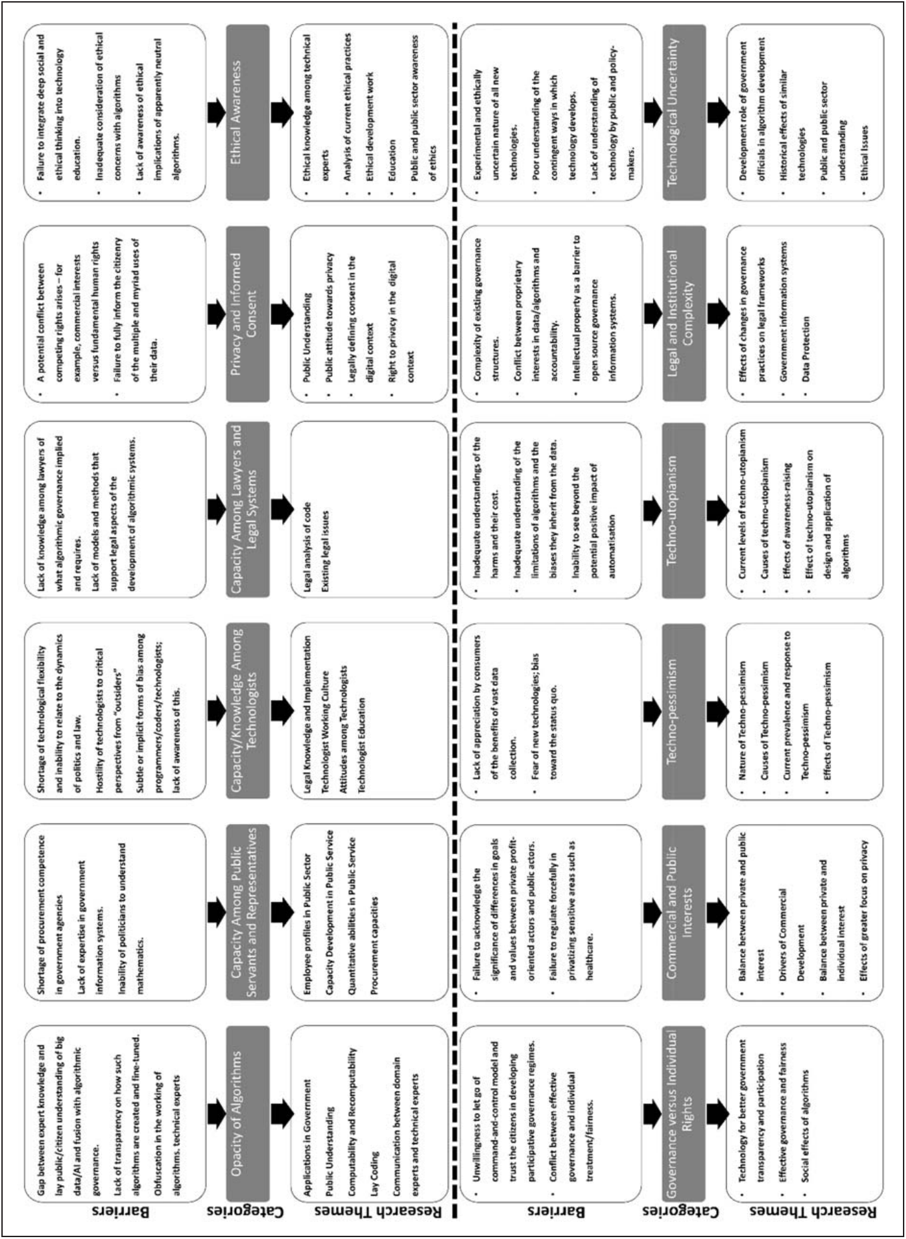
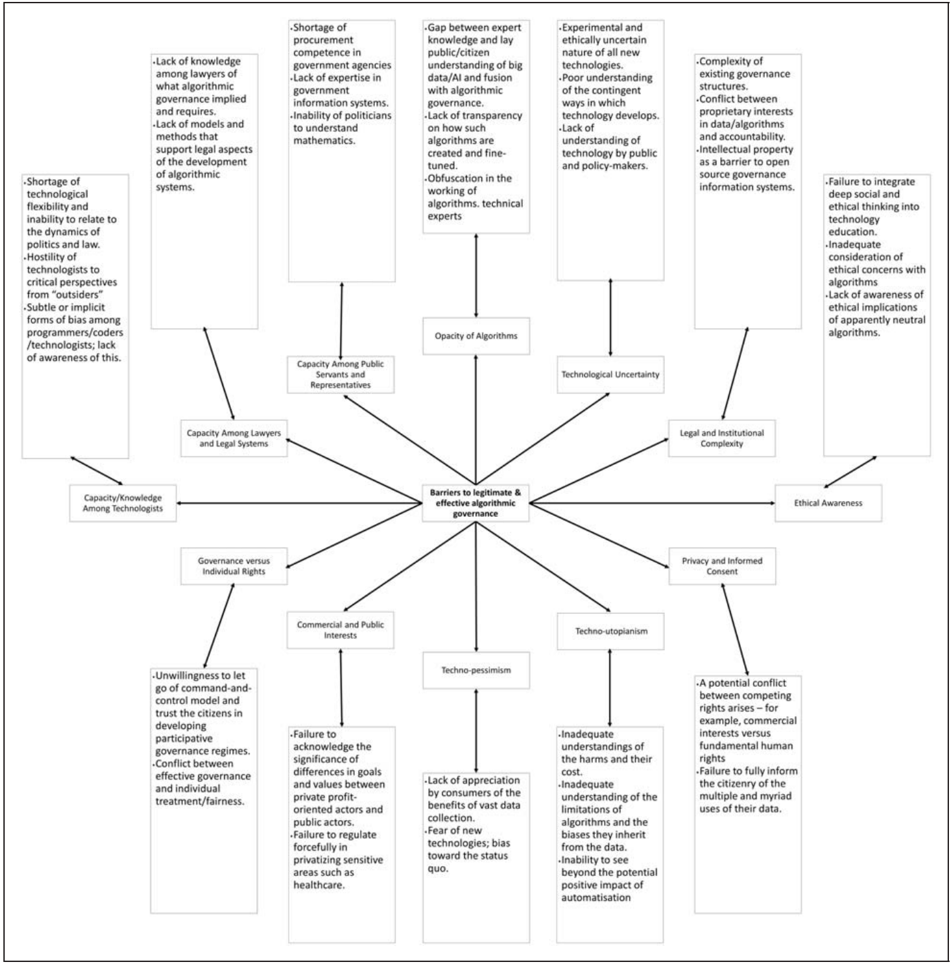
- Participants identified 12 major categories of barriers to effective and legitimate algorithmic governance, plus an additional challenge of interdisciplinarity; barriers included opacity of algorithms, techno-utopianism, techno-pessimism, technological uncertainty, capacity/knowledge among technologists, public servants, and lawyers/legal systems, legal and institutional complexity, commercial/public interests, effective governance versus individual rights, ethical awareness, and privacy/informed consent.
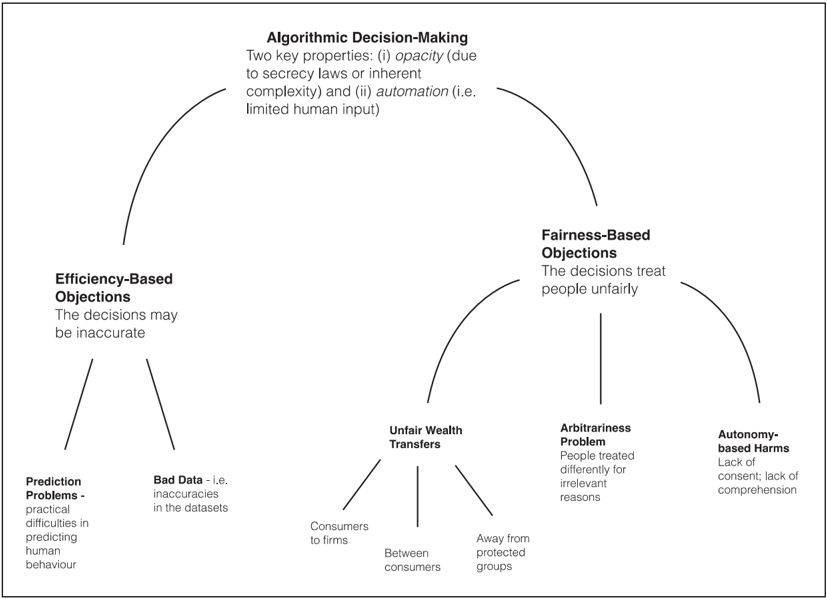
- The resulting research agenda contained at least 48 distinct research questions and 65 research applications; the authors compare this with Kitchin’s framework (one research focus, three challenges, six methodological approaches) and Zarsky’s efficiency/fairness taxonomy.
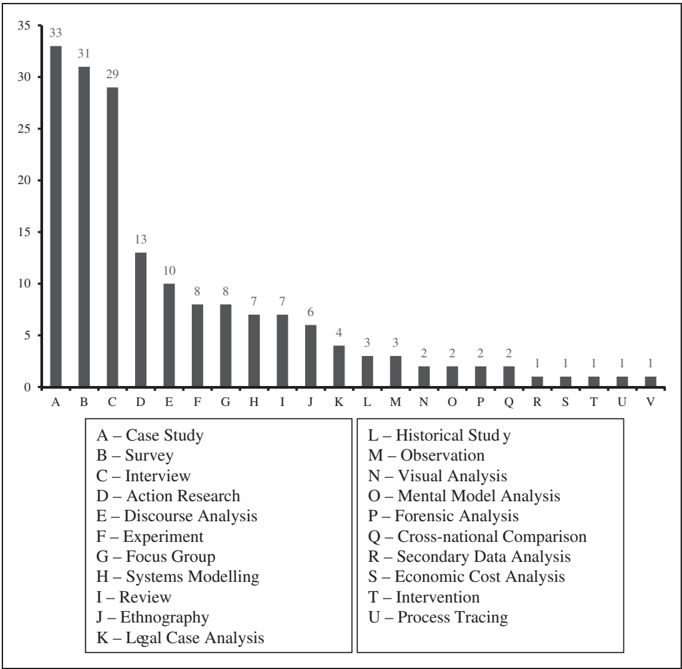
- Proposed methods included studying coders in real time via video-streaming services or hackathons, forensic and ethnographic analysis, surveys, interviews, focus groups, case studies, citizen science, visual qualitative methods, FOI requests, actor-network theory, experimental moot courts, blockchain pilots, and an open-source charter of algorithmic ethics.
- The workshop categorized 57 barrier ideas using paired comparison and three interdependent coders; Figure 4 reports a frequency count of proposed research methods.
Methods
- Design: collective intelligence workshop using interactive management (IM), combining modified nominal group technique, ideawriting, and field representations; held at NUI Galway in March 2016.
- Sample: 15 invited participants (10 men, 5 women) from computer science, law, library science, philosophy, geography, psychology, data science, political science, and information systems; 20 were invited, 15 attended, and 2 were self-selecting; one was a former elected official, three had programming/industry backgrounds, and one was employed by a company with a commercial interest (declared).
- Procedure/analysis: barriers were generated via email NGT and clarified in the first hour; 57 ideas were categorized by three coders into field representations using paired comparison; a 2-hour ideawriting session generated research options; sheets were transcribed and analysed to synthesize the agenda, with Figure 4 providing a frequency count of proposed methods.
Limitations
- Stated: group representativeness was limited—participants were selected for academic and technical expertise; only 1 of 15 was currently employed in industry, while 14 were in academia; minority perspectives were not explicitly sought; the agenda came from a particular group on a particular day; critical/radical perspectives may be missing; and the legitimacy/effectiveness framing had a mainstream liberal orientation.
- Stated: the agenda is not complete or final; future CI workshops with different groups are needed; groupwork can lead to convergent thinking and reliance on common knowledge, though IM techniques were designed to mitigate this.
- Evident from the text: this was a single workshop with no independent replication or validation, and the proposed agenda and frequency counts are descriptive outputs of one facilitated group rather than empirically tested outcomes.
Model-written summary. Check it against the paper before relying on it.
Integrity signals
Registry
Cites
Statistics
Figures
Verification
Claims the paper makes
2 Valid · 3 Not valid · 14 Not checked · 63 Own results and interpretations
The cited sources support only part of this claim — read each source’s verdict below.
In the paper
“Whether we like it or not, algorithms are increasingly being used to nudge, bias, guide, provoke, control, manipulate and constrain human behaviour.”
What the sources say
- Partly supportedcites Danaher, 2016 matched to “The threat of algocracy: reality, resistance and accommodation” (2016) sourceExperimental — accuracy not yet measured
The Abstract describes increasing reliance on algorithms in public decision-making and warns that algocratic systems may constrain human participation. Section 3 also says self-tracking apps can help with goal setting and habit formation. These passages support the broad point that algorithms increasingly guide or constrain behaviour, but they do not establish the full list of effects, particularly provoking and manipulating people. (LLM, conf=0.82)
- Not checked — no full text of the sourcecites Pasquale, 2015 matched to “The Black Box Society: The Secret Algorithms That Control Money and Information” (2015) source
- Not checked — no full text of the sourcecites Zarsky, 2016 matched to “The Trouble with Algorithmic Decisions: An Analytic Road Map to Examine Efficiency and Fairness in Automated and Opaque Decision Making” (2016) source
plainstates a cause- Asserted: passes — The authors put it forward as true.
- Checkable: passes — It can be checked against evidence.
- Load-bearing: passes — The paper’s conclusions depend on it.
- Based: passes — The paper gives a reason why it holds.
- Partly supported
In the paper
“The barriers identified in our CI workshop covered much of the same territory, with participants also highlighting specific concerns about inefficiencies, biases, lack of transparency and unfairness in the implementation of these systems.”
What the sources say
- Not matchedcites Zarsky
This doesn’t read as a citation we can look up.
plainstates an association- Asserted: passes — The authors put it forward as true.
- Checkable: passes — It can be checked against evidence.
- Load-bearing: passes — The paper’s conclusions depend on it.
- Based: passes — The paper gives a reason why it holds.
- Not matched
A result the paper reports from its own data — it cites no other source for it, so there is none to check. The quote shows it is in the paper.
In the paper
“This method enabled participants to produce a framework and research agenda for those who are concerned about algorithmic governance.”
plainstates a cause- Asserted: passes — The authors put it forward as true.
- Checkable: passes — It can be checked against evidence.
- Load-bearing: passes — The paper’s conclusions depend on it.
- Based: passes — The paper gives a reason why it holds.
A result the paper reports from its own data — it cites no other source for it, so there is none to check. The quote shows it is in the paper.
In the paper
“It is worth noting that such perspectives are not entirely absent from what has been produced.”
plain- Asserted: passes — The authors put it forward as true.
- Checkable: passes — It can be checked against evidence.
- Load-bearing: unclear — It is unclear whether the paper’s conclusions depend on it.
- Based: passes — The paper gives a reason why it holds.
In the paper
“But the participants went much further than Zarsky, highlighting how the efficiency and fairness problems were connected to other problems in education, public understanding, technical competence, recruitment, institutional complexity, gaps in legal standards and more.”
What the sources say
- Not matchedcites Zarsky
This doesn’t read as a citation we can look up.
plainstates an association- Asserted: passes — The authors put it forward as true.
- Checkable: passes — It can be checked against evidence.
- Load-bearing: passes — The paper’s conclusions depend on it.
- Based: passes — The paper gives a reason why it holds.
- Not matched
9 more claims
Create a free account to see all 82 claims and to verify the 1 reference still open.
- Probably not a substantial claim. 59
- It may state two separate claims as one. 19
- The quote only partly states this claim. 1
Claims other papers make about this one
Each is checked against this paper’s own text: does it say what the citing paper says it does?
In the citing paper
“Deep learning is our term for deeply layered neural networks, and this is the machine learning approach used by the AI economist I use as an example, as well as by Google's AlphaGo and AlphaZero [31,28,32,1].”
From A shallow defence of a technocracy of artificial intelligence: Examining the political harms of algorithmic governance in the domain of government (2020) · cites this paper as [32]
Citations
Cites
The magical number seven, plus or minus two: Some limits on our capacity for processing information.
Miller, G. A. (1956) · Psychological Review · doi:10.1037/h0043158 · Cited by 17,812
Grossman, P. (2009) · Discrete Mathematics for Computing · doi:10.1007/978-0-230-37405-8_1 · Cited by 8,834
The Black Box Society: The Secret Algorithms That Control Money and Information
Pasquale, F. (2015) · doi:10.4159/harvard.9780674736061 · Cited by 3,796
How the machine “thinks”: Understanding opacity in machine learning algorithms
Burrell, J. (2016) · Big Data & Society · doi:10.1177/2053951715622512 · Cited by 3,196
The Data Revolution: Big Data, Open Data, Data Infrastructures & Their Consequences
Kitchin, R. (2014) · doi:10.4135/9781473909472 · Cited by 1,469 · cited 2×
“This network produces ever-larger datasets of potentially useful information, updated in real time (Kitchin, 2014; Mayer-Schonberger and Cukier, 2013).”
Thinking critically about and researching algorithms
Kitchin, R. (2017) · Information, Communication & Society · doi:10.1080/1369118x.2016.1154087 · Cited by 1,186 · cited 2×
“This table was created by the lead author based on the discussion in Kitchin (2017).”
BackgroundMethodHacking, I. (2006) · Cambridge University Press eBooks · doi:10.1017/cbo9780511817557 · Cited by 1,028
Idea Generation in Groups: A Basis for Creativity in Organizations
Paulus, P. B., & Yang, H.-C. (2000) · Organizational Behavior and Human Decision Processes · doi:10.1006/obhd.2000.2888 · Cited by 833
The ethics of big data: current and foreseeable issues in biomedical contexts
Mittelstadt, B. D., & Floridi, L. (2016) · Science and Engineering Ethics · doi:10.1007/s11948-015-9652-2 · Cited by 714 · cited 1×
“There are other studies expressing concerns about the emerging ‘Big Data divide’ which ensures that only large institutions can realize the benefits of the data revolution (Mittelstadt and Floridi, 2016).”
What makes Big Data, Big Data? Exploring the ontological characteristics of 26 datasets
Kitchin, R., & McArdle, G. (2016) · Big Data & Society · doi:10.1177/2053951716631130 · Cited by 606
Research works printed but not linked: 10
- Ashby WR (1958) Requisite variety and its implications for the control of complex systems. Cybernetica 1(2): 1-17.
- Carr N (2015) The Glass Cage: Where Automation is Taking Us . London: The Bodley Head.
- Citron D and Pasquale F (2014) The scored society: Due process for automated predictions. Washington Law Review 86: 101.
- Coke JG and Moore CM (1981) Coping with a budgetary crisis: Helping a city council decide where expenditure cuts should be made. In: Building City Council Leadership Skills: A Casebook of Models and Methods , Washington, DC: National League of Cities, pp. 72-85.
- Domingos P (2015) The Master Algorithm: How the Quest for Ultimate Machine Learning will Remake Our World . New York, NY: Basic Books.
- Keever DB (1989, April) Cultural complexities in the participative design of a computer-based organization information system. Paper presented at the International Conference on Support, Society and Culture: Mutual Uses of Cybernetics and Science, Amsterdam, The Netherlands.
- Kellermeit D and Obodovski D (2013) The Silent Intelligence: The Internet of Things . DND Ventures LLC.
- Polonetsky J and Tene O (2013) Privacy and Big Data: Making ends meet. Stanford Law Review 66: 25-33.
- Weber M (1947) The Theory of Social and Economic Organzation . New York, NY: The Free Press.
- Zarsky T (2013) Transparent prediction. University of Illinois Law Review 4: 1504.
Cited by
Items 201–300 of 358
Кондратенко, К. С. (2023) · Полис Политические исследования · doi:10.17976/jpps/2023.03.11 · Cited by 4
Jin, S. (2025) · Architectural Engineering and Design Management · doi:10.1080/17452007.2025.2478021 · Cited by 6
“With the advancements in computer science and complex systems theory, the concept of CI began to be integrated into computational fields (Danaher et al., 2017), especially in the context of heuristic optimization algorithms, to address complex optimization and decision-making problems (Sim & Sun,…”
Badi, S. M., & Naidoo, L. (2025) · International Journal of Production Economics · doi:10.1016/j.ijpe.2025.109709 · Cited by 5
الطبيعة القانونية للتنبؤ بالجريمة بواسطة الذكاء الاصطناعي ومشروعيته
Elsherif, M. S. (2021) · Arab Journal of Forensic Sciences and Forensic Medicine · doi:10.26735/ngso4969 · Cited by 7
Digital Platforms: Producing and Infrastructuring Users in the Age of Airbnb
Bruni, A., & Esposito, F. M. (2019) · Springer eBooks · doi:10.1007/978-3-030-28258-5_9 · Cited by 9
Evincing Offence: How Digital Forensics Turns Big Data into Evidence for Policing Sexual Abuse
Rappert, B., Wilson‐Kovacs, D. M., Wheat, H. C., & Leonelli, S. (2022) · Engaging Science Technology and Society · doi:10.17351/ests2022.1049 · Cited by 4
“…algorithms, sifting such voluminous data requires the ongoing development of appropriate procedures for digital data collection, storage, processing and filtering, as well as appropriate forms of governance, expertise, and division of labor within criminal justice agencies (Danaher et al. 2017).”
BackgroundDiscussion Paper: Should statistics rescue mathematical modelling?Preprint
Saltelli, A. (2017) · arXiv (Cornell University) · doi:10.48550/arxiv.1712.06457 · Cited by 10
“In New York, where algorithms are used by the administration for a large array of decisions, the mayor has decided to pursue legislation for “algorithmic audits” [105] and agendas are set to tackle algorithmic governance [106](1).”
BackgroundLee, J., & Dai, Y. (2025) · Journal of Comparative Policy Analysis Research and Practice · doi:10.1080/13876988.2025.2598371 · Cited by 12
“Yet, as mentioned above, critics also argue that human judgment, deliberation, and political debate are essential to weigh normative considerations that AI cannot capture (Danaher et al. 2017).”
Cunha, C. R., Stamile, N., & Grupenmacher, B. T. (2024) · Pensar - Revista de Ciências Jurídicas · doi:10.5020/2317-2150.2024.13867 · Cited by 2
Government Digital Surveillance in Africa
Czuba, K. (2025) · Governance · doi:10.1111/gove.70049 · Cited by 4
Zhang, X., Yu, D., & Yang, J. (2025) · SAGE Open · doi:10.1177/21582440251405329 · Cited by 6
“Algorithmic management, first proposed by Lee et al. (2015), refers to the practice of using algorithmic systems for management, replacing traditional management methods to achieve automation (Danaher et al., 2017; Jarrahi et al., 2021).”
Haug, K. B., Haug, A., & Hansen, J. U. (2025) · Government Information Quarterly · doi:10.1016/j.giq.2025.102103 · Cited by 4
Haesevoets, T., Verschuere, B., Hiel, A. V., & Roets, A. (2026) · Government Information Quarterly · doi:10.1016/j.giq.2026.102134 · Cited by 6
Shahbazi, A., Behtaji, S., Tajiki, A. H., ŞİRZAD, N., Darvishan, S., & Najaf-Zadeh, H. (2026) · Scientific Reports · doi:10.1038/s41598-026-49522-y · Cited by 6
Prologue. DECONSTRUCTING smart city citizenship: Data ecosystems and democracy
Calzada, I. (2020) · Elsevier eBooks · doi:10.1016/b978-0-12-815300-0.09986-x · Cited by 2
The electrified social and its dark alternatives: policing and politics in the computational age
Maddox, A., & Heemsbergen, L. (2021) · Continuum · doi:10.1080/10304312.2021.1983253
“Danaher et al. (2017) argue that in this algorithmic age, proliferating forms of computational governance increasingly influence, shape and guide our behaviours.”
BackgroundArtificial Intelligence in Sociology: A Critical Review and Future Directions
Zhou, C. (2024) · Filosofija Sociologija · doi:10.6001/fil-soc.2024.34.4.7 · Cited by 8
“The concept of ‘algorithmic governance’ has emerged to describe the increasing role of AI systems in shaping social and political processes, raising questions about democratic accountability and the distribution of power in society (Danaher et al. 2017).”
Kalpokas, I. (2019) · Springer eBooks · doi:10.1007/978-3-030-31922-9_3 · Cited by 1
Cook, S., Cochrane, L., & Corbett, J. (2020) · International Journal of E-Planning Research · doi:10.4018/ijepr.2020100102 · Cited by 4
Comunicação, opinião pública e os impactos da revolução digital na era da pós-verdade e fake news
de Farias, L. A., Cardoso, I. D. A., & Nassar, P. (2021) · Organicom · doi:10.11606/issn.2238-2593.organicom.2021.176133 · Cited by 15
Introduction: Rhythm, Rhythmanalysis and Urban Life
Lyon, D. (2021) · Emerald Group Publishing Limited eBooks · doi:10.1108/s1047-004220210000017029 · Cited by 4
Aradau, C., & Blanke, T. (2022) · Oxford University Press eBooks · doi:10.1093/oso/9780192859624.003.0001 · Cited by 3
(De)coding a technopolity: tethering the civic blockchain to political transformation
Husain, S. O. (2020) · doi:10.18174/514268 · Cited by 4
Aradau, C., & Blanke, T. (2022) · Oxford University Press eBooks · doi:10.1093/oso/9780192859624.003.0004 · Cited by 1
Aradau, C., & Blanke, T. (2022) · Oxford University Press eBooks · doi:10.1093/oso/9780192859624.003.0002 · Cited by 1
A Discussion of Trust Abuse and Lack of Trust in Human-Computer Trust
王, 云. (2022) · Advances in Psychology · doi:10.12677/ap.2022.128317 · Cited by 2
Conceptualisation of the Relational Governance of Artificial Intelligence
Wiesmüller, S. (2023) · Relational economics and organization governance · doi:10.1007/978-3-031-25023-1_3 · Cited by 2
Cao, W., Zheng, R., Ding, S., Wu, J., Cheng, J., Liu, J., & Pan, X. (2023) · International Conference on Reliability, Maintainability and Safety · doi:10.1109/icrms59672.2023.00070 · Cited by 1
Ethical Design Thinking Embedding Moral Decision Making in AI Development Projects
Waladi, C., Sefian, M. L., & Khaldi, M. (2025) · Advances in educational technologies and instructional design book series · doi:10.4018/979-8-3373-2262-9.ch016 · Cited by 1
Capón, P. R., Lombardero, J. A. A., & Verea, N. F. (2025) · IDP Revista de Internet Derecho y Política · doi:10.7238/idp.v0i43.9800300 · Cited by 4
Nets of Fairness. Graph-Based Inference and Visualization to Delve into Gig Workers’ Conditions
Lettieri, N., Zaccagnino, R., Malandrino, D., Lomasto, L., & Buccella, I. (2025) · International Conference on Information Visualisation (IV) · doi:10.1109/iv68685.2025.00037 · Cited by 1
“As highlighted in the emerging field of Critical data studies , a new research agenda is needed to expose, interpret, and transform the data infrastructures shaping social and economic life [4], [5].”
Resisting disinformation: theorising whole-of-society and sociotechnical resistance
Thornton, M. (2025) · European Journal of International Relations · doi:10.1177/13540661251382639 · Cited by 3
“Algorithmic governance involves systems of algorithm-based decisions which utilise large datasets maintained by tech-savvy actors to the inform bureaucratic decision-making systems (Danaher et al., 2017: 2).”
Loefflad, C., Chen, M., & Grossklags, J. (2025) · Human Behavior and Emerging Technologies · doi:10.1155/hbe2/9184190 · Cited by 5
Khoreva, V., Vaiman, V., & Kim, S. A. (2026) · Human Resource Management Journal · doi:10.1111/1748-8583.70038 · Cited by 3
Legitimating entrepreneurship through generative AI: The reproduction of visual stereotypes
Hormiga, E., Jonckers, G., & Urbano, D. (2026) · Technology in Society · doi:10.1016/j.techsoc.2026.103278 · Cited by 4
The Algorithmic Boardroom: AI-Driven Governance and Strategic Decision Making
Anwar, C. M. (2026) · AIB Insights · doi:10.46697/001c.157710 · Cited by 2
D, A. T. (2026) · International Journal of Administration and Management Research Studies (IJAMRS) · doi:10.63090/ijamrs/3107.9695.0023 · Cited by 4
Othengrafen, F., Sievers, L., & Frankl, M. (2026) · International Journal of Urban Sustainable Development · doi:10.1080/19463138.2026.2686016 · Cited by 3
Cho, W., & Sagarik, D. (2026) · Global Public Policy and Governance · doi:10.1007/s43508-026-00145-z · Cited by 1
“Nevertheless, introducing AI into budgeting processes also raises institutional concerns surrounding transparency, explainability, accountability, and legitimacy in public-sector decision-making (Danaher et al., 2017 ).”
When leadership becomes epistemic: paradoxes of educational leadership in AI-mediated systems
Balázs, L. (2026) · Frontiers in Education · doi:10.3389/feduc.2026.1919644 · Cited by 1
Prentice, M. M. (2021) · Journal of Organizational Ethnography · doi:10.1108/joe-02-2021-0010 · Cited by 4
What Is Open Data? Historical and Instrumental Perspectives
Jethani, S., & Leorke, D. (2021) · Springer eBooks · doi:10.1007/978-981-16-4251-7_2 · Cited by 2
Landmann, E., Siems, F., & Nguyen, B. D. (2023) · Europäische Kulturen in der Wirtschaftskommunikation · doi:10.1007/978-3-658-40705-6_8 · Cited by 1
Algorithm and Administrative Law; Challenges and Solutions
Berelian, M. M., & tangestani, M. (2023) · Payam Marafat Journal of Social Sciences · doi:10.61186/qjal.10.34.163 · Cited by 1
Lee, S. (2024) · International Conference on Computer Information and Big Data Applications (CIBDA) · doi:10.1145/3671151.3671290 · Cited by 1
“This dependence has led to a growing willingness to delegate decision-making to AI-based systems [ 15 ] .”
Haug, K. B., & Hansen, M. P. (2025) · Journal of European Social Policy · doi:10.1177/09589287251345909 · Cited by 4
“…proliferation of algorithmic governance in the welfare state has given rise to signi fi cant controversy and scandals, eliciting widespread concern and calls for more legitimate governance (Danaher et al., 2017; Dwivedi et al., 2019; K¨onig and Wenzelburger, 2021; Valle-Cruz et al., 2020).”
Coordination in the age of Industry 4.0: The case of blockchain
Pietrewicz, L. (2019) · Kwartalnik Nauk o Przedsiębiorstwie · doi:10.5604/01.3001.0013.4790 · Cited by 2
“With such developments we are entering an algorithmic age where mathematics and computer science are coming together to influence, shape and guide our behavior (Danaher et al, 2017, p. 1).”
BackgroundAlgorithmic Governance der Wikipedia: Ein Vorbild für die Gestaltung algorithmischer Systeme?
Müller-Birn, C. (2020) · Ars digitalis · doi:10.1007/978-3-658-27852-6_12 · Cited by 1
Csótó, M., Rupp, Z., & Petényi, S. (2022) · Central and Eastern European eDem and eGov Days · doi:10.24989/ocg.v341.20 · Cited by 5
“This trend has led to a machine-like system of governance (with subdivided task and specialized roles in order to achieve as efficient operation as possible), which has always depended on the collection of data about the society and citizens and computers have been involved to automate some parts of different procedur…”
MethodDIGITAL TECHNOLOGIES AS A FACTOR INFLUENCING POLITICAL PROCESSES: AN ATTEMPT AT CONCEPTUALIZATION
Shmanatov, M. (2021) · The Journal of V N Karazin Kharkov National University Issues of Political Science · doi:10.26565/2220-8089-2021-40-04 · Cited by 6
Algoritmos de valoración de riesgo
Liñares, D. C. (2023) · Estudios Penales y Criminológicos · doi:10.15304/epc.44.8887
Sætra, H. S. (2019) · SSRN Electronic Journal · doi:10.2139/ssrn.3494309 · Cited by 1
Thornton, M. (2022) · SSRN Electronic Journal · doi:10.2139/ssrn.4110413 · Cited by 2
Mapping artificial intelligence affordances for the public sector
Fatima, S. (2022) · Queensland University of Technology · doi:10.5204/thesis.eprints.235926 · Cited by 2
Algorithmic Governance via Recommender Systems: The Case of Short Video PlatformPreprint
Zhang, J., Yang, M., Bi, X., & Wei, Q. (2023) · SSRN Electronic Journal · doi:10.2139/ssrn.4572513 · Cited by 7
When Metrics Govern: Pre-Algorithmic Optimisation and the Ethics of Artificial IntelligencePreprint
Elemure, I. E., Chuwa, C. C., Kolawole, L. O., Ologun, A. G., Ibidunmoye, A. F., Eneano, G. A., & Ikeakaonwu, O. M. (2026) · Research Square · doi:10.21203/rs.3.rs-8752951/v1 · Cited by 4
Salazar-Altamirano, M. A., & Ravina-Ripoll, R. (2026) · SSRN Electronic Journal · doi:10.2139/ssrn.6254031 · Cited by 1
Segal, A. (2019) · CUNY Academic Works (City University of New York)
Paganoni, M. C. (2019) · Springer eBooks · doi:10.1007/978-3-030-16788-2_1
EVOLUTION OF THE CONCEPT OF GOVERNABILITY IN THE CONTEXT OF DIGITALIZATION
Владимирович, С. Л., Неверов, К. А., & Кондратенко, К. С. (2019) · doi:10.33965/ict2019_201908c047 · Cited by 2
“Blockchain was also examined for administrative purposes, its challenges, risks and limitations (Cusumano 2014; Shermin 2017; Danaher et al. 2017; Scott, Loonam, Kumar 2017).”
BackgroundDo We Need a Critical Evaluation of the Role of Mathematics in Data Science?
Allo, P. (2019) · Digital ethics lab yearbook · doi:10.1007/978-3-030-17152-0_3
Propagação e influência de pós-verdade e fake news na opinião pública
Cardoso, I. D. A. (2019) · Digital Library of Theses and Dissertations (Universidade de São Paulo) · doi:10.11606/d.27.2019.tde-11112019-174743 · Cited by 19
Flyverbom, M. (2019) · Cambridge University Press eBooks · doi:10.1017/9781316442692.006
'The algorithm says no' : a study into algorithmic governance in public agencies
de Groot, M. A. (2020)
Digital Technologies for Governance
Filgueiras, F. D. B., & Almeida, V. A. F. (2020) · Springer eBooks · doi:10.1007/978-3-030-55248-0_3 · Cited by 3
COMMONING smart city citizenship: Data Commons through (smart) citizens
Calzada, I. (2020) · Elsevier eBooks · doi:10.1016/b978-0-12-815300-0.00006-x · Cited by 2
Campagnolo, G. M. (2020) · Springer eBooks · doi:10.1007/978-3-030-60358-8_1 · Cited by 1
Background of Algorithmic Government
Gupta, R., & Pal, S. K. (2021) · Springer eBooks · doi:10.1007/978-981-16-0282-5_2
Flyverbom, M. (2019) · Cambridge University Press eBooks · doi:10.1017/9781316442692.002 · Cited by 1
Negotiating Peace in the Shadows
Dochartaigh, N. Ó. (2022) · Springer eBooks · doi:10.1007/978-3-030-82962-9_14
The Future of Biometrics and Liberal Democracy
Smith, M., & Miller, S. (2021) · SpringerBriefs in ethics · doi:10.1007/978-3-030-90256-8_5
Conclusion: Life in the Digital Prism
Flyverbom, M. (2019) · Cambridge University Press eBooks · doi:10.1017/9781316442692.007
Organizations Gone Transparent
Flyverbom, M. (2019) · Cambridge University Press eBooks · doi:10.1017/9781316442692.005 · Cited by 2
Transparency and Managed Visibilities
Flyverbom, M. (2019) · Cambridge University Press eBooks · doi:10.1017/9781316442692.003
Flyverbom, M. (2019) · Cambridge University Press eBooks · doi:10.1017/9781316442692.008
Flyverbom, M. (2019) · Cambridge University Press eBooks · doi:10.1017/9781316442692.004
Introduction: The Transparency Formula
Flyverbom, M. (2019) · Cambridge University Press eBooks · doi:10.1017/9781316442692.001
Flyverbom, M. (2019) · Cambridge University Press eBooks · doi:10.1017/9781316442692.009
TECNOMIA E DEMOGRAMÁTICA: DIREITO E TÉCNICA NO NOMOS DAS PLATAFORMAS
Magalhães, J. A. R. (2021) · doi:10.17771/pucrio.acad.53235 · Cited by 2
Networked Society and Governance: Algorithmic Default?
Cockburn, T. (2022) · Emerald Group Publishing Limited eBooks · doi:10.1108/978-1-80043-700-520221007 · Cited by 1
Braga, A. (2022) · Advances in educational technologies and instructional design book series · doi:10.4018/978-1-7998-8904-5.ch006
Aradau, C., & Blanke, T. (2022) · Oxford University Press eBooks · doi:10.1093/oso/9780192859624.003.0006
Aradau, C., & Blanke, T. (2022) · Oxford University Press eBooks · doi:10.1093/oso/9780192859624.003.0008
Aradau, C., & Blanke, T. (2022) · Oxford University Press eBooks · doi:10.1093/oso/9780192859624.003.0007
Алгократия в политической системе: pro & contra
Ignatjeva, O. (2022) · Socialʹnye i gumanitarnye znania · doi:10.18255/2412-6519-2022-2-138-145 · Cited by 1
Aradau, C., & Blanke, T. (2022) · Oxford University Press eBooks · doi:10.1093/oso/9780192859624.003.0009
Aradau, C., & Blanke, T. (2022) · Oxford University Press eBooks · doi:10.1093/oso/9780192859624.003.0005
Aradau, C., & Blanke, T. (2022) · Oxford University Press eBooks · doi:10.1093/oso/9780192859624.003.0010
Aradau, C., & Blanke, T. (2022) · Oxford University Press eBooks · doi:10.1093/oso/9780192859624.003.0003
Training the Algorithm: Governance, Agency, and Literacy in the Use of YouTube
Sued, G. (2022) · Contratexto · doi:10.26439/contratexto2022.n037.53315669
A Theoretical Approximation to Artificial Intelligence as an Autopoietic System
Wiesmüller, S. (2023) · Relational economics and organization governance · doi:10.1007/978-3-031-25023-1_2
Gupta, R., Das, S., & Pal, S. K. (2023) · Springer eBooks · doi:10.1007/978-981-19-9798-3_1
(2022) · Oxford University Press eBooks · doi:10.1093/oso/9780192859624.002.0003
(2022) · Oxford University Press eBooks · doi:10.1093/oso/9780192859624.002.0006
Scarlett, A., & Lipton, L. (2023) · Afterimage · doi:10.1525/aft.2023.50.2.1
QUALIDADE DA DEMOCRACIA COMO RESPOSTA AO POPULISMO: UMA QUESTÃO TRANSNACIONAL
Filho, A. J. C. D. C., & Garcia, F. H. F. (2023) · Revista Contemporânea · doi:10.56083/rcv3n9-142
Domingues, J. A. (2023) · Digital Library of Theses and Dissertations (Universidade de São Paulo) · doi:10.11606/d.27.2023.tde-27112023-103227
da Silva, A. A. B., Brunetta, C. M., & Maia, P. R. F. (2023) · Revista de Direito Brasileira · doi:10.26668/indexlawjournals/2358-1352/2023.v34i13.7486 · Cited by 1
Metadata
- Authors
- Danaher, J., Hogan, M. J., Noone, C., Kennedy, R., Behan, A., De Paor, A., Felzmann, H., Haklay, M., Khoo, S.-M., Morison, J., Murphy, M. H., O'Brolchain, N., Schafer, B., & Shankar, K.
- Affiliations
- Ollscoil na Gaillimhe – University of Galway (IE)
- IBM (Ireland) (IE)
- School of Law and Government, Dublin City University, Ireland
- University College London (GB)
- Queen's University Belfast (GB)
- National University of Ireland, Maynooth (IE)
- National University of Ireland – Galway, Ireland
- School of Law, Old College, University of Edinburgh, UK
- University College Dublin (IE)
- Corresponding author
- Danaher, John
- ORCID
- Venue
- Big Data & Society
- Publisher
- SAGE Publications
- Published
- 2017-09-19
- Volume
- 4
- Issue
- 2
- Pages
- 205395171772655
- ISSN
- 2053-9517 (ISSN-L)
- OpenAlex
- W2753975405
- Cited by
- 369
- References
- 26
- Citations by year
- 2026: 59 · 2025: 32 · 2024: 20 · 2023: 33 · 2022: 51 · 2021: 58 · 2020: 40 · 2019: 55 · 2018: 19 · 2017: 2
- FWCI
- 72.72
- Type
- journal article
- Language
- en
- Open access
- gold
- doi.org
- Licence
- cc-by-nc
- journals.sagepub.com/page/policies/text-and-data-mining-license (tdm)
- Locations
- Big Data & Society (publishedVersion, cc-by-nc)
- Maynooth University ePrints and eTheses Archive (Maynooth University) (acceptedVersion)
- Arrow@dit (Dublin Institute of Technology) (acceptedVersion)
- ARAN (University of Galway Research Repository) (Ollscoil na Gaillimhe – University of Galway) (acceptedVersion, cc-by-nc-nd)
- ARAN (University of Galway Research Repository) (Ollscoil na Gaillimhe – University of Galway) (submittedVersion, cc-by-nc-nd)
- Edinburgh Research Explorer (University of Edinburgh) (submittedVersion, cc-by-nc)
- Research Portal (Queen's University Belfast) (submittedVersion, cc-by-nc)
- Arrow@dit (Dublin Institute of Technology) (submittedVersion)
- Arrow@dit (Dublin Institute of Technology) (submittedVersion, cc-by-nc-nd)
- DOAJ (DOAJ: Directory of Open Access Journals) (submittedVersion, cc-by-sa)
- UCL Discovery (University College London) (submittedVersion)
- Research Repository UCD (University College Dublin) (submittedVersion, cc-by-nc)
- University of Galway Research Repository (submittedVersion, cc-by)
- Funders
- University of Galway
- Irish Research Council
- Topics
- Physical Sciences › Computer Science › Artificial Intelligence › Ethics and Social Impacts of AI
- Social Sciences › Political Science and International Relations › E-Government and Public Services
- Social Sciences › Urban Studies › Smart Cities and Technologies
- Keywords
- algorithmic governance, collective intelligence, research agenda, algorithmic legitimacy, algorithmic fairness, algorithmic bias, procedural justice, critical algorithm studies, multidisciplinary collaboration
About these checks
Registry, retraction, Cites and statistics results are computed, not judged, with one exception: a printed reference that no index lists is read once by a model before it counts as a citation error. Claims are extracted by a model and kept only when their quote appears verbatim in the text; each cited source is then checked, with a model’s help, for whether it says what the claim relies on. Those verdicts can be wrong — read the claim’s quote and the cited source before relying on one.
The claim verdicts this report counts are experimental: their accuracy is not yet measured.
A language model drew the claims from the paper on 2026-10-10, under version 3 of the claim definition (model deepseek-v4.1-flash, prompt extract-v3).
A second model labelled each claim on 2026-10-10 (model jev-1.13-20260917, definition revision gold-guideline-v0.2).
Cited sources are checked with a language model’s help (gpt-6-sol).
Statistics and arithmetic are recomputed, not judged.
Confidence bands are shown only for fields calibrated on our annotated test set. None is calibrated yet, so no band is shown.
What counts as a claim ›How we measure confidence ›How we check this ›
Are you an author, or do you see a problem with this page? Request a review
Data sources
Bibliographic data: Semantic Scholar, OpenAlex, Crossref.
Contains information from the Semantic Scholar Academic Graph Datasets, made available under the ODC Attribution License (ODC-BY 1.0).
Semantic Scholar’s data is described in: Kinney, R., et al. (2023). The Semantic Scholar Open Data Platform. arXiv:2301.10140.
