

Algorithmic governance: Developing a research agenda through the power of collective intelligence
Open accessThe DOI matches its Crossref record; 39 of the 39 references it cites were found in a registry or an index; 2 of the 27 sources its claims cite were checked for support.
Abstract
We are living in an algorithmic age where mathematics and computer science are coming together in powerful new ways to influence, shape and guide our behaviour and the governance of our societies. As these algorithmic governance structures proliferate, it is vital that we ensure their effectiveness and legitimacy. That is, we need to ensure that they are an effective means for achieving a legitimate policy goal that are also procedurally fair, open and unbiased. But how can we ensure that algorithmic governance structures are both? This article shares the results of a collective intelligence workshop that addressed exactly this question. The workshop brought together a multidisciplinary group of scholars to consider (a) barriers to legitimate and effective algorithmic governance and (b) the research methods needed to address the nature and impact of specific barriers. An interactive management workshop technique was used to harness the collective intelligence of this multidisciplinary group. This method enabled participants to produce a framework and research agenda for those who are concerned about algorithmic governance. We outline this research agenda below, providing a detailed map of key research themes, questions and methods that our workshop felt ought to be pursued. This builds upon existing work on research agendas for critical algorithm studies in a unique way through the method of collective intelligence.
Overview
CoChat Summary
TL;DR
This article reports a collective intelligence/interactive management workshop held at NUI Galway in March 2016 to identify barriers to legitimate and effective algorithmic governance and to build a research agenda. The workshop produced 12 barrier categories plus an interdisciplinarity challenge, linked to at least 48 research questions and 65 research applications.
Key findings
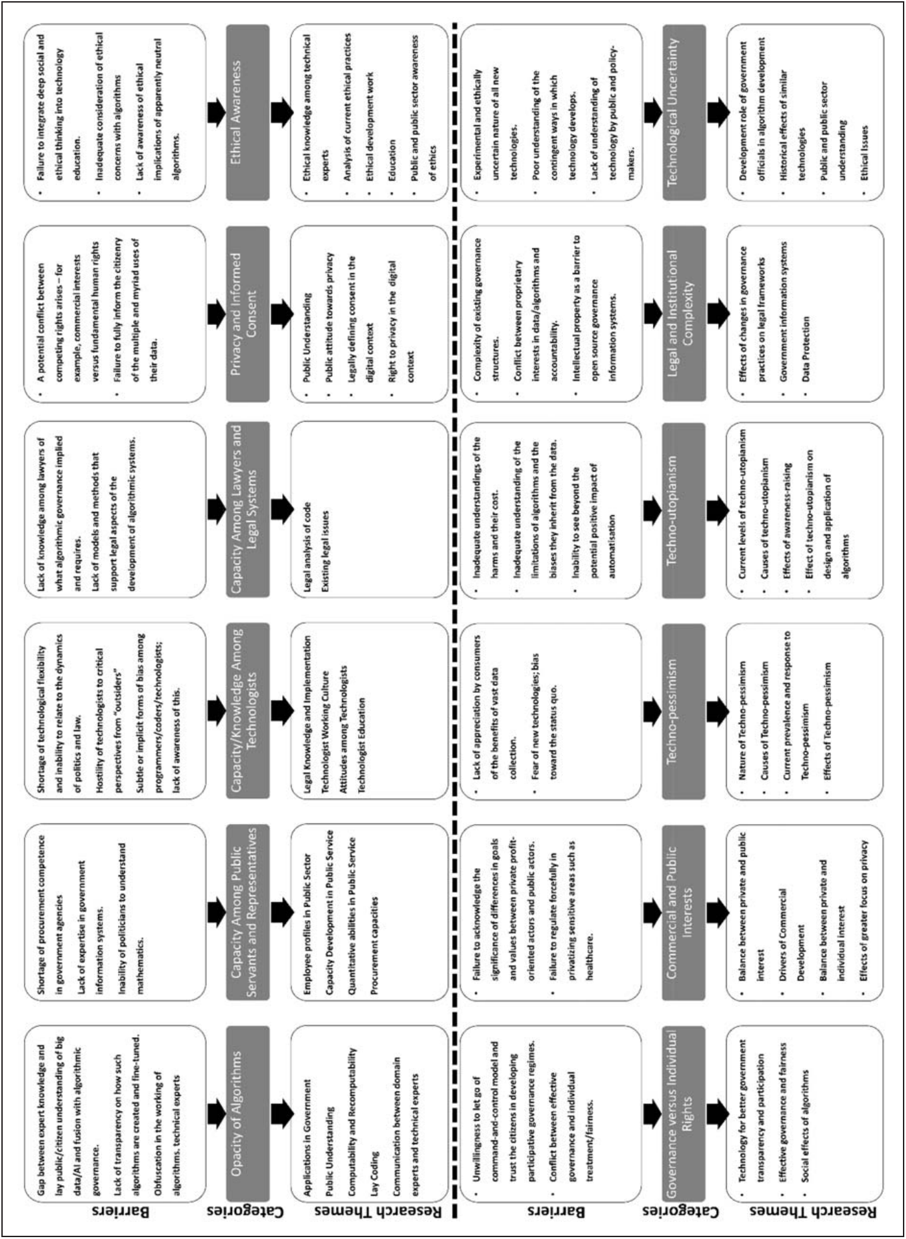
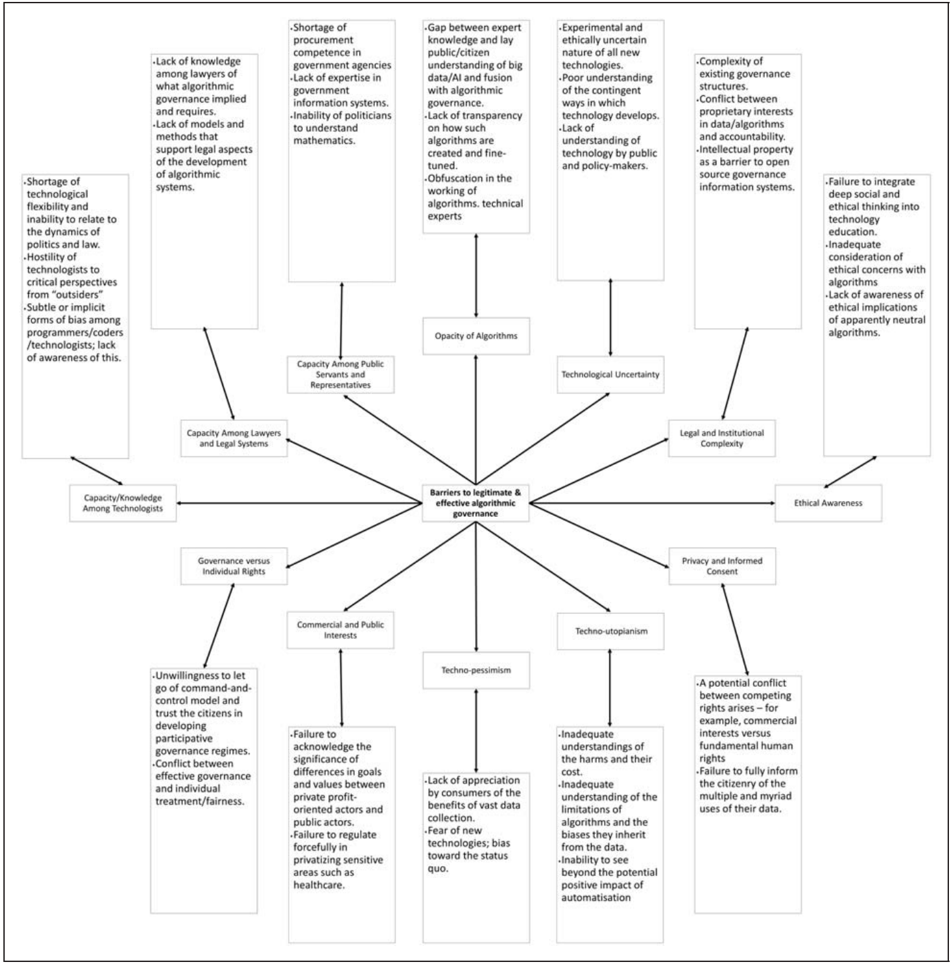
- Participants identified 12 major categories of barriers to effective and legitimate algorithmic governance, plus an additional challenge of interdisciplinarity; barriers included opacity of algorithms, techno-utopianism, techno-pessimism, technological uncertainty, capacity/knowledge among technologists, public servants, and lawyers/legal systems, legal and institutional complexity, commercial/public interests, effective governance versus individual rights, ethical awareness, and privacy/informed consent.
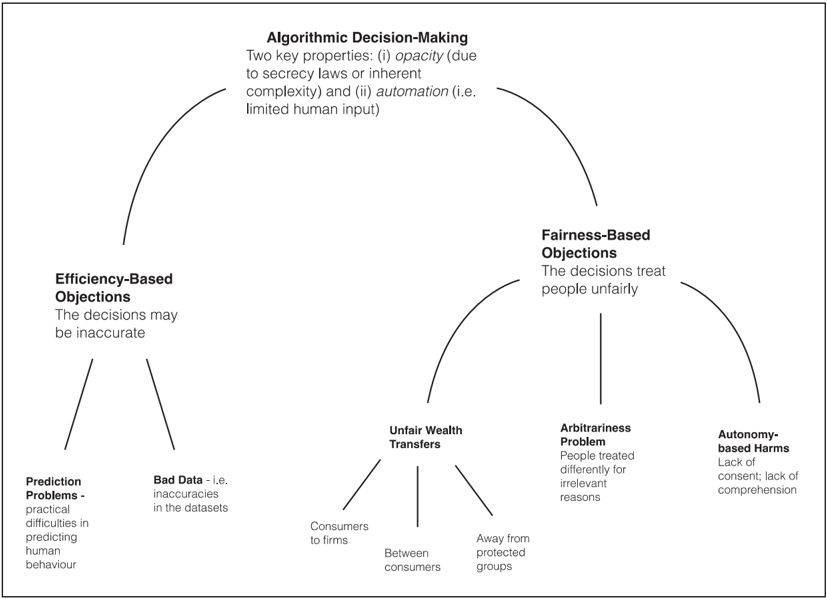
- The resulting research agenda contained at least 48 distinct research questions and 65 research applications; the authors compare this with Kitchin’s framework (one research focus, three challenges, six methodological approaches) and Zarsky’s efficiency/fairness taxonomy.
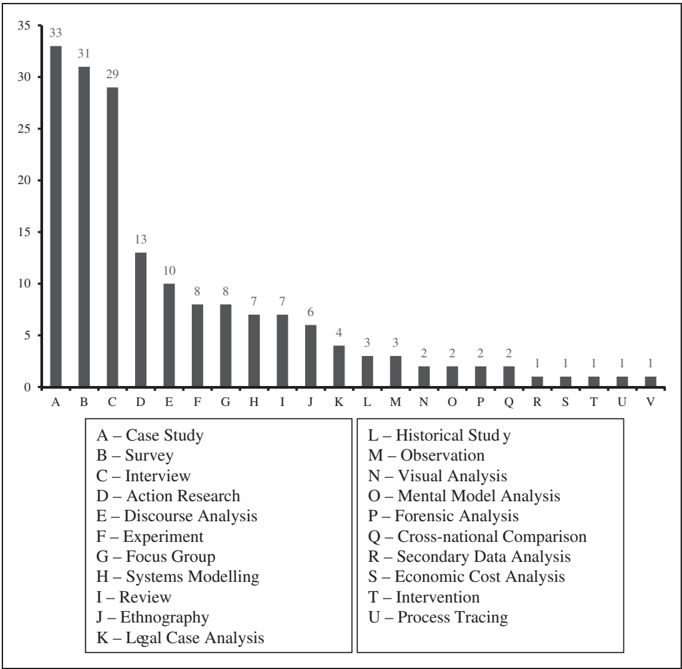
- Proposed methods included studying coders in real time via video-streaming services or hackathons, forensic and ethnographic analysis, surveys, interviews, focus groups, case studies, citizen science, visual qualitative methods, FOI requests, actor-network theory, experimental moot courts, blockchain pilots, and an open-source charter of algorithmic ethics.
- The workshop categorized 57 barrier ideas using paired comparison and three interdependent coders; Figure 4 reports a frequency count of proposed research methods.
Methods
- Design: collective intelligence workshop using interactive management (IM), combining modified nominal group technique, ideawriting, and field representations; held at NUI Galway in March 2016.
- Sample: 15 invited participants (10 men, 5 women) from computer science, law, library science, philosophy, geography, psychology, data science, political science, and information systems; 20 were invited, 15 attended, and 2 were self-selecting; one was a former elected official, three had programming/industry backgrounds, and one was employed by a company with a commercial interest (declared).
- Procedure/analysis: barriers were generated via email NGT and clarified in the first hour; 57 ideas were categorized by three coders into field representations using paired comparison; a 2-hour ideawriting session generated research options; sheets were transcribed and analysed to synthesize the agenda, with Figure 4 providing a frequency count of proposed methods.
Limitations
- Stated: group representativeness was limited—participants were selected for academic and technical expertise; only 1 of 15 was currently employed in industry, while 14 were in academia; minority perspectives were not explicitly sought; the agenda came from a particular group on a particular day; critical/radical perspectives may be missing; and the legitimacy/effectiveness framing had a mainstream liberal orientation.
- Stated: the agenda is not complete or final; future CI workshops with different groups are needed; groupwork can lead to convergent thinking and reliance on common knowledge, though IM techniques were designed to mitigate this.
- Evident from the text: this was a single workshop with no independent replication or validation, and the proposed agenda and frequency counts are descriptive outputs of one facilitated group rather than empirically tested outcomes.
Model-written summary. Check it against the paper before relying on it.
Integrity signals
Registry
Cites
Statistics
Figures
Verification
Claims the paper makes
2 Valid · 3 Not valid · 14 Not checked · 63 Own results and interpretations
The cited sources support only part of this claim — read each source’s verdict below.
In the paper
“Whether we like it or not, algorithms are increasingly being used to nudge, bias, guide, provoke, control, manipulate and constrain human behaviour.”
What the sources say
- Partly supportedcites Danaher, 2016 matched to “The threat of algocracy: reality, resistance and accommodation” (2016) sourceExperimental — accuracy not yet measured
The Abstract describes increasing reliance on algorithms in public decision-making and warns that algocratic systems may constrain human participation. Section 3 also says self-tracking apps can help with goal setting and habit formation. These passages support the broad point that algorithms increasingly guide or constrain behaviour, but they do not establish the full list of effects, particularly provoking and manipulating people. (LLM, conf=0.82)
- Not checked — no full text of the sourcecites Pasquale, 2015 matched to “The Black Box Society: The Secret Algorithms That Control Money and Information” (2015) source
- Not checked — no full text of the sourcecites Zarsky, 2016 matched to “The Trouble with Algorithmic Decisions: An Analytic Road Map to Examine Efficiency and Fairness in Automated and Opaque Decision Making” (2016) source
plainstates a cause- Asserted: passes — The authors put it forward as true.
- Checkable: passes — It can be checked against evidence.
- Load-bearing: passes — The paper’s conclusions depend on it.
- Based: passes — The paper gives a reason why it holds.
- Partly supported
In the paper
“The barriers identified in our CI workshop covered much of the same territory, with participants also highlighting specific concerns about inefficiencies, biases, lack of transparency and unfairness in the implementation of these systems.”
What the sources say
- Not matchedcites Zarsky
This doesn’t read as a citation we can look up.
plainstates an association- Asserted: passes — The authors put it forward as true.
- Checkable: passes — It can be checked against evidence.
- Load-bearing: passes — The paper’s conclusions depend on it.
- Based: passes — The paper gives a reason why it holds.
- Not matched
A result the paper reports from its own data — it cites no other source for it, so there is none to check. The quote shows it is in the paper.
In the paper
“This method enabled participants to produce a framework and research agenda for those who are concerned about algorithmic governance.”
plainstates a cause- Asserted: passes — The authors put it forward as true.
- Checkable: passes — It can be checked against evidence.
- Load-bearing: passes — The paper’s conclusions depend on it.
- Based: passes — The paper gives a reason why it holds.
A result the paper reports from its own data — it cites no other source for it, so there is none to check. The quote shows it is in the paper.
In the paper
“It is worth noting that such perspectives are not entirely absent from what has been produced.”
plain- Asserted: passes — The authors put it forward as true.
- Checkable: passes — It can be checked against evidence.
- Load-bearing: unclear — It is unclear whether the paper’s conclusions depend on it.
- Based: passes — The paper gives a reason why it holds.
In the paper
“But the participants went much further than Zarsky, highlighting how the efficiency and fairness problems were connected to other problems in education, public understanding, technical competence, recruitment, institutional complexity, gaps in legal standards and more.”
What the sources say
- Not matchedcites Zarsky
This doesn’t read as a citation we can look up.
plainstates an association- Asserted: passes — The authors put it forward as true.
- Checkable: passes — It can be checked against evidence.
- Load-bearing: passes — The paper’s conclusions depend on it.
- Based: passes — The paper gives a reason why it holds.
- Not matched
9 more claims
Create a free account to see all 82 claims and to verify the 1 reference still open.
- Probably not a substantial claim. 59
- It may state two separate claims as one. 19
- The quote only partly states this claim. 1
Claims other papers make about this one
Each is checked against this paper’s own text: does it say what the citing paper says it does?
In the citing paper
“Deep learning is our term for deeply layered neural networks, and this is the machine learning approach used by the AI economist I use as an example, as well as by Google's AlphaGo and AlphaZero [31,28,32,1].”
From A shallow defence of a technocracy of artificial intelligence: Examining the political harms of algorithmic governance in the domain of government (2020) · cites this paper as [32]
Citations
Cites
The magical number seven, plus or minus two: Some limits on our capacity for processing information.
Miller, G. A. (1956) · Psychological Review · doi:10.1037/h0043158 · Cited by 17,812
Grossman, P. (2009) · Discrete Mathematics for Computing · doi:10.1007/978-0-230-37405-8_1 · Cited by 8,834
The Black Box Society: The Secret Algorithms That Control Money and Information
Pasquale, F. (2015) · doi:10.4159/harvard.9780674736061 · Cited by 3,796
How the machine “thinks”: Understanding opacity in machine learning algorithms
Burrell, J. (2016) · Big Data & Society · doi:10.1177/2053951715622512 · Cited by 3,196
The Data Revolution: Big Data, Open Data, Data Infrastructures & Their Consequences
Kitchin, R. (2014) · doi:10.4135/9781473909472 · Cited by 1,469 · cited 2×
“This network produces ever-larger datasets of potentially useful information, updated in real time (Kitchin, 2014; Mayer-Schonberger and Cukier, 2013).”
Thinking critically about and researching algorithms
Kitchin, R. (2017) · Information, Communication & Society · doi:10.1080/1369118x.2016.1154087 · Cited by 1,186 · cited 2×
“This table was created by the lead author based on the discussion in Kitchin (2017).”
BackgroundMethodHacking, I. (2006) · Cambridge University Press eBooks · doi:10.1017/cbo9780511817557 · Cited by 1,028
Idea Generation in Groups: A Basis for Creativity in Organizations
Paulus, P. B., & Yang, H.-C. (2000) · Organizational Behavior and Human Decision Processes · doi:10.1006/obhd.2000.2888 · Cited by 833
The ethics of big data: current and foreseeable issues in biomedical contexts
Mittelstadt, B. D., & Floridi, L. (2016) · Science and Engineering Ethics · doi:10.1007/s11948-015-9652-2 · Cited by 714 · cited 1×
“There are other studies expressing concerns about the emerging ‘Big Data divide’ which ensures that only large institutions can realize the benefits of the data revolution (Mittelstadt and Floridi, 2016).”
What makes Big Data, Big Data? Exploring the ontological characteristics of 26 datasets
Kitchin, R., & McArdle, G. (2016) · Big Data & Society · doi:10.1177/2053951716631130 · Cited by 606
Research works printed but not linked: 10
- Ashby WR (1958) Requisite variety and its implications for the control of complex systems. Cybernetica 1(2): 1-17.
- Carr N (2015) The Glass Cage: Where Automation is Taking Us . London: The Bodley Head.
- Citron D and Pasquale F (2014) The scored society: Due process for automated predictions. Washington Law Review 86: 101.
- Coke JG and Moore CM (1981) Coping with a budgetary crisis: Helping a city council decide where expenditure cuts should be made. In: Building City Council Leadership Skills: A Casebook of Models and Methods , Washington, DC: National League of Cities, pp. 72-85.
- Domingos P (2015) The Master Algorithm: How the Quest for Ultimate Machine Learning will Remake Our World . New York, NY: Basic Books.
- Keever DB (1989, April) Cultural complexities in the participative design of a computer-based organization information system. Paper presented at the International Conference on Support, Society and Culture: Mutual Uses of Cybernetics and Science, Amsterdam, The Netherlands.
- Kellermeit D and Obodovski D (2013) The Silent Intelligence: The Internet of Things . DND Ventures LLC.
- Polonetsky J and Tene O (2013) Privacy and Big Data: Making ends meet. Stanford Law Review 66: 25-33.
- Weber M (1947) The Theory of Social and Economic Organzation . New York, NY: The Free Press.
- Zarsky T (2013) Transparent prediction. University of Illinois Law Review 4: 1504.
Cited by
Items 301–358 of 358
Technik, Macht und Mitbestimmung
Wenckebach, J. (2023) · Politik in der digitalen Gesellschaft · doi:10.1515/9783839465455-002
Digitalisierung von Gegenmacht: Gewerkschaftliche Konfliktfähigkeit und Arbeitskampf heute
Oppelt, M., Blumenthal, F., & (Politik), T. O. L. 2. (2023) · Politik in der digitalen Gesellschaft · doi:10.1515/9783839465455 · Cited by 3
Apps e Jovens Adultos: Contributos para um Mapeamento de Práticas Mediadas
Antunes, E. (2024) · UMinho Editora/CECS eBooks · doi:10.21814/uminho.ed.82 · Cited by 4
Poleac, G. (2024) · UMinho Editora/CECS eBooks · doi:10.21814/uminho.ed.82.6
Alhamdi, F. M. (2024) · Ijaz Arabi Journal of Arabic Learning · doi:10.18860/ijazarabi.v7i1.26316
“…collective intelligence is a group of workers who work as one unit, and this intelligence consists of either a source or several sources, as a group or team is studied as one entity, the study of complex elements becomes Multiplexing for variability is easier/possible (Danaher et al., 2017:20).”
BackgroundSegredo de negócios, proteção de dados pessoais e inteligência artificial - os desafios do diálogo
Fujimoto, M. Y. (2023) · Digital Library of Theses and Dissertations (Universidade de São Paulo) · doi:10.11606/d.2.2023.tde-28022024-085125 · Cited by 1
Ulbricht, L., & Katzenbach, C. (2024) · SSRN Electronic Journal · doi:10.2139/ssrn.4850176
Whisper of Understanding: Age Differences in Algorithmic Literacy Across Generations
Ghani, M. M., Mustafa, W. A., Hashim, M. E. A., Hanafi, H. F., & Alabdeli, H. M. (2023) · International Conference for Technological Engineering and its Applications in Sustainable Development (ICTEASD) · doi:10.1109/icteasd57136.2023.10584953 · Cited by 1
“Without a basic understanding of how these algorithms work and the potential biases or limitations they may have, we risk becoming passive consumers of technology, unable to critically engage with the systems that shape our experiences [1].”
BackgroundInfluentialPrivacy, Big Data and eHealth Profiling in European Law: Rights & Wrongs
Teixeira, M. L. (2024) · The International Library of Bioethics · doi:10.1007/978-3-031-66804-3_17
What drives the performance of the SME sector? Evidence from selected European countries
Milosavljevic, M., & Radovanović, S. (2024) · Yugoslav journal of operations research · doi:10.2298/yjor240115048m
Laage‐Thomsen, J., & Ratner, H. (2025) · Politica · doi:10.7146/politica.v57i2.153262
“Endvidere, som Danaher et al. (2017) anfører, indebærer algoritmisk regulering ”en voksende vilje til at outsource beslutningstagning til algoritmebaserede beslutningssystemer”.”
Tripathi, S., Petropoulos, G., & Kyriakou, H. (2026) · Hawaii International Conference on System Sciences (HICSS) · doi:10.24251/hicss.2026.499
Vivares, E., & Rodriguez-Ortiz, F. (2025) · Globalizations · doi:10.1080/14747731.2025.2497209 · Cited by 7
Rousseau’s “General Will” and AI: A Framework for Democratic Governance in the Era of Big Tech
Tallent, A. (2025) · Moral Philosophy and Politics · doi:10.1515/mopp-2024-0062 · Cited by 3
“People seem aware that the opacity of these systems is a problem, especially when it generates a lack of public and governmental understanding (Danaher et al. 2017).”
Fundamentals of Smart Government
Ruíz-Vanoye, J. A., Díaz-Parra, O., & Simancas-Acevedo, E. (2025) · IGI Global eBooks · doi:10.4018/979-8-3373-5535-1.ch001
Paz, C. D. (2025) · IEEE International Symposium on Technology and Society (ISTAS) · doi:10.1109/istas65609.2025.11269665
“Central themes in this group include algorithmic regulation [44], accountability [48], algorithmic governance[37], among others.”
The Impact of Digital Technologies on Public Administration: Opportunities and Challenges
Eren, V., & Duman, H. (2025) · IGI Global eBooks · doi:10.4018/979-8-3373-1484-6.ch002 · Cited by 1
Bibi, M., Tan, T. G., & Yao, H. (2026) · SAGE Open · doi:10.1177/21582440251382640 · Cited by 1
“At present, this major shift on the technology side falls under the category of the industrial (fourth) revolution (McKinsey & Company, 2022; Schwab, 2016), machines or algorithms’ second age (Brynjolfsson & McAfee, 2014; Danaher et al., 2017).”
GOVERNANÇA ALGORÍTMICA E EDUCAÇÃO: DESAFIOS PARA AS POLÍTICAS PÚBLICAS NA ERA DA PLATAFORMIZAÇÃO
Larrosa, S. A. O., GONÇALVES, S. R. G., Sanches, R. D. S. A., & Miranda, P. R. (2026) · Colloquium humanarum · doi:10.5747/ch.2025.v22.h648
Beyond the Veil: why Rawlsian Fairness is Too Blind
Woods, D. (2026) · Fudan Journal of the Humanities and Social Sciences · doi:10.1007/s40647-025-00457-0 · Cited by 1
“Algorithms can be viewed as extensions of institutions, wielding significant power over indi - viduals’ lives (Danaher et al. 2017).”
Elemure, I. E., Chuwa, C. C., Kolawole, L. O., Ologun, A. G., Ibidunmoye, A. F., Eneano, G. A., & Ikeakaonwu, O. M. (2026) · Research Square · doi:10.21203/rs.3.rs-9087686/v1 · Cited by 3
Guitton, C., Druta, V., Tamò‐Larrieux, A., Hary, E., & Mayer, S. (2026) · Big Data & Society · doi:10.1177/20539517261431640
“…in line with previous research: in a study carrying out an international comparison amongst 16 countries, France ranked the lowest in terms of acceptance of ‘ algorithmic government ’ (Sidhu et al., 2024; see as well Danaher et al., 2017 on the topic), a theme very close to the acceptance of APR.”
Participatory Modelling for ‘Better AI’
Ahrweiler, P. (2026) · Artificial intelligence, simulation and society · doi:10.1007/978-3-032-15283-1_16
The evolutionary past and future of collective intelligence: introduction to the theme issue
Seabright, E., Alami, S., Mulder, M. B., O’Madagain, C., Segovia‐Martín, J., Smaldino, P. E., Winters, J., & Whiten, A. (2026) · Philosophical Transactions of the Royal Society B Biological Sciences · doi:10.1098/rstb.2024.0439 · Cited by 2
The dual role of AI in whistleblowing systems for anti-corruption in Africa
Walle, Y. M., Gedif, B., & Bezabih, H. A. (2026) · Discover Artificial Intelligence · doi:10.1007/s44163-026-01269-1
Toward Post-Digital Futures: Integrating Design, Creativity, and Sustainability
Son, N. D. (2026) · IGI Global eBooks · doi:10.4018/979-8-3373-4262-7.ch013
Legitimacy in the Age of Algocracy
Foster, M. (2026) · Springer eBooks · doi:10.1007/978-3-032-15112-4_16
The Vanishing User: Web Analytics in an Agent-Dominated Internet
George, B., & Choudhary, D. (2026) · Information · doi:10.3390/info17050453 · Cited by 1
Cunha, C. R., Stamile, N., & Grupenmacher, B. T. (2024) · Pensar - Revista de Ciências Jurídicas · doi:10.5020/2317-2150.2024.16864
Суров, М. Ю. (2026) · Вестник юридических исследований · doi:10.66621/3034-140x-2026-5-2-32-39
Redefining Ethics: The Impact of Advanced Moral Norms in AMAs and the Risk of Moral Alienation
Heinrichs, J.-H. (2026) · Synthese Library/Synthese library · doi:10.1007/978-3-032-10073-3_12
Павлов, Р., & Павлова, Т. (2026) · International Journal of Managing Projects in Business · doi:10.1108/ijmpb-08-2025-0352 · Cited by 2
Algorithmic inequality by design: Human resistance and its limits in chatbot-based customer service
Zhao, G. (2026) · Big Data & Society · doi:10.1177/20539517261458297
“CBCS should thus be understood not merely as a service technology, but as a site through which users experience and negotiate wider automated decision-making and communication infrastructures (Danaher et al., 2017; Katzenbach and Ulbricht, 2019; Shin, 2026).”
Ertan, M. G. (2026) · Van Yüzüncü Yıl Üniversitesi İktisadi ve İdari Bilimler Fakültesi Dergisi · doi:10.54831/vanyyuiibfd.1904833 · Cited by 2
Eslamipoor, R., & Malachi, I. (2026) · Research Square · doi:10.21203/rs.3.rs-10172326/v1
Artificial intelligence as a new agent of culture: Strategic imperatives of management
ROMANENKO, K., Shevchenko, N., Shevchenko, O., ROMANENKO, M., & ГОРДІЄНКО, О. (2026) · Multidisciplinary Reviews · doi:10.31893/multirev.2026spe002
“The identified gap structurally correlates with the issues of algorithmic governance outlined in Danaher et al. (2017) but demonstrates limited integration of cultural analysis into technical discourse.”
InfluentialSocial dimensions, stakeholder engagement, and community benefits
Spataru, C. (2026) · Elsevier eBooks · doi:10.1016/b978-0-443-27720-7.00011-9
Redzwan, A. A., Bakar, N. A. A., Hussein, S. S., Sallehudin, H., & Yahya, F. (2026) · Communications in computer and information science · doi:10.1007/978-3-032-34189-1_4
ANAYASA MAHKEMESİ’NİN SINIR DIŞI KARARLARININ ANALİZİ VE YAPAY ZEKÂ KULLANIMI
CİHAN, M. (2026) · Göç Araştırmaları Dergisi · doi:10.70972/gad.1902694
Algorithmic Curation and Cultural Heritage Visibility:,Who Gets Seen in Digital Heritage Platforms?Preprint
Wang, H. (2026) · SSRN Electronic Journal · doi:10.2139/ssrn.7243393
Lind, N. S. (2026) · Emerald Group Publishing Limited eBooks · doi:10.1108/978-1-80791-658-920261014
Strategic Decision-Making Using Artificial Intelligence
Saura, J. R., Debasa, F., & Zekan, S. B. (2026) · Contributions to management science · doi:10.1007/978-3-032-22360-9_5
Contextualizing Digital Transformation and Sustainability in South Asia
Huq, P. A., Islam, M. S., & Moazzam, A. (2026) · Springer eBooks · doi:10.1007/978-3-032-28051-0_1
Smart public administration: digital innovation scenarios in the era of artificial intelligence
Popa, C.-R. (2026) · Development Through Research and Innovation (IDSC) · doi:10.53486/dri2026.89
Gobernanza algorítmica en seguridad pública en Colombia: un análisis documental institucional
Toca-Camargo, A. (2026) · Revista Logos Ciencia & Tecnología · doi:10.22335/rlct.v18i2.2333
Agentic AI as a Governance Partner in Higher Education Leadership
Polat, M. (2026) · Advances in computational intelligence and robotics book series · doi:10.4018/979-8-2600-0263-6.ch004
حکمرانی الگوریتمی و مواجهۀ انتقادی در پلتفرمهای دیجیتال
مصباح, ع. (2026) · NEBRAS academic and Research Quarterly · doi:10.68138/nebras-005 · Cited by 1
Beyond efficiency: epistemic well-being at work under algorithmic governance
Salazar-Altamirano, M. A., & Ravina-Ripoll, R. (2026) · AI & Society · doi:10.1007/s00146-026-03351-9 · Cited by 1
Generative AI, algorithmic subjectivation and the conditions of thought
Hamamra, B. (2026) · Subjectivity · doi:10.1057/s41286-026-00248-2
“Algo-rithmic procedure makes efficiency an epistemic value within modern rationality (Totaro and Ninno 2014; Lowrie 2017), and algorithmic governance installs collective norms through procedural infrastructures (Danaher et al. 2017; Weiner 2018).”
InfluentialNakamura, H., & Kato, Y. (2022) · Journal of Digital Business and Management Studies · doi:10.68159/t244799637
Schuilenburg, M. B., & van Swaaningen, R. (2026) · Oxford University Press eBooks · doi:10.1093/9780197698655.003.0007
Choudhary, A. (2026) · IGI Global eBooks · doi:10.4018/979-8-3373-8382-8.ch015
Balancing Personalization and Homogenization in AI-Generated Consumer Recommendations
Kaur, J., & Singh, H. (2026) · Advances in computational intelligence and robotics book series · doi:10.4018/979-8-3373-9589-0.ch005
Bharadwaj, S., & Gangurde, R. D. (2026) · Advances in computational intelligence and robotics book series · doi:10.4018/979-8-2600-4473-5.ch001
Alenezi, A. F. (2026) · Discover Education · doi:10.1007/s44217-026-02221-2
“Algorithmic governance theory extends these concerns to the institutional and political dimensions of AI deployment, raising questions about democratic accountability, procedural legitimacy, and the distribution of decisional authority between automated systems and human agents [12].”
Valdovinos, L. D. H. (2026) · RDP Revista Digital de Posgrado · doi:10.22201/fesa.29928273e.2027.14.124
Metadata
- Authors
- Danaher, J., Hogan, M. J., Noone, C., Kennedy, R., Behan, A., De Paor, A., Felzmann, H., Haklay, M., Khoo, S.-M., Morison, J., Murphy, M. H., O'Brolchain, N., Schafer, B., & Shankar, K.
- Affiliations
- Ollscoil na Gaillimhe – University of Galway (IE)
- IBM (Ireland) (IE)
- School of Law and Government, Dublin City University, Ireland
- University College London (GB)
- Queen's University Belfast (GB)
- National University of Ireland, Maynooth (IE)
- National University of Ireland – Galway, Ireland
- School of Law, Old College, University of Edinburgh, UK
- University College Dublin (IE)
- Corresponding author
- Danaher, John
- ORCID
- Venue
- Big Data & Society
- Publisher
- SAGE Publications
- Published
- 2017-09-19
- Volume
- 4
- Issue
- 2
- Pages
- 205395171772655
- ISSN
- 2053-9517 (ISSN-L)
- OpenAlex
- W2753975405
- Cited by
- 369
- References
- 26
- Citations by year
- 2026: 59 · 2025: 32 · 2024: 20 · 2023: 33 · 2022: 51 · 2021: 58 · 2020: 40 · 2019: 55 · 2018: 19 · 2017: 2
- FWCI
- 72.72
- Type
- journal article
- Language
- en
- Open access
- gold
- doi.org
- Licence
- cc-by-nc
- journals.sagepub.com/page/policies/text-and-data-mining-license (tdm)
- Locations
- Big Data & Society (publishedVersion, cc-by-nc)
- Maynooth University ePrints and eTheses Archive (Maynooth University) (acceptedVersion)
- Arrow@dit (Dublin Institute of Technology) (acceptedVersion)
- ARAN (University of Galway Research Repository) (Ollscoil na Gaillimhe – University of Galway) (acceptedVersion, cc-by-nc-nd)
- ARAN (University of Galway Research Repository) (Ollscoil na Gaillimhe – University of Galway) (submittedVersion, cc-by-nc-nd)
- Edinburgh Research Explorer (University of Edinburgh) (submittedVersion, cc-by-nc)
- Research Portal (Queen's University Belfast) (submittedVersion, cc-by-nc)
- Arrow@dit (Dublin Institute of Technology) (submittedVersion)
- Arrow@dit (Dublin Institute of Technology) (submittedVersion, cc-by-nc-nd)
- DOAJ (DOAJ: Directory of Open Access Journals) (submittedVersion, cc-by-sa)
- UCL Discovery (University College London) (submittedVersion)
- Research Repository UCD (University College Dublin) (submittedVersion, cc-by-nc)
- University of Galway Research Repository (submittedVersion, cc-by)
- Funders
- University of Galway
- Irish Research Council
- Topics
- Physical Sciences › Computer Science › Artificial Intelligence › Ethics and Social Impacts of AI
- Social Sciences › Political Science and International Relations › E-Government and Public Services
- Social Sciences › Urban Studies › Smart Cities and Technologies
- Keywords
- algorithmic governance, collective intelligence, research agenda, algorithmic legitimacy, algorithmic fairness, algorithmic bias, procedural justice, critical algorithm studies, multidisciplinary collaboration
About these checks
Registry, retraction, Cites and statistics results are computed, not judged, with one exception: a printed reference that no index lists is read once by a model before it counts as a citation error. Claims are extracted by a model and kept only when their quote appears verbatim in the text; each cited source is then checked, with a model’s help, for whether it says what the claim relies on. Those verdicts can be wrong — read the claim’s quote and the cited source before relying on one.
The claim verdicts this report counts are experimental: their accuracy is not yet measured.
A language model drew the claims from the paper on 2026-10-10, under version 3 of the claim definition (model deepseek-v4.1-flash, prompt extract-v3).
A second model labelled each claim on 2026-10-10 (model jev-1.13-20260917, definition revision gold-guideline-v0.2).
Cited sources are checked with a language model’s help (gpt-6-sol).
Statistics and arithmetic are recomputed, not judged.
Confidence bands are shown only for fields calibrated on our annotated test set. None is calibrated yet, so no band is shown.
What counts as a claim ›How we measure confidence ›How we check this ›
Are you an author, or do you see a problem with this page? Request a review
Data sources
Bibliographic data: Semantic Scholar, OpenAlex, Crossref.
Contains information from the Semantic Scholar Academic Graph Datasets, made available under the ODC Attribution License (ODC-BY 1.0).
Semantic Scholar’s data is described in: Kinney, R., et al. (2023). The Semantic Scholar Open Data Platform. arXiv:2301.10140.
