

Algorithmic governance: Developing a research agenda through the power of collective intelligence
Open accessThe DOI matches its Crossref record; 39 of the 39 references it cites were found in a registry or an index; 2 of the 27 sources its claims cite were checked for support.
Abstract
We are living in an algorithmic age where mathematics and computer science are coming together in powerful new ways to influence, shape and guide our behaviour and the governance of our societies. As these algorithmic governance structures proliferate, it is vital that we ensure their effectiveness and legitimacy. That is, we need to ensure that they are an effective means for achieving a legitimate policy goal that are also procedurally fair, open and unbiased. But how can we ensure that algorithmic governance structures are both? This article shares the results of a collective intelligence workshop that addressed exactly this question. The workshop brought together a multidisciplinary group of scholars to consider (a) barriers to legitimate and effective algorithmic governance and (b) the research methods needed to address the nature and impact of specific barriers. An interactive management workshop technique was used to harness the collective intelligence of this multidisciplinary group. This method enabled participants to produce a framework and research agenda for those who are concerned about algorithmic governance. We outline this research agenda below, providing a detailed map of key research themes, questions and methods that our workshop felt ought to be pursued. This builds upon existing work on research agendas for critical algorithm studies in a unique way through the method of collective intelligence.
Overview
CoChat Summary
TL;DR
This article reports a collective intelligence/interactive management workshop held at NUI Galway in March 2016 to identify barriers to legitimate and effective algorithmic governance and to build a research agenda. The workshop produced 12 barrier categories plus an interdisciplinarity challenge, linked to at least 48 research questions and 65 research applications.
Key findings
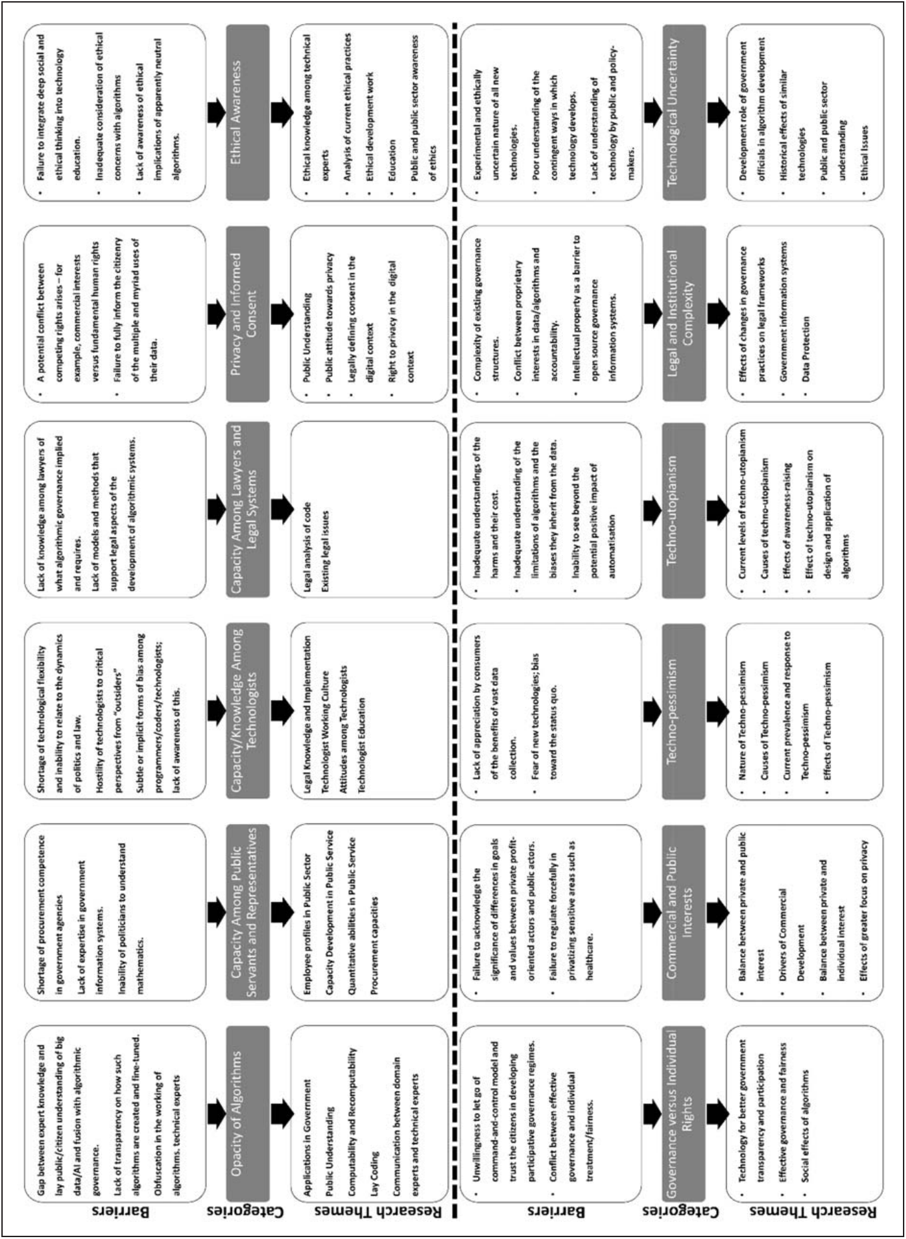
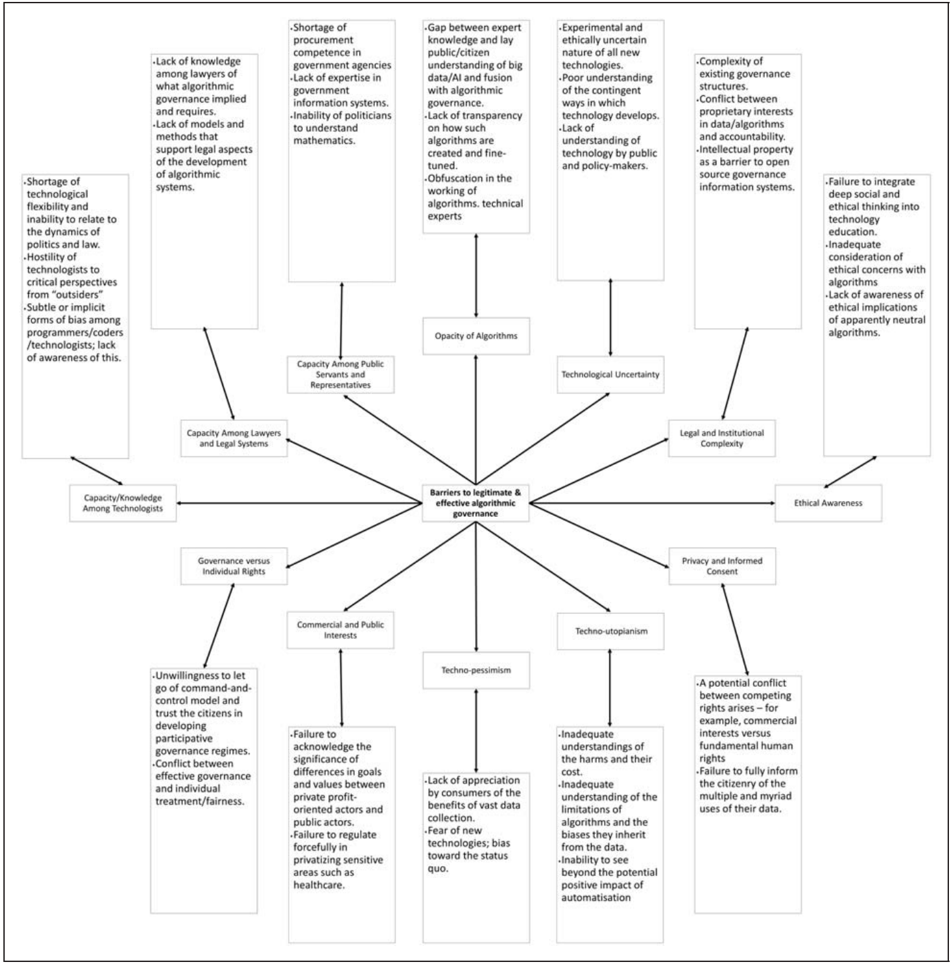
- Participants identified 12 major categories of barriers to effective and legitimate algorithmic governance, plus an additional challenge of interdisciplinarity; barriers included opacity of algorithms, techno-utopianism, techno-pessimism, technological uncertainty, capacity/knowledge among technologists, public servants, and lawyers/legal systems, legal and institutional complexity, commercial/public interests, effective governance versus individual rights, ethical awareness, and privacy/informed consent.
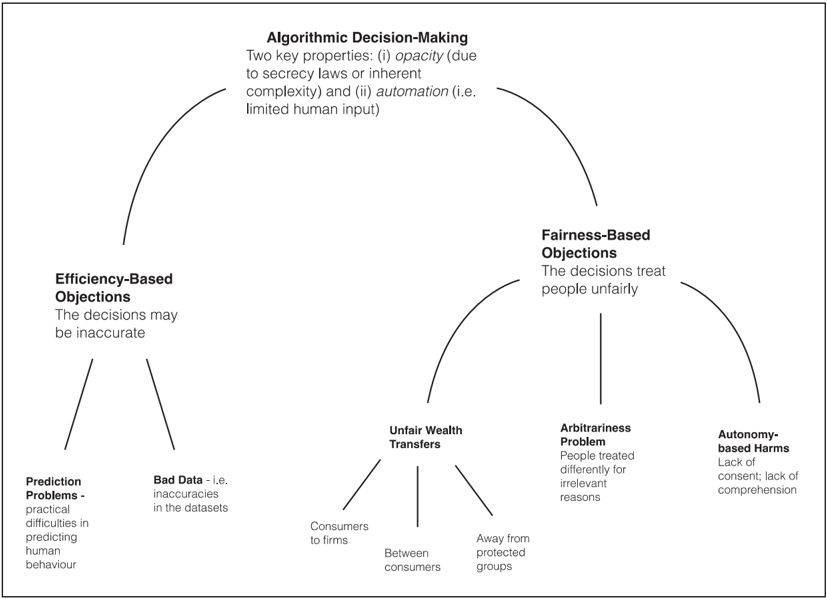
- The resulting research agenda contained at least 48 distinct research questions and 65 research applications; the authors compare this with Kitchin’s framework (one research focus, three challenges, six methodological approaches) and Zarsky’s efficiency/fairness taxonomy.
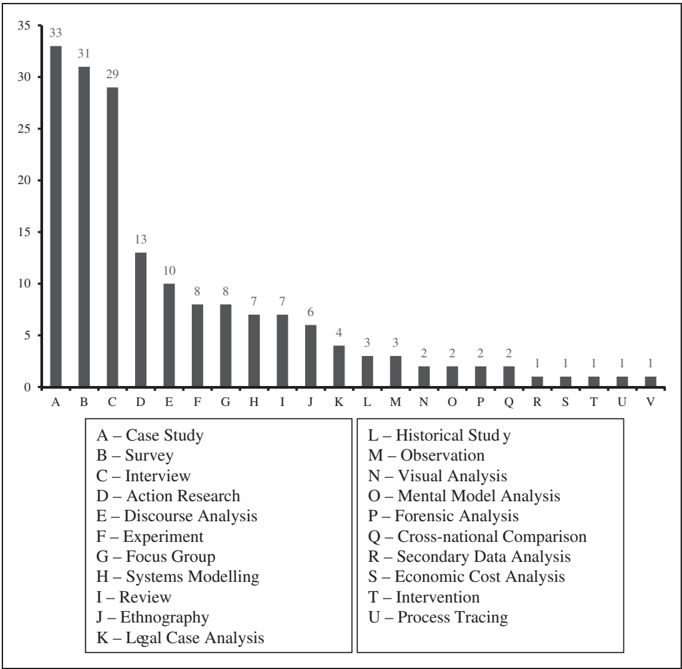
- Proposed methods included studying coders in real time via video-streaming services or hackathons, forensic and ethnographic analysis, surveys, interviews, focus groups, case studies, citizen science, visual qualitative methods, FOI requests, actor-network theory, experimental moot courts, blockchain pilots, and an open-source charter of algorithmic ethics.
- The workshop categorized 57 barrier ideas using paired comparison and three interdependent coders; Figure 4 reports a frequency count of proposed research methods.
Methods
- Design: collective intelligence workshop using interactive management (IM), combining modified nominal group technique, ideawriting, and field representations; held at NUI Galway in March 2016.
- Sample: 15 invited participants (10 men, 5 women) from computer science, law, library science, philosophy, geography, psychology, data science, political science, and information systems; 20 were invited, 15 attended, and 2 were self-selecting; one was a former elected official, three had programming/industry backgrounds, and one was employed by a company with a commercial interest (declared).
- Procedure/analysis: barriers were generated via email NGT and clarified in the first hour; 57 ideas were categorized by three coders into field representations using paired comparison; a 2-hour ideawriting session generated research options; sheets were transcribed and analysed to synthesize the agenda, with Figure 4 providing a frequency count of proposed methods.
Limitations
- Stated: group representativeness was limited—participants were selected for academic and technical expertise; only 1 of 15 was currently employed in industry, while 14 were in academia; minority perspectives were not explicitly sought; the agenda came from a particular group on a particular day; critical/radical perspectives may be missing; and the legitimacy/effectiveness framing had a mainstream liberal orientation.
- Stated: the agenda is not complete or final; future CI workshops with different groups are needed; groupwork can lead to convergent thinking and reliance on common knowledge, though IM techniques were designed to mitigate this.
- Evident from the text: this was a single workshop with no independent replication or validation, and the proposed agenda and frequency counts are descriptive outputs of one facilitated group rather than empirically tested outcomes.
Model-written summary. Check it against the paper before relying on it.
Integrity signals
Registry
Cites
Statistics
Figures
Verification
Claims the paper makes
2 Valid · 3 Not valid · 14 Not checked · 63 Own results and interpretations
The cited sources support only part of this claim — read each source’s verdict below.
In the paper
“Whether we like it or not, algorithms are increasingly being used to nudge, bias, guide, provoke, control, manipulate and constrain human behaviour.”
What the sources say
- Partly supportedcites Danaher, 2016 matched to “The threat of algocracy: reality, resistance and accommodation” (2016) sourceExperimental — accuracy not yet measured
The Abstract describes increasing reliance on algorithms in public decision-making and warns that algocratic systems may constrain human participation. Section 3 also says self-tracking apps can help with goal setting and habit formation. These passages support the broad point that algorithms increasingly guide or constrain behaviour, but they do not establish the full list of effects, particularly provoking and manipulating people. (LLM, conf=0.82)
- Not checked — no full text of the sourcecites Pasquale, 2015 matched to “The Black Box Society: The Secret Algorithms That Control Money and Information” (2015) source
- Not checked — no full text of the sourcecites Zarsky, 2016 matched to “The Trouble with Algorithmic Decisions: An Analytic Road Map to Examine Efficiency and Fairness in Automated and Opaque Decision Making” (2016) source
plainstates a cause- Asserted: passes — The authors put it forward as true.
- Checkable: passes — It can be checked against evidence.
- Load-bearing: passes — The paper’s conclusions depend on it.
- Based: passes — The paper gives a reason why it holds.
- Partly supported
In the paper
“The barriers identified in our CI workshop covered much of the same territory, with participants also highlighting specific concerns about inefficiencies, biases, lack of transparency and unfairness in the implementation of these systems.”
What the sources say
- Not matchedcites Zarsky
This doesn’t read as a citation we can look up.
plainstates an association- Asserted: passes — The authors put it forward as true.
- Checkable: passes — It can be checked against evidence.
- Load-bearing: passes — The paper’s conclusions depend on it.
- Based: passes — The paper gives a reason why it holds.
- Not matched
A result the paper reports from its own data — it cites no other source for it, so there is none to check. The quote shows it is in the paper.
In the paper
“This method enabled participants to produce a framework and research agenda for those who are concerned about algorithmic governance.”
plainstates a cause- Asserted: passes — The authors put it forward as true.
- Checkable: passes — It can be checked against evidence.
- Load-bearing: passes — The paper’s conclusions depend on it.
- Based: passes — The paper gives a reason why it holds.
A result the paper reports from its own data — it cites no other source for it, so there is none to check. The quote shows it is in the paper.
In the paper
“It is worth noting that such perspectives are not entirely absent from what has been produced.”
plain- Asserted: passes — The authors put it forward as true.
- Checkable: passes — It can be checked against evidence.
- Load-bearing: unclear — It is unclear whether the paper’s conclusions depend on it.
- Based: passes — The paper gives a reason why it holds.
In the paper
“But the participants went much further than Zarsky, highlighting how the efficiency and fairness problems were connected to other problems in education, public understanding, technical competence, recruitment, institutional complexity, gaps in legal standards and more.”
What the sources say
- Not matchedcites Zarsky
This doesn’t read as a citation we can look up.
plainstates an association- Asserted: passes — The authors put it forward as true.
- Checkable: passes — It can be checked against evidence.
- Load-bearing: passes — The paper’s conclusions depend on it.
- Based: passes — The paper gives a reason why it holds.
- Not matched
9 more claims
Create a free account to see all 82 claims and to verify the 1 reference still open.
- Probably not a substantial claim. 59
- It may state two separate claims as one. 19
- The quote only partly states this claim. 1
Claims other papers make about this one
Each is checked against this paper’s own text: does it say what the citing paper says it does?
In the citing paper
“Deep learning is our term for deeply layered neural networks, and this is the machine learning approach used by the AI economist I use as an example, as well as by Google's AlphaGo and AlphaZero [31,28,32,1].”
From A shallow defence of a technocracy of artificial intelligence: Examining the political harms of algorithmic governance in the domain of government (2020) · cites this paper as [32]
Citations
Cites
The magical number seven, plus or minus two: Some limits on our capacity for processing information.
Miller, G. A. (1956) · Psychological Review · doi:10.1037/h0043158 · Cited by 17,812
Grossman, P. (2009) · Discrete Mathematics for Computing · doi:10.1007/978-0-230-37405-8_1 · Cited by 8,834
The Black Box Society: The Secret Algorithms That Control Money and Information
Pasquale, F. (2015) · doi:10.4159/harvard.9780674736061 · Cited by 3,796
How the machine “thinks”: Understanding opacity in machine learning algorithms
Burrell, J. (2016) · Big Data & Society · doi:10.1177/2053951715622512 · Cited by 3,196
The Data Revolution: Big Data, Open Data, Data Infrastructures & Their Consequences
Kitchin, R. (2014) · doi:10.4135/9781473909472 · Cited by 1,469 · cited 2×
“This network produces ever-larger datasets of potentially useful information, updated in real time (Kitchin, 2014; Mayer-Schonberger and Cukier, 2013).”
Thinking critically about and researching algorithms
Kitchin, R. (2017) · Information, Communication & Society · doi:10.1080/1369118x.2016.1154087 · Cited by 1,186 · cited 2×
“This table was created by the lead author based on the discussion in Kitchin (2017).”
BackgroundMethodHacking, I. (2006) · Cambridge University Press eBooks · doi:10.1017/cbo9780511817557 · Cited by 1,028
Idea Generation in Groups: A Basis for Creativity in Organizations
Paulus, P. B., & Yang, H.-C. (2000) · Organizational Behavior and Human Decision Processes · doi:10.1006/obhd.2000.2888 · Cited by 833
The ethics of big data: current and foreseeable issues in biomedical contexts
Mittelstadt, B. D., & Floridi, L. (2016) · Science and Engineering Ethics · doi:10.1007/s11948-015-9652-2 · Cited by 714 · cited 1×
“There are other studies expressing concerns about the emerging ‘Big Data divide’ which ensures that only large institutions can realize the benefits of the data revolution (Mittelstadt and Floridi, 2016).”
What makes Big Data, Big Data? Exploring the ontological characteristics of 26 datasets
Kitchin, R., & McArdle, G. (2016) · Big Data & Society · doi:10.1177/2053951716631130 · Cited by 606
Research works printed but not linked: 10
- Ashby WR (1958) Requisite variety and its implications for the control of complex systems. Cybernetica 1(2): 1-17.
- Carr N (2015) The Glass Cage: Where Automation is Taking Us . London: The Bodley Head.
- Citron D and Pasquale F (2014) The scored society: Due process for automated predictions. Washington Law Review 86: 101.
- Coke JG and Moore CM (1981) Coping with a budgetary crisis: Helping a city council decide where expenditure cuts should be made. In: Building City Council Leadership Skills: A Casebook of Models and Methods , Washington, DC: National League of Cities, pp. 72-85.
- Domingos P (2015) The Master Algorithm: How the Quest for Ultimate Machine Learning will Remake Our World . New York, NY: Basic Books.
- Keever DB (1989, April) Cultural complexities in the participative design of a computer-based organization information system. Paper presented at the International Conference on Support, Society and Culture: Mutual Uses of Cybernetics and Science, Amsterdam, The Netherlands.
- Kellermeit D and Obodovski D (2013) The Silent Intelligence: The Internet of Things . DND Ventures LLC.
- Polonetsky J and Tene O (2013) Privacy and Big Data: Making ends meet. Stanford Law Review 66: 25-33.
- Weber M (1947) The Theory of Social and Economic Organzation . New York, NY: The Free Press.
- Zarsky T (2013) Transparent prediction. University of Illinois Law Review 4: 1504.
Cited by
Bankins, S., Ocampo, A. C., Marrone, M., Restubog, S. L. D., & Woo, S. E. (2024) · Journal of Organizational Behavior · doi:10.1002/job.2735 · Cited by 799
Cardullo, P., & Kitchin, R. (2019) · GeoJournal · doi:10.1007/s10708-018-9845-8 · Cited by 796
Newman, D. T., Fast, N. J., & Harmon, D. J. (2020) · Organizational Behavior and Human Decision Processes · doi:10.1016/j.obhdp.2020.03.008 · Cited by 550
Transparency in Algorithmic and Human Decision-Making: Is There a Double Standard?
Zerilli, J., Knott, A., Maclaurin, J., & Gavaghan, C. (2019) · Philosophy & Technology · doi:10.1007/s13347-018-0330-6 · Cited by 420
“And they are being made at a time when the procurement capacities of government agencies are still not well understood (Danaher et al. 2017; Oswald and Grace 2016).”
BackgroundKatzenbach, C., & Ulbricht, L. (2019) · Internet Policy Review · doi:10.14763/2019.4.1424 · Cited by 359
Bucher, E. L., Schou, P. K., & Waldkirch, M. (2021) · Organization · doi:10.1177/1350508420961531 · Cited by 349
“For workers, however, the most important aspect is that algorithmic management and its decision mechanisms are opaque and continuously evolving and, thus, on the user side ultimately inscrutable (Burrell, 2016; Danaher et al., 2017; Hansen and Flyverbom, 2015).”
BackgroundThe ethnographer and the algorithm: beyond the black box
Christin, A. (2020) · Theory and Society · doi:10.1007/s11186-020-09411-3 · Cited by 327
Wieringa, M. (2020) · Proceedings of the 2020 Conference on Fairness, Accountability, and Transparency · doi:10.1145/3351095.3372833 · Cited by 321
“Thus, one aspect of an account of algorithms should be the measure of human involvement [37, 40, 41, 46, 62, 89].”
BackgroundTechnologies of Crime Prediction: The Reception of Algorithms in Policing and Criminal Courts
Brayne, S., & Christin, A. (2021) · Social Problems · doi:10.1093/socpro/spaa004 · Cited by 279
Public value creation in digital government
Panagiotopoulos, P., Klievink, B., & Cordella, A. (2019) · Government Information Quarterly · doi:10.1016/j.giq.2019.101421 · Cited by 265
“Conflicts in public value creation enabled by algorithmic governance could be identified in trade-offs between efficiency, fairness and transparency or other unintended consequences (e.g. Danaher et al., 2017; Janssen & Kuk, 2016).”
BackgroundHannah-Moffat, K. (2019) · Theoretical Criminology · doi:10.1177/1362480618763582 · Cited by 236
Platformic Management, Boundary Resources for Gig Work, and Worker Autonomy
Jarrahi, M. H., Sutherland, W., Nelson, S. B., & Sawyer, S. (2020) · Computer Supported Cooperative Work (CSCW) · doi:10.1007/s10606-019-09368-7 · Cited by 230
Governance of artificial intelligence: A risk and guideline-based integrative framework
Wirtz, B. W., Weyerer, J. C., & Kehl, I. (2022) · Government Information Quarterly · doi:10.1016/j.giq.2022.101685 · Cited by 193
Algorithmic governance: A modes of governance approach
Gritsenko, D., & Wood, M. (2022) · Regulation & Governance · doi:10.1111/rego.12367 · Cited by 183
“…implications of accelerated deployment of algorithmic systems within public life informed a renewed interest toward the role of new technologies across disciplines, leading to the emergence of an interdisciplinary body of literature on algorithmic governance (AG, for an overview see Danaher et al .”
BackgroundMeijer, A., Lorenz, L., & Wessels, M. (2021) · Public Administration Review · doi:10.1111/puar.13391 · Cited by 174
Andrews, L. (2019) · Public Administration · doi:10.1111/padm.12534 · Cited by 172
“tors affecting whether or not a problem might be defined as ‘wicked’ and solutions found (Danaher et al. 2017).”
Background(Smart) Citizens from Data Providers to Decision-Makers? The Case Study of Barcelona
Calzada, I. (2018) · Sustainability · doi:10.3390/su10093252 · Cited by 169
Lee, M. K., & Rich, K. (2021) · Proceedings of the 2021 CHI Conference on Human Factors in Computing Systems · doi:10.1145/3411764.3445570 · Cited by 145
“healthcare, education, criminal justice systems, organizational management and public assistance [8, 9, 25, 40], AI systems are automating or augmenting decisions that human experts used to make.”
BackgroundDigital data and management accounting: why we need to rethink research methods
Bhimani, A. (2020) · Journal of Management Control · doi:10.1007/s00187-020-00295-z · Cited by 296
Algorithmic Decision-Making in AVs: Understanding Ethical and Technical Concerns for Smart Cities
Lim, H. S. M., & Taeihagh, A. (2019) · Sustainability · doi:10.3390/su11205791 · Cited by 136
“The limitations of the top-down approach can be offset by the bottom-up approach, whereby the algorithm constructs its own rules by learning from past driving experiences and human judgements that are deemed morally correct [93,94,99,100], but doing so can also introduce its own safety risks to AVs due to several impl…”
BackgroundTowards platform observability
Rieder, B., & Hofmann, J. (2020) · Internet Policy Review · doi:10.14763/2020.4.1535 · Cited by 132
Martin, K., & Waldman, A. (2023) · Journal of Business Ethics · doi:10.1007/s10551-021-05032-7 · Cited by 132
“For example, Danaher et al. (2017) examine the legitimacy of ADM governance mechanisms (rather than the legitimacy of the decision), and Lünich and Kieslich (2021) studied attributes of respondents (i.e. general trust) in their perception of legitimacy of a vaccine distribution algorithm.”
BackgroundThe Digital Prism: Transparency and Managed Visibilities in a Datafied World
Flyverbom, M. (2019) · Cambridge University Press eBooks · doi:10.1017/9781316442692 · Cited by 129
Chuang, Y., Chiang, H.-L., & Lin, A.-P. (2025) · International Journal of Information Management · doi:10.1016/j.ijinfomgt.2025.102887 · Cited by 267
Algorithmic Governance and the International Politics of Big Tech
Srivastava, S. (2021) · Perspectives on Politics · doi:10.1017/s1537592721003145 · Cited by 202
“…literature has emerged to study the consequences of algorithmic governance for social control (Amoore 2020; Andrejevic 2020; Benjamin 2019; Bucher 2018; Citron and Pasquale 2014; Crawford 2021; Crawford and Schultz 2019; Danaher et al. 2017; Noble 2018; Pasquale 2015; Yeung 2018; Zuboff 2019).”
BackgroundEmployment relationships in algorithmic management: A psychological contract perspective
Tomprou, M., & Lee, M. K. (2022) · Computers in Human Behavior · doi:10.1016/j.chb.2021.106997 · Cited by 113
“Many organizational managerial functions, such as recruiting job candidates, onboarding new hires, and allocating tasks, are already executed by software and/or chatbots (Cascio & Montealegre, 2018; Danaher et al., 2017).”
Sætra, H. S. (2020) · Technology in Society · doi:10.1016/j.techsoc.2020.101283 · Cited by 111
Algorithmic Reason: The New Government of Self and Other
Aradau, C., & Blanke, T. (2022) · doi:10.1093/oso/9780192859624.001.0001 · Cited by 185
Park, S., & Gil-García, J. R. (2021) · Government Information Quarterly · doi:10.1016/j.giq.2020.101456 · Cited by 149
Datafication, dataveillance, and the social credit system as China’s new normal
Lee, C. S. (2019) · Online Information Review · doi:10.1108/oir-08-2018-0231 · Cited by 123
The Mutual Domestication of Users and Algorithmic Recommendations on Netflix
Siles, I., Rojas, J. E., Naranjo, A., & Tristán, M. F. (2019) · Communication Culture and Critique · doi:10.1093/ccc/tcz025 · Cited by 160
New spaces of disruption? The failures of Bitcoin and the rhetorical power of algorithmic governance
Zook, M. A., & Blankenship, J. (2018) · Geoforum · doi:10.1016/j.geoforum.2018.08.023 · Cited by 103
Data ecosystems for protecting European citizens’ digital rights
Calzada, I., & Almirall, E. (2020) · Transforming Government People Process and Policy · doi:10.1108/tg-03-2020-0047 · Cited by 109
Anticipation and Organization: Seeing, knowing and governing futures
Flyverbom, M., & Garsten, C. (2021) · Organization Theory · doi:10.1177/26317877211020325 · Cited by 131
“Making sense of the workings and effects of such opaque forms of algorithmic governance (Danaher et al, 2017), both in the context of anticipation and in other domains of governance, remains a looming task for scholars, policy-makers and practitioners in years to come.”
BackgroundArtificial Intelligence and Public Human Resource Management: Questions for Research and Practice
Johnson, B. A. M., Coggburn, J. D., & Llorens, J. J. (2022) · Public Personnel Management · doi:10.1177/00910260221126498 · Cited by 173
“The application of these tools in public administration settings has given rise to the notion of algorithmic governance (Danaher et al., 2017), which refers to a decision-making environment where algorithmic tools are increasingly playing a role in governing decisions (see also Busuioc, 2021).”
BackgroundFosch‐Villaronga, E., Lutz, C., & Tamò‐Larrieux, A. (2019) · International Journal of Social Robotics · doi:10.1007/s12369-019-00605-z · Cited by 104
Kim, S., Khoreva, V., & Vaiman, V. (2024) · Human Resource Management · doi:10.1002/hrm.22268 · Cited by 164
Shin, D., Chotiyaputta, V., & Zaid, B. (2022) · Computers in Human Behavior · doi:10.1016/j.chb.2021.107007 · Cited by 84
Waldman, A. E., & Martin, K. E. (2022) · Big Data & Society · doi:10.1177/20539517221100449 · Cited by 95
Kozinets, R. V. (2021) · Journal of service management · doi:10.1108/josm-07-2021-0263 · Cited by 113
A taxonomy of human–machine collaboration: capturing automation and technical autonomy
Simmler, M., & Frischknecht, R. (2020) · AI & Society · doi:10.1007/s00146-020-01004-z · Cited by 109
“Challenges regarding a lack of explain-ability arise, likewise affecting questions of legitimacy (Mit-telstadt et al. 2016), governance (Danaher et al. 2017) and accountability (Shin and Park 2019).”
BackgroundDigital policy sociology: software and science in data-intensive precision education
Williamson, B. (2019) · Critical Studies in Education · doi:10.1080/17508487.2019.1691030 · Cited by 126
Beyond mystery: Putting algorithmic accountability in context
Reddy, E., Cakici, B., & Ballestero, A. (2019) · Big Data & Society · doi:10.1177/2053951719826856 · Cited by 60
“Whether the ethical concerns that emerge around algorithms are explicitly epistemic, normative, or a matter of traceability (as in Mittelstadt et al., 2016), algorithmic governance is a problem that many understand to be pressing (see the review presented in Danaher et al., 2017).”
BackgroundFrom sociology of quantification to ethics of quantification
Saltelli, A., & Fiore, M. D. (2020) · Humanities and Social Sciences Communications · doi:10.1057/s41599-020-00557-0 · Cited by 67
“At the same time, this increasing complexity of algorithms comes in the form of black boxes (Danaher et al., 2017), where clarity is sacrificed, because although algorithms have the power to act upon data and make decisions, they are largely beyond query or question (Kitchin, 2017; O’Neil, 2016),…”
BackgroundInfluentialQualitative Research Ethics in the Big Data Era
Hesse, A., Glenna, L., Hinrichs, C. C., Chiles, R. M., & Sachs, C. (2018) · American Behavioral Scientist · doi:10.1177/0002764218805806 · Cited by 105
“…of the ethical and practical concerns that arise for the practice of qualitative research in the Big Data era.1 Big Data is differentiated from other data by its volume, variety, and velocity (Danaher et al., 2017; Lyon, 2014; Richards & King, 2014; for other metrics, see Kitchin, 2014).”
BackgroundSeeing Like an Infrastructure: Low-resolution Citizens and the Aadhaar Identification Project
Singh, R., & Jackson, S. (2021) · Proceedings of the ACM on Human-Computer Interaction · doi:10.1145/3476056 · Cited by 60
In Waze We Trust: Algorithmic Governance of the Public Sphere
van der Graaf, S. (2018) · Media and Communication · doi:10.17645/mac.v6i4.1710 · Cited by 64
“Moreover, in today’s context, particularly in urban settings like smart cities, attention is also drawn to terms such as ‘algorithmic governance’ (Coletta & Kitchin, 2017; Danaher et al., 2017), ‘artificial intelligence governance’ (Gasser & Almeida, 2017), ‘Internet of Things governance’ (Almeida, Doneda, & Monteiro,…”
BackgroundPorter, L., Fields, D., Landau-Ward, A., Rogers, D., Sadowski, J., Maalsen, S., Kitchin, R., Dawkins, O., Young, G. W., & Bates, L. K. (2019) · Planning Theory & Practice · doi:10.1080/14649357.2019.1651997 · Cited by 74
Artificial Intelligence and Community Well-being: A Proposal for an Emerging Area of Research
Musikanski, L., Rakova, B., Bradbury, J., Phillips, R., & Manson, M. (2020) · International Journal of Community Well-Being · doi:10.1007/s42413-019-00054-6 · Cited by 62
Holton, R., & Boyd, R. (2021) · Journal of Sociology · doi:10.1177/1440783319873046 · Cited by 53
“Yet there is also a clear trend towards the outsourcing of decision-making to algorithmic processes (Danaher et al., 2017).”
BackgroundMethodInfluentialKim, E. S. (2020) · Technology in Society · doi:10.1016/j.techsoc.2020.101378 · Cited by 67
Just data? Solidarity and justice in data-driven medicine
Hummel, P., & Braun, M. (2020) · Life Sciences Society and Policy · doi:10.1186/s40504-020-00101-7 · Cited by 63
Information management in the smart city
Stone, M., Knapper, J., Evans, G., & Aravopoulou, E. (2018) · The Bottom Line Managing Library Finances · doi:10.1108/bl-07-2018-0033 · Cited by 58
Axiological futurism: The systematic study of the future of values
Danaher, J. (2021) · Futures · doi:10.1016/j.futures.2021.102780 · Cited by 77
Self-citationAn Integrative Collaborative Ecosystem for Smart Cities — A Framework for Organizational Governance
Wirtz, B. W., & Müller, W. M. (2022) · International Journal of Public Administration · doi:10.1080/01900692.2021.2001014 · Cited by 66
“As various authors promote governance by algorithmic programming of interactions via digital devices working independently of human intervention (Danaher et al., 2017; Lumineau et al., 2020), a review of the mode of action of SC software and hardware indicates an innovative governance mechanism…”
BackgroundSocial impacts of algorithmic decision-making: A research agenda for the social sciences
Gerdon, F., Bach, R. L., Kern, C. A., & Kreuter, F. (2022) · Big Data & Society · doi:10.1177/20539517221089305 · Cited by 88
“…(Lange et al., 2019), social and political challenges with respect to regulation (Mittelstadt, 2019), privacy (Anthony et al., 2017), and governance (Danaher et al., 2017), to arti fi cial intelligence shifting power relationships (Kalluri, 2020), or other social impacts beyond inequality outcomes.”
BackgroundBig Data Dreams and Reality in Shenzhen: An Investigation of Smart City Implementation in China
Große-Bley, J., & Kostka, G. (2021) · Big Data & Society · doi:10.1177/20539517211045171 · Cited by 83
Algorithmic transparency and bureaucratic discretion: The case of SALER early warning system
Criado, J. I., Valero, J., & Villodre, J. (2020) · Information Polity · doi:10.3233/ip-200260 · Cited by 47
Hagendorff, T. (2021) · Minds and Machines · doi:10.1007/s11023-021-09573-8 · Cited by 47
“By following such an integrated approach, unintended cognitive biases in the selection off intended training data biases can be tracked, but it can also be ensured that the selection of values and traits stands in accordance with democratic consensuses (Floridi et al., 2018; Brundage et al. 2020; Daly et al. 2019b; Da…”
BackgroundLemos, A. (2021) · Civitas - Revista de Ciências Sociais · doi:10.15448/1984-7289.2021.2.39638 · Cited by 198
Johns, F. (2021) · Annual Review of Law and Social Science · doi:10.1146/annurev-lawsocsci-120920-085138 · Cited by 76
Public AI canvas for AI-enabled public value: A design science approach
Fatima, S., Desouza, K. C., Buck, C., & Fielt, E. (2022) · Government Information Quarterly · doi:10.1016/j.giq.2022.101722 · Cited by 58
Werth, R. (2019) · Sociology Compass · doi:10.1111/soc4.12659 · Cited by 73
What is algorithmic governance?
Issar, S., & Aneesh, A. (2021) · Sociology Compass · doi:10.1111/soc4.12955 · Cited by 72
The Global Institutional Governance of AI: A Four-Dimensional Perspective
Neuwirth, R. J. (2024) · International Journal of Digital Law and Governance · doi:10.1515/ijdlg-2024-0004 · Cited by 60
The Digital Phenotype: a Philosophical and Ethical Exploration
Loi, M. (2018) · Philosophy & Technology · doi:10.1007/s13347-018-0319-1 · Cited by 47
Indian Institute of Management Tiruchirappalli, Vimalkumar, M., Gupta, A., Indian Institute of Technology Delhi, Sharma, D., OP Jindal Global University, Dwivedi, Y. K., & Swansea University (2021) · AIS Transactions on Human-Computer Interaction · doi:10.17705/1thci.00144 · Cited by 43
Hohma, E., Boch, A., Trauth, R., & Lütge, C. (2023) · Frontiers in Psychology · doi:10.3389/fpsyg.2023.1073686 · Cited by 64
Knowledge development, technology and questions of nursing ethics
Peirce, A. G., Elie, S., George, A., Gold, M., O’Hara, K., & Rose-Facey, W. (2020) · Nursing Ethics · doi:10.1177/0969733019840752 · Cited by 42
Tulumello, S., & Iapaolo, F. (2021) · Urban Geography · doi:10.1080/02723638.2021.1887634 · Cited by 64
“Indeed, it is in their promises, in their “mundanely predictable hopes” (Datta & Odendaal, 2019, p. 392), that we find the power of predictive policing and smart city.”
BackgroundRobo-advisors (RAs): the programmed self-service market for professional advice
Wexler, M. N., & Oberlander, J. (2021) · Journal of Service Theory and Practice · doi:10.1108/jstp-07-2020-0153 · Cited by 52
Chasing Frankenstein's Monster: Information Literacy in the Black Box Society
Lloyd, A. (2019) · Journal of Documentation · doi:10.1108/jd-02-2019-0035 · Cited by 41
Fan, Y., & Liu, X. (2022) · Frontiers in Psychology · doi:10.3389/fpsyg.2022.1009173 · Cited by 40
“With these characteristics, algorithms have been becoming the basis of decision-making in “algorithmic life” and have started to intervene and even dominate more and more human social affairs, becoming agents in people’s daily lives (Bo and Benbasat, 2007; Danaher et al., 2017).”
BackgroundOn Chances and Risks of Security Related Algorithmic Decision Making Systems
Zweig, K. A., Wenzelburger, G., & Krafft, T. D. (2018) · European Journal for Security Research · doi:10.1007/s41125-018-0031-2 · Cited by 50
“Admittedly, the question of how to “govern” (Danaher et al. 2017; Ziewitz 2016) or how to “regulate” (Yeung 2017) ADM systems can be analyzed from very different analytical perspectives.”
BackgroundA guideline for understanding and measuring algorithmic governance in everyday life
Latzer, M., & Festic, N. (2019) · Internet Policy Review · doi:10.14763/2019.2.1415 · Cited by 62
Smart urban governance: An urgent symbiosis?
Jiang, H., Geertman, S. C. M., & Witte, P. (2019) · Information Polity · doi:10.3233/ip-190130 · Cited by 51
Digital Technology, Politics, and Policy-Making
Gilardi, F. (2022) · Cambridge University Press eBooks · doi:10.1017/9781108887304 · Cited by 57
Data, AI and governance in MaaS – Leading to sustainable mobility?
Servou, E., Behrendt, F., & Horst, M. (2023) · Transportation Research Interdisciplinary Perspectives · doi:10.1016/j.trip.2023.100806 · Cited by 60
Adam or Eve? Automatic users’ gender classification via gestures analysis on touch devices
Guarino, A., Lettieri, N., Malandrino, D., Zaccagnino, R., & Capo, C. (2022) · Neural Computing and Applications · doi:10.1007/s00521-022-07454-4 · Cited by 38
“…contexts in which automatic decisions/classifications occur, designers, engineers and all the persons behind the project must ensure that the solution has been designed and implemented in a way that certifies both its effectiveness and legitimacy, so that the results are beneficial and/or benign [16].”
BackgroundSocial data governance: Towards a definition and model
Liu, J. (2022) · Big Data & Society · doi:10.1177/20539517221111352 · Cited by 48
“…various models through which governmental and corporate, state and non-state actors worldwide are trying to make greater use of large volumes of data to identify, predict, and even modify human behavior (e.g. Birch et al., 2021; Danaher et al., 2017; Gritsenko and Wood, 2020; Micheli et al., 2020).”
BackgroundInfluentialLorenz, L., Meijer, A. J., & Schuppan, T. (2020) · Information Polity · doi:10.3233/ip-200279 · Cited by 39
“In the algocracy, authority is exercised through algorithmic systems which codify legal, organizational but also professionals rules (Peeters & Schuilenburg, 2018; Danaher et al., 2017; Coletta & Kitchin, 2017).”
Na-Nan, K., Roopleam, T., & Wongsuwan, N. (2019) · Kybernetes · doi:10.1108/k-01-2019-0053 · Cited by 60
Büchner, S., & Dosdall, H. (2021) · KZfSS Kölner Zeitschrift für Soziologie und Sozialpsychologie · doi:10.1007/s11577-021-00752-0 · Cited by 50
Calzada, I. (2019) · Regions Magazine · doi:10.1080/13673882.2018.00001038 · Cited by 31
“Indeed, the non-transparency of algorithmic governance systems is all the worse when such algorithms are fused into already-opaque governance structures (Danaher et al. 2017).”
BackgroundPerrotta, C., & Pangrazio, L. (2023) · Education Policy Analysis Archives · doi:10.14507/epaa.31.7952 · Cited by 56
van Noordt, C., & Misuraca, G. C. (2020) · International Conference on Theory and Practice of Electronic Governance · doi:10.1145/3428502.3428504 · Cited by 57
“…of AI governance against the backdrop of the practices of data controllers, data protection authorities and individuals, but also highlighting the opportunities that AI can unleash for revitalising governance and democracy by harnessing citizen participation and 'collective intelligence' [71].”
BackgroundFilgueiras, F. D. B. (2021) · AI & Society · doi:10.1007/s00146-021-01201-4 · Cited by 58
A credit-like rating system to determine the legitimacy of scientific journals and publishers
da Silva, J. A. T., Dunleavy, D. J., Moradzadeh, M., & Eykens, J. (2021) · Scientometrics · doi:10.1007/s11192-021-04118-3 · Cited by 39
Dekker, R., Koot, P., Birbil, Ş. İ., & Andres, M. V. E. (2022) · Big Data & Society · doi:10.1177/20539517221087855 · Cited by 39
“This trend has been captured under the label of “ algorithmic governance ” (Danaher et al., 2017; Gritsenko and Wood, 2020; Williamson, 2014).”
Technology in the Workplace: Opportunities and Challenges
Griep, Y., Vranješ, I., van Hooff, M. L. M., Beckers, D. G. J., & Geurts, S. A. E. (2021) · Springer eBooks · doi:10.1007/978-3-030-74128-0_6 · Cited by 50
Poritskiy, N., de Oliveira, F. G., & Almeida, F. L. (2019) · Digital Policy Regulation and Governance · doi:10.1108/dprg-05-2019-0039 · Cited by 44
Collective Exclusion: How White Heterosexual Dating App Norms Reproduce Status Quo Hookup Culture
Hanson, K. R. (2021) · Sociological Inquiry · doi:10.1111/soin.12426 · Cited by 35
Dealing with Gender Bias Issues in Data-Algorithmic Processes: A Social-Statistical Perspective
Castaneda, J., Jover-Leal, A., Calvet, L., Torrado, S. Y., Juan, A. A., & Ibáñez, M. S. (2022) · Algorithms · doi:10.3390/a15090303 · Cited by 35
“This is what experts, such as Danaher et al. [22], have agreed to call “algocracy” or governance of the algorithms.”
BackgroundFestic, N. (2020) · Regulation & Governance · doi:10.1111/rego.12333 · Cited by 40
“Computer says no”: Algorithmic decision support and organisational responsibility
Adensamer, A., Gsenger, R., & Klausner, L. D. (2021) · Journal of Responsible Technology · doi:10.1016/j.jrt.2021.100014 · Cited by 41
Machine Intelligence, Bureaucracy, and Human Control
Bullock, J. B., Huang, H., & Kim, K.-C. (2022) · Perspectives on Public Management and Governance · doi:10.1093/ppmgov/gvac006 · Cited by 40
Predictive analytics and governance: a new sociotechnical imaginary for uncertain futures
Lazaro, C., & Rizzi, M. (2022) · International Journal of Law in Context · doi:10.1017/s1744552322000477 · Cited by 48
“A growing body of literature has emerged in recent years to examine the nuts and bolts of ‘algorithmic governance’ (Cantero Gamito and Ebers, 2021; Danaher et al., 2017; Gritsenko and Wood, 2022; Kalpokas, 2019) or ‘algorithmic regulation’ (Yeung, 2018).”
BackgroundSullivan, R., Veen, A., & Riemer, K. (2024) · Information and Organization · doi:10.1016/j.infoandorg.2024.100528 · Cited by 36
Zhou, W., Dai, L., Zhang, Y., & Wen, C. (2021) · Online Information Review · doi:10.1108/oir-06-2020-0249 · Cited by 28
Infrastrukturen als Produkte und Produzenten von Zeit
Engels, J. I. (2020) · NTM Zeitschrift für Geschichte der Wissenschaften Technik und Medizin · doi:10.1007/s00048-019-00234-7 · Cited by 36
Metadata
- Authors
- Danaher, J., Hogan, M. J., Noone, C., Kennedy, R., Behan, A., De Paor, A., Felzmann, H., Haklay, M., Khoo, S.-M., Morison, J., Murphy, M. H., O'Brolchain, N., Schafer, B., & Shankar, K.
- Affiliations
- Ollscoil na Gaillimhe – University of Galway (IE)
- IBM (Ireland) (IE)
- School of Law and Government, Dublin City University, Ireland
- University College London (GB)
- Queen's University Belfast (GB)
- National University of Ireland, Maynooth (IE)
- National University of Ireland – Galway, Ireland
- School of Law, Old College, University of Edinburgh, UK
- University College Dublin (IE)
- Corresponding author
- Danaher, John
- ORCID
- Venue
- Big Data & Society
- Publisher
- SAGE Publications
- Published
- 2017-09-19
- Volume
- 4
- Issue
- 2
- Pages
- 205395171772655
- ISSN
- 2053-9517 (ISSN-L)
- OpenAlex
- W2753975405
- Cited by
- 369
- References
- 26
- Citations by year
- 2026: 59 · 2025: 32 · 2024: 20 · 2023: 33 · 2022: 51 · 2021: 58 · 2020: 40 · 2019: 55 · 2018: 19 · 2017: 2
- FWCI
- 72.72
- Type
- journal article
- Language
- en
- Open access
- gold
- doi.org
- Licence
- cc-by-nc
- journals.sagepub.com/page/policies/text-and-data-mining-license (tdm)
- Locations
- Big Data & Society (publishedVersion, cc-by-nc)
- Maynooth University ePrints and eTheses Archive (Maynooth University) (acceptedVersion)
- Arrow@dit (Dublin Institute of Technology) (acceptedVersion)
- ARAN (University of Galway Research Repository) (Ollscoil na Gaillimhe – University of Galway) (acceptedVersion, cc-by-nc-nd)
- ARAN (University of Galway Research Repository) (Ollscoil na Gaillimhe – University of Galway) (submittedVersion, cc-by-nc-nd)
- Edinburgh Research Explorer (University of Edinburgh) (submittedVersion, cc-by-nc)
- Research Portal (Queen's University Belfast) (submittedVersion, cc-by-nc)
- Arrow@dit (Dublin Institute of Technology) (submittedVersion)
- Arrow@dit (Dublin Institute of Technology) (submittedVersion, cc-by-nc-nd)
- DOAJ (DOAJ: Directory of Open Access Journals) (submittedVersion, cc-by-sa)
- UCL Discovery (University College London) (submittedVersion)
- Research Repository UCD (University College Dublin) (submittedVersion, cc-by-nc)
- University of Galway Research Repository (submittedVersion, cc-by)
- Funders
- University of Galway
- Irish Research Council
- Topics
- Physical Sciences › Computer Science › Artificial Intelligence › Ethics and Social Impacts of AI
- Social Sciences › Political Science and International Relations › E-Government and Public Services
- Social Sciences › Urban Studies › Smart Cities and Technologies
- Keywords
- algorithmic governance, collective intelligence, research agenda, algorithmic legitimacy, algorithmic fairness, algorithmic bias, procedural justice, critical algorithm studies, multidisciplinary collaboration
About these checks
Registry, retraction, Cites and statistics results are computed, not judged, with one exception: a printed reference that no index lists is read once by a model before it counts as a citation error. Claims are extracted by a model and kept only when their quote appears verbatim in the text; each cited source is then checked, with a model’s help, for whether it says what the claim relies on. Those verdicts can be wrong — read the claim’s quote and the cited source before relying on one.
The claim verdicts this report counts are experimental: their accuracy is not yet measured.
A language model drew the claims from the paper on 2026-10-10, under version 3 of the claim definition (model deepseek-v4.1-flash, prompt extract-v3).
A second model labelled each claim on 2026-10-10 (model jev-1.13-20260917, definition revision gold-guideline-v0.2).
Cited sources are checked with a language model’s help (gpt-6-sol).
Statistics and arithmetic are recomputed, not judged.
Confidence bands are shown only for fields calibrated on our annotated test set. None is calibrated yet, so no band is shown.
What counts as a claim ›How we measure confidence ›How we check this ›
Are you an author, or do you see a problem with this page? Request a review
Data sources
Bibliographic data: Semantic Scholar, OpenAlex, Crossref.
Contains information from the Semantic Scholar Academic Graph Datasets, made available under the ODC Attribution License (ODC-BY 1.0).
Semantic Scholar’s data is described in: Kinney, R., et al. (2023). The Semantic Scholar Open Data Platform. arXiv:2301.10140.
