

Engagement features judged by excessive drinkers as most important to include in smartphone applications for alcohol reduction: A mixed-methods study
Open accessThe DOI matches its Crossref record; 63 of the 63 references it cites were found in a registry or an index.
Abstract
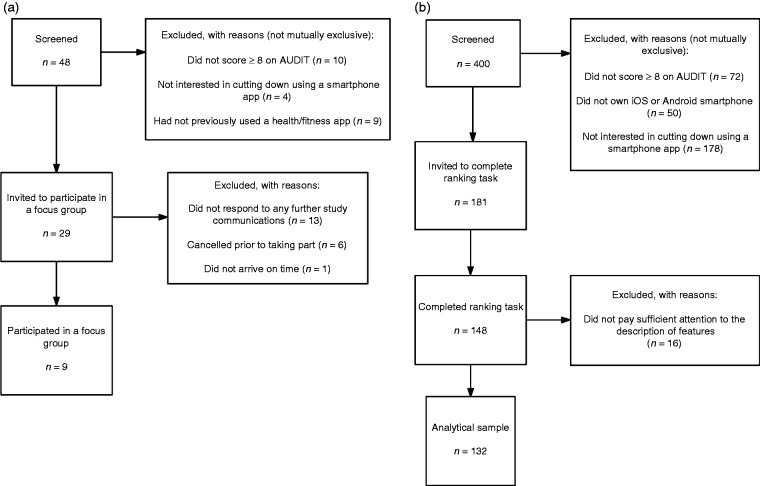
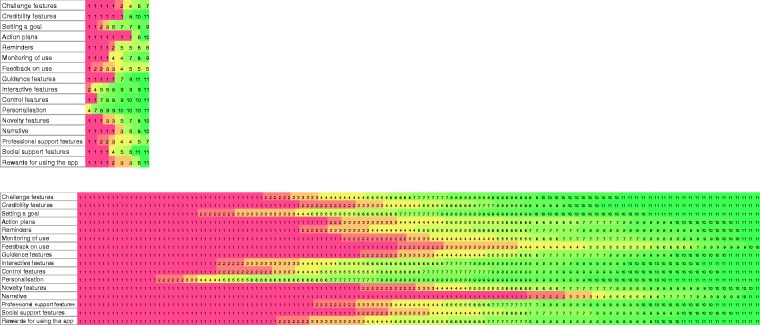
Objective: Engagement with smartphone applications (apps) for alcohol reduction is necessary for their effectiveness. This study explored (1) the features that are ranked as most important for engagement by excessive drinkers and (2) why particular features are judged to be more important for engagement than others. Methods: Two studies were conducted in parallel. The first was a focus group study with adult excessive drinkers, interested in reducing alcohol consumption using an app ( n groups = 3). Participants individually ranked their top 10 features from a pre-specified list and subsequently discussed their rankings. The second was an online study with a new sample ( n = 132). Rankings were analysed using the intraclass correlation coefficient (ICC) to assess the level of agreement between raters for each study. Qualitative data were analysed using inductive thematic analysis. Results: There was low agreement between participants in their rankings, both in the focus groups (ICC = 0.15, 95% confidence interval (CI) = 0.03–0.38) and the online sample (ICC = 0.11, 95% CI = 0.06–0.23). ‘Personalisation’, ‘control features’ and ‘interactive features’ were most highly ranked in the focus groups. These were expected to elicit a sense of benefit and usefulness, adaptability, provide motivational support or spark users’ interest. Results from the online study partly corroborated these findings. Conclusion: There was little agreement between participants, but on average, the features judged to be most important for inclusion in smartphone apps for alcohol reduction were personalisation, interactive features and control features. Tailoring on users’ underlying psychological needs may promote engagement with alcohol reduction apps.
Overview
The claims and statistics of this paper haven’t been checked yet.
Free: it reads the open-access text and checks the first 5 claims that cite a source we can check. Create a free account to check every claim.
Integrity signals
Registry
Cites
Statistics
Figures
Verification
Claims the paper makes
The claims and statistics of this paper haven’t been checked yet.
Free: it reads the open-access text and checks the first 5 claims that cite a source we can check. Create a free account to check every claim.
Claims other papers make about this one
Each is checked against this paper’s own text: does it say what the citing paper says it does?
The source backs part of the claim, not all of it — or backs it for a different population, condition or comparison.
In the citing paper
“Goal setting [38,39,45,48,51,54,56,58,59,66,71,74] was related to sustained engagement with health and well-being apps (Q61).”
From Influences on the Uptake of and Engagement With Health and Well-Being Smartphone Apps: Systematic Review (2020) · cites this paper as [59]
Experimental — accuracy not yet measuredThe source backs part of the claim, not all of it — or backs it for a different population, condition or comparison.
In the citing paper
“It was proposed that having a guide on how to use an app could positively affect the users’ intention to engage with it, and hence, users might be able to better regulate their behavior (Q4) [46,59].”
From Influences on the Uptake of and Engagement With Health and Well-Being Smartphone Apps: Systematic Review (2020) · cites this paper as [59]
Experimental — accuracy not yet measuredThe source backs part of the claim, not all of it — or backs it for a different population, condition or comparison.
In the citing paper
“Numerous studies have found that interactivity and positivity of tone may be efficacious for engagement, especially when attempting to change behaviors associated with self-blame (eg, weight management) (Q29) [46,51,57-60,69,71,72].”
From Influences on the Uptake of and Engagement With Health and Well-Being Smartphone Apps: Systematic Review (2020) · cites this paper as [59]
Experimental — accuracy not yet measuredThe source backs part of the claim, not all of it — or backs it for a different population, condition or comparison.
In the citing paper
“Several studies suggested that demanding or annoying language would be ignored (Q30) [57-59], although a study of nutrition apps reported the occasional need for a tougher attitude to achieve goals (Q31) [51].”
From Influences on the Uptake of and Engagement With Health and Well-Being Smartphone Apps: Systematic Review (2020) · cites this paper as [59]
Experimental — accuracy not yet measuredThe source backs part of the claim, not all of it — or backs it for a different population, condition or comparison.
In the citing paper
“It was suggested that unsupportive language would evoke negative emotions (eg, guilt and regret), which would affect the intention to engage with an app [46,59,71].”
From Influences on the Uptake of and Engagement With Health and Well-Being Smartphone Apps: Systematic Review (2020) · cites this paper as [59]
Experimental — accuracy not yet measured
12 more claims about this paper
Create a free account to see every claim other papers make about this one.
Self-check
Percentages, sums and reported differences re-computed from the paper’s own numbers.
The self-check needs the paper’s full text.
Citations
Cites
Using thematic analysis in psychology
Braun, V., & Clarke, V. (2006) · Qualitative Research in Psychology · doi:10.1191/1478088706qp063oa · Cited by 194,414 · cited 1×
“The thematic analysis was conducted in six phases: (i) gaining familiarity with the data, (ii) generating initial codes, (iii) searching for themes, (iv) reviewing themes, (v) defining and naming themes and (vi) producing the report.(45) Data were coded independently by the first and second author.”
MethodThe Elaboration Likelihood Model of Persuasion
Petty, R. E., & Cacioppo, J. T. (1986) · Advances in Experimental Social Psychology · doi:10.1016/s0065-2601(08)60214-2 · Cited by 8,822
Deci, E. L., Koestner, R., & Ryan, R. M. (1999) · Psychological Bulletin · doi:10.1037/0033-2909.125.6.627 · Cited by 7,176
Self-determination theory: A macrotheory of human motivation, development, and health
Deci, E. L., & Ryan, R. M. (2008) · Canadian Psychology / Psychologie canadienne · doi:10.1037/a0012801 · Cited by 6,664 · cited 1×
“‘controlled motivation’).(55) However, the finding that participants also expected the receipt of rewards which have previously been found to undermine autonomous motivation(56) to help them engage, begs the question as to what sources of motivation are most supportive of engagement.”
BackgroundThe methodology of Focus Groups: the importance of interaction between research participants
Kitzinger, J. (1994) · Sociology of Health & Illness · doi:10.1111/1467-9566.ep11347023 · Cited by 3,870 · cited 1×
“Focus groups are useful for gaining an in-depth understanding of participants’ experiences, beliefs and motivations, and are particularly suitable when the interaction between participants is expected to yield additional insight into the topic of interest.(34) Hearing about others’ experiences and views may stimulate…”
BackgroundInstructional manipulation checks: Detecting satisficing to increase statistical power
Oppenheimer, D. M., Meyvis, T., & Davidenko, N. (2009) · Journal of Experimental Social Psychology · doi:10.1016/j.jesp.2009.03.009 · Cited by 3,493 · cited 2×
“Despite these strengths, online surveys that require cognitive effort may suffer from ‘satisficing’, where respondents simply provide a satisfactory answer or randomly choose from response options.(36,37)”
BackgroundMethodAzevedo, R. S. S., de Sousa, J. R., Araujo, M. T. F., Martins Filho, A. J., de Alcantara, B. N., Araujo, F. M. C., Queiroz, M. G. L., Cruz, A. C. R., Vasconcelos, B. H. B., Chiang, J. O., et al. (2018) · Scientific Reports · doi:10.1038/s41598-017-17765-5 · Cited by 3,478
(2006) · doi:10.1080/01449290500330331 · Cited by 3,026 · cited 1×
“needs that do not serve as a means to achieve a particular aim), such as the need for stimulation or enjoyment.(59,60) The presence of features that address these non-instrumental needs is expected to give rise to a positive user experience and hence encourage technology engagement.”
BackgroundPonterotto, J. G. (2005) · Journal of Counseling Psychology · doi:10.1037/0022-0167.52.2.126 · Cited by 2,699 · cited 1×
“To inform the analysis, an interpretivist theoretical framework was used, based on the premise that the ‘lived experience’ of the individual can be captured through discussion between the researcher and participant.(44) The thematic analysis was conducted in six phases: (i) gaining familiarity with the data, (ii) gene…”
MethodEysenbach, G. (2005) · Journal of Medical Internet Research · doi:10.2196/jmir.7.1.e11 · Cited by 2,524 · cited 1×
“Although the precise nature of the relationship between engagement and intervention effectiveness is as yet unclear particularly in the context of apps for alcohol reduction low engagement with health apps is typically observed.(11) 13 Although many users download and try health apps, engagement is typically not susta…”
Background
Research works printed but not linked: 3
- Babor TF Higgins-Biddle JC Saunders JB et al. The Alcohol Use Disorders Identification Test: Guidelines for Use in Primary Care, 2nd ed Geneva: World Health Organisation, 2001.
- Oinas-Kukkonen H Harjumaa M Persuasive systems design: Key issues, process model, and system features. Commun Assoc Inf Syst 2009; 24: 486– 501.
- Cooper A Reimann R Cronin D et al. About Face: The Essentials of Interaction Design, 4th ed Indianapolis, IN: John Wiley & Sons, Inc, 2014.
Cited by
Szinay, D., Jones, A., Chadborn, T., Brown, J., & Naughton, F. (2020) · Journal of Medical Internet Research · doi:10.2196/17572 · Cited by 289
“The focus of some studies was very specific and targeted a certain health behavior or condition, including alcohol reduction [38,46,54,58,59,64], smoking cessation [40,58,67,72,77], increasing physical activity [39,45,48,49,53,62,65,68], weight management [47,48,51,53,63,65,66,71,78], depression [52,61], mindfulness […”
BackgroundInfluentialWei, Y., Zheng, P., Deng, H., Wang, X., Li, X., & Fu, H. (2020) · Journal of Medical Internet Research · doi:10.2196/21687 · Cited by 234
“Users trusted mHealth interventions from authoritative and familiar organizations or developers that were free from advertisements [41,43,48,54,61,63,68,74].”
BackgroundInfluentialPerski, O., Hébert, E. T., Naughton, F., Hekler, E. B., Brown, J., & Businelle, M. S. (2022) · Addiction · doi:10.1111/add.15687 · Cited by 150
“flat payment, payment per EMA); (ix) intervention options, coded against the Behaviour Change Technique (BCT) taxonomy version 1 [17]; (x) presence of engagement features, as specified in [18]; (xi) type of data used at decision points to trigger real-time support (i.”
BackgroundSelf-citationDesigning m-Health interventions for precision mental health support
Bidargaddi, N., Schrader, G., Klasnja, P., Licinio, J., & Murphy, S. (2020) · Translational Psychiatry · doi:10.1038/s41398-020-00895-2 · Cited by 92
Szinay, D., Perski, O., Jones, A., Chadborn, T., Brown, J., & Naughton, F. (2021) · JMIR mhealth and uhealth · doi:10.2196/29098 · Cited by 91
“Engagement is further influenced by the users’ physical opportunities, such as tailored technology, and social opportunities and peer support, including community networking, embedded social media and social competitions, and professional support [20,24,25,37].”
BackgroundSelf-citationBaretta, D., Bondaronek, P., Direito, A., & Steca, P. (2019) · Digital Health · doi:10.1177/2055207619862706 · Cited by 61
“Adapting app content to the user’s progress has also been hypothesised as an effective strategy to improve engagement with digital interventions targeting healthrelated behaviours.(43) However, in the current study, app features implementing goal setting were largely fixed and unresponsive to changes in the user’s per…”
BackgroundSelf-citationSmith, A. “., Bamgboje‐Ayodele, A., Butow, P., Klein, B., Turner, J., Sharpe, L., Fardell, J., Beatty, L., Pearce, A., Thewes, B., et al. (2020) · Psycho-Oncology · doi:10.1002/pon.5218 · Cited by 54
“Automated reminder emails, based on individual progress, were also utilised.(21) (c) Engagement was facilitated by incorporating interactive activities such as personal evaluation, credibility checks, reflective activities, and concept quizzes.”
BackgroundDeSmet, A., Bourdeaudhuij, I. D., CHASTIN, S. F. M., Crombez, G., Maddison, R., & Cardon, G. (2019) · JMIR mhealth and uhealth · doi:10.2196/15707 · Cited by 44
“Participants rated their preferences for specific engagement app features on a 5-point rating scale including social media connection [28], gamification [25,26], competition with others [25], a virtual coach to give instructions [27,28], being able to ask questions via a chat function [27], having a narrative (eg, fic…”
BackgroundResultInfluentialWilliamson, C., White, K. M., Rona, R. J., Simms, A., Fear, N. T., Goodwin, L., Murphy, D., & Leightley, D. (2022) · Substance Abuse · doi:10.1080/08897077.2022.2074595 · Cited by 29
Perski, O., Naughton, F., Garnett, C. V., BLANDFORD, A. E., Beard, E., West, R., & Michie, S. (2019) · JMIR mhealth and uhealth · doi:10.2196/14098 · Cited by 19
“…to be most important for engagement, potential users tend to highlight app-related aspects, such as the presence of features that enhance motivation to change (eg, goal setting, self-monitoring, and proactive reminders) and perceived usefulness (eg, tailoring of content and rewards) [18,20].”
Self-citationBaretta, D., Amrein, M. A., Bäder, C., Ruschetti, G. G., Rüttimann, C. L., Carral, M. D. R., Fabian, C., & Inauen, J. (2023) · JMIR mhealth and uhealth · doi:10.2196/43241 · Cited by 19
Self-citationDECENT: A sociotechnical approach for developing mobile health apps in underserved settings
Ikwunne, T. A., Hederman, L., & Wall, P. J. (2023) · Digital Health · doi:10.1177/20552076231203595 · Cited by 15
Szinay, D., Perski, O., Jones, A., Chadborn, T., Brown, J., & Naughton, F. (2021) · Qeios · doi:10.32388/ie9k0n · Cited by 14
“Available studies have focused on weight loss behaviours and alcohol reduction, and have found that health information provided [16,21], personalisation of app content [24] and tailoring of content to the user’s demographics [21] are some of the factors deemed to be important for Qeios, CC-BY 4.”
BackgroundSelf-citationÖsth, J., Danielsson, A., Lundin, A., Wennberg, P., Andréasson, S., & Jirwe, M. (2023) · Substance Use & Misuse · doi:10.1080/10826084.2023.2269578 · Cited by 14
“Apps need to be perceived as relevant, beneficial, and targeted (Bertholet et al., 2023; Neale & Bowen, 2022; Perski et al., 2018), and allow for flexibility of specific features (Perski et al., 2018; Puddephatt et al., 2019).”
BackgroundSedotto, R. N. M., Edwards, A. E., Dulin, P. L., & King, D. K. (2024) · Healthcare · doi:10.3390/healthcare12010101 · Cited by 12
Black, N., Loomes, M., Juraskova, I., & Johnston, I. (2020) · Cyberpsychology Behavior and Social Networking · doi:10.1089/cyber.2019.0289 · Cited by 11
“On average, features important for engagement have been identified as community support, 19 personalisation, 21 interactive elements, 21 features that increase autonomy, 20,21 and features that increase motivation—such as goal-setting 20,21 and self-monitoring with feedback on progress.”
Nordholt, P. U., Christalle, E., Zill, J. M., & Dirmaier, J. (2020) · Journal of Medical Internet Research · doi:10.2196/18826 · Cited by 10
“The RCT was registered at the German Clinical Trials Register (reference number: DRKS00006104), and ethical approval was obtained from the Ethics Committee of the Hamburg State Chamber of Physicians (reference number: PV4802).”
BackgroundInfluentialPark, L., Kornfield, R., Yezihalem, M., Quanbeck, A., Mellinger, J. L., & German, M. N. (2023) · JMIR Formative Research · doi:10.2196/47404 · Cited by 9
“User-centered design studies have also surfaced the value of daily quotes and other brief encouraging messages as a source of novelty and motivation, supporting sustained engagement [45,46].”
BackgroundDauber, S. E., Beacham, A. R., West, A. L., Devkota, J., Barrie, K., & Thrul, J. (2023) · Drug and Alcohol Dependence Reports · doi:10.1016/j.dadr.2023.100146 · Cited by 8
Glenn, S. D., Turrisi, R., Hecht, M. L., Russell, M. A., & Ray, A. E. (2023) · Addictive Behaviors · doi:10.1016/j.addbeh.2023.107673 · Cited by 7
Development of an Ontology of Engagement with Behaviour Change Interventions
Finnerty, A. N., Schenk, P. M., Eymery, E. J., Moore, C., Atha, K., Norris, E., Marques, M. M., Santilli, M., West, R., Hastings, J., et al. (2025) · Wellcome Open Research · doi:10.12688/wellcomeopenres.24239.1 · Cited by 3
Self-citationKarsimus, T., Mäki-Kuutti, A.-M., Ekqvist, E., & Kuusisto, K. (2023) · Finnish Journal of eHealth and eWelfare · doi:10.23996/fjhw.125714 · Cited by 3
“2023 FinJeHeW 2023;15(3) 261 previous studies [37-42] users of digital applications in substance abuse appreciate individuality and personal interactivity.”
BackgroundRezaee, R., Ghaffari, M., Rabiei, R., Kavousi, A., & Rakhshanderou, S. (2024) · Journal of Prevention · doi:10.1007/s10935-024-00801-2 · Cited by 2
“Users trusted mHealth interventions from reputable and familiar organizations or developers that were free of advertisements (Coyne et al., 2016; Crane et al., 2017; McClure et al., 2017; Peng et al., 2016; Perski et al., 2017, 2018).”
Kurilla, A., Čavojská, N., Ikegwuonu, T., Nemcikova, M., Schulte‐Strathaus, J. C. C., Uyttebroek, L., Beames, J. R., Breznoščáková, D., Dančík, D., Hajdúk, M., et al. (2026) · JMIR Formative Research · doi:10.2196/79510 · Cited by 2
“On the other hand, repetitiveness, receipt of nontailored content, and inability to self-navigate to desired content are considered barriers to the use of mHealth tools by individuals with SUDs [21,32,33].”
InfluentialUnderstanding Users’ Confidence in Spoken Queries for Conversational Search Systems
Yu, Y., Shi, Z., & Lipani, A. (2024) · Communications in computer and information science · doi:10.1007/978-3-031-62495-7_31 · Cited by 1
“Furthermore, Perski et al. [22] carried out another study where raters were asked to rate the top ten features from a pre-specified list that are most important for the reduction of alcohol consumption and they found that the overall ICC is only 0.15.”
InfluentialAndré, C., Sauton, P., Dreinaza, M., Diouf, M., Bodeau, S., Martinetti, M. P., Trouillet, R., Groote, C. D., Nandrino, J., Alexandre, A., et al. (2025) · International Journal of Methods in Psychiatric Research · doi:10.1002/mpr.70014 · Cited by 1
“Yet this type of BI is preferred by users (Perski et al. 2018) and therefore potentially more effective.”
Digital tools and apps to reduce alcohol use
Boniface, S., & Davies, E. (2023) · BMJ · doi:10.1136/bmj.p1665 · Cited by 1
Davies, E., Khadjesari, Z., Perski, O., & Garnett, C. V. (2019) · Psychologist
Self-citationSunyaev, A., Renner, M., Toussaint, P. A., Thiebes, S., & Lins, S. (2021) · Repository KITopen (Karlsruhe Institute of Technology) · doi:10.5445/ir/1000138902
Luo, J., Qin, N., Li, Y., 秦东仁, Zhu, J., Zhang, H., Zhou, Y., Cheng, Q., Duan, Y., Xie, J., et al. (2026) · doi:10.2196/preprints.100723
Baretta, D., Rüttimann, C. L., & Inauen, J. (2026) · Applied Psychology Health and Well-Being · doi:10.1111/aphw.70161
“Nonetheless, since changing several behaviors at once can be burdensome, it is important to support individuals' engagement and sense of control (Perski et al., 2018), for example, by allowing participants to decide how many mitigation behaviors they wish to address at a given time.”
Self-citationLuo, J., Qin, N., Li, Y., 秦东仁, Zhu, J., Zhang, H., Zhou, Y., Cheng, Q., Duan, Y., Xie, J., et al. (2026) · Research Square · doi:10.21203/rs.3.rs-9938177/v1
Metadata
- Authors
- Perski, O., Baretta, D., Blandford, A., West, R., & Michie, S.
- Affiliations
- University College London (GB)
- University of Milano-Bicocca (IT)
- Corresponding author
- Perski, Olga
- Venue
- DIGITAL HEALTH
- Publisher
- SAGE Publications
- Published
- 2018-01
- Volume
- 4
- Pages
- 2055207618785841-2055207618785841
- ISSN
- 2055-2076 (ISSN-L)
- PMC
- PMC6048661
- OpenAlex
- W2883250047
- Cited by
- 31
- References
- 63
- Citations by year
- 2026: 2 · 2025: 3 · 2024: 3 · 2023: 7 · 2022: 3 · 2021: 4 · 2020: 5 · 2019: 4
- FWCI
- 4.96
- Type
- journal article
- Language
- en
- Open access
- gold
- doi.org
- Licence
- cc-by
- journals.sagepub.com/page/policies/text-and-data-mining-license (tdm)
- Locations
- Digital Health (publishedVersion, cc-by)
- PubMed Central (publishedVersion, cc-by)
- PubMed (publishedVersion)
- BOA (University of Milano-Bicocca) (submittedVersion, cc-by)
- DOAJ (DOAJ: Directory of Open Access Journals) (submittedVersion, cc-by-sa)
- UCL Discovery (University College London) (submittedVersion)
- Funders
- National Institute for Health and Care Research (NF-SI-0617-10014)
- Engineering and Physical Sciences Research Council (EP/G004560/1)
- Topics
- Health Sciences › Health Professions › General Health Professions › Mobile Health and mHealth Applications
- Health Sciences › Medicine › Epidemiology › Substance Abuse Treatment and Outcomes
- Social Sciences › Psychology › Applied Psychology › Digital Mental Health Interventions
- Keywords
- mobile application, alcohol consumption reduction, excessive drinking, user engagement, app features, personalization, interactive features, psychological needs, motivational support, digital interventions
About these checks
Registry, retraction, Cites and statistics results are computed, not judged, with one exception: a printed reference that no index lists is read once by a model before it counts as a citation error. Claims are extracted by a model and kept only when their quote appears verbatim in the text; each cited source is then checked, with a model’s help, for whether it says what the claim relies on. Those verdicts can be wrong — read the claim’s quote and the cited source before relying on one.
Statistics and arithmetic are recomputed, not judged.
Confidence bands are shown only for fields calibrated on our annotated test set. None is calibrated yet, so no band is shown.
What counts as a claim ›How we measure confidence ›How we check this ›
Are you an author, or do you see a problem with this page? Request a review
Data sources
Bibliographic data: Semantic Scholar, OpenAlex, Crossref.
Contains information from the Semantic Scholar Academic Graph Datasets, made available under the ODC Attribution License (ODC-BY 1.0).
Semantic Scholar’s data is described in: Kinney, R., et al. (2023). The Semantic Scholar Open Data Platform. arXiv:2301.10140.
