

Public opinion on types of voice systems for older adults
Open accessThe DOI matches its Crossref record; 44 of the 45 references it cites were found in a registry or an index; 3 of the 10 sources its claims cite were checked for support.
Abstract
Public opinion may influence the adoption of technologies for older adults, yet studies on different contexts of technology for older adults is limited. In an online YouGov survey ( N = 500) with text-and-image vignettes, participants gave more positive ratings of social acceptability, trust, and perceived impact on eldercare when the voice assistant (“VA” system) shown in the vignette performed a functional task (medication adherence) versus when it performed a social task (companionship). The VA received more positive sentiment comments when it appeared to use a machine learning (ML)-based dialogue system compared to when it appeared to be using a rule-based dialogue system. These results may assist designers and stakeholders select what type of voice system to develop or use with older adults.
Overview
CoChat Summary
## TL;DR
In a YouGov online vignette experiment with 500 U.S. adults, voice assistants for older adults were rated more positively when they were shown doing a functional task (medication adherence) than a social task (companionship). Participants also expressed more positive sentiment toward machine-learning-based dialogue systems than rule-based systems.
## Key findings
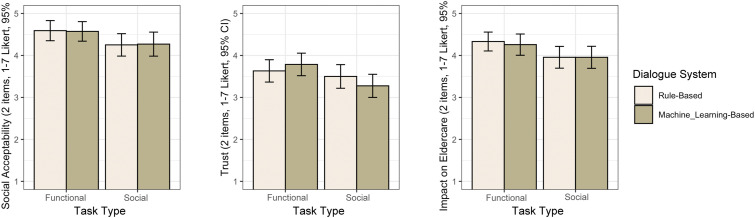
- For task type, three ANOVAs found significant effects favoring functional over social tasks on:
- social acceptability, p = .014
- trust, p = .021
- perceived impact on eldercare, p = .008
- The task-type effects were small, with eta-squared values between 1% and 2% of variance for each measure.
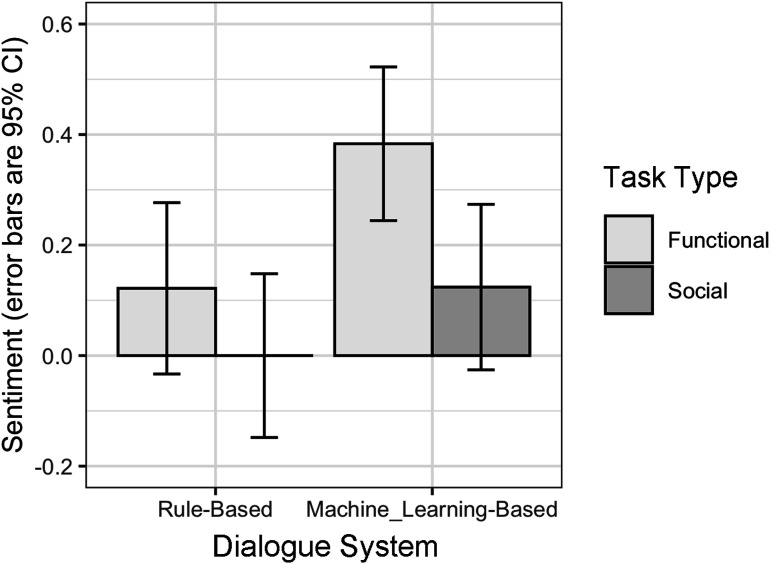
- For dialogue system type, the ANOVA found no significant effect on social acceptability, trust, or impact, but sentiment comments were more positive for ML-based than rule-based systems:
- ordinal logistic regression OR = 1.84, 95% CI [1.13, 3.00]
- sentiment comparison t = 2.46, p = .014
- ANOVA on sentiment: main effect of Dialogue System F(1,472) = 6.7, p = .010
- Thematic analysis found more coded benefits than challenges for functional-task VAs (62 benefits vs 31 challenges) and more challenges than benefits for rule-based systems (35 challenges vs 3 benefits).
## Methods
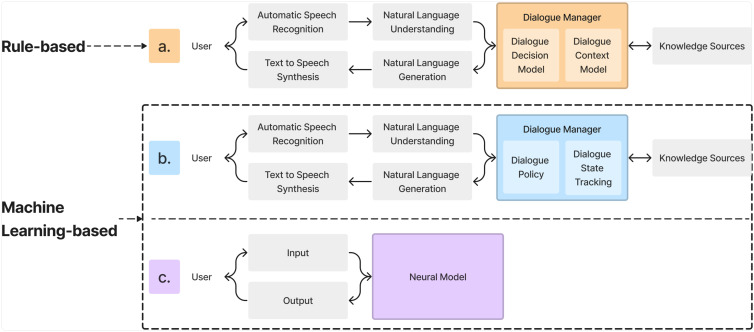
- Online survey experiment with a 2 × 2 between-participants design: task type (functional medication adherence vs social companionship) × dialogue system type (rule-based vs ML-based).
- Sample: 500 participants recruited from YouGov, described as a representative sampling platform matching a randomly drawn U.S. sampling frame.
- Participants saw one of four text-and-image vignettes; quantitative outcomes were analyzed with 2 × 2 ANOVAs, and open-ended responses were analyzed with sentiment coding plus ordinal logistic regression and consensus-based thematic analysis.
## Limitations
- The paper states it was a single-stimulus study, using only one wording and one comic-like image per condition, which may threaten construct validity.
- The vignette format may not be realistic enough to capture actual VA effects, so judgments could differ from those made about working systems.
- The paper says it did not examine demographic factors such as age range, past experience with VAs, or educational background.
- Evident from the text: the study measured public opinion rather than older adults’ own preferences, so the findings may not reflect the specific needs of older adults (stated in the paper).
Model-written summary. Check it against the paper before relying on it.
Integrity signals
Registry
Cites
Statistics
Figures
Verification
Claims the paper makes
3 Valid · 2 Not valid · 3 Not checked · 45 Own results and interpretations
The sources with a verdict support this claim; the rest weren’t checked yet, have no full text we could read, or their verdicts aren’t rated yet.
In the paper
“Focusing exclusively on targeted stakeholders may overlook critical factors that influence the acceptance of gerontechnology at the societal level.8,9”
§ Public opinion on types of voice systems for older adults > Introduction
What the sources say
- Not checked yetcites [8] Hoppe JA Melkas H Pekkarinen S, et al. Perception of society’s trust in care robots by public opinion leaders. Int J Hum Comput Interact 2023; 39(13): 2589– 2605. source
Checked before — its earlier verdict is held back until a new check runs.
- Supportedcites [9] Tuisku O Pekkarinen S Hennala L, et al. “robots do not replace a nurse with a beating heart” the publicity around a robotic innovation in elderly care. Inf Technol People 2019; 32(1): 47– 67. source
Section 2.2 (Factors affecting acceptance) says research has focused mainly on older users and caregivers while overlooking public discussion, which the paper calls important for understanding obstacles to robots in elderly care. The Conclusion (Section 7) also identifies public engagement as important to acceptance. These passages support the citing sentence’s point about factors beyond targeted stakeholders. (LLM, conf=0.90)
hedgedstates a possible cause- Asserted: passes — The authors put it forward as true.
- Checkable: passes — It can be checked against evidence.
- Load-bearing: passes — The paper’s conclusions depend on it.
- Based: passes — The paper gives a reason why it holds.
- Not checked yet
A result the paper reports from its own data — it cites no other source for it, so there is none to check. The quote shows it is in the paper.
In the paper
“19 participants believed it would be beneficial for older adults to have a VA companion to talk to (e.g., “Could be good company and entertainment for the elderly or anyone actually. The interactivity could be beneficial especially for someone with limited mobility.”), especially for older adults living independently (3 participants; e.g., “This would be good for elderly people who live alone.”)”
§ Public opinion on types of voice systems for older adults > Findings of thematic analysis > Benefits and concerns of VA task type
plainn = 19- Asserted: passes — The authors put it forward as true.
- Checkable: passes — It can be checked against evidence.
- Load-bearing: unclear — It is unclear whether the paper’s conclusions depend on it.
- Based: passes — The paper gives a reason why it holds.
A result the paper reports from its own data — it cites no other source for it, so there is none to check. The quote shows it is in the paper.
In the paper
“Positive comments also include the potential of VAs to alleviate older adults’ loneliness (14 participants; e.g., “It might also can be helpful for folks who feel lonely and need company.”)”
§ Public opinion on types of voice systems for older adults > Findings of thematic analysis > Benefits and concerns of VA task type
plainstates a possible causen = 14- Asserted: passes — The authors put it forward as true.
- Checkable: passes — It can be checked against evidence.
- Load-bearing: unclear — It is unclear whether the paper’s conclusions depend on it.
- Based: passes — The paper gives a reason why it holds.
A result the paper reports from its own data — it cites no other source for it, so there is none to check. The quote shows it is in the paper.
In the paper
“Ten participants also provided negative feedback regarding the limitation of rule-based systems, as they can only function based on pre-determined scripts (e.g., “Well. It seems a little limited by only answering what is scripted.”).”
§ Public opinion on types of voice systems for older adults > Findings of thematic analysis > Benefits and concerns of VA dialogue system type
plainn = 10- Asserted: passes — The authors put it forward as true.
- Checkable: passes — It can be checked against evidence.
- Load-bearing: unclear — It is unclear whether the paper’s conclusions depend on it.
- Based: passes — The paper gives a reason why it holds.
A result the paper reports from its own data — it cites no other source for it, so there is none to check. The quote shows it is in the paper.
In the paper
“Participants assigned more positive social acceptability, trust and impact to VAs performing functional rather than social tasks, p = .014, .021, and .008, respectively (Figure 2).”
§ Public opinion on types of voice systems for older adults > Results of quantitative analyses > Effects of task type
plain- Asserted: passes — The authors put it forward as true.
- Checkable: passes — It can be checked against evidence.
- Load-bearing: passes — The paper’s conclusions depend on it.
- Based: passes — The paper gives a reason why it holds.
- Rests on 2 assumptions not shown here.
26 more claims
Create a free account to see all 53 claims and to verify the 2 references still open.
- It may state two separate claims as one. 14
- The quote only partly states this claim. 2
- Probably not a substantial claim. 9
Statistics recomputed
Every reported test result, recomputed from its test statistic and degrees of freedom. A result shows as not adding up only once an independent check has confirmed it.
- ConsistentF(1, 472) = 6.7reported p = .01 · recomputed p = .010
“F (1,472) = 6.7, p = .010”
- ConsistentF(1, 472) = 6.6reported p = .01 · recomputed p = .011
“F (1,472) = 6.6, p = .010”
Self-check
Percentages, sums and reported differences re-computed from the paper’s own numbers.
Self-check results appear here once an independent check has confirmed them.
Citations
Cites
Mass Communication and Para-Social Interaction
Horton, D., & Richard Wohl, R. (1956) · Psychiatry · doi:10.1080/00332747.1956.11023049 · Cited by 4,380
The processes of causal attribution.
Kelley, H. H. (1973) · American Psychologist · doi:10.1037/h0034225 · Cited by 4,025 · cited 1×
“Thus, attribution theory 35 – 37 is relevant in this case.”
BackgroundAttribution theory and research
Kelley, H. H., & Michela, J. L. (1980) · Annual Review of Psychology · doi:10.1146/annurev.ps.31.020180.002325 · Cited by 2,651
A theory of motivation for some classroom experiences
Weiner, B. (1979) · Journal of Educational Psychology · doi:10.1037/0022-0663.71.1.3 · Cited by 2,453
Handbook of Research Methods in Social and Personality Psychology
(2024) · Cambridge University Press eBooks · doi:10.1017/9781009170123 · Cited by 2,121
Proceedings of the ACM on Human-Computer Interaction
Karahalios, K. G., Monroy‐Hernández, A., Lampinen, A., & Fitzpatrick, G. (2018) · Cited by 1,074
Assessing public opinions of and interest in new vehicle technologies: An Austin perspective
Bansal, P., Kockelman, K. M., & Singh, A. (2016) · Transportation Research Part C: Emerging Technologies · doi:10.1016/j.trc.2016.01.019 · Cited by 1,025 · cited 1×
“Bansal et al. 32 found that people were willing to pay more for level 4 (higher automation) versus level 3 (lower automation) vehicles but did not assess the acceptability of different technological architectures in VAs for older adults.”
BackgroundHorton and Wohl revisited: exploring viewers’ experience of parasocial interaction
Hartmann, T., & Goldhoorn, C. (2011) · Journal of Communication · doi:10.1111/j.1460-2466.2011.01595.x · Cited by 569 · cited 1×
“26 Hartmann and Goldhoorn 27 also found that actors creating social contact, like direct eye contact in videos, enhance viewers ’ para-social interactions and commitment to the actor.”
BackgroundThe sourcebook for political communication research: Methods, measures, and analytical techniques
Bucy, E. P., & Holbert, R. L. (2010) · Medical Entomology and Zoology · Cited by 504
Bertolazzi, A., Quaglia, V., & Bongelli, R. (2024) · BMC Public Health · doi:10.1186/s12889-024-18036-5 · Cited by 399
Watching TV news as para‐social interaction
Levy, M. R. (1979) · Journal of Broadcasting · doi:10.1080/08838157909363919 · Cited by 301
Use of Intelligent Voice Assistants by Older Adults with Low Technology Use
Pradhan, A., Lazar, A., & Findlater, L. (2020) · ACM Transactions on Computer-Human Interaction · doi:10.1145/3373759 · Cited by 285
Recent advances in deep learning based dialogue systems: a systematic survey
Ni, J., Young, T., Pandelea, V., Xue, F., & Cambria, E. (2023) · Artificial Intelligence Review · doi:10.1007/s10462-022-10248-8 · Cited by 264
Chatbots: Security, privacy, data protection, and social aspects
Hasal, M., Nowaková, J., Ahmed Saghair, K., Abdulla, H., Snášel, V., & Ogiela, L. (2021) · Concurrency and Computation: Practice and Experience · doi:10.1002/cpe.6426 · Cited by 249 · cited 1×
“Hasal et al. 33 discussed how chatbot systems with different dialogue systems (rule-based, modern natural language and ML techniques) result in different levels of data security and privacy, but did not explore public opinions of VAs for older adults.”
BackgroundPeterson, E., & Iyengar, S. (2019) · doi:10.31235/osf.io/pmn7h · Cited by 241
Memmott, T., Carley, S., Graff, M., & Konisky, D. M. (2021) · Nature Energy · doi:10.1038/s41560-020-00763-9 · Cited by 238 · cited 1×
“40”
Kim, S., & Choudhury, A. (2021) · Computers in Human Behavior · doi:10.1016/j.chb.2021.106914 · Cited by 200
Whang, C., & Im, H. (2021) · Psychology & Marketing · doi:10.1002/mar.21437 · Cited by 183
A survey on providing customer and public administration based services using AI: chatbot
Nirala, K. K., Singh, N. K., & Purani, V. S. (2022) · Multimedia Tools and Applications · doi:10.1007/s11042-021-11458-y · Cited by 159
Conversational AI: Dialogue Systems, Conversational Agents, and Chatbots
McTear, M. (2021) · Synthesis Lectures on Human Language Technologies · doi:10.1007/978-3-031-02176-3 · Cited by 155 · cited 2×
“20,21 While previous research has investigated the effects of rule-based and ML-based dialogue systems on the technical characteristics of VAs, 22 : 19 – 24), the impact of (dialogue) system type, on perceived bene fi ts in eldercare contexts, has yet to be investigated.”
BackgroundMethodRzepka, C., Berger, B., & Hess, T. (2022) · Information Systems Frontiers · doi:10.1007/s10796-021-10226-5 · Cited by 146
Voice‐Controlled Intelligent Personal Assistants to Support Aging in Place
O'Brien, K., Liggett, A., Ramirez‐Zohfeld, V., Sunkara, P., & Lindquist, L. A. (2020) · Journal of the American Geriatrics Society · doi:10.1111/jgs.16217 · Cited by 142 · cited 2×
“…black-and-white comic-like image 41 with a dialogue script between an older man and a VA that was either about medication adherence 13,15 or companionship 16 (for task type) and a second dialogue section that was either about a poem that the system retrieved or generated (for dialogue system type).”
BackgroundCho, E., Molina, M. D., & Wang, J. (2019) · Cyberpsychology, Behavior, and Social Networking · doi:10.1089/cyber.2018.0571 · Cited by 87
Miura, C., Chen, S., Saiki, S., Nakamura, M., & Yasuda, K. (2022) · Sensors · doi:10.3390/s22103829 · Cited by 82
Zhong, R., Ma, M., Zhou, Y., Lin, Q., Li, L., & Zhang, N. (2022) · Universal Access in the Information Society · doi:10.1007/s10209-022-00936-1 · Cited by 76
Software-Based Dialogue Systems: Survey, Taxonomy, and Challenges
Motger, Q., Franch, X., & Marco, J. (2023) · ACM Computing Surveys · doi:10.1145/3527450 · Cited by 68
Chen, C., Johnson, J. G., Charles, K., Lee, A., Lifset, E. T., Hogarth, M., Moore, A. A., Farcas, E., & Weibel, N. (2021) · Proceedings of the 23rd International ACM SIGACCESS Conference on Computers and Accessibility · doi:10.1145/3441852.3471218 · Cited by 67
Tuisku, O., Pekkarinen, S., Hennala, L., & Melkas, H. (2019) · Information Technology & People · doi:10.1108/itp-06-2018-0277 · Cited by 67
Hey Alexa, why do we use voice assistants? The driving factors of voice assistant technology use
Buteau, E., & Lee, J. (2021) · Communication Research Reports · doi:10.1080/08824096.2021.1980380 · Cited by 50 · cited 2×
“” ), VA perception was measured with a 6-item (close-ended) scale adapted from past public opinion surveys for VAs 42,43 and for agent-based technologies in eldercare.”
BackgroundMethodMathur, N., Dhodapkar, K., Zubatiy, T., Li, J., Jones, B., & Mynatt, E. (2022) · Proceedings of the 24th International ACM SIGACCESS Conference on Computers and Accessibility · doi:10.1145/3517428.3544830 · Cited by 45 · cited 3×
“12 Regarding the task type, the Human-Computer Interaction (HCI) community has explored VAs to help older adults with various tasks, from functional tasks such as medication adherence 13 – 15 to social tasks such as chatting for entertainment or companionship.”
BackgroundSelf-citationAttribution Theory: A Theoretical Framework for Understanding Information Systems Success
Snead, K. C., Magal, S. R., Christensen, L. F., & Ndede-Amadi, A. A. (2015) · Systemic Practice and Action Research · doi:10.1007/s11213-014-9328-x · Cited by 42 · cited 3×
“Using an approach that applies attribution theory to information systems, 34 our research tested whether user perceptions of potential causes of the outcome in fl uences overall system perception.”
BackgroundMethodInfluentialYuan, F., Anderson, J. G., Wyatt, T. H., Lopez, R. P., Crane, M., Montgomery, A., & Zhao, X. (2022) · International Journal of Social Robotics · doi:10.1007/s12369-021-00862-x · Cited by 35 · cited 1×
“44 Measure of perceived social acceptability consisted of 1 item on personal connection norms ( “ To what extent do you agree or disagree with the following statement: Most people whose opinion I value would approve of the use of the voice assistant pictured in this survey.”
BackgroundChin, J., Desai, S., Lin, S. (.-H., & Mejia, S. (2024) · Proceedings of the ACM on Human-Computer Interaction · doi:10.1145/3637365 · Cited by 27
Chen, C., Lifset, E. T., Han, Y., Roy, A., Hogarth, M., Moore, A. A., Farcas, E., & Weibel, N. (2023) · The 25th International ACM SIGACCESS Conference on Computers and Accessibility · doi:10.1145/3597638.3608378 · Cited by 25
Stimulus Sampling and Research Integrity
Cummings, J. J., & Reeves, B. B. (2022) · Oxford University Press eBooks · doi:10.1093/oso/9780190938550.003.0008 · Cited by 24
Horstmann, A. C., Schubert, T., Lambrich, L., & Strathmann, C. (2023) · ACM International Conference on Intelligent Virtual Agents (IVA) · doi:10.1145/3570945.3607342 · Cited by 22
Task type's effect on attitudes towards voice assistants
Sung, B., Im, H., & Duong, V. C. (2023) · International Journal of Consumer Studies · doi:10.1111/ijcs.12946 · Cited by 20 · cited 2×
“12 Regarding the task type, the Human-Computer Interaction (HCI) community has explored VAs to help older adults with various tasks, from functional tasks such as medication adherence 13 – 15 to social tasks such as chatting for entertainment or companionship.”
BackgroundShade, M., Rector, K., & Kupzyk, K. (2021) · JMIR Formative Research · doi:10.2196/26361 · Cited by 19
Medication Adherence Reminder System for Virtual Home Assistants: Mixed Methods Evaluation Study
Corbett, C. F., Combs, E. M., Chandarana, P. S., Stringfellow, I., Worthy, K., Nguyen, T., Wright, P. J., & O'Kane, J. M. (2021) · JMIR Formative Research · doi:10.2196/27327 · Cited by 14 · cited 2×
“12 Regarding the task type, the Human-Computer Interaction (HCI) community has explored VAs to help older adults with various tasks, from functional tasks such as medication adherence 13 – 15 to social tasks such as chatting for entertainment or companionship.”
BackgroundPerception of Society’s Trust in Care Robots by Public Opinion Leaders
Hoppe, J. A., Melkas, H., Pekkarinen, S., Tuisku, O., Hennala, L., Johansson-Pajala, R.-M., Gustafsson, C., & Thommes, K. (2023) · International Journal of Human–Computer Interaction · doi:10.1080/10447318.2022.2081283 · Cited by 7 · cited 1×
“8,9 Investigating public opinion may also be predictive of how relatively young people may feel about technologies as they age in the future, showing how robust applicability of technologies will be over the longer term.”
BackgroundMahmood, A., Wang, J., & Huang, C.-M. (2026) · ACM Transactions on Accessible Computing · doi:10.1145/3796236 · Cited by 6
Gilbert, T. K., Qu, N. Z., Ju, W. G., & Li, J. J. (2023) · Transportation Research Part F Traffic Psychology and Behaviour · doi:10.1016/j.trf.2023.01.013 · Cited by 3
Self-citationIntroduction to the First Edition
Reis, H. T., & Judd, C. M. (n.d.) · Handbook of Research Methods in Social and Personality Psychology · doi:10.1017/cbo9780511996481.002
Research works printed but not linked: 2
- Mazur M Rzepka R Araki K. Chatterbots with occupation-between non task and task oriented conversational agents. In: Proceedings of linguistic and cognitive approaches to dialogue agents (LaCATODA 2012), Montreal, QC, 21 August 2012, 61– 66.
- Eickhoff F Zhevak L. The consumer attitude towards AI in marketing: An experimental study of consumers attitudes and purchase intention (Dissertation). Retrieved from. XXXX. 2023. https://urn.kb.se/resolve?urn=urn:nbn:se:hj:diva-60756.
Cited by
Qu, N. Z., Li, J. J., & Chignell, M. (2026) · Computers in Human Behavior Artificial Humans · doi:10.1016/j.chbah.2026.100291
Self-citation
Metadata
- Authors
- Qu, N. Z., Li, J., Kongmanee, J., & Chignell, M.
- Affiliations
- University of Toronto (CA)
- Edinburgh Napier University (GB)
- Corresponding author
- Chignell, Mark
- Venue
- Journal of Rehabilitation and Assistive Technologies Engineering
- Publisher
- SAGE Publications
- Published
- 2024-01
- Volume
- 11
- Pages
- 20556683241287414-20556683241287414
- ISSN
- 2055-6683 (ISSN-L)
- PMC
- PMC11483701
- OpenAlex
- W4403461137
- Cited by
- 1
- References
- 44
- Citations by year
- 2026: 1
- FWCI
- 0.86
- Type
- journal article
- Language
- en
- Open access
- gold
- doi.org
- Licence
- Locations
- Journal of Rehabilitation and Assistive Technologies Engineering (publishedVersion, cc-by-nc)
- PubMed Central (publishedVersion, cc-by-nc)
- PubMed (publishedVersion)
- Edinburgh Napier Research Repository (Edinburgh Napier University) (submittedVersion, cc-by-nc)
- DOAJ (DOAJ: Directory of Open Access Journals) (submittedVersion, cc-by-sa)
- Topics
- Health Sciences › Medicine › Geriatrics and Gerontology › Technology Use by Older Adults
- Social Sciences › Psychology › Social Psychology › Social Robot Interaction and HRI
- Social Sciences › Business, Management and Accounting › Marketing › AI in Service Interactions
- Keywords
- voice assistants, older adults, public opinion, technology adoption, medication adherence, companionship, rule-based dialogue systems, social acceptance, trust, elderly care, assistive technology design
About these checks
Registry, retraction, Cites and statistics results are computed, not judged, with one exception: a printed reference that no index lists is read once by a model before it counts as a citation error. Claims are extracted by a model and kept only when their quote appears verbatim in the text; each cited source is then checked, with a model’s help, for whether it says what the claim relies on. Those verdicts can be wrong — read the claim’s quote and the cited source before relying on one.
The claim verdicts this report counts are experimental: their accuracy is not yet measured.
A language model drew the claims from the paper on 2026-09-30, under version 3 of the claim definition (model deepseek-v4.1-flash, prompt extract-v3).
A second model labelled each claim on 2026-09-30 (model jev-1.13-20260917, definition revision gold-guideline-v0.2).
Cited sources are checked with a language model’s help (gpt-6-sol).
Statistics and arithmetic are recomputed, not judged.
Confidence bands are shown only for fields calibrated on our annotated test set. None is calibrated yet, so no band is shown.
What counts as a claim ›How we measure confidence ›How we check this ›
Are you an author, or do you see a problem with this page? Request a review
Data sources
Bibliographic data: Semantic Scholar, OpenAlex, Crossref.
Contains information from the Semantic Scholar Academic Graph Datasets, made available under the ODC Attribution License (ODC-BY 1.0).
Semantic Scholar’s data is described in: Kinney, R., et al. (2023). The Semantic Scholar Open Data Platform. arXiv:2301.10140.
