

Objective Assessment of Listening Effort: Coregistration of Pupillometry and EEG
Open accessThe DOI matches its Crossref record; 77 of the 77 references it cites were found in a registry or an index; none of the 56 sources its claims cite is checked for support yet.
Abstract
Listening to speech in noise is effortful, particularly for people with hearing impairment. While it is known that effort is related to a complex interplay between bottom-up and top-down processes, the cognitive and neurophysiological mechanisms contributing to effortful listening remain unknown. Therefore, a reliable physiological measure to assess effort remains elusive. This study aimed to determine whether pupil dilation and alpha power change, two physiological measures suggested to index listening effort, assess similar processes. Listening effort was manipulated by parametrically varying spectral resolution (16- and 6-channel noise vocoding) and speech reception thresholds (SRT; 50% and 80%) while 19 young, normal-hearing adults performed a speech recognition task in noise. Results of off-line sentence scoring showed discrepancies between the target SRTs and the true performance obtained during the speech recognition task. For example, in the SRT80% condition, participants scored an average of 64.7%. Participants’ true performance levels were therefore used for subsequent statistical modelling. Results showed that both measures appeared to be sensitive to changes in spectral resolution (channel vocoding), while pupil dilation only was also significantly related to their true performance levels (%) and task accuracy (i.e., whether the response was correctly or partially recalled). The two measures were not correlated, suggesting they each may reflect different cognitive processes involved in listening effort. This combination of findings contributes to a growing body of research aiming to develop an objective measure of listening effort.
Overview
CoChat Summary
TL;DR
This study corecorded pupillometry and EEG alpha power in 19 young normal-hearing adults during a noise-vocoded speech recognition task to test whether two proposed physiological indices of listening effort assess similar processes. Both measures were sensitive to spectral degradation, but only pupil dilation tracked true performance and task accuracy, and the two measures were not correlated.
Key findings
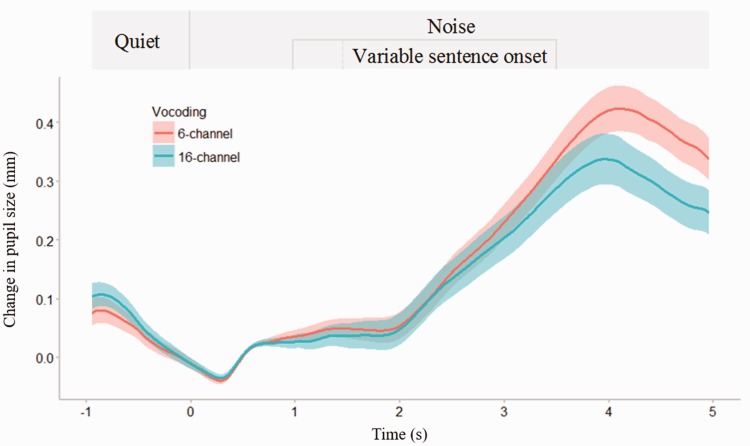
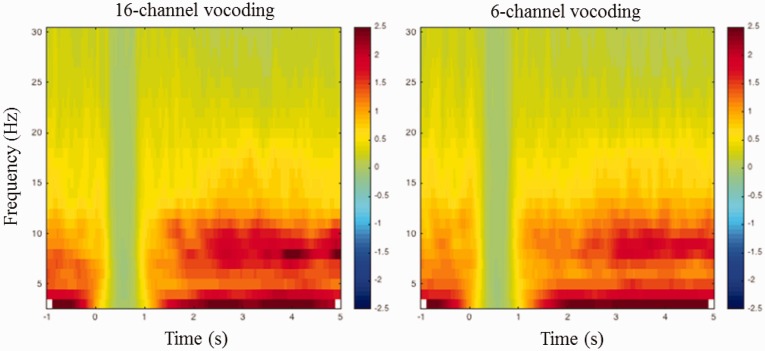
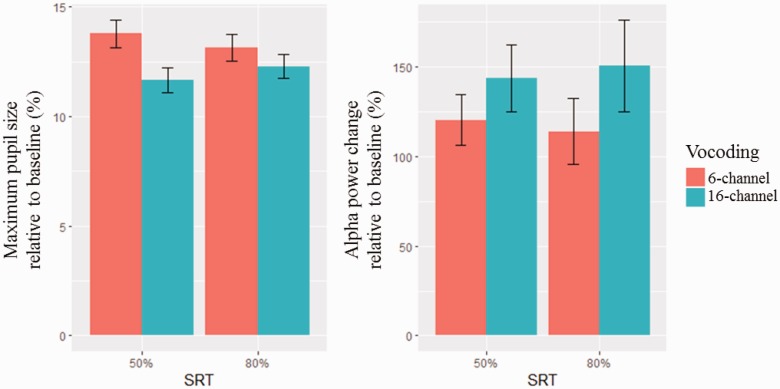
- Both measures were sensitive to spectral resolution: pupil size was 1.49% larger in 6-channel than 16-channel vocoding (p < .01), and alpha power change was −30.0% lower in 6-channel than 16-channel vocoding (p = .03).
- Pupil dilation, but not alpha power, was related to true performance: as true performance increased toward 100%, pupil size decreased by −0.05% (p < .01), whereas alpha power showed no effect (p = .75).
- Pupil size was 1.61% larger for partially correct than correctly recalled sentences (p < .01), while alpha power showed no task-accuracy effect (p = .63).
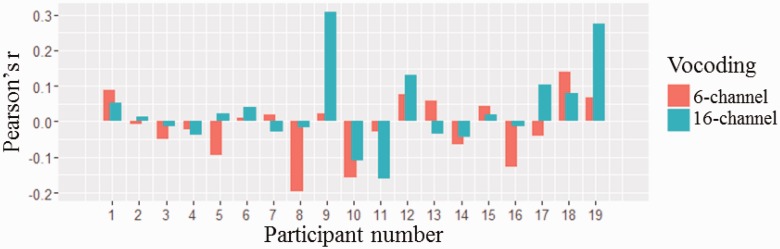
- Pupil dilation and alpha power were not significantly correlated within individuals for any condition (n = 19, p > .05; collapsed mean r = .01, SD = .08).
Methods
- Nineteen normal-hearing monolingual English-speaking adults (12 women, 7 men; mean age 27 years, SD = 4.28, range 22–34) were included after exclusions from 27 recruited; simultaneous pupil and EEG recordings were made during a speech recognition-in-noise task.
- BKB-A sentences and four-talker babble were noise-vocoded into 16 or 6 channels; individual 50% and 80% SRTs were obtained behaviorally, and fixed participant-specific SNRs were used during physiological testing.
- Linear mixed-effects models in R (nlme) with random intercept for individual tested effects of SRT/vocoding, true performance/vocoding, task accuracy/vocoding, and SNR; correlations were averaged across participants, and intraclass correlations assessed reliability.
Limitations
- The paper states that alpha power analyses were confined to parietal electrodes and that the 8–12 Hz alpha band may be too coarse, potentially averaging parallel attentional (8–10 Hz) and linguistic/semantic (10–12 Hz) processes; future work should consider whole-head and narrow-band analyses.
- The paper reports that true performance during physiological testing deviated from target SRTs, especially for the 80% SRT (true performance averaged 64.7% collapsed across vocoding; range of averages 36–93%), which may have contributed to the nonsignificant SRT effect; session differences in motivation/fatigue are also suggested.
- Evident from the text: the sample was young, normal-hearing, and cognitively robust, so findings may not generalize to older adults or people with hearing loss; removing incorrect responses also reduced statistical power for alpha power.
Model-written summary. Check it against the paper before relying on it.
Integrity signals
Registry
Cites
Statistics
Figures
Verification
Claims the paper makes
0 Valid · 0 Not valid · 33 Not checked · 66 Own results and interpretations
A result the paper reports from its own data — it cites no other source for it, so there is none to check. The quote shows it is in the paper.
In the paper
“A main effects model indicated no effect of SRT (p = .29), and a significant effect of vocoding (p = .03).”
§ Objective Assessment of Listening Effort: Coregistration of Pupillometry and EEG > Results > SRT and Vocoding
plainstates an association- Asserted: passes — The authors put it forward as true.
- Checkable: passes — It can be checked against evidence.
- Load-bearing: passes — The paper’s conclusions depend on it.
- Based: passes — The paper gives a reason why it holds.
A result the paper reports from its own data — it cites no other source for it, so there is none to check. The quote shows it is in the paper.
In the paper
“Variability in performance for the targeted SRTs existed within the physiological experiment, despite using a validated adaptive method in the behavioral session to obtain these SRTs.”
§ Objective Assessment of Listening Effort: Coregistration of Pupillometry and EEG > Materials and Methods > Statistical Methods
plain- Asserted: passes — The authors put it forward as true.
- Checkable: passes — It can be checked against evidence.
- Load-bearing: passes — The paper’s conclusions depend on it.
- Based: passes — The paper gives a reason why it holds.
A result the paper reports from its own data — it cites no other source for it, so there is none to check. The quote shows it is in the paper.
In the paper
“Alpha power was more variable than the pupil dilation measure; however, even in the conditions where there was strong reliability across both measures (e.g., 16 channels), the two measures were not correlated (Table 1).”
§ Objective Assessment of Listening Effort: Coregistration of Pupillometry and EEG > Results > Correlation Between Pupil Size and Alpha Power Change
plain- Asserted: passes — The authors put it forward as true.
- Checkable: passes — It can be checked against evidence.
- Load-bearing: unclear — It is unclear whether the paper’s conclusions depend on it.
- Based: passes — The paper gives a reason why it holds.
A result the paper reports from its own data — it cites no other source for it, so there is none to check. The quote shows it is in the paper.
In the paper
“Removing the incorrect responses in the current study (n = 888), revealed that channel vocoding no longer appeared to influence alpha power.”
§ Objective Assessment of Listening Effort: Coregistration of Pupillometry and EEG > Discussion
hedgedn = 888- Asserted: passes — The authors put it forward as true.
- Checkable: passes — It can be checked against evidence.
- Load-bearing: passes — The paper’s conclusions depend on it.
- Based: passes — The paper gives a reason why it holds.
A result the paper states — it cites no source for it, so there is none to check. The quote shows it is in the paper.
In the paper
“It was anticipated that the pupil would be sensitive to changes in SRT, with greater increases in pupil size expected in the more cognitively demanding 50% SRT compared with 80% SRT condition. Contrary to expectations, however, this was not the case.”
§ Objective Assessment of Listening Effort: Coregistration of Pupillometry and EEG > Discussion
plain- Asserted: passes — The authors put it forward as true.
- Checkable: passes — It can be checked against evidence.
- Load-bearing: passes — The paper’s conclusions depend on it.
- Based: passes — The paper gives a reason why it holds.
61 more claims
Create a free account to see all 99 claims and to verify the 38 references still open.
- It may state two separate claims as one. 19
- Probably not a substantial claim. 19
Claims other papers make about this one
Each is checked against this paper’s own text: does it say what the citing paper says it does?
The source backs part of the claim, not all of it — or backs it for a different population, condition or comparison.
In the citing paper
“While both pupil dilation and EEG alpha power have been widely used for detecting changes in listening effort, they have not been reported to correlate to one other during tasks involving short duration stimuli [36].”
From An exploratory Study of EEG Alpha Oscillation and Pupil Dilation in Hearing-Aid Users During Effortful listening to Continuous Speech (2020) · cites this paper as [36]
Experimental — accuracy not yet measuredIn the citing paper
“Controversially, higher working memory load and more adverse conditions were also found to lead to a decrease in alpha power (Miles et al., 2017;Hjortkjær et al., 2018).”
From Hearing Aid Noise Reduction Lowers the Sustained Listening Effort During Continuous Speech in Noise—A Combined Pupillometry and EEG Study (2021) · cites this paper as Miles et al., 2017
In the citing paper
“whereas in others, alpha activity decreases with more demand [35]–[37].”
From An exploratory Study of EEG Alpha Oscillation and Pupil Dilation in Hearing-Aid Users During Effortful listening to Continuous Speech (2020) · cites this paper as [36]
In the citing paper
“Miles et al., reported that in a speech recognition task, parietal alpha was decreased during a demanding situation when the spectral content of the signal using noise vocoding and speech intelligibility were changed [36].”
From An exploratory Study of EEG Alpha Oscillation and Pupil Dilation in Hearing-Aid Users During Effortful listening to Continuous Speech (2020) · cites this paper as [36]
In the citing paper
“The co-registration between pupillometry and EEG has also been shown in previous studies, such as [34] and [36], who used vocoded short sentences and 4-talker babble background noise.”
From An exploratory Study of EEG Alpha Oscillation and Pupil Dilation in Hearing-Aid Users During Effortful listening to Continuous Speech (2020) · cites this paper as [36]
2 more claims about this paper
Create a free account to see every claim other papers make about this one.
Self-check
Percentages, sums and reported differences re-computed from the paper’s own numbers.
Each contradiction between two passages listed here was confirmed by an independent check.
Rated major: it would touch a result — a value a result rests on, reported and recomputed p-values on opposite sides of the significance level, two passages that conflict with no sign which is right, or a cited work retracted before this paper was published.
In the paper
§ Objective Assessment of Listening Effort: Coregistration of Pupillometry and EEG > Discussion
“Therefore, while decreased spectral quality and partially recalled sentences appear to increase listening effort, when sentences are accurately recalled (correct response), there is no difference in listening effort between vocoding conditions, as indexed by pupil size.”
§ Objective Assessment of Listening Effort: Coregistration of Pupillometry and EEG > Results > Task Accuracy and Vocoding
“A main effects model showed a significant effect of task accuracy (p < .01) and a significant effect of vocoding (p < .01). Pupil size for partially correct sentence recall was 1.61% larger than correctly recalled sentences and 1.57% larger for 6-channel vocoded sentences compared with 16-channel vocoded sentences.”
Rated major: it would touch a result — a value a result rests on, reported and recomputed p-values on opposite sides of the significance level, two passages that conflict with no sign which is right, or a cited work retracted before this paper was published.
In the paper
§ Objective Assessment of Listening Effort: Coregistration of Pupillometry and EEG > Materials and Methods > Pupil Recording
“compiled into single-trial pupil-diameter waveforms ( − 1 s to 5 s) for further processing and analyses using customized MATLAB scripts.”
§ Objective Assessment of Listening Effort: Coregistration of Pupillometry and EEG > Materials and Methods > Pupil Recording
“Regions of interest included baseline in noise (0–1 s) and the encoding period (2–6 s).”
Rated minor: it would not touch a result — a value no result rests on, a p-value that stays on the same side of the significance level, or a conflict that is clerical, resolved elsewhere in the paper, or outside its own findings.
In the paper
“| SNR dB | 0.4 (1.7) | −1.7 (1.4) | 3.7 (1.9) | 0.7 (1.7) | 2.1 (2.4) | −0.7 (1.9) | −0.6 (2.0) | 2.0 (2.4) |”
§ Objective Assessment of Listening Effort: Coregistration of Pupillometry and EEG > Materials and Methods > Speech Reception Thresholds
Reported 2 · recomputed 2.2
Citations
Cites
The assessment and analysis of handedness: The Edinburgh inventory
Oldfield, R. C. (1971) · Neuropsychologia · doi:10.1016/0028-3932(71)90067-4 · Cited by 35,900
EEG alpha and theta oscillations reflect cognitive and memory performance: a review and analysis
Klimesch, W. (1999) · Brain Research Reviews · doi:10.1016/s0165-0173(98)00056-3 · Cited by 6,889
Adverse health effects of high-effort/low-reward conditions.
Siegrist, J. (1996) · Journal of Occupational Health Psychology · doi:10.1037/1076-8998.1.1.27 · Cited by 5,713 · cited 1×
“Adverse health effects of prolonged mental effort, particularly with an effort-reward imbalance (Kuper, Singh-Manoux, Siegrist, & Marmot, 2002; Siegrist, 1996), have been linked to fatigue (Mehta & Agnew, 2012), cardiovascular strain (Peters et al., 1998), and stress (Hua et al., 2014).”
The reorienting system of the human brain: from environment to theory of mind
Corbetta, M., Patel, G., & Shulman, G. L. (2008) · Neuron · doi:10.1016/j.neuron.2008.04.017 · Cited by 3,889
Alpha-band oscillations, attention, and controlled access to stored information
Klimesch, W. (2012) · Trends in Cognitive Sciences · doi:10.1016/j.tics.2012.10.007 · Cited by 3,310 · cited 4×
“Changes in brain oscillations is another physiological measure that has shown systematic changes associated with a wide variety of cognitive processes (Başar, Başar-Eroglu, Karakaş, & Schürmann, 2001; Herrmann, Fründ, & Lenz, 2010; Klimesch, 1996, 1999, 2012; Ward, 2003).”
InfluentialFrontiers in Human Neuroscience
Avenanti, A. (2013) · Archivio istituzionale della ricerca (Alma Mater Studiorum Università di Bologna) · Cited by 1,572
Hearing Impairment and Cognitive Energy: The Framework for Understanding Effortful Listening (FUEL)
Pichora-Fuller, M. K., Kramer, S. E., Eckert, M. A., Edwards, B., Hornsby, B. W. Y., Humes, L. E., Lemke, U., Lunner, T., Matthen, M., Mackersie, C. L., et al. (2016) · Ear & Hearing · doi:10.1097/aud.0000000000000312 · Cited by 1,318
Gamma, alpha, delta, and theta oscillations govern cognitive processes
Başar, E., Başar-Eroglu, C., Karakaş, S., & Schürmann, M. (2001) · International Journal of Psychophysiology · doi:10.1016/s0167-8760(00)00145-8 · Cited by 1,219
Friesen, L. M., Shannon, R. V., Baskent, D., & Wang, X. (2001) · The Journal of the Acoustical Society of America · doi:10.1121/1.1381538 · Cited by 1,049
Synchronous neural oscillations and cognitive processes
Ward, L. M. (2003) · Trends in Cognitive Sciences · doi:10.1016/j.tics.2003.10.012 · Cited by 1,009
Research works printed but not linked: 1
- Pichora-Fuller, M. K. (2006). Perceptual effort and apparent cognitive decline: implications for audiologic rehabilitation. Seminars in Hearing, 27(4), 284–293. · DOI
Cited by
Winn, M. B., Wendt, D., Koelewijn, T., & Kuchinsky, S. E. (2018) · Trends in Hearing · doi:10.1177/2331216518800869 · Cited by 339
The Pupil Dilation Response to Auditory Stimuli: Current State of Knowledge
Zekveld, A. A., Koelewijn, T., & Kramer, S. E. (2018) · Trends in Hearing · doi:10.1177/2331216518777174 · Cited by 306
Hughes, S. E., Hutchings, H. A., Rapport, F. L., McMahon, C. M., & Boisvert, I. (2018) · Ear & Hearing · doi:10.1097/aud.0000000000000553 · Cited by 131
Self-citationA model of listening engagement (MoLE)
Herrmann, B., & Johnsrude, I. S. (2020) · Hearing Research · doi:10.1016/j.heares.2020.108016 · Cited by 135
Fiedler, L., Seifi Ala, T., Graversen, C., Alickovic, E., Lunner, T., & Wendt, D. (2021) · Ear & Hearing · doi:10.1097/aud.0000000000001050 · Cited by 80
Seifi Ala, T., Graversen, C., Wendt, D., Alickovic, E., Whitmer, W. M., & Lunner, T. (2020) · PLOS ONE · doi:10.1371/journal.pone.0235782 · Cited by 80
Pupil Dilation Is Sensitive to Semantic Ambiguity and Acoustic Degradation
Kadem, M., Herrmann, B., Rodd, J. M., & Johnsrude, I. S. (2020) · Trends in Hearing · doi:10.1177/2331216520964068 · Cited by 77
Paul, B. T., Chen, J., Le, T., Lin, V., & Dimitrijevic, A. (2021) · PLoS ONE · doi:10.1371/journal.pone.0254162 · Cited by 65
Decruy, L., Lesenfants, D., Vanthornhout, J., & Francart, T. (2020) · European Journal of Neuroscience · doi:10.1111/ejn.14753 · Cited by 49
Comparisons of the Sensitivity and Reliability of Multiple Measures of Listening Effort
Giuliani, N. P., Brown, C., & Wu, Y.-H. (2020) · Ear and Hearing · doi:10.1097/aud.0000000000000950 · Cited by 57
Degradation levels of continuous speech affect neural speech tracking and alpha power differently
Hauswald, A., Keitel, A., Chen, Y., Rösch, S., & Weisz, N. (2020) · European Journal of Neuroscience · doi:10.1111/ejn.14912 · Cited by 55
Winn, M. B., & Teece, K. H. (2022) · Journal of Speech Language and Hearing Research · doi:10.1044/2022_jslhr-21-00631 · Cited by 53
Grenzebach, J., & Romanus, E. (2022) · Noise and Health · doi:10.4103/nah.nah_34_22 · Cited by 44
The Effect of Stimulus Choice on an EEG-Based Objective Measure of Speech Intelligibility
Verschueren, E., Vanthornhout, J., & Francart, T. (2020) · Ear and Hearing · doi:10.1097/aud.0000000000000875 · Cited by 41
Shields, C., Sladen, M., Bruce, I. A., Kluk, K., & Nichani, J. (2023) · Trends in Hearing · doi:10.1177/23312165221137116 · Cited by 43
Rowland, S. C., Hartley, D. E. H., & Wiggins, I. M. (2018) · Trends in Hearing · doi:10.1177/2331216518804116 · Cited by 37
Hunter, C. R. (2020) · Ear and Hearing · doi:10.1097/aud.0000000000000856 · Cited by 37
Alhanbali, S., Munro, K. J., Dawes, P., Carolan, P. J., & Millman, R. E. (2021) · International Journal of Audiology · doi:10.1080/14992027.2020.1853262 · Cited by 35
Eye Movements Decrease during Effortful Speech Listening
Cui, M. E., & Herrmann, B. (2023) · Journal of Neuroscience · doi:10.1523/jneurosci.0240-23.2023 · Cited by 33
The Effect of Fatigue on Working Memory and Auditory Perceptual Abilities in Trained Musicians
Jain, S., & Nataraja, N. P. (2019) · American Journal of Audiology · doi:10.1044/2019_aja-ind50-18-0102 · Cited by 33
Slade, K., Kramer, S. E., Fairclough, S. H., & Richter, M. M. (2021) · Hearing Research · doi:10.1016/j.heares.2021.108348 · Cited by 32
Quantifying the Effects of Motivation on Listening Effort: A Systematic Review and Meta-Analysis
Carolan, P. J., Heinrich, A., Munro, K. J., & Millman, R. E. (2022) · Trends in Hearing · doi:10.1177/23312165211059982 · Cited by 31
Defenderfer, J., Forbes, S. H., Wijeakumar, S., Hedrick, M. S., Plyler, P. N., & Buss, A. T. (2021) · NeuroImage · doi:10.1016/j.neuroimage.2021.118385 · Cited by 29
Hughes, S., Rapport, F., Watkins, A. J., Boisvert, I., McMahon, C. M., & Hutchings, H. A. (2019) · BMJ Open · doi:10.1136/bmjopen-2018-028881 · Cited by 29
Self-citationBsharat-Maalouf, D., Degani, T., & Karawani, H. (2023) · Trends in Hearing · doi:10.1177/23312165231205107 · Cited by 27
Prince, P., Paul, B. T., Chen, J., Le, T., Lin, V. W., & Dimitrijevic, A. (2021) · European Journal of Neuroscience · doi:10.1111/ejn.15365 · Cited by 27
Rasch Analysis of the Listening Effort Questionnaire—Cochlear Implant
Hughes, S., Watkins, A. J., Rapport, F., Boisvert, I., McMahon, C. M., & Hutchings, H. A. (2021) · Ear and Hearing · doi:10.1097/aud.0000000000001059 · Cited by 25
Self-citationEEG power spectral dynamics associated with listening in adverse conditions
Wisniewski, M. G., Zakrzewski, A. C., Bell, D. R., & Wheeler, M. (2021) · Psychophysiology · doi:10.1111/psyp.13877 · Cited by 24
Scharinger, C. (2024) · Psychological Research · doi:10.1007/s00426-024-01939-8 · Cited by 23
Alpha Oscillations During Effortful Continuous Speech: From Scalp EEG to Ear-EEG
Ala, T. S., Aličković, E., Cabrera, A. F., Whitmer, W. M., Hadley, L. V., Rank, M. L., Lunner, T., & Graversen, C. (2022) · IEEE Transactions on Biomedical Engineering · doi:10.1109/tbme.2022.3214428 · Cited by 23
Kraft, N. G., Demarchi, G., & Weisz, N. (2020) · eLife · doi:10.7554/elife.55508 · Cited by 22
Early phase trials of novel hearing therapeutics: Avenues and opportunities
Schilder, A. G. M., Su, M. P., Mandavia, R., Anderson, C. R., Landry, E., Ferdous, T., & Blackshaw, H. (2019) · Hearing Research · doi:10.1016/j.heares.2019.07.003 · Cited by 19
Seropian, L., Ferschneider, M., Cholvy, F., Micheyl, C., Bidet‐Caulet, A., & Moulin, A. M. (2022) · Heliyon · doi:10.1016/j.heliyon.2022.e09631 · Cited by 21
Corcoran, A. W., Perera, R., Koroma, M., Kouider, S., Hohwy, J., & Andrillon, T. (2022) · Cerebral Cortex · doi:10.1093/cercor/bhac094 · Cited by 21
Kraus, F., Tune, S., Obleser, J., & Herrmann, B. (2023) · Journal of Neuroscience · doi:10.1523/jneurosci.2181-22.2023 · Cited by 20
Keur‐Huizinga, L., Kramer, S. E., de Geus, E. J. C., & Zekveld, A. A. (2024) · Ear and Hearing · doi:10.1097/aud.0000000000001508 · Cited by 21
Combining Multiple Psychophysiological Measures of Listening Effort: Challenges and Recommendations
Richter, M. M., Buhiyan, T., Bramsløw, L., Innes-Brown, H., Fiedler, L., Hadley, L. V., Naylor, G., Saunders, G. H., Wendt, D., Whitmer, W. M., et al. (2023) · Seminars in Hearing · doi:10.1055/s-0043-1767669 · Cited by 18
Assessment methods for determining small changes in hearing performance over time
Brungart, D. S., Sherlock, L. P., Kuchinsky, S. E., Perry, T. T., Bieber, R. E., Grant, K. W., & Bernstein, J. G. W. (2022) · The Journal of the Acoustical Society of America · doi:10.1121/10.0011509 · Cited by 18
Time Scales and Moments of Listening Effort Revealed in Pupillometry
Winn, M. B. (2023) · Seminars in Hearing · doi:10.1055/s-0043-1767741 · Cited by 17
The Neurophysiological Costs of Learning in a Noisy Classroom: An Ecological Virtual Reality Study
Levy, O., Korisky, A., Zvilichovsky, Y., & Golumbic, E. Z. (2025) · Journal of Cognitive Neuroscience · doi:10.1162/jocn_a_02249 · Cited by 16
Cartocci, G., Inguscio, B. M. S., Giliberto, G., Vozzi, A., Giorgi, A., Greco, A., Babiloni, F., & Attanasio, G. (2023) · Brain Sciences · doi:10.3390/brainsci13071084 · Cited by 15
Electromyographic correlates of effortful listening in the vestigial auriculomotor system
Schroeer, A., Corona–Strauss, F. I., Hannemann, R., Hackley, S. A., & Strauß, D. J. (2025) · Frontiers in Neuroscience · doi:10.3389/fnins.2024.1462507 · Cited by 14
Ferschneider, M., & Moulin, A. M. (2023) · Trends in Hearing · doi:10.1177/23312165231176320 · Cited by 13
Speech to noise ratio improvement induces nonlinear parietal phase synchrony in hearing aid users
Baboukani, P. S., Graversen, C., Alickovic, E., & Østergaard, J. (2022) · Frontiers in Neuroscience · doi:10.3389/fnins.2022.932959 · Cited by 13
An Exploratory Study of the Effect of Tinnitus on Listening Effort Using EEG and Pupillometry
Sendesen, E., Kılıç, S., Erbil, N., Aydın, Ö., & Türkyılmaz, M. D. (2023) · Otolaryngology · doi:10.1002/ohn.367 · Cited by 13
Huang, C.-Y., Li, D.-S., Tsai, M.-H., Chen, C., & Cheng, Y. (2022) · International Journal of Environmental Research and Public Health · doi:10.3390/ijerph19063661 · Cited by 13
Saksida, A., Ghiselli, S., Bembich, S., Scorpecci, A., Giannantonio, S., Resca, A., Marsella, P., & Orzan, E. (2021) · Audiology Research · doi:10.3390/audiolres12010001 · Cited by 12
How the eyes respond to sounds
Hu, J., & Vetter, P. (2023) · Annals of the New York Academy of Sciences · doi:10.1111/nyas.15093 · Cited by 12
Chapman, L. R., & Hallowell, B. (2021) · Journal of Speech Language and Hearing Research · doi:10.1044/2021_jslhr-21-00129 · Cited by 12
Villard, S., Perrachione, T. K., Lim, S.-J., Alam, A., & Kidd, G. D. (2023) · The Journal of the Acoustical Society of America · doi:10.1121/10.0020539 · Cited by 10
Methodological Aspects of Pupillometry
Laeng, B., & Mathôt, S. (2024) · Springer eBooks · doi:10.1007/978-3-031-54896-3_13 · Cited by 9
Krueger, M., Schulte, M., & Brand, T. (2022) · Trends in Hearing · doi:10.1177/23312165221129407 · Cited by 9
Woods, S. J., Silcox, J. W., & Payne, B. R. (2024) · Auditory Perception & Cognition · doi:10.1080/25742442.2024.2395217 · Cited by 8
Silcox, J. W., Bennett, K., Copeland, A., Ferguson, S. H., & Payne, B. R. (2024) · Journal of Cognitive Neuroscience · doi:10.1162/jocn_a_02161 · Cited by 9
Wisniewski, M. G., & Zakrzewski, A. C. (2020) · The Journal of the Acoustical Society of America · doi:10.1121/10.0001742 · Cited by 8
Kemp, A. M., Eddins, D. A., Shrivastav, R., & Wray, A. H. (2019) · Journal of Speech Language and Hearing Research · doi:10.1044/2018_jslhr-h-17-0396 · Cited by 8
Degradation levels of continuous speech affect neural speech tracking and alpha power differentlyPreprint
Hauswald, A., Keitel, A., Chen, Y.-P., Rösch, S., & Weisz, N. (2019) · bioRxiv (Cold Spring Harbor Laboratory) · doi:10.1101/615302 · Cited by 8
Baroni, F., Morillon, B., Trébuchon, A., Liégeois‐Chauvel, C., Olasagasti, I., & Giraud, A. (2020) · NeuroImage · doi:10.1016/j.neuroimage.2020.116882 · Cited by 7
Pupillometry Studies of Listening Effort: Implications for Clinical Audiology
Kuchinsky, S. E., & Milvae, K. D. (2024) · Springer eBooks · doi:10.1007/978-3-031-54896-3_8 · Cited by 6
Listening challenges in children: Comprehension and effort in noisy and voice-degraded conditions
Murgia, S. (2024) · The Psychology of learning and motivation/The psychology of learning and motivation · doi:10.1016/bs.plm.2024.07.004 · Cited by 6
Acoustically Transparent Hearing Aids Increase Physiological Markers of Listening Effort
Kemper, M., Denk, F., Husstedt, H., & Obleser, J. (2025) · Trends in Hearing · doi:10.1177/23312165251333225 · Cited by 6
Impact of Single‐Side Deafness on Listening Effort: A Prospective Comparative Study
Su, W., Xia, Y., Xia, C., Zhang, Y., Zhang, Y., & Liu, Y. (2025) · Laryngoscope Investigative Otolaryngology · doi:10.1002/lio2.70185 · Cited by 6
Gianakas, S. P., & Winn, M. B. (2025) · Journal of Speech Language and Hearing Research · doi:10.1044/2025_jslhr-24-00184 · Cited by 6
Hunter, C. R. (2022) · Frontiers in Neuroscience · doi:10.3389/fnins.2022.915349 · Cited by 6
Streamlining experiment design in cognitive hearing science using OpenSesame
Sulas, E., Hasan, P.-Y., Zhang, Y., & Patou, F. (2022) · Behavior Research Methods · doi:10.3758/s13428-022-01886-5 · Cited by 6
Neurophysiology of Effortful Listening: Decoupling Motivational Modulation from Task Demands
Kraus, F., Roß, B., Herrmann, B., & Obleser, J. (2024) · Journal of Neuroscience · doi:10.1523/jneurosci.0589-24.2024 · Cited by 6
Wiggins, I. M., Stacey, J. E., Naylor, G., & Saunders, G. H. (2025) · Ear and Hearing · doi:10.1097/aud.0000000000001662 · Cited by 5
Dolhopiatenko, H., & Nogueira, W. (2025) · Hearing Research · doi:10.1016/j.heares.2025.109306 · Cited by 5
Physiological methods as indexes of listening effort measurement: an integrative literature review
Guijo, L. M., & Cardoso, A. C. V. (2018) · Revista CEFAC · doi:10.1590/1982-021620182044018 · Cited by 5
Cabrera, A. F., Petersen, E. B., Graversen, C., Sorensen, A. T., Lunner, T., & Rank, M. L. (2018) · Annual International Conference of the IEEE Engineering in Medicine and Biology Society (EMBC) · doi:10.1109/embc.2018.8512491 · Cited by 5
Husstedt, H., Kreyenhagen, J., Langhof, L., Kreikemeier, S., Denk, F., Wollermann, S., & Frenz, M. (2021) · Acta Acustica · doi:10.1051/aacus/2021036 · Cited by 5
Listening Effort for Soft Speech in Quiet
Husstedt, H., Schmidt, J., Wiederschein, L., Wiedenbeck, R., Kemper, M., & Denk, F. (2025) · Trends in Hearing · doi:10.1177/23312165251370006 · Cited by 4
Pupil Size Tracks the Effects of Global Context and Semantic Ambiguity on Word-Meaning Processing
Laurino, J., & Kaczer, L. (2025) · Journal of Cognition · doi:10.5334/joc.454 · Cited by 4
Parkinson's disease affects the neural alpha oscillations associated with speech‐in‐noise processing
Groote, E. D., Eqlimi, E., Bockstael, A., Botteldooren, D. B., Santens, P., & Letter, M. D. (2021) · European Journal of Neuroscience · doi:10.1111/ejn.15477 · Cited by 4
Mepham, A., Knight, S., McGarrigle, R., Rakusen, L. L., & Mattys, S. L. (2025) · Journal of Speech Language and Hearing Research · doi:10.1044/2025_jslhr-24-00658 · Cited by 3
Teubner-Rhodes, S. E., & Kuchinsky, S. E. (2020) · Wiley eBooks · doi:10.1002/9781119554189.ch1 · Cited by 3
Allostasis and uncertainty: An active inference perspective
Corcoran, A. W. (2021) · Figshare · doi:10.26180/16570770 · Cited by 3
Kılıç, S., Tuz, D., & Gürses, E. (2025) · Laryngoscope Investigative Otolaryngology · doi:10.1002/lio2.70166 · Cited by 2
The Effect of Hearing Loss on the P300 Auditory-Evoked Potential as a Measure of Listening Effort
Goylen, L. V., Kestens, K., Keppler, H., & Yper, L. N. V. (2025) · Ear and Hearing · doi:10.1097/aud.0000000000001748 · Cited by 2
Aperiodic neural activity during speech comprehension in aging: Insights into cognitive effort
Woods, S. J., Silcox, J. W., & Payne, B. R. (2025) · Cognitive Affective & Behavioral Neuroscience · doi:10.3758/s13415-025-01356-3 · Cited by 2
Raghavendra, S. (2025) · Journal of Otorhinolaryngology Hearing and Balance Medicine · doi:10.3390/ohbm6020024 · Cited by 2
Kılıç, S., Sendesen, E., Aslan, F., Erbil, N., Aydın, Ö., & Türkyılmaz, D. (2024) · Brain and Behavior · doi:10.1002/brb3.70135 · Cited by 2
Listening effort elicited by energetic versus informational masking
Villard, S., Perrachione, T. K., Lim, S.-J., Alam, A., & Kidd, G. D. (2021) · Proceedings of meetings on acoustics · doi:10.1121/2.0001546 · Cited by 2
Sendesen, E., & Türkyılmaz, M. D. (2025) · Brain and Behavior · doi:10.1002/brb3.70306 · Cited by 2
Quantifying the Effects of Motivation on Listening Effort: A Systematic Review and Meta-AnalysisPreprint
Carolan, P., Heinrich, A., Munro, K. J., & Millman, R. E. (2021) · OSF Preprints (OSF Preprints) · doi:10.31219/osf.io/nduq9 · Cited by 2
Defenderfer, J. (2022) · doi:10.21007/etd.cghs.2022.0594 · Cited by 2
Gianakas, S. P., & Winn, M. B. (2024) · PsyArXiv (OSF Preprints) · doi:10.31234/osf.io/5hfg8 · Cited by 2
Iceberg: A loudspeaker-based room auralization method
Aguirre, S. (2023) · Nottingham ePrints (University of Nottingham) · Cited by 2
Impact de la réhabilitation auditive sur l’effort cognitif d’écoute des personnes malentendantes
Ferschneider, M. (2021) · theses.fr (ABES) · doi:10.70675/b2d528c9za069z41f6z972dz3c193bd9bcde · Cited by 2
Gagné, N., Greenlaw, K., & Coffey, E. B. J. (2025) · Hearing Research · doi:10.1016/j.heares.2025.109303 · Cited by 1
Minagi, M., Tabaru, K., Innes-Brown, H., Kubo, M., Komoda, T., Kataoka, Y., & Ando, M. (2025) · Ear and Hearing · doi:10.1097/aud.0000000000001688 · Cited by 1
Illg, A., Bräcker, T., Schulte, M., & Lesinski‐Schiedat, A. (2026) · American Journal of Audiology · doi:10.1044/2026_aja-25-00220 · Cited by 1
Objective assessment of the "listening effort" in audiology
Ghiselli, S., & Cuda, D. (2021) · Otorhinolaryngology · doi:10.23736/s2724-6302.21.02373-2 · Cited by 1
Introducing the Australian Hearing Hub
McAlpine, D., McMahon, C. M., Dillon, H., Leigh, G., Hungerford, J., Patrick, J., Cowan, R., & Dodd, L. (2017) · Trends in Hearing · doi:10.1177/2331216517722920 · Cited by 1
Self-citationSendesen, E., & Türkyılmaz, M. D. (2024) · Brain and Behavior · doi:10.1002/brb3.3571 · Cited by 1
Effects of Speaker-Identity Cueing on Listening Effort During Speech-in-Noise
Wickham, M., Geller, J., & Choi, I. (2020) · Iowa Research Online (The University of Iowa) · Cited by 1
Listening Fatigue in College Students
Murphy, B. (2021) · ThinkTech (Texas Tech University) · Cited by 1
Waitt, A. E. (2022) · Nottingham ePrints (University of Nottingham) · Cited by 1
Evaluating listening effort with electroencephalography in ecological situations
Ala, T. S. (2022) · Nottingham ePrints (University of Nottingham) · Cited by 1
Fidgeting Increases Pupil Diameter During Auditory Processing in Young Healthy Adults
Kataoka, S., Miyaguchi, H., Ishizuki, C., Fukuda, H., Yasunaga, M., & Kirimoto, H. (2026) · Brain Sciences · doi:10.3390/brainsci16020127
Metadata
- Authors
- Miles, K., McMahon, C., Boisvert, I., Ibrahim, R., de Lissa, P., Graham, P., & Lyxell, B.
- Affiliations
- Linköping University (SE)
- Macquarie University (AU)
- Corresponding author
- Miles, Kelly
- ORCID
- Venue
- Trends in Hearing
- Publisher
- SAGE Publications
- Published
- 2017-01
- Volume
- 21
- Pages
- 2331216517706396-2331216517706396
- ISSN
- 2331-2165 (ISSN-L)
- PMC
- PMC5536372
- OpenAlex
- W2741995250
- Semantic Scholar
- 3c06943e020fc7ff3720ad0b9101b0af0355bd90
- Cited by
- 128
- References
- 77
- Citations by year
- 2026: 7 · 2025: 24 · 2024: 13 · 2023: 14 · 2022: 19 · 2021: 19 · 2020: 14 · 2019: 10 · 2018: 7 · 2017: 1
- FWCI
- 9.63
- Type
- journal article
- Language
- en
- Open access
- gold
- doi.org
- Licence
- cc-by-nc
- journals.sagepub.com/page/policies/text-and-data-mining-license (tdm)
- Locations
- Trends in Hearing (publishedVersion, cc-by-nc)
- Macquarie University (publishedVersion, cc-by-nc)
- PubMed (publishedVersion)
- PubMed Central (publishedVersion, cc-by-nc)
- DiVA (Digitala Vetenskapliga Arkivet) (submittedVersion, other-oa)
- DOAJ (DOAJ: Directory of Open Access Journals) (submittedVersion, cc-by-sa)
- Funders
- Australian Government
- Macquarie University
- Topics
- Health Sciences › Health Professions › Speech and Hearing › Hearing Loss and Rehabilitation
- Life Sciences › Neuroscience › Sensory Systems › Hearing, Cochlea, Tinnitus, Genetics
- Social Sciences › Psychology › Experimental and Cognitive Psychology › Phonetics and Phonology Research
- Keywords
- listening effort, pupil dilation, alpha power, speech perception in noise, spectral resolution, speech reception threshold, speech recognition (audiology), pupillometry, EEG, top-down processing, bottom-up processing
- MeSH terms
- Acoustic Stimulation, Adult, Alpha Rhythm, Attention, Auditory Threshold, Brain, Brain Mapping, Cognition, Electroencephalography, Female, Humans, Male, Noise, Perceptual Masking, Pupil, Speech Intelligibility, Speech Perception, Speech Reception Threshold Test, Time Factors, Mydriasis, Recognition, Psychology, Young Adult
About these checks
Registry, retraction, Cites and statistics results are computed, not judged, with one exception: a printed reference that no index lists is read once by a model before it counts as a citation error. Claims are extracted by a model and kept only when their quote appears verbatim in the text; each cited source is then checked, with a model’s help, for whether it says what the claim relies on. Those verdicts can be wrong — read the claim’s quote and the cited source before relying on one.
A language model drew the claims from the paper on 2026-11-19, under version 3 of the claim definition (model deepseek-v4.1-flash, prompt extract-v3).
A second model labelled each claim on 2026-11-19 (model jev-1.13-20260917, definition revision gold-guideline-v0.2).
Statistics and arithmetic are recomputed, not judged.
Confidence bands are shown only for fields calibrated on our annotated test set. None is calibrated yet, so no band is shown.
What counts as a claim ›How we measure confidence ›How we check this ›
Are you an author, or do you see a problem with this page? Request a review
Data sources
Bibliographic data: Semantic Scholar, OpenAlex, Crossref.
Contains information from the Semantic Scholar Academic Graph Datasets, made available under the ODC Attribution License (ODC-BY 1.0).
Semantic Scholar’s data is described in: Kinney, R., et al. (2023). The Semantic Scholar Open Data Platform. arXiv:2301.10140.
