

Perceptions and Use of Generative Artificial Intelligence in Medical Students: A Multicenter Survey
Open accessThe DOI matches its Crossref record; 27 of the 27 references it cites were found in a registry or an index.
Abstract
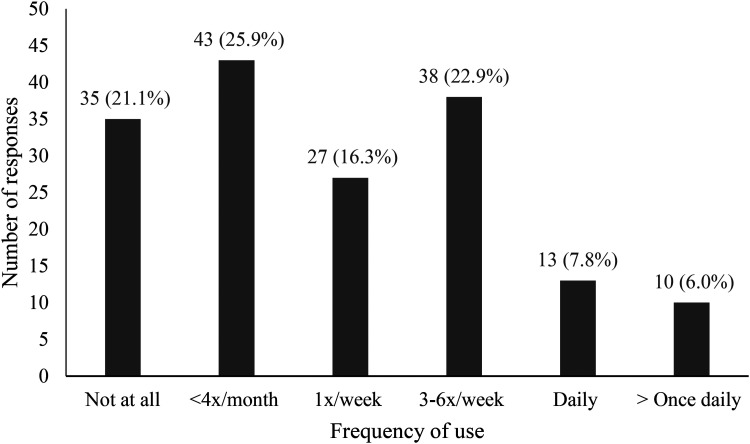
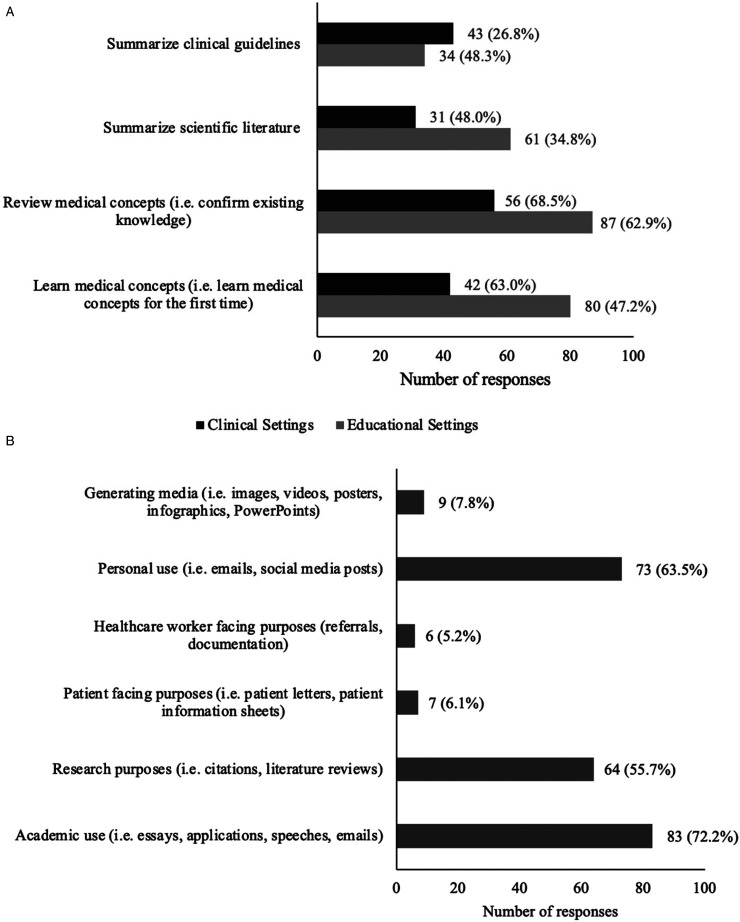
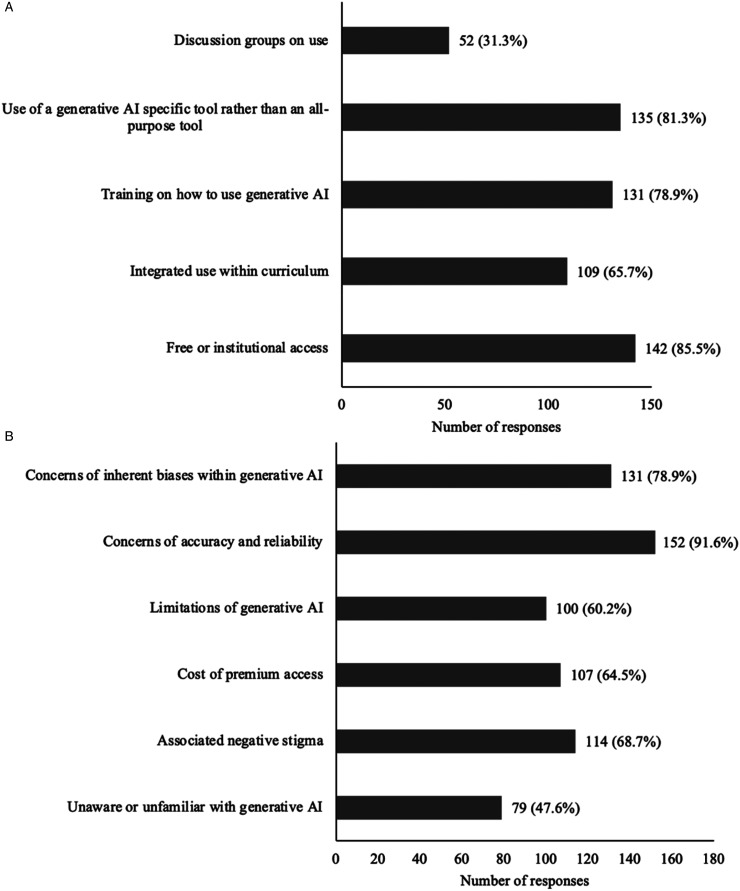
Introduction: Generative artificial intelligence (AI) has transformative potential in medical training, and its role in medicine holds drastic implications for patients, healthcare providers, and society; however, its current use by medical students is unknown. The study aims to characterize the use, frequency of use, and perceptions of generative AI by Canadian medical students. Methods: A cross-sectional survey was distributed to 6 medical schools in Ontario, Canada, to investigate how medical students use generative AI in education, clinical settings, and for communication, and to assess the perceived barriers and enablers that influence their use. Results: A total of 167 respondents completed the survey (60.8% female, 69.3% in first and second year), and over 78.9% of respondents reported using generative AI, with ChatGPT being the most popular model; 53.0% of respondents were frequent users and reported using generative AI tools at least once a week. In clinical settings, students report using generative AI for learning and reviewing medical content, summarizing clinical guidelines, and generating differential diagnoses; 92.8% of students were willing to learn how to use generative AI to integrate it into their future clinical practice. At the same time, most medical students appreciated the limitations of generative AI in terms of its risk for inaccuracy (91.6%) and bias (78.9%); 75.9% of participants agreed that generative AI should be implemented as a resource or formal teaching topic in medical training. Discussion: The findings of this study may help guide medical education institutions in adapting curricula and developing policies to promote the ethical and appropriate use of generative AI in medicine.
Overview
The claims and statistics of this paper haven’t been checked yet.
Free: it reads the open-access text and checks the first 5 claims that cite a source we can check. Create a free account to check every claim.
Integrity signals
Registry
Cites
Statistics
Figures
Verification
Claims the paper makes
The claims and statistics of this paper haven’t been checked yet.
Free: it reads the open-access text and checks the first 5 claims that cite a source we can check. Create a free account to check every claim.
Claims other papers make about this one
Each is checked against this paper’s own text: does it say what the citing paper says it does?
The cited source doesn’t support the claim as written.
In the citing paper
“Among 2,847 medical students across eight survey studies, 79% expressed considerable apprehension about using GenAI in high-stakes assessments.”
From The impact of generative artificial intelligence tools on assessment equity for non-native English-speaking medical students: a systematic review (2026) · cites this paper as [27]
Checked by a reasoning model — may be wrong.
Experimental — accuracy not yet measuredThe source backs part of the claim, not all of it — or backs it for a different population, condition or comparison.
In the citing paper
“Between 2024 and 2025, learners’ perceptions of AI shifted from cautious hesitancy toward broader acceptance of the technology [4,5].”
From Integration of Artificial Intelligence Into a Medical Curriculum: Evolving Student Perceptions and Faculty Development Challenges (2026) · cites this paper as [5]
Experimental — accuracy not yet measured
Self-check
Percentages, sums and reported differences re-computed from the paper’s own numbers.
The self-check needs the paper’s full text.
Citations
Cites
von Elm, E., Altman, D. G., Egger, M., Pocock, S. J., Gøtzsche, P. C., Vandenbroucke, J. P., & Initiative, F. T. S. (2007) · Annals of Internal Medicine · doi:10.7326/0003-4819-147-8-200710160-00010 · Cited by 17,796
Kung, T. H., Cheatham, M., Medenilla, A., Sillos, C., De Leon, L., Elepaño, C., Madriaga, M., Aggabao, R., Diaz-Candido, G., Maningo, J., et al. (2023) · PLOS Digital Health · doi:10.1371/journal.pdig.0000198 · Cited by 4,115
Thematic analysis of qualitative data: AMEE Guide No. 131
Kiger, M. E., & Varpio, L. (2020) · Medical Teacher · doi:10.1080/0142159x.2020.1755030 · Cited by 3,787
Prompt Engineering with ChatGPT: A Guide for Academic Writers
Giray, L. (2023) · Annals of Biomedical Engineering · doi:10.1007/s10439-023-03272-4 · Cited by 776 · cited 1×
“23 Currently, various studies have explored how LLMs may be integrated into the UGME curriculum to support test performance, clinical decision-making, and knowledge acquisition.”
Haltaufderheide, J., & Ranisch, R. (2024) · npj Digital Medicine · doi:10.1038/s41746-024-01157-x · Cited by 396
An exploratory survey about using ChatGPT in education, healthcare, and research
Hosseini, M., Gao, C. A., Liebovitz, D. M., Carvalho, A. M., Ahmad, F. S., Luo, Y., MacDonald, N., Holmes, K. L., & Kho, A. (2023) · PLOS ONE · doi:10.1371/journal.pone.0292216 · Cited by 238
An exploratory survey about using ChatGPT in education, healthcare, and research
Hosseini, M., Gao, C. A., Liebovitz, D. M., Carvalho, A. M., Ahmad, F. S., Luo, Y., MacDonald, N., Holmes, K. L., & Kho, A. (2023) · doi:10.1101/2023.03.31.23287979 · Cited by 238
Evaluation of ChatGPT-generated medical responses: A systematic review and meta-analysis
Wei, Q., Yao, Z., Cui, Y., Wei, B., Jin, Z., & Xu, X. (2024) · Journal of Biomedical Informatics · doi:10.1016/j.jbi.2024.104620 · Cited by 201 · cited 1×
“22 While generative AI has demonstrated immense promise as a medical resource, it is currently unable to fully capture the nuances and complexities of modern medicine.”
Moldt, J.-A., Festl-Wietek, T., Madany Mamlouk, A., Nieselt, K., Fuhl, W., & Herrmann-Werner, A. (2023) · Medical Education Online · doi:10.1080/10872981.2023.2182659 · Cited by 186 · cited 11×
“While previous research has reported the perceptions and beliefs of medical students toward generative AI, 9 – 12 this does not provide suf fi cient guidance for medical institutions to develop policies and curricular changes to responsibly address the real-world use of generative AI.”
InfluentialXu, X., Chen, Y., & Miao, J. (2024) · Journal of Educational Evaluation for Health Professions · doi:10.3352/jeehp.2024.21.6 · Cited by 169 · cited 1×
“8 Owing to these concerns, the use of generative AI in medicine must be cautioned and should be implemented in a manner that helps rather than harms clinical decision-making and improves patient safety.”
Mir, M. M. (2023) · PubMed · doi:10.30476/jamp.2023.98655.1803 · Cited by 165
Mehta, N., Harish, V., Bilimoria, K., Morgado, F., Ginsburg, S., Law, M., & Das, S. (2021) · MedEdPublish · doi:10.15694/mep.2021.000075.1 · Cited by 145
Pucchio, A., Rathagirishnan, R., Caton, N., Gariscsak, P. J., Del Papa, J., Nabhen, J. J., Vo, V., Lee, W., & Moraes, F. Y. (2022) · BMC Medical Education · doi:10.1186/s12909-022-03896-5 · Cited by 138
Alkhaaldi, S. M. I., Kassab, C. H., Dimassi, Z., Oyoun Alsoud, L., Al Fahim, M., Al Hageh, C., & Ibrahim, H. (2023) · JMIR Medical Education · doi:10.2196/51302 · Cited by 132 · cited 1×
“While previous research has reported the perceptions and beliefs of medical students toward generative AI, 9 – 12 this does not provide suf fi cient guidance for medical institutions to develop policies and curricular changes to responsibly address the real-world use of generative AI.”
ChatGPT in medicine: prospects and challenges: a review article
Tan, S., Xin, X., & Wu, D. (2024) · International Journal of Surgery · doi:10.1097/js9.0000000000001312 · Cited by 126 · cited 1×
“1,6,7,16 The questionnaire was fi rst pretested through a process of inclusion and exclusion based on binary and general feedback provided by 2 staff physicians (BNH, AJES).”
Jeyaraman, M., Ramasubramanian, S., Balaji, S., Jeyaraman, N., Nallakumarasamy, A., & Sharma, S. (2023) · World Journal of Methodology · doi:10.5662/wjm.v13.i4.170 · Cited by 125
ChatGPT's Ability to Assist with Clinical Documentation: A Randomized Controlled Trial
Baker, H. P., Dwyer, E., Kalidoss, S., Hynes, K., Wolf, J., & Strelzow, J. A. (2024) · Journal of the American Academy of Orthopaedic Surgeons · doi:10.5435/jaaos-d-23-00474 · Cited by 115
The Pros and Cons of Using ChatGPT in Medical Education: A Scoping Review
Mohammad, B., Supti, T., Alzubaidi, M., Shah, H., Alam, T., Shah, Z., & Househ, M. (2023) · Studies in Health Technology and Informatics · doi:10.3233/shti230580 · Cited by 114 · cited 3×
“7 The overreliance of generative AI by learners may lead to plagiarism and declining critical thinking skills.”
Western Australian medical students’ attitudes towards artificial intelligence in healthcare
Stewart, J., Lu, J., Gahungu, N., Goudie, A., Fegan, P. G., Bennamoun, M., Sprivulis, P., & Dwivedi, G. (2023) · PLOS ONE · doi:10.1371/journal.pone.0290642 · Cited by 104 · cited 11×
“While previous research has reported the perceptions and beliefs of medical students toward generative AI, 9 – 12 this does not provide suf fi cient guidance for medical institutions to develop policies and curricular changes to responsibly address the real-world use of generative AI.”
InfluentialTangadulrat, P., Sono, S., & Tangtrakulwanich, B. (2023) · JMIR Medical Education · doi:10.2196/50658 · Cited by 99 · cited 2×
“In 2023, Tangadulrat et al found that 62% of respondents have never used AI and that only 8% used it regularly, 14 whereas a year later, we reported that only 21.1% of respondents did not use generative AI, and that 53.0% of respondents used it regularly.”
InfluentialCohen, S., Brant, A. R., Fisher, A. C., Pershing, S., Diana, V., & Pan, C. K. (2024) · Seminars in Ophthalmology · doi:10.1080/08820538.2024.2326058 · Cited by 84
Mehta, N., Harish, V., Bilimoria, K., et al. (2021) · medRxiv · doi:10.1101/2021.01.14.21249830 · Cited by 52 · cited 1×
“The survey items were generated through a literature review of studies exploring medical students ’ perceptions and utilization of AI, 10 – 15 as well as the broader applications of AI in medicine.”
Hryciw, B. N., Seely, A. J. E., & Kyeremanteng, K. (2023) · Frontiers in Artificial Intelligence · doi:10.3389/frai.2023.1283353 · Cited by 45
Self-citationDoctor-patient interactions in the age of AI: navigating innovation and expertise
Hryciw, B. N., Fortin, Z., Ghossein, J., & Kyeremanteng, K. (2023) · Frontiers in Medicine · doi:10.3389/fmed.2023.1241508 · Cited by 40
Self-citationOSCEai: personalized interactive learning for undergraduate medical education
Guo, E., Ramchandani, R., Park, Y., & Gupta, M. (2024) · Canadian Medical Education Journal · doi:10.36834/cmej.79220 · Cited by 16 · cited 1×
“24 In this platform, users conduct a history via speech or text communication with the LLM and receive a feedback report based on the Calgary – Cambridge model for medical interviews.”
Mizuta, K., Hirosawa, T., Harada, Y., & Shimizu, T. (2024) · Diagnosis · doi:10.1515/dx-2024-0027 · Cited by 14 · cited 1×
“A 2024 study by Mizuta et al found ChatGPT-4 was able to generate a differential diagnosis when given complex case reports with 95.9% accuracy, 19 alluding to its use as a supportive tool for generating differential diagnoses may be suitable.”
InfluentialMeaney, C. A., Huang, R. S., Lu, K. J. Q., Fischer, A. W., Leung, F., Kulasegaram, K. M., Tzanetos, K., & Punnett, A. (2023) · medRxiv · doi:10.1101/2023.09.14.23295571 · Cited by 7 · cited 1×
“25 ChatGPT-4 out-performed all years of medical students, achieving a score of 79%.”
Cited by
GenAI-Supported Virtual Patients in Health Care Education: Systematic Review
Jiang, J., Ye, M. Z., Kwok, T. T.-O., & Wong, J. Y. H. (2026) · Journal of Medical Internet Research · doi:10.2196/82756 · Cited by 24
“Most critically, the tendency of GenAI models to generate plausible but incorrect or fabricated information—known as “halluci-nations”—poses a direct threat to clinical accuracy [56].”
Um, Y. J. (2026) · Psychiatry Investigation · doi:10.30773/pi.2026.0068 · Cited by 4
M, S. P., David Sam Selva Jeyam, P., & Hiranmahi Gandhi, K. (2026) · Cureus · doi:10.7759/cureus.112457 · Cited by 3
A Call to Address the Generative AI-Environment Paradox in Graduate Medical Education
Verma, S., Philipsborn, R. P., James, C. A., & Sullivan, G. M. (2026) · Journal of Graduate Medical Education · doi:10.4300/jgme-d-26-00169.1 · Cited by 2
Lu, M., Cheng, J., & Gopalan, V. (2026) · Anatomical Sciences Education · doi:10.1002/ase.70256 · Cited by 2
Metadata
- Authors
- Tran, C., Hryciw, B. N., Moore, S. W., Chaput, A., & Seely, A. J. E.
- Affiliations
- University of Ottawa (CA)
- Ottawa Hospital (CA)
- NOSM University (CA)
- Corresponding author
- Seely, Andrew John Ervine
- Venue
- Journal of Medical Education and Curricular Development
- Publisher
- SAGE Publications
- Published
- 2025-10
- Volume
- 12
- Pages
- 23821205251391969-23821205251391969
- ISSN
- 2382-1205 (ISSN-L)
- PMC
- PMC12576227
- OpenAlex
- W4415671096
- Cited by
- 22
- References
- 25
- Citations by year
- 2026: 22
- FWCI
- 5.30
- Type
- journal article
- Language
- en
- Open access
- gold
- doi.org
- Licence
- cc-by
- creativecommons.org/licenses/by/4.0/ (vor)
- journals.sagepub.com/page/policies/text-and-data-mining-license (tdm)
- Locations
- Journal of Medical Education and Curricular Development (publishedVersion, cc-by)
- Europe PMC (PubMed Central) (publishedVersion, cc-by)
- PubMed (publishedVersion)
- DOAJ (DOAJ: Directory of Open Access Journals) (submittedVersion, cc-by-sa)
- Funders
- Faculty of Medicine, University of Ottawa
- Topics
- Health Sciences › Medicine › Health Informatics › Artificial Intelligence in Healthcare and Education
- Social Sciences › Education › Artificial Intelligence in Education
- Social Sciences › Education › Innovations in Medical Education
- Keywords
- generative AI, medical students, ChatGPT, student perceptions, barriers and facilitators, clinical implementation of AI, medical curriculum integration
About these checks
Registry, retraction, Cites and statistics results are computed, not judged, with one exception: a printed reference that no index lists is read once by a model before it counts as a citation error. Claims are extracted by a model and kept only when their quote appears verbatim in the text; each cited source is then checked, with a model’s help, for whether it says what the claim relies on. Those verdicts can be wrong — read the claim’s quote and the cited source before relying on one.
Statistics and arithmetic are recomputed, not judged.
Confidence bands are shown only for fields calibrated on our annotated test set. None is calibrated yet, so no band is shown.
What counts as a claim ›How we measure confidence ›How we check this ›
Are you an author, or do you see a problem with this page? Request a review
Data sources
Bibliographic data: Semantic Scholar, OpenAlex, Crossref.
Contains information from the Semantic Scholar Academic Graph Datasets, made available under the ODC Attribution License (ODC-BY 1.0).
Semantic Scholar’s data is described in: Kinney, R., et al. (2023). The Semantic Scholar Open Data Platform. arXiv:2301.10140.
