

Genetically defined individual reference ranges for tryptase limit unnecessary procedures and unmask myeloid neoplasms
Open accessPublished version of a preprint
The DOI matches its Crossref record; 36 of the 36 references it cites were found in a registry or an index.
Abstract
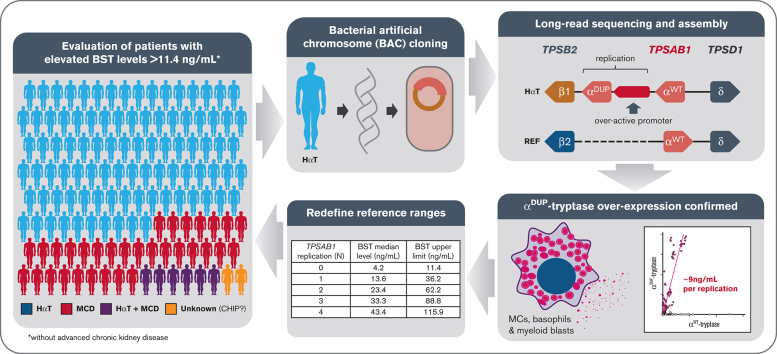
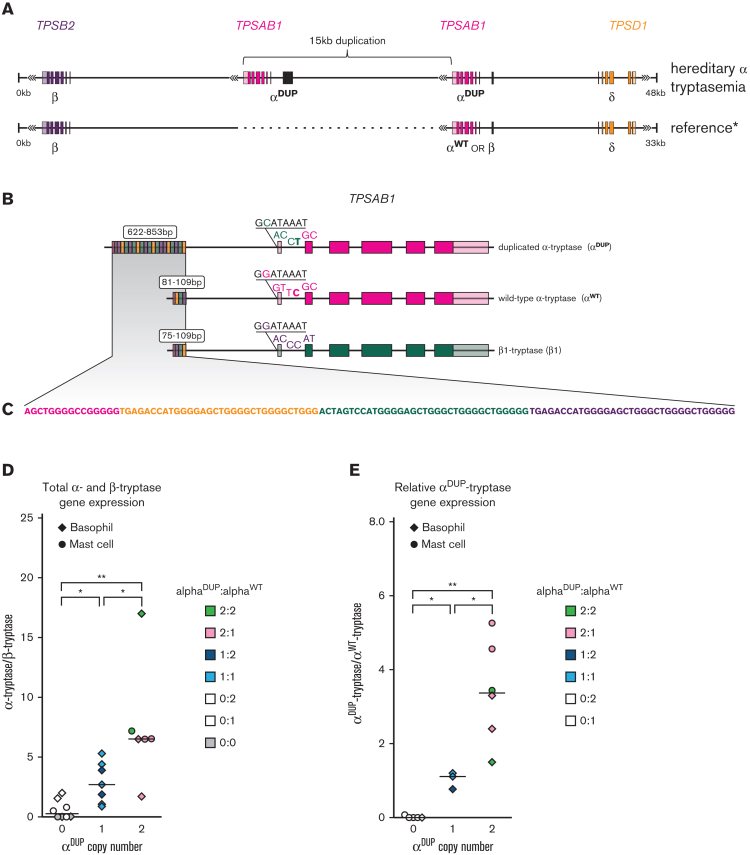
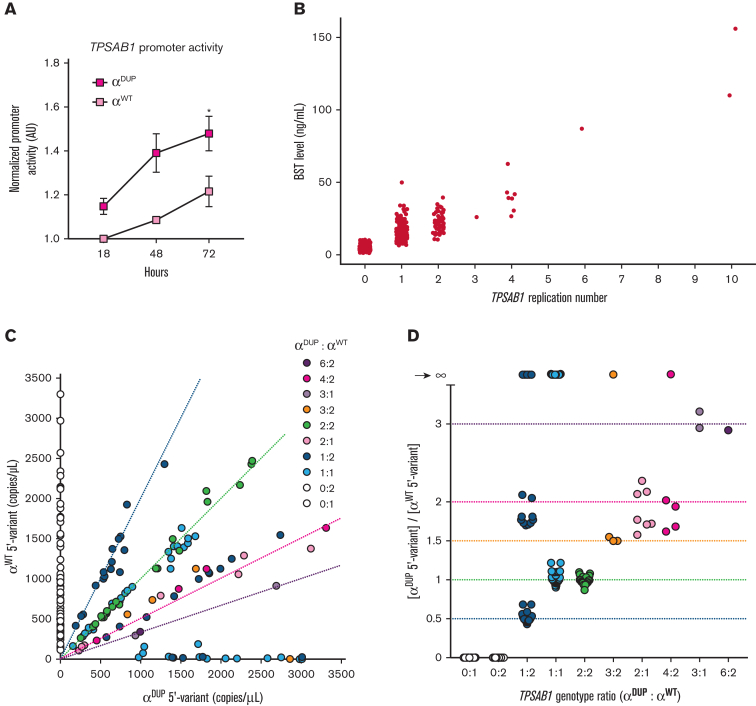
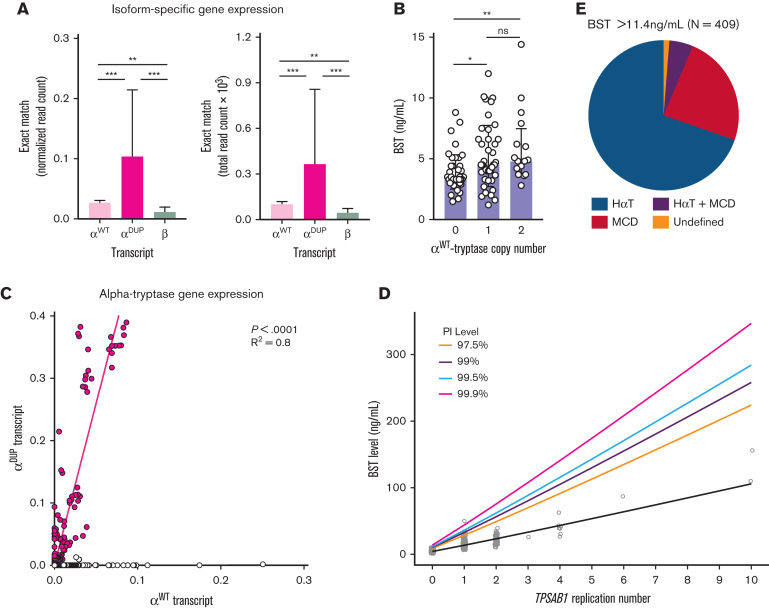
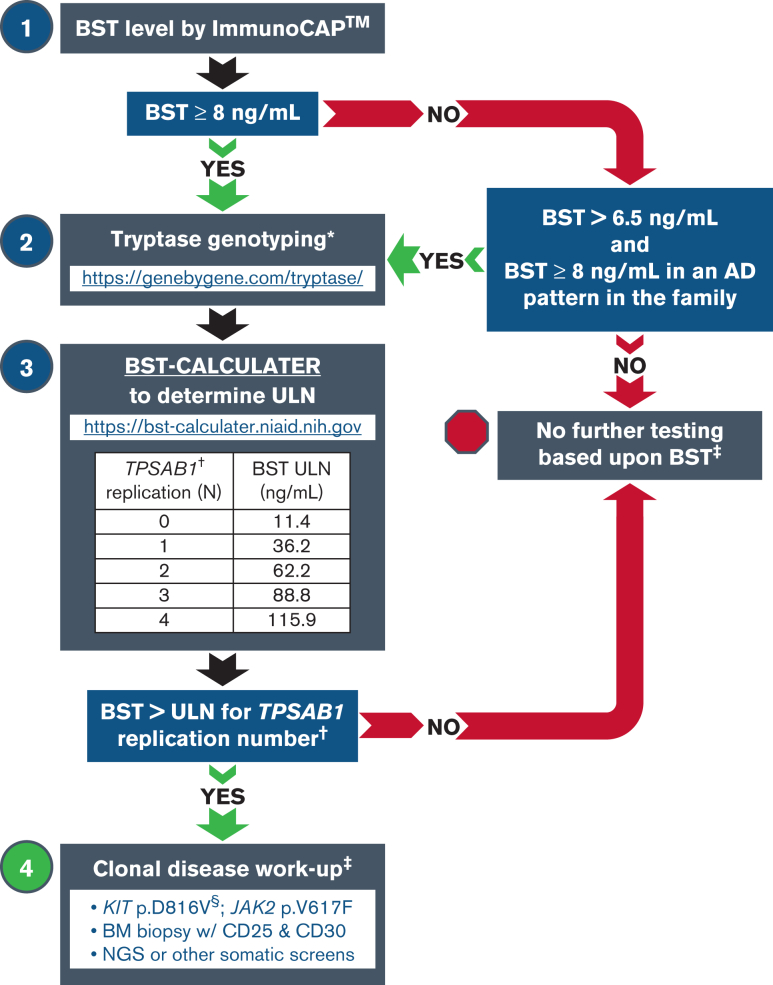
Serum tryptase is a biomarker used to aid in the identification of certain myeloid neoplasms, most notably systemic mastocytosis, where basal serum tryptase (BST) levels >20 ng/mL are a minor criterion for diagnosis. Although clonal myeloid neoplasms are rare, the common cause for elevated BST levels is the genetic trait hereditary α-tryptasemia (HαT) caused by increased germline TPSAB1 copy number. To date, the precise structural variation and mechanism(s) underlying elevated BST in HαT and the general clinical utility of tryptase genotyping, remain undefined. Through cloning, long-read sequencing, and assembling of the human tryptase locus from an individual with HαT, and validating our findings in vitro and in silico, we demonstrate that BST elevations arise from overexpression of replicated TPSAB1 loci encoding canonical α-tryptase protein owing to coinheritance of a linked overactive promoter element. Modeling BST levels based on TPSAB1 replication number, we generate new individualized clinical reference values for the upper limit of normal. Using this personalized laboratory medicine approach, we demonstrate the clinical utility of tryptase genotyping, finding that in the absence of HαT, BST levels >11.4 ng/mL frequently identify indolent clonal mast cell disease. Moreover, substantial BST elevations (eg, >100 ng/mL), which would ordinarily prompt bone marrow biopsy, can result from TPSAB1 replications alone and thus be within normal limits for certain individuals with HαT.
Overview
The claims and statistics of this paper haven’t been checked yet.
Free: it reads the open-access text and checks the first 5 claims that cite a source we can check. Create a free account to check every claim.
Integrity signals
Registry
Cites
Statistics
Figures
Verification
Claims the paper makes
The claims and statistics of this paper haven’t been checked yet.
Free: it reads the open-access text and checks the first 5 claims that cite a source we can check. Create a free account to check every claim.
Claims other papers make about this one
Each is checked against this paper’s own text: does it say what the citing paper says it does?
The cited source says what the claim attributes to it.
In the citing paper
“Another way is by using an online calculator tool (https://bst-calculater.niaid.nih.gov/ (accessed on 13 November 2023)) developed by Chovanek et al. [44].”
From Diagnostic Significance of Tryptase for Suspected Mast Cell Disorders (2023) · cites this paper as [44]
The cited source says what the claim attributes to it.
In the citing paper
“Further studies have elucidated as the number of TPSAB1 copies determined an increase in α-tryptase levels, on turn ultimately leading to elevated BST, each additional copy number adding approximately 9–10 ng/ml to the basal BST levels (12, 13).”
From Defining “Normal” basal serum tryptase levels: a context-dependent approach to improve diagnostics in systemic mastocytosis (2025) · cites this paper as [13]
The cited source says what the claim attributes to it.
In the citing paper
“In addition to this, three other methods of correction have been proposed (5, 13, 23) (Table 2).”
From Defining “Normal” basal serum tryptase levels: a context-dependent approach to improve diagnostics in systemic mastocytosis (2025) · cites this paper as [13]
In the citing paper
“In HαT, increased TPSAB1 copy number encoding α-tryptase results in increased BST levels as a result of promoter-driven overexpression of the replicated gene.37”
From Mast cell activation syndrome: Current understanding and research needs (2024) · cites this paper as [37]
In the citing paper
“HαT is a recently described genetic trait reported among 5% to 7% of Whites.17,37”
From Mast cell activation syndrome: Current understanding and research needs (2024) · cites this paper as [37]
Self-check
Percentages, sums and reported differences re-computed from the paper’s own numbers.
The self-check needs the paper’s full text.
Citations
Cites
Trimmomatic: a flexible trimmer for Illumina sequence data
Bolger, A. M., Lohse, M., & Usadel, B. (2014) · Bioinformatics · doi:10.1093/bioinformatics/btu170 · Cited by 65,548
The Ensembl Variant Effect Predictor
McLaren, W., Gil, L., Hunt, S. E., Riat, H. S., Ritchie, G. R. S., Thormann, A., Flicek, P., & Cunningham, F. (2016) · Genome Biology · doi:10.1186/s13059-016-0974-4 · Cited by 8,099
Sensitive detection of somatic point mutations in impure and heterogeneous cancer samples
Cibulskis, K., Lawrence, M. S., Carter, S. L., Sivachenko, A., Jaffe, D., Sougnez, C., Gabriel, S., Meyerson, M., Lander, E. S., & Getz, G. (2013) · Nature Biotechnology · doi:10.1038/nbt.2514 · Cited by 4,981 · cited 1×
“7.(26) In addition to paired calling, we also performed tumor-only calling with a combination of MuTect2 GATK version 4.”
Strelka2: fast and accurate calling of germline and somatic variants
Kim, S., Scheffler, K., Halpern, A. L., Bekritsky, M. A., Noh, E., Källberg, M., Chen, X., Kim, Y., Beyter, D., Krusche, P., et al. (2018) · Nature Methods · doi:10.1038/s41592-018-0051-x · Cited by 1,632
Diagnostic criteria and classification of mastocytosis: a consensus proposal
Valent, P., Horny, H.-P., Escribano, L., Longley, B. J., Li, C. Y., Schwartz, L. B., Marone, G., Nuñez, R., Akin, C., Sotlar, K., et al. (2001) · Leukemia Research · doi:10.1016/s0145-2126(01)00038-8 · Cited by 1,108
Self-citationVarDict: a novel and versatile variant caller for next-generation sequencing in cancer research
Lai, Z., Markovets, A., Ahdesmaki, M., Chapman, B., Hofmann, O., McEwen, R., Johnson, J., Dougherty, B., Barrett, J. C., & Dry, J. R. (2016) · Nucleic Acids Research · doi:10.1093/nar/gkw227 · Cited by 970 · cited 1×
“0.(27) The latter approach of performing somatic variant detection without including the paired PBMC sample was done to account for the fact that somatic variants in the BM granulocytes and BM mononuclear cells could also be present at low fractions in the PBMC sample, and therefore, be excluded as contaminating germ…”
BackgroundSAMBLASTER: fast duplicate marking and structural variant read extraction
Faust, G. G., & Hall, I. M. (2014) · Bioinformatics · doi:10.1093/bioinformatics/btu314 · Cited by 909
Tryptase levels as an indicator of mast-cell activation in systemic anaphylaxis and mastocytosis
Schwartz, L. B., Metcalfe, D. D., Miller, J. S., Earl, H., & Sullivan, T. (1987) · New England Journal of Medicine · doi:10.1056/nejm198706253162603 · Cited by 784 · cited 1×
“Whereas HaT is the most common heritable cause for elevated BST, the clonal mast cell 112 disorder systemic mastocytosis (SM) is a common acquired cause (10, 12), and BST levels are 113 used routinely as a biomarker to screen for this disorder.”
BackgroundSelf-citationKirshenbaum, A. S., Goff, J. P., Semere, T., Foster, B., Scott, L. M., & Metcalfe, D. D. (1999) · Blood · doi:10.1182/blood.v94.7.2333.419k30_2333_2342 · Cited by 420
Self-citationLyons, J. J., Yu, X., Hughes, J. D., Le, Q. T., Jamil, A., Bai, Y., Ho, N., Zhao, M., Liu, Y., O'Connell, M. P., et al. (2016) · Nature Genetics · doi:10.1038/ng.3696 · Cited by 394 · cited 7×
“220 Using these haplotypes, we next re-examined genome sequence reads from 183 individuals 221 without increased TPSAB1 copy number, and from 32 affected individuals from 10 families with 222 HaT (5).”
BackgroundMethodInfluentialSelf-citationDevelopment of a new, more sensitive immunoassay for human tryptase: use in systemic anaphylaxis
Schwartz, L. B., Bradford, T. R., Rouse, C., Irani, A.-M., Rasp, G., Van Der Zwan, J. K., & Van Der Linden, P.-W. G. (1994) · Journal of Clinical Immunology · doi:10.1007/bf01533368 · Cited by 263
Self-citationLyons, J. J., Chovanec, J., O’Connell, M. P., Liu, Y., Šelb, J., Zanotti, R., Bai, Y., Kim, J., Le, Q. T., DiMaggio, T., et al. (2021) · Journal of Allergy and Clinical Immunology · doi:10.1016/j.jaci.2020.06.035 · Cited by 230
Self-citationCloning and characterization of complementary DNA for human tryptase.
Miller, J. S., Westin, E. H., & Schwartz, L. B. (1989) · Journal of Clinical Investigation · doi:10.1172/jci114284 · Cited by 199
Self-citationGreiner, G., Sprinzl, B., Górska, A., Ratzinger, F., Gurbisz, M., Witzeneder, N., Schmetterer, K. G., Gisslinger, B., Uyanik, G., Hadzijusufovic, E., et al. (2021) · Blood · doi:10.1182/blood.2020006157 · Cited by 189
Cloning and characterization of a second complementary DNA for human tryptase.
Miller, J. S., Moxley, G., & Schwartz, L. B. (1990) · Journal of Clinical Investigation · doi:10.1172/jci114786 · Cited by 179
Self-citationLyons, J. J. (2018) · Immunology and Allergy Clinics of North America · doi:10.1016/j.iac.2018.04.003 · Cited by 179 · cited 1×
“108 Moreover, since only a small region of TPSAB1 has been probed to demonstrate gene replication 109 (5, 11), it remains unknown whether extra-allelic copies of TPSAB1 encode wild-type or novel 110”
BackgroundSelf-citationTryptase genetics and anaphylaxis
Caughey, G. H. (2006) · Journal of Allergy and Clinical Immunology · doi:10.1016/j.jaci.2006.02.026 · Cited by 150
Self-citationRehder, C., Bean, L. J. H., Bick, D., Chao, E., Chung, W., Das, S., O’Daniel, J., Rehm, H., Shashi, V., & Vincent, L. M. (2021) · Genetics in Medicine · doi:10.1038/s41436-021-01139-4 · Cited by 141 · cited 1×
“Paired peripheral blood samples from the same individuals were also exome sequenced consistent with clinically recommended standards.(22)”
MethodHereditary alpha-tryptasemia: UK prevalence and variability in disease expression
Robey, R. C., Wilcock, A., Bonin, H., Beaman, G., Myers, B., Grattan, C., Briggs, T. A., & Arkwright, P. D. (2020) · The Journal of Allergy and Clinical Immunology In Practice · doi:10.1016/j.jaip.2020.05.057 · Cited by 119
Tao, Q. (1998) · Nucleic Acids Research · doi:10.1093/nar/26.21.4901 · Cited by 91 · cited 1×
“1798 CHOVANEC et al of fragments into the pCC1BAC vector (Epicentre Biotechnologies, Madison, WI) and transformation of DH10B Escherichia coli cells.(17,18) The clones were robotically chosen and replicated.”
MethodDefining baseline variability of serum tryptase levels improves accuracy in identifying anaphylaxis
Mateja, A., Wang, Q., Chovanec, J., Kim, J., Wilson, K. J., Schwartz, L. B., Glover, S. C., Carter, M. C., Metcalfe, D. D., Brittain, E., et al. (2022) · Journal of Allergy and Clinical Immunology · doi:10.1016/j.jaci.2021.08.007 · Cited by 91 · cited 1×
“9 Elevated BST levels among patients with HaT have been shown to result from increased 163 constitutive release of pro-tryptases (5, 17).”
BackgroundSelf-citationHereditary alpha tryptasemia is not associated with specific clinical phenotypes
Chollet, M. B., & Akin, C. (2022) · Journal of Allergy and Clinical Immunology · doi:10.1016/j.jaci.2021.06.017 · Cited by 90 · cited 1×
“Moreover, several studies 394 have now demonstrated an increased prevalence of HaT among symptomatic individuals with SM 395 (6-8) - likely due to potentiation of mast cell-mediated symptoms and reactions.”
BackgroundGenetic deficiency of human mast cell a‐tryptase
Soto, D., Malmsten, C., Blount, J. L., Muilenburg, D. J., & Caughey, G. H. (2002) · Clinical & Experimental Allergy · doi:10.1046/j.1365-2222.2002.01416.x · Cited by 89
Self-citationClinical characteristics and risk profile of patients with elevated baseline serum tryptase
Fellinger, C., Hemmer, W., Wöhrl, S., Sesztak-Greinecker, G., Jarisch, R., & Wantke, F. (2014) · Allergologia et Immunopathologia · doi:10.1016/j.aller.2014.05.002 · Cited by 89
Höltke, H.-J., Ankenbauer, W., Mühlegger, K., Rein, R., Sagner, G., Seibl, R., & Walter, T. J. (1995) · PubMed · Cited by 85
Factors influencing serum total tryptase concentrations in a general adult population
Gonzalez-Quintela, A., Vizcaino, L., Gude, F., Rey, J., Meijide, L., Fernandez-Merino, C., Linneberg, A., & Vidal, C. (2010) · cclm · doi:10.1515/cclm.2010.124 · Cited by 84
Trivedi, N. N., Tamraz, B., Chu, C., Kwok, P.-Y., & Caughey, G. H. (2009) · Journal of Allergy and Clinical Immunology · doi:10.1016/j.jaci.2009.07.026 · Cited by 73 · cited 1×
“445 446 Total basal serum tryptase quantification 447 Total basal serum tryptase (BST) levels were measured using the commercially available 448 ImmunCAP assay (Thermo Fisher Scientific, Phadia AB, Uppsala, Sweden) or ELISA as 449 described (16), performed in CLIA-certified laboratories (Mayo Clinic, Rochester, NY and…”
MethodSelf-citationThe Genetic Basis and Clinical Impact of Hereditary Alpha-Tryptasemia
Luskin, K. T., White, A. A., & Lyons, J. J. (2021) · The Journal of Allergy and Clinical Immunology: In Practice · doi:10.1016/j.jaip.2021.03.005 · Cited by 67 · cited 2×
“Severe renal dysfunction can also affect BST levels, as can other parasitic diseases, which are rare in most Western countries.(15) These factors were not represented or evaluated in this study and should be considered when applying this model to patients.”
BackgroundSelf-citationClinical relevance of inherited genetic differences in human tryptases
Glover, S. C., Carter, M. C., Korošec, P., Bonadonna, P., Schwartz, L. B., Milner, J. D., Caughey, G. H., Metcalfe, D. D., & Lyons, J. J. (2021) · Annals of Allergy, Asthma & Immunology · doi:10.1016/j.anai.2021.08.009 · Cited by 64 · cited 2×
“Copy number gain and loss of tryptase gene sequences encoding both α- and β-tryptases have also been reported.(4) However, the structures of such copy number variants remain unknown.”
BackgroundSelf-citationInherited and acquired determinants of serum tryptase levels in humans
Lyons, J. J. (2021) · Annals of Allergy, Asthma & Immunology · doi:10.1016/j.anai.2021.06.019 · Cited by 52
Self-citationEffect of sex and haplotype on plasma tryptase levels in healthy adults
Min, H., Moxley, G. F., Neale, M. C., & Schwartz, L. B. (2004) · Journal of Allergy and Clinical Immunology · doi:10.1016/j.jaci.2004.04.008 · Cited by 49 · cited 2×
“Mast cells were then differentiated under the 526 established conditions described (21).”
BackgroundSelf-citationElevated Basal Serum Tryptase: Disease Distribution and Variability in a Regional Health System
Waters, A. M., Park, H. J., Weskamp, A. L., Mateja, A., Kachur, M. E., Lyons, J. J., Rosen, B. J., & Boggs, N. A. (2022) · The Journal of Allergy and Clinical Immunology In Practice · doi:10.1016/j.jaip.2021.12.031 · Cited by 46
Expression of a Mast Cell Tryptase in the Human Monocytic Cell Lines U‐937 and Mono Mac 6
HUANG, R., ÅBRINK, M., GOBL, A. E., NILSSON, G., AVESKOGH, M., LARSSON, L. G., NILSSON, K., & HELLMAN, L. (1993) · Scandinavian Journal of Immunology · doi:10.1111/j.1365-3083.1993.tb01738.x · Cited by 37 · cited 1×
“These constructs were sequence-verified and transfected into MonoMac189 6 cells – an AML line that expresses tryptases (18, 19).”
BackgroundConstruction of a full bacterial artificial chromosome (BAC) library of Oryza sativa genome
Tao, Q., Zhao, H., Qiu, L., & Hong, G. (1994) · Cell Research · doi:10.1038/cr.1994.13 · Cited by 33 · cited 1×
“1798 CHOVANEC et al of fragments into the pCC1BAC vector (Epicentre Biotechnologies, Madison, WI) and transformation of DH10B Escherichia coli cells.(17,18) The clones were robotically chosen and replicated.”
MethodLyons, J. J., Stotz, S. C., Chovanec, J., Liu, Y., Lewis, K. L., Nelson, C., DiMaggio, T., Jones, N., Stone, K. D., Sung, H., et al. (2018) · Genetics in Medicine · doi:10.1038/gim.2017.136 · Cited by 30 · cited 1×
“Critically, TPSAB1 and TPSB2 are reportedly in nearly complete linkage disequilibrium and are coinherited in virtually all individuals such that major haplotypes exist and inheritance can be inferred.(29,33) The major tryptase isoforms encoded at TPSAB1 are β1-tryptase followed by α-tryptase, and at TPSB2 are β3-trypt…”
BackgroundSelf-citationLyons, J. J., & Schwartz, L. B. (2019) · Springer eBooks · doi:10.1007/978-3-030-27820-5_3 · Cited by 11
Self-citation
Research works printed but not linked: 1
- Reid GA Sambroo kJ Fritsch EF Maniatis T Molecular Cloning: A Laboratory Manual 2nd ed. 1989 Cold Spring Harbor Laboratory Press
Cited by
Human germline heterozygous gain-of-function STAT6 variants cause severe allergic disease
Sharma, M., Leung, D., Momenilandi, M., Jones, L. C. W., Pacillo, L., James, A. E., Murrell, J. R., Delafontaine, S., Maimaris, J., Vaseghi-Shanjani, M., et al. (2023) · Journal of Experimental Medicine · doi:10.1084/jem.20221755 · Cited by 125
Self-citationIncorporating Tryptase Genotyping Into the Workup and Diagnosis of Mast Cell Diseases and Reactions
Lyons, J. J., Greiner, G., Hoermann, G., & Metcalfe, D. D. (2022) · The Journal of Allergy and Clinical Immunology: In Practice · doi:10.1016/j.jaip.2022.05.003 · Cited by 47
Self-citationMast cell activation syndrome: Current understanding and research needs
Castells, M., Giannetti, M. P., Hamilton, M. J., Novak, P., Pozdnyakova, O., Nicoloro-SantaBarbara, J., Jennings, S. V., Francomano, C., Kim, B., Glover, S. C., et al. (2024) · Journal of Allergy and Clinical Immunology · doi:10.1016/j.jaci.2024.05.025 · Cited by 45
Self-citationClonal mast cell disorders and hereditary α-tryptasemia as risk factors for anaphylaxis
Kačar, M., Rijavec, M., Šelb, J., & Korošec, P. (2023) · Clinical & Experimental Allergy · doi:10.1111/cea.14264 · Cited by 37
Self-citationKorošec, P., Sturm, G. J., Lyons, J. J., Marolt, T. P., Svetina, M., Košnik, M., Zidarn, M., Kačar, M., Frelih, N., Lalek, N., et al. (2024) · Allergy · doi:10.1111/all.16084 · Cited by 51
Self-citation
Metadata
- Authors
- Chovanec, J., Tunc, I., Hughes, J., Halstead, J., Mateja, A., Liu, Y., O’Connell, M. P., Kim, J., Park, Y. H., Wang, Q., Le, Q., Pirooznia, M., Trivedi, N. N., Bai, Y., Yin, Y., Hsu, A. P., McElwee, J., Lassiter, S., Nelson, C., Bandoh, J., DiMaggio, T., Šelb, J., Rijavec, M., Carter, M. C., Komarow, H. D., Sabato, V., Steinberg, J., Hafer, K. M., Feuille, E., Hourigan, C. S., Lack, J., Khoury, P., Maric, I., Zanotti, R., Bonadonna, P., Schwartz, L. B., Milner, J. D., Glover, S. C., Ebo, D. G., Korošec, P., Caughey, G. H., Brittain, E. H., Busby, B., Metcalfe, D. D., & Lyons, J. J.
- Affiliations
- National Institutes of Health (US)
- Foundation Medicine (United States) (US)
- Birmingham Women’s and Children’s NHS Foundation Trust (GB)
- Frederick National Laboratory for Cancer Research (US)
- 1Translational Allergic Immunopathology Unit, Laboratory of Allergic Diseases, National Institute of Allergy and Infectious Diseases (NIAID), National Institutes of Health (NIH), Bethesda, MD
- Virginia Commonwealth University (US)
- San Francisco VA Medical Center (US)
- 12Nimbus Therapeutics, Cambridge, MA
- University Clinic of Pulmonary and Allergic Diseases Golnik (SI)
- University of Antwerp (BE)
- Medical College of Wisconsin (US)
- Stanford Medicine (US)
- Cornell University (US)
- 23Hematology Service, Department of Laboratory Medicine, Clinical Center, NIH, Bethesda, MD
- University of Verona (IT)
- Azienda Ospedaliera Universitaria Integrata Verona (IT)
- Columbia University (US)
- University of Mississippi Medical Center (US)
- Corresponding author
- Lyons, Jonathan J.
- ORCID
- Chovanec, Jack
- Tunc, Ilker
- Mateja, Allyson
- Liu, Yihui
- O’Connell, Michael P.
- Park, Young Hwan
- Le, Quang
- Pirooznia, Mehdi
- Bai, Yun
- Yin, Yuzhi
- Hsu, Amy P.
- McElwee, Joshua
- Nelson, Celeste
- DiMaggio, Thomas
- Šelb, Julij
- Rijavec, Matija
- Carter, Melody C.
- Komarow, Hirsh D.
- Sabato, Vito
- Steinberg, Joshua
- Feuille, Elizabeth
- Hourigan, Christopher S.
- Lack, Justin
- Khoury, Paneez
- Zanotti, Roberta
- Bonadonna, Patrizia
- Schwartz, Lawrence B.
- Milner, Joshua D.
- Glover, Sarah C.
- Ebo, Didier G.
- Korošec, Peter
- Caughey, George H.
- Brittain, Erica H.
- Busby, Ben
- Metcalfe, Dean D.
- Lyons, Jonathan J.
- Venue
- Blood Advances
- Publisher
- American Society of Hematology
- Published
- 2023-04-28
- Volume
- 7
- Issue
- 9
- Pages
- 1796-1810
- ISSN
- 2473-9529 (ISSN-L)
- 2473-9537
- PMC
- PMC10164828
- OpenAlex
- W4297520278
- Cited by
- 62
- References
- 36
- Citations by year
- 2026: 11 · 2025: 24 · 2024: 13 · 2023: 11
- FWCI
- 4.68
- Type
- journal article
- Language
- en
- Open access
- gold
- doi.org
- Licence
- cc-by-nc-nd
- Locations
- Blood Advances (publishedVersion, cc-by-nc-nd)
- medRxiv (acceptedVersion)
- PubMed Central (publishedVersion, cc-by-nc-nd)
- PubMed (publishedVersion)
- Funders
- U.S. Department of Health and Human Services (HHSN261201500003I)
- Fonds Wetenschappelijk Onderzoek (1804518N, 1800614N, FWO: 1800614N)
- Vlaamse regering
- National Institutes of Health (75N910D00024, HHSN261201500003I)
- National Heart, Lung, and Blood Institute
- National Cancer Institute (75N910D00024, HHSN261201500003I, HHSN261201500003C)
- National Institute of Allergy and Infectious Diseases (HHSN261201500003I, 75N910D00024)
- National Institute of Dental and Craniofacial Research (R21DE028378)
- U.S. National Library of Medicine
- NHLBI Division of Intramural Research
- Topics
- Life Sciences › Immunology and Microbiology › Immunology › Mast cells and histamine
- Life Sciences › Biochemistry, Genetics and Molecular Biology › Genetics › Genomics and Rare Diseases
- Health Sciences › Medicine › Hematology › Acute Myeloid Leukemia Research
- Keywords
- serum tryptase, hereditary alpha-tryptasemia, upper limit of normal, systemic mastocytosis, myeloid neoplasms
- MeSH terms
- Mast Cell Activation Syndrome, Humans, Mast Cells, Mastocytosis, Myeloproliferative Disorders, Reference Values, Unnecessary Procedures, Tryptases
About these checks
Registry, retraction, Cites and statistics results are computed, not judged, with one exception: a printed reference that no index lists is read once by a model before it counts as a citation error. Claims are extracted by a model and kept only when their quote appears verbatim in the text; each cited source is then checked, with a model’s help, for whether it says what the claim relies on. Those verdicts can be wrong — read the claim’s quote and the cited source before relying on one.
Statistics and arithmetic are recomputed, not judged.
Confidence bands are shown only for fields calibrated on our annotated test set. None is calibrated yet, so no band is shown.
What counts as a claim ›How we measure confidence ›How we check this ›
Are you an author, or do you see a problem with this page? Request a review
Data sources
Bibliographic data: Semantic Scholar, OpenAlex, Crossref.
Contains information from the Semantic Scholar Academic Graph Datasets, made available under the ODC Attribution License (ODC-BY 1.0).
Semantic Scholar’s data is described in: Kinney, R., et al. (2023). The Semantic Scholar Open Data Platform. arXiv:2301.10140.
