

Weight and metabolic effects of cpap in obstructive sleep apnea patients with obesity
Open accessThe DOI matches its Crossref record; 46 of the 47 references it cites were found in a registry or an index.
Abstract
Background: Obstructive sleep apnea (OSA) is associated with obesity, insulin resistance (IR) and diabetes. Continuous positive airway pressure (CPAP) rapidly mitigates OSA in obese subjects but its metabolic effects are not well-characterized. We postulated that CPAP will decrease IR, ghrelin and resistin and increase adiponectin levels in this setting. Methods: In a pre- and post-treatment, within-subject design, insulin and appetite-regulating hormones were assayed in 20 obese subjects with OSA before and after 6 months of CPAP use. Primary outcome measures included glucose, insulin, and IR levels. Other measures included ghrelin, leptin, adiponectin and resistin levels. Body weight change were recorded and used to examine the relationship between glucose regulation and appetite-regulating hormones. Results: CPAP effectively improved hypoxia. However, subjects had increased insulin and IR. Fasting ghrelin decreased significantly while leptin, adiponectin and resistin remained unchanged. Forty percent of patients gained weight significantly. Changes in body weight directly correlated with changes in insulin and IR. Ghrelin changes inversely correlated with changes in IR but did not change as a function of weight. Conclusions: Weight change rather than elimination of hypoxia modulated alterations in IR in obese patients with OSA during the first six months of CPAP therapy.
Overview
The claims and statistics of this paper haven’t been checked yet.
Free: it reads the open-access text and checks the first 5 claims that cite a source we can check. Create a free account to check every claim.
Integrity signals
Registry
Cites
Statistics
Figures
Verification
Claims the paper makes
The claims and statistics of this paper haven’t been checked yet.
Free: it reads the open-access text and checks the first 5 claims that cite a source we can check. Create a free account to check every claim.
Claims other papers make about this one
Each is checked against this paper’s own text: does it say what the citing paper says it does?
The source backs part of the claim, not all of it — or backs it for a different population, condition or comparison.
In the citing paper
“Although untreated OSA is associated with weight gain”
From International Consensus Statement on Obstructive Sleep Apnea (2023) · cites this paper as [792]
Experimental — accuracy not yet measuredThe cited source says what the claim attributes to it.
In the citing paper
“CPAP adherence has not been associated with weight loss and may even lead to weight gain.”
From International Consensus Statement on Obstructive Sleep Apnea (2023) · cites this paper as [792]
Self-check
Percentages, sums and reported differences re-computed from the paper’s own numbers.
The self-check needs the paper’s full text.
Citations
Cites
Matthews, D. R., Hosker, J. P., Rudenski, A. S., Naylor, B. A., Treacher, D. F., & Turner, R. C. (1985) · Diabetologia · doi:10.1007/bf00280883 · Cited by 31,502
Matsuda, M., & DeFronzo, R. A. (1999) · Diabetes Care · doi:10.2337/diacare.22.9.1462 · Cited by 5,621
Leptin and the regulation of body weight in mammals
Friedman, J. M., & Halaas, J. L. (1998) · Nature · doi:10.1038/27376 · Cited by 5,405 · cited 1×
“It is elevated in obesity and its administration suppresses appetite and induces weight loss [8].”
BackgroundEpidemiology of Obstructive Sleep Apnea: A Population Health Perspective
Young, T., Peppard, P. E., & Gottlieb, D. J. (2002) · American Journal of Respiratory and Critical Care Medicine · doi:10.1164/rccm.2109080 · Cited by 4,244 · cited 1×
“Obesity is a strong risk factor for OSA [3] and both obesity and OSA are associated with increased insulin resistance and diabetes [4].”
BackgroundKatz, A., Nambi, S. S., Mather, K., Baron, A. D., Follmann, D. A., Sullivan, G., & Quon, M. J. (2000) · The Journal of Clinical Endocrinology & Metabolism · doi:10.1210/jcem.85.7.6661 · Cited by 3,931 · cited 1×
“Estimates of insulin resistance from both indices correlate well with estimates from the “gold standard” hyperinsulinemic euglycemic clamp method [10,11].”
MethodGhrelin enhances appetite and increases food intake in humans
Wren, A. M., Seal, L. J., Cohen, M. A., Brynes, A. E., Frost, G. S., Murphy, K. G., Dhillo, W. S., Ghatei, M. A., & Bloom, S. R. (2001) · The Journal of Clinical Endocrinology & Metabolism · doi:10.1210/jcem.86.12.8111 · Cited by 2,494 · cited 1×
“Administration of ghrelin increases adiposity, food intake and body weight [6].”
BackgroundPlasma Ghrelin Levels after Diet-Induced Weight Loss or Gastric Bypass Surgery
Cummings, D. E., Weigle, D. S., Frayo, R. S., Breen, P. A., Ma, M. K., Dellinger, E. P., & Purnell, J. Q. (2002) · New England Journal of Medicine · doi:10.1056/nejmoa012908 · Cited by 2,241
Obstructive Sleep Apnea Is Independently Associated with Insulin Resistance
Ip, M. S. M., Lam, B., Ng, M. M. T., Lam, W. K., Tsang, K. W. T., & Lam, K. S. L. (2002) · American Journal of Respiratory and Critical Care Medicine · doi:10.1164/ajrccm.165.5.2103001 · Cited by 1,300 · cited 2×
“Several reports have demonstrated an association between OSA and insulin resistance [2,21-24].”
BackgroundResultSleep-disordered Breathing and Insulin Resistance in Middle-aged and Overweight Men
PUNJABI, N. M., SORKIN, J. D., KATZEL, L. I., GOLDBERG, A. P., SCHWARTZ, A. R., & SMITH, P. L. (2002) · American Journal of Respiratory and Critical Care Medicine · doi:10.1164/ajrccm.165.5.2104087 · Cited by 962
Becker, H. F., Jerrentrup, A., Ploch, T., Grote, L., Penzel, T., Sullivan, C. E., & Peter, J. H. (2003) · Circulation · doi:10.1161/01.cir.0000042706.47107.7a · Cited by 931
Broglio, F. (2001) · Journal of Clinical Endocrinology & Metabolism · doi:10.1210/jc.86.10.5083 · Cited by 720
FACCENDA, J. F., MACKAY, T. W., BOON, N. A., & DOUGLAS, N. J. (2001) · American Journal of Respiratory and Critical Care Medicine · doi:10.1164/ajrccm.163.2.2005037 · Cited by 631 · cited 1×
“We did not observe any changes in blood pressure, or heart rate after CPAP treatment in contrast to what most [ 15-17 ] but not all studies [18-20] have reported.”
ResultObstructive Sleep Apnea Among Obese Patients With Type 2 Diabetes
Foster, G. D., Sanders, M. H., Millman, R., Zammit, G., Borradaile, K. E., Newman, A. B., Wadden, T. A., Kelley, D., Wing, R. R., Pi Sunyer, F. X., et al. (2009) · Diabetes Care · doi:10.2337/dc08-1776 · Cited by 600
Silha, J., Krsek, M., Skrha, J., Sucharda, P., Nyomba, B., & Murphy, L. (2003) · European Journal of Endocrinology · doi:10.1530/eje.0.1490331 · Cited by 589
Harsch, I. A., Schahin, S. P., Radespiel-Tröger, M., Weintz, O., Jahreiß, H., Fuchs, F. S., Wiest, G. H., Hahn, E. G., Lohmann, T., Konturek, P. C., et al. (2004) · American Journal of Respiratory and Critical Care Medicine · doi:10.1164/rccm.200302-206oc · Cited by 583 · cited 4×
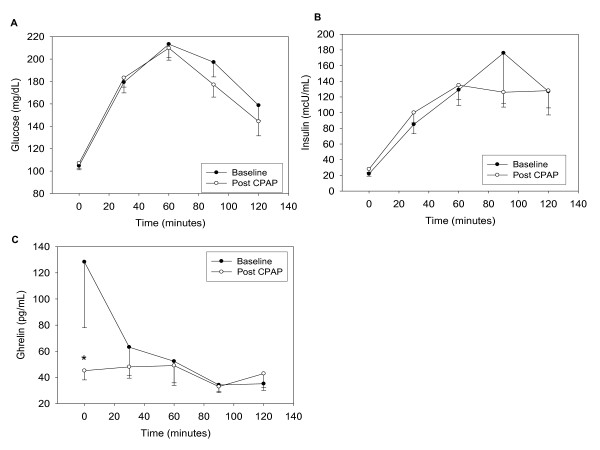
“37 mcmol/Kg × min [13] and ghrelin decreased by 38.”
BackgroundMethodResultInfluentialLee, J. H., Chan, J. L., Yiannakouris, N., Kontogianni, M., Estrada, E., Seip, R., Orlova, C., & Mantzoros, C. S. (2003) · The Journal of Clinical Endocrinology & Metabolism · doi:10.1210/jc.2003-030519 · Cited by 548
Diabetes and Sleep Disturbances
Resnick, H. E., Redline, S., Shahar, E., Gilpin, A., Newman, A., Walter, R., Ewy, G. A., Howard, B. V., & Punjabi, N. M. (2003) · Diabetes Care · doi:10.2337/diacare.26.3.702 · Cited by 504 · cited 1×
“Obesity is a strong risk factor for OSA [3] and both obesity and OSA are associated with increased insulin resistance and diabetes [4].”
BackgroundImpact of untreated obstructive sleep apnea on glucose control in type 2 diabetes
Aronsohn, R. S., Whitmore, H., Van Cauter, E., & Tasali, E. (2010) · American Journal of Respiratory and Critical Care Medicine · doi:10.1164/rccm.200909-1423oc · Cited by 453
Serum Leptin and Vascular Risk Factors in Obstructive Sleep Apnea
Ip, M. S. M., Lam, K. S. L., Ho, C.-M., Tsang, K. W. T., & Lam, W.-K. (2000) · Chest · doi:10.1378/chest.118.3.580 · Cited by 420
Leptin Prevents Respiratory Depression in Obesity
O'DONNELL, C. P., SCHAUB, C. D., HAINES, A. S., BERKOWITZ, D. E., TANKERSLEY, C. G., SCHWARTZ, A. R., & SMITH, P. L. (1999) · American Journal of Respiratory and Critical Care Medicine · doi:10.1164/ajrccm.159.5.9809025 · Cited by 396
Invited Review: Physiological consequences of intermittent hypoxia: systemic blood pressure
Fletcher, E. C. (2001) · Journal of Applied Physiology · doi:10.1152/jappl.2001.90.4.1600 · Cited by 378
The influence of insulin on circulating ghrelin
Flanagan, D. E., Evans, M. L., Monsod, T. P., Rife, F., Heptulla, R. A., Tamborlane, W. V., & Sherwin, R. S. (2003) · American Journal of Physiology-Endocrinology and Metabolism · doi:10.1152/ajpendo.00569.2001 · Cited by 367
Hedner, J., Darpo, B., Ejnell, H., Carlson, J., & Caidahl, K. (1995) · European Respiratory Journal · doi:10.1183/09031936.95.08020222 · Cited by 302
Ghrelin promotes slow-wave sleep in humans
Weikel, J. C., Wichniak, A., Ising, M., Brunner, H., Friess, E., Held, K., Mathias, S., Schmid, D. A., Uhr, M., & Steiger, A. (2003) · American Journal of Physiology-Endocrinology and Metabolism · doi:10.1152/ajpendo.00184.2002 · Cited by 291
Effect of Continuous Positive Airway Pressure on Blood Pressure: A Placebo Trial
Dimsdale, J. E., Loredo, J. S., & Profant, J. (2000) · Hypertension · doi:10.1161/01.hyp.35.1.144 · Cited by 287
Leptin and ghrelin levels in patients with obstructive sleep apnoea: effect of CPAP treatment
Harsch, I. A., Konturek, P. C., Koebnick, C., Kuehnlein, P. P., Fuchs, F. S., Pour Schahin, S., Wiest, G. H., Hahn, E. G., Lohmann, T., & Ficker, J. H. (2003) · European Respiratory Journal · doi:10.1183/09031936.03.00010103 · Cited by 286
McLaughlin, T., Abbasi, F., Lamendola, C., Frayo, R. S., & Cummings, D. E. (2004) · The Journal of Clinical Endocrinology & Metabolism · doi:10.1210/jc.2003-031572 · Cited by 274
Active Ghrelin Levels and Active to Total Ghrelin Ratio in Cancer-Induced Cachexia
Garcia, J. M., Garcia-Touza, M., Hijazi, R. A., Taffet, G., Epner, D., Mann, D., Smith, R. G., Cunningham, G. R., & Marcelli, M. (2005) · The Journal of Clinical Endocrinology & Metabolism · doi:10.1210/jc.2004-1788 · Cited by 260
Self-citationPrevalence of Sleep Apnea in a Population of Adults with Type 2 Diabetes Mellitus
Einhorn, D., Stewart, D. A., Erman, M. K., Gordon, N., Philis-Tsimikas, A., & Casal, E. (2007) · Endocrine Practice · doi:10.4158/ep.13.4.355 · Cited by 232 · cited 1×
“Several reports have demonstrated an association between OSA and insulin resistance [2,21-24].”
BackgroundInsulin, Unlike Food Intake, Does Not Suppress Ghrelin in Human Subjects
Caixas, A. (2002) · Journal of Clinical Endocrinology & Metabolism · doi:10.1210/jc.87.4.1902 · Cited by 211
Valsamakis, G., McTernan, P. G., Chetty, R., Al Daghri, N., Field, A., Hanif, W., Barnett, A. H., & Kumar, S. (2004) · Metabolism · doi:10.1016/j.metabol.2003.11.022 · Cited by 189
CPAP Therapy of Obstructive Sleep Apnea in Type 2 Diabetics Improves Glycemic Control During Sleep
Dawson, A., Abel, S. L., Loving, R. T., DAILEY, G. E., Shadan, F. F., CRONIN, J. W., Kripke, D. F., & Kline, L. E. (2008) · Journal of Clinical Sleep Medicine · doi:10.5664/jcsm.27347 · Cited by 156
Neuropeptide Y and Leptin in Patients with Obstructive Sleep Apnea Syndrome: Role of Obesity
Barceló, A., Barbé, F., Llompart, E., de la Peña, M., Durán-Cantolla, J., Ladaria, A., Bosch, M., Guerra, L., & Agustí, A. G. N. (2005) · American Journal of Respiratory and Critical Care Medicine · doi:10.1164/rccm.200405-579oc · Cited by 136
Engleman, H. M., Gough, K., Martin, S. E., Kingshott, R. N., Padfield, P. L., & Douglas, N. J. (1996) · Sleep · doi:10.1093/sleep/19.5.378 · Cited by 133
Leptin and Ghrelin Levels in Patients with Obstructive Sleep Apnea Syndrome
Ulukavak Ciftci, T., Kokturk, O., Bukan, N., & Bilgihan, A. (2005) · Respiration · doi:10.1159/000086254 · Cited by 127
Effects of obstructive sleep apnea syndrome on serum aminotransferase levels in obese patients
Chin, K., Nakamura, T., Takahashi, K. P., Sumi, K., Ogawa, Y., Masuzaki, H., Muro, S., Hattori, N., Matsumoto, H., Niimi, A., et al. (2003) · The American Journal of Medicine · doi:10.1016/s0002-9343(02)01570-x · Cited by 126
Çuhadaroğlu, Ç., Utkusavaş, A., Öztürk, L., Salman, S., & Ece, T. (2009) · Lung · doi:10.1007/s00408-008-9131-5 · Cited by 125
Obstructive sleep apnea: role in the risk and severity of diabetes
Pamidi, S., Aronsohn, R. S., & Tasali, E. (2010) · Best Practice & Research Clinical Endocrinology & Metabolism · doi:10.1016/j.beem.2010.08.009 · Cited by 121
Fagerberg, B., Hultén, L. M., & Hulthe, J. (2003) · Metabolism · doi:10.1016/s0026-0495(03)00274-9 · Cited by 108
Plasma Levels of Adiponectin, a Novel Adipocyte‐Derived Hormone, in Sleep Apnea**
Wolk, R., Svatikova, A., Nelson, C. A., Gami, A. S., Govender, K., Winnicki, M., & Somers, V. K. (2005) · Obesity Research · doi:10.1038/oby.2005.24 · Cited by 84
Pallayová, M., Donič, V., & Tomori, Z. (2008) · Diabetes Research and Clinical Practice · doi:10.1016/j.diabres.2008.03.012 · Cited by 77
Adiponectin in Patients with Obstructive Sleep Apnea Syndrome: Course and Physiological Relevance
Harsch, I. A., Wallaschofski, H., Koebnick, C., Pour Schahin, S., Hahn, E. G., Ficker, J. H., & Lohmann, T. (2004) · Respiration · doi:10.1159/000081758 · Cited by 60
Nasal CPAP and weight loss in hypertensive patients with obstructive sleep apnoea.
Rauscher, H., Formanek, D., Popp, W., & Zwick, H. (1993) · Thorax · doi:10.1136/thx.48.5.529 · Cited by 58 · cited 2×
“We did not observe any changes in blood pressure, or heart rate after CPAP treatment in contrast to what most [15-17] but not all studies [18-20] have reported.”
ResultSCHUESSLER, P., UHR, M., ISING, M., SCHMID, D., WEIKEL, J., & STEIGER, A. (2005) · Journal of Sleep Research · doi:10.1111/j.1365-2869.2005.00486.x · Cited by 52
Acylated ghrelin level in patients with OSA before and after nasal CPAP treatment
TAKAHASHI, K., CHIN, K., AKAMIZU, T., MORITA, S., SUMI, K., OGA, T., MATSUMOTO, H., NIIMI, A., TSUBOI, T., FUKUHARA, S., et al. (2008) · Respirology · doi:10.1111/j.1440-1843.2008.01357.x · Cited by 45
Serum adiponectin level in patients with obstructive sleep apnea hypopnea syndrome.
Zhang, X., Yin, K., Mao, H., Hong, W., & Yu, Y. (2004) · PubMed · Cited by 29
Cited by
International Consensus Statement on Obstructive Sleep Apnea
Chang, J. L., Goldberg, A. N., Alt, J. A., Mohammed, A., Ashbrook, L., Auckley, D., Ayappa, I., Bakhtiar, H., Barrera, J. E., Bartley, B. L., et al. (2023) · International Forum of Allergy & Rhinology · doi:10.1002/alr.23079 · Cited by 350
Drager, L. F., Brunoni, A. R., Jenner, R., Lorenzi-Filho, G., Bensenor, I. M., & Lotufo, P. A. (2015) · Thorax · doi:10.1136/thoraxjnl-2014-205361 · Cited by 277
Obstructive Sleep Apnea and Type 2 Diabetes: Is There a Link?
Pamidi, S., & Tasali, E. (2012) · Frontiers in Neurology · doi:10.3389/fneur.2012.00126 · Cited by 231
“…were negative (Saini et al., 1993; Cooper et al., 1995; Stoohs et al., 1996; Saarelainen et al., 1997; Ip et al., 2000; Smurra et al., 2001; Czupryniak et al., 2005; Trenell et al., 2007; Vgontzas et al., 2008; Carneiro et al., 2009; Comondore et al., 2009; Murri et al., 2009; Garcia et al., 2011).”
Morselli, L. L., Guyon, A., & Spiegel, K. (2012) · Pflügers Archiv - European Journal of Physiology · doi:10.1007/s00424-011-1053-z · Cited by 199
Role of sleep quality in the metabolic syndrome
Gozal, D., Dumin, M., & Koren, D. (2016) · Diabetes, Metabolic Syndrome and Obesity: Targets and Therapy · doi:10.2147/dmso.s95120 · Cited by 196
“ment (which appeared to be primarily due to CPAP-associated weight gain).(238) Recently, a randomized, parallel-group”
Metadata
- Authors
- Garcia, J. M., Sharafkhaneh, H., Hirshkowitz, M., Elkhatib, R., & Sharafkhaneh, A.
- Affiliations
- Baylor College of Medicine (US)
- Michael E. DeBakey VA Medical Center (US)
- Corresponding author
- Sharafkhaneh, Amir
- Venue
- Respiratory Research
- Published
- 2011-12
- Volume
- 12
- Issue
- 1
- Pages
- 80-80
- ISSN
- 1465-9921 (ISSN-L)
- 1465-993X
- PMC
- PMC3146428
- OpenAlex
- W2158839902
- Semantic Scholar
- f9d3d5994d201c7431584cacf6d6c48aaac7b2c2
- Cited by
- 75
- References
- 47
- Citations by year
- 2026: 1 · 2025: 3 · 2024: 2 · 2023: 2 · 2022: 7 · 2021: 1 · 2020: 5 · 2019: 3 · 2018: 4 · 2017: 1 · 2016: 12 · 2015: 8 · 2014: 13 · 2013: 3 · 2012: 7
- FWCI
- 5.67
- Type
- journal article
- Language
- en
- Open access
- gold
- doi.org
- Licence
- Locations
- Respiratory Research (publishedVersion, cc-by)
- Europe PMC (PubMed Central) (publishedVersion, cc-by)
- PubMed Central (publishedVersion, cc-by)
- PubMed (publishedVersion)
- DOAJ (DOAJ: Directory of Open Access Journals) (submittedVersion)
- Funders
- U.S. Department of Veterans Affairs
- National Institutes of Health (NIH K12)
- Topics
- Health Sciences › Medicine › Physiology (medical) › Obstructive Sleep Apnea Research
- Health Sciences › Medicine › Endocrinology, Diabetes and Metabolism › Adipokines, Inflammation, and Metabolic Diseases
- Life Sciences › Neuroscience › Endocrine and Autonomic Systems › Regulation of Appetite and Obesity
- Keywords
- obstructive sleep apnea, obesity, continuous positive airway pressure, insulin resistance, ghrelin, leptin, adiponectin, resistin, weight change, hypoxia, glucose regulation, appetite-regulating hormones
- MeSH terms
- Appetite Regulation, Blood Glucose, Body Weight, Female, Humans, Insulin, Insulin Resistance, Male, Middle Aged, Obesity, Sleep, Texas, Time Factors, Biomarkers, Chi-Square Distribution, Linear Models, Treatment Outcome, Sleep Apnea, Obstructive, Continuous Positive Airway Pressure, Adiponectin, Resistin, Ghrelin
About these checks
Registry, retraction, Cites and statistics results are computed, not judged, with one exception: a printed reference that no index lists is read once by a model before it counts as a citation error. Claims are extracted by a model and kept only when their quote appears verbatim in the text; each cited source is then checked, with a model’s help, for whether it says what the claim relies on. Those verdicts can be wrong — read the claim’s quote and the cited source before relying on one.
Statistics and arithmetic are recomputed, not judged.
Confidence bands are shown only for fields calibrated on our annotated test set. None is calibrated yet, so no band is shown.
What counts as a claim ›How we measure confidence ›How we check this ›
Are you an author, or do you see a problem with this page? Request a review
Data sources
Bibliographic data: Semantic Scholar, OpenAlex, Crossref.
Contains information from the Semantic Scholar Academic Graph Datasets, made available under the ODC Attribution License (ODC-BY 1.0).
Semantic Scholar’s data is described in: Kinney, R., et al. (2023). The Semantic Scholar Open Data Platform. arXiv:2301.10140.
