

The DOI matches its Crossref record; 20 of the 20 references it cites were found in a registry or an index.
GOrilla: a tool for discovery and visualization of enriched GO terms in ranked gene lists
Open accessAbstract
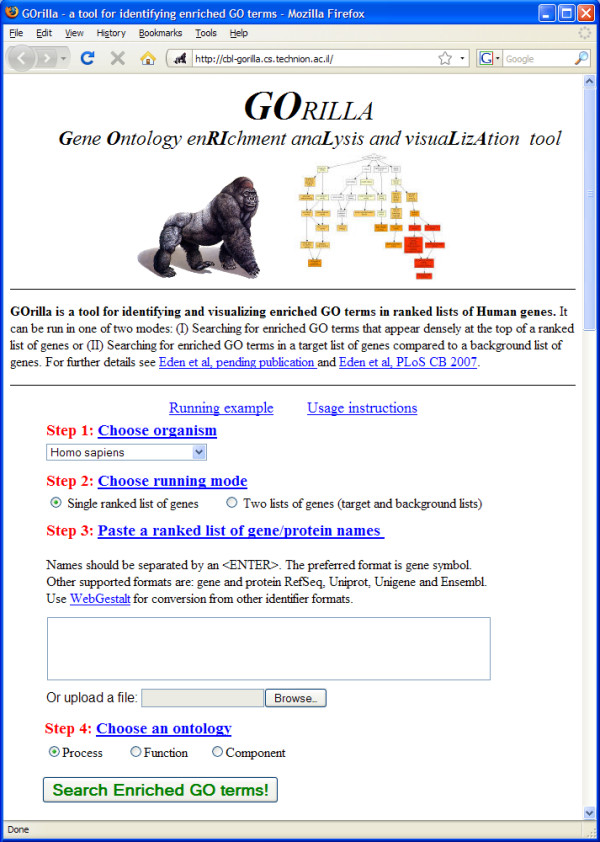
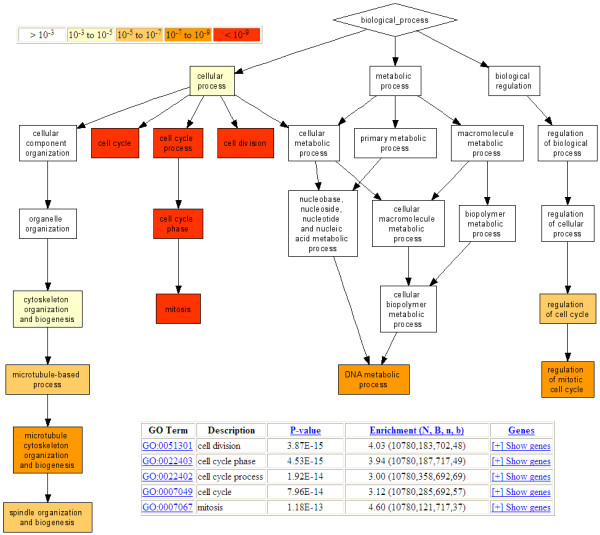
BACKGROUND: Since the inception of the GO annotation project, a variety of tools have been developed that support exploring and searching the GO database. In particular, a variety of tools that perform GO enrichment analysis are currently available. Most of these tools require as input a target set of genes and a background set and seek enrichment in the target set compared to the background set. A few tools also exist that support analyzing ranked lists. The latter typically rely on simulations or on union-bound correction for assigning statistical significance to the results. RESULTS: GOrilla is a web-based application that identifies enriched GO terms in ranked lists of genes, without requiring the user to provide explicit target and background sets. This is particularly useful in many typical cases where genomic data may be naturally represented as a ranked list of genes (e.g. by level of expression or of differential expression). GOrilla employs a flexible threshold statistical approach to discover GO terms that are significantly enriched at the top of a ranked gene list. Building on a complete theoretical characterization of the underlying distribution, called mHG, GOrilla computes an exact p-value for the observed enrichment, taking threshold multiple testing into account without the need for simulations. This enables rigorous statistical analysis of thousand of genes and thousands of GO terms in order of seconds. The output of the enrichment analysis is visualized as a hierarchical structure, providing a clear view of the relations between enriched GO terms. CONCLUSION: GOrilla is an efficient GO analysis tool with unique features that make a useful addition to the existing repertoire of GO enrichment tools. GOrilla's unique features and advantages over other threshold free enrichment tools include rigorous statistics, fast running time and an effective graphical representation. GOrilla is publicly available at: http://cbl-gorilla.cs.technion.ac.il
Overview
The claims and statistics of this paper haven’t been checked yet.
Run the check — free, no account needed. It reads the open-access text and checks the sources it cites.
Integrity signals
Registry
Cites
Statistics
Figures
Verification
Claims the paper makes
The claims and statistics of this paper haven’t been checked yet.
Run the check — free, no account needed. It reads the open-access text and checks the sources it cites.
Claims other papers make about this one
Each is checked against this paper’s own text: does it say what the citing paper says it does?
The source backs part of the claim, not all of it — or backs it for a different population, condition or comparison.
In the citing paper
“Biological ontologies are large hierarchies which also have a DAG structure; as such, existing tools for visualizing ontologies can also have direct application to data-driven multiscale models (Binns et al., 2009; Eden et al., 2009; Sealfon et al., 2006; Supek et al., 2011; Zhu et al., 2019).”
From Mapping the multiscale structure of biological systems (2021) · cites this paper as Eden et al., 2009
Experimental — accuracy not yet measuredThe cited source says what the claim attributes to it.
In the citing paper
“GO term analysis (33) indicated significant enrichment of only one process (P-value = 5.2E-5; false discovery rate = 6.3E-2): regulators of calcineurin (CNB1, RCN1), a well-studied Ca2+/calmodulin-dependent protein phosphatase.”
From Echinocandin tolerance and persistence in vitro are regulated by calcineurin signaling in Candida glabrata (2026) · cites this paper as [33]
The cited source says what the claim attributes to it.
In the citing paper
“These were enriched for specialized programs across ages: Embryonic epithelia upregulated genes for developmental processes (Figure 3K, S3K), while aged epithelia upregulated host-defense programs (Figure 3L, FDR q-value < 0.01, GOrilla (Eden et al., 2007, 2009;Baruch et al., 2014).”
From A cellular and spatial map of the choroid plexus across brain ventricles and ages (2021) · cites this paper as Eden et al., 2009
In the citing paper
“We employed GOrilla (Eden et al. , 2009) on the genes ranked according to the LFC along the genotype -axis and along the Aβ -axis, and identified 13 functional super categories (Figure S3A, Table S2).”
From Spatial Transcriptomics and In Situ Sequencing to Study Alzheimer’s Disease (2020) · cites this paper as Eden et al., 2009
Self-check
Percentages, sums and reported differences re-computed from the paper’s own numbers.
The self-check needs the paper’s full text.
Citations
Cites
Subramanian, A., Tamayo, P., Mootha, V. K., Mukherjee, S., Ebert, B. L., Gillette, M. A., Paulovich, A., Pomeroy, S. L., Golub, T. R., Lander, E. S., et al. (2005) · Proceedings of the National Academy of Sciences · doi:10.1073/pnas.0506580102 · Cited by 53,625
Gene Ontology: tool for the unification of biology
Ashburner, M., Ball, C. A., Blake, J. A., Botstein, D., Butler, H., Cherry, J. M., Davis, A. P., Dolinski, K., Dwight, S. S., Eppig, J. T., et al. (2000) · Nature Genetics · doi:10.1038/75556 · Cited by 43,206
Gene expression profiling predicts clinical outcome of breast cancer
van 't Veer, L. J., Dai, H., van de Vijver, M. J., He, Y. D., Hart, A. A. M., Mao, M., Peterse, H. L., van der Kooy, K., Marton, M. J., Witteveen, A. T., et al. (2002) · Nature · doi:10.1038/415530a · Cited by 9,536
DAVID: Database for Annotation, Visualization, and Integrated Discovery
Dennis, G., Sherman, B. T., Hosack, D. A., Yang, J., Gao, W., Lane, H. C., & Lempicki, R. A. (2003) · Genome Biology · doi:10.1186/gb-2003-4-5-p3 · Cited by 9,327
Maere, S., Heymans, K., & Kuiper, M. T. R. (2005) · Computer applications in the biosciences · doi:10.1093/bioinformatics/bti551 · Cited by 4,163
Boyle, E. I., Weng, S., Gollub, J., Jin, H., Botstein, D., Cherry, J. M., & Sherlock, G. (2004) · Bioinformatics · doi:10.1093/bioinformatics/bth456 · Cited by 2,067
GOstat: find statistically overrepresented Gene Ontologies within a group of genes
Beißbarth, T., & Speed, T. P. (2004) · Bioinformatics · doi:10.1093/bioinformatics/bth088 · Cited by 1,256
GoMiner: a resource for biological interpretation of genomic and proteomic data
Zeebèrg, B. R., Feng, W., Wang, G., Wang, M. D., Fojo, A. T., Sunshine, M., Narasimhan, S., Kane, D. W., Reinhold, W. C., Lababidi, S., et al. (2003) · Genome biology · doi:10.1186/gb-2003-4-4-r28 · Cited by 1,198
FatiGO: a web tool for finding significant associations of Gene Ontology terms with groups of genes
Al‐Shahrour, F., Díaz‐Uriarte, R., & Dopazo, J. (2004) · Bioinformatics · doi:10.1093/bioinformatics/btg455 · Cited by 1,135
Ontological analysis of gene expression data: current tools, limitations, and open problems
Khatri, P., & Drăghici, S. (2005) · Bioinformatics · doi:10.1093/bioinformatics/bti565 · Cited by 850
Research works printed but not linked: 1
- Eden E: Discovering Motifs in Ranked Lists of DNA Sequences. Master's thesis [ http://bioinfo.cs.technion.ac.il/people/zohar/thesis/eran.pdf ]
Cited by
Sorted by citations
Items 101–117 of 117
GO-PCA: An Unsupervised Method to Explore Gene Expression Data Using Prior Knowledge
Wagner, F. (2015) · PLOS ONE · doi:10.1371/journal.pone.0143196 · Cited by 35
Butler, V. J., Gao, F., Corrales, C. I., Cortopassi, W. A., Caballero, B., Vohra, M., Ashrafi, K., Cuervo, A. M., Jacobson, M. P., Coppola, G., et al. (2019) · PLOS Genetics · doi:10.1371/journal.pgen.1008295 · Cited by 39
Pentón-Rol, G., Lagumersindez-Denis, N., Muzio, L., Bergami, A., Furlan, R., Fernández-Massó, J. R., Nazabal-Galvez, M., Llópiz-Arzuaga, A., Herrera-Rolo, T., Veliz-Rodriguez, T., et al. (2016) · Journal of Neuroimmune Pharmacology · doi:10.1007/s11481-015-9642-9 · Cited by 36
Genome-wide DNA methylation in suicide victims revealing impact on gene expression
Kouter, K., Zupanc, T., & Videtič Paska, A. (2019) · Journal of Affective Disorders · doi:10.1016/j.jad.2019.04.077 · Cited by 36
Fuglerud, B. M., Lemma, R. B., Wanichawan, P., Sundaram, A. Y. M., Eskeland, R., & Gabrielsen, O. S. (2017) · Nucleic Acids Research · doi:10.1093/nar/gkx364 · Cited by 36
Genome-scale CRISPR screening for modifiers of cellular LDL uptake
Emmer, B. T., Sherman, E. J., Lascuna, P. J., Graham, S. E., Willer, C. J., & Ginsburg, D. (2021) · PLOS Genetics · doi:10.1371/journal.pgen.1009285 · Cited by 32
A code for transcription elongation speed
Cohen, E., Zafrir, Z., & Tuller, T. (2018) · RNA Biology · doi:10.1080/15476286.2017.1384118 · Cited by 29
MONET: Multi-omic module discovery by omic selection
Rappoport, N., Safra, R., & Shamir, R. (2020) · PLoS Computational Biology · doi:10.1371/journal.pcbi.1008182 · Cited by 26
Yang, J., Guo, F., Chin, H. S., Chen, G. B., Ang, C. H., Lin, Q., Hong, W., & Fu, N. Y. (2023) · Cell Reports · doi:10.1016/j.celrep.2023.112065 · Cited by 22
Transcriptomes of antigen presenting cells in human thymus
Gabrielsen, I. S. M., Helgeland, H., Akselsen, H., D. Aass, H. C., Sundaram, A. Y. M., Snowhite, I. V., Pugliese, A., Flåm, S. T., & Lie, B. A. (2019) · PLOS ONE · doi:10.1371/journal.pone.0218858 · Cited by 21
Han, X., Maharjan, S., Chen, J., Zhao, Y., Qi, Y., White, L. E., Johnson, G. A., & Wang, N. (2024) · NeuroImage · doi:10.1016/j.neuroimage.2024.120734 · Cited by 15
Payen, C., Guillot, A., Paillat, L., Fothi, A., Dib, A., Bourreau, J., Schmitt, F., Loufrani, L., Aranyi, T., Henrion, D., et al. (2021) · International Journal of Obesity · doi:10.1038/s41366-021-00777-7 · Cited by 12
FURIN regulates cytotoxic T-lymphocyte effector function and memory cell transition in mice
Ojanen, M. J. T., Caro, F. M., Aittomäki, S., Ploquin, M. J., Ortutay, Z., Pekkarinen, M., Kesseli, J., Vähätupa, M., Määttä, J., Nykter, M., et al. (2023) · European Journal of Immunology · doi:10.1002/eji.202250246 · Cited by 10
HIV-1 Vpr combats the PU.1-driven antiviral response in primary human macrophages
Virgilio, M. C., Ramnani, B., Chen, T., Disbennett, W. M., Lubow, J., Welch, J. D., & Collins, K. L. (2024) · Nature Communications · doi:10.1038/s41467-024-49635-w · Cited by 14
Bauduin, S. E. E. C., den Rooijen, I. L. B., Meijer, M., van der Werff, S. J. A., Keo, A., Dzyubachyk, O., Pereira, A. M., Giltay, E. J., van der Wee, N. J. A., Meijer, O. C., et al. (2021) · Psychoneuroendocrinology · doi:10.1016/j.psyneuen.2021.105334 · Cited by 9
Harrington, A. A., Nickels, T. J., & Cunningham, K. W. (2026) · mBio · doi:10.1128/mbio.02546-25 · Cited by 4
Li, Q., Nichols, C., Welner, R. S., Chen, J. Y., Ku, W.-S., & Yue, Z. (2026) · Briefings in Bioinformatics · doi:10.1093/bib/bbag244
Metadata
- Authors
- Eden, E., Navon, R., Steinfeld, I., Lipson, D., & Yakhini, Z.
- Affiliations
- Weizmann Institute of Science (IL)
- Tel Aviv University (IL)
- Technion – Israel Institute of Technology (IL)
- Corresponding author
- Eden, Eran
- Navon, Roy
- Venue
- BMC Bioinformatics
- Published
- 2009-02-03
- Volume
- 10
- Issue
- 1
- Pages
- 48-48
- ISSN
- 1471-2105 (ISSN-L)
- PMC
- PMC2644678
- OpenAlex
- W2038963685
- Cited by
- 3,356
- References
- 20
- Citations by year
- 2026: 64 · 2025: 135 · 2024: 169 · 2023: 213 · 2022: 274 · 2021: 409 · 2020: 305 · 2019: 319 · 2018: 300 · 2017: 251 · 2016: 242 · 2015: 217 · 2014: 168 · 2013: 138 · 2012: 67
- FWCI
- 20.15
- Type
- journal article
- Language
- en
- Open access
- gold
- doi.org
- Licence
- Locations
- BMC Bioinformatics (publishedVersion, cc-by)
- PubMed Central (publishedVersion, cc-by)
- PubMed (publishedVersion)
- DOAJ (DOAJ: Directory of Open Access Journals) (submittedVersion)
- Funders
- European Commission
- Topics
- Life Sciences › Biochemistry, Genetics and Molecular Biology › Molecular Biology › Bioinformatics and Genomic Networks
- Life Sciences › Biochemistry, Genetics and Molecular Biology › Molecular Biology › Genomics and Phylogenetic Studies
- Health Sciences › Medicine › Health Informatics › Biomedical Text Mining and Ontologies
- Keywords
- gorillas, gene ontology enrichment, exact p-values, web-based bioinformatics tool, differential gene expression
- MeSH terms
- Algorithms, Animals, Data Interpretation, Statistical, Genes, Humans, Models, Genetic, Terminology as Topic, Software, User-Computer Interface, Yeasts, Models, Statistical, Information Storage and Retrieval, Arabidopsis, Computational Biology, Internet, Gene Expression Profiling, Genomics, Databases, Genetic
About these checks
Registry, retraction, Cites and statistics results are computed, not judged, with one exception: a printed reference that no index lists is read once by a model before it counts as a citation error. Claims are extracted by a model and kept only when their quote appears verbatim in the text; each cited source is then checked, with a model’s help, for whether it says what the claim relies on. Those verdicts can be wrong — read the claim’s quote and the cited source before relying on one.
Statistics and arithmetic are recomputed, not judged.
Confidence bands are shown only for fields calibrated on our annotated test set. None is calibrated yet, so no band is shown.
What counts as a claim ›How we measure confidence ›How we check this ›
Are you an author, or do you see a problem with this page? Request a review
