

TimeDelay-ARACNE: Reverse engineering of gene networks from time-course data by an information theoretic approach
Open accessThe DOI matches its Crossref record; 72 of the 73 references it cites were found in a registry or an index, and 1 are not checked yet.
Abstract
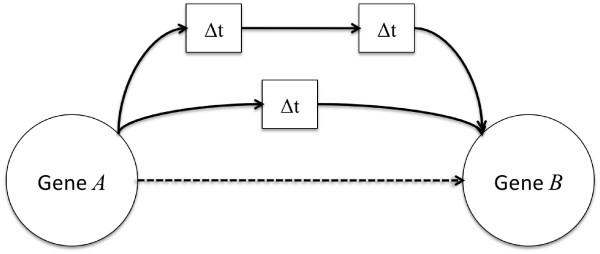
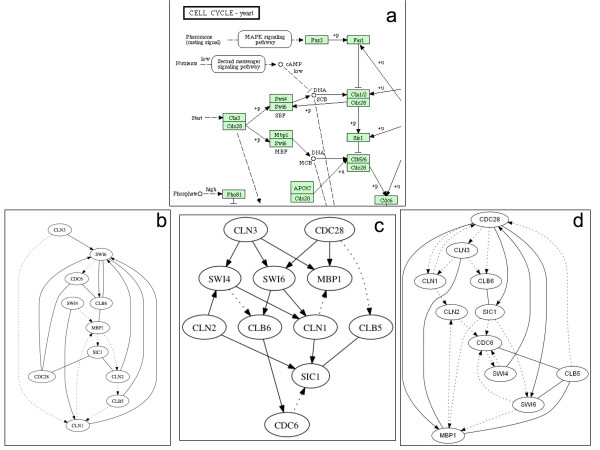
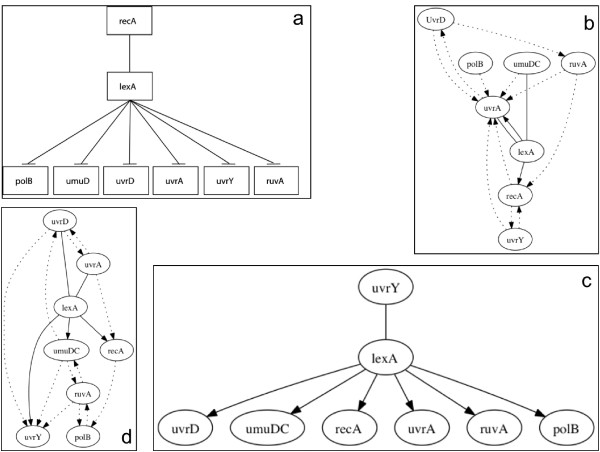
Background: One of main aims of Molecular Biology is the gain of knowledge about how molecular components interact each other and to understand gene function regulations. Using microarray technology, it is possible to extract measurements of thousands of genes into a single analysis step having a picture of the cell gene expression. Several methods have been developed to infer gene networks from steady-state data, much less literature is produced about time-course data, so the development of algorithms to infer gene networks from time-series measurements is a current challenge into bioinformatics research area. In order to detect dependencies between genes at different time delays, we propose an approach to infer gene regulatory networks from time-series measurements starting from a well known algorithm based on information theory. Results: In this paper we show how the ARACNE (Algorithm for the Reconstruction of Accurate Cellular Networks) algorithm can be used for gene regulatory network inference in the case of time-course expression profiles. The resulting method is called TimeDelay-ARACNE. It just tries to extract dependencies between two genes at different time delays, providing a measure of these dependencies in terms of mutual information. The basic idea of the proposed algorithm is to detect time-delayed dependencies between the expression profiles by assuming as underlying probabilistic model a stationary Markov Random Field. Less informative dependencies are filtered out using an auto calculated threshold, retaining most reliable connections. TimeDelay-ARACNE can infer small local networks of time regulated gene-gene interactions detecting their versus and also discovering cyclic interactions also when only a medium-small number of measurements are available. We test the algorithm both on synthetic networks and on microarray expression profiles. Microarray measurements concern S. cerevisiae cell cycle,E. coli SOS pathways and a recently developed network for in vivo assessment of reverse engineering algorithms. Our results are compared with ARACNE itself and with the ones of two previously published algorithms: Dynamic Bayesian Networks and systems of ODEs, showing that TimeDelay-ARACNE has good accuracy, recall and F-score for the network reconstruction task. Conclusions: Here we report the adaptation of the ARACNE algorithm to infer gene regulatory networks from time-course data, so that, the resulting network is represented as a directed graph. The proposed algorithm is expected to be useful in reconstruction of small biological directed networks from time course data.
Overview
The claims and statistics of this paper haven’t been checked yet.
Free: it reads the open-access text and checks the first 5 claims that cite a source we can check. Create a free account to check every claim.
Integrity signals
Registry
Cites
Statistics
Figures
Verification
Claims the paper makes
The claims and statistics of this paper haven’t been checked yet.
Free: it reads the open-access text and checks the first 5 claims that cite a source we can check. Create a free account to check every claim.
Claims other papers make about this one
Each is checked against this paper’s own text: does it say what the citing paper says it does?
The source backs part of the claim, not all of it — or backs it for a different population, condition or comparison.
In the citing paper
“edge relationships using mutual information or other association measures might be necessary to accurately detect modules in time-series data, which can be non-monotonic46–48.”
From Systems biology and gene networks in neurodevelopmental and neurodegenerative disorders (2015) · cites this paper as [48]
Experimental — accuracy not yet measuredThe cited source says what the claim attributes to it.
In the citing paper
“However, in the years following that statement some progress was made, and some information-theoretic methods capable of recovering directions are already available [69,82].”
From Reverse engineering and identification in systems biology: strategies, perspectives and challenges (2014) · cites this paper as [69]
In the citing paper
“A time-delay version of ARACNE, which is especially suited for time-course data, is also available [69].”
From Reverse engineering and identification in systems biology: strategies, perspectives and challenges (2014) · cites this paper as [69]
Self-check
Percentages, sums and reported differences re-computed from the paper’s own numbers.
The self-check needs the paper’s full text.
Citations
Cites
An Introduction to the Bootstrap
Efron, B., & Tibshirani, R. J. (1994) · doi:10.1201/9780429246593 · Cited by 40,500
KEGG: Kyoto Encyclopedia of Genes and Genomes
Kanehisa, M. (2000) · Nucleic Acids Research · doi:10.1093/nar/28.1.27 · Cited by 37,077
Elements of Information Theory
Cover, T. M., & Thomas, J. A. (2001) · Wiley eBooks · doi:10.1002/0471200611 · Cited by 36,808
KEGG: Kyoto Encyclopedia of Genes and Genomes
Ogata, H., Goto, S., Sato, K., Fujibuchi, W., Bono, H., & Kanehisa, M. (1999) · Nucleic Acids Research · doi:10.1093/nar/27.1.29 · Cited by 31,232
An Introduction to the Bootstrap
Efron, B., & Tibshirani, R. J. (1993) · doi:10.1007/978-1-4899-4541-9 · Cited by 21,230
Nelsen, R. B. (1999) · Lecture Notes in Statistics · doi:10.1007/978-1-4757-3076-0 · Cited by 7,744
Bootstrap Methods and their Application
Davison, A. C., & Hinkley, D. V. (1997) · doi:10.1017/cbo9780511802843 · Cited by 7,350
New Introduction to Multiple Time Series Analysis
Lütkepohl, H. (2005) · Springer eBooks · doi:10.1007/978-3-540-27752-1 · Cited by 5,918
Bootstrap Methods and Their Application
Loughin, T. M., Davison, A. C., & Hinkley, D. V. (1999) · Journal of the American Statistical Association · doi:10.2307/2669707 · Cited by 5,418
Spellman, P. T., Sherlock, G., Zhang, M. Q., Iyer, V. R., Anders, K., Eisen, M. B., Brown, P. O., Botstein, D., & Futcher, B. (1998) · Molecular Biology of the Cell · doi:10.1091/mbc.9.12.3273 · Cited by 4,722
The Jackknife and the Bootstrap for General Stationary Observations
Kunsch, H. R. (1989) · The Annals of Statistics · doi:10.1214/aos/1176347265 · Cited by 3,342
Using Bayesian Networks to Analyze Expression Data
Friedman, N., Linial, M., Nachman, I., & Pe'er, D. (2000) · Journal of Computational Biology · doi:10.1089/106652700750050961 · Cited by 3,266
Wand, M. P., & Jones, M. C. (1995) · Springer eBooks · doi:10.1007/978-1-4899-4493-1 · Cited by 2,663
Politis, D. N., & Romano, J. P. (1994) · Journal of the American Statistical Association · doi:10.1080/01621459.1994.10476870 · Cited by 2,649 · cited 1×
“The blocks may be non-overlapping [51,55] or overlapping [56,57] The bootstrap sample is obtained by sampling blocks randomly with replacement and laying them end-to-end in the order samples.”
Margolin, A. A., Nemenman, I., Basso, K., Wiggins, C., Stolovitzky, G., Favera, R. D., & Califano, A. (2006) · BMC Bioinformatics · doi:10.1186/1471-2105-7-s1-s7 · Cited by 2,420
Margolin, A. A., Nemenman, I. M., Basso, K., Wiggins, C. H., Stolovitzky, G. A., Favera, R. D., & Califano, A. (2006) · BMC Bioinformatics · doi:10.7916/d8g15zbp · Cited by 2,246
Rue, H., & Held, L. (2005) · Chapman & Hall/CRC eBooks · doi:10.1201/9780203492024 · Cited by 1,823
Probabilistic Boolean networks: a rule-based uncertainty model for gene regulatory networks
Shmulevich, I., Dougherty, E. R., Kim, S., & Zhang, W. (2002) · Bioinformatics · doi:10.1093/bioinformatics/18.2.261 · Cited by 1,608
Faith, J. J., Hayete, B., Thaden, J. T., Mogno, I., Wierzbowski, J., Cottarel, G., Kasif, S., Collins, J. J., & Gardner, T. S. (2007) · PLoS Biology · doi:10.1371/journal.pbio.0050008 · Cited by 1,563
(2017) · Encyclopedia of Machine Learning and Data Mining · doi:10.1007/978-1-4899-7687-1_100245 · Cited by 1,424
Reverse engineering of regulatory networks in human B cells
Basso, K., Margolin, A. A., Stolovitzky, G., Klein, U., Dalla-Favera, R., & Califano, A. (2005) · Nature Genetics · doi:10.1038/ng1532 · Cited by 1,404
Gaussian Markov Random Fields: Theory and Applications
Rue, H., & Held, L. (2005) · Thammasat University Digital Collections · Cited by 1,240
Resampling Methods for Dependent Data
Lahiri, S. N. (2003) · Springer Series in Statistics · doi:10.1007/978-1-4757-3803-2 · Cited by 1,015
BUTTE, A. J., & KOHANE, I. S. (1999) · Biocomputing 2000 · doi:10.1142/9789814447331_0040 · Cited by 945
An empirical Bayes approach to inferring large-scale gene association networks
Schäfer, J., & Strimmer, K. (2005) · Bioinformatics · doi:10.1093/bioinformatics/bti062 · Cited by 795
Carlstein, E. (1986) · The Annals of Statistics · doi:10.1214/aos/1176350057 · Cited by 768
How to infer gene networks from expression profiles
Bansal, M., Belcastro, V., Ambesi‐Impiombato, A., & di Bernardo, D. (2007) · Molecular Systems Biology · doi:10.1038/msb4100120 · Cited by 766
Yu, J., Smith, V. A., Wang, P. P., Hartemink, A. J., & Jarvis, E. D. (2004) · Bioinformatics · doi:10.1093/bioinformatics/bth448 · Cited by 675 · cited 1×
“TimeDelay-ARACNE was evaluated first alone than against ARACNE, dynamical Bayesian Networks implemented in the Banjo package [28] (a software application and framework for structure learning of static and dynamic Bayesian networks) and ODE implemented in the TSNI package [29] (Time Series Network…”
Computational studies of gene regulatory networks: in numero molecular biology
Hasty, J., McMillen, D., Isaacs, F., & Collins, J. J. (2001) · Nature Reviews Genetics · doi:10.1038/35066056 · Cited by 587
Zou, M., & Conzen, S. D. (2005) · Bioinformatics · doi:10.1093/bioinformatics/bth463 · Cited by 587 · cited 4×
“In the recent literature several dynamic models, such as Probabilistic Boolean Networks (PBN) [15]; Dynamic Bayesian Networks (DBN) [ 7 ]; Hidden Markov Model (HMM) [16] Kalfman filters [17]; Ordinary Differential Equations (ODEs) [4,18]; pattern recognition approaches [19]; signal processing approaches [20], model-fr…”
InfluentialIdentification of additional genes belonging to the LexA regulon in Escherichia coli
Fernández de Henestrosa, A. R., Ogi, T., Aoyagi, S., Chafin, D., Hayes, J. J., Ohmori, H., & Woodgate, R. (2000) · Molecular Microbiology · doi:10.1046/j.1365-2958.2000.01826.x · Cited by 570
Ronen, M., Rosenberg, R., Shraiman, B. I., & Alon, U. (2002) · Proceedings of the National Academy of Sciences · doi:10.1073/pnas.152046799 · Cited by 532
Control of the yeast cell cycle by the Cdc28 protein kinase
Nasmyth, K. (1993) · Current Opinion in Cell Biology · doi:10.1016/0955-0674(93)90099-c · Cited by 486
Pacific Symposium on Biocomputing 2002/2003/2004
Dunker, A. K. (2004) · doi:10.2172/833844 · Cited by 482
Politis, D. N., & Romano, J. P. (1994) · Journal of the American Statistical Association · doi:10.2307/2290993 · Cited by 468
Cluster analysis of gene expression dynamics
Ramoni, M. F., Sebastiani, P., & Kohane, I. S. (2002) · Proceedings of the National Academy of Sciences · doi:10.1073/pnas.132656399 · Cited by 465
Estimation of copula-based semiparametric time series models
Chen, X., & Fan, Y. (2006) · Journal of Econometrics · doi:10.1016/j.jeconom.2005.03.004 · Cited by 435
Gaussian Markov Random Fields: Theory and Applications
Picka, J. D. (2006) · Technometrics · doi:10.1198/tech.2006.s352 · Cited by 383
Bansal, M., Gatta, G. D., & di Bernardo, D. (2006) · Bioinformatics · doi:10.1093/bioinformatics/btl003 · Cited by 382
A Yeast Synthetic Network for In Vivo Assessment of Reverse-Engineering and Modeling Approaches
Cantone, I., Marucci, L., Iorio, F., Ricci, M. A., Belcastro, V., Bansal, M., Santini, S., di Bernardo, M., di Bernardo, D., & Cosma, M. P. (2009) · Cell · doi:10.1016/j.cell.2009.01.055 · Cited by 376
Hausser, J., & Strimmer, K. (2008) · arXiv (Cornell University) · doi:10.48550/arxiv.0811.3579 · Cited by 356
THE SOS RESPONSE: Recent Insights into umuDC-Dependent Mutagenesis and DNA Damage Tolerance
Sutton, M. D., Smith, B. T., Godoy, V. G., & Walker, G. C. (2000) · Annual Review of Genetics · doi:10.1146/annurev.genet.34.1.479 · Cited by 318
Modular Construction of Time-Delay Neural Networks for Speech Recognition
Waibel, A. (1989) · Neural Computation · doi:10.1162/neco.1989.1.1.39 · Cited by 316
Dynamic modeling of gene expression data
Holter, N. S., Maritan, A., Cieplak, M., Fedoroff, N. V., & Banavar, J. R. (2001) · Proceedings of the National Academy of Sciences · doi:10.1073/pnas.98.4.1693 · Cited by 300
Bootstrap Methods for Time Series
Härdle, W., Horowitz, J., & Kreiss, J. (2003) · International Statistical Review · doi:10.1111/j.1751-5823.2003.tb00485.x · Cited by 294
Information-Theoretic Inference of Large Transcriptional Regulatory Networks
Meyer, P. E., Kontos, K., Lafitte, F., & Bontempi, G. (2007) · EURASIP Journal on Bioinformatics and Systems Biology · doi:10.1155/2007/79879 · Cited by 273
Using hidden Markov models to analyze gene expression time course data
Schliep, A., Schönhuth, A., & Steinhoff, C. (2003) · Bioinformatics · doi:10.1093/bioinformatics/btg1036 · Cited by 246
Reverse-engineering transcription control networks
GARDNER, T., & FAITH, J. (2005) · Physics of Life Reviews · doi:10.1016/j.plrev.2005.01.001 · Cited by 234
Neapolitan, R. E. (2007) · Proceedings of the 13th ACM SIGKDD international conference on Knowledge discovery and data mining · doi:10.1145/1281192.1327961 · Cited by 230
Hall, P. (1985) · Stochastic Processes and their Applications · doi:10.1016/0304-4149(85)90212-1 · Cited by 225
Entropy and Inference, Revisited
Nemenman, I., Shafee, F., & Bialek, W. (2002) · Advances in Neural Information Processing Systems 14 · doi:10.7551/mitpress/1120.003.0065 · Cited by 211
Semple, J. I., Vavouri, T., & Lehner, B. (2008) · BMC Systems Biology · doi:10.1186/1752-0509-2-1 · Cited by 153
Zhao, W., Serpedin, E., & Dougherty, E. R. (2006) · Bioinformatics · doi:10.1093/bioinformatics/btl364 · Cited by 149
Opgen-Rhein, R., & Strimmer, K. (2007) · BMC Bioinformatics · doi:10.1186/1471-2105-8-s2-s3 · Cited by 149
Starting the cell cycle: what's the point?
Cross, F. R. (1995) · Current Opinion in Cell Biology · doi:10.1016/0955-0674(95)80062-x · Cited by 146
Causality and pathway search in microarray time series experiment
Mukhopadhyay, N. D., & Chatterjee, S. (2006) · Bioinformatics · doi:10.1093/bioinformatics/btl598 · Cited by 124
Asymptotic theory for bootstrap methods in statistics
Beran, R. J., & Ducharme, G. R. (1991) · HAL · Cited by 119
Inferring Connectivity of Genetic Regulatory Networks Using Information-Theoretic Criteria
Zhao, W., Serpedin, E., & Dougherty, E. R. (2008) · IEEE Transactions on Computational Biology and Bioinformatics · doi:10.1109/tcbb.2007.1067 · Cited by 92
Discovery of time-delayed gene regulatory networks based on temporal gene expression profiling
Li, X., Rao, S., Jiang, W., Li, C., Xiao, Y., Guo, Z., Zhang, Q., Wang, L., Du, L., Li, J., et al. (2006) · BMC Bioinformatics · doi:10.1186/1471-2105-7-26 · Cited by 91
Siegmund, R. F., & Nasmyth, K. (1996) · Molecular and Cellular Biology · doi:10.1128/mcb.16.6.2647 · Cited by 88
Nonparametric Calibration for Age Estimation
Lucy, D., Aykroyd, R. G., & Pollard, A. M. (2002) · Journal of the Royal Statistical Society Series C: Applied Statistics · doi:10.1111/1467-9876.00262 · Cited by 76
Inferring gene regulatory networks from temporal expression profiles under time-delay and noise
Kim, S., Kim, J., & Cho, K. (2007) · Computational Biology and Chemistry · doi:10.1016/j.compbiolchem.2007.03.013 · Cited by 55
Partial Cross-Correlation Analysis Resolves Ambiguity in the Encoding of Multiple Movement Features
Stark, E., Drori, R., & Abeles, M. (2006) · Journal of Neurophysiology · doi:10.1152/jn.00981.2005 · Cited by 39
EURASIP Journal on Bioinformatics and Systems Biology
(2013) · EURASIP Journal on Bioinformatics and Systems Biology · doi:10.1007/13637.1687-4153 · Cited by 38
Modeling and Analysis of Heterogeneous Regulation in Biological Networks
Gat‐Viks, I., Tanay, A., & Ron Shamir, A. (2004) · Journal of Computational Biology · doi:10.1089/cmb.2004.11.1034 · Cited by 36
A pattern recognition approach to infer time-lagged genetic interactions
Chuang, C.-L., Jen, C., Chen, C., & Shieh, G. S. (2008) · Bioinformatics · doi:10.1093/bioinformatics/btn098 · Cited by 33
Heavy traffic approximations for busy period in an M/G/∞ queue
Hall, P. A. (1985) · Stochastic Processes and their Applications · doi:10.1016/0304-4149(85)90028-6 · Cited by 32
Mutational analysis of Cak1p, an essential protein kinase that regulates cell cycle progression
Chun, K. T., & Goebl, M. G. (1997) · Molecular and General Genetics MGG · doi:10.1007/s004380050580 · Cited by 28
Network evaluation from the consistency of the graph structure with the measured data
Saito, S., Aburatani, S., & Horimoto, K. (2008) · BMC Systems Biology · doi:10.1186/1752-0509-2-84 · Cited by 27
EURASIP Journal on Bioinformatics and Systems Biology
(2006) · EURASIP Journal on Bioinformatics and Systems Biology · doi:10.1155/bsb · Cited by 27
Cui, Q., Liu, B., Jiang, T., & Ma, S. (2004) · Computer applications in the biosciences · doi:10.1093/bioinformatics/bti197 · Cited by 15
Distinct activities of the related protein kinases Cdk1 and Ime2
Sawarynski, K. E., Kaplun, A., Tzivion, G., & Brush, G. S. (2006) · Biochimica et Biophysica Acta (BBA) - Molecular Cell Research · doi:10.1016/j.bbamcr.2006.10.003 · Cited by 15
Modeling and Analysis of Heterogeneous Regulation in Biological Networks
Gat‐Viks, I., Tanay, A., & Shamir, R. (2005) · Lecture notes in computer science · doi:10.1007/978-3-540-32280-1_10 · Cited by 6
Research works printed but not linked: 1
- Bansal M Della Gatta G Di Bernardo D Inference of Gene Regulatory Networks and Compound Mode of Action from Time Course Gene Expression Profiles Bioinformatics 2006 22 7 815 822 10.1093/bioinformatics/btl003 16418235 · DOI · Paper page
Cited by
Gene Regulatory Network Inference from Single-Cell Data Using Multivariate Information Measures
Chan, T. E., Stumpf, M. P. H., & Babtie, A. C. (2017) · Cell Systems · doi:10.1016/j.cels.2017.08.014 · Cited by 578
Systems biology and gene networks in neurodevelopmental and neurodegenerative disorders
Parikshak, N. N., Gandal, M. J., & Geschwind, D. H. (2015) · Nature Reviews Genetics · doi:10.1038/nrg3934 · Cited by 430
TIGRESS: Trustful Inference of Gene REgulation using Stability Selection
Haury, A.-C., Mordelet, F., Vera-Licona, P., & Vert, J.-P. (2012) · BMC Systems Biology · doi:10.1186/1752-0509-6-145 · Cited by 414
Yan, J., Risacher, S. L., Shen, L., & Saykin, A. J. (2017) · Briefings in Bioinformatics · doi:10.1093/bib/bbx066 · Cited by 325
Data based identification and prediction of nonlinear and complex dynamical systems
Wang, W.-X., Lai, Y.-C., & Grebogi, C. (2016) · Physics Reports · doi:10.1016/j.physrep.2016.06.004 · Cited by 299
Metadata
- Authors
- Zoppoli, P., Morganella, S., & Ceccarelli, M.
- Affiliations
- University of Sannio (IT)
- Corresponding author
- Ceccarelli, Michele
- Venue
- BMC Bioinformatics
- Published
- 2010-03-25
- Volume
- 11
- Issue
- 1
- Pages
- 154-154
- ISSN
- 1471-2105 (ISSN-L)
- PMC
- PMC2862045
- OpenAlex
- W2108421561
- Cited by
- 248
- References
- 71
- Citations by year
- 2026: 1 · 2024: 3 · 2023: 7 · 2022: 7 · 2021: 25 · 2020: 12 · 2019: 17 · 2018: 22 · 2017: 17 · 2016: 24 · 2015: 36 · 2014: 21 · 2013: 24 · 2012: 20
- FWCI
- 7.11
- Type
- journal article
- Language
- en
- Open access
- gold
- doi.org
- Licence
- cc-by
- Locations
- BMC Bioinformatics (publishedVersion, cc-by)
- PubMed Central (publishedVersion, cc-by)
- PubMed (publishedVersion)
- DOAJ (DOAJ: Directory of Open Access Journals) (submittedVersion)
- Funders
- Ministero dell’Istruzione, dell’Università e della Ricerca
- Topics
- Life Sciences › Biochemistry, Genetics and Molecular Biology › Molecular Biology › Gene Regulatory Network Analysis
- Life Sciences › Biochemistry, Genetics and Molecular Biology › Molecular Biology › Bioinformatics and Genomic Networks
- Life Sciences › Biochemistry, Genetics and Molecular Biology › Molecular Biology › Microbial Metabolic Engineering and Bioproduction
- Keywords
- gene regulatory network inference, temporal gene expression, ARACNE, mutual information, Markov random fields, microarray data, yeast cell cycle, network inference
- MeSH terms
- Algorithms, Escherichia coli, Saccharomyces cerevisiae, Software, Genome, Bacterial, Genome, Fungal, Computational Biology, Oligonucleotide Array Sequence Analysis, Gene Expression Profiling, Gene Regulatory Networks
About these checks
Registry, retraction, Cites and statistics results are computed, not judged, with one exception: a printed reference that no index lists is read once by a model before it counts as a citation error. Claims are extracted by a model and kept only when their quote appears verbatim in the text; each cited source is then checked, with a model’s help, for whether it says what the claim relies on. Those verdicts can be wrong — read the claim’s quote and the cited source before relying on one.
Statistics and arithmetic are recomputed, not judged.
Confidence bands are shown only for fields calibrated on our annotated test set. None is calibrated yet, so no band is shown.
What counts as a claim ›How we measure confidence ›How we check this ›
Are you an author, or do you see a problem with this page? Request a review
Data sources
Bibliographic data: Semantic Scholar, OpenAlex, Crossref.
Contains information from the Semantic Scholar Academic Graph Datasets, made available under the ODC Attribution License (ODC-BY 1.0).
Semantic Scholar’s data is described in: Kinney, R., et al. (2023). The Semantic Scholar Open Data Platform. arXiv:2301.10140.
